Self-Sovereign Identity (SSI) is a digital identity model that gives individuals full ownership and control of their credentials without relying on third parties, operating through three participants (issuer, holder, verifier) and three pillars (verifiable credentials, blockchain, and decentralized identifiers) to enable secure, private, and efficient identity verification in travel scenarios.
Self-Sovereign Identity and Digi Yatra: A Secure Travel Framework
Added:Deep Dive
Basic principles of Blockchain technology and distributed ledger systems.

Sunday TechBits - E08 - What is Blockchain?
730
The five basic principles underlying blockchain technology are: (1) Distributed database - each party has access to the entire database and its complete history, with no single party controlling the data; (2) Peer-to-peer transmission - communication occurs directly between peers instead of to a central node, with each node storing and forwarding information to all other nodes; (3) Transparency with pseudonymity - every transaction and its associated values are visible to anyone with access to the system, and each user has a unique 30-character alphanumeric address; (4) Irreversibility of records - once a transaction is entered, records cannot be altered because they are linked to every transaction record that came before them; (5) Computational logic - the digital nature of the ledger means transactions can be tied to computational logic and programmed to automatically trigger transactions between nodes.
Click to watch →

Basics Of Blockchain | What is Blockchain | Blockchain Tutorial for Beginners | Great Learning
4.5K
Blockchain operates on three fundamental principles: cryptography (hidden writing ensuring data confidentiality), distributed ledgers (identical copies of records across all network nodes), and peer-to-peer networks (equal status among all participants). These principles collectively enable secure, transparent, and tamper-proof record-keeping without reliance on central authorities.
Click to watch →
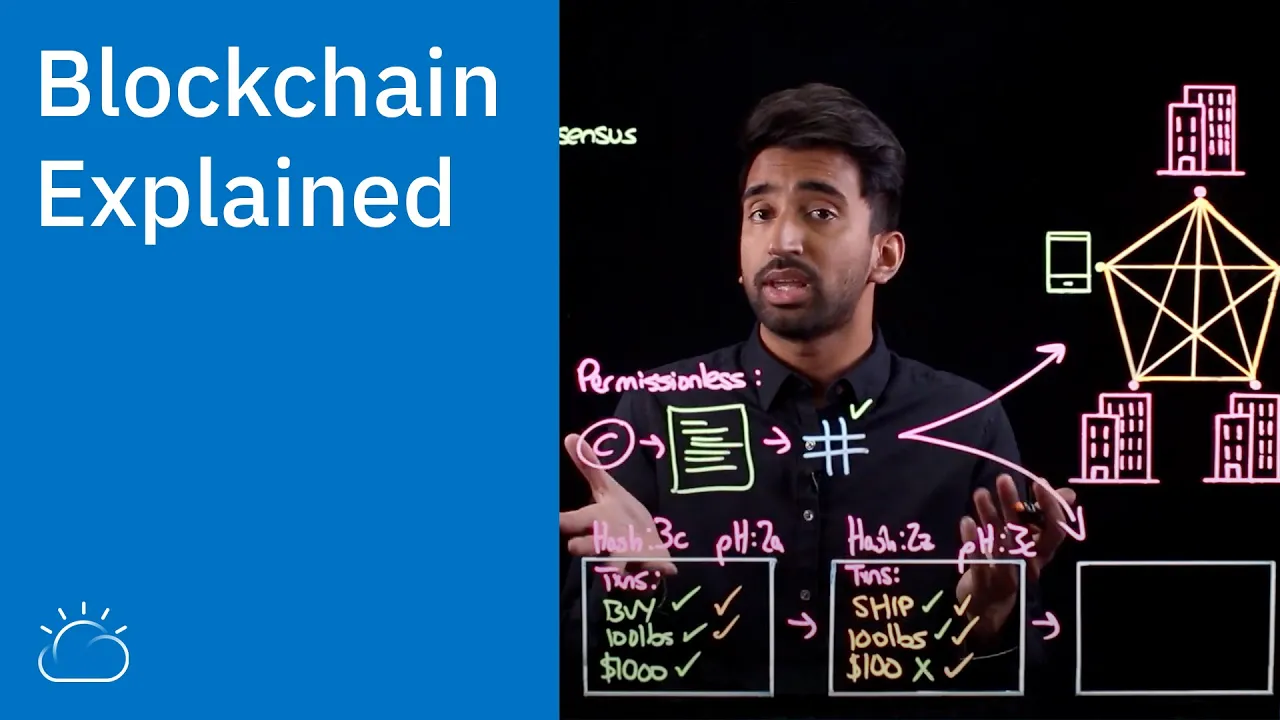
Blockchain Explained
285.9K
Blockchain is a distributed and immutable ledger technology enabling tracking of tangible and intangible goods. Its core principles include: (1) Distributed architecture where all network nodes maintain identical copies of every transaction, creating a single source of truth; (2) Immutability achieved through cryptographic hash chains where each block contains transactions, its own unique hash, and the previous block's hash. This structure ensures that any attempt to alter past transactions would require recalculating all subsequent hashes, making tampering practically impossible. These foundational characteristics distinguish blockchain from traditional ledger systems and enable secure, transparent record-keeping across multiple untrusted parties.
Click to watch →

Blockchain Tutorial | Blockchain introduction | Blockchain Online Course
530
Blockchain addresses the problems of the current trading system through three main principles: (1) Ledger should be open - anyone can see what transactions have taken place, (2) Ledger should be distributed - multiple copies are maintained without a central place, and (3) Ledger should be in sync - all copies must be synchronized. An open ledger allows visibility of all transactions to anyone participating. However, since it is also writable, this creates security issues that are solved by making the ledger distributed among multiple people.
Click to watch →
![[KOTERA TV] 전자화폐 비트코인과 이더리움 투자전략(171206)_지용태선임전문위원](https://i.ytimg.com/vi/bJllhBulI_4/sddefault.jpg)
[KOTERA TV] 전자화폐 비트코인과 이더리움 투자전략(171206)_지용태선임전문위원
451
Blockchain (블록체인) is a technology that uses encryption methods to create currency, also known as encrypted currency (암호화폐). It is produced through mining (채굴) - the process of solving cryptographic puzzles - and operates as a distributed ledger stored across a network of computers. Unlike traditional currencies managed by central banks, blockchain operates without a central authority. All users connect to a peer-to-peer network and maintain identical copies of the transaction ledger. New transactions are added to the ledger every 10 minutes by users gathering together. When a transaction is recorded, all users receive the updated ledger. If someone attempts to alter the ledger by changing numbers or removing pages, other users can instantly detect this by comparing their copies. The system requires majority consensus to validate transactions, making it nearly impossible for any individual to manipulate the records.
Click to watch →
Deep Dive
Fundamentals of Public Key Cryptography, including digital signatures and key pairs.

Code-Based Cryptography - an Overview : Prof. Anna-Lena Horlemann
535
Public key cryptography enables secure communication over insecure channels through asymmetric key pairs. Bob generates a public-private key pair where the public key encrypts messages and the private key decrypts them. Digital signatures provide authentication by having Alice sign messages with her private key and Bob verify with her public key. RSA implements this using modular exponentiation with security based on integer factorization. Shor's algorithm threatens RSA by solving factorization on quantum computers, necessitating post-quantum alternatives.
Click to watch →
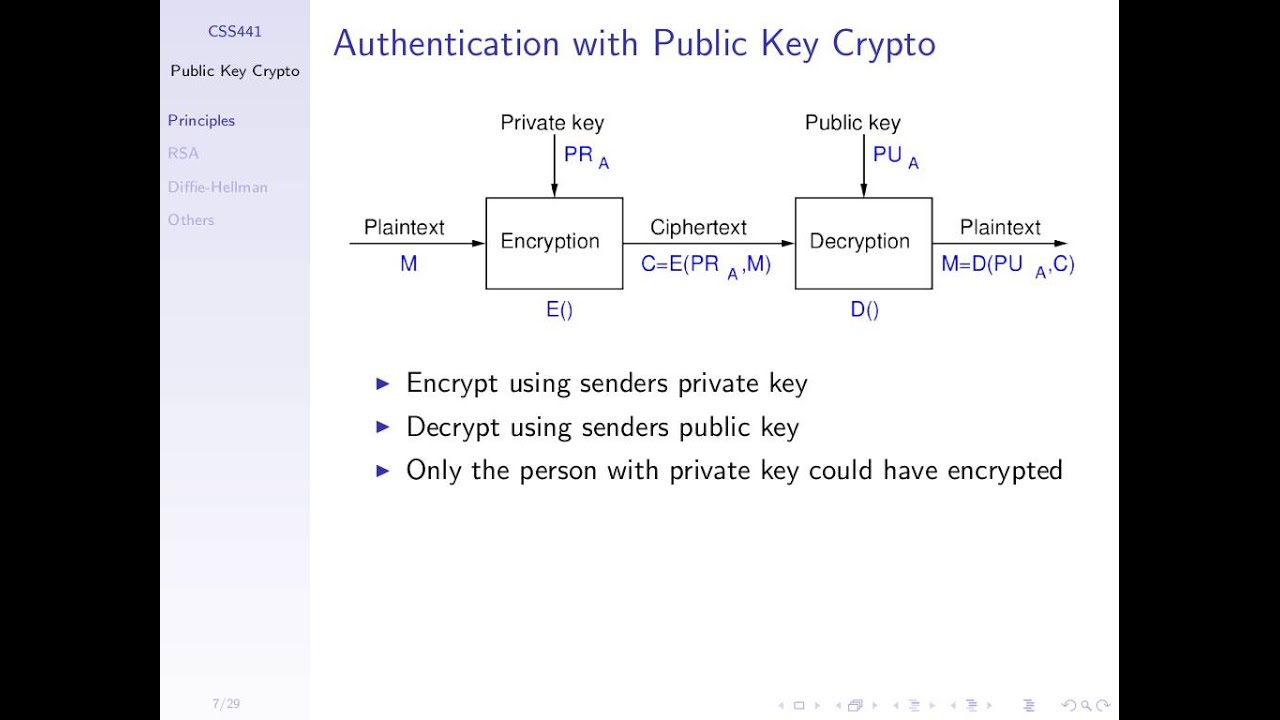
Public Key Cryptography (CSS441, L13, Y15)
1.1K
Public key cryptography was developed to overcome limitations of symmetric key cryptography, particularly the key exchange problem where both parties must share the same secret key. In public key cryptography, each user has a key pair: a public key (shared openly) and a private key (kept secret). Keys can be used in different orders: for confidentiality, encrypt with the receiver's public key so only they can decrypt; for authentication, encrypt with the sender's private key so anyone can verify with the sender's public key. This enables digital signatures where the sender signs messages with their private key, and anyone can verify the signature using the sender's public key.
Click to watch →
Self-Hosted TRUST with your own Certificate Authority!
61.5K
Public key cryptography uses a pair of mathematically related keys: a private key (kept secret) and a public key (shared openly). When someone generates a private key and creates a corresponding public key, anyone can use the public key to verify that data was signed using the private key. This forms the basis for digital signatures and secure communication.
Click to watch →

Public Key Cryptography
305
Asymmetric cryptography uses key pairs (public and private) for encryption/decryption, solving key distribution and digital signature problems that plagued symmetric encryption. Diffie and Hellman's 1976 breakthrough enabled secure communication without trusted third parties. Key terms include plain text, encryption algorithm, public key (shared openly), private key (kept secret), ciphertext, and decryption algorithm. Public key encryption provides confidentiality: sender encrypts with recipient's public key, only recipient can decrypt with private key. Digital signatures provide authentication: sender signs with private key, anyone verifies with sender's public key. In practice, hash functions are applied before signing for efficiency.
Click to watch →

CS61065 - Theory and Applications of Blockchain | Lecture 3 and 4 | 13-08-2021
468
Digital signatures provide authentication, integrity, and non-repudiation for electronic documents. Public key cryptography uses asymmetric key pairs: public keys for encryption and private keys for decryption. Only the key holder can decrypt messages encrypted with their public key. This enables secure communication without pre-shared secrets. The security depends on keeping private keys secret, not on hiding the algorithm.
Click to watch →
Deep Dive
Understanding of traditional identity models (centralized and federated) versus decentralized identity concepts.

3 - BUILDING A DIGITAL SOCIETY ON SELF-SOVEREIGN IDENTITY - MARIE WALLACE - ACCENTURE
294
There are three main identity models: centralized (organizations manage identity for their own use), decentralized (multiple organizations share a single identity provider), and self-sovereign/decentralized (data subjects control their own identity and data). The key distinction is that decentralization focuses on how data can be used rather than who issues it, giving individuals agency over their information.
Click to watch →

W3C Identity Standards around Europe
116
Identity models represent how users authenticate and manage credentials. Centralized identity uses a single entity as both identity provider and website (e.g., logging into email with email credentials). Federated identity involves two entities: an identity provider (like W3C account) and a relying party (external website), allowing credential reuse. Decentralized identity is the latest model with three entities: the user (with a wallet on mobile or web), an issuer (provides credentials), and a verifier (website that accepts credentials). This model gives users more control over their identity data.
Click to watch →

The 3 Models of Identity Management (Centralized vs Federated vs Decentralized)
2.6K
Identity management has evolved through three models: the centralized model where users create separate accounts for each online service, resulting in password management challenges and security risks; the federated model that allows users to log in with existing credentials from services like Google or Facebook, improving user experience but eroding privacy as these companies can track user behavior and monetize data; and the decentralized model where users maintain control of their credentials stored in a personal wallet, enabling them to access services while retaining privacy and control over their identity information.
Click to watch →
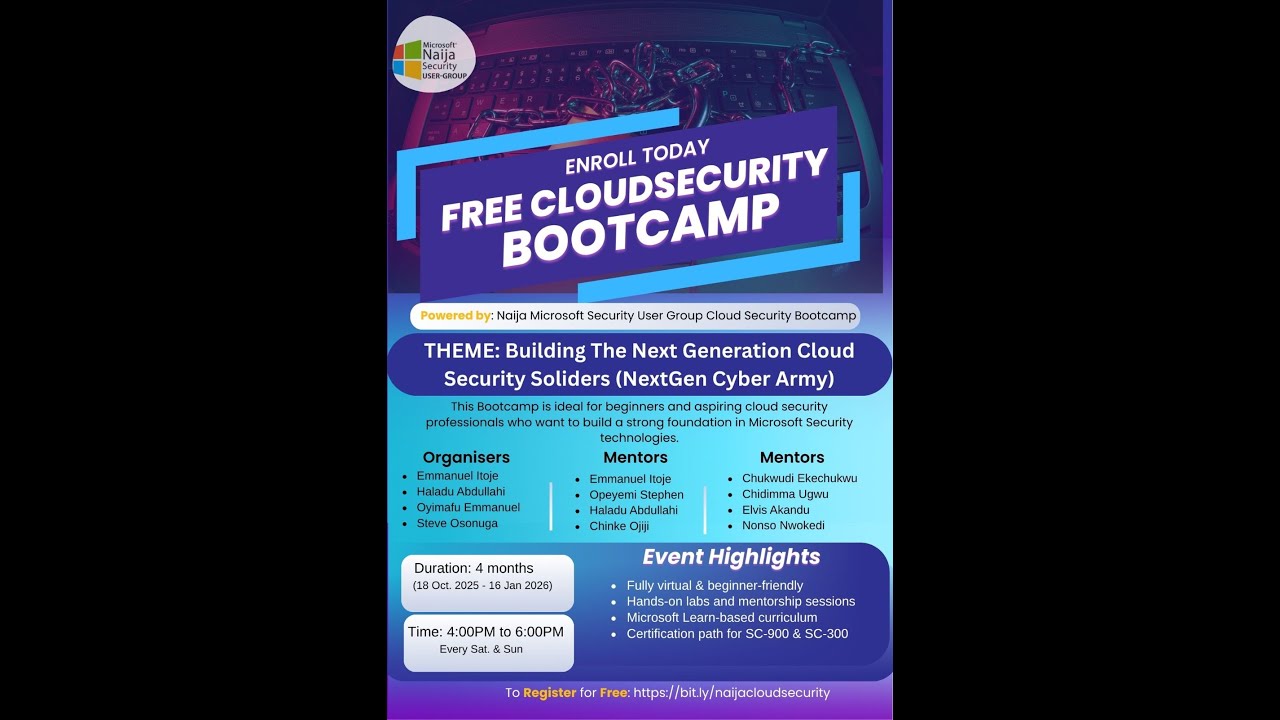
NextGen Cyber Army – Explore identity in Microsoft Entra ID | Chinke Ojiji
249
Centralized identity models (like Entra ID) manage all users and applications in one directory, providing simplicity, consistency, and centralized control. Decentralized identity models give users more autonomy over their credentials, allowing them to control certain verifiable information about their accounts. Entra ID represents a centralized directory model, while personal Microsoft accounts represent decentralized identities. Organizations choose between these models based on their governance and control requirements.
Click to watch →

What Is Decentralized Identity?
1.8K
Decentralized identity is an alternative to centralized and federated identity systems where users carry verifiable credentials containing verified claims about themselves, allowing them to prove their identity and share specific attributes with any party without requiring direct communication with the original issuer; unlike federated identity where trust comes from the identity provider (like Facebook or GitHub), decentralized identity enables users to present verified information flexibly across different contexts, reducing integration costs for organizations and enabling peer-to-peer interactions rather than traditional client-server models.
Click to watch →
Deep Dive
Concepts of biometric authentication systems and associated data privacy principles.
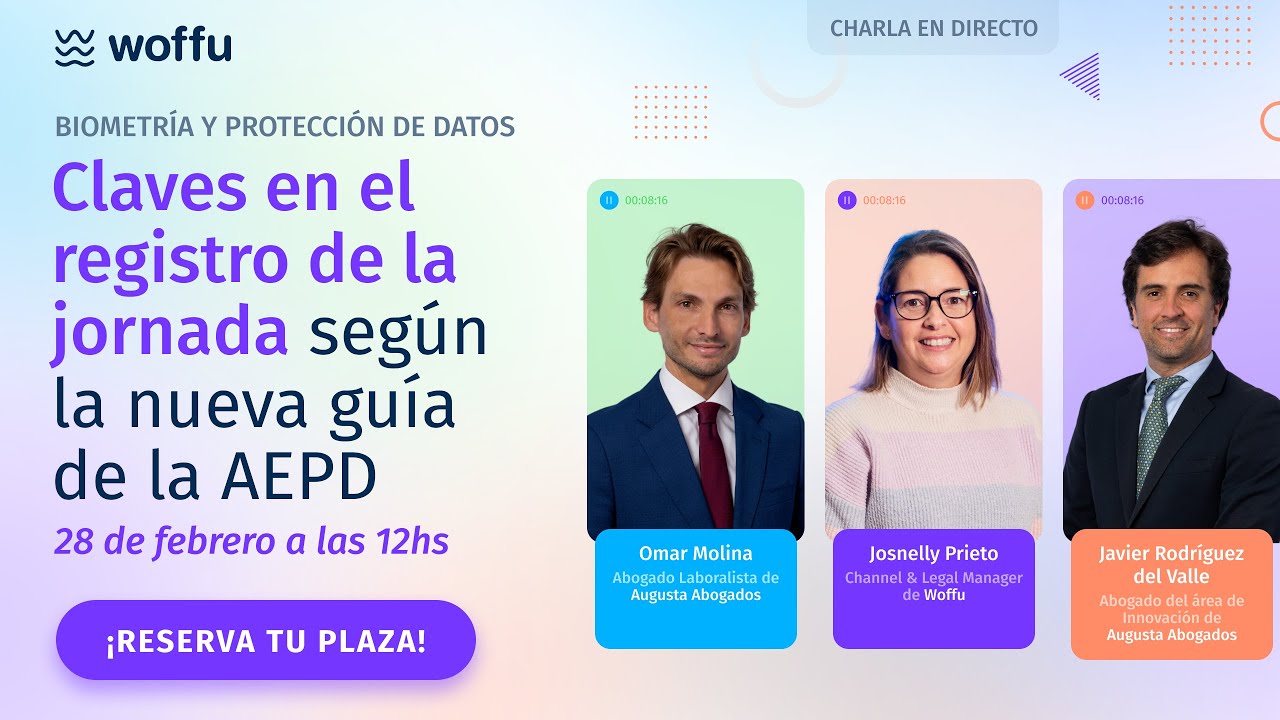
Biometría: Claves en el registro de la jornada según la nueva guía de la AEPD
540
When implementing biometric systems, companies must follow key data protection principles: minimization (collecting only the minimum necessary characteristics), and the principles of suitability, necessity, and proportionality. These principles form the basis for conducting a Data Protection Impact Assessment (DPIA) to evaluate the system's compliance with data protection requirements.
Click to watch →

CPDP 2018: BIOMETRIC SYSTEMS, LAW ENFORCEMENT AND BORDER CONTROL ...
1K
Two additional key concepts for preserving privacy in biometric systems are irreversibility and renewability. Irreversibility means that once biometric data is stored as a template, it should not be possible to reconstruct the original biometric image (such as a facial image or fingerprint) from the stored template. This prevents misuse of the database by unauthorized parties who might attempt to recreate sensitive biometric information. Renewability addresses the fundamental problem that unlike passwords, biometric data cannot be changed if compromised. If a biometric database is compromised (as occurred with Brazil's fingerprint database), templates should be continuously renewed using new methodologies based on the original biometric data, similar to how passwords can be reset. Together with unlinkability, these three concepts form a comprehensive approach to privacy-preserving biometric data management.
Click to watch →

Identification and Authentication - Information Security Lesson #2 of 12
115.5K
Biometric authentication uses physical or biological characteristics of the human body to authenticate users, based on the assumption that these characteristics are unique to each individual. Examples include fingerprints, voice pattern recognition, retinal scans, face recognition, hand recognition, and DNA. A critical privacy concern is that unlike passwords, biometric data is permanent—it cannot be changed once compromised. Once fingerprints, DNA profiles, or other biometric data are stored in databases, individuals permanently lose a certain type of privacy. This raises important questions about whether governments should require citizens to provide such sensitive biometric information.
Click to watch →
Segurança da informação - Mecanismos de Autenticação
4.5K
Biometric authentication uses unique physical or behavioral characteristics for identification, including fingerprints, iris patterns, hand geometry, voice patterns, and gait analysis. Effective biometric systems require five key criteria: universality (present in all individuals), uniqueness (distinct per person), permanence (stable over time), measurability (quantifiable for comparison), and acceptability (user-friendly collection). System architecture includes sensors for data capture, comparators for matching against stored templates, and databases for secure template storage. Modern implementations use standardized frameworks to unify authentication across systems, reduce algorithm complexity, and provide consistent programming interfaces.
Click to watch →
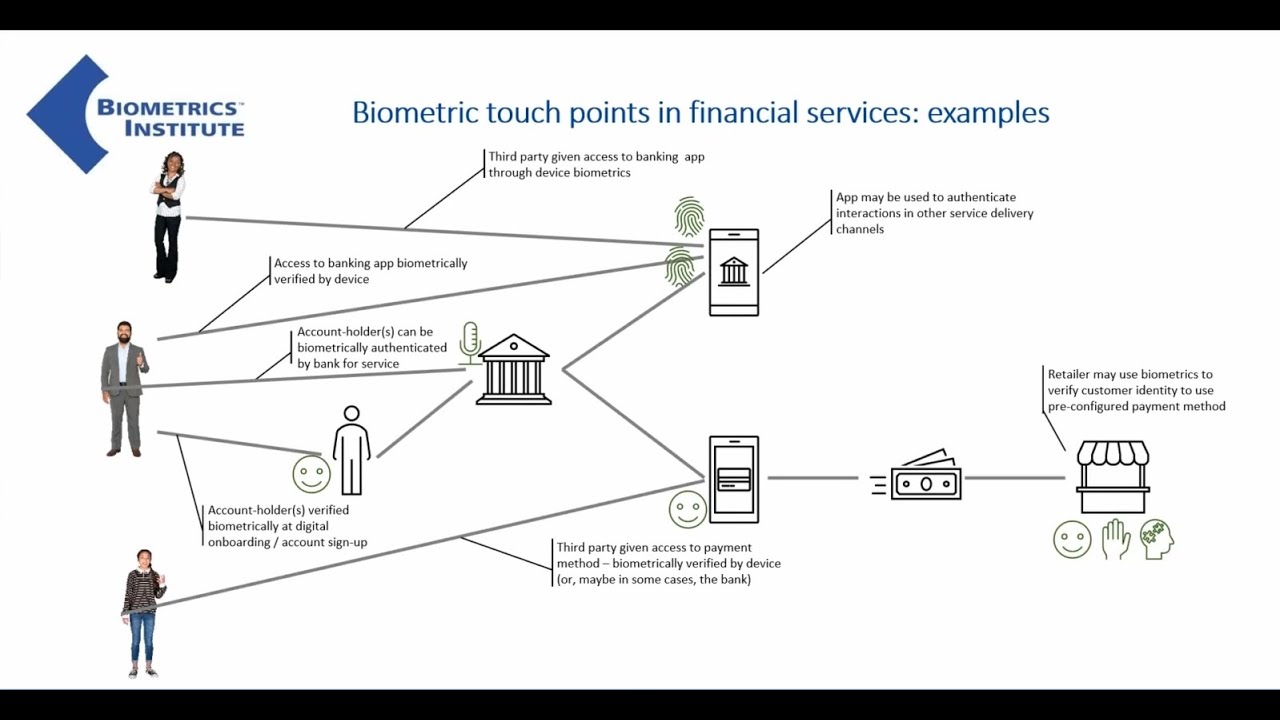
Biometrics: How To Create Digital Identities Right First Time
121
The Biometrics Institute's Privacy Guidelines, first launched in 2006 and regularly updated, provide 16 core principles for ethical biometric implementation. Recent updates added principles addressing communication requirements and ensuring ethical use by law enforcement. These guidelines address the challenge of public misunderstanding about biometric capabilities and limitations, helping organizations communicate transparently about how biometric data will and will not be used.
Click to watch →
Prerequisite Knowledge
- Concept 01Basic principles of Blockchain technology and distributed ledger systems.
- Concept 02Fundamentals of Public Key Cryptography, including digital signatures and key pairs.
- Concept 03Understanding of traditional identity models (centralized and federated) versus decentralized identity concepts.
- Concept 04Concepts of biometric authentication systems and associated data privacy principles.
Subsequent Learning
- Step 01Deep dive into W3C standards for Decentralized Identifiers (DIDs) and Verifiable Credentials (VCs).
- Step 02Exploring Zero-Knowledge Proofs (ZKPs) and their application in minimizing data disclosure during identity verification.
- Step 03Comparative analysis of global digital travel frameworks (such as KTDI and the EU Digital Identity Wallet) alongside Digi Yatra.
- Step 04Technical implementation of SSI frameworks using enterprise platforms like Hyperledger Indy or Aries.
SSI Basics
SSI Mechanics
SSI Basics
0:01Playing Section
- 1
SSI grants individuals full control of their digital identity and credentials.
- 2
Key participants are issuer, holder, and verifier, forming a trust triangle.
The Illusion of Sovereignty: Biometric Surveillance and Centralized Control in State-Sanctioned Travel Frameworks
While Self-Sovereign Identity (SSI) promises user control, critics argue that integrating it into state-led travel systems like Digi Yatra creates a false sense of autonomy and introduces significant privacy risks. In practice, the state remains the ultimate arbiter of identity, meaning true user 'sovereignty' is compromised. Furthermore, digital rights advocates raise profound concerns regarding biometric mass surveillance, data leaks, and 'function creep'—where facial recognition data collected for airport convenience could be accessed by law enforcement or repurposed for tracking. There are also risks of technological exclusion for those without smartphone access or whose biometrics fail to register. Rather than truly decentralizing power, these systems can centralize authority under the guise of modern convenience, normalizing intrusive biometric collection.
Deep Dive
Deep dive into W3C standards for Decentralized Identifiers (DIDs) and Verifiable Credentials (VCs).

Future of Decentralized Identity- Wayne Chang & Kasima Tharnpipitchai
2.9K
Decentralized Identifiers (DIDs) are a W3C global standard that enables user-controlled identifiers similar to email addresses. Verifiable credentials are digitally signed statements about reality that can be held offline and never need to touch the blockchain. DIDs can interoperate with both new decentralized systems and existing centralized systems, allowing disparate trust systems to communicate when they agree on the same basis for conversation. The W3C standards process involves multiple entities with different goals working toward common objectives, including organizations like Microsoft, GS1, and Web3 companies. Each entity wants something different from the format—whether tracking vessels at sea or linking Ethereum and Solana accounts. The goal is to create interoperability so all systems can communicate, which requires defining common protocols and standards.
Click to watch →

Decentralized Identifiers (DIDs) Fundamentals & Deep Dive
29K
Decentralized Identifiers (DIDs) are a new type of cryptographically-verifiable URI that combines four essential properties: persistence (never changes), resolvability (can be looked up to retrieve information), cryptographic verification (binding between identifier and subject can be verified), and decentralization (no centralized registration required). DIDs work through a three-part architecture involving the identifier itself, a DID Document that contains public keys and service endpoints for interacting with the subject, and the subject being identified. Unlike traditional identifiers like domain names, DIDs solve fundamental PKI trust triangle problems by enabling self-certifying identifiers where the controller generates both the identifier and public key, then using DID Documents to create chains of trust for key rotation without centralized authorities. This enables self-sovereign identity where individuals and entities can create, manage, and control their own identifiers without intermediaries.
Click to watch →
The Off Chain Internet: Decentralized Identity & Verifiable Credentials | ETHDenver 2022
11.4K
The W3C has defined standards enabling public addresses to build independently verifiable Web 3 reputation from Web 2 and Web 3 apps using self-attestations and social attestations. Decentralized Identifiers (DIDs) are off-chain data backpacks that enable users to sign and control private data written about them. DIDs are globally unique, cryptographically verifiable, and allow key rotation for security. Verifiable Credentials (VCs) are signed, encrypted attestations containing any data type, non-transferable, tamper-evident, and revocable. VCs can be disclosed with user consent at any granularity. Unlike public blockchains, VCs give users control over information sharing and are free to create. DIDs and VCs enable cross-chain communication between any identifier types without bridges or gas fees.
Click to watch →

Introduction to Decentralized Identifiers (DID) - by Ivan Herman (W3C)
17.6K
Decentralized Identifiers (DIDs) are self-sovereign, decentralized digital identifiers that solve the limitations of traditional identifiers by being easy to create, persistent, resolvable, and cryptographically verifiable without depending on any centralized authority; they work through a system where each DID points to a DID document containing cryptographic keys and controller information stored in a distributed ledger or verifiable data registry, enabling applications like verifiable credentials, secure peer-to-peer communication, and product provenance tracking.
Click to watch →

All Things Open 2022 - Keynotes - Tuesday, November 1st 2022
188
Decentralized identifiers (DIDs) are W3C standards that enable users to own and control their digital identity. Unlike traditional identifiers controlled by intermediaries, DIDs are self-sovereign and consist of a scheme, method, and subject. The only information stored on the blockchain is the DID string itself, not personal data. Verifiable credentials work hand-in-hand with DIDs to enable trustless interactions, allowing cryptographically signed statements about subjects that can be verified without requiring mutual trust between parties. This enables scenarios like employment verification where employers can issue credentials that lenders can cryptographically verify.
Click to watch →
Deep Dive
Exploring Zero-Knowledge Proofs (ZKPs) and their application in minimizing data disclosure during identity verification.
WORLDCOIN: ¿Estafa? o ¿Realidad? Que es y Como Funciona World
163.7K
Worldcoin uses zero-knowledge proofs (ZKPs) to verify user identity without revealing personal data. When someone wants to confirm their identity, the three decentralized identities respond with a simple 'yes' or 'no' answer. This is analogous to a bouncer checking if someone is over 18 without asking for their name, address, or other personal details. The system confirms that a person is human without storing or revealing their actual biometric data.
Click to watch →

No More Forms, No More Leaks: The Identity Revolution - The Math Behind Zero Knowledge Proofs
7.9K
Zero knowledge proofs (ZKPs) are cryptographic protocols that allow one party to prove possession of certain information to another party without revealing the information itself, consisting of three core properties: zero knowledge (the verifier learns nothing about the underlying data), completeness (if the prover knows the secret, they can always successfully prove it), and soundness (false proofs cannot be generated). These proofs enable privacy-preserving identity verification where users can prove attributes like age or citizenship status without revealing sensitive personal information, addressing the fundamental challenge that blockchain addresses alone cannot support complex coordination requiring identity data beyond wallet addresses.
Click to watch →

Аутентификация без разглашения и криптовалюты
373
This extensive section explores zero-knowledge proofs as a solution to digital identity verification challenges. In a digital world with digital passports, the fundamental problem is proving identity without revealing the entire passport, which could be copied and used fraudulently. Unlike physical passports that can be shown and taken but not copied, digital passports can be easily duplicated. The solution is zero-knowledge proof - a cryptographic method allowing one party to prove they know specific information without revealing the information itself. The video demonstrates this using graph isomorphism: two graphs that are structurally identical but have different vertex labels. The prover knows the secret mapping between them, and the verifier can confirm this knowledge without learning the actual mapping. The interactive protocol involves the verifier randomly choosing which transformation to verify, and the prover responding correctly. By repeating this process multiple times, the probability of a dishonest prover succeeding decreases exponentially, making the proof practically secure.
Click to watch →

Top Trends in Crypto VC with Delphi Digital | EP 59
3.4K
Zero-knowledge proofs enable revolutionary privacy-preserving applications across multiple domains. In identity verification, ZKPs allow proof of financial attributes (net worth, income levels) without revealing sensitive account details, addressing limitations of current verification methods. Professional platforms like Blind already use email-based verification for salary discussions, but ZKPs could provide stronger privacy guarantees by enabling verification of claims without exposing underlying data. Beyond finance, ZKPs enable selective disclosure of information—users can prove possession of sensitive information without revealing it until payment is received, creating new categories of applications for confidential information sharing, expert consulting, and secure communication channels.
Click to watch →

Not Your Keys, Not Your CARD? Entenda a Diferença. 💳
390
Zero-Knowledge Proof (ZKP) is cryptographic technology enabling one party to prove knowledge of information without revealing it. In identity verification, ZKP allows services like P2PME to verify users have legitimate social media accounts without storing credentials. This reduces verification costs by approximately 90% compared to traditional methods and protects user privacy. The verification is performed by third-party services that confirm account existence without storing identifying information.
Click to watch →
Deep Dive
Comparative analysis of global digital travel frameworks (such as KTDI and the EU Digital Identity Wallet) alongside Digi Yatra.
Biometrics is Key - The Future of Digital Identity with Annet Steenbergen
112
The travel and tourism industry is experiencing multiple digital identity innovations. The ICAO Digital Travel Credential (DTC) Type 1, published in fall 2020, serves as the first global standard for digital passports. The EU Digital Identity Wallet includes travel as a key use case with large-scale pilot programs. India's Digiyatra provides national digital identity for travel, while the US DHS is exploring innovations with European eIDAS-compliant companies. IATA's One ID project developed a passport credential solution for aviation. These initiatives aim to create trusted digital identity infrastructure for cross-border travel, though implementation depends on international reciprocity and government adoption.
Click to watch →

KTDI | Known Traveller Digital Identity
335
The Known Traveller Digital Identity (KTDI) is a World Economic Forum initiative that enables secure, seamless international travel by allowing travelers to share verified identity data with governments, airlines, and hotels through a digital identity system built on distributed ledger technology, cryptography, and biometrics, while maintaining traveler control over their personal information.
Click to watch →

Corona World Order
245.3K
The World Economic Forum's Known Traveler Digital Identity (KTDI) is a surveillance-by-design system that binds together through a traveler's mobile device: biometrics (facial images, fingerprints), government-issued ID credentials, passport numbers, travel history including border crossings and hotel stays, purchase logs, and financial records. Each hotel stay, purchase, or transaction becomes like a border crossing permanently stamped in the digital passport, subject to inspection at any checkpoint.
Click to watch →

The Digital Identity Wallet and the Travel Use Case from a EU and Global Perspective
220
The EU Digital Identity Wallet (EUDI Wallet) represents a transformative approach to travel identification that enables self-sovereign digital identity, allowing travelers to share only the necessary data for compliance while minimizing privacy risks. This system integrates with the ICAO Digital Travel Credential (DTC) framework, which includes three types: Type 1 (self-derived from e-passport chips using NFC), Type 2 (authority-issued on mobile devices), and Type 3 (fully virtual). The wallet addresses current travel identification challenges such as excessive data sharing with private parties, manual data entry errors in Advanced Passenger Information (API) systems, and inefficient hotel registration processes. While the EUDI Wallet will be available within two years, global interoperability remains a key challenge requiring international cooperation, trust frameworks, and alignment between technical standards and legal regulations across different jurisdictions.
Click to watch →
Today’s GK – 18 August 2022 | Drishti IAS English
5.8K
DigiYatra is India's digital traveler identification system that enables seamless airport transit through biometric verification, allowing travelers to pass through various airport checkpoints using facial recognition technology with 99.6% accuracy.
Click to watch →
Deep Dive
Technical implementation of SSI frameworks using enterprise platforms like Hyperledger Indy or Aries.
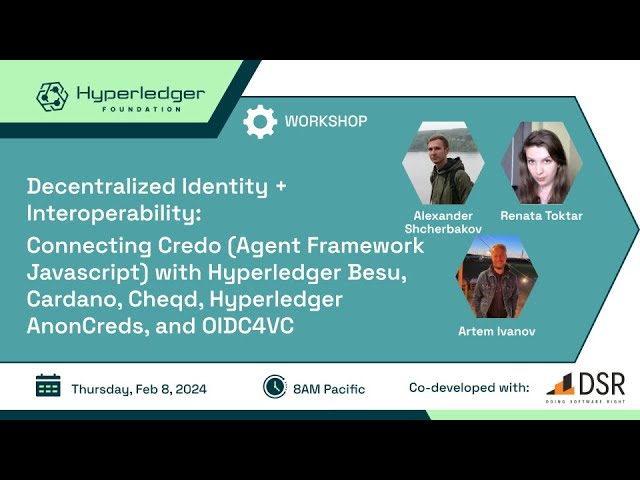
Decentralized Identity + Interoperability Workshop
2K
This section covers Verifiable Data Registry implementation options and SSI frameworks. VDR options include Cardano (public permissionless blockchain with proof-of-stake), Check (public permissionless blockchain based on Cosmos SDK designed for decentralized identity), Hyperledger Indy (permissioned ledger with custom consensus), and Hyperledger Besu (permissioned ledger for enterprise use). The Indy-Besu initiative is an experimental project replacing Indy's custom consensus with Hyperledger Besu, implementing SSI business logic as Solidity smart contracts. Kredo (formerly Hyperledger Aries) is a JavaScript framework implementing Indy credentials and W3C verifiable credentials, supporting multiple DID methods and VDRs. The framework provides pluggable architecture for different VDR implementations. DIDCOM is a secure communication methodology establishing encrypted channels between agents using keys associated with DIDs, supporting both online and offline scenarios over various transports. OpenID for Verifiable Credentials differs from OpenID Connect by supporting self-sovereign identity where holders present credentials directly to verifiers without intermediaries.
Click to watch →

Building a Next Generation DID and VC System with Hyperledger Indy/Aries
3.3K
Hyperledger Indy and Aries provide an enterprise-grade framework for building decentralized identity (DID) and verifiable credential (VC) systems that enable self-sovereign identity, where users control their own data and credentials through cryptographic proofs, while maintaining interoperability across multiple blockchains and applications.
Click to watch →

Aries Framework Javascript 0.4.0 Release, Setting Up an Agent and Issuing Credentials
1.5K
Hyperledger Aries Framework JavaScript (AFJ) is a framework for implementing self-sovereign or decentralized identity solutions. It is based on Hyperledger Aries standards (RFCs implemented in multiple languages) and is the JavaScript version of Aries, originally born in the Hyperledger Indy project. AFJ is multi-platform, supporting server-side Node.js and mobile React Native. The SSI ecosystem has three roles: Holder (receives credentials), Issuer (issues credentials), and Verifier (verifies credentials), with a Verifiable Data Registry (VDR) in the middle. The 0.4.0 release focuses on modularization, separating the framework into core components and platform-specific dependencies.
Click to watch →

Hyperledger Aries E Caso De Uso Identidade Digital Autossoberana
456
This extensive section provides a comprehensive technical overview of the Hyperledger projects enabling verifiable credentials. It explains Indy as a permissioned identity-focused blockchain that handles key distribution and credential issuance, and Aries as the protocol layer for credential exchange. The section covers the Trust Over IP stack architecture with its four layers (ledger, agents, participants, applications), the DIDComm protocol for agent communication, and the separation between framework components and business logic controllers. It details the available implementations: Aries Cloud Agent Python for enterprise agents, Aries Framework .NET for mobile integration via Xamarin, and Aries Framework Go as a native alternative. The section emphasizes that Aries is not production-ready and recommends starting with Aries-based frameworks for interoperability across the ecosystem.
Click to watch →

Designing a SSI Wallet – Insights from a Designer w/ Marco Lüthi (ID SIG 07-28-22)
110
The Aries working group is developing credential supplements (issuer credentials, hash link data, attach) as an alternative to generic extra structures. The Aries Framework JavaScript is being integrated with Hyperledger Fabric to create a unified platform combining enterprise capabilities (smart contracts, tokens) with decentralized identity (verifiable credentials). This integration addresses Fabric's X.509 identity limitations while maintaining enterprise functionality, enabling supply chain networks where identity verification can use verifiable credentials instead of requiring separate Indy and Fabric blockchains.
Click to watch →
SSI Basics
SSI Mechanics
SSI Basics
0:01- 1
SSI grants individuals full control of their digital identity and credentials.
- 2
Key participants are issuer, holder, and verifier, forming a trust triangle.
The Illusion of Sovereignty: Biometric Surveillance and Centralized Control in State-Sanctioned Travel Frameworks
While Self-Sovereign Identity (SSI) promises user control, critics argue that integrating it into state-led travel systems like Digi Yatra creates a false sense of autonomy and introduces significant privacy risks. In practice, the state remains the ultimate arbiter of identity, meaning true user 'sovereignty' is compromised. Furthermore, digital rights advocates raise profound concerns regarding biometric mass surveillance, data leaks, and 'function creep'—where facial recognition data collected for airport convenience could be accessed by law enforcement or repurposed for tracking. There are also risks of technological exclusion for those without smartphone access or whose biometrics fail to register. Rather than truly decentralizing power, these systems can centralize authority under the guise of modern convenience, normalizing intrusive biometric collection.
Basic principles of Blockchain technology and distributed ledger systems.
Fundamentals of Public Key Cryptography, including digital signatures and key pairs.
Understanding of traditional identity models (centralized and federated) versus decentralized identity concepts.
Concepts of biometric authentication systems and associated data privacy principles.
Deep dive into W3C standards for Decentralized Identifiers (DIDs) and Verifiable Credentials (VCs).
Exploring Zero-Knowledge Proofs (ZKPs) and their application in minimizing data disclosure during identity verification.
Comparative analysis of global digital travel frameworks (such as KTDI and the EU Digital Identity Wallet) alongside Digi Yatra.
Technical implementation of SSI frameworks using enterprise platforms like Hyperledger Indy or Aries.
435.7K views802likes2:38@DigiYatraFoundationOriginal Release: 2024-06-06
what is SSI self- Sovereign identity is a model that gives individuals full ownership and control of their credentials digital identities Etc without relying on a third party with SSI you are the boss of your identity the three main participants in the SSI system are issuer holder verifier the issuer DG yatra verif I your information creates a verifiable digital credential and Records it on the blockchain for the holder the holder passenger stores and controls their verifiable digital credentials in a secure wallet presenting them when needed the verifier the airport receives checks and validates the holder's credentials validates authenticity and provides access the interactions between the holder issuer and verifier is sometimes called the trust triangle SSI allows holders to store their credentials securely in their digital ID wallets and to prove claims of identity in travel with verifiers directly and cryptographically reducing the risk of fake credentials SSI enables the holder to prove claims of identity and travel directly to the verifier airport with trust and privacy without the need for any third party intervention with SSI there is no personally identifiable information d data that is stored on the blockchain but how does SSI work its working is based on three pillars verifiable credentials VCS cryptographically secured digital versions of credentials stored in a secure wallet that people can present to verifiers directly blockchain a decentralized database shared across the blockchain network that securely records the cryptographic hash timestamp and the transaction data making it hard to alter hack or cheat there is no personally identifiable information data that is stored on the blockchain decentralized identifiers dids a method to verify your identity online without relying on a centralized organization dids operate on the decentralized blockchain framework dids are based on encryption and decryption technology making them cryptographically verifiable and do not contain any personally identifiable information which enhances privacy and security s SII makes your Digital Life simpler safer and more convenient
Up Next
86:22
Decentralized Identifiers (DIDs) Fundamentals & Deep Dive
@ssimeetup
29K views•2020-02-04

52:00
Hybrid Key Establishment in Production: Post-Quantum Cryptography
@durumcrustulum
14.7K views•2025-08-27

64:25
Operational Security Essentials: A Guide for Hacktivists (OPSEC)
@hitbsecconf
157.4K views•2012-11-26

11:49
Understanding Ethereum: A Comprehensive Beginner's Overview
@99Bitcoins
3.1M views•2018-06-26
Related Study Plans & Knowledge Roadmaps
Structured learning paths in Blockchain & Crypto
blockchain-and-crypto
MPC Wallets: TSS, DKG & Secure Custody
01Foundations of Cryptography & Digital Signatures
02Secret Sharing & Introduction to MPC
03Distributed Key Generation (DKG)
+ 2 more learning modules
24h5 modules
Explore Roadmap
blockchain-and-crypto
ERC-4626: Yield Aggregators & Leverage
01Blockchain, Ethereum, and Solidity Foundations
02DeFi Primitives: Lending, Pools, and Yield Farming
03Mastering the ERC-4626 Tokenized Vault Standard
+ 3 more learning modules
35h6 modules
Explore Roadmap
blockchain-and-crypto
DePIN: IoT Registries, Proofs & Rewards
01Foundations of Blockchain & IoT
02Introduction to DePIN and the Flywheel Effect
03Designing IoT Device Registries & Secure Identity
+ 3 more learning modules
30h6 modules
Explore Roadmap
blockchain-and-crypto
Building EigenLayer AVS: Operators & Contracts
01Blockchain, Ethereum, and Smart Contract Basics
02Proof of Stake and Ethereum Staking
03Introduction to EigenLayer and Restaking
+ 3 more learning modules
24h6 modules
Explore Roadmap