













![Trust over IP [Evernym Webinar]](https://i.ytimg.com/vi/X1bstPSqE9g/maxresdefault.jpg)


Self-Sovereign Identity (SSI) is a digital identity framework where individuals or organizations have sole ownership and control over their identities, enabling them to selectively share only necessary data for specific transactions through a trust triangle model involving holders, issuers, and verifiers, with decentralized identifiers (DIDs) stored on distributed ledgers and actual identity data kept on decentralized storage, thereby addressing the limitations of current proprietary identity systems that lack user control and suffer from data breaches.
Understanding Self-Sovereign Identity: A Technical Introduction
Added:Basic principles of Public Key Cryptography, including asymmetric encryption, public/private key pairs, and digital signatures.
Fundamental concepts of Blockchain and Distributed Ledger Technology (DLT), specifically how data is written, stored, and secured in a decentralized network.
Familiarity with traditional digital identity architectures, such as centralized databases and federated identity models like OAuth 2.0 and SAML.
Deep dive into the W3C standards and specifications for Decentralized Identifiers (DIDs) and Verifiable Credentials (VCs).
Technical implementation of SSI Wallets and Agent-to-Agent communication protocols, such as DIDComm.
Advanced Zero-Knowledge Proof (ZKP) schemes (e.g., zk-SNARKs, BBS+ signatures) for selective disclosure and predicate proofs in identity verification.
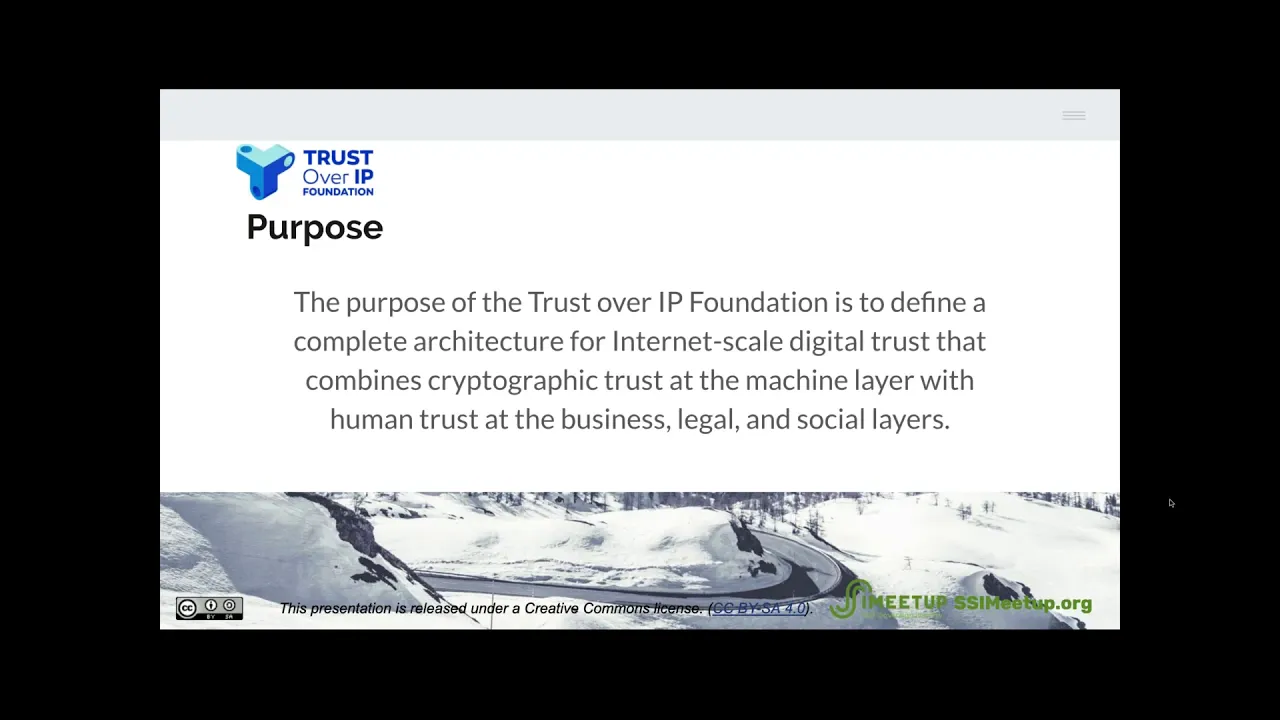
Governance frameworks and trust registries, including the Trust over IP (ToIP) model, to understand how trust is established between issuers, holders, and verifiers.
Regulatory compliance and privacy engineering, exploring how SSI aligns with frameworks like GDPR, California Consumer Privacy Act (CCPA), and eIDAS.
22.8K views433likes9:00Original Release: 2019-06-12
what is self sovereign identity in this video I will answer this question and explain why our current form of digital identity is broken and what could be the future of identity management identity is a uniquely human concept and before we dive into the online identity I want to explain what we're talking about identity is what defines a person and distinguishes it from another person in psychology the scientific study of the mind and behavior it includes qualities beliefs and personality when we ask sociology the scientific study of society we get a slightly different answer which includes culture history in religion so whatever technology we use as a framework for this concept it needs to be flexible enough to display an incredible amount of human diversity [Music] the miserable status quo so let's take a look on how online identity currently works every one of us got a lot of personas at different companies and organizations a persona is a subset of an identity taken from a particular standpoint one person can have multiple personas depending on social context like work clothes friends hobbies etc each of these administrative identity systems is proper terry and owned by an organization that provides it and we use usernames and passwords to authenticate ourselves proprietary uses centric approaches like sign-in with Google or sign it in with Apple or any other civilians capitalist will just lock you up in the ecosystem again the consequences are that the user isn't in control it's cumbersome and data breaches and at the new fraud are prevailing issues we deserve better and your identity needs to be truly yours the need for a new base layer framework we use the terminology of self sovereign identity SS I in short as the concept of individuals or organizations having the sole ownership of their digital and analog identities and control over how their personal data is shared and used the user essential to the administration of one's own identity this adds a layer of security and flexibility allowing the identity holder to only reveal the necessary data for any given transaction or interaction it gives individuals or organizations agency to control the identity information and therefore acknowledges that identity is about much more than logging in since this explanation sounds a little incomprehensible let me explain a key concept of sorts of writing identity the trust triangle the trust triangle explains the issuance of a credential and its usage and here we have three major stakeholders the holder of a certain attribute or credential who is also referred to a subject the issue of identity information and the verifier who requested the information if you want to prove your identity for example for opening a bank account you need to authenticate yourself with your government ID this ID is issued by the government to you as digital credential which is signed by the government which makes it a verified credential you can then show a proof of this verify credential to a verifier which in this case is the bank since the bank trusts the government we have established a trusted relationship between all participants before we dive deeper into the topic I want to explain what an attribute is an attribute explains what qualifies a person without necessarily being unique to the person these are elements like gender height weight etc an attribute can also be a verified credential which is issued by a third party such as citizenship a university degree or a membership status then obviously you ask yourself where's the data of the credential start and for that question we don't have a common answer yet however the SSI community has a consensus to not store this data on a blockchain a blockchain is only used to store the decentralized identifiers D ID and short as well as a signature if necessary the identity data itself Sahra stored on a decentralized data storage these centralized identifiers the ID an identifier refers to a real-world identity about a particular use case or domain which has legal and practical implications like a passport number phone number or an email address a decentralized identifier serves as an identifier for verifiable self so write digital identity D IDs are fully under a control of the holder of the D ID independent from any centralized registry identity provider or certificate authority basically a global unique identifier that does not require any centralized registration authority because it is registered with the distributed ledger technology or other forms of these centralized networks like rock chains which points to ID ID document containing further instructions were to fight attributes claims or similar information and how to communicate with the identity holder real-world examples the first use case I want to illustrate here is buying alcohol where the identity holder is proving his age but the alcohol vendor doesn't need to know your birthday they only need to know if you reach the age which permits you to buy alcohol with the trust triangle this works like this the government issues a verified credential an ID the holder who shows a serial knowledge proof to the verifier who in this case is the alcohol vendor the merchant then verifies his signature and cross checks the D ID with a public registry from the issuer the CEO knowledge proof contains super-fancy cryptography and basically proves that you're 18 or older without revealing your birthday or any other information another use case is access to mobility here a collaboration between eurocom X right Deutsche Telekom T labs riddle encode and simple mobility offers a fully decentralized scooter rental system enabling the user to share their credentials directly with the scooter company get on and write all from the control of their cell phones now the application for the ride-sharing is jumping over to myself Southern identity and this is the cool part my identity exists with me and I'm gonna connect to this ride-sharing service and tell the service what I wanted to have about me and in this case it's it's basically my name you guys might want to watch out no I'm kidding but if you look closely you can see the wheel moving right now the scooters on it's activated I'm cruising around Barcelona right now and it was that quick and ask an identity standard to conclude we can say that the SSI community aims to build a universal identity layer for the web and once enable technical interoperability between identity systems of all sorts that puts the user into Center promising projects like hyper ledger you port sovereign eurocom bloom and many more already enable us to experience a small taste of what is coming nevertheless it is still an askin technology and further exploration standardisation and integration will be necessary to develop a holistic framework and unleashed immense potential of self sovereign identity so this video is only a short introduction to SSI and part 1 of a series so let me know in the poll what topic of SSI you want to know more about and subscribe and hit the Buy button if you don't want to miss the following videos have you had your first experience with applications enabling you to own your identity data already if so let me know in the comments thanks for watching this video if you liked it let the algorithm know and give it a thumbs up see you in the next video and as always on your keys
Up Next
60:00
Decentralized Identity Fundamentals: A Technical Overview
@docknetwork
279 views•2025-10-13
52:00
Hybrid Key Establishment in Production: Post-Quantum Cryptography
@durumcrustulum
14.7K views•2025-08-27
64:25
Operational Security Essentials: A Guide for Hacktivists (OPSEC)
@hitbsecconf
157.4K views•2012-11-26
11:49
Understanding Ethereum: A Comprehensive Beginner's Overview
@99Bitcoins
3.1M views•2018-06-26
Related Study Plans & Knowledge Roadmaps
Structured learning paths in Blockchain & Crypto
blockchain-and-crypto
MPC Wallets: TSS, DKG & Secure Custody
01Foundations of Cryptography & Digital Signatures
02Secret Sharing & Introduction to MPC
03Distributed Key Generation (DKG)
+ 2 more learning modules
24h5 modules
Explore Roadmap
blockchain-and-crypto
ERC-4626: Yield Aggregators & Leverage
01Blockchain, Ethereum, and Solidity Foundations
02DeFi Primitives: Lending, Pools, and Yield Farming
03Mastering the ERC-4626 Tokenized Vault Standard
+ 3 more learning modules
35h6 modules
Explore Roadmap
blockchain-and-crypto
DePIN: IoT Registries, Proofs & Rewards
01Foundations of Blockchain & IoT
02Introduction to DePIN and the Flywheel Effect
03Designing IoT Device Registries & Secure Identity
+ 3 more learning modules
30h6 modules
Explore Roadmap
blockchain-and-crypto
Building EigenLayer AVS: Operators & Contracts
01Blockchain, Ethereum, and Smart Contract Basics
02Proof of Stake and Ethereum Staking
03Introduction to EigenLayer and Restaking
+ 3 more learning modules
24h6 modules
Explore Roadmap