FROST (Flexible Round-Optimized Schnorr Threshold) is a cryptographic threshold signature scheme that enables a quorum of signers (e.g., any 5 out of 10 participants) to collaboratively produce a single unified signature, representing complex multi-party signing policies as a single key; the scheme supports nested threshold structures where individual keys can themselves be threshold keys, allowing arbitrarily complicated signing policies while offloading all protocol complexity to the signers so the blockchain only sees one key and one signature, with the system designed to be resilient against misbehavior by ensuring that as long as a sufficient number of honest parties exist, they can identify and exclude dishonest participants to produce valid signatures.
The FROST Signature Scheme: Bitcoin Threshold Signatures Explained
Added:Understanding of public-key cryptography and asymmetric encryption principles.
Public key cryptography (asymmetric encryption) uses two keys: public key for encryption, private key for decryption. Four core security requirements: Authentication (verifying identity), Authenticity (confirming information source), Integrity (ensuring data hasn't been altered), and Confidentiality (preventing unauthorized access). RSA is the primary public key algorithm, based on the difficulty of factoring large numbers. Multiplying two large primes is easy, but finding their factors is computationally hard. RSA key generation involves choosing two large primes P and Q, calculating N = P × Q, computing Euler's totient function φ(N) = (P-1)(Q-1), selecting E relatively prime to φ(N), and calculating D such that E × D ≡ 1 (mod φ(N)). RSA encryption works by raising the message to the power of the public exponent modulo N: Y = X^E mod N. Decryption uses the private exponent: X = Y^D mod N. Diffie-Hellman enables two parties to establish a shared secret over an insecure channel without pre-existing secrets. The protocol: both parties agree on public variables P and G, each generates a private key and calculates public key, they exchange public keys, and each calculates the shared secret using the received public key and their own private key.
Asymmetric cryptography, also called public key cryptography, addresses the limitations of symmetric key systems. While symmetric cryptography uses a single shared key for both encryption and decryption, asymmetric cryptography employs a mathematically linked pair of keys: a public key for encryption and a private key for decryption. The public key is openly accessible to all users, enabling secure key exchange without prior communication. The private key remains confidential to the owner and is never transmitted. This fundamental difference eliminates the critical vulnerability of symmetric systems where key distribution poses significant security risks.
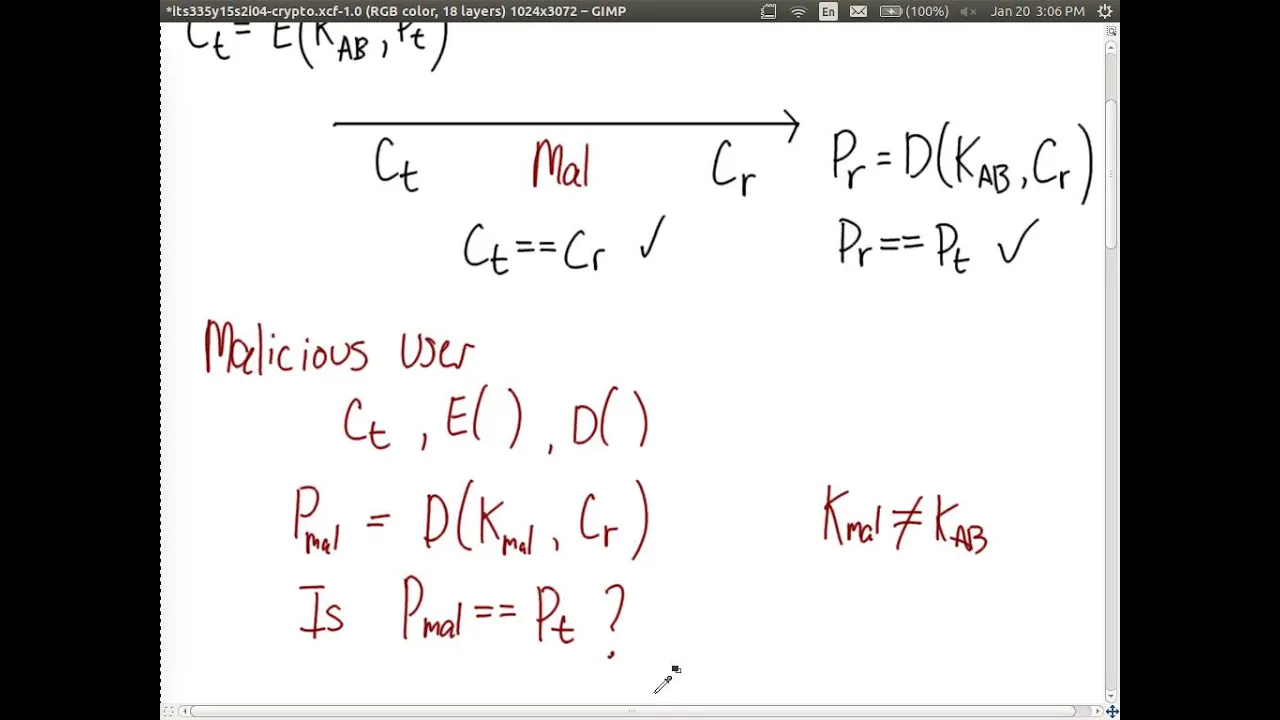
Public key cryptography (asymmetric encryption) uses two mathematically related keys: a public key (PU) and a private key (PR). Unlike symmetric encryption where the same key encrypts and decrypts, public key cryptography uses one key for encryption and a different related key for decryption. The public key can be freely distributed to anyone, while the private key must remain secret. This key pair relationship enables new security services not possible with symmetric encryption alone.
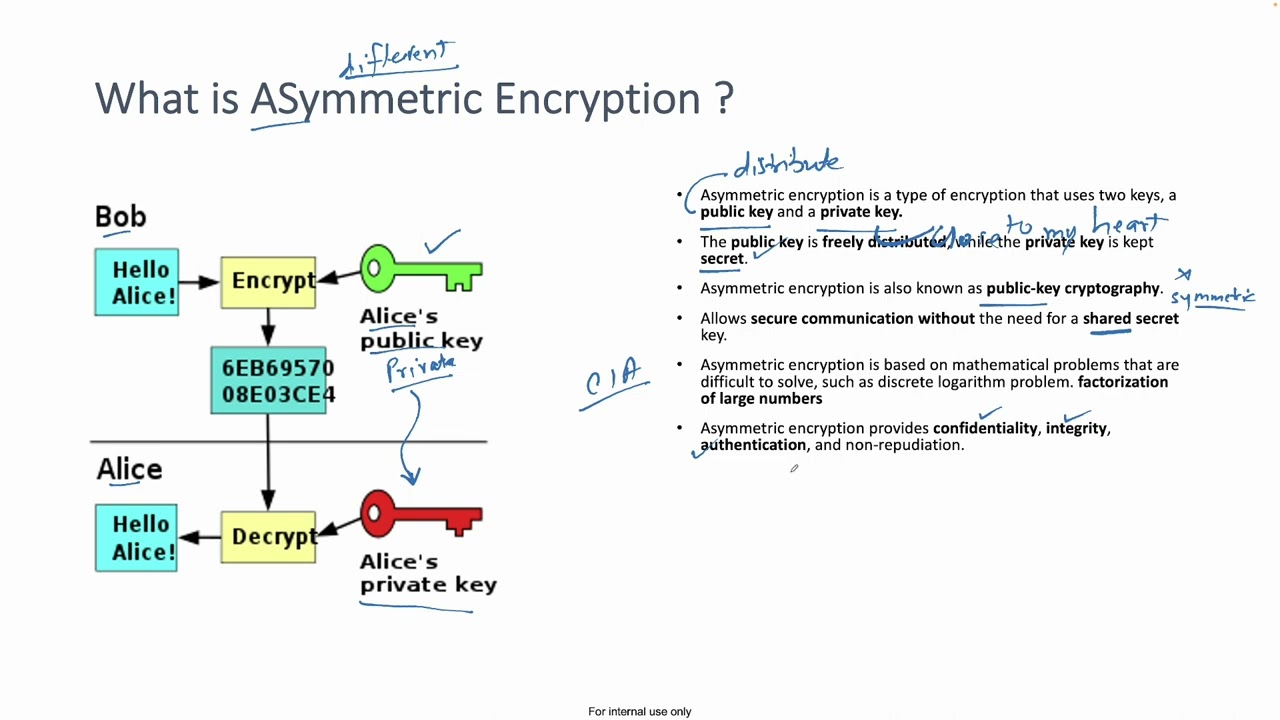
Asymmetric encryption, also known as public key cryptography, uses two mathematically related but distinct keys—a public key and a private key—that work in complementary pairs. Unlike symmetric encryption where the same key serves both encryption and decryption, asymmetric encryption employs different keys for each process. The public key can be freely distributed to anyone, while the private key must be kept strictly confidential and never shared. When a sender encrypts a message using the recipient's public key, only the recipient's corresponding private key can decrypt it. This fundamental difference eliminates the need for parties to pre-share a secret key, addressing a major limitation of symmetric encryption systems.

Asymmetric encryption uses two mathematically related keys: a public key and a private key. Data encrypted with the public key can only be decrypted with the corresponding private key, and vice versa. The public key can be freely shared with anyone while the private key must remain secret. This solves the key exchange problem inherent in symmetric encryption.
Familiarity with Schnorr signatures and how they differ from ECDSA (Elliptic Curve Digital Signature Algorithm).
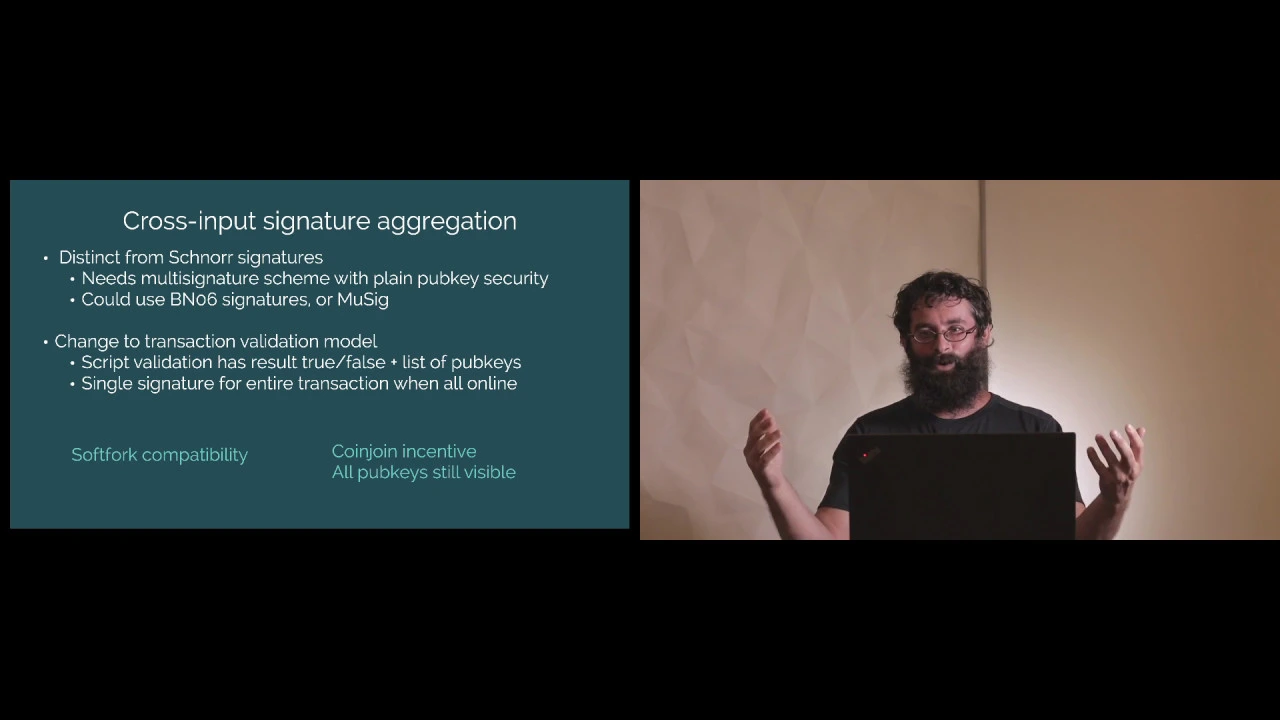
Schnorr signatures are a digital signature system based on the discrete logarithm problem, sharing security assumptions with ECDSA but offering significant advantages. Unlike ECDSA, Schnorr signatures have a formal security proof: if the discrete logarithm problem is hard in the random oracle model, signatures cannot be forged. They can be implemented with exactly 64 bytes (removing ECDSA's 6-7 byte overhead), and they support batch verification - the ability to verify multiple signature-message-public key triplets simultaneously. This batch verification is ideal for transaction validation where the goal is simply to confirm validity, not to identify which specific signatures failed.

Schnorr signatures, introduced by Claus-Peter Schnorr in 1991, are a type of digital signature scheme that offers significant advantages over ECDSA (Elliptic Curve Digital Signature Algorithm), including mathematical linearity which enables multiple advanced applications such as multi-signature creation through simple addition of signatures, pay-to-contract mechanisms for embedding conditions within public keys, timestamping through nonce commitments, protection against compromised wallet attacks via random nonce binding, and atomic swaps between parties without revealing private keys; unlike ECDSA which lacks formal security proofs and involves computationally expensive division operations, Schnorr signatures provide provable security reductions to the discrete logarithm problem and enable efficient cryptographic operations through linear algebraic properties.

Elliptic curve cryptography is defined by the equation y² = x³ + ax + b over a finite field, with fundamental operations including point addition, point doubling, and scalar multiplication. These primitives enable digital signature schemes. Schnorr signatures differ from ECDSA (used in Bitcoin) by possessing a mathematical linearity property: when multiple signatures from different senders are aggregated, the resulting signature remains valid against the sum of all public keys. This allows multiple transaction inputs to be signed with a single aggregated signature, reducing transaction size and improving efficiency. The verification algorithm uses scalar multiplication and point addition primitives, and can be implemented in less than 30 lines of code.

This section provides a comprehensive comparison between ECDSA and Schnorr signatures. ECDSA requires a conversion function mapping group elements to integers, is malleable (negating the response produces another valid signature), and has complex verification. Schnorr signatures have proven security under the discrete logarithm assumption in the random oracle model, even if the hash function has collision weaknesses. The section explains why ECDSA's security proofs in the generic group model can prove things that aren't actually true, as demonstrated by ECDSA's malleability.

Schnorr signatures form the cryptographic foundation of Taproot, enabling multiple signatures to be combined into a single signature. This consolidation reduces transaction size while enhancing privacy and security. Invented by Claus Peter Schnorr in 1991, the patent expired in 2008, coinciding with Bitcoin's introduction. Despite having access to Schnorr signatures, Satoshi Nakamoto chose ECDSA combined with ElGamal to avoid patent complications. Schnorr signatures offer significant advantages over ECDSA: better privacy, greater security, and easier implementation. If adopted earlier, they would have placed less strain on the network. The combination of Taproot and Schnorr signatures could potentially expand Bitcoin's functionality significantly, representing a major advancement in digital signature technology.
Basic knowledge of Shamir's Secret Sharing scheme and the concept of a threshold (t-of-n) setup.
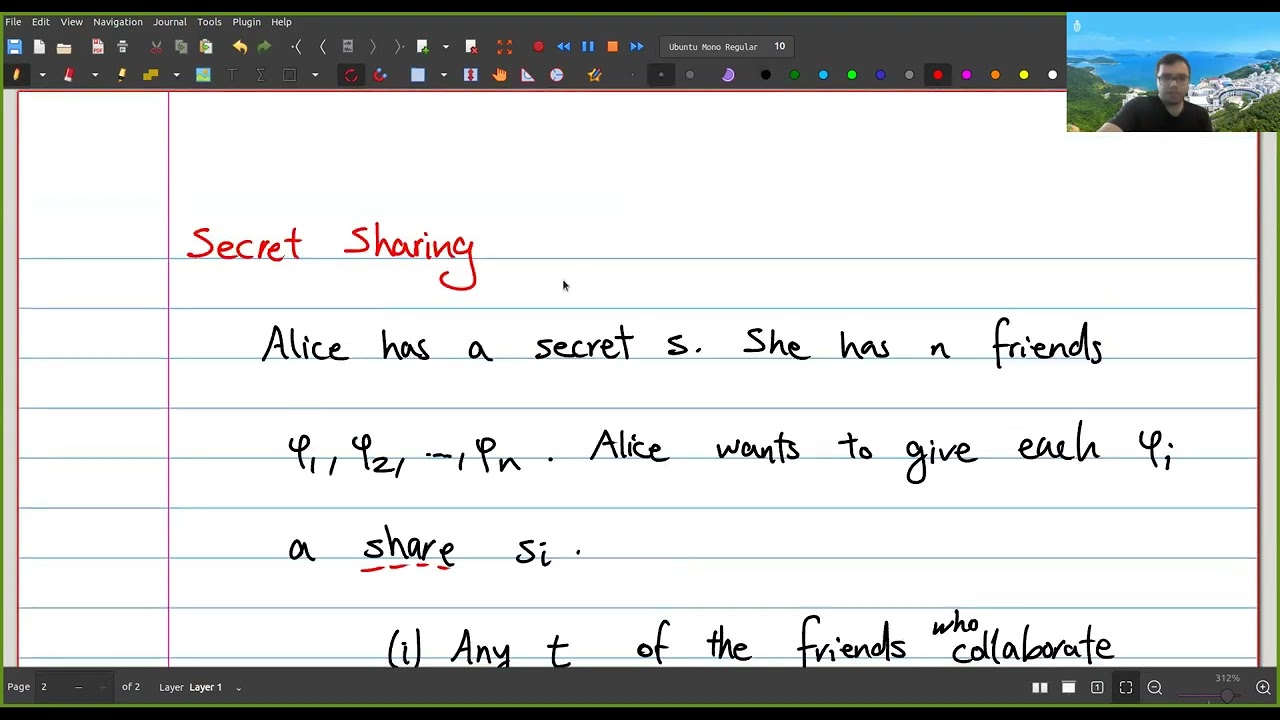
Shamir's secret sharing works as follows: (1) Choose a large prime number P and announce it to all participants; (2) Create a polynomial F(x) = a₀ + a₁x + a₂x² + ... + a_{t-1}x^{t-1} where a₀ = S (the secret) and coefficients a₁...a_{t-1} are randomly chosen values in [0, P-1]; (3) Each participant receives a share s_i = F(i) (the value of the polynomial evaluated at their index i). The threshold t determines how many shares are needed to reconstruct the secret.
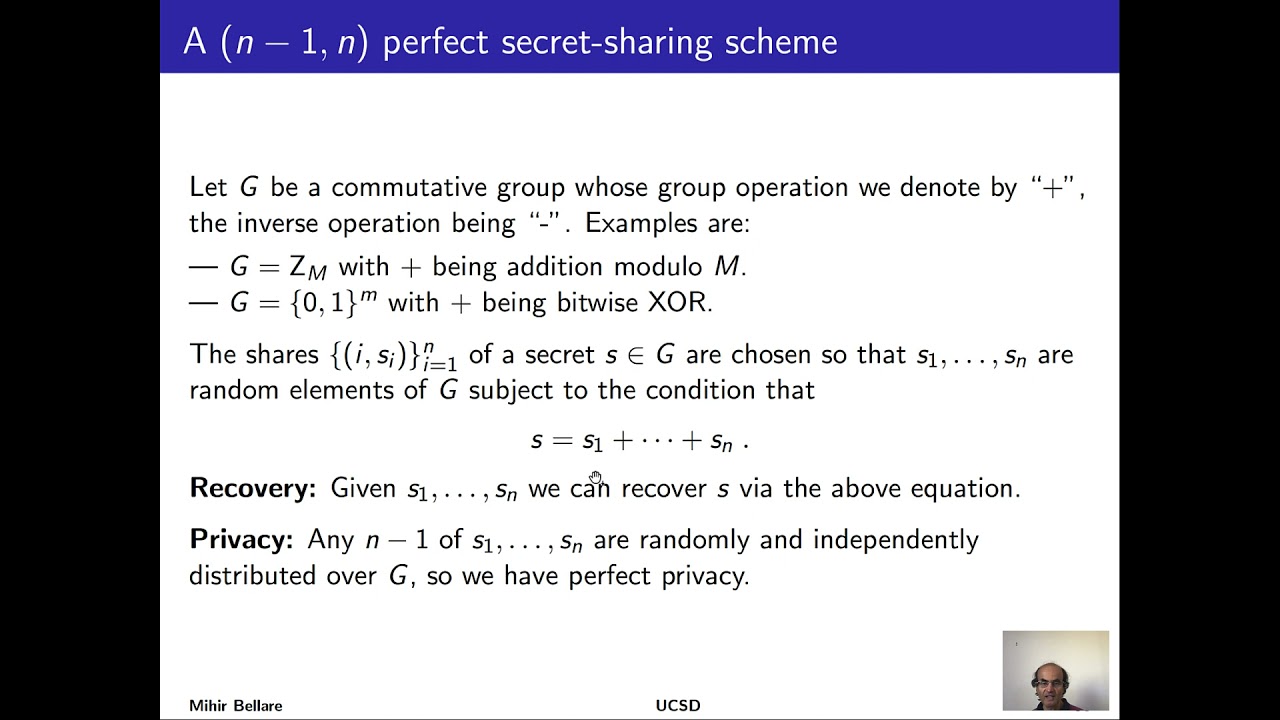
Shamir's (t,n)-threshold secret sharing scheme uses finite field arithmetic to achieve threshold access control. The scheme operates over a finite field (supporting addition and multiplication) with at least n+1 elements. The dealer constructs a polynomial f(x) of degree at most t, where the constant term is the secret s. Random coefficients fill the remaining positions. Each player receives a share equal to f(e_i), where e_i is a distinct basis point in the field. The scheme relies on two mathematical facts: (1) any degree-t polynomial is uniquely determined by t+1 distinct points, enabling reconstruction; (2) any t points on such a polynomial reveal no information about the constant term. When t+1 or more players collaborate, they interpolate the polynomial and evaluate it at x=0 to recover the secret. This achieves perfect privacy because the random coefficients ensure that t shares appear uniformly distributed.

Shamir's secret sharing is a cryptographic threshold scheme that divides a secret into n shares such that any t or more shares can reconstruct the secret, while any fewer than t shares reveal no information about it. The scheme works by selecting a prime number p ≥ n+1, choosing n distinct non-zero values x₁, x₂, ..., xₙ, and constructing a polynomial f(x) = s + a₁x + a₂x² + ... + aₜ₋₁x^(t-1) where s is the secret and the coefficients a₁, a₂, ..., aₜ₋₁ are randomly chosen. Each participant receives a share (xᵢ, f(xᵢ)). To reconstruct the secret, t or more participants apply Lagrange interpolation on their shares to determine the polynomial and evaluate f(0) to recover the secret s. The security relies on the mathematical property that for any m < t shares, there are exactly p^(t-m-1) possible polynomials that could explain those shares, making all possible secret values equally likely and revealing no information about the actual secret.

Secret sharing, introduced by Adi Shamir in 1979, allows a secret to be divided among multiple parties such that any subset of t+1 or more parties can reconstruct the secret, while any subset of t or fewer parties learns nothing. The scheme uses polynomial interpolation over finite fields: a dealer creates a polynomial of degree t with the secret as the constant term, evaluates it at n distinct points, and distributes one share (evaluation point) to each participant. Reconstruction involves interpolating the polynomial from any t+1 shares to recover the secret. This threshold structure provides both security against coalitions smaller than the threshold and flexibility in choosing reconstruction requirements.

Shamir Secret-Sharing is an efficient threshold secret-sharing scheme that uses properties of t-degree polynomials over a finite field to divide a secret among n parties such that any t+1 shareholders can reconstruct the secret using Lagrange interpolation, while any t or fewer shareholders learn nothing about the secret; the scheme requires a finite field with at least n+1 elements, n distinct non-zero evaluation points, and random polynomial coefficients to ensure information-theoretic security.
Fundamental understanding of Bitcoin's transaction model, specifically how multisig (multi-signature) scripts currently operate.

Multisig (multi-signature) Bitcoin wallets require multiple private keys to authorize transactions, providing exponentially greater security than single-signature wallets. Unlike standard addresses starting with '1', multisig addresses start with '3'. Users can distribute private keys across different locations, offline storage, or with different providers, making hacking infinitely more difficult. Multisig enables trustless escrow arrangements where users maintain control even when using third-party services like exchanges. The threshold configuration (m-of-n) determines how many signatures are needed, with current implementations supporting up to 3-party multisig. Before spending, transactions must receive sufficient blockchain confirmations (typically 12+ blocks) before becoming spendable. Users verify transaction status using blockchain explorers like blockchain.info or Insight, which display transaction IDs, confirmations, and output details.

This comprehensive lesson covers the fundamental mechanics of Bitcoin transactions and the multi-signature workflow. Key concepts include: (1) Bitcoin transactions operate in discrete packet units, requiring users to send complete packets rather than arbitrary amounts; (2) When sending less than the total packet value, wallets automatically generate change transactions with network fees; (3) Transaction outputs can store additional information like messages; (4) Multi-signature transactions require a specific number of signatures (e.g., 1 of 3) for authorization; (5) Each transaction has a unique identification code that can be shared via QR code for co-signers; (6) Pending transactions remain in the wallet until fully validated by the network. The video demonstrates the complete workflow from transaction creation through the multi-signature approval process.
This section explains multi-sig transactions, which allow multiple parties to jointly control funds. For example, in a 2-of-3 setup, any 2 out of 3 designated parties must sign to authorize a transaction. The lock script contains OP_N (number of required signatures), M public keys, and OP_CHECKMULTISIG. The unlock script provides signatures corresponding to the public keys. OP_CHECKMULTISIG verifies that the required number of signatures match their corresponding public keys. This provides enhanced security, prevents single-point-of-failure, and enables organizational fund management where no single person can move funds alone.
A multisig address in Bitcoin is created by combining two or more public keys into a single script that requires multiple signatures to authorize spending; the process involves generating separate mnemonic phrases and hardware wallets for each participant, deriving their respective master public keys, and then creating a script-based address (starting with '3') that enforces the required number of signatures (e.g., 2-of-2), though it is strongly recommended to use a 2-of-3 configuration rather than 2-of-2 for enhanced security since losing one key in a 2-of-2 setup results in permanent fund loss.
![[Lecture 3] Bitcoin Mechanics and Optimizations: A Technical Overview](https://i.ytimg.com/vi/BJpVnpoFHd8/maxresdefault.jpg)
Every transaction maps inputs to outputs, redeeming bitcoins from previous transactions. Each transaction contains metadata (ID, input/output counts, version, lock time, size). Inputs reference previous transactions by hash and include unlocking scripts (signatures and public keys). Outputs contain amounts and locking scripts specifying redemption requirements. The locking script defines conditions; the unlocking script provides information to satisfy them. Script execution uses a stack-based virtual machine with operations like OP_DUP, OP_HASHVERIFY, OP_EQUALVERIFY, and OP_CHECKSIG. Pay to Public Key Hash (P2PKH) is the most common type, requiring signature and public key matching the address hash. Pay to Script Hash (P2SH) stores only script hashes, allowing complex scripts to be provided later. Multi-signature transactions require multiple signatures (e.g., 2-of-3) for redemption, enabling shared control of funds for joint accounts, business arrangements, or escrow services.
Prerequisite Knowledge
- Concept 01Understanding of public-key cryptography and asymmetric encryption principles.
- Concept 02Familiarity with Schnorr signatures and how they differ from ECDSA (Elliptic Curve Digital Signature Algorithm).
- Concept 03Basic knowledge of Shamir's Secret Sharing scheme and the concept of a threshold (t-of-n) setup.
- Concept 04Fundamental understanding of Bitcoin's transaction model, specifically how multisig (multi-signature) scripts currently operate.
Subsequent Learning
- Step 01Deep dive into Distributed Key Generation (DKG) protocols, which allow parties to generate shared public keys without a trusted dealer.
- Step 02A comparative study of FROST versus MuSig2 (multi-signatures) and traditional ECDSA threshold schemes.
- Step 03Exploration of Taproot (BIP340) on Bitcoin and how threshold signatures integrate with Tapscript for enhanced privacy.
- Step 04Analysis of practical implementation challenges of FROST, such as handling malicious coordinators or network disruptions during the signing phase.
Frost Basics
0:03- 1
Threshold signatures allow a quorum to produce one key and signature.
- 2
Policies can be nested for complex signing rules.
- 3
Blockchain sees only one key, hiding internal complexity.
The Implementation Risks of Off-Chain TSS and the Case for Native Multisig or MuSig2
While FROST offers excellent efficiency and privacy by producing a single, indistinguishable signature on-chain, it introduces significant complexity and security risks compared to Bitcoin’s native on-chain multisig or MuSig2. First, FROST relies on a complex Distributed Key Generation (DKG) process and interactive signing phases. Implementation flaws in these threshold cryptography protocols can lead to catastrophic key exposure. Second, FROST requires strict state management to prevent nonce reuse; if a signing node reuses a cryptographic nonce (for example, due to a virtual machine rollback), the private key can be reconstructed by an adversary. In contrast, native on-chain multisig (using Taproot trees or legacy scripts) is highly robust, relies on simpler, well-tested cryptography, and avoids the risks associated with interactive off-chain coordinate protocols. Additionally, for cooperative n-of-n scenarios, MuSig2 provides a simpler, two-round protocol that avoids much of the complexity of general m-of-n threshold schemes like FROST.
Deep dive into Distributed Key Generation (DKG) protocols, which allow parties to generate shared public keys without a trusted dealer.

This paper introduces an aggregatable distributed key generation (DKG) protocol that eliminates complaint rounds through public-channel encryption with aggregated transcripts, achieving linear communication complexity (O(n log² n)) instead of quadratic (O(n²)), while simultaneously presenting a new fully structure-preserving unique signature scheme (UF) that enables secure randomness beacons and threshold cryptography applications without requiring a trusted dealer.

Frost requires a three-round interactive Distributed Key Generation (DKG) protocol where multiple participants contribute to key creation without any single party knowing the full key. Each participant generates a Shamir polynomial and shares with others. Participants aggregate received shares, resulting in shares of aggregated polynomials. Additional Verifiable Secret Sharing (VSS) provides commitments to polynomials, allowing verification of polynomial structure. A proof of knowledge for the first coefficient prevents rogue attacks, and a broadcast channel ensures all participants saw the same commitments. This upside-down approach (generating shares first, then combining) prevents any participant from ever having the complete private key.

Threshold cryptography enables splitting private keys across multiple servers so any t+1 parties can perform cryptographic operations while up to t compromised parties learn nothing. Distributed Key Generation (DKG) is the interactive protocol where N parties generate both a secret key and its public counterpart without trusting any single dealer. Shamir secret sharing, developed in the late 1970s, provides the mathematical foundation: a random polynomial of degree t with the secret as the constant term is evaluated at n distinct points to create shares. Any t+1 shares reconstruct the secret through interpolation, while any t shares reveal nothing. Fully secure DKG requires four critical properties: correctness, secrecy, unbiasability, and robustness. Known lower bounds for secure computation with guaranteed output delivery don't directly apply to DKG because it's essentially a no-input functionality. The impossibility result shows no one-round statistically unbiased DKG protocol exists regardless of setup assumptions—the proof demonstrates that some party can exploit the rushing adversary model to bias the output key toward a desired value, contradicting unbiasedness requirements.

Distributed Key Generation (DKG) is a protocol enabling multiple participants to collaboratively generate cryptographic keys for threshold BLS signatures. This implementation runs on Ethereum using pre-compiled contracts originally designed for efficient ZK-SNARK verification. The demonstration uses Ganache for virtual testing and Truffle for development. The smart contract is deployed with 22 participants and a threshold of 14, requiring 15 participants to produce valid signatures. Each participant deposits 25 ether as an incentivization layer to encourage honest participation.
Distributed Key Generation (DKG) enables multiple parties to collaboratively generate a shared public key without any single party knowing the complete secret. The core application is threshold cryptography, where any T out of N parties can perform cryptographic operations (signing, decrypting) that require the full secret key. This addresses scenarios like company messaging systems or blockchain services where no single server should hold complete control. DKG involves both cryptographic challenges (secret sharing) and consensus problems (agreeing on the public key). Classical use cases run DKG once, tolerating inefficiency, while modern applications like randomness beacons require continuous efficient execution in asynchronous environments. Shamir's Secret Sharing forms the mathematical foundation: a dealer creates a degree-T polynomial with the secret as the constant term, evaluates it at each participant's index, and distributes these evaluations. Any T+1 participants can reconstruct the secret via Lagrange interpolation. DKG extends this by having each participant act as a dealer simultaneously, generating their own polynomial. The final public key is the sum of all individual polynomials evaluated at zero. However, this naive approach fails because malicious dealers might distribute invalid shares. Verifiable Secret Sharing (VSS) solves this by allowing participants to verify shares against pre-committed values, enabling detection and exclusion of faulty contributions through complaint rounds.
A comparative study of FROST versus MuSig2 (multi-signatures) and traditional ECDSA threshold schemes.
FROST is a threshold signature scheme designed to efficiently verify the integrity of precomputed values in SNARK systems like G16 and PLONK, addressing vulnerabilities in older schemes such as the Wagner's algorithm attack; unlike traditional Secure Multi-Party Computation (MPC) ceremonies that require extensive coordination and can take weeks to complete, FROST achieves similar security guarantees through two key innovations: each signer uses two independent random mixers instead of one, and the protocol applies hash functions twice during the signing process, which balances the mathematical complexity and prevents the chosen-message attack by ensuring pre-image sets are roughly equal in size on both sides of the verification equation.
Traditional Bitcoin multi-signature uses scripts that explicitly list all public keys and a threshold, creating privacy loss (scripts reveal all public keys when spending) and on-chain bloat (large scripts listing all keys). Frost solves these issues by appearing as a single signature on-chain while maintaining multi-sig functionality. The underlying mechanism uses Shamir secret sharing where the secret is the first coefficient of a polynomial. For a threshold of t, a polynomial of degree t-1 is created with random coefficients. Points (x,y) are generated by plugging in x-values to get y-values, which become the shares. Reconstruction requires t points to uniquely define the polynomial and recover the secret. Frost's innovation is generating shares without ever having the complete secret, eliminating the vulnerable reconstruction point where malware could compromise the entire key.

MuSig2 is a two-round Schnorr multi-signature scheme that achieves security through a novel technique where each signer generates two nonces and combines them using a random linear combination with a hash-derived exponent, eliminating the need for the third communication round required in the earlier MuSig1 scheme while maintaining security under the Algebraic One More Discrete Logarithm (AOMDL) assumption in the Random Oracle Model.

A significant FROST advantage over script multi-sig is backup simplicity. In script multi-sig, you must backup the entire output descriptor containing all X-pubs because every single X-pub is needed to recreate the redeem script. With FROST, each participant only needs to backup their own single X-pub or seed share, making recovery much simpler. FROST is 'malleable' in that you can add or remove signers at a later date, which is impossible with script multi-sig. With script multi-sig, if you lose a key in a 2-of-3 setup, you cannot add a new participant to make it 2-of-4. FROST allows changing the quorum and adding/removing participants, requiring agreement from a threshold number of existing parties. There's a philosophical debate between seed phrases (12-24 words) and FROST's distributed key approach. Seed phrases offer verifiability but are prone to human error. FROST moves security away from a single point of failure to distributed risk across multiple devices. FROST becomes computationally expensive with very high thresholds (50 of 100), requiring many elliptic curve multiplications that can take several minutes.
Implementing threshold signatures for ECDSA is more challenging than for BLS or Schnorr because ECDSA requires computing modular inverses, which is not a polynomial operation. Proper threshold ECDSA requires implementing a non-interactive zero-knowledge proof protocol, which is a hard cryptographic problem. Threshold signatures and multi-signatures serve different purposes: multi-signatures allow multiple parties to sign with each party contributing a signature verified against their public key, while threshold signatures allow a subset to generate a single signature appearing from one party. Threshold signatures have a fixed public key, while multi-signatures compute a public key from input public keys for each signature. The choice depends on whether you need a single signature that looks like it came from one party or multiple signatures verified against individual public keys.
Exploration of Taproot (BIP340) on Bitcoin and how threshold signatures integrate with Tapscript for enhanced privacy.

The Taproot upgrade is a soft fork to the Bitcoin protocol that bundles multiple improvements (BIPs) to make transactions cheaper, more efficient, and more private while enabling more feasible smart contracts. It achieves these goals through three key mechanisms: (1) Schnorr signature algorithm, which allows multiple transactions from a single wallet to be hashed together and assigned a unique key, making simple transactions indistinguishable from complex ones; (2) Merkle Alternative Script Trees (MAST), which condenses transaction conditions into a single script, reducing data size and fees; and (3) unified address types that eliminate the distinction between single-key and multi-key locked addresses, enhancing privacy by preventing observers from determining transaction complexity. The upgrade also improves smart contract composability by making conditions easier to reason about, though full wallet integration will take several years.

Taproot is a soft fork update for Bitcoin that introduces new address formats (bc1p), Schnorr signatures enabling key aggregation, and Merkle tree structures for selective disclosure of transaction rules. This update enhances privacy by making different transaction types (lightning channels, multi-signature, regular transactions) appear identical on the blockchain, while also improving transaction efficiency by reducing data overhead for complex transactions. The update was activated in block 709,1632 and achieved near-unanimous network consensus, though it may create regulatory challenges by making transaction tracing more difficult.
Schnorr signatures form the cryptographic foundation of Taproot, enabling multiple signatures to be combined into a single signature. This consolidation reduces transaction size while enhancing privacy and security. Invented by Claus Peter Schnorr in 1991, the patent expired in 2008, coinciding with Bitcoin's introduction. Despite having access to Schnorr signatures, Satoshi Nakamoto chose ECDSA combined with ElGamal to avoid patent complications. Schnorr signatures offer significant advantages over ECDSA: better privacy, greater security, and easier implementation. If adopted earlier, they would have placed less strain on the network. The combination of Taproot and Schnorr signatures could potentially expand Bitcoin's functionality significantly, representing a major advancement in digital signature technology.
Taproot is a major Bitcoin upgrade that implements Schnorr signatures, enabling more efficient and private smart contracts by aggregating multiple signatures into a single signature, which enhances privacy by hiding transaction participants while reducing storage requirements and improving transaction efficiency.
Taproot (SegWit version 1) introduces Schnorr signatures, a new cryptographic scheme enabling signature aggregation. Unlike traditional elliptic curve signatures, Schnorr allows multiple signatures to be combined into a single signature, reducing transaction size for multisig transactions. Taproot transactions appear identical to legacy Pay to Public Key Hash transactions, maintaining backward compatibility. The format uses a single aggregated public key (Taproot output) derived from combining multiple keys. This design enables complex spending scripts while keeping them hidden from the blockchain, as only the root hash is visible. The upgrade is being activated as a soft fork, expected around November, allowing decentralized adoption without requiring all nodes to upgrade.
Analysis of practical implementation challenges of FROST, such as handling malicious coordinators or network disruptions during the signing phase.
FROST has been proven secure cryptographically. Jesse Posner has an official C implementation being heavily vetted by the community, while Lloyd Fournier and Nick Farrow have their own implementation in the libsecp256k1 library. The next steps include advancing the FROST specification for compatibility between implementations and integrating coordinator software with existing wallets. ROAST (Robustness Protocol for FROST) is not a signature scheme but a set of instructions for running FROST robustly. It addresses disruptive signers who might disconnect, refuse to sign, or send invalid signatures. ROAST uses identifiable aborts - when a signer sends invalid data, others can identify them as malicious and exclude them from future rounds. ROAST keeps track of reliable versus problematic signers, ensuring that with T honest signers, a signature will eventually be produced.
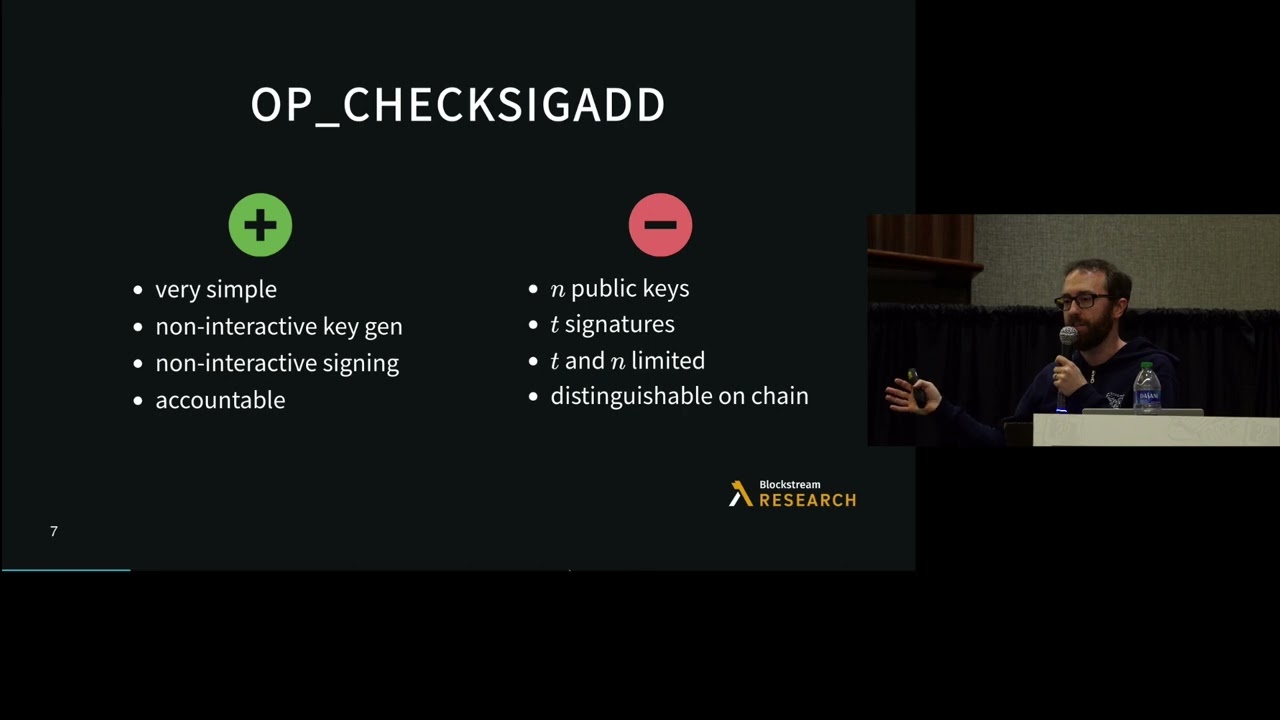
Schnorr signatures were introduced to Bitcoin via BIP 340 as part of Taproot, offering better provable security, efficiency, and easier construction of advanced protocols. Threshold signatures allow t of n signers to produce valid signatures with unforgeability and robustness properties. Applications include personal wallet security, institutional asset protection, and sidechain operations. The naive implementation using OP_CHECKMULTISIG requires all public keys on-chain, limiting scalability. FROST (Flexible Round-Optimized Schnorr Threshold) by Ian Goldberg provides security under concurrent signing sessions but lacks robustness - if a signer never responds, the coordinator cannot determine if they are malicious, crashed, or will respond later, preventing progress.
FROST signing involves pre-processing (participants select nonces d_i, e_i and publish commitments D_i, E_i) and signing phases. During signing, a coordinator collects commitments and broadcasts B containing all commitments and participant IDs. Each signer derives binding factor ρ_i = H(participant_id || m || B), binds their signature to specific parameters. The group commitment R = product(D_i * E_i^ρ_i) is computed, challenge c = H(R || Y || m) is derived, and responses z_i = d_i + e_i*ρ_i + s_i*c are generated. The final signature (R, sum(z_i)) matches single-party Schnorr format, enabling seamless integration with existing systems while maintaining threshold security.
FROST (Flexible Round-Optimized Schnorr Threshold) has released version 1.0.0 RC0, the first release candidate, with the goal of gathering feedback to stabilize the API before the final stable release. Current development includes adding socket communications to the terminal demo, planning to refactor the demo architecture since the coordinator is unlikely to be the server in practice, and adding no-STD support for embedded environments. A ZIP for using FROST with Cashu has been written but is pending a security proof by Chelsea.

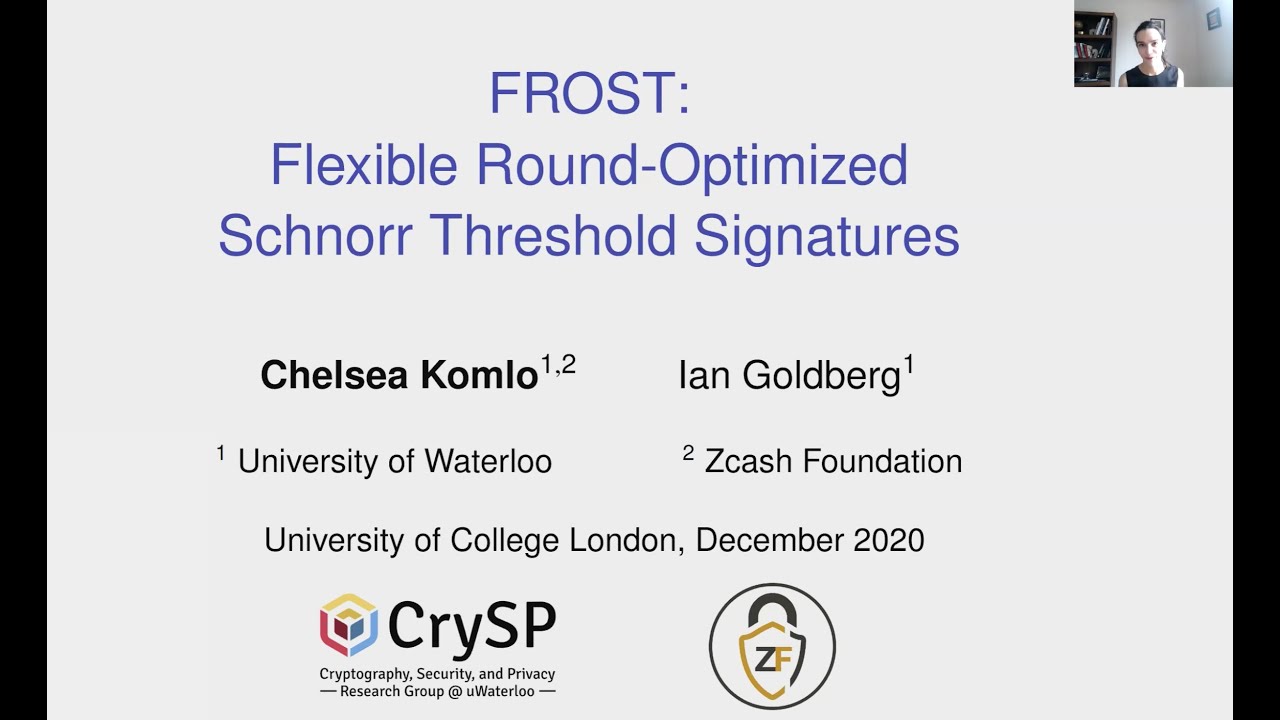
The original FROST paper lacked a security proof without heuristic assumptions. The goal was a simple, mechanical proof. Security proofs should be modularized into two parts: simulating honest interactions with the adversary and extracting solutions to hard problems. The Bishnor assumption involves two oracles: the first returns two nonces (necessary to prevent RRS attacks), and the second returns signatures incorporating both nonces. To ensure correct counting of one more discrete log queries, security reductions were implemented in Python. The DKG uses the general extractor assumption, while threshold signing reduces to the Bishnor assumption. The Schnorr extractor assumption is avoidable at the cost of an additional round but is necessary because non-tight reductions are cryptographically unsatisfying. Two critical implementation requirements: must hash identities of all signers and must hash all nonces and verify they are identical.
Frost Basics
0:03- 1
Threshold signatures allow a quorum to produce one key and signature.
- 2
Policies can be nested for complex signing rules.
- 3
Blockchain sees only one key, hiding internal complexity.
The Implementation Risks of Off-Chain TSS and the Case for Native Multisig or MuSig2
While FROST offers excellent efficiency and privacy by producing a single, indistinguishable signature on-chain, it introduces significant complexity and security risks compared to Bitcoin’s native on-chain multisig or MuSig2. First, FROST relies on a complex Distributed Key Generation (DKG) process and interactive signing phases. Implementation flaws in these threshold cryptography protocols can lead to catastrophic key exposure. Second, FROST requires strict state management to prevent nonce reuse; if a signing node reuses a cryptographic nonce (for example, due to a virtual machine rollback), the private key can be reconstructed by an adversary. In contrast, native on-chain multisig (using Taproot trees or legacy scripts) is highly robust, relies on simpler, well-tested cryptography, and avoids the risks associated with interactive off-chain coordinate protocols. Additionally, for cooperative n-of-n scenarios, MuSig2 provides a simpler, two-round protocol that avoids much of the complexity of general m-of-n threshold schemes like FROST.
[Applause] cross is the threshold signature scheme you have maybe like 10 participants and now like any five of them or any eight of them or you know whatever whatever parameters you want uh if you have a quorum of them they are able to kind of interactively fill in the gaps for the missing participants and they're able to produce a single signature so now just like with mus you have one key one signature but now the signature represents a quorum of people so you have this Quorum kind of policy and what's cool is you can Nest these um or at least we've been working very hard to make these nestable so the individual keys in a frost can themselves be frosted and so you can have kind of these arbitrarily complicated um policies signing policies that are all represented by a single key and to r a signature was a single key everybody needs to do this interactive protocol in the background but all of the complexity here is kind of offloaded to the sign themselves and so the blockchain doesn't care about the complexity the blockchain just sees one key one signature and they can't tell if there's a normal single key wallet they can't tell whether it's a two2 lightning Channel they can't tell if it's a two3 escrow they can't tell if it's some like more complicated thing is the idea behind Frost but as you might imagine the complexities of of this interactive protocol are even worse for Frost then for musig right and musig you kind of worry about all this kind of misbehavior in Frost you could imagine that you need seven of 10 signers but then you have an e signer shows up and just starts griefing things and you still want the protocol to work right you want to make sure that that even if you can't necessarily tell who's misbehaving somehow you eventually figure it out and you're able to get like as long as you have seven honest parties you can somehow weed out all the dishonest ones and then produce a valid signature and that's a lot of the work that we've been doing uh over the last year three four years um has been to a protocol that's resilient to all these different failure modes
Up Next

Chain-Key Cryptography: Scaling Blockchain with ICP | Dominic Williams
@DFINITY
3.3K views•2024-01-10
Hybrid Key Establishment in Production: Post-Quantum Cryptography
@durumcrustulum
14.7K views•2025-08-27
Operational Security Essentials: A Guide for Hacktivists (OPSEC)
@hitbsecconf
157.4K views•2012-11-26
Understanding Ethereum: A Comprehensive Beginner's Overview
@99Bitcoins
3.1M views•2018-06-26
Related Study Plans & Knowledge Roadmaps
Structured learning paths in Blockchain & Crypto