



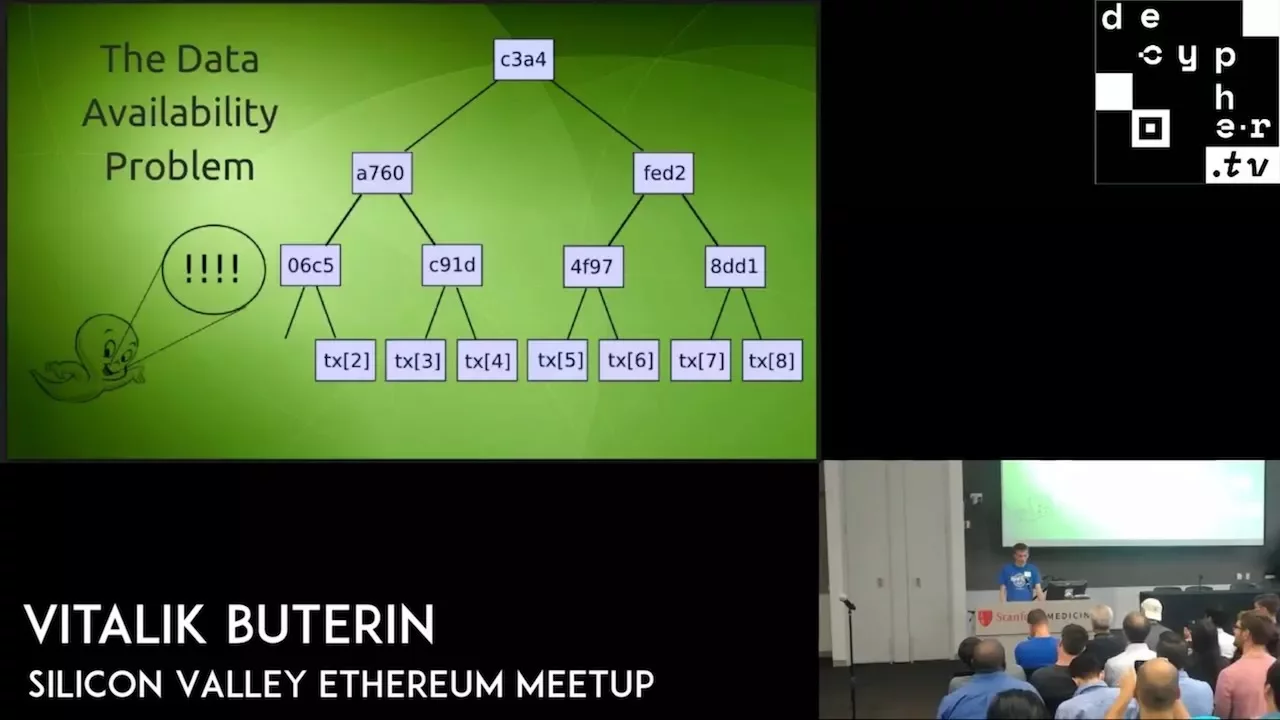
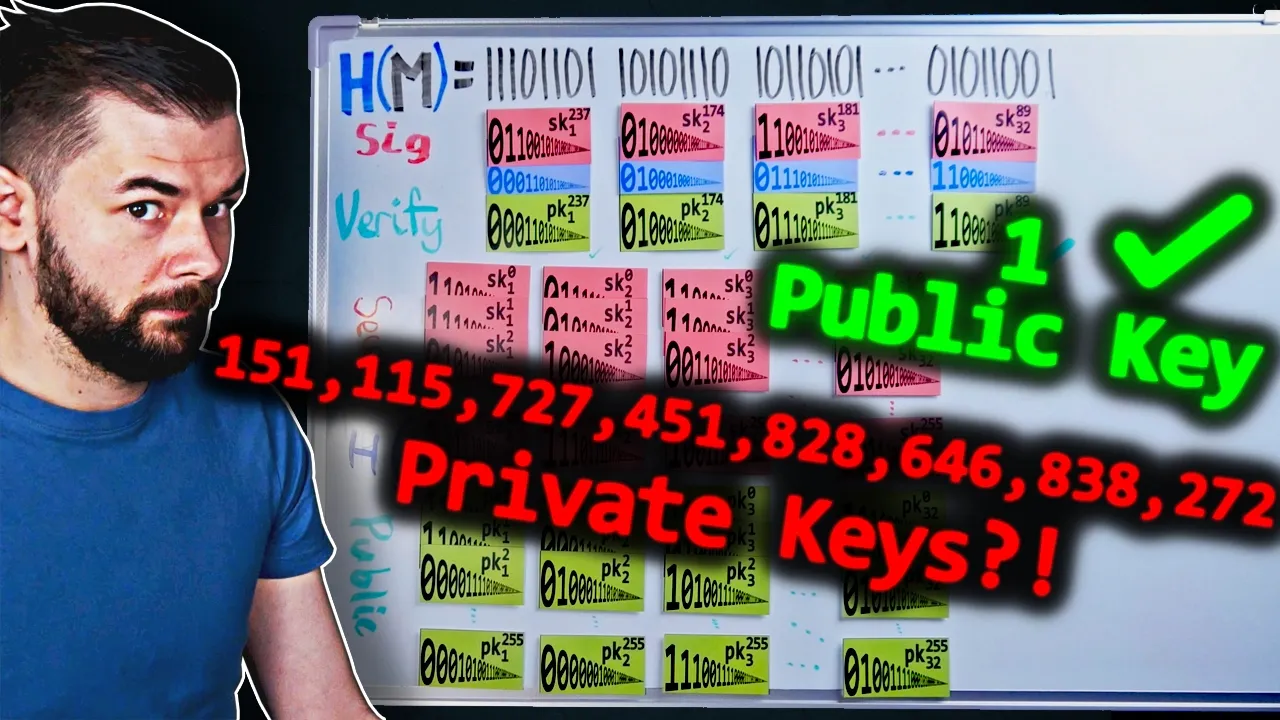














Data Availability Sampling (DAS) is a cryptographic technique that enables light clients to verify data availability without downloading the entire dataset by randomly sampling small chunks of data; similar to how QR codes use erasure coding to remain functional even when damaged, DAS allows Celestia's light nodes and embedded light clients to confirm data availability with high probability after sufficient random sampling attempts, thereby enabling billions of users to participate in network verification regardless of device capabilities.
Data Availability Sampling and Erasure Coding in Celestia
Added:The fundamental differences between full nodes and light clients in a blockchain network.
The 'Data Availability Problem' in distributed ledgers and why it is critical for decentralized consensus.
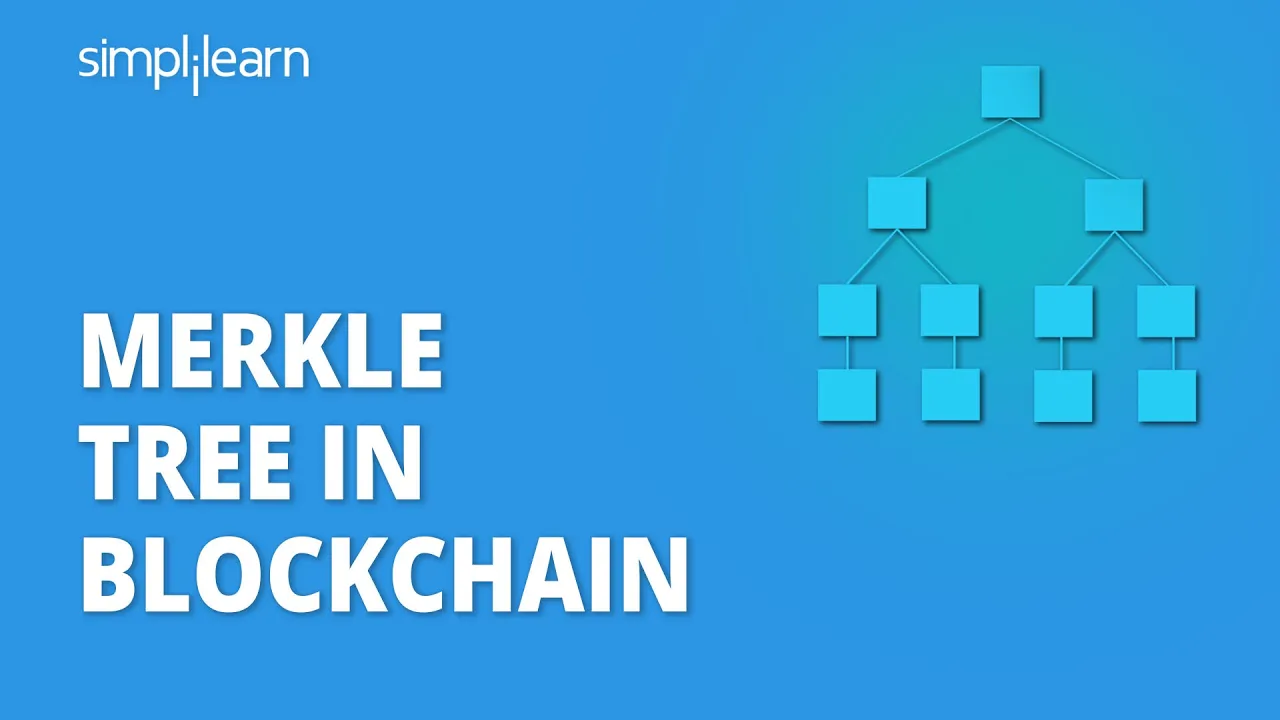
Basic cryptography concepts, specifically cryptographic hashing and the structure of Merkle Trees.
The core philosophy of modular blockchain architecture (separating execution, consensus, and data availability).
Namespaced Merkle Trees (NMTs) and how they enable applications to query only relevant subsets of data.
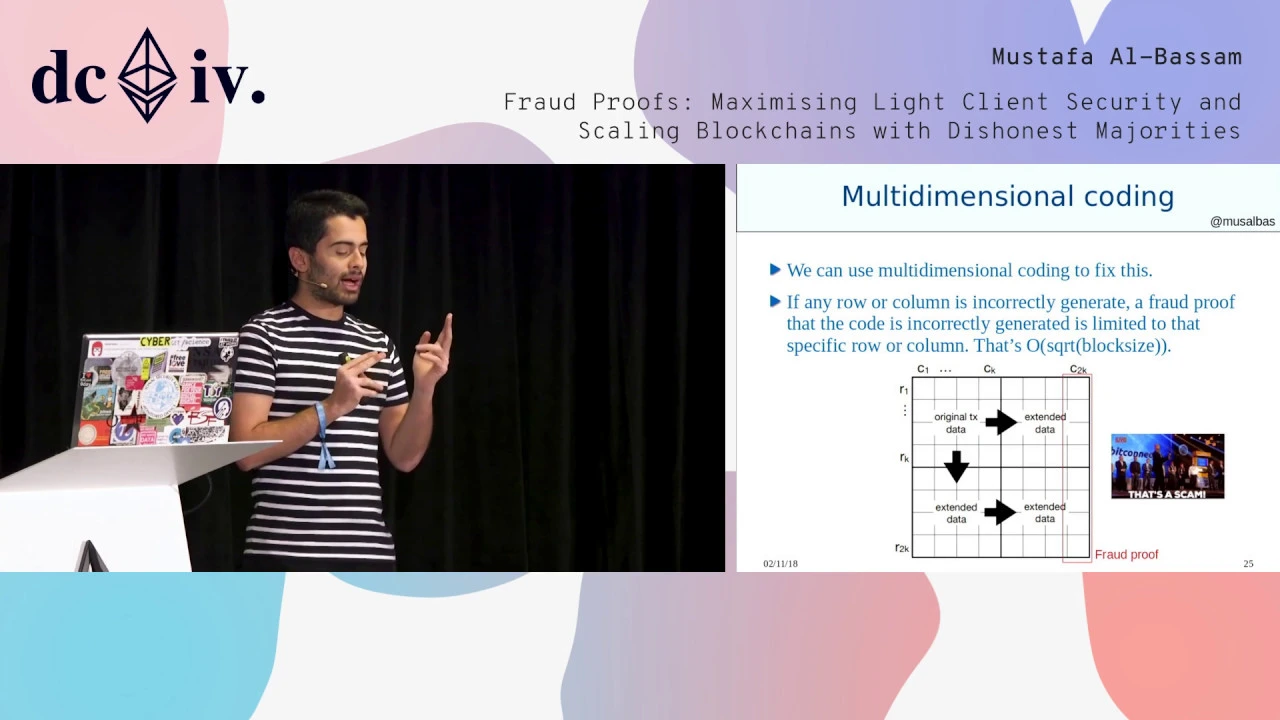
How fraud proofs and validity proofs are used to secure light clients against malformed erasure-coded blocks.
Designing and deploying rollups (Optimistic or ZK) that utilize Celestia as an off-chain data availability layer.
A comparative study of Celestia's DAS versus other data availability solutions like EigenDA (KZG commitments) and Ethereum's Danksharding.
768 views35likes5:25Original Release: 2024-12-18
gMammoth.
Luke here.
I'm a Developer Advocate at Celestia Labs, and this is a video all about erasure coding and Data Availability Sampling.
But to understand that, let's start with something simpler.
This QR code.
When we're developing software we think about common attack vectors, right.
We think about MEV, we think about front running, we think about reentrancy bugs.
But a QR code, it exists in the physical world and has completely different attack vectors.
QR codes have to worry about rain.
They have to worry about extreme heat, crumpled paper, even a dog deciding to well, you know.
Right.
And yet they still work, even when damaged.
Have you ever wondered why?
Well, here, let me show you.
Start with this QR code. Right.
Scan it. It works.
Now imagine I cut off a corner here.
Still works.
I bring that corner back, cut off a different corner, scan it, and still works.
How does it work?
Well, the answer is erasure coding.
But let's talk a little bit more first.
Okay, let's think for a moment how you can embed backup data into a QR code.
Well, you could embed the data into the code once and then put it left and right.
So that if either half is damaged, you still have the data.
Or maybe you want to go further.
You build a giant square where you take that that QR code and put it four times, so each quadrant has the same data.
That way, if any one quadrant is damaged, you can still reconstruct the code.
Well, what happens if someone shoots a hole right through the middle, damaging all four quadrants?
It's not going to work, right?
Instead, with erasure coding, what we do is we weave redundant data all throughout the QR code itself.
Erasure coding takes the original data and breaks it into small chunks, and then it generates redundant data using polynomial interpolation.
But stick with me here.
It's much easier than it seems at first.
So think of your original data as points on a curve.
And then with erasure coding, what we do is we generate additional points all along that same curve.
That way, if some of the points are lost, like because our QR code is damaged, you'll only need a minimum number of points in order to reconstruct the entire curve.
There are different ways to create a QR code, but generally about 25% of it can be damaged, and the QR code will still work.
Okay, so here's a challenge for you.
Imagine I show you this QR code and I ask you to verify that it's works without actually scanning it.
What would you do?
Well, since only 75% of the QR code needs to be there, we don't care if the whole QR code is there.
We only need 75% of it.
So what you could do is you could randomly sample a handful of points.
And if you verify enough of these random points, you can be confident with a high degree of probability that the QR code is valid.
The TLDR here is that a QR code can withstand a data withholding attack.
Meaning up to 25% of its data can be withheld, and it'll still work.
Just as QR codes use erasure coding to remain functional despite damage.
Celestia uses the same technology to build a highly decentralized network of nodes.
In Celestia, there are three types of Data Availability nodes.
First up, full nodes.
Now full nodes store the entire chain, but running a full node requires significant hardware resources, which of course can limit decentralization if too few participants can afford to run one.
Then we have bridge nodes.
Bridge nodes serve as intermediaries between the consensus network and the data availability network.
They download and validate block headers and they ensure data availability by erasure coding the blocks.
There are also high hardware requirements for running a bridge node.
And finally light nodes.
Light nodes verify data availability without downloading the entire chain.
Instead of storing the full data, they only download block headers, and then they use Data Availability Sampling to ensure that the underlying block data is available.
But how do you verify the data is there without downloading it?
Well, just as we're able to verify that QR code without actually scanning it, Celestia’s light nodes do the same thing with Celestia blocks.
Here's how it works.
So when data is uploaded to Celestia, Celestia erasure codes it.
Basically takes that original data adds extra rows and columns, weaving redundant data throughout.
light nodes then randomly sample small chunks of each block to check if the data is available.
Then, once the light node has sampled a block at least 16 times, it can ensure, with a high degree of probability, that the data is available.
All right, that may not seem like a lot, but peep this.
You actually have a greater chance of a rogue photon hitting RAM and switching a bit from 0 to 1 than you do of getting a wrong result with Data Availability Sampling after 100 tries.
Now, in addition to light nodes, we also have light clients which perform the same function.
But this is the cool part.
Light clients fundamentally change the scale of blockchain participation.
Imagine a world where every app built on Celestia has a light client embedded inside.
That means every user of every app helps verify the security of the network.
And in this model, we're not just talking about thousands of clients.
We're not talking about millions of clients.
We're talking about billions of clients helping to verify the security of Celestia’s network.
Now, the light client is already embedded in the Leap wallet.
It's already embedded in Lumina.rs.
This showcases just how accessible verification can be, even on mobile devices, even in browsers.
And this is the vision of Celestia, a blockchain network where decentralization scales organically with participation.
All right, that's it for now.
Listen, when you're ready to build whatever.
Check below.
There are docs linked.
My DMs are open and you can always reach us in Discord.
That's it for now. More soon.
Peace out. Thank you very much.
Bye bye.
Up Next
8:28
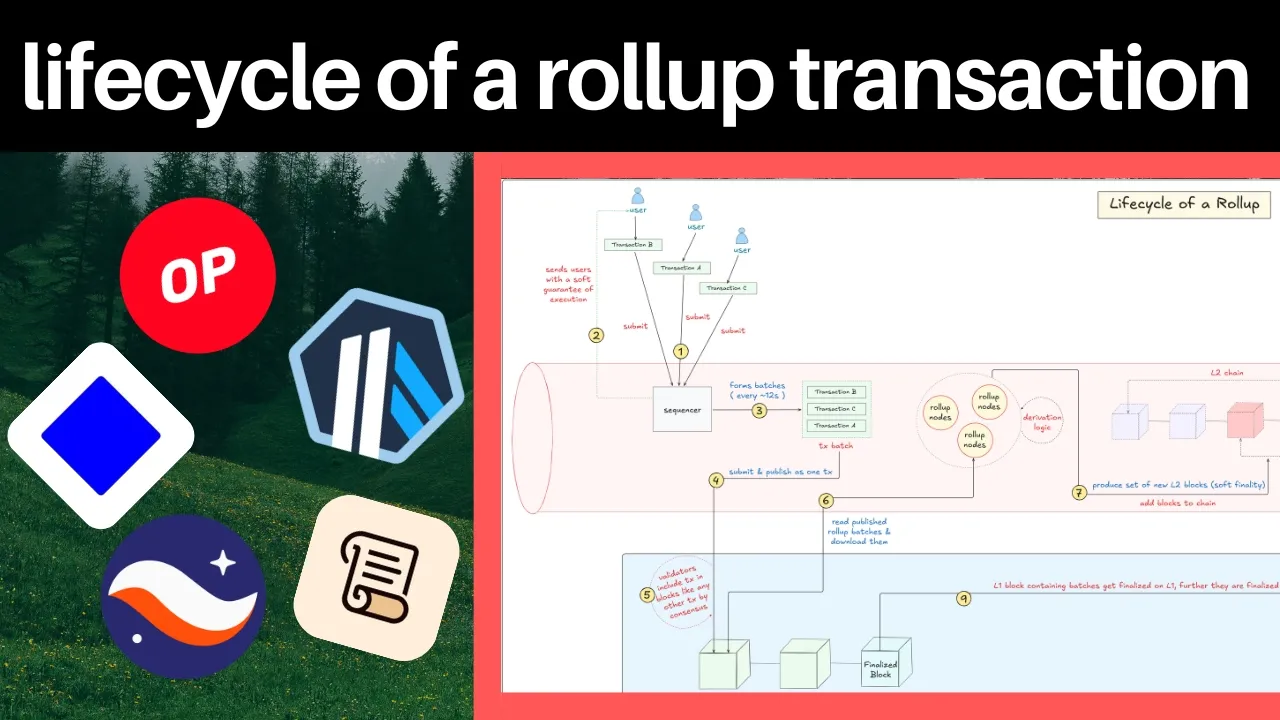
Rollup Transaction Lifecycle: A Visual Technical Guide
@supitsrohan
116 views•2026-03-25
52:00
Hybrid Key Establishment in Production: Post-Quantum Cryptography
@durumcrustulum
14.7K views•2025-08-27
64:25
Operational Security Essentials: A Guide for Hacktivists (OPSEC)
@hitbsecconf
157.4K views•2012-11-26

11:49
Understanding Ethereum: A Comprehensive Beginner's Overview
@99Bitcoins
3.1M views•2018-06-26
Related Study Plans & Knowledge Roadmaps
Structured learning paths in Blockchain & Crypto
blockchain-and-crypto
MPC Wallets: TSS, DKG & Secure Custody
01Foundations of Cryptography & Digital Signatures
02Secret Sharing & Introduction to MPC
03Distributed Key Generation (DKG)
+ 2 more learning modules
24h5 modules
Explore Roadmap
blockchain-and-crypto
ERC-4626: Yield Aggregators & Leverage
01Blockchain, Ethereum, and Solidity Foundations
02DeFi Primitives: Lending, Pools, and Yield Farming
03Mastering the ERC-4626 Tokenized Vault Standard
+ 3 more learning modules
35h6 modules
Explore Roadmap
blockchain-and-crypto
DePIN: IoT Registries, Proofs & Rewards
01Foundations of Blockchain & IoT
02Introduction to DePIN and the Flywheel Effect
03Designing IoT Device Registries & Secure Identity
+ 3 more learning modules
30h6 modules
Explore Roadmap
blockchain-and-crypto
Building EigenLayer AVS: Operators & Contracts
01Blockchain, Ethereum, and Smart Contract Basics
02Proof of Stake and Ethereum Staking
03Introduction to EigenLayer and Restaking
+ 3 more learning modules
24h6 modules
Explore Roadmap