Smart contract wallets differ from traditional EOA (Externally Owned Account) wallets by offering enhanced security through multi-signature and social recovery mechanisms, enabling programmable transaction logic for automated operations, and allowing third parties to pay gas fees on behalf of users, which makes them more secure, flexible, and user-friendly for Web3 interactions.
EOA vs Smart Contract Wallets: Web3 Wallet Types Explained
Added:Deep Dive
Fundamental understanding of blockchain technology, specifically how the Ethereum network operates and maintains state.

ETHEREUM: COS'È e COME FUNZIONA SPIEGATO SEMPLICE | Corso BASE di Crypto Ep. 7
59.1K
Ethereum is a decentralized 'world computer' enabling programmable applications beyond simple value transfer. It operates as a state machine where each transaction changes the network's state, creating transitions from 'world state before' to 'world state after.' The network uses Proof of Work (transitioning to Proof of Stake) with memory-intensive mining requiring GPUs. Block time is 12 seconds with 15-20 transactions per second throughput. Ethereum has two account types: Externally Owned Accounts (EOAs) controlled by private keys, and Contract Accounts (Smart Contracts) controlled by code. Smart contracts are deployed at specific addresses with executable code that determines their behavior, enabling complex decentralized applications while maintaining immutability.
Click to watch →
Module-4 one shot|BCS613A Blockchain technology important questions|Vtu|MQP+Pyq|Eduyodha
425
The Ethereum Stack enables user interaction through: Web Applications sending RPC requests, Clients communicating with peer-to-peer nodes, and the Network maintaining distributed state. The workflow involves request interpretation, node communication, transaction verification, local state synchronization, and response delivery. The state contains account balances, smart contract code, and storage values. State Transition is the process of changing the current state to a new state through transaction execution: starting with current state, validating transactions (signature, balance, gas), executing in EVM, updating state (balances, storage, blocks), and making the new state accepted. This mechanism ensures consistent, permanent record of all network activities.
Click to watch →

Ethereum Virtual Machine: Architecture & State Transitions
32.3K
The Ethereum world state is the complete snapshot of all accounts, balances, tokens, and contracts at any given moment. It contains exactly one current state with a historical record of previous states. When a new block is mined, all transactions within it are applied simultaneously to transition from the old state to a new state. This state transition mechanism is the core purpose of Ethereum, with consensus mechanisms (proof of stake/work) supporting this capability. The world state consists of two account types: externally owned accounts (EOAs) with private keys controlling balances and nonces, and contract accounts containing immutable code and mutable storage. All user assets and DApps exist within contract accounts.
Click to watch →
Blockchain para desenvolvedores #7. A rede Ethereum.
546
This section covers the technical infrastructure that makes Ethereum work. The Yellow Paper is the technical specification document that describes the state transition model - the mathematical framework defining how the blockchain works. The Ethereum Virtual Machine (EVM) is the execution engine that processes transactions and updates the blockchain state according to this framework. Smart contracts are written in Solidity, defining state variables and functions that modify those variables. Contracts are deployed through transactions that store the code and initial state. The global state contains all variables from all contracts, and each transaction may update one or more variables. The state transition model ensures that all participants can independently verify the current state by replaying all transactions from the initial state, creating a complete, immutable history of all changes.
Click to watch →
Алексей Малашкевич — Работа с Web3 с помощью Python на примере Uniswap
2.9K
Ethereum is a global network of nodes interacting through peer-to-peer protocol, creating a decentralized computer not owned by any entity. This distributed ledger ensures that shutting down one node doesn't affect the network. The network solves the double-spend problem by ensuring once a Bitcoin is sent, it cannot be sent again. Game theory is applied to incentivize honest behavior. Vitalik Buterin proposed adding executable logic to the network, creating a distributed spreadsheet with macros. After receiving $100,000 and raising $18 million, development began in 2013 with the first release in 2015. Nodes store the network state and respond to smart contract method calls. Each node maintains a copy of the network state, protecting against unauthorized actions. The village example illustrates how decentralized databases work: residents collectively maintain ledger copies, requiring collective agreement for changes. Transaction processing involves users calling contract methods, transactions entering a pool, and eventually being included in blocks. New blocks appear every 15 seconds.
Click to watch →
Deep Dive
Concepts of public-key cryptography, including public/private key pairs, digital signatures, and seed phrases.

“Public Keys, Private Keys & Seed Phrases (The Most Important Lesson)” Level 1 Crypto Boot Camp # 7
923
In cryptocurrency, a public key (or address) is like a locker number that can be shared publicly to receive funds, while a private key is a secret code that proves ownership and enables fund movement; the seed phrase is a human-readable master key that can recreate all private keys and must never be shared or stored online, as anyone with it can access and drain your wallet.
Click to watch →

Tất cả mọi thứ cơ bản bạn cần biết về Crypto trong hơn 200 phút | Xóa Mù Crypto x Aptos
346.3K
Public key cryptography uses two related numbers: a public key and a private key. The public key can be shared openly, while the private key must be kept secret. Messages encrypted with the public key can only be decrypted with the corresponding private key. Digital signatures work by encrypting a message with your private key, allowing anyone with your public key to verify you created it. This enables secure communication without sharing secret keys, solving the classic problem of how to share encryption keys safely.
Click to watch →

MCS 215 | Unit 2 - CRYPTOGRAPHY MECHANISMS | Block 1 | Security & Cyber Laws | MCA/MCA_NEW
8.1K
Public key cryptography uses a pair of keys for each user: a public key that can be shared openly and a private key that must be kept secret. To send a secure message, the sender encrypts it using the recipient's public key, and only the recipient can decrypt it using their private key. Electronic signatures are digital equivalents of handwritten signatures that provide authentication for electronic documents. Digital signatures use public key cryptography to ensure the signer's identity can be verified and that the document has not been tampered with. Trusted third parties (Certificate Authorities) issue digital certificates that bind public keys to entity identities, providing non-repudiation and legal validity.
Click to watch →

Webinar on Cryptography Concepts and Applications | CySecK | K-tech | IISc | KSCST |
208
Public key encryption uses asymmetric key pairs: a public key for encryption and a private key for decryption. Only the holder of the private key can decrypt messages encrypted with the corresponding public key. Digital signatures provide message integrity, authentication, and non-repudiation using public key cryptography. A signature scheme has key generation, signing, and verification algorithms. The security property is existential unforgeability under chosen message attack - adversaries cannot forge signatures on new messages even after seeing many message-signature pairs.
Click to watch →

Fundamental Blockchain Concepts and Wallets | Chainlink Bootcamp - Day 1
20.6K
Asymmetric encryption uses mathematically linked key pairs: public keys (shared) and private keys (secret). Messages encrypted with a public key can only be decrypted with the corresponding private key. Digital signatures authenticate senders by: hashing the message, encrypting the hash with the sender's private key, and sending both message and signature. Recipients verify by decrypting with the sender's public key and comparing hashes. This proves both sender identity and message integrity. Never share private keys as they provide complete access to funds.
Click to watch →
Deep Dive
The basic definition and execution model of Smart Contracts on decentralized virtual machines like the EVM.
Lecture #6. Ethereum Smart Contracts
363
Smart contracts represent the second revolution in the decentralized world, following Bitcoin. They are immutable code published on the blockchain that executes deterministically by validators. Once deployed, they cannot be changed. They execute in a decentralized manner where each validator processes the code and stores results. Smart contracts cannot access external data directly—all external data must be loaded into the blockchain first. They are Turing complete, enabling virtually any application logic. The five-stage lifecycle includes design, testing/auditing, deployment via special transactions, interaction, and destruction. The EVM is a stack-based virtual machine with memory (dynamic storage), storage (persistent state), and calldata (read-only parameters). Different memory types have different gas costs. Contracts can return arbitrary bytes for cross-contract communication.
Click to watch →

Blockchain One Shot Unit 2: IPU Edition | Consensus Algorithms & Smart Contracts Explained
150
The EVM execution model works as follows: transactions are broadcast, nodes execute smart contracts using EVM, results are verified by all nodes, valid transactions are added to blocks, and the gas mechanism tracks costs. If gas runs out, transactions fail. Smart contract lifecycle consists of three phases: development (writing Solidity code), deployment (compiling to EVM bytecode, generating ABI, deploying to blockchain), and execution (triggering functions when conditions are met). The ABI defines function names, event structures, and input/output formats for external interaction. Read queries retrieve data without modifying state, while state-changing transactions require gas payment. EVM-compatible blockchains include Polygon, Harmony, BNB Chain, and Moonbeam, enabling developers to leverage existing Ethereum tooling across multiple platforms.
Click to watch →
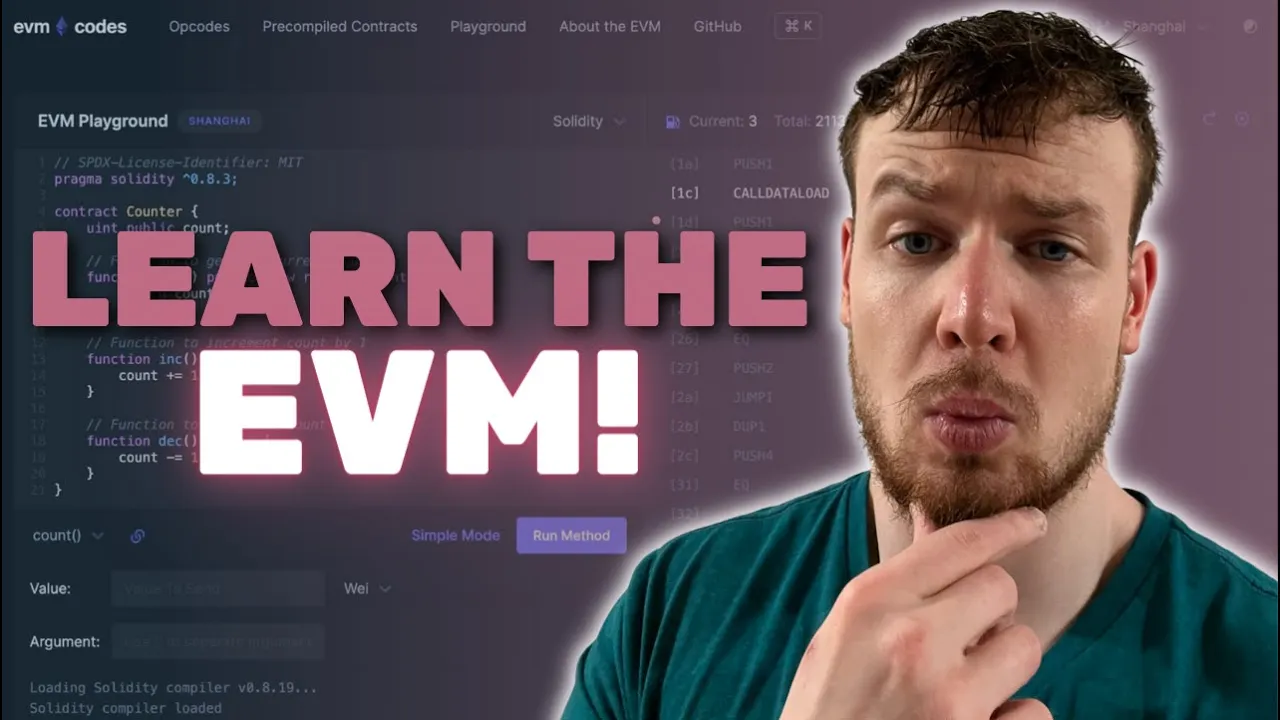
Understanding the Ethereum Virtual Machine: A Technical Guide
10.1K
The Ethereum Virtual Machine executes programs through a comprehensive set of single-byte hexadecimal opcodes that manipulate the stack, memory, and storage. Key opcodes include PUSH1-PUSH32 for pushing n-byte values, POP for removing stack items, MSTORE and MLOAD for memory operations, and SSTORE and SLOAD for storage interactions. Smart contract execution follows a systematic dispatch mechanism: after initializing the free memory pointer and validating the call value, the system verifies call data size exceeds four bytes. The function selector is extracted by shifting the first call data word right by 224 bits, isolating the 32-bit identifier. Contracts compare this selector against predefined function signatures in ascending order, using linear search for ≤4 functions or binary search for >4 functions. Execution jumps to the matching function's starting opcode location. Lower numerical selectors execute more efficiently due to earlier position in the search sequence. This opcode-level architecture transforms high-level Solidity code into executable bytecode that drives blockchain state transitions.
Click to watch →

LEC16 | Blockchain | Ethereum Virtual Machine (EVM) by Mrs. G. Sowmya
654
Ethereum is a decentralized blockchain platform enabling smart contract execution. Smart contracts are self-executing code that automatically runs when conditions are met. The EVM (Ethereum Virtual Machine) is a deterministic and Turing complete runtime environment where smart contracts execute. Deterministic means same input always produces same output. Turing complete means it can compute anything algorithmically computable. Smart contracts are compiled to bytecode, which the EVM executes instruction by instruction. Gas measures computational effort, with fees paid by senders to compensate network participants and prevent spam.
Click to watch →

Cryptocurrency Full Course | Cryptocurrency For Beginners | Cryptocurrency Explained | Simplilearn
1.5M
The Ethereum Virtual Machine (EVM) executes smart contract bytecode. Smart contracts are compiled into EVM bytecode from higher-level languages. The EVM uses opcodes to execute specific tasks. When a user triggers a transaction, the wallet sends a message to the EVM which connects with the wallet address on the Ethereum network to process the transaction and send it to the receiver.
Click to watch →
Deep Dive
How transactions are structured, broadcasted, and paid for using Gas fees on a blockchain.

The ULTIMATE Cryptocurrency Exchange Programming Tutorial for Blockchain - PT 1
78.7K
Every transaction on the Ethereum network requires payment of gas fees, which are debited from the sender's account balance. Gas fees compensate miners for processing and validating transactions. When deploying smart contracts or executing contract functions, the deployer account pays these fees, which reduces their ether balance even if the transaction succeeds.
Click to watch →
Modul 4 - Gas Fee Ongkos Jalan di Blockchain
2.3K
Gas fees are computational work costs required to process transactions on blockchain networks, functioning like highway tolls. The fee consists of three components: Gas Price (cost per unit of computation), Gas Limit (maximum gas a user is willing to pay), and Gas Total (actual cost calculated by multiplying gas used by gas price). Gas fees fluctuate based on network congestion—when many users transact simultaneously, fees increase to prioritize faster processing. Validators and miners receive these fees as compensation for securing the network. Layer 2 solutions like Polygon, Arbitrum, and Optimism address high gas costs by processing transactions off-chain and batching them into single Ethereum transactions, reducing costs to $0.01 or less compared to $1-20 on mainnet.
Click to watch →

Estimating Gas Fees for Transactions | Using Circle Wallets | #8
309
Gas fees are transaction costs that compensate validators for processing transactions on the blockchain. The gas fee is calculated by multiplying gas price (rate per unit) by gas limit (maximum units allocated). EIP-1559 introduced a new fee structure with base fees (minimum protocol fees) and priority fees (tips to incentivize validators). Gas prices fluctuate based on network congestion—higher demand increases prices, while lower demand decreases them. This system ensures transactions are processed efficiently while allowing users to control their costs through fee selection.
Click to watch →

آموزش صفر تا صد دیفای داگز نات بی تی سی اتریوم داری بیا اینجا
47.9K
Gas fees are transaction costs required to perform any operation on a blockchain network. These fees compensate network validators for processing transactions. Every action in crypto—whether swapping tokens, sending funds, or opening trading positions—requires gas fees. The fee amount depends on network congestion and transaction complexity. For example, sending Ethereum requires ETH as gas, while BNB Chain requires BNB. You must hold the native token of the network you're transacting on to pay these fees.
Click to watch →
Flash Loans in DeFi: Understanding No-Collateral Borrowing
193K
On Ethereum, every operation including sending ETH, transferring ERC20 tokens, and interacting with smart contracts occurs within a transaction scope. Multiple steps can be grouped into a single Ethereum transaction, such as supplying collateral, borrowing assets, swapping tokens, and providing liquidity across different protocols. However, if any step results in an error, the whole transaction rolls back. Users still pay gas fees even for failed contract executions, and the number of steps is limited by the maximum gas cost per block.
Click to watch →
Prerequisite Knowledge
- Concept 01Fundamental understanding of blockchain technology, specifically how the Ethereum network operates and maintains state.
- Concept 02Concepts of public-key cryptography, including public/private key pairs, digital signatures, and seed phrases.
- Concept 03The basic definition and execution model of Smart Contracts on decentralized virtual machines like the EVM.
- Concept 04How transactions are structured, broadcasted, and paid for using Gas fees on a blockchain.
Subsequent Learning
- Step 01In-depth study of ERC-4337 and the technical architecture of Account Abstraction.
- Step 02The implementation and security implications of Multi-Signature (Multi-sig) wallets and social recovery mechanisms.
- Step 03Smart contract security auditing, focusing on the unique vulnerability vectors of wallet contracts compared to standard tokens.
- Step 04The role of Paymasters and transaction batching in enhancing User Experience (UX) on Layer 2 scaling solutions.
Smart Wallets
Smart Wallets
0:10Playing Section
- 1
Explains smart contract wallet basics and key recovery features.
- 2
Highlights gas payment flexibility and programmable transaction logic.
- 3
Emphasizes enhanced security, automation, and improved user experience.
The Cryptographic Pragmatism of EOAs and Smart Contract Risks
While smart contract wallets (SCWs) and account abstraction are often framed as the inevitable future of Web3, critics emphasize that they introduce significant trade-offs compared to Externally Owned Accounts (EOAs). First, SCWs introduce 'smart contract risk'—bugs or vulnerabilities in the wallet's code can lead to catastrophic fund drains, whereas EOAs rely on pure, battle-tested cryptographic key pairs. Second, SCWs are far more expensive, requiring higher gas fees for deployment and transaction execution, which can be cost-prohibitive on congested networks. Third, EOAs naturally share the same address across all EVM-compatible blockchains, whereas SCWs require complex, costly setup to achieve cross-chain consistency, risking user confusion. Finally, the infrastructure powering SCWs (like bundlers and relayers) introduces new centralization vectors and potential censorship risks, challenging the core Web3 ethos of trustless decentralization.
Deep Dive
In-depth study of ERC-4337 and the technical architecture of Account Abstraction.

Deep Dive Web3: Account Abstraction, EIP-7702, Permission và nhiều thứ khác | Quan IT
1.1K
Account Abstraction (ERC-4337) consists of several key components: (1) User Operations - describe what users want to accomplish, (2) Bundlers - package multiple user operations into transactions, (3) Entry Point Contracts - receive operations and execute them, (4) Paymasters - enable gas sponsorship by depositing tokens, (5) Smart Wallets - manage user accounts with enhanced features. This architecture separates transaction processing from validation, enabling more flexible account management.
Click to watch →

Ethereum Foundation 🛠 Account abstraction: building an ERC-4337 wallet - Yoav Weiss, Dror Tirosh
9.8K
Account abstraction (ERC-4337) is an Ethereum protocol that abstracts away traditional account security mechanisms (authentication, replay protection, and gas payments) by replacing standard transactions with 'user operations' that are validated by a wallet contract. The system architecture includes user operations, wallet contracts, deployer contracts, bundlers, and an entry point contract that executes transactions through four steps: wallet creation (if needed), validation, paymaster consultation, and execution. This enables features like flexible signature schemes (ECDSA, BLS), multiple signers, recovery mechanisms, and external payment via paymasters. The wallet contract must implement validateUserOperation, nonce, and executeFromEntryPoint methods, and can be created counterfactually (before deployment) using a deployer contract that generates deterministic addresses based on signer information.
Click to watch →

Zeeve Talk Show with Biconomy: How AA in Rollups is Transforming Blockchain Interactions
118
Account abstraction is implemented through smart contract wallets that execute validation logic on-chain rather than relying solely on private keys. ERC-4337 is the dominant standard for this architecture, enabling three core features: paymasters for gas fee sponsorship (allowing applications or chains to sponsor fees), transaction batching for combining multiple operations into single transactions, and session keys for time-limited access. These features enable use cases like one-click trading in DeFi platforms, gasless gaming experiences, and seamless user onboarding. The modular architecture allows developers to plug in custom modules for specific use cases while maintaining gas efficiency.
Click to watch →

ERC-4337 Account Abstraction: Foundry, Next.js, Wagmi, and Account Kit Tutorial
3.5K
ERC-4337 Account Abstraction is an Ethereum standard that enables gasless transactions by using onchain wallets (smart contracts) instead of externally owned accounts. In this system, users sign 'user operations' (structured data containing sender, init code, and call data) which are bundled by services like StackUp, Candide, or Alchemy Account Kit, and executed through an entry point smart contract. The entry point validates the operation, executes the call data on the onchain wallet, and handles reimbursement to bundlers and paymasters. This architecture allows users to interact with dApps without holding gas tokens in their accounts, as paymasters can cover transaction costs.
Click to watch →

A deep dive into Ethereum's roadmap (with Barnabé Monnot)
883
Account abstraction makes smart contracts more first-class citizens by allowing user accounts to have advanced validation logic beyond simple ECDSA signatures. Instead of transactions signed by private keys, users send 'user operations' to a bundler pool. Third-party bundlers collect multiple user operations, package them into meta-transactions, and submit them to the EVM for execution. This separates validation (checking transaction validity using smart contract predicates) from execution. Benefits include enhanced security through recovery mechanisms (multi-sig systems, guardians) preventing permanent fund loss. However, ERC-4337 incurs higher gas costs (~42,000 vs ~21,000 for standard transactions) due to its out-of-protocol nature, representing a trade-off between user flexibility and network overhead.
Click to watch →
Deep Dive
The implementation and security implications of Multi-Signature (Multi-sig) wallets and social recovery mechanisms.

How I Store My Bitcoin (Revealed For The First Time)
73.9K
This section presents multi-signature (multi-sig) as the ultimate security solution for large bitcoin holdings. Multi-sig requires multiple signatures to move funds, with common configurations being 2-of-3 and 3-of-5. The speaker explains that with 2-of-3, three signers are required but only two signatures move funds, allowing geographic distribution of hardware wallets (e.g., one in Hawaii, one in Paris). This makes it extremely difficult for any single attacker to compromise funds. Multi-sig also provides recovery capabilities if one wallet is lost or stolen, as remaining signers can still access funds. The section details practical implementation: receiving bitcoin uses public addresses freely shared, while moving funds requires signing with hardware wallets. The Trezor Model T allows signing directly on the device screen, providing security even if the computer is infected.
Click to watch →

Мультисиг кошелек: Как крупный капитал хранит биткоин | Пошаговая настройка 2-из-3
72.8K
Multi-sig wallets require multiple participants (5-15) with a threshold determining required signatures, distributing secrets across participants to prevent single-point compromise. Hardware wallets like CasTone 3 Pro store keys on secure chips, supporting three simultaneous wallets. Setup requires: hardware wallet with Bitcoin firmware, smartphone interface, and secure backup medium. For each participant: verify device, create wallet with PIN, name it, select standard Shamir phrase, use 12 words (128-bit entropy), and write seed phrases on paper in uppercase. To create multi-sig configuration: import extended keys (xpub) from each participant's hardware wallet, set threshold (e.g., '2 out of 3'). Import the configuration to each participant's device. To send funds: enter amount and recipient address, create transaction, export unsigned transaction as QR code. Each participant scans, signs with PIN, and the wallet displays signature QR code. After collecting required signatures, broadcast the transaction. Export to Sparrow desktop wallet for advanced management. Multi-sig wallets allow participants in different locations to sign transactions remotely via messaging apps. If a transaction is intercepted, only information is compromised, not funds—this is not fatal. The threshold system ensures no single participant can spend funds alone.
Click to watch →

These Bitcoin Hardware Wallet Private Keys Are NOT Safe!
56.9K
Multi-sig (multi-signature) wallets provide an alternative security model where funds can only be spent by signing with multiple different hardware devices. For example, a wallet might require signatures from 3 out of 5 devices to send funds, similar to a safe deposit box requiring two keys. This approach distributes trust across multiple devices, meaning if one device's randomness is compromised or if a user makes an error during entropy generation, the funds remain safe. Different hardware wallet providers use different entropy generation methods—Cold Card allows user-provided entropy while Ledger uses proprietary methods. Users must trade off the convenience of not rolling dice against trusting companies to follow proper entropy practices.
Click to watch →

WAZIRX HACK UPDATE || HACK EXPLAINED
46.2K
The WazirX hack revealed critical vulnerabilities in multi-sig wallet security. Despite requiring 3 out of 6 signatures, the attack succeeded because hackers exploited a phishing smart contract during a wallet upgrade, replacing legitimate code with malicious code. This gave hackers unauthorized access to the wallet. They then executed a data delegation call to an external contract, modifying the smart contract code within the wallet. The attack began 8 days before the main theft, with hackers sending small test transactions ($10 Shiba Inu, $29 USDT) to verify the system. The exchange team and Nomad signed these transactions, providing hackers with the credentials needed for the main attack.
Click to watch →

Bitcoin Self-Custody and Cold Storage: The Risks and Benefits of Hard Wallet Devices feat. NVK
17.7K
Multi-signature wallets require multiple approvals (e.g., 2-of-3 or 3-of-5) to authorize transactions, substantially increasing security by distributing control among multiple parties. However, this requires backing up multiple seed phrases stored in separate locations. Passphrase extensions provide enhanced security for single-signature wallets by splitting secrets into base phrases and additional passphrases added during signing. These mechanisms represent trade-offs between security complexity and accessibility, with different approaches suited to varying risk tolerances and technical capabilities.
Click to watch →
Deep Dive
Smart contract security auditing, focusing on the unique vulnerability vectors of wallet contracts compared to standard tokens.

GTDA Method for Smart Contract Auditing: Finding Critical Bugs
15.1K
Effective smart contract auditing requires understanding that vulnerabilities are unique logical errors specific to each codebase, not generic attack patterns that can be memorized. The core skill is deep understanding of DeFi concepts and codebases, which cannot be automated. Auditing consists of two phases: the challenging context phase where auditors build mental models of how systems work, and the exploitation phase where they apply attacker's mindset. Three productivity pillars support this: eliminating distractions, using timed focused sessions, and setting clear goals with notepads. This foundation enables auditors to move beyond surface-level security checks to finding meaningful vulnerabilities.
Click to watch →

Bitnest Security Audit by Certik
238
Smart contract security audits involve scanning code to identify vulnerabilities including vulnerable withdrawers, reentrancy risks, locked funds, source code verification issues, and unauthorized upgrade capabilities. The audit process produces a security score (96% in this case) indicating the contract's security level. Key vulnerabilities checked include: reentrancy attacks, approval vulnerabilities, owner abuse potential, blocking loops, wallet blacklisting, and ownership transfer risks. The audit ensures the contract cannot be exploited by malicious actors and that funds remain protected.
Click to watch →

Learning Solidity : Tutorial 26 Auditing, Security and Testing (Long, but important)
8.6K
Smart contract security is paramount given irreversible blockchain transactions. The Parity multi-signature wallet incident ($300 million loss) demonstrates that even audited contracts contain severe vulnerabilities. Three critical vulnerability categories threaten contract integrity: owner removal vulnerabilities occur when the 'removeOwner' function lacks validation, allowing anyone to eliminate all contract owners and permanently lock funds; callback vulnerabilities arise when contracts call other contracts during transactions, potentially triggering infinite recursion loops that drain funds or cause stack overflows; array index underflows occur because Solidity uses unsigned integers for array indices, so decrementing zero wraps to large positive numbers, corrupting storage by accessing unintended memory locations. The Truffle testing framework enables systematic verification through JavaScript-based test scripts with deployment capabilities. Access control testing verifies that modifiers correctly restrict function access to authorized addresses only. Testing methodology uses promise chains with .then() for expected successes and .catch() blocks to handle expected failures, asserting that error messages confirm transactions were reverted rather than succeeding unexpectedly.
Click to watch →

Como AUDITAR 🔎 Smart Contracts de un Token 👉 Online, Facil y Gratis ✅
2K
Smart contract auditing involves analyzing token contracts to detect potential scams by examining key indicators such as fake transactions, suspicious wallet distributions (where developers hold excessive percentages like 80-86%), honeypot mechanisms that allow purchases but prevent sales, and non-standard owner contracts that hide ownership information; these audits can be performed online using free tools like BSC Check and honeypot.is to identify red flags before investing.
Click to watch →

Is your Smart Contract safe? - Audit 101 with Oxorio
175
Smart contract security is essential for protecting blockchain tokens and the broader crypto economy from vulnerable exploits. The Tornado Cash hack in May 2022 demonstrates why audits are critical - the DAO governance proposal to change smart contract code was not audited before implementation, allowing hackers to steal all funds. A comprehensive audit involves scope assessment, team allocation, code freeze, and cross-checking. Code review differs from audits: code review focuses on quality and architecture (faster, collaborative), while audits focus on identifying vulnerabilities (slower, hacker-like approach). Smart contracts can be safe in isolation but vulnerable when interacting with external contracts through composability. Best practices include using standardized interfaces like ERC20 and ERC721, limiting external contract capabilities, and implementing pausability for emergency situations. Crowdsourced audits provide opportunities for white hat hackers but have limitations compared to professional audits.
Click to watch →
Deep Dive
The role of Paymasters and transaction batching in enhancing User Experience (UX) on Layer 2 scaling solutions.

How Stacie Waleyko is Transforming Bitcoin Education
2.6K
Pay Join is a transaction batching mechanism that combines transactions from multiple parties into single transactions, breaking the assumption that all inputs belong to the sender. This improves transaction throughput and reduces fees. Lightning Network is a Layer 2 protocol enabling fast, low-cost transactions using smart contracts rather than the main blockchain. The integration with Nostr (a social media protocol) creates social payment features called 'zaps,' representing emerging use cases for Lightning adoption.
Click to watch →

Le problème "impossible" d'Ethereum vient d'être résolu
10K
Rollups are Layer 2 scaling solutions that batch multiple transactions together, calculate their results, and publish only the aggregated result (plus a proof of correctness) to Layer 1, rather than publishing each transaction individually. This dramatically reduces the amount of data stored on Layer 1. The analogy is sending 1000 emails to one person: instead of sending 1000 separate emails, you send one email with a summary of all 1000 messages plus a proof that the summary is accurate. This batching mechanism is the core innovation that enables Layer 2s to process many transactions efficiently while maintaining Layer 1 security guarantees.
Click to watch →

Bitcoin Has Officially Broken And This Is What Happens Next INSANE Ethereum Rollout In 2026
9.3K
Modern blockchain networks like Ethereum, Cardano, and others have moved away from providing simple transaction throughput numbers. Instead, they rely on Layer 2 solutions that batch multiple transactions together and process them in larger units (such as 10 megabytes per transaction). This approach allows for higher effective throughput while maintaining the security of the underlying Layer 1 chain.
Click to watch →

Building On Uniswap by Daniel Robinson, Hayden Adams
1.5K
Layer 2 scaling solutions like optimistic roll-ups enable significant UX improvements for decentralized applications. Optimistic roll-ups execute transactions optimistically, assuming validity unless proven invalid through fraud proofs. This approach combines scalability benefits with security—transactions are posted off-chain with minimal on-chain data, while fraud proofs maintain integrity. A demonstration showed 2,100 transactions saved users approximately 2,600 minutes of waiting time compared to base layer transactions. The system enables instant confirmation, batched transactions (approve and transfer together), and native account abstraction for complex multi-step operations. Fraud proofs can be submitted by anyone within a one-minute window, maintaining security while enabling fast finality.
Click to watch →

Bake Me a Layer Cake Layer Cake – Panel Discussion
124
Layer 2 scaling solutions are technologies built on top of Layer 1 blockchains to improve scalability, user experience, and reduce costs. Scale Network provides smart contract execution and file storage services, solving user experience problems for developers and end users. Chainlink enables externally connected smart contracts to be secure and reliable by addressing scalability, privacy, and connectivity issues. Celer Network enables internet-scale adoption by allowing developers to build real-time interactive applications with extremely low transaction costs. Layer 2 solutions face two layers of UX problems: the blockchain UX problem and the Layer 2 technology UX problem. The biggest challenge is hiding away not only the blockchain but also the Layer 2 technology on top of it. Solutions include using familiar concepts from existing internet applications, abstracting away complicated layers, and building seamless integrations with API wallets.
Click to watch →
Smart Wallets
Smart Wallets
0:10- 1
Explains smart contract wallet basics and key recovery features.
- 2
Highlights gas payment flexibility and programmable transaction logic.
- 3
Emphasizes enhanced security, automation, and improved user experience.
The Cryptographic Pragmatism of EOAs and Smart Contract Risks
While smart contract wallets (SCWs) and account abstraction are often framed as the inevitable future of Web3, critics emphasize that they introduce significant trade-offs compared to Externally Owned Accounts (EOAs). First, SCWs introduce 'smart contract risk'—bugs or vulnerabilities in the wallet's code can lead to catastrophic fund drains, whereas EOAs rely on pure, battle-tested cryptographic key pairs. Second, SCWs are far more expensive, requiring higher gas fees for deployment and transaction execution, which can be cost-prohibitive on congested networks. Third, EOAs naturally share the same address across all EVM-compatible blockchains, whereas SCWs require complex, costly setup to achieve cross-chain consistency, risking user confusion. Finally, the infrastructure powering SCWs (like bundlers and relayers) introduces new centralization vectors and potential censorship risks, challenging the core Web3 ethos of trustless decentralization.
Fundamental understanding of blockchain technology, specifically how the Ethereum network operates and maintains state.
Concepts of public-key cryptography, including public/private key pairs, digital signatures, and seed phrases.
The basic definition and execution model of Smart Contracts on decentralized virtual machines like the EVM.
How transactions are structured, broadcasted, and paid for using Gas fees on a blockchain.
In-depth study of ERC-4337 and the technical architecture of Account Abstraction.
The implementation and security implications of Multi-Signature (Multi-sig) wallets and social recovery mechanisms.
Smart contract security auditing, focusing on the unique vulnerability vectors of wallet contracts compared to standard tokens.
The role of Paymasters and transaction batching in enhancing User Experience (UX) on Layer 2 scaling solutions.
109 views0likes2:23@BOX_VERSEOriginal Release: 2025-03-28
How do smart contract wallets completely change cryptocurrency transactions? Have you ever worried about losing your private key and being unable to retrieve your cryptocurrency or felt troubled by the high gas fees with every transaction? If these issues concern you, then why not consider smart contract wallets? It will completely transform your web 3 experience. What is a smart contract wallet? It is a wallet based on smart contracts that no longer relies on traditional custodianship making transaction verification more flexible yield and secure. Users can utilize biometric identification, multi-device authorization or even social recovery mechanisms to verify identity. This means that even if assets are lost, they can still be recovered.
In traditional crypto wallets, once a private key is stolen, assets can be instantly wiped out with no chance of recovery. However, a smart contract wallet allows users to set up multi- signature, trusted devices, or social recovery mechanisms. This greatly enhances account security and reduces the risk of losing private keys.
Traditional cryptocurrency transactions require users to pay gas fees, but smart contract wallets allow DAPs or third parties to pay gas fees on behalf of users, significantly simplifying the transaction process and even enabling gas-free automated transactions, enhancing the web 3 interaction experience. One of the biggest advantages of smart contract wallets is programmable transaction logic. Users can set conditions for the wallet to automatically execute transactions. for example, automatically replenish when the ETH balance falls below one or regularly transfer assets to a cold wallet. No manual operation is required.
This not only helps individual users manage assets, but also makes corporate fund operations more efficient. Smart contract wallets are changing the way web 3 is used, making transactions smarter, safer, and more user-friendly.
It can be said that smart contract wallets are the future of web 3.
Thank you for watching. See you next time.
Up Next

19:41
ERC-4337 Account Abstraction on Ethereum Explained
@Thinklair
105 views•2025-09-07

52:00
Hybrid Key Establishment in Production: Post-Quantum Cryptography
@durumcrustulum
14.7K views•2025-08-27

64:25
Operational Security Essentials: A Guide for Hacktivists (OPSEC)
@hitbsecconf
157.4K views•2012-11-26
11:49
Understanding Ethereum: A Comprehensive Beginner's Overview
@99Bitcoins
3.1M views•2018-06-26
Related Study Plans & Knowledge Roadmaps
Structured learning paths in Blockchain & Crypto
blockchain-and-crypto
MPC Wallets: TSS, DKG & Secure Custody
01Foundations of Cryptography & Digital Signatures
02Secret Sharing & Introduction to MPC
03Distributed Key Generation (DKG)
+ 2 more learning modules
24h5 modules
Explore Roadmap
blockchain-and-crypto
ERC-4626: Yield Aggregators & Leverage
01Blockchain, Ethereum, and Solidity Foundations
02DeFi Primitives: Lending, Pools, and Yield Farming
03Mastering the ERC-4626 Tokenized Vault Standard
+ 3 more learning modules
35h6 modules
Explore Roadmap
blockchain-and-crypto
DePIN: IoT Registries, Proofs & Rewards
01Foundations of Blockchain & IoT
02Introduction to DePIN and the Flywheel Effect
03Designing IoT Device Registries & Secure Identity
+ 3 more learning modules
30h6 modules
Explore Roadmap
blockchain-and-crypto
Building EigenLayer AVS: Operators & Contracts
01Blockchain, Ethereum, and Smart Contract Basics
02Proof of Stake and Ethereum Staking
03Introduction to EigenLayer and Restaking
+ 3 more learning modules
24h6 modules
Explore Roadmap