A smart contract is a self-executing program stored on a blockchain that automatically enforces the terms of an agreement between parties by executing predefined rules when specific conditions are met, such as transferring funds when payment conditions are satisfied, and once deployed, it becomes immutable ensuring the contract terms are carried out exactly as programmed without intermediaries.
Smart Contracts Explained: How They Work on Blockchain
Added:Deep Dive
Fundamentals of Blockchain Technology: Understanding distributed ledgers, consensus mechanisms, and how blocks of data are immutably linked.
Blockchain Fundamentals
729
A blockchain is a distributed, decentralized ledger consisting of interconnected blocks storing transactions, participant information, and unique cryptographic hashes. Five core fundamentals define blockchain technology: (1) Transparency - all actions are permanently recorded and accessible; (2) Security - immutable records resist tampering as hash changes indicate modifications; (3) Immutability - records cannot be edited or deleted; (4) Identity - users possess public-private key pairs where public keys serve as digital signatures while private keys must remain secure; (5) Decentralization - anyone can join the network without central authority. Consensus mechanisms like Proof-of-Work and Proof-of-Stake enable participants to verify new blocks collectively, ensuring network security through distributed validation.
Click to watch →

Blockchain 101 | What is Blockchain Technology | Blockchain Training | Edureka
23.7K
A blockchain is a distributed platform for exchanging cryptocurrencies like Bitcoin, consisting of blocks containing transaction details stored at fixed intervals (15-20 minutes). The system operates on a peer-to-peer network where anyone can join and download the complete encrypted transaction ledger. Key features include a distributed public ledger storing only transaction IDs (not personal details), hash encryption providing unidirectional security where inputs cannot be reversed from outputs, and proof of work validating new blocks through complex mathematical puzzles. This architecture ensures anonymity, security, and prevents invalid transactions from being included in the chain.
Click to watch →
Emerging Technologies | Blockchain Technology | Hindi
209
Blockchain is a digital growing list of cryptographically secured records linked together. Network participants (nodes) reach consensus to add blocks, creating a continuous mechanism for data quality control. Key components include: distributed ledger technology where all participants have access to transaction records; immutable records that cannot be modified once entered; and smart contracts that automatically execute predefined rules. These features enable trust establishment, reduce human intervention, and eliminate third-party verification costs.
Click to watch →

P004- Blockchain'e giriş (Introduction to Blockchain)
200
Blockchain is a decentralized, distributed ledger technology consisting of interconnected blocks that store permanent, tamper-proof records. It emerged in 2008 when Satoshi Nakamoto published the foundational paper, leading to Bitcoin's creation in 2009. The technology's core characteristics include immutability (records cannot be altered), decentralization (no central authority controls the system), and cryptographic security through digital signatures. This technology addresses fundamental business needs for trust, security, and transparency in digital transactions, particularly as more people conduct business online.
Click to watch →

Python Destinations #1: How to create blockchain on Python using Flask?
1.2K
Blockchain is a distributed ledger technology enabling secure information sharing. It consists of three core attributes: cryptographic security requiring public and private keys, a digital transaction log, and a shared database across public or private networks. Data is stored in encrypted blocks with unique hashes (SHA-256), appended sequentially to create immutable records. Consensus mechanisms like Proof of Work (miners solve cryptographic puzzles for rewards) and Proof of Stake (validators stake coins for validation) ensure network agreement. Public blockchains like Bitcoin allow anyone to participate, while private networks restrict access.
Click to watch →
Deep Dive
Basic Cryptography: Knowing how public/private key pairs and digital signatures are used to authorize and secure transactions.

Basic Cryptography
16K
Cryptography is the science of keeping information secret, derived from the Greek words 'crypto' (hiding) and 'graphy' (writing), which involves techniques to conceal information from unauthorized access.
Click to watch →
CICADA 3301: il test d’intelligenza più estremo mai creato online
97.8K
This segment introduces fundamental concepts in digital forensics and cryptography through the Cicada 3301 puzzle. It explains how digital image files are actually sequences of binary data (bytes composed of 0s and 1s) that encode pixel information, colors, and technical metadata. When opened in a text editor, these files appear as seemingly random characters. The segment then introduces the Caesar cipher, a substitution cipher where letters are shifted by a fixed number of positions in the alphabet, demonstrating how encryption works at a basic level.
Click to watch →

Tutorial Kriptografi Untuk Pemula Teori dan Praktek
1.1K
Cryptography is a method for protecting information by encoding data through codes that cannot be understood by unauthorized parties, with two main elements: plain-text (original readable information) and cipher-text (encrypted unreadable form), and two fundamental techniques: Caesar cipher (a simple substitution method where letters are shifted by a fixed key, such as shifting 'A' to 'D' with a key of 3) and substitution cipher (a more flexible method where each letter is replaced by a different letter according to a custom mapping).
Click to watch →
🔥 Segurança - Noções Básicas de Criptografia e Assinatura Digital
21.8K
Cryptography is a security mechanism that uses mathematical algorithms to transform readable information (plaintext) into unreadable data (ciphertext) to ensure confidentiality, integrity, and authenticity of information, while digital signature is an electronic mark that authenticates user identity and guarantees document integrity and non-repudiation, typically stored on a secure token or smart card.
Click to watch →
Hacker unlocks Cryptography secrets (hashing, encryption and more)
71.2K
Cryptography provides confidentiality through mathematical transformations. Basic techniques include XOR operations (output 0 for same inputs, 1 for different), arbitrary substitution (letter-to-letter mapping), rotation ciphers (shifting letters forward), and permutation (rearranging positions). XOR-based one-time pads achieve 'perfect encryption' when keys equal plaintext length and are never reused. Symmetric cryptography uses a single shared key for encryption and decryption. Stream ciphers generate keystreams equal to plaintext length using the key and IV, then XOR with plaintext. Initialization vectors prevent identical plaintext from producing identical ciphertext. Without proper IV management, known-plaintext attacks can recover keystreams. The birthday paradox shows collisions occur sooner than expected, requiring careful IV selection and rekeying before exhaustion.
Click to watch →
Deep Dive
The Concept of Decentralization: Grasping how peer-to-peer networks operate and validate state changes without a central authority.

FEDERALISM FULL CHAPTER | CLASS 10 CIVICS | SHUBHAM PATHAK #class10 #sst #socialscience #federalism
279.3K
Decentralization is the process of transferring power from central and state governments to local governments. When power is taken away from central and state governments and given to local governments, it is called decentralization. This process was implemented in India through the 73rd and 74th Constitutional Amendments in the 1990s, which introduced local governance at the village and urban levels.
Click to watch →

Public Policy and Administration in india || vikendrikaran विकेंद्रीकरण Decentralization
33.1K
Decentralization is the process of transferring authority, power, and responsibilities from a central authority to lower-level institutions or officials. It involves distributing administrative functions among various units rather than concentrating them in a single person or department. The central government transfers some powers to state governments, some to local governments, and some to various institutions. In administrative organizations, this means creating smaller units and assigning specific tasks to lower-level officials who can handle routine work while higher officials focus on major decisions. This concept applies to both government and private sector organizations like banks, where account opening is handled by lower-level officers with delegated authority.
Click to watch →

DECENTRALISATION AND LOCAL GOVERNMENT UNIT 13 BPAG-172#ignou
15.2K
Decentralization is a governance concept where political power and decision-making authority are distributed from a central government to lower levels of government, including state governments and local governments. This distribution of power enhances political participation, makes government more responsive, improves implementation of development schemes, and promotes democratic principles by involving citizens in decision-making processes at the grassroots level.
Click to watch →

Class 7 Social Science Annual Exam 2026 | Most Important 2 Chapters! | Xylem Class 7
65.8K
Decentralization of power is the process of transferring decision-making and implementation authority from central government to local levels. It involves legally transferring power to enable local people to participate in governance and make decisions affecting their communities. This contrasts with centralization, where authority is concentrated at top levels. Decentralization increases citizen participation in administration and allows local communities to address their specific needs and development priorities.
Click to watch →

MPPSC 2023 | मध्य प्रदेश में पंचायती राज एवं नगरीय स्वशासन व्यवस्था | Panchayati Raj | MP Exams
104.1K
Decentralization (विकेंद्रीकरण) refers to the transfer of power from the central government to states, and from states to local governments. It ensures that power is distributed from top to bottom, enabling local people to participate in governance and development activities without needing to travel to distant capitals.
Click to watch →
Deep Dive
Traditional Contract Basics: Understanding how standard legal agreements work, including terms, execution, and the role of intermediaries.

Contract Basics 101 from UVM Legal Issues in Higher Education Conference
172.6K
A contract is simply an enforceable agreement between two or more parties. Three essential elements must be present: offer, acceptance, and consideration (something of value exchanged, even as minimal as a 'pepper corn'). Contrary to common belief, contracts do not require negotiation, written documents, signatures, or fairness. What matters is mutual assent and exchange of value. Many everyday interactions—from clicking website terms to purchasing airplane tickets—constitute legally binding contracts.
Click to watch →

صكوك.. الحلقة (08) "قراءة العقود"
213
Traditional contract documents (Sak) follow a structured format: (1) Introduction establishing legal validity as 'Hajjah' (evidence); (2) Identification of parties (seller and buyer); (3) Detailed property description using directional boundaries and landmarks; (4) Precise price specification including fractions; (5) Formal legal language declaring transaction validity; (6) Payment confirmation; (7) Ownership transfer statement; (8) Witnesses and date. Property names often derive from local dialects or village names, making them challenging to pronounce. The currency used was the Indian rupee, standard in Bahrain around 1915.
Click to watch →

How to Approach a Contract Law Fact Pattern: Introduction to Contracts
125.4K
A traditional enforceable contract requires four essential elements: mutual assent (offer and acceptance), consideration (something of value exchanged), absence of defenses that invalidate the contract, and satisfaction of statute of frauds requirements. This forms the default standard for contract enforcement. If any element is missing, the contract may not be enforceable under traditional theory, though alternative recovery theories may still apply.
Click to watch →
![How is a Traditional, Enforceable Contract Formed? (Mutual Assent and Consideration) [LEAP Preview]](https://i.ytimg.com/vi/pw41KIMT6iE/maxresdefault.jpg)
How is a Traditional, Enforceable Contract Formed? (Mutual Assent and Consideration) [LEAP Preview]
9.3K
A traditional enforceable contract requires three essential elements: mutual assent (meeting of the minds through offer and acceptance), consideration (exchange of value), and absence of defenses to formation. The statute of frauds serves as a key defense requiring certain contracts to be in writing. While contracts can be formed verbally or even on a napkin, the statute of frauds creates exceptions. Even when traditional elements are missing, alternative enforcement theories like promissory estoppel and quasi-contracts may apply. The M.C.D.S. acronym (Mutual Assent, Consideration, Defenses, Statute of Frauds) provides a systematic framework for analyzing contract formation in legal fact patterns.
Click to watch →

BÀI 01 SOẠN THẢO HỢP ĐỒNG_TỔNG QUAN VỀ HỢP ĐỒNG
775
Five basic contract principles: (1) Equality - all parties are legally equal; (2) Freedom and voluntariness - parties freely determine their rights and obligations; (3) Good faith and honesty - parties must act honestly; (4) Non-infringement - must not harm national interests, public interests, or others' rights; (5) Self-responsibility - parties bear responsibility for their actions. Basic contract content includes: parties, subject matter, quantity/quality, price, payment method, performance details, rights/obligations, breach liability, and dispute resolution.
Click to watch →
Prerequisite Knowledge
- Concept 01Fundamentals of Blockchain Technology: Understanding distributed ledgers, consensus mechanisms, and how blocks of data are immutably linked.
- Concept 02Basic Cryptography: Knowing how public/private key pairs and digital signatures are used to authorize and secure transactions.
- Concept 03The Concept of Decentralization: Grasping how peer-to-peer networks operate and validate state changes without a central authority.
- Concept 04Traditional Contract Basics: Understanding how standard legal agreements work, including terms, execution, and the role of intermediaries.
Subsequent Learning
- Step 01Smart Contract Programming Languages: Learning how to write code using languages like Solidity (for Ethereum) or Rust (for Solana).
- Step 02Decentralized Applications (dApps): Exploring how smart contracts act as the backend logic for user-facing decentralized web applications.
- Step 03Blockchain Oracles: Investigating how smart contracts securely interact with and retrieve real-world, off-chain data (e.g., weather, stock prices).
- Step 04Decentralized Finance (DeFi) and DAOs: Analyzing advanced financial protocols and decentralized governance structures managed entirely by smart contracts.
- Step 05Security and Auditing: Studying common smart contract vulnerabilities (like reentrancy attacks) and the best practices for code auditing and optimization.
Smart Contracts
Smart Contracts
0:00Playing Section
- 1
Smart contracts self-execute agreement terms on blockchain networks.
- 2
Code is immutable and enforces rules automatically without intermediaries.
- 3
They cut costs and boost efficiency across various industries.
The Fallacy of 'Code is Law' and the Reality of Smart Contract Inflexibility
While proponents champion smart contracts as self-executing, trustless agreements, critics argue that the "code is law" paradigm is fundamentally flawed and legally impractical. Unlike traditional contracts, smart contracts are rigidly inflexible and cannot easily accommodate unforeseen circumstances, ambiguity, or mutual renegotiation. A single coding error or exploit can lead to catastrophic, irreversible financial losses with no legal recourse or central authority to undo the damage. Furthermore, smart contracts rely on "oracles" to feed them real-world data, which reintroduces points of centralization, manipulation, and trust. Legal scholars also point out that smart contracts often lack the nuance of human judgment and do not align with established contract law, which relies on intent and equity. Therefore, rather than replacing traditional legal frameworks, critics argue that smart contracts are merely rigid software tools that still require human oversight and traditional legal systems to resolve disputes.
Deep Dive
Smart Contract Programming Languages: Learning how to write code using languages like Solidity (for Ethereum) or Rust (for Solana).

THE Top 10 Web3/Smart Contract Developer Tools you NEED for 2022
26.4K
Smart contract developers have three main language choices: Solidity, Vyper, and Rust. Solidity is the most commonly used language, being an EVM-compatible language that works with Ethereum, Avalanche, Polygon, and Binance Smart Chain. Vyper is a Pythonic alternative used by protocols like Iron Finance and Curve. Rust is used for newer blockchains like Solana and Polkadot. Solidity is highly recommended for beginners as it covers 90% of the smart contract development space.
Click to watch →

Davos 2020 Fireside Chat: Charles Hoskinson with Yanislav Malahov, Founder of Aeternity
2.2K
Programming languages exhibit distinct design patterns, with JavaScript being poorly designed for smart contracts due to lack of built-in support for oracles, state channels, names, and tokens. Effective smart contract languages should integrate higher-level abstractions to make development more explicit, safer, and productive. Plutus is a Turing-complete functional language based on System F Omega, while Marlowe is a Domain Specific Language (DSL) for smart contracts. The ecosystem requires multiple paradigms because developers interact with assets, information, metadata, distributed systems, and synchrony issues. While 100,000 Solidity developers exist, only about 500 are truly proficient, with most serious applications written in JavaScript or Java connected via bridges.
Click to watch →
Blockchain Training | Blockchain Certification Course | Blockchain Tutorial For Beginners |MindMajix
173
Smart contracts utilize multiple programming languages: Solidity (most popular for Ethereum, object-oriented, statically typed, contract-oriented with 'contract' keywords, gas-based, supports inheritance), Vyper (more secure and auditable), and Chaincode (for Hyperledger Fabric with Go, Node.js, Java). Development frameworks like Hardhat, Brownie, and Truffle enable sophisticated contract management, testing, and deployment with front-end integration via Web3.js or Ethers.js. Remix IDE serves as the primary web-based environment providing compilation, debugging, and testing without system configuration. The development workflow involves writing contracts with license, pragma version, contract keyword, name, variables, mappings, events, constructor, and functions. Compilation checks for errors with line numbers, and successful compilation is indicated by a green button before deployment.
Click to watch →
![สร้าง Smart Contract ด้วย Solidity | สำหรับผู้เริ่มต้น [จบในคลิปเดียว]](https://i.ytimg.com/vi/WoGIjHPIc8A/hqdefault.jpg)
สร้าง Smart Contract ด้วย Solidity | สำหรับผู้เริ่มต้น [จบในคลิปเดียว]
49.6K
This section explains the Ethereum Virtual Machine (EVM) and Solidity programming language. The instructor describes the EVM as the runtime environment that executes smart contracts on the Ethereum blockchain, inspired by the Java Virtual Machine concept. The section covers how Solidity is the primary programming language for writing smart contracts, sharing similarities with Java and JavaScript. The instructor explains the compilation process where Solidity code is transformed into bytecode that can be executed by the EVM. The section also covers the verification process where developers prove that deployed contracts match their original source code.
Click to watch →
Алексей Малашкевич — Работа с Web3 с помощью Python на примере Uniswap
2.9K
Smart contracts are executable code called by users, functioning as objects with methods and states. Ethereum can be conceptualized as a distributed spreadsheet with macros. Solidity, the most common language, resembles JavaScript and C++ with version specifications and memory management keywords. Vyper, Python-influenced, emphasizes security and readability without inheritance support. Both compile to bytecode with interfaces for encoding/decoding parameters. Gas is the payment mechanism preventing attacks on the shared network infrastructure. The JSON-RPC protocol enables network access through Web3 libraries, with providers like Infura offering reliable node access.
Click to watch →
Deep Dive
Decentralized Applications (dApps): Exploring how smart contracts act as the backend logic for user-facing decentralized web applications.
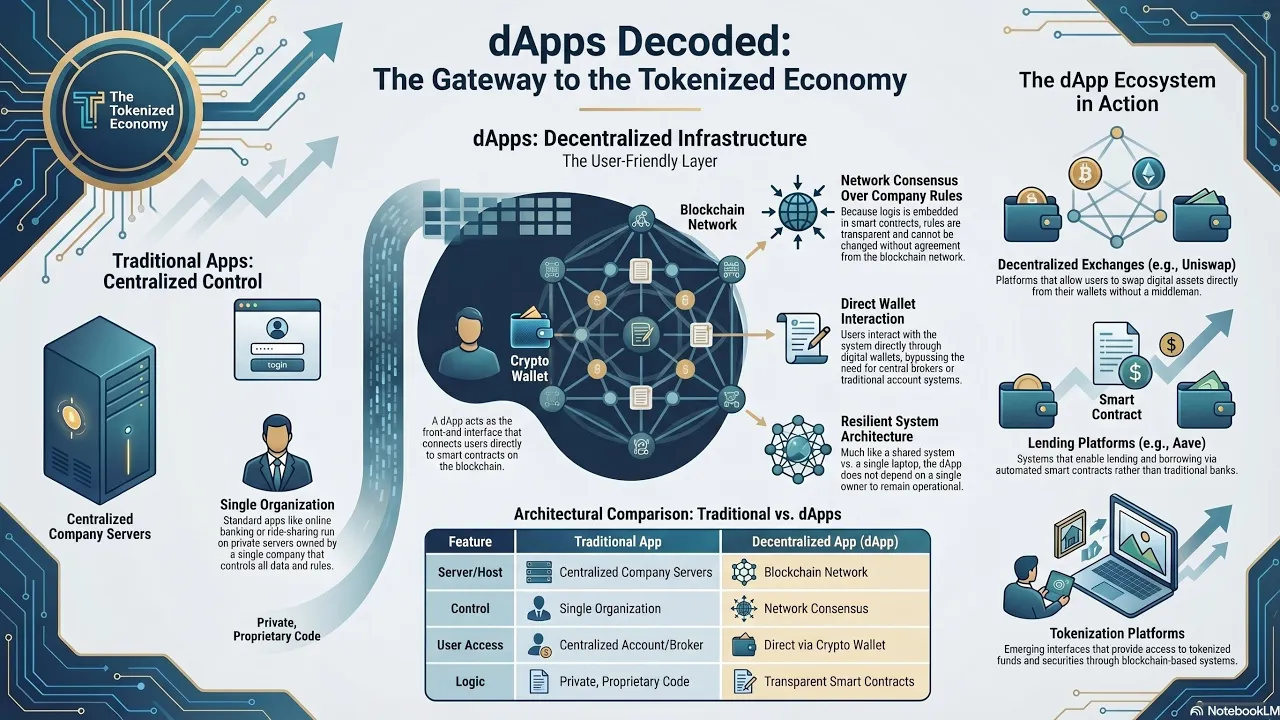
What is a dApp?
165
Decentralized Applications (DApps) are applications that run on global shared blockchain networks instead of servers owned by single companies. Unlike traditional apps controlled by corporations like Google or banks, DApps have no single owner, making them transparent and community-run. They eliminate single points of failure, ensuring continued operation even if individual computers crash. Users interact with DApps through crypto wallets, which serve as digital passports connecting directly to smart contracts without middlemen. Real-world examples include DeFi platforms like Uniswap for asset trading and Aave for lending, which replace traditional financial intermediaries. DApps represent the evolution of blockchain from a secure ledger into a global application platform, serving as building blocks for new digital economies owned and operated by users rather than centralized corporations.
Click to watch →

Introduction aux DApps (Applications Décentralisées) - Feel Summer 3.0 #1
120
DApps are applications built on blockchain technology that offer services from automated financial systems to transparent voting platforms. Unlike traditional apps on centralized servers, DApps operate on decentralized networks with open-source, autonomous functionality and encrypted distributed data. Key advantages include immutability, transparency, and censorship resistance. They use smart contracts for autonomous execution, primarily on blockchains like Ethereum. Uniswap exemplifies DApps as a Decentralized Exchange (DEX) using Automated Market Making (AMM) protocols, enabling peer-to-peer crypto trading without intermediaries. DApps create economic value through transaction fees and rewards, generating continuous cash flows that stabilize and increase associated token values while reducing costs and enhancing security.
Click to watch →

Ethereum Smart Contracts Tutorial | Deploying Smart Contracts | Blockchain Training | Edureka
47.1K
A Decentralized Application (DApp) is a set of smart contracts operating on data stored within those contracts. For an application to qualify as a DApp, it must meet four criteria: be open-sourced, be decentralized, have tokens fueling itself, and generate tokens with an inbuilt consensus mechanism. DApps enable direct interaction between users and providers through organizations called Decentralized Autonomous Organizations (DAOs), which operate without third-party intermediaries.
Click to watch →

16分で学ぶイーサリアムブロックチェーンの仕組み入門 | Dapps開発入門 #01
25K
DApps (Decentralized Applications) are applications that run on the Ethereum network instead of relying on central servers. Traditional web applications connect to a single server, while DApps connect to the distributed network of many computers. A DApp using ERC-20 tokens might have a web interface where users can view token balances by calling the 'balanceOf' function, view token names by calling 'name', and transfer tokens by calling 'transfer'. The web interface sends transactions to the network, and miners execute the smart contract functions to provide results, enabling fully decentralized applications.
Click to watch →
How dApps work?
10K
Decentralized applications (dApps) differ from conventional web apps by executing application logic through smart contracts and storing all persistent data on the blockchain ledger, rather than using traditional back-end servers and databases; to interact with the blockchain, dApps connect to nodes via providers like Infura or Alchemy, and users sign transactions using crypto wallets such as Metamask to write data to the ledger.
Click to watch →
Deep Dive
Blockchain Oracles: Investigating how smart contracts securely interact with and retrieve real-world, off-chain data (e.g., weather, stock prices).

What Is a Blockchain Oracle? What Is the Oracle Problem?
111.9K
A blockchain oracle is a middleware system that connects deterministic blockchains with real-world external data, solving the oracle problem which occurs when smart contracts need to access off-chain data like API calls; since blockchains require consensus and cannot make direct API calls themselves, oracles bridge this gap by securely reporting external data onto the blockchain, but using centralized oracles undermines blockchain's decentralization benefits, which is why decentralized oracle networks like Chainlink are essential for maintaining trustless smart contract execution.
Click to watch →
![[Blockchain Oracle] Bài 1: Blockchain Oracle là gì | What is Blockchain Oracle](https://i.ytimg.com/vi/h1geCBbIAvc/maxresdefault.jpg)
[Blockchain Oracle] Bài 1: Blockchain Oracle là gì | What is Blockchain Oracle
744
A blockchain oracle is a bridge that connects the blockchain network to external data sources, solving the fundamental limitation that blockchains cannot access information outside their own network. Oracles listen to requests from smart contracts, gather and verify information from external sources (such as APIs, hardware devices, or human experts), and deliver this data into the blockchain for use in smart contracts. This technology is essential for applications like price feeds in DeFi, random number generation in games, and real-world data integration, with Chainlink being one of the most widely used oracle networks.
Click to watch →

What Are Blockchain Oracles & How They Actually Work (Animated)
3.1K
Blockchain oracles are intermediary systems that connect smart contracts with external data sources, solving the fundamental limitation that smart contracts cannot access real-world information. There are two main types: input oracles gather data from the real world (like sports results or weather conditions) and send it to smart contracts, while output oracles transmit data from blockchains to real-world systems (like car rental services or banking systems). To prevent manipulation, modern oracle networks like Chainlink use multiple nodes with reputation contracts, order matching, and aggregation contracts to verify and combine data from trusted sources. Practical applications include flight insurance (automatic payouts when flights are delayed) and crop insurance (automatic payments when weather conditions damage crops), demonstrating how oracles enable automated, trustless real-world interactions on blockchains.
Click to watch →

Blockchain oracles: a decentralized reality check
5.5K
Blockchain oracles are decentralized systems that enable smart contracts to access real-world data by randomly selecting isolated participants who verify events and vote on outcomes, with incentives for correct votes and penalties for incorrect ones, thereby bridging the gap between digital blockchains and physical reality.
Click to watch →
Oracles Connect the Dots: Blockchain Meets Reality!
9.8K
Oracles are essential bridges that connect blockchains to real-world data, enabling smart contracts to access external information like stock prices, weather, and sports scores; they power critical Web3 applications including DeFi, NFT marketplaces, and insurance contracts, though they face challenges such as security vulnerabilities, centralization risks, and gas fees, with projections suggesting they will power 80% of smart contracts by 2030.
Click to watch →
Deep Dive
Decentralized Finance (DeFi) and DAOs: Analyzing advanced financial protocols and decentralized governance structures managed entirely by smart contracts.
Intro to Web3 - Change With Decentralization
189
Decentralized Finance (DeFi) encompasses the world of cryptocurrency and financial tools that allow financial freedom and autonomy in a peer-to-peer system without relying on intermediaries like banks. Decentralized Autonomous Organizations (DAOs) are new organizational structures governed by smart contracts (computer code that executes when conditions are met). DAOs allow people to pool assets and resources toward shared missions, with governance voted upon and earnings distributed based on contributions. This creates a more bottom-up, community-driven approach to organization.
Click to watch →

Joel Dietz - Founding Member of Ethereum, Cryptoeconomics & Cyber Futurist Author and Entrepreneur
41K
Decentralized Autonomous Organizations (DAOs) have become the default paradigm for the new DeFi (Decentralized Finance) world. Two years ago, DAOs were seen as interesting novelties, but now hardly any organization is created without some kind of DAO structure in the middle, with real rights and governance mechanisms. Once people experience the control and ability to influence organizations and communities, it's very hard to go back to traditional centralized systems like banks.
Click to watch →

Decentralised Autonomous Organisations
254
DeFi (Decentralized Finance) is essential for DAOs to reach their full potential because it provides the financial infrastructure needed for economic transactions. DeFi makes finance trustless, borderless, transparent, accessible, and composable. When combined with DAOs, DeFi creates new digital corporations that enable economic and financial activities in totally new ways. Without DeFi, DAOs would lack the financial tools necessary for capital formation, lending, borrowing, and other economic activities that traditional organizations perform.
Click to watch →
The System Is Broken. This Is The Solution.
7.9K
DeFi (decentralized finance) has seen explosive growth, with the total value locked in DeFi protocols jumping from $20 billion in 2020 to $100 billion in 2024. This growth is not driven only by crypto-native whales but by regular people—teachers, nurses, freelancers, small business owners—anyone fed up with being denied access to basic financial tools by legacy systems. DAOs (decentralized autonomous organizations) are working experiments with transparent community-led governance. Instead of political parties behind closed doors, DAOs offer open code and collective voting. Projects like MakerDAO and ConstitutionDAO have shown what's possible when people organize with a shared purpose and don't have to ask permission to build.
Click to watch →
META WHALE TACTICS AND STRATEGY T&S BUSINESS PLAN IN HINDI
108
Decentralized Finance (DeFi) represents a new financial paradigm operating on blockchain networks. Decentralized Autonomous Organizations (DAOs) are community-governed entities where members vote on updates and changes. Unlike traditional systems, DAOs allow public participation in decision-making processes, enabling collective governance of digital assets and platforms.
Click to watch →
Deep Dive
Security and Auditing: Studying common smart contract vulnerabilities (like reentrancy attacks) and the best practices for code auditing and optimization.

TIER LIST Materias de Ingeniería
58.4K
Information Security and Auditing is a subject where students learn about various types of viruses, trojans, malware, and phishing. The speaker considers this subject not difficult at all, with multiple-choice partial exams that are very simple. The speaker believes it can be passed without attending classes.
Click to watch →

Cyber Security Introduction
82.6K
SSL/TLS encrypts traffic between browsers and web servers, protecting data in transit. Even internal web applications should use SSL to prevent network sniffing attacks. Let's Encrypt provides free SSL certificates with automatic renewal. Organizations should regularly audit their own systems and attempt to find vulnerabilities—external penetration testers may miss issues because they don't know the infrastructure. Family members using company computers present additional threat vectors, and organizations should consider continuous authentication (webcam-based) to verify user identity and prevent unauthorized access by family members.
Click to watch →

Become an Awe$ome Linux SysAdmin In Under 2 Hours
189.3K
This section covers file permission analysis and security auditing. The find command can search by permission numbers (octal notation) where the first digit represents owner permissions, the second represents group permissions, and the third represents other permissions. The find command can search for files with execute permissions using -perm +x. The find command can combine file type and permission filters for precise searching. The passwd file contains user information including usernames, user IDs, home directories, and default shells. The /etc/group file contains group information including group names, group IDs, and members.
Click to watch →

¡Revelando los Secretos del WiFi! Accede a Cualquier Red con Kali Linux | Hacking Ético"
322.3K
This video demonstrates how to audit WiFi networks using Kali Linux by following three key steps: first, putting a wireless network adapter into monitor mode to capture all packets passing through the network; second, forcing devices to reconnect to capture the encrypted handshake containing the password; and third, using dictionary attacks with wordlists to decrypt the captured handshake and retrieve the WiFi password. The process requires a compatible wireless adapter (such as those with Atheros AR9271 chipsets), Kali Linux installed either natively or in a virtual machine, and understanding of command-line tools like airmon-ng, airodump-ng, aireplay-ng, and aircrack-ng.
Click to watch →
🚀 Node.js 🧑💻 Введение в технологию ✨
71.2K
NPM provides security auditing capabilities through npm audit, which checks installed packages for known vulnerabilities. However, npm audit has limitations as it cannot detect all vulnerabilities, especially in transitive dependencies. Developers should review package repositories, check for active development, and consider reading package code when security is critical.
Click to watch →
Smart Contracts
Smart Contracts
0:00- 1
Smart contracts self-execute agreement terms on blockchain networks.
- 2
Code is immutable and enforces rules automatically without intermediaries.
- 3
They cut costs and boost efficiency across various industries.
The Fallacy of 'Code is Law' and the Reality of Smart Contract Inflexibility
While proponents champion smart contracts as self-executing, trustless agreements, critics argue that the "code is law" paradigm is fundamentally flawed and legally impractical. Unlike traditional contracts, smart contracts are rigidly inflexible and cannot easily accommodate unforeseen circumstances, ambiguity, or mutual renegotiation. A single coding error or exploit can lead to catastrophic, irreversible financial losses with no legal recourse or central authority to undo the damage. Furthermore, smart contracts rely on "oracles" to feed them real-world data, which reintroduces points of centralization, manipulation, and trust. Legal scholars also point out that smart contracts often lack the nuance of human judgment and do not align with established contract law, which relies on intent and equity. Therefore, rather than replacing traditional legal frameworks, critics argue that smart contracts are merely rigid software tools that still require human oversight and traditional legal systems to resolve disputes.
Fundamentals of Blockchain Technology: Understanding distributed ledgers, consensus mechanisms, and how blocks of data are immutably linked.
Basic Cryptography: Knowing how public/private key pairs and digital signatures are used to authorize and secure transactions.
The Concept of Decentralization: Grasping how peer-to-peer networks operate and validate state changes without a central authority.
Traditional Contract Basics: Understanding how standard legal agreements work, including terms, execution, and the role of intermediaries.
Smart Contract Programming Languages: Learning how to write code using languages like Solidity (for Ethereum) or Rust (for Solana).
Decentralized Applications (dApps): Exploring how smart contracts act as the backend logic for user-facing decentralized web applications.
Blockchain Oracles: Investigating how smart contracts securely interact with and retrieve real-world, off-chain data (e.g., weather, stock prices).
Decentralized Finance (DeFi) and DAOs: Analyzing advanced financial protocols and decentralized governance structures managed entirely by smart contracts.
Security and Auditing: Studying common smart contract vulnerabilities (like reentrancy attacks) and the best practices for code auditing and optimization.
832 views2likes1:18@SH3LLH4CK3ROriginal Release: 2023-04-19
what is Smart contract and how does it works a smart contract is a self-executing program that automatically enforces the terms of an agreement between two or more parties it operates on a blockchain network which is a decentralized ledger that records and verifies transactions.the code of a smart contract is stored on the blockchain and can be accessed and executed by anyone on the network smart contracts work by executing predefined rules and conditions encoded in their code when certain events or conditions are met for example a smart contract for a simple payment agreement would automatically transfer funds from one party to another when the specified conditions are met these conditions can include things like the amount of payment the date of payment and the identity of the parties involved once a smart contract is deployed to a blockchain network it becomes immutable meaning it cannot be altered or tampered with this ensures that the terms of the contract will be carried out exactly as they were programmed without the need for intermediaries or third parties smart contracts have the potential to revolutionize many industries by reducing costs increasing efficiency and enabling new types of decentralized applications and business models
Up Next
10:46
Web3 Explained: A New Era of Decentralized Internet Ownership
@mzarrebini
68.1K views•2023-01-24

52:00
Hybrid Key Establishment in Production: Post-Quantum Cryptography
@durumcrustulum
14.7K views•2025-08-27

64:25
Operational Security Essentials: A Guide for Hacktivists (OPSEC)
@hitbsecconf
157.4K views•2012-11-26
11:49
Understanding Ethereum: A Comprehensive Beginner's Overview
@99Bitcoins
3.1M views•2018-06-26
Related Study Plans & Knowledge Roadmaps
Structured learning paths in Blockchain & Crypto
blockchain-and-crypto
MPC Wallets: TSS, DKG & Secure Custody
01Foundations of Cryptography & Digital Signatures
02Secret Sharing & Introduction to MPC
03Distributed Key Generation (DKG)
+ 2 more learning modules
24h5 modules
Explore Roadmap
blockchain-and-crypto
ERC-4626: Yield Aggregators & Leverage
01Blockchain, Ethereum, and Solidity Foundations
02DeFi Primitives: Lending, Pools, and Yield Farming
03Mastering the ERC-4626 Tokenized Vault Standard
+ 3 more learning modules
35h6 modules
Explore Roadmap
blockchain-and-crypto
DePIN: IoT Registries, Proofs & Rewards
01Foundations of Blockchain & IoT
02Introduction to DePIN and the Flywheel Effect
03Designing IoT Device Registries & Secure Identity
+ 3 more learning modules
30h6 modules
Explore Roadmap
blockchain-and-crypto
Building EigenLayer AVS: Operators & Contracts
01Blockchain, Ethereum, and Smart Contract Basics
02Proof of Stake and Ethereum Staking
03Introduction to EigenLayer and Restaking
+ 3 more learning modules
24h6 modules
Explore Roadmap