Slashing is a penalty mechanism in proof-of-stake blockchains that punishes validators for dishonest behavior such as double-signing, going offline, or attacking the network, by burning a portion or all of their staked coins; this economic incentive system ensures validators act honestly and keeps the network secure without requiring massive energy consumption like proof-of-work systems.
Proof-of-Stake Slashing: Punishing Bad Validators in Ethereum
Added:Deep Dive
Understanding the fundamental differences between Proof-of-Work (PoW) and Proof-of-Stake (PoS) consensus mechanisms.

이더리움이 줄어들고 있다 f. 디지털애셋 박근모 기자
36.8K
This segment explains the fundamental difference between Proof of Work (PoW) and Proof of Stake (PoS) consensus mechanisms. In PoW, miners compete to solve computational puzzles, and new coins are created as rewards for successful mining. In PoS, validators are selected based on their stake in the network, and new coins are created as rewards for validation. The key difference is that PoS eliminates the continuous creation of new coins that occurs in PoW. The video explains that this transition from PoW to PoS in Ethereum 2.0 was designed to reduce inflation and create a more sustainable monetary policy.
Click to watch →

Proof of Work VS Proof of Stake - SIMPLIFIED EXPLANATION
506.4K
Proof of Work (PoW) and Proof of Stake (PoS) are two fundamental consensus mechanisms used in blockchain networks to validate transactions and secure the network. In PoW, miners compete to solve complex cryptographic puzzles using computational power, consuming significant energy and hardware resources, with rewards given in new coinage (e.g., 12.5 BTC for Bitcoin). In PoS, validators are selected to create blocks based on their stake size in the network, with rewards coming from transaction fees rather than new coin creation. PoS offers advantages including environmental friendliness, prevention of mining cartels, and making 51% attacks economically impractical, while PoW provides established security through computational difficulty.
Click to watch →

Proof of Work VS Proof of Stake - Объяснение
40.3K
Proof of Work (PoW) and Proof of Stake (PoS) are two fundamental consensus mechanisms in blockchain networks. In PoW, miners compete to solve complex cryptographic puzzles using computational power, with the first to solve it earning a block reward (e.g., 12.5 BTC in Bitcoin, which halves every 4 years). The network adjusts difficulty to ensure blocks are found approximately every 10 minutes, and PoW provides strong security but consumes significant electricity. In contrast, PoS selects validators based on their token holdings rather than computational power, with larger holdings increasing the probability of block creation. Validators earn transaction fees instead of new coins, and PoS offers advantages including lower energy consumption, no incentive to increase computing power, and economic security where attackers risk their own holdings.
Click to watch →

Is Ethereum a sh*t coin? - Bitcoin Maximalist answers | Saifedean Ammous and Lex Fridman
72.8K
Proof of work is the foundational technology that enables digital currency to exist, analogous to the invention of flight. Proof of stake, by contrast, is characterized as a step backward that recreates centralized control systems like the federal reserve. The key distinction is that proof of work is grounded in physics and real-world constraints, while proof of stake is essentially a political system where a small group controls the rules. Proof of stake fraudulently presents itself as decentralized when it is not, and the small group in charge can be corrupted or coerced, making it fundamentally unsuitable for secure value transfer.
Click to watch →

Proof of Work Vs Proof of Stake | PoW और PoS क्या है | CoinSwitch Kuber
33.7K
Proof of Work (PoW) and Proof of Stake (PoS) are two fundamental consensus mechanisms used in blockchain networks to validate transactions and secure the network. In PoW, miners compete to solve complex mathematical puzzles using computational power, with the first to solve it earning rewards; this process is energy-intensive and tends to centralize among those with powerful hardware. In contrast, PoS selects validators based on their staked cryptocurrency holdings, where the algorithm randomly chooses validators proportionally to their stake, making it significantly more energy-efficient (approximately 99% less energy consumption) and more accessible to smaller participants. While PoW has proven effective for securing major cryptocurrencies like Bitcoin, PoS offers advantages in decentralization and sustainability, making it an increasingly popular choice for modern blockchain platforms.
Click to watch →
Deep Dive
The role of a validator in a PoS network, including staking collateral, proposing blocks, and casting attestations.

CredibleCommitments.WTF | Barnabé Monnot - Aligning like a Protocol
144
Validators are first-class protocol operators responsible for maintaining a single view of the Ethereum ledger through proof of stake consensus. To become a validator, participants must deposit 32 ETH into a deposit contract, committing significant capital at risk. Validators perform two critical duties: proposing blocks every 12 seconds (including pending transactions) and providing attestations (voting messages confirming chain state). Rewards include block production rewards, transaction fees from included transactions, and inactivity penalties for offline behavior. Severe faults like proposing conflicting blocks result in slashing penalties that destroy a substantial portion of deposited stake.
Click to watch →

Ethereum - Tutorial 6 - Proof of Stake vs. Proof of Work Explained
537
In the Proof of Stake system, validators are algorithmically chosen by the Beacon chain to propose new blocks (called proposers). Other validators are responsible for checking and confirming these proposed blocks (called attestors). Validators can lose a portion of their stake for going offline or failing to validate, and can lose their entire stake for deliberate malicious behavior. This stake mechanism incentivizes good behavior.
Click to watch →

Run a Node, Be a Validator
428.9K
In Over Protocol's Open Beta Test Net Season 2, users can operate validators by staking 200.56 over tokens per validator, with rewards accumulating once staking exceeds 256 over tokens; validators perform three randomly assigned roles (block attestation, block proposal, and sync committee) to earn rewards, which are distributed in a queue system that may take several days to process, and users must keep their validator phrase secure as it cannot be recovered even by developers.
Click to watch →

Ripple/XRP-The Fed=Crypto Bully,Coinbase Case,Stuart Alderoty,XRP=Preallocation
12.2K
In staking arrangements, the entity that does the work is the validator, who collects assets from clients who want their assets staked for them and updates the ledger using their resources. There is an agreement between a staker submitting their assets to earn yield and a validator using those funds to be awarded staking rewards. The question is whether this arrangement constitutes a security.
Click to watch →

How to Become an Ethereum Validator 💎 Dmitry Gusakov, Lido
1.3K
Validators have three main duties: block proposals, attestations, and sync committee participation. Block proposals involve proposing new blocks to the network when selected by the random selection mechanism. Attestations involve voting on other validators' blocks to help determine the canonical chain. Sync committees are specialized groups that aggregate attestation data to keep the network synchronized efficiently. Each duty is performed at specific intervals and contributes to the overall security and operation of the network.
Click to watch →
Deep Dive
Basic cryptographic concepts used in blockchain networks, specifically public-private key cryptography and digital signatures.

Fundamental Blockchain Concepts and Wallets | Chainlink Bootcamp - Day 1
20.6K
Asymmetric encryption uses mathematically linked key pairs: public keys (shared) and private keys (secret). Messages encrypted with a public key can only be decrypted with the corresponding private key. Digital signatures authenticate senders by: hashing the message, encrypting the hash with the sender's private key, and sending both message and signature. Recipients verify by decrypting with the sender's public key and comparing hashes. This proves both sender identity and message integrity. Never share private keys as they provide complete access to funds.
Click to watch →

END SEM: Blockchain Unit 1 | Last Minute Revision | All Topics in 1 Shot
220
Public key cryptography is the foundation of digital signatures in blockchain. It uses a pair of keys: (1) Private key - kept secret by the owner, used to sign transactions; (2) Public key - shared with others, used to verify signatures. Key properties include: (1) Mathematical relationship - public and private keys are mathematically linked; (2) One-way function - it's easy to derive the public key from the private key but impossible to derive the private key from the public key; (3) Non-repudiation - the sender cannot deny having signed the transaction. This enables secure, trustless transactions in blockchain networks.
Click to watch →

Blockchain: The Revolution will not be televised | Paweł Pinio | TWF Conference 2017
259
Blockchain relies on several cryptographic concepts: (1) Hash functions that take input and produce fixed-length digests, with properties including quick computation, determinism, one-way irreversibility, and collision resistance; (2) Encryption vs hashing - encryption is reversible with keys while hashing is irreversible; (3) Public key cryptography using mathematically related private and public keys; (4) Digital signatures created by encrypting message hashes with private keys, allowing verification with public keys. These cryptographic primitives enable the security and trust properties essential to blockchain technology.
Click to watch →

Intro to Blockchain - BRK3050
4.8K
Blockchain security relies on three core cryptographic primitives. First, cryptographic hash functions create fixed-size digests of arbitrary data with collision resistance - no two different inputs produce the same hash. Second, public key cryptography uses key pairs where the public key encrypts data only the private key can decrypt, enabling secure communication. Third, digital signatures reverse this process: the sender encrypts a data hash with their private key, allowing recipients to verify authenticity using the public key. Together, these mechanisms enable secure, tamper-evident digital transactions that form the foundation of blockchain systems.
Click to watch →

Blockchain ve Web3’e Giriş | Blockchain Başlangıç Bootcampi
1.7K
Public and private key cryptography uses a pair of mathematically related keys for secure communication. The public key can be shared openly and is used to encrypt messages or verify signatures, while the private key must be kept secret and is used to decrypt messages or create signatures. This asymmetric approach is more secure than symmetric encryption because even if the public key is known, it is computationally infeasible to derive the private key. In blockchain, public keys serve as addresses where users can receive funds, while private keys are used to sign transactions and prove ownership.
Click to watch →
Deep Dive
The architecture of Ethereum's consensus layer (formerly the Beacon Chain) and how validator nodes communicate.

Validator Architecture | James He
446
The validator client in Ethereum's consensus layer is responsible for managing validator key stores and performing protocol duties such as block proposal and attestation. The architecture typically includes components like a wallet for key management, a key manager for signing operations, a monitoring service for metrics, a validator service for executing protocol duties, and an RPC service for external API access. The client connects to the beacon node to receive duties and perform signing operations, with key stores stored locally or remotely. The client is designed to be a 'dumb' layer that simply calls beacon node APIs and performs assigned duties, without making protocol-level decisions about incentives or slashing.
Click to watch →

Ethereum 2.0 explained by Justin Drake
3.2K
This section explains the core architecture of Ethereum 2.0's sharding system. The goal is to increase scalability by a factor of 1000 through parallel processing. Validators become participants by depositing 32 ETH into a special contract, replacing proof-of-work mining. The beacon chain generates randomness at regular intervals to fairly select validators and assign them to shards. Each shard has its own state and pool of validators, allowing the system to process transactions in parallel rather than sequentially. Cross-links enable communication between shards, with notary committees validating these connections.
Click to watch →
Ethereum 2.0 Explained By Vitalik Buterin 2022
112.4K
Ethereum 2.0 represents a major upgrade from proof of work to proof of stake, with the beacon chain serving as the central consensus mechanism. The beacon chain manages active validators, tracks their messages, and connects to existing Ethereum 1.0 through a bridge that allows moving ether and assets into shards. Time is divided into six-minute epochs with 64 slots, where blocks are proposed and attested by validators. To participate, users deposit 32 ether into a contract, generating Merkle proofs for the beacon chain. This architecture enables rapid block proposal and agreement while maintaining network security through economic incentives.
Click to watch →
Why BMNR stock NEEDS THIS to happen in order to RALLY!
12.6K
Ethereum operates as a decentralized network running on thousands of computers worldwide, functioning like a distributed computer program. Smart contracts are automated 'if-then' rules that execute transactions without banks or middlemen. Unlike centralized banks that can unilaterally change rules, Ethereum requires majority consensus for any rule changes. Anyone can run a node by installing software, which verifies all transactions from 2015 to present. The software has two parts: a memory section that executes and records transactions, and a referee section that ensures rules are followed. Validator nodes create and approve new blocks, requiring a 32 ETH security deposit. When transactions occur, validators compile them into digital records, check authorization, balance sufficiency, and smart contract execution, then broadcast to other validators. When enough validators confirm correctness, transactions are finalized on the blockchain. If a validator approves invalid transactions or goes offline, they lose their staked ETH through 'slashing.' This creates powerful economic incentives for honest behavior, with honest validators earning 3-4% staking yields. Network security depends on staked ETH distribution: attackers need 33% to stall transactions and 67% to affect outcomes.
Click to watch →

Consensus Specifications | Technical Walkthrough
295
The consensus layer specifications are maintained in a GitHub repository organized by phases (Phase 0, Phase 1, etc.). Each phase contains markdown files that define protocol specifications, serving as the authoritative reference for all Ethereum consensus clients. The Beacon Chain specification is the most critical document, containing Python code that defines types, constants, and entry functions for state transitions. The state transition process involves preparing the pre-state, applying a block, and generating the post-state. This architecture ensures all clients implement the same logic consistently, making the Beacon Chain specification a high-priority area for security research.
Click to watch →
Prerequisite Knowledge
- Concept 01Understanding the fundamental differences between Proof-of-Work (PoW) and Proof-of-Stake (PoS) consensus mechanisms.
- Concept 02The role of a validator in a PoS network, including staking collateral, proposing blocks, and casting attestations.
- Concept 03Basic cryptographic concepts used in blockchain networks, specifically public-private key cryptography and digital signatures.
- Concept 04The architecture of Ethereum's consensus layer (formerly the Beacon Chain) and how validator nodes communicate.
Subsequent Learning
- Step 01The distinction between 'Slashing' (punishment for malicious behavior) and 'Inactivity Leak' (penalties for being offline during network instability).
- Step 02Advanced validator infrastructure design, including Distributed Validator Technology (DVT) and anti-slashing databases to prevent accidental double-signing.
- Step 03The economic security of Ethereum, including the calculation of the 'cost to attack' the network and game-theoretic models of validator behavior.
- Step 04The mechanics of Restaking (e.g., EigenLayer) and how slashing risks propagate when validator collateral is secured across multiple services.
Slashing Basics
Validator Role
Penalty Examples
Economic Security
Attack Deterrence
Network Rules
Automatic Enforcement
Investor Protection
Trust System
Slashing Basics
0:01Playing Section
- 1
Slashing penalizes dishonest validators in proof-of-stake networks.
- 2
Validators lose staked coins for double signing or extended offline periods.
Centralization Risks and Honest-Error Penalties of Strict Slashing
While slashing is intended to secure Proof-of-Stake networks like Ethereum, critics argue that severe penalties create significant centralization risks and unfairly punish honest validators. Maintaining a redundant validator node is technically complex. Simple infrastructure mishaps—such as a backup node accidentally activating and double-signing, or a temporary network partition—can result in devastating financial losses for independent, 'at-home' validators. Because the financial penalty for an honest mistake is so high, individual participants are deterred from running self-hosted nodes. Instead, they are incentivized to outsource their assets to large, centralized staking pools or institutional node operators with specialized risk-mitigation infrastructure. Consequently, strict slashing can inadvertently drive network centralization, undermining the core tenet of blockchain security. Furthermore, alternative PoS designs (such as Cardano) demonstrate that networks can remain secure without slashing principal stakes, relying instead on the forfeiture of future rewards and delegator mobility to disincentivize bad behavior.
Deep Dive
The distinction between 'Slashing' (punishment for malicious behavior) and 'Inactivity Leak' (penalties for being offline during network instability).

Beacon Chain metrics, Scroll mainnet now live & more - The Daily Gwei Refuel #674 - Ethereum Updates
1.8K
There is an important distinction between slashing and inactivity leak in Ethereum's proof of stake consensus. When a validator goes offline, they are not immediately slashed but instead suffer from the inactivity leak, which slowly bleeds out their ETH stake. The inactivity leak is very forgiving - validators can typically get their node back online before they bleed out enough ETH to be kicked out of the active validator set. In contrast, slashing is a severe penalty where validators lose a portion of their stake and are permanently kicked out of the validator set, requiring them to re-enter with a new validator key. The inactivity leak is not a slashing event and is designed to be a gentle penalty for temporary offline periods.
Click to watch →
Spin it up - spin up your own Ethereum validator on testnet | Devcon Bogotá
685
Inactivity leak is a penalty for being offline, where validators lose rewards equal to what they would have earned during their downtime. Slashing is a much harsher penalty (potentially losing the entire 32 ETH bond) for directly attacking the consensus, such as double signing or attempting to change historical blockchain data.
Click to watch →

Merge Community Call #3
745
Inactivity leak occurs when the network isn't finalizing and validators are offline, resulting in severe penalties if offline more than 20% of the time. Slashing is fundamentally different - it's punishment for breaking rules like double-signing, not for being offline. Slashing is very severe, resulting in ejection from the network and loss of stake. Running two validator clients simultaneously is a classic way to get slashed. The merge is triggered by terminal total difficulty on the proof of work side. Once reached, no new blocks can exceed this difficulty, but multiple competing forks can still exist. The beacon chain proposer selects the next block, and two epochs after that, the first post-proof-of-work block gets finalized.
Click to watch →
How to Design DVT While Ensuring Non-Correlation | Devcon Bogotá
434
This section provides a comprehensive explanation of slashing and inactivity penalties in proof of stake networks. Slashing is described as the defense mechanism or immune system of proof of stake networks, designed to punish rule violations and maintain network credibility. Two primary types exist: uncorrelated slashing (predominant on mainnet, where individual validators can lose up to one-eighth of stake) and correlated slashing (catastrophic events where validators can lose all 32 ETH). The critical distinction is made between inactivity penalty and slashing - when a machine goes offline, it is not a slashable offense but simply downtime. However, if a large portion of the network becomes inactive (dropping below 66% uptime), the inactivity penalty mechanism grows progressively larger to rebalance the system. This distinction is crucial for understanding how DVT should be designed to avoid making things worse when trying to make them better.
Click to watch →

Foundations of Blockchains (Lecture 12.20: Pros and Cons of Slashing)
772
Proof of stake Ethereum implements 'inactivity leak' slashing where validators lose stake when the blockchain stalls and stops finalizing new blocks. This is a more aggressive form of slashing because nodes have plausible deniability - they can claim network problems or that other validators are censoring them. The protocol must record votes on chain to detect violations, but this creates risks of honest validators being slashed if other validators deliberately exclude their votes.
Click to watch →
Deep Dive
Advanced validator infrastructure design, including Distributed Validator Technology (DVT) and anti-slashing databases to prevent accidental double-signing.
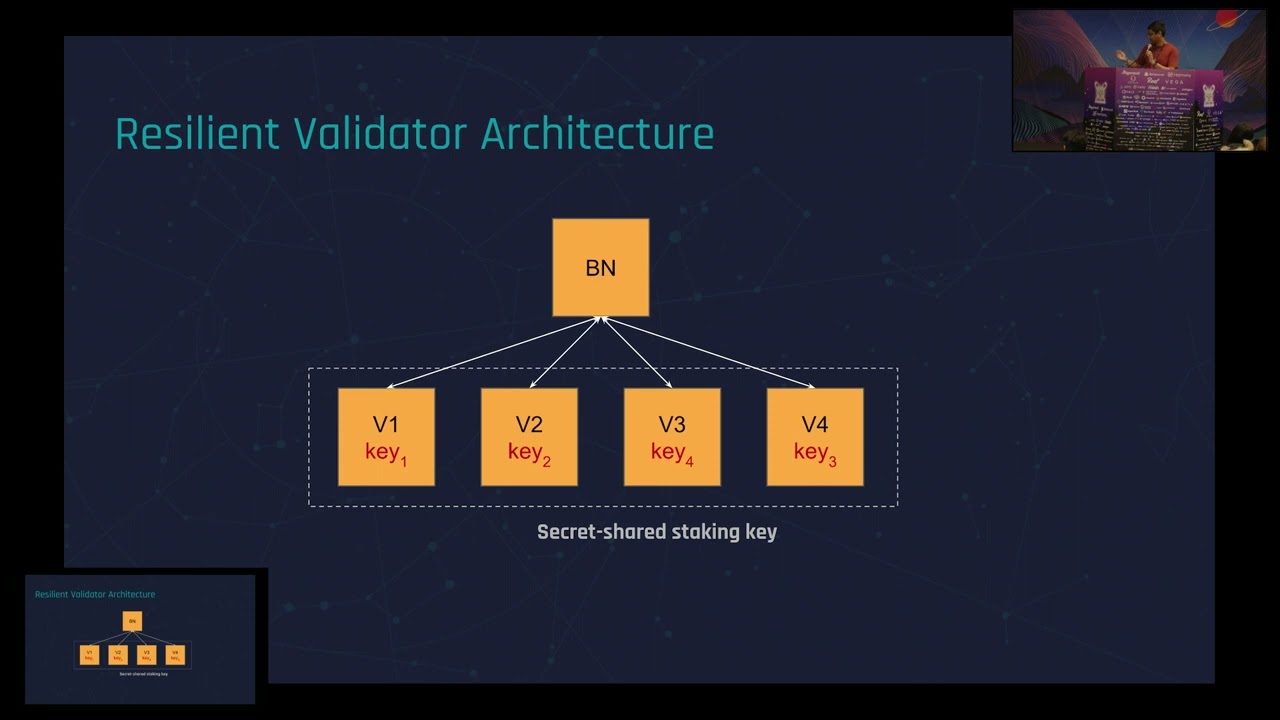
Distributed Validator Technology_Aditya Asgaonkar
956
Modern validator architecture separates the beacon node (P2P interaction, block production) from the validator client (private, holds staking key). The current design has a single point of failure at the validator client. The solution uses a distributed validator middleware between the beacon node and key-holding components. Since normal validator clients don't accept incoming connections, remote signers handle signing requests. The middleware ensures all signing requests undergo consensus among redundant instances. This architecture decentralizes staking infrastructure without protocol changes, as reconstructed signatures from distributed pieces appear identical to single-validator signatures.
Click to watch →
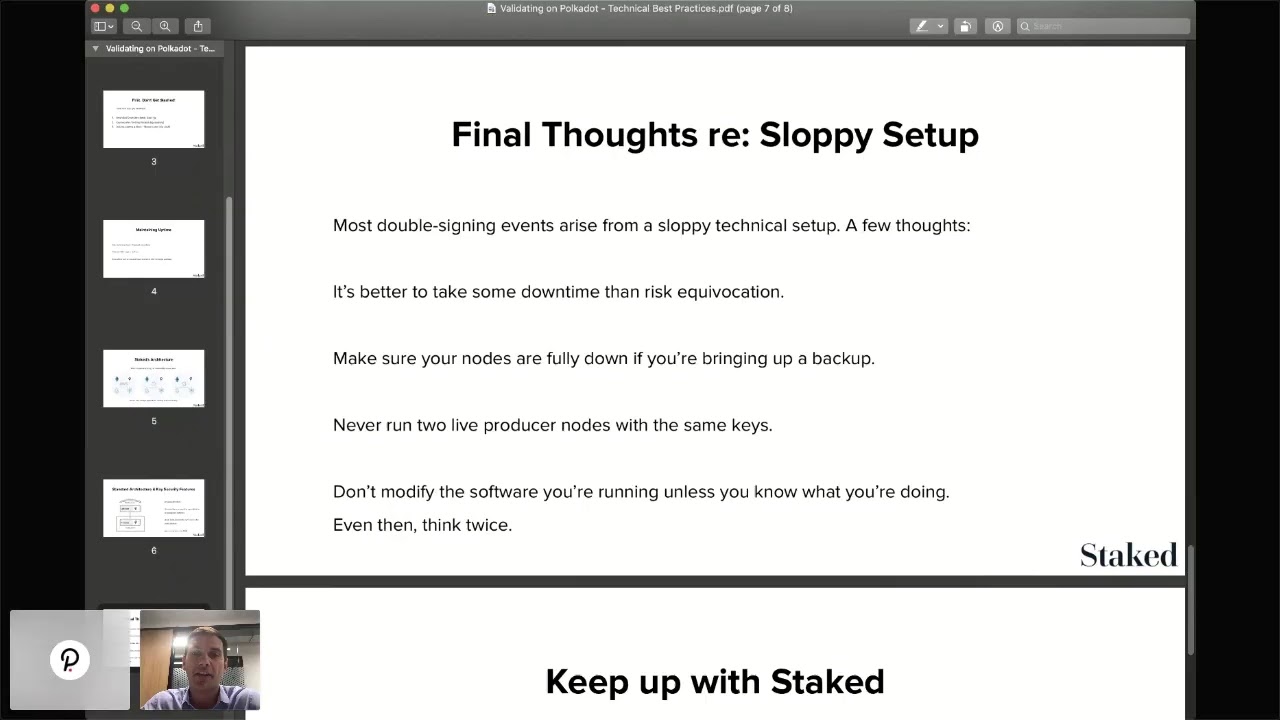
Validating on Polkadot feat. Joe Petrowski, David Drogan, and Tim Ogilvie
565
Robust validator infrastructure requires 2-4 CPU cores, sufficient memory, and archive pruning for full chain data retention. High-stake operators should deploy multiple validator instances across different availability zones and cloud providers to mitigate superlinear slashing risks. Best practice architecture places sentry nodes facing the internet behind bastion hosts, with validators operating in private networks. Defense-in-depth requires both cloud provider and local firewalls, restricting external access to only P2P ports.
Click to watch →

Obol Labs & Bringing Distributed Validator Infrastructure to Ethereum
1.3K
Distributed Validator Technology (DVT) is a cryptographic innovation that transforms blockchain validation by distributing a validator's key shares across multiple machines and enabling groups of people to collectively operate a validator, thereby eliminating single points of failure and shifting validation from 'won't be evil' assumptions to 'can't be evil' cryptographic guarantees; this technology serves as middleware that complements existing Ethereum clients rather than replacing them, and has applications across liquid staking pools, centralized validators, at-home validators, and emerging DeFi use cases, with Obol Labs having deployed the world's first DVT on Ethereum mainnet in December 2022.
Click to watch →
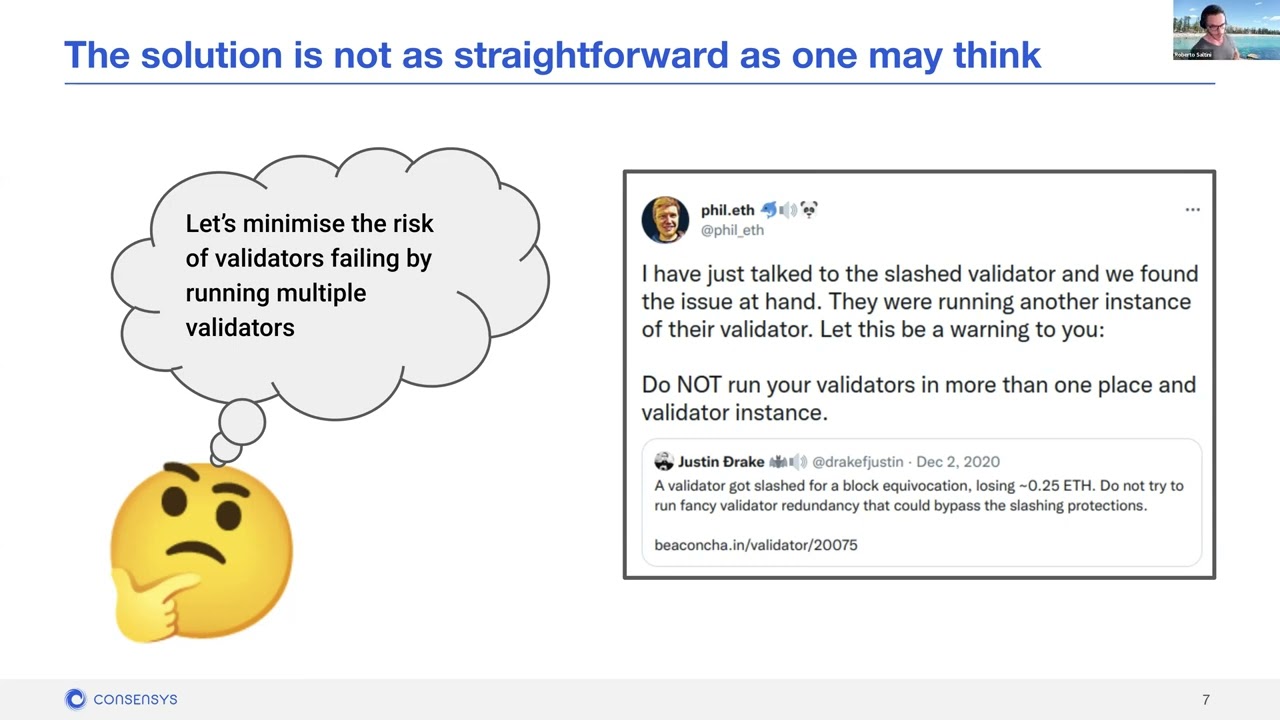
Formal Verification of Distributed Validator Technology
364
Proving DVT safety against slashing requires demonstrating that no two attestations from the same validator can be slashable. The proof uses inductive environments as over-approximations of reachable states, proceeding in three steps: verifying the initial state satisfies the environment, proving the environment is preserved through transitions, and showing the environment implies safety. Key constraints include 3F+1 ≤ N and quorums requiring at least 2N/3 nodes. The core argument shows that any intersection between quorums used to construct different attestations contains at least one honest node, ensuring consistency and preventing slashable violations.
Click to watch →

What's new in Eth2 Edition 99 - 12 August 2022 with Ben Edgington and superphiz
634
A consensus protocol builds reliable distributed systems on unreliable infrastructure. Distributed Validator Technology (DVT) takes this further by allowing a single validator across multiple hardware instances. If one instance fails, others continue validating. BLS signatures enable aggregation, making DVT practical for Ethereum. However, DVT marketing should not diminish solo staking's value.
Click to watch →
Deep Dive
The economic security of Ethereum, including the calculation of the 'cost to attack' the network and game-theoretic models of validator behavior.
Buterin: ataque de 51% ao Ethereum pela Binance custará à exchange US$ 48 bilhões
106
A 51% attack on the Ethereum network would cost approximately $48 billion due to the massive staking volume, making such an attack economically irrational even for large entities like Binance; however, the security architecture should focus on strengthening multiple layers including point-to-point infrastructure, eliminating critical vulnerabilities, and enhancing community coordination capabilities rather than relying solely on economic barriers.
Click to watch →

Der ultimative Blockchain Portfolio Guide 2026
282
Network security depends critically on validator diversity and distribution. Ethereum has 900,000 validators but only ~12,000 unique entities stabilize the network, while Solana has 800 and Tron has 25-45. Client diversity (multiple software implementations) enhances resilience—Ethereum has multiple execution clients (Nethermind, Geth, Besu) and consensus clients (Lighthouse, Prism, Teku, Erigon). A 51% attack requires controlling 50% of network hash power or stake: for Bitcoin, this would require millions of ASIC chips and the Netherlands' electricity supply; for Ethereum, costs reach $33 billion. Slashing mechanisms penalize offline validators, adding security. These attacks are economically infeasible for major chains.
Click to watch →

Ликвидный рестейкинг для Чайников. EigenLayer, Kelp, Renzo, Puffer, EtherFi и другие
2.9K
Proof-of-stake networks like Ethereum maintain security through economic incentives rather than computational power. Validators must stake 32 ETH to participate, and the total staked amount (approximately 29.5 million ETH) creates a massive economic barrier to attacks. A successful double-spend attack would require controlling over 33% of the active validator set, currently estimated at 10 million ETH. This economic model ensures that attacking the network is financially impractical, as the potential losses far exceed any possible gains from successful attacks. The security model relies on the principle that it is more profitable for validators to behave honestly than to attempt attacks.
Click to watch →

Danny Ryan: Ethereum Foundation – An Eth2 Progress Update #393
1.3K
Ethereum 2.0 implements sophisticated economic incentives for validator behavior. Normal penalties apply for missed duties, with offline validators losing approximately 6-12% annually. Severe slashing penalties apply for malicious activities like double-signing, with severity scaling dramatically: isolated incidents result in smaller penalties (around 1/8 of stake), while one-third or more of the validator set engaging in slashable activities results in 100% stake loss. This creates a self-defeating economic model for attackers. The system also includes doppelgänger detection to prevent accidental double-signing from sophisticated multi-machine deployments. This comprehensive incentive structure ensures validator alignment with network security while providing clear disincentives for both individual malice and coordinated attacks.
Click to watch →

Ethereum MAJOR Upgrade | Explained
246.6K
Vitalik Buterin conducted mathematical analysis comparing attack costs across different consensus mechanisms. For proof of work networks, attacking costs approximately $486.75 per dollar earned, making honest participation more profitable than malicious attacks. However, proof of stake offers even stronger security because staked coins do not degrade in value over time like mining equipment does. The calculated cost to attack a proof of stake network is approximately $2,189 per dollar earned, creating a much larger economic disincentive for attackers. This mathematical advantage demonstrates why proof of stake provides superior security guarantees compared to proof of work systems.
Click to watch →
Deep Dive
The mechanics of Restaking (e.g., EigenLayer) and how slashing risks propagate when validator collateral is secured across multiple services.

Restaking, Eigenlayer und die Airdrop Jagd - Chancen & Risiken im Überblick
4.3K
Restaking works through smart contracts where validators deposit ETH into EigenLayer accounts, which then deposit into native Ethereum staking. Validators can use their EigenLayer balance to secure other protocols. If a validator misbehaves or goes offline, their EigenLayer balance gets slashed even though underlying ETH remains in staking. This creates a system where the same capital can secure multiple protocols simultaneously, but also creates correlated risks where problems in one protocol can affect the validator's entire stake across all secured protocols.
Click to watch →
![CRYPTO BILLIONAIRES Are BUYING These ALTCOINS! [NOT CLICKBAIT]](https://i.ytimg.com/vi/EBa0nspjF84/maxresdefault.jpg)
CRYPTO BILLIONAIRES Are BUYING These ALTCOINS! [NOT CLICKBAIT]
27.2K
The video explains the security mechanism of restaking protocols like EigenLayer. When users restake their ETH to secure other protocols (such as Chainlink price feeds or Solana validators), they grant permissions for that value to secure another consensus protocol. If a user acts as a bad actor in the secondary protocol, they get slashed, and the secondary protocol's validators gain rights to the user's staked ETH, which can then be liquidated. This creates a chain of security where one protocol's security can cascade through multiple layers, though the speaker acknowledges concerns about potential chain reactions if multiple protocols fail simultaneously.
Click to watch →

Restaking: DeFi’s New Engine or Risk Time Bomb? | The Debate | Simple Terms Podcast
577
Restaking introduces layered technical risk by extending slashing conditions across four distinct layers: LST issuer, EigenLayer middleware, LRT protocol, and AVS contract. This facilitates rehypothecation - using the same ETH as collateral for multiple obligations simultaneously, multiplying points of failure and correlated failure severity. Low collateral validators (e.g., 4 ETH vs standard 32 ETH) decrease the theoretical minimum attack threshold. The combination of layered complexity and reduced collateral creates vectors that potentially compromise Ethereum's cryptoeconomic assumptions about validator set security.
Click to watch →

Ethereum Restaking and EigenLayer: An Academic Guide
25.4K
Restaking is a DeFi innovation that allows users to repurpose already staked ETH across multiple venues to secure multiple protocols and earn multiple yields simultaneously. EigenLayer, founded by Stefan Cannon (former UW Blockchain Lab director), provides the infrastructure enabling this by creating a pooled security model where Ethereum's $13 billion staked token value secures multiple Application-Specific Validated Services (AVS). This approach is more capital efficient than traditional siloed security models where each protocol must bootstrap its own trust network. The Open Marketplace allows validators to choose which EigenLayer modules to support, creating competition among protocols. However, restaking introduces additional slashing conditions for validators, raising concerns about potential risks to Ethereum's mainnet security.
Click to watch →

BITCOIN CROLLERÀ DOPO L'HALVING e RIPARTIRÀ a MAGGIO | OCCHIO a QUESTA CRYPTO! (la prossima SOLANA?)
24.3K
Restaking introduces new risk dimensions beyond traditional staking. When validators participate in restaking, they become exposed to slashing risks not only from Ethereum but also from the other chains they are securing. This means that a single validator could face penalties from multiple networks simultaneously. The speaker emphasizes that restaking requires careful consideration of these compounded risks, as the security of the entire restaking ecosystem depends on the validator's behavior across all participating networks.
Click to watch →
Slashing Basics
Validator Role
Penalty Examples
Economic Security
Attack Deterrence
Network Rules
Automatic Enforcement
Investor Protection
Trust System
Slashing Basics
0:01- 1
Slashing penalizes dishonest validators in proof-of-stake networks.
- 2
Validators lose staked coins for double signing or extended offline periods.
Centralization Risks and Honest-Error Penalties of Strict Slashing
While slashing is intended to secure Proof-of-Stake networks like Ethereum, critics argue that severe penalties create significant centralization risks and unfairly punish honest validators. Maintaining a redundant validator node is technically complex. Simple infrastructure mishaps—such as a backup node accidentally activating and double-signing, or a temporary network partition—can result in devastating financial losses for independent, 'at-home' validators. Because the financial penalty for an honest mistake is so high, individual participants are deterred from running self-hosted nodes. Instead, they are incentivized to outsource their assets to large, centralized staking pools or institutional node operators with specialized risk-mitigation infrastructure. Consequently, strict slashing can inadvertently drive network centralization, undermining the core tenet of blockchain security. Furthermore, alternative PoS designs (such as Cardano) demonstrate that networks can remain secure without slashing principal stakes, relying instead on the forfeiture of future rewards and delegator mobility to disincentivize bad behavior.
Understanding the fundamental differences between Proof-of-Work (PoW) and Proof-of-Stake (PoS) consensus mechanisms.
The role of a validator in a PoS network, including staking collateral, proposing blocks, and casting attestations.
Basic cryptographic concepts used in blockchain networks, specifically public-private key cryptography and digital signatures.
The architecture of Ethereum's consensus layer (formerly the Beacon Chain) and how validator nodes communicate.
The distinction between 'Slashing' (punishment for malicious behavior) and 'Inactivity Leak' (penalties for being offline during network instability).
Advanced validator infrastructure design, including Distributed Validator Technology (DVT) and anti-slashing databases to prevent accidental double-signing.
The economic security of Ethereum, including the calculation of the 'cost to attack' the network and game-theoretic models of validator behavior.
The mechanics of Restaking (e.g., EigenLayer) and how slashing risks propagate when validator collateral is secured across multiple services.
21.6K views2.6Klikes2:48@CEXIOOriginal Release: 2025-09-09
In proofofstake blockchains, cheating doesn't just fail, it costs you. That's slashing. Slashing is the penalty system that keeps validators honest. When validators double sign, go offline too long, or try to attack the network, they risk losing part of their staked coins. In proof ofstake networks like Ethereum, validators are the backbone of the system. They verify transactions and create new blocks. To become a validator, you need to stake your coins, essentially putting up a security deposit. Here's where it gets serious. This isn't a small fine we're talking about. Slashing can burn thousands, even millions of dollars instantly.
Let's look at some real examples. If a validator signs two conflicting blocks at the same height, what we call double signing, they can lose up to 5% of their stake immediately. That's $1,600 on a standard 32 ETH validator stake. But it can get much worse. If validators coordinate an attack, the penalties scale dramatically. You may have seen cases where entire validator groups lost their complete stakes. That's over $100,000 per validator. The system is designed this way for a reason. Traditional proofof work systems like Bitcoin use massive energy consumption to secure the network. Proof of stake takes a different approach. It uses economic incentives. Think of it like this. If you're guarding a bank, you need skin in the game. Validators don't just earn rewards for good behavior. They risk real financial loss for bad behavior.
The threat of slashing ensures validators keep their nodes secure online and playing by the rules. It's what makes proof of stake resistant to manipulation. Bad actors literally pay for their mistakes. Different networks have different slashing conditions. Ethereum slashes for double signing and going offline for extended periods. Other networks like Cosmos add penalties for governance misbehavior or failing to participate in consensus. The beauty of this system is its automaticity. There's no committee deciding punishments. The protocol itself detects violations and applies penalties immediately. This removes human bias and political considerations.
But here's what you may not realize. Slashing protects your investments, too. When you hold tokens on a proofofstake network, you can trust that validators have real incentives to act honestly. It's an elegant solution to trust. You can make dishonesty more expensive than honesty. In short, staking rewards the honest and slashing punishes the dishonest. This creates a system where you can profit most by keeping everyone secure. So next time you see staking APR, remember you can earn rewards, but only with responsibility. Validators earn because they risk real money and that's what keeps your assets safe. Join us and reach your next crypto level.
Up Next

7:33
Liquid Staking and Restaking Explained: LSTs and LRTs
@WhiteboardCrypto
40.6K views•2024-04-26

52:00
Hybrid Key Establishment in Production: Post-Quantum Cryptography
@durumcrustulum
14.7K views•2025-08-27

64:25
Operational Security Essentials: A Guide for Hacktivists (OPSEC)
@hitbsecconf
157.4K views•2012-11-26

11:49
Understanding Ethereum: A Comprehensive Beginner's Overview
@99Bitcoins
3.1M views•2018-06-26
Related Study Plans & Knowledge Roadmaps
Structured learning paths in Blockchain & Crypto
blockchain-and-crypto
MPC Wallets: TSS, DKG & Secure Custody
01Foundations of Cryptography & Digital Signatures
02Secret Sharing & Introduction to MPC
03Distributed Key Generation (DKG)
+ 2 more learning modules
24h5 modules
Explore Roadmap
blockchain-and-crypto
ERC-4626: Yield Aggregators & Leverage
01Blockchain, Ethereum, and Solidity Foundations
02DeFi Primitives: Lending, Pools, and Yield Farming
03Mastering the ERC-4626 Tokenized Vault Standard
+ 3 more learning modules
35h6 modules
Explore Roadmap
blockchain-and-crypto
DePIN: IoT Registries, Proofs & Rewards
01Foundations of Blockchain & IoT
02Introduction to DePIN and the Flywheel Effect
03Designing IoT Device Registries & Secure Identity
+ 3 more learning modules
30h6 modules
Explore Roadmap
blockchain-and-crypto
Building EigenLayer AVS: Operators & Contracts
01Blockchain, Ethereum, and Smart Contract Basics
02Proof of Stake and Ethereum Staking
03Introduction to EigenLayer and Restaking
+ 3 more learning modules
24h6 modules
Explore Roadmap