Secure aggregation in federated learning protects user privacy by allowing only the server to see the aggregate model while keeping individual client updates completely private; clients add cryptographic masks to their local model updates, making them indistinguishable from random sequences, and the server can only unmask the final aggregated result using protocols like PLUS or Lifestyle-GAG.
Secure Aggregation in Flower: Salvia+ Protocols for Federated Learning
Added:Deep Dive
Fundamentals of Federated Learning, including local training, model updates, and standard aggregation algorithms like FedAvg.

Flower AMA: Pre-training 7B LLMs made easy with Flower
210
This comprehensive section covers federated learning theory, algorithms, and system design for distributed model training. Federated learning preserves data privacy by keeping training data local to each client device, with only model parameters exchanged. FedAvg (Federated Averaging) is the standard algorithm where clients perform local optimization then send updated parameters to a central server that aggregates them by averaging. Key insight: FedAvg is mathematically equivalent to performing global stochastic gradient descent on the federated problem formulation, enabling extension of momentum-based optimizers like Adam to the federated setting using pseudo gradients derived from parameter differences. The system can be framed in three complementary ways: Empirical Risk Minimization (treating all clients' data as a combined dataset), Multi-task Learning (viewing each client's data as a separate task with regularization), and Meta-Learning (treating each client as a distinct task and learning how to adapt quickly to new data distributions). Communication efficiency is achieved by performing multiple local optimization steps between communication rounds, unlike centralized distributed training requiring frequent gradient aggregation after each mini-batch.
Click to watch →
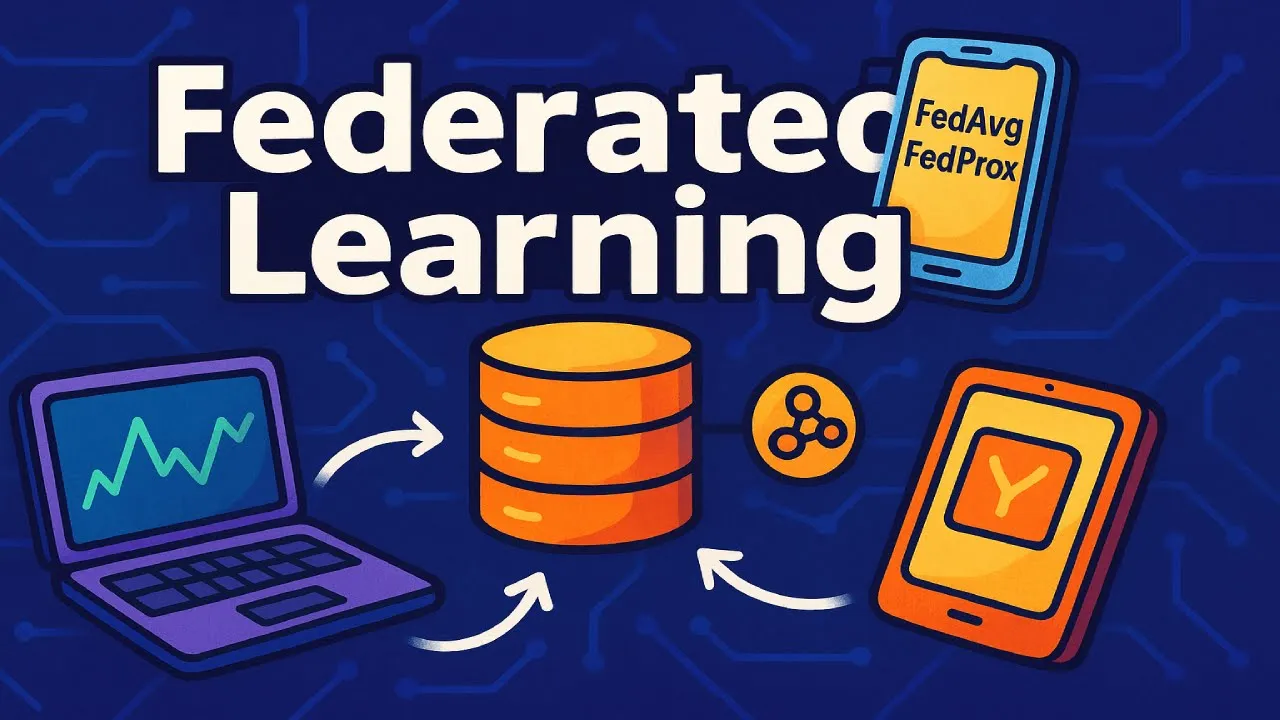
Hands-on 13: Building Federated Learning with FedAvg, FedProx, FedDANE & FedSGD
3.4K
Federated learning trains machine learning models directly on distributed devices (smartphones, edge sensors) without centralizing data. The core workflow involves: (1) partitioning datasets into client-specific slices, (2) local training on private data, (3) sending only model updates to a central server, and (4) server aggregation. Four key algorithms are implemented: FedAvg (averages client model weights proportionally to data size), FedSGD (averages gradients after single batch), FedDANE (solves local sub-problem approximating Newton step with quadratic terms), and FedProx (extends FedAvg with proximal term to penalize deviations and reduce client drift). Core hyperparameters include algorithm selection, number of clients, communication rounds, local epochs, sampling fraction, learning rates, batch size, and device configuration. Two fundamental aggregation approaches exist: model averaging (stacking and averaging weight tensors) and gradient averaging (stacking and averaging gradient vectors). Gradient averaging enables sophisticated server-side optimization strategies like momentum or adaptive optimizers but may amplify noise with skewed data distributions.
Click to watch →
![[deep learning] Federated Learning - training on decentralized data](https://i.ytimg.com/vi_webp/KxZXhzfDgik/maxresdefault.webp)
[deep learning] Federated Learning - training on decentralized data
11.5K
Federated learning is a privacy-preserving machine learning approach where model training occurs on decentralized devices (such as mobile phones) rather than on a central server, with devices sending only model parameters (weights and biases) to the server for aggregation rather than raw data; this method uses algorithms like Federated Stochastic Gradient Descent (Federated SGD) and Federated Averaging (FedAvg), where FedAvg achieves better communication efficiency and faster convergence by allowing devices to perform multiple local training iterations before sending aggregated updates to the server.
Click to watch →
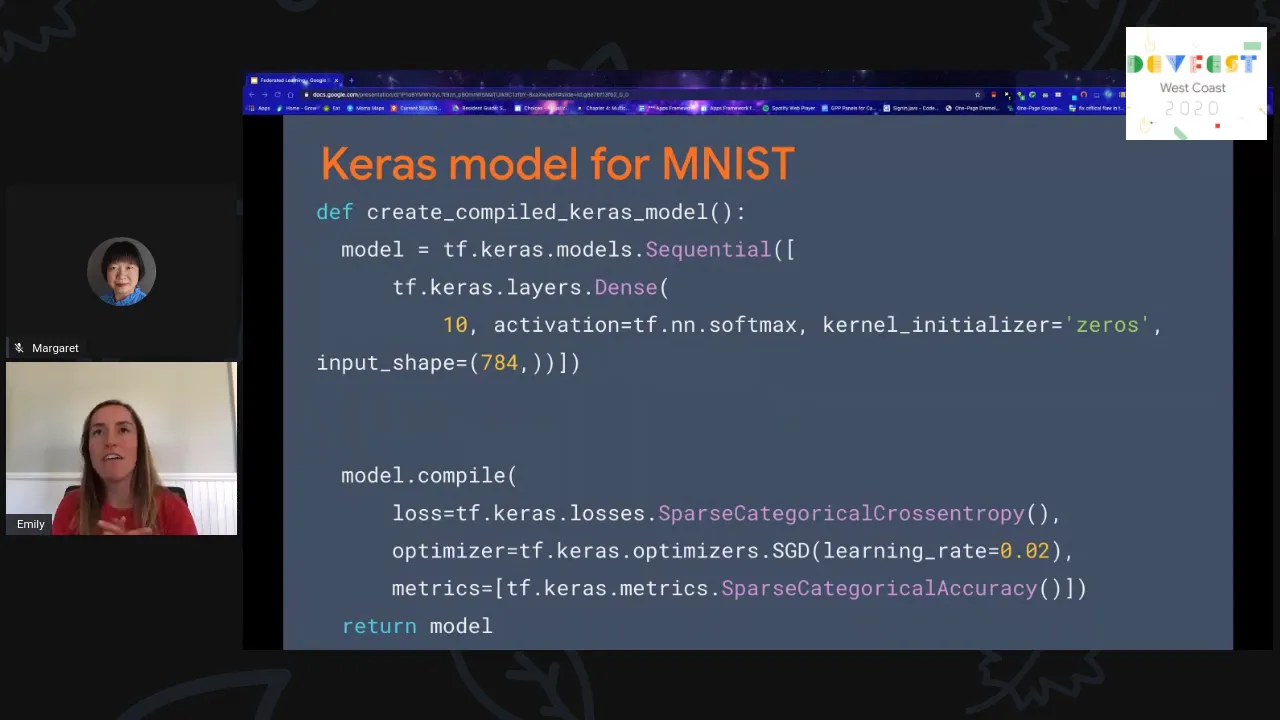
Federated Learning with TensorFlow Federated
12.6K
Federated learning is a privacy-preserving machine learning paradigm where multiple edge devices collaboratively train a shared model under the coordination of a central server, without exchanging raw training data; instead, each device trains a local model using its own data and only shares model updates (gradients or parameters) with the server, which aggregates these updates to improve the global model, enabling collaborative learning across decentralized data sources like smartphones while maintaining data privacy.
Click to watch →

CS-E4740 Guest Talk from Javier Fernandez-Marques (Flower Labs)
446
A typical Federated Learning pipeline consists of five stages: (1) Global Model Initialization - a model starts on the server, either randomly initialized or pre-trained; (2) Client Sampling - devices or institutions that want to participate are sampled; (3) Local Training - sampled clients receive the model and train it locally using their own data; (4) Model Upload - clients send their updated models (not data) to the server; (5) Aggregation - the server combines all received models into a new global model. FedAvg (Federated Averaging) is the standard aggregation mechanism, taking the element-wise average of all models received from clients. This process repeats for multiple rounds until the model converges.
Click to watch →
Deep Dive
Basic cryptographic concepts such as Secure Multi-Party Computation (SMPC), Secret Sharing Schemes, and Homomorphic Encryption.
![[Cryptography Meetup] A crash course on Secure Multiparty Computation (MPC)](https://i.ytimg.com/vi_webp/HOqv5xzrlFI/maxresdefault.webp)
[Cryptography Meetup] A crash course on Secure Multiparty Computation (MPC)
21.1K
Shamir secret sharing encodes secrets as polynomials where any t+1 shares reconstruct the secret. With n=3 and t=1, each party holds one point on a line; knowing one point reveals nothing, but two points reveal everything. Addition works by summing shares. Multiplication requires a protocol: parties multiply their shares, secret-share intermediates, then compute linear combinations using Lagrange coefficients to obtain product shares. This enables multi-party computation for any number of parties under honest majority. The protocol achieves perfect security with passive adversaries and can be extended to active adversaries with additional mechanisms. This threshold approach generalizes to distributed storage and other applications beyond secure computation.
Click to watch →
![[7B] Multiparty Homomorphic Encryption from Ring-Learning-With-Errors](https://i.ytimg.com/vi/x0MXA8zL-Q8/maxresdefault.jpg)
[7B] Multiparty Homomorphic Encryption from Ring-Learning-With-Errors
1.2K
Secure Multiparty Computation (MPC) enables n parties to compute functions of joint inputs without revealing more than the final output, assuming a passive adversary can observe communications and corrupt up to n-1 parties. Traditional MPC solutions use linear secret sharing schemes with offline-online phases generating multiplication triples. Multiparty Homomorphic Encryption (MH) offers an alternative approach using four procedures: key generation, encryption, evaluation supporting arithmetic operations, and decryption. MH schemes enable non-interactive evaluation phases but historically suffered from inverted CPU-network cost trade-offs. Recent advances with BGV and CKKS schemes, along with actively maintained libraries and standardization efforts, have made MH-based MPC more practical for real-world privacy-preserving applications.
Click to watch →
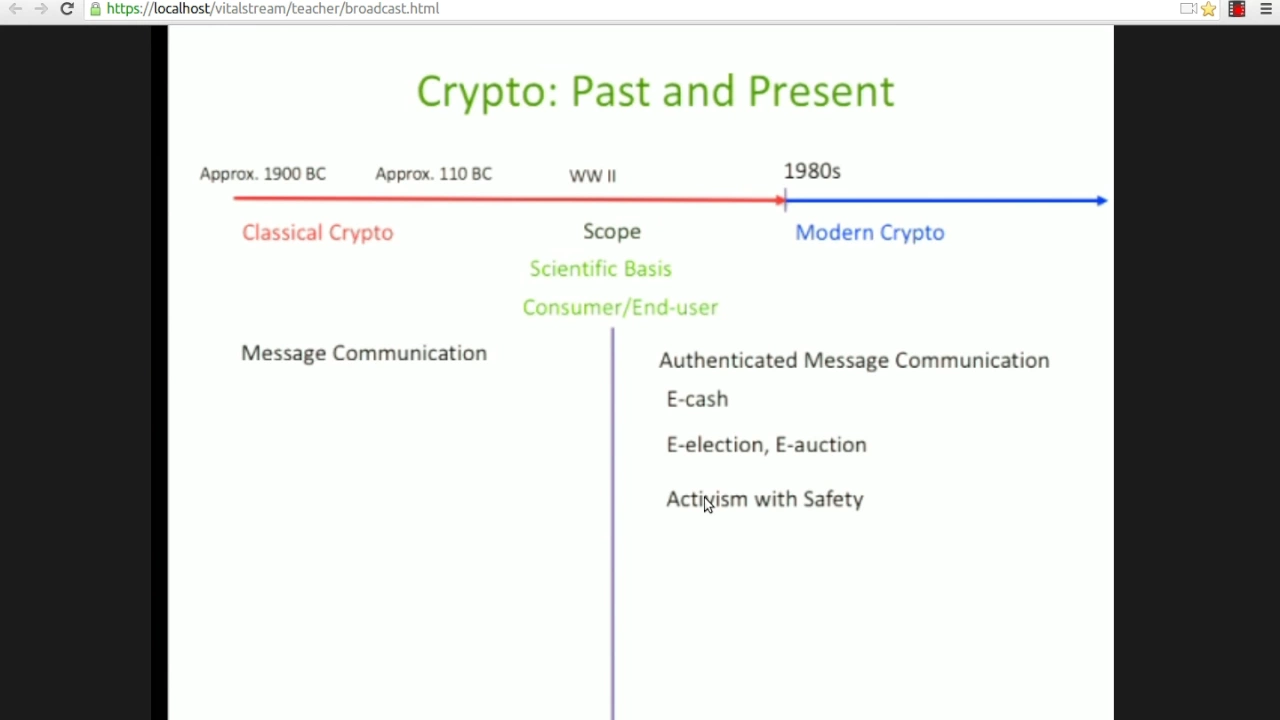
The Joy of Cryptography | Arpita Patra| CSAUSS17
2K
In the information age, individuals and organizations have enormous sensitive data including bank details, biometric information, and personal records. This data often needs computation while remaining private. The Secure Multi-Party Computation (MPC) problem involves n distrustful parties, each with private inputs, computing a common function f while ensuring correctness and privacy (nothing more than the output should be leaked). The trusted third party solution creates single points of failure, motivating the need for MPC without trusted parties. For any polynomially computable function, there is a corresponding circuit representation. Key building blocks include: circuit garbling (evaluating circuits on encoded inputs revealing only output), oblivious transfer (sender sends two messages while receiver chooses one without revealing choice), secret sharing (distributing secrets among parties), Byzantine agreement (honest parties agree despite corrupted parties), and message transmission. OT is complete for MPC, meaning any MPC protocol can be built from OT.
Click to watch →

Lecture 7a - Secure Multiparty Computation, Oblivious Transfer and Garbled Circuits
449
Secure Multi-Party Computation (SMPC) enables distributed parties to jointly compute functions over private inputs without revealing those inputs. Three adversarial models exist: semi-honest parties follow protocols but try to infer secrets, malicious parties actively deviate, and colluding parties form alliances. Secret sharing ensures coalitions of up to k-1 adversaries cannot recover private values. SMPC eliminates the need for trusted third parties by using cryptographic protocols, enabling privacy-preserving machine learning and collaborative computation without central trust assumptions.
Click to watch →

Yifan Song: Malicious Security Comes Free in Honest-Majority Multiparty Computation
423
Secure Multi-Party Computation (MPC) enables multiple parties with private inputs to jointly compute a function without revealing their individual data. The ideal scenario involves a trusted third party collecting all data, computing the function, and distributing results. Since such trusted parties aren't always available, MPC protocols emulate this functionality through secure interactions. Functions are represented as arithmetic circuits over finite fields, supporting addition and multiplication operations. Security is measured across three dimensions: adversary behavior (semi-honest vs malicious), security basis (computational vs unconditional), and corruption threshold (honest majority vs dishonest majority). Shamir's secret sharing scheme forms the mathematical foundation, enabling secrets to be shared among parties such that any t+1 shares reconstruct the secret while any t shares reveal nothing. Critical homomorphic properties allow distributed computation: adding two degree-t sharings produces a degree-t sharing of the sum, and multiplying two degree-t sharings produces a degree-2t sharing of the product.
Click to watch →
Deep Dive
Privacy risks in distributed machine learning, specifically gradient leakage and reconstruction attacks on client updates.

EfficientML.ai Lecture 19: On-Device Training and Transfer Learning (MIT 6.5940, Fall 2023, Zoom)
1.6K
This section examines security vulnerabilities in federated learning systems. Despite the promise of keeping data local, sharing gradients between devices can actually leak sensitive training information. Gradient leakage attacks demonstrate that by observing gradients, attackers can reconstruct original input images or text through iterative gradient matching techniques. The attack works by initializing random inputs and labels, then adjusting them to match observed gradients until recovering the true training data. This reveals fundamental privacy risks in gradient-based collaborative learning approaches.
Click to watch →

15. Wireless for Machine Learning (with Carlo Fischione)
114
Distributed machine learning faces complex security and privacy challenges including: (1) Gradient leakage where model updates may reveal training data information, (2) Poisoning attacks where malicious devices inject false updates to corrupt the learning model, (3) Difficulty distinguishing intentional misbehavior from genuine unique observations. Addressing these requires interdisciplinary approaches combining cryptography, differential privacy, and information-theoretic secrecy.
Click to watch →

MBZUAI AI Quorum - SlowDNN - Qi Lei
145
This comprehensive section establishes the foundational context for understanding privacy vulnerabilities in machine learning. The speaker introduces three main attack categories: integrity attacks that mislead models on specific inputs, availability attacks (poisoning) that modify training data to degrade performance, and privacy attacks that allow adversaries to infer information about user data. The focus narrows to privacy attacks, which threaten confidentiality and undermine trust in real-world deployment. The section introduces the federated learning framework proposed by McMahan et al. in 2016, where data remains on local client devices and only model updates (gradients) are transmitted to a parameter server. The fundamental question posed is whether this design actually protects privacy or if gradients reveal information about training data. The section distinguishes between membership inference attacks (determining if specific data points were in training) and reconstruction attacks (recovering actual training samples), establishing that reconstruction attacks are stronger as they inherently include membership inference capabilities. The speaker distinguishes between statistical identifiability (whether gradient information is theoretically sufficient to identify training samples given infinite computational power) and practical identifiability (whether efficient algorithms exist to recover samples). Previous empirical work led to beliefs that gradients alone are insufficient for reconstruction, particularly at random initialization or well-trained models, but these findings were based on gradient matching algorithm failures rather than theoretical analysis. The section then analyzes activation functions: with linear activations, the gradient is a rank-1 matrix representing a linear combination of training samples, allowing only directional information but not individual samples. With quadratic activations, the gradient reveals the second moment (x_i * x_i^T), enabling recovery of the data span but not individual samples due to non-unique matrix decomposition. Both cases demonstrate that these activation functions fundamentally lack the information necessary for reconstruction, regardless of computational power. Shepp's Lemma provides a mathematical method to extract higher-order moments from gradient queries by using random Gaussian initializations. The attacker queries gradients at random Gaussian weights, then applies Shepp's Lemma to extract the third-order tensor representing the third moment of the data. Tensor decomposition then uniquely identifies individual training samples from this tensor, provided they are linearly independent. The section presents an efficient two-step reconstruction algorithm: first, second-order tensor decomposition estimates the span of training data, requiring M to scale linearly with dimension D; second, third-order tensor decomposition on the projected data recovers individual samples. The reconstruction error is bounded by √(D/M), showing that quality improves with more hidden nodes and decreases with higher data dimension. This practical approach reduces computational complexity from D^3 to D, making the attack feasible for high-dimensional data while maintaining theoretical guarantees.
Click to watch →
![[ICASSP’23] Speech Privacy Leakage from Shared Gradients in Distributed Learning](https://i.ytimg.com/vi/7ConSX5tZ-I/maxresdefault.jpg)
[ICASSP’23] Speech Privacy Leakage from Shared Gradients in Distributed Learning
126
Distributed learning, while offering privacy benefits by allowing data holders to retain private data and only share gradients, still faces significant privacy risks; research demonstrates that speech data can be reconstructed from shared gradients, with Mel spectrogram reconstruction preserving speaker biometrics (over 90% verification success rate) while MFCC reconstruction shows higher distortion due to its decibel scale and high variance, revealing that gradient leakage attacks can expose sensitive personal information in speech recordings.
Click to watch →

코센브릿지포럼 4회 인공지능 2차 정강수
205
This section covers privacy risks in machine learning systems. Model inversion attacks allow attackers to reconstruct training data by querying model outputs, as demonstrated with facial recognition systems. Federated learning addresses these risks by keeping raw data local and only sharing model parameters. However, Deep Leakage from Gradients (DLG) attack shows that even model parameters can leak training data through gradient observations. This attack iteratively reconstructs original data from gradient updates, demonstrating that federated learning alone does not guarantee privacy protection.
Click to watch →
Deep Dive
Familiarity with the Flower (flwr) framework architecture, including Client-Server communication mechanisms.
CS-E4740 Guest Talk from Javier Fernandez-Marques (Flower Labs)
446
The Flower framework consists of two key components: (1) Server - handles client sampling, model distribution, and aggregation; (2) Client - implements fit() for local training and evaluate() for model evaluation. Flower is framework-agnostic, supporting PyTorch, TensorFlow, and even non-ML tools like pandas or XGBoost. The server strategy defines how clients are sampled, how models are sent, and how aggregation is performed. The client API is lightweight, requiring only implementation of fit() and evaluate() methods. This design allows developers to adapt existing centralized training code for FL by placing it in the fit() method, making FL accessible to practitioners familiar with standard machine learning workflows.
Click to watch →

Flower Tutorial | Federated Learning Quickstart with Flower and TensorFlow
13.4K
This section covers creating a server.py file and implementing the server-side logic. The server is started using `flwr.server.start_server()` with an address of 0.0.0.0 to accept connections from any local network interface. The client connects using `flwr.client.start_numpy_client()` with the server address. The federation workflow begins with the server initializing global parameters, requesting initial weights from a random client if none exist, then proceeding through training rounds where clients receive weights, perform local training/evaluation, and return results for aggregation.
Click to watch →

Dr. Chong Shen Ng - Federated Learning Made Simple: A Beginner’s Guide with Flower
336
This section provides hands-on technical guidance for implementing federated learning with Flower. The Flower CLI offers five essential commands: flower new generates boilerplate code from templates, flower run executes federated learning workloads, flower log tracks progress, flower listen monitors running processes, and flower stop terminates training. The generated project structure includes client and server applications, task definitions, and configuration files. The internal architecture reveals how the server initializes global model parameters and defines aggregation strategies (such as federated averaging), while the client loads local data and implements the Flower Client class for model training and weight return. Both components operate within subprocesses coordinated by the superlink and supernodes, enabling secure, distributed model training across heterogeneous environments.
Click to watch →

Understanding Flower Apps: ClientApp and ServerApp in Federated AI Simulations
6.5K
In the Flower framework for federated learning, the ServerApp and ClientApp are fundamental components that work together to enable collaborative model training across distributed clients. The ServerApp uses a strategy (such as FedAvg) to sample clients, distribute the global model, aggregate local updates through weighted averaging, and coordinate training rounds. The ClientApp loads local data, applies global model parameters via set_weights, performs local training using standard ML loops, and returns updated parameters along with metrics. Data partitioning can be customized using different partitioners like IID or Dirichlet to simulate various real-world data distribution scenarios, with lower alpha values creating more heterogeneous (non-IID) distributions that better reflect practical federated learning challenges.
Click to watch →

Client–Server Communication using Fetch API calling Flask Backend | Full Stack Tutorial.
568
Client-server communication is the backbone of web applications where clients send requests to servers and receive responses. Flask is a Python web framework that handles this communication. To set up Flask, create a server folder, install Flask using pip, and create a Flask application object using Flask(__name__). The framework manages routing, request handling, and response generation, making it suitable for building web APIs.
Click to watch →
Prerequisite Knowledge
- Concept 01Fundamentals of Federated Learning, including local training, model updates, and standard aggregation algorithms like FedAvg.
- Concept 02Basic cryptographic concepts such as Secure Multi-Party Computation (SMPC), Secret Sharing Schemes, and Homomorphic Encryption.
- Concept 03Privacy risks in distributed machine learning, specifically gradient leakage and reconstruction attacks on client updates.
- Concept 04Familiarity with the Flower (flwr) framework architecture, including Client-Server communication mechanisms.
Subsequent Learning
- Step 01Integrating Secure Aggregation with Differential Privacy (DP) to guarantee privacy against both the server and the final global model.
- Step 02Evaluating the communication and computational overhead trade-offs of SOTA protocols like Salvia+ on resource-constrained edge devices.
- Step 03Byzantine-robust federated learning and how to detect malicious model poisoning attacks when updates are hidden by secure aggregation.
- Step 04Real-world deployment strategies for Flower in production environments, including secure key management and network orchestration.
Privacy Threats
Flower Protocols
Privacy Threats
0:00Playing Section
- 1
Inference attacks reveal user data from model updates.
- 2
Passive attacks reconstruct private details invisibly.
- 3
Secure aggregation limits server to aggregate models only.
The Privacy-Robustness Trade-off and Resource Overhead of Cryptographic Secure Aggregation
While secure aggregation protocols like Salvia+ protect client privacy by concealing individual updates, they introduce critical trade-offs in system robustness and resource overhead. First, hiding individual updates prevents the central server from inspecting data for malicious activity. This makes the system highly vulnerable to model poisoning attacks and Byzantine faults, as anomalous updates cannot be audited or filtered. Second, cryptographic secure aggregation imposes significant computational and communication overhead on clients. Even optimized protocols require complex key agreements and multi-round secret sharing. For resource-constrained edge devices, this overhead can drastically increase latency and battery consumption, prompting researchers to advocate for alternative paradigms like Local Differential Privacy (LDP) or hardware-assisted Trusted Execution Environments (TEEs) which can offer privacy without the same cryptographic complexity.
Deep Dive
Integrating Secure Aggregation with Differential Privacy (DP) to guarantee privacy against both the server and the final global model.

EIFFeL: Ensuring Integrity for Federated Learning
509
An interesting future direction is integrating differential privacy (DP) with Eiffel to address potential privacy leaks in the aggregated result itself. While secure aggregation masks individual client updates, the final aggregated value revealed in clear text could potentially leak sensitive user information. To address this, clients can add shares of suitable noise (such as discrete Gaussian noise) to their aggregate shares after the proof verification stage. The server then computes a noisy aggregate that satisfies differential privacy guarantees. This extension works by having clients contribute noise shares that are combined during aggregation, ensuring that the final result provides privacy protection for individual contributions. Research by Google's team has explored determining the appropriate amount of discrete Gaussian noise needed to achieve compatibility with secure aggregation schemes.
Click to watch →

FLOW Seminar #100: Amrita Roy Chowdhury (UC San Diego) Ensuring Integrity for Federated Learning
433
Differential privacy can be integrated with Eiffel to enhance data privacy protection. While secure aggregation reveals the aggregate in clear text, this aggregate itself may leak sensitive information. To address this, clients can add shares of suitable noise (such as discrete Gaussian noise) to their aggregate shares after proof verification. The final aggregate computed by the server will then be noisy, satisfying differential privacy guarantees. This integration also provides additional robustness against poisoning attacks, as the noise injection makes it harder for adversaries to manipulate the aggregate.
Click to watch →
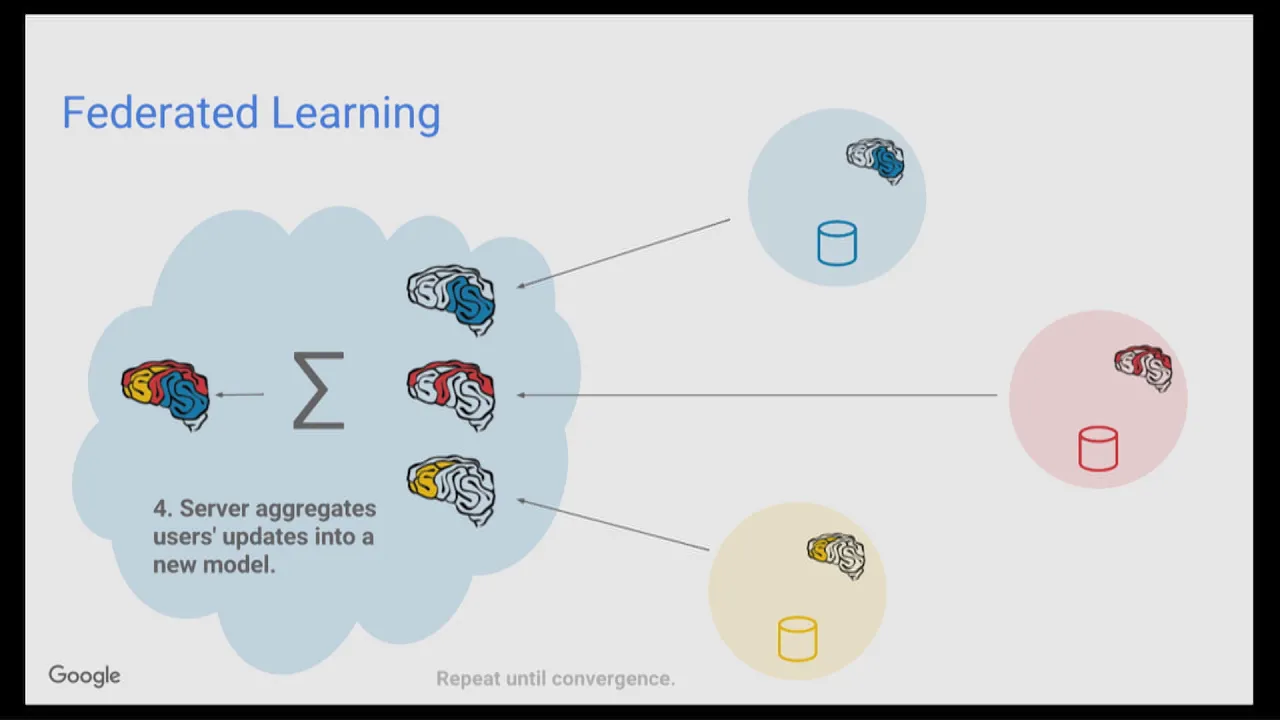
Federated Learning & Differential Privacy for Mobile ML
17.1K
Federated learning provides inherent privacy benefits through data decentralization, but model updates still risk exposing sensitive information. Differential privacy formally protects user privacy by adding calibrated Gaussian noise to aggregated updates, requiring modifications including random user sampling, gradient clipping to bound influence, and noise addition proportional to clipping thresholds. Secure aggregation ensures the server learns only the aggregate without seeing individual contributions. Critically, communication-efficient algorithms like federated averaging provide dual benefits: reduced communication rounds mean fewer privacy budget expenditures, and larger datasets enable stronger privacy through amplification via sampling. With sufficient users, privacy costs can be absorbed through increased computation rather than accuracy loss, making deployment feasible for real-world applications.
Click to watch →

Flower support for Differential Privacy and Secure Aggregation (Flower AI Summit 2024)
519
This video explains how Flower implements differential privacy and secure aggregation to protect user data in federated learning. Differential privacy ensures that model outputs remain similar whether a data point is added or removed, using clipping (to bound sensitivity) and noising (adding calibrated noise). Flower supports both central DP (server applies mechanisms) and local DP (client applies mechanisms). Secure aggregation further protects individual client updates by masking them with random noise, allowing the server to compute only the aggregate result without learning individual contributions. These mechanisms address privacy risks from model updates that could enable membership inference, attribute inference, or model extraction attacks.
Click to watch →

Toward Provably Private Federated Learning
273
In March 2023, researchers combined secure aggregation with differential privacy by adding noise shares to inputs before aggregation. The approach involves local clipping, adding noise shares to each input, performing secure aggregation, and obtaining an output equivalent to computing the clipped sum and adding appropriate noise. However, this method yielded weaker privacy guarantees compared to DP-FTRL, highlighting trade-offs between different privacy mechanisms.
Click to watch →
Deep Dive
Evaluating the communication and computational overhead trade-offs of SOTA protocols like Salvia+ on resource-constrained edge devices.
![[Ambient AI] Lecture 9: Edge-included AI system design and applications (1)](https://i.ytimg.com/vi/wjOtDekxBG8/maxresdefault.jpg)
[Ambient AI] Lecture 9: Edge-included AI system design and applications (1)
201
The system demonstrates that communication overhead is often more energy-intensive than computation overhead. When edge devices have sufficient computational capability, pure edge processing can outperform cloud-dependent approaches in terms of energy efficiency. This insight guides system design decisions about where to process tasks.
Click to watch →

zenoh: A Next-Generation Protocol for IoT and Edge Computing - Frédéric Desbiens, Eclipse Foundation
1.1K
Zenoh supports multiple communication modes: peer-to-peer mesh with multicast/gossip scouting for local discovery, and router-based architecture enabling constrained client devices to communicate securely over public internet. The protocol prioritizes extreme efficiency with approximately 5 bytes overhead, push/pull subscriber modes for power optimization, zero-copy transmission, and reliable delivery with fragmentation. These optimizations enable deployment on resource-limited edge devices while maintaining robust functionality across diverse deployment scenarios.
Click to watch →

The Day Grok Unknowingly verified my SS138 Protocol
100
Traditional signal processing requires massive computational power that causes thermal throttling on small mobile devices. The SS138 protocol eliminates this bottleneck by continuously loading dynamic noise projections from a parallel validation channel, effectively pre-calculating noise shapes. The main processor only performs direct real-time complex tensor transformations. This allows the protocol to run on ARM Cortex A72 architecture (same as Raspberry Pi 4), achieving Byzantine fault tolerance on hobbyist hardware without hardware damage.
Click to watch →

Optimization and Federated Learning for Edge Computing with Resource Constraints | Kin K. Leung
814
Split learning divides a neural network model between a mobile device and a base station or central server. The larger portion of the model resides at the base station with abundant resources, while a smaller portion runs on the resource-constrained mobile device. This approach creates a trade-off curve between computational cost at the device and communication cost for transmitting model parameters. The total system cost forms a U-shaped curve, with optimal operation occurring at the bottom of this curve where the combined costs are minimized. This technique effectively balances the competing demands of computation and communication in edge computing environments.
Click to watch →
Moreno Ambrosin - Secure And Scalable Management of Internet of Things Deployments
238
Performance evaluation of SNA was conducted on: (1) Resource-constrained devices (24 MHz MCUs) for end devices, showing signature computation takes approximately 2 seconds. (2) Higher-end devices (Raspberry Pi, Intel Galileo) for aggregators. (3) Network simulation using OMNET++ with up to 1 million devices using ZB protocol for IoT communication. Results showed: (1) Global attestation of 1 million devices takes up to 12 seconds, demonstrating logarithmic scalability. (2) Performance is slightly worse than previous work (SETA) but provides much better security guarantees. The overhead is mainly due to the resource-intensive signature scheme on constrained devices.
Click to watch →
Deep Dive
Byzantine-robust federated learning and how to detect malicious model poisoning attacks when updates are hidden by secure aggregation.

USENIX Security '20 - Local Model Poisoning Attacks to Byzantine-Robust Federated Learning
2.6K
Comprehensive experiments evaluate local model poisoning attacks across multiple datasets (MNIST, Fashion MNIST, CIFAR-10, Breast Cancer) with 100 workers and 20 compromised by default. Results demonstrate that poisoning attacks dramatically increase global model error rates compared to baseline attacks (Gaussian noise, label flipping), particularly under non-i.i.d. data distributions where attack effectiveness scales with data heterogeneity. When attackers lack knowledge of the aggregation rule, some attacks transfer across rules while others fail. Defense mechanisms including error-rate-based rejection and loss-function-based rejection show partial effectiveness but fail universally. This research establishes that current Byzantine-robust federated learning requires fundamentally new defense strategies to counter sophisticated local model poisoning attacks.
Click to watch →

FLOW Seminar #11: Krishna Pillutla (Washington) Robust Aggregation for Federated Learning
675
Three types of corruptions are considered in federated learning: (1) Static data poisoning - bugs in software/hardware cause corrupted updates without adversarial intent; (2) Adaptive data poisoning - adversary reads current global model and modifies training data to hurt the global model; (3) Update poisoning - adversary controls the model update proposed by corrupted devices. Byzantine robustness (preventing arbitrary aggregation manipulation) is incompatible with secure aggregation oracles since adversaries could corrupt each round's average computation.
Click to watch →

SHIELD - Secure Aggregation against Poisoning in Hierarchical Federated Learning
148
SHIELD is a defense mechanism that protects hierarchical Federated Learning systems from poisoning attacks by implementing HDBSCAN-based clustering at each aggregation layer to filter out malicious model updates, thereby maintaining system accuracy even when over 50% of clients are compromised.
Click to watch →
NDSS 2021 Manipulating the Byzantine: Optimizing Model Poisoning Attacks and Defenses for Federat...
1.3K
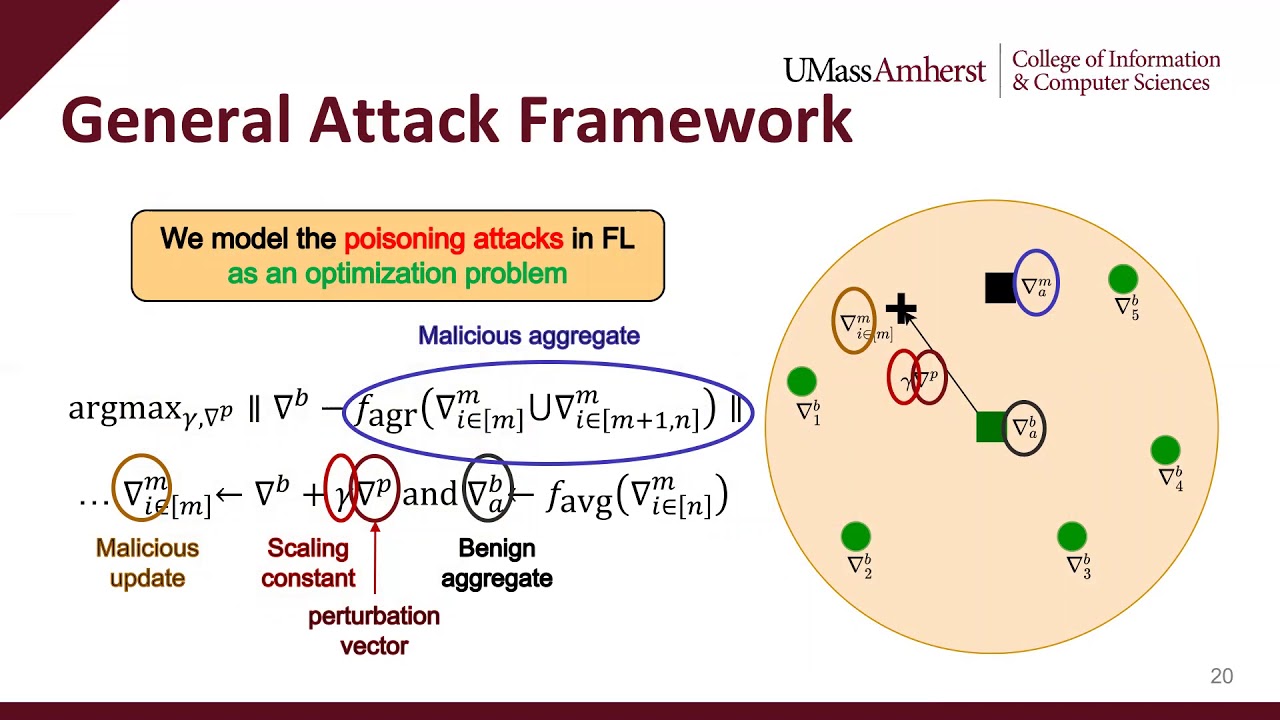
This paper presents a general optimization framework for designing model poisoning attacks in federated learning by maximizing the distance between benign and malicious aggregates through carefully crafted perturbation vectors, demonstrating that existing Byzantine-robust FL algorithms are significantly more vulnerable to poisoning than previously believed; the authors then introduce a novel defense called divide-and-conquer (DnC) based on principal component analysis that achieves 2.5x to 12x better resilience against poisoning attacks compared to existing defenses.
Click to watch →

FLOW Seminar #60: Amir Houmansadr (UMass) The Actual Risk of Poisoning Attacks on Federated Learning
341
Poisoning attacks work by searching within the space of acceptable updates to find those causing maximum damage to benign aggregations. This is fundamentally an optimization problem requiring attackers to understand specific aggregation mechanisms. Model poisoning (controlling device internals) is more powerful than data poisoning (providing malicious data to honest users). Defenses include aggregation rules that identify and reduce the impact of potentially malicious updates, though effectiveness depends on understanding the specific attack vectors and system constraints.
Click to watch →
Deep Dive
Real-world deployment strategies for Flower in production environments, including secure key management and network orchestration.

EU AI Week 2026 - Secure federated learning
178
Flower is a popular open-source framework for federated learning. A production demonstrator can combine Flower with Kubernetes (for orchestration), MQTT (for communication), and Vue.js (for visualization). Key components include public/private key management for secure collaboration and multi-client training cycles where clients become available sequentially.
Click to watch →

Flower Monthly 2025-05
109
Flower supports three deployment runtimes: Simulation runtime (for experimentation), Deployment runtime (for actual devices), and Third-party runtime (for other platforms). The deployment runtime has two core components: Superlink (server orchestrating execution) and Supernode (client-side execution). Subprocess mode collocs components (one container for Superlink+server app, another for Supernode+client app), while Process mode isolates components in dedicated containers for more flexibility. GCP integration uses Google Artifact Registry (blob storage for images), Kubernetes (orchestration tool), and GCP Autopilot (automatic resource provisioning). The deployment process involves creating a GCP project, configuring Google Cloud SDK, enabling Artifact Registry, building Docker images, tagging with registry, pushing images to GCP, and deploying via kubectl apply with YAML files. Flower can be deployed across different regions (Japan, Middle East, North America) and different clouds (GCP, AWS) using VPN infrastructure networking.
Click to watch →

The future of AI training is federated
212
Deploying Flower in production requires three sequential steps: (1) Install Flower on local machines or code spaces; (2) Run superlink in Docker container with appropriate port and certificate configurations; (3) Start supernode containers on each client device (edge devices like Raspberry Pi). The superlink manages the federation orchestration while supernodes handle message routing between devices and the central server. This deployment pattern enables federated learning across geographically distributed devices while maintaining data privacy and computational isolation.
Click to watch →

Running CloudABI applications on a FreeBSD based Kubernetes cluster - Ed Schouten
262
Flower is a daemon that acts as a socket switchboard for inter-container communication, addressing limitations of traditional IPv4 networking in Kubernetes. It enables processes to register as services and allows other processes to connect to them. When a match is found between server and client, Flower creates a unique socket pair and hands out both file descriptors. Flower uses label-based matching (not exact matching), allowing both parties to attach extra metadata like IP addresses, port numbers, or process identifiers. This enables better identification, debugging, and load balancing. Flower can be extended to support DNS lookups and load balancing, with future work including cross-datacenter load balancing involving BGP and other network logistics.
Click to watch →
LFN Webinar: Orange Deploys ONAP In Production
1.1K
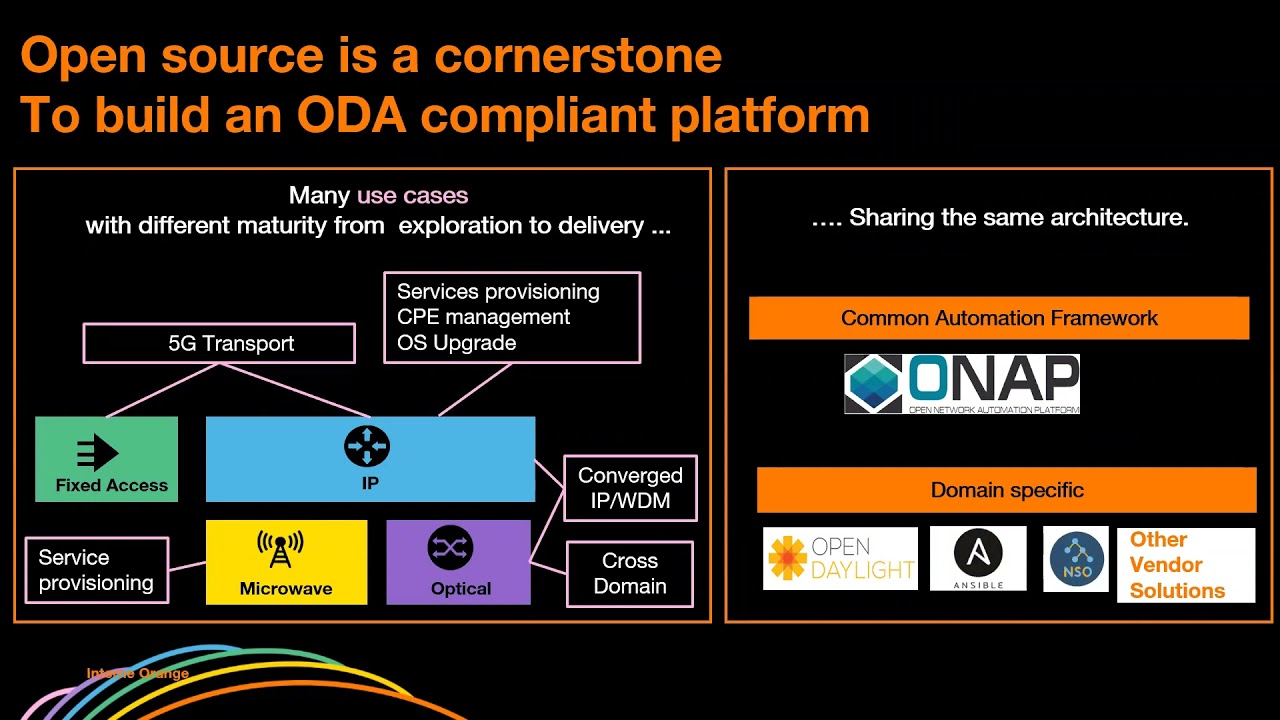
Successful ONAP deployment follows a phased strategy: install in lab environments first, purchase scope-of-work rather than licenses, dedicate 100% initial resources to automation before introducing orchestration, start with simple use cases, divide teams proportionally (two-thirds automation, one-third orchestration), ensure operations team acceptance through daily collaboration, complete CI/CD cycles before orchestration deployment, create comprehensive test labs, minimize device variety, invest in user experience, establish source-of-truth systems immediately, and display automation savings prominently to secure budget support.
Click to watch →
Privacy Threats
Flower Protocols
Privacy Threats
0:00- 1
Inference attacks reveal user data from model updates.
- 2
Passive attacks reconstruct private details invisibly.
- 3
Secure aggregation limits server to aggregate models only.
The Privacy-Robustness Trade-off and Resource Overhead of Cryptographic Secure Aggregation
While secure aggregation protocols like Salvia+ protect client privacy by concealing individual updates, they introduce critical trade-offs in system robustness and resource overhead. First, hiding individual updates prevents the central server from inspecting data for malicious activity. This makes the system highly vulnerable to model poisoning attacks and Byzantine faults, as anomalous updates cannot be audited or filtered. Second, cryptographic secure aggregation imposes significant computational and communication overhead on clients. Even optimized protocols require complex key agreements and multi-round secret sharing. For resource-constrained edge devices, this overhead can drastically increase latency and battery consumption, prompting researchers to advocate for alternative paradigms like Local Differential Privacy (LDP) or hardware-assisted Trusted Execution Environments (TEEs) which can offer privacy without the same cryptographic complexity.
Fundamentals of Federated Learning, including local training, model updates, and standard aggregation algorithms like FedAvg.
Basic cryptographic concepts such as Secure Multi-Party Computation (SMPC), Secret Sharing Schemes, and Homomorphic Encryption.
Privacy risks in distributed machine learning, specifically gradient leakage and reconstruction attacks on client updates.
Familiarity with the Flower (flwr) framework architecture, including Client-Server communication mechanisms.
Integrating Secure Aggregation with Differential Privacy (DP) to guarantee privacy against both the server and the final global model.
Evaluating the communication and computational overhead trade-offs of SOTA protocols like Salvia+ on resource-constrained edge devices.
Byzantine-robust federated learning and how to detect malicious model poisoning attacks when updates are hidden by secure aggregation.
Real-world deployment strategies for Flower in production environments, including secure key management and network orchestration.
814 views9likes3:56@flowerlabsOriginal Release: 2022-06-20
hello i'm pan today i'm going to cover secure aggregation flower in federated learning only local model parameters are transferred to the server but the history of uploaded parameters definitely tell something about the data it trains on and like here through inference attack an adversary can infer whether patient belongs to the database of a hospital or not and it is not impossible to review user level privacy like an anniversary can reconstruct fine brand user data through passive attack and in the passive tag the server where the server will only analyze a received parameters from clients but with street still strictly follows the protocol as if nothing happens so such kind of tag is completely invisible to clients and the solution is allow and only allow the server to see the aggregate model in securitization clients will add masks to their local mod updates which makes them completely indistinguishable from a randomly uniformly random sequences and the server will can only unmask the aggregate model flower supports two state-of-the-art protocols the first is the plus protocol in this protocol it allows it allows clients to add pairwise mods and individual marks to their local model updates and pairwise mods can be canceled out simply by adding them together and individual masks will be reconstructed at the end of secure aggregation the server can obtain the aggregate as a accurate aggregate model the other protocol is the lifestyle gag built for clients will encode the most and sends local models with masks the server is only allowed to decode the aggregate mask and then compute the aggregate model flowers for secure aggregation through a module called server plus quite easy to use if you want to use one of the segregation protocols just choose a strategy supporting sa such as segac plus fat average and lifestyle fat average and then on the server then on the client side choose a corresponding client wrapper and we have already optimized this module and we create python binding to allow us to call c plus plus functions in python these functions are more far more efficient in dealing with the cryptographic stuffs and four contributors and developers wanted to test their own secure creation protocols server plus is extendable it allows arbitrary user-defined strategies and client wrappers so just define the define a strategy and the corresponding client wrapper then you can use basically any sort of protocol thank you that's all about security in flowers
Up Next
31:29
Federated Learning & Differential Privacy for Mobile ML
@DIMACS_CCICADA
17.1K views•2018-06-25

57:48
Secure Multiparty Computation (MPC): Foundations & Challenges
@SimonsInstitute
7.3K views•2015-05-28
38:35
Understanding Flower Apps: ClientApp and ServerApp in Federated AI Simulations
@flowerlabs
6.5K views•2024-12-11
18:41
Neural Networks Explained: Math, Layers, and Learning Fundamentals
@3blue1brown
21.9M views•2017-10-05
Related Study Plans & Knowledge Roadmaps
Structured learning paths in Artificial Intelligence
artificial-intelligence
Aligning LLMs: DPO, TRL & Custom Datasets
01Foundations of Python & Machine Learning
02Transformers and Large Language Models (LLMs)
03Aligning LLMs: SFT and RLHF
+ 3 more learning modules
24h6 modules
Explore Roadmap
artificial-intelligence
Federated Learning: PyTorch, Flower & Privacy
01Python & Machine Learning Foundations
02Deep Learning Basics with PyTorch
03Introduction to Federated Learning
+ 2 more learning modules
35h5 modules
Explore Roadmap
artificial-intelligence
Securing LLMs: Guardrails AI & NeMo Gateway
01Introduction to LLMs, Python, and APIs
02Understanding LLM Vulnerabilities & Threats
03Defending LLMs with Guardrails AI
+ 2 more learning modules
15h5 modules
Explore Roadmap
artificial-intelligence
Building Recommenders: Two-Tower & Vector DBs
01Foundations of Python & Machine Learning Basics
02Introduction to Recommender Systems
03Deep Learning & Representation Learning
+ 3 more learning modules
75h6 modules
Explore Roadmap