Federated Learning: PyTorch, Flower & Privacy
Learning Goal: Design and implement a privacy-preserving federated learning system using PyTorch and the Flower framework to train deep learning models collaboratively across decentralized clients without centralizing sensitive data.
- Prerequisites: Basic mathematical intuition (pre-calculus level). Prior programming experience in Python is highly recommended but not strictly required (a comprehensive primer is included).
- Estimated Total Study Time: 35 hours (Students with prior Python experience can bypass Module 1 to reduce this to ~20 hours).
Module 1: Python & Machine Learning Foundations
This module introduces the fundamental elements of Python programming, basic linear algebra representations, and the underlying mechanics of gradient descent. You will build a conceptual and mathematical framework to support deep learning and decentralized optimization.
💡 Path Optimization: If you are already proficient in Python syntax, loops, and object-oriented paradigms, you should skip directly to Module 2 to save approximately 13 hours of study time.

- Why this video: It acts as a comprehensive, single-source primer for Python programming. It systematically takes absolute beginners from foundational setup to intermediate programming patterns, establishing the hands-on coding skills required to configure and execute Flower scripts.
- Knowledge Checkpoint:
- Configure a local Python workspace and execute a basic script.
- Utilize conditional statements, iterative loops, and basic collections (lists, dictionaries).
- Write reusable functions with argument passing and returned values.
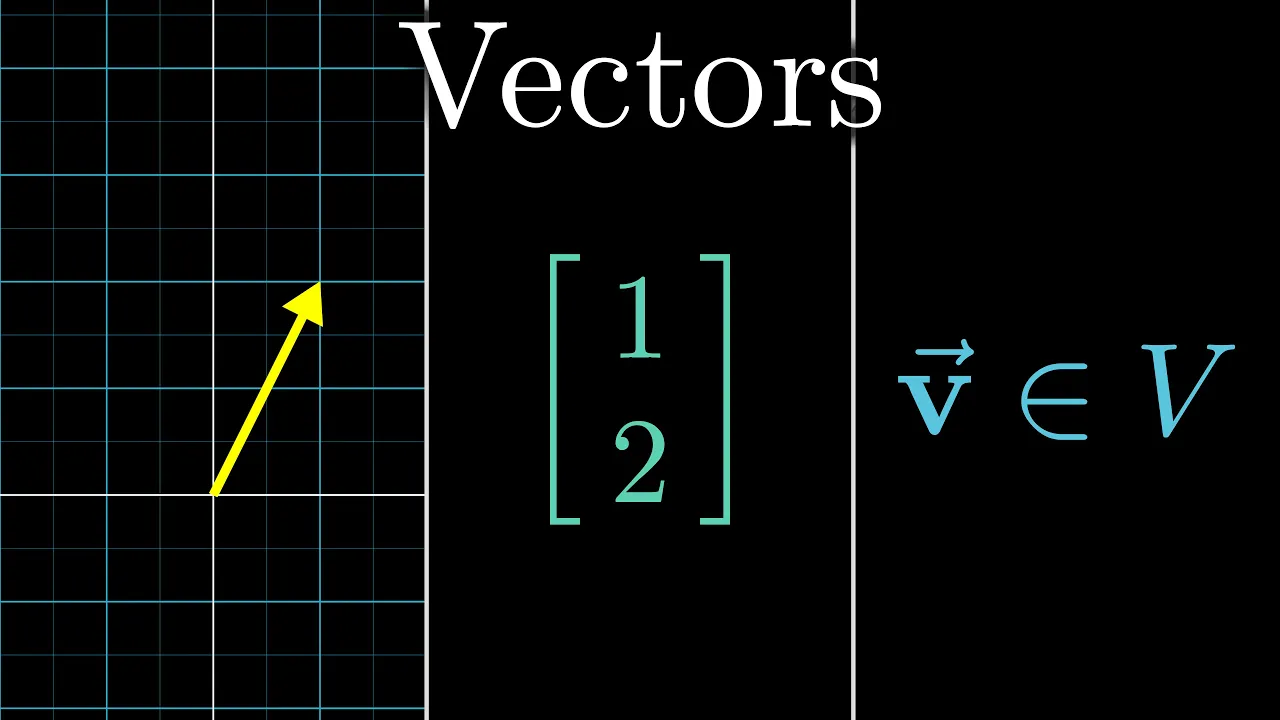
- Why this video: Linear algebra is the core mathematical framework of deep learning. This beautifully animated video by 3Blue1Brown visually grounds the concept of vectors—both as geometric entities in coordinate spaces and as numeric arrays inside neural network weights.
- Knowledge Checkpoint:
- Describe a vector from both a spatial (arrow) and numerical (ordered list) perspective.
- Perform basic vector operations such as addition and scalar multiplication.
- Understand how multidimensional data features are represented mathematically as high-dimensional vectors.

- Why this video: Optimization is the engine of machine learning. This visual guide explains how parameters are iteratively updated by following the negative gradient of a cost surface, which is vital for understanding both centralized training and localized client updates.
- Knowledge Checkpoint:
- Explain the physical intuition of gradient descent using a valley-descending analogy.
- Define what a loss function (cost function) calculates and how its derivative guides parameter adjustments.
- Explain the role of the learning rate in weight optimization.
Module 2: Deep Learning Basics with PyTorch
This module bridges theory and application. You will learn the mechanics of artificial neural networks and construct your first model structures using PyTorch's native APIs and data pipelines.
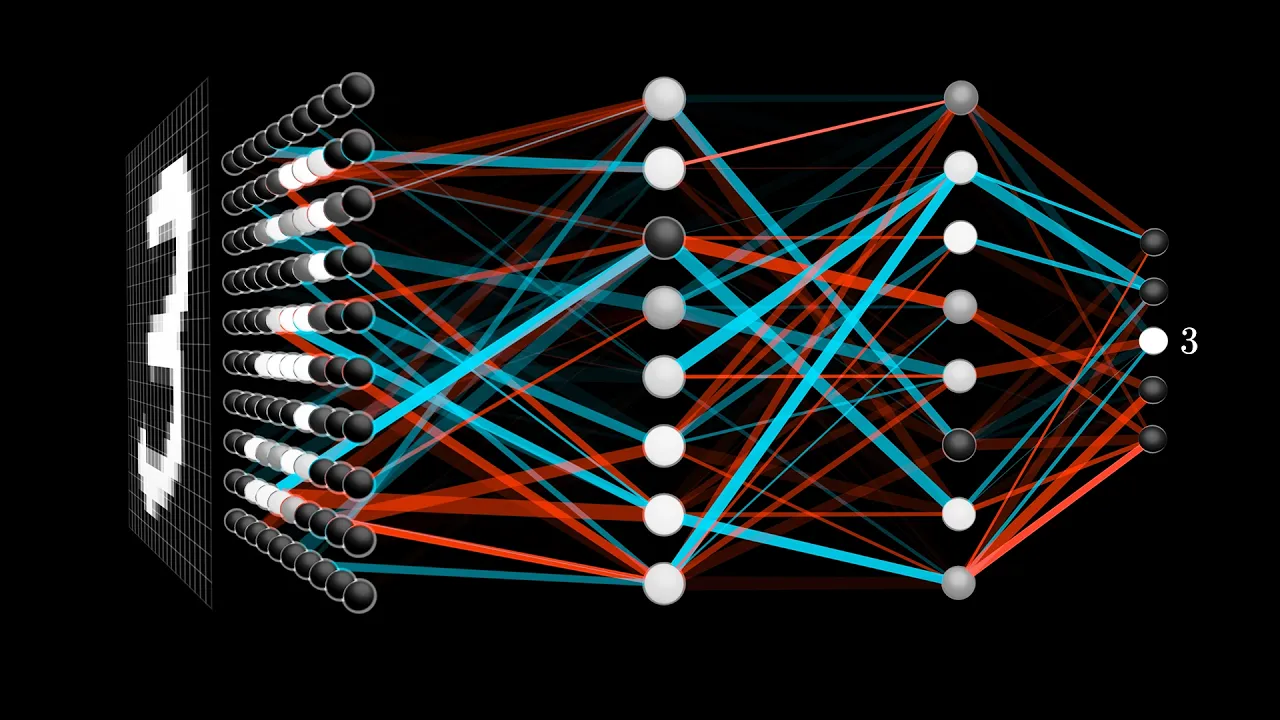
- Why this video: This video provides a highly intuitive conceptual foundation of deep learning architectures. It visually unpacks how layers of neurons extract increasingly abstract features from raw input data (like pixel values) through weighted sums, biases, and activation functions.
- Knowledge Checkpoint:
- Define the operational purpose of layers (input, hidden, output) and biological neural analogies.
- Calculate output activations using weights, inputs, biases, and activation functions.
- Describe how activation thresholds enable non-linear modeling.

- Why this video: A practical, minimal coding tutorial that introduces PyTorch syntax within Google Colab. It demonstrates how to initialize model instances, define loss criteria, and execute a centralized optimization loop in under 20 lines of code.
- Knowledge Checkpoint:
- Extend the
torch.nn.Moduleclass to design a simple neural network. - Select and configure appropriate loss functions (e.g., MSE or Cross-Entropy) and optimizers (e.g., SGD or Adam).
- Code a centralized training loop with zeroing gradients, backpropagation (
loss.backward()), and step adjustments.
- Extend the
- Why this video: This tutorial covers the critical data pipeline abstractions of PyTorch. Implementing federated learning requires splitting datasets into localized client shards, making custom implementations of
DatasetandDataLoaderan absolute prerequisite. - Knowledge Checkpoint:
- Differentiate between the role of
Dataset(indexing data points) andDataLoader(batching, shuffling, and multi-processing). - Implement the
__init__,__len__, and__getitem__methods of a custom PyTorch dataset. - Manage batch size allocations and data shuffling inside the training routine.
- Differentiate between the role of
Module 3: Introduction to Federated Learning
This module introduces the conceptual foundations of decentralized artificial intelligence. It focuses on the paradigm shift of sending algorithms to local data pools, rather than collecting raw user data on a central server, and explains the core mathematics of the standard Federated Averaging (FedAvg) algorithm.

- Why this video: This video offers an intuitive overview of the federated framework, explaining the server-to-client handshake, local epoch operations, and global parameter aggregation.
- Knowledge Checkpoint:
- Explain the central architectural differences between traditional (centralized) ML pipelines and decentralized federated learning.
- Detail the life-cycle of a single federated learning round.
- Identify the primary privacy advantages and bandwidth limitations of federated architectures.

- Why this video: This lecture closes a crucial conceptual gap by explaining the Federated Averaging (FedAvg) algorithm mathematically. It covers how a central coordinator samples clients, registers local training updates, and aggregates parameters using a weighted average based on client sample sizes.
- Knowledge Checkpoint:
- Define the mathematical optimization objective of the Federated Averaging (FedAvg) algorithm.
- Explain how the aggregation calculation weights model updates using the proportional size of local datasets.
- Distinguish between executing local gradient descents on a client versus calculating a simple global gradient update.
- Why this video: This interview grounds federated learning in real-world engineering constraints, edge personalization, and data governance. It helps you understand when federated learning is appropriate, how edge models adapt to local contexts, and the challenges of deploying non-IID (Independent and Identically Distributed) data networks.
- Knowledge Checkpoint:
- Describe how decentralized AI solves data governance and compliance challenges (like GDPR or HIPAA).
- Explain "personalization at the edge" and why local clients might require tailored model outputs.
- Discuss the practical difficulties of heterogeneous edge resources (compute power, intermittent network connections).
Module 4: Federated Learning with Flower Framework
This module covers the hands-on engineering aspects of federated learning. You will use Flower (flwr) to adapt a centralized PyTorch workflow into a multi-client simulation. This process uses Flower's ClientApp and ServerApp architecture to scale up decentralized setups.

- Why this video: A step-by-step code tutorial from Flower Labs that details the transition from a centralized PyTorch script to a decentralized, multi-client environment. It covers client instantiation and implementing Flower's key evaluation hooks.
- Knowledge Checkpoint:
- Transition a standard PyTorch module into a Flower client by mapping variables to local operations.
- Implement the
fitandevaluatemethods within a custom Flower client class. - Configure a basic Flower server and initiate simulated client connections.

- Why this video: This deep dive focuses on the 2025
ServerAppandClientAppsimulation models. It shows you how to design structured federated runs on single machines or distributed clusters using modular architectures, which addresses the gap of scaling client systems. - Knowledge Checkpoint:
- Map client logic to a
ClientAppclass and coordinate server execution using aServerApp. - Differentiate between physical client execution patterns and virtual simulation modes.
- Manage server state changes across multi-round execution workflows.
- Map client logic to a

- Why this video: A practical tutorial on running your first multi-node federated simulation using Flower's simulation engine. It walks you through setting up Python environments (3.9+), managing virtual resources, and launching simulations from a configuration file.
- Knowledge Checkpoint:
- Set up a virtual environment and configure system dependencies specifically for Flower simulations.
- Set limits on CPU and GPU allocations per simulated client to prevent memory overloads.
- Interpret simulation metrics, logs, and global performance records during a test run.
Module 5: Advanced Privacy in Federated Learning
While standard federated learning protects raw data by keeping it local, raw gradients can still leak sensitive information during transmission. This final module secures your system using privacy-enhancing technologies like Differential Privacy (DP) via PyTorch Opacus and cryptographic Secure Aggregation (SecAgg).
- Why this video: This technical presentation introduces Opacus, PyTorch's official library for Differential Privacy. It explains the mechanics of DP-SGD (Differential Privacy Stochastic Gradient Descent), showing how to calculate per-sample gradients, clip their norms, and inject calibrated Gaussian noise to protect individual data points.
- Knowledge Checkpoint:
- Explain how gradient tracking changes during DP-SGD compared to standard SGD.
- Wrap a standard PyTorch optimizer and model using the Opacus
PrivacyEngine. - Explain the trade-off between the privacy budget (epsilon , delta ) and model accuracy.
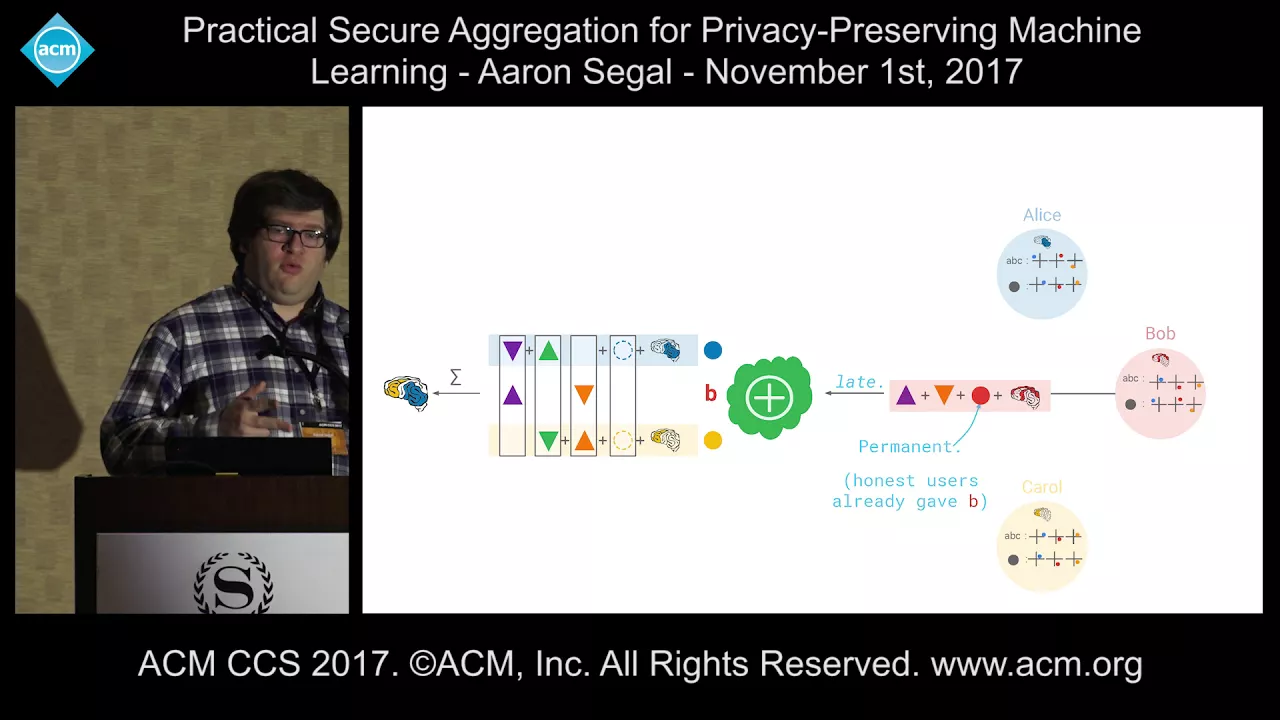
- Why this video: This presentation explains Google's practical Secure Aggregation (SecAgg) protocol. It details how cryptographic secrets, secret sharing (Shamir's Scheme), and pair-wise masks allow the central server to decrypt only the sum of client updates, without exposing individual model updates.
- Knowledge Checkpoint:
- Explain why raw parameters sent to a central server present a privacy risk even without sharing raw datasets.
- Describe how pair-wise additive masks cancel out when aggregated across a complete set of clients.
- Explain how the secret sharing scheme handles offline or dropped clients during the aggregation phase.
- Why this video: This video bridges cryptography and practical implementation. It shows how Flower natively integrates Secure Aggregation protocols, allowing you to configure private workflows with minimal API calls.
- Knowledge Checkpoint:
- Configure server aggregation strategies to require secure aggregation protocols.
- Set up client drivers to generate and exchange cryptographic keys securely during a federated training round.
- Differentiate between standard averaging strategies (like
FedAvg) and their cryptographically secure variants (likeSecAgg).
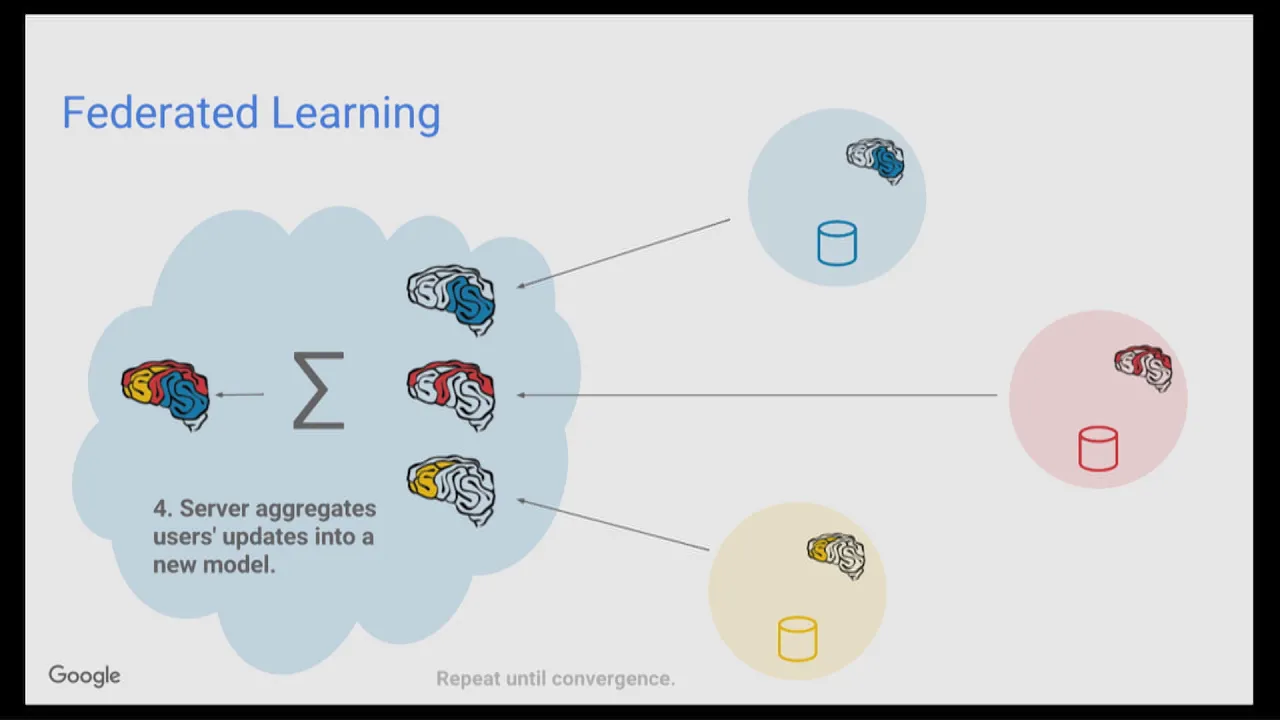
- Why this video: This lecture segment is delivered by Brendan McMahan, one of the original pioneers of federated learning. It explains how to combine Federated Learning and Differential Privacy at scale, showing how decentralized setups and DP noise work together to build secure systems.
- Knowledge Checkpoint:
- Explain how local differential privacy (adding noise on the client) differs from central differential privacy (adding noise during aggregation).
- Describe why scaling the client pool size reduces the utility loss caused by differential privacy noise.
- Evaluate the security profile of a federated network that uses both Differential Privacy and Secure Aggregation.
Course Map
Below is the recommended learning progression. Each module builds upon the previous one, leading to the final deployment of a privacy-preserving federated system.
Key People Index
- Dr. Brendan McMahan (Google): One of the primary creators of Federated Learning and the original developer of the Federated Averaging (FedAvg) algorithm. His research focus sits at the intersection of decentralization, cryptographic protocols, and Differential Privacy (DP).
- Grant Sanderson (3Blue1Brown): Renowned digital educator and animator. His visual breakdowns of linear algebra, calculus, and neural network foundations are widely considered the gold standard for intuitive mathematical learning.
- Aaron Segal (Google Research): Cryptographer and security researcher. His work focusing on practical multi-party cryptographic systems laid the groundwork for deploying Secure Aggregation (SecAgg) protocols in production systems with millions of users.
Final Self-Assessment
Complete this checklist to verify your understanding of the curriculum concepts.
- Python & Math: You can manipulate multi-dimensional tensors using Python and write custom object-oriented scripts.
- Gradient Optimization: You can explain how backpropagation maps output errors back through model parameters to perform optimization.
- Centralized PyTorch: You can construct a deep neural network, load datasets using custom DataLoaders, and train the model using standard optimization loops.
- Decentralized AI Paradigm: You can explain the key privacy and infrastructure differences between centralized and federated learning workflows.
- FedAvg Algorithm: You can mathematically explain how local parameters are weighted, aggregated, and averaged based on client sample sizes.
- Flower Architecture: You can explain the difference between a
ClientAppandServerApp, and construct modular workflows using the Flower framework. - Virtual Simulations: You can run a multi-client federated simulation on a single system while managing hardware resource limits.
- DP-SGD Mechanics: You can explain how clipping gradients and injecting calibrated Gaussian noise mathematically guarantees individual privacy.
- Opacus Integration: You can integrate Opacus into a PyTorch training pipeline and explain the relationship between epsilon () and your privacy guarantees.
- Secure Aggregation: You can describe how cryptographic additive masking enables a server to calculate aggregate parameter updates without reading individual client updates.
- Production Privacy Architecture: You can design a federated learning architecture that uses both local Differential Privacy and cryptographic Secure Aggregation to protect decentralized data networks.