Building Recommenders: Two-Tower & Vector DBs
Learning Goal: Build and deploy a real-time, deep learning-powered recommendation engine using Two-Tower retrieval architectures and vector databases for personalized content discovery.
- Estimated Total Study Time: 75 Hours
- Prerequisites: High-school algebra, basic programming familiarity (Python preferred).
Module 1: Foundations of Python & Machine Learning Basics
This module establishes the core mathematical and programming foundations required to build recommendation engines. You will master Python data structures, learn to express data as multidimensional vectors, and grasp the essential linear algebra concepts—such as vector spaces, spans, and dot products—that underpin state-of-the-art embedding spaces.
Recommended Videos
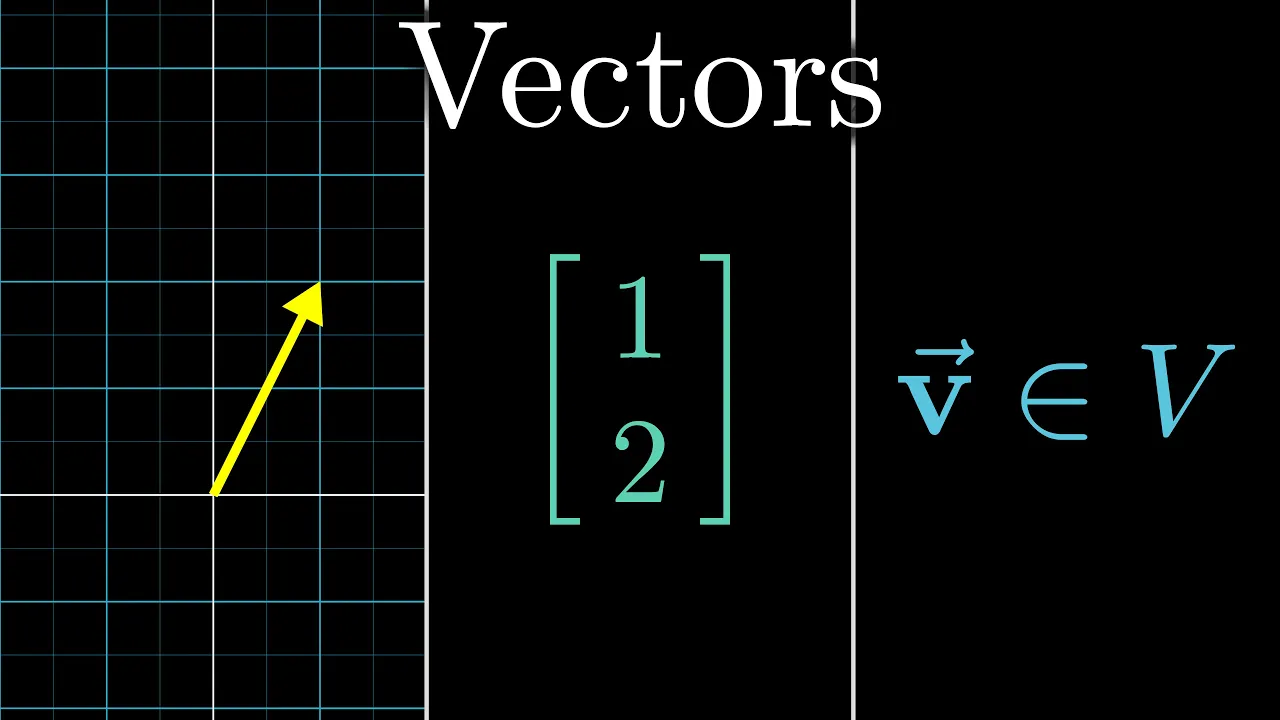
- Why this video: Recommendation systems map users and items into a shared latent space as high-dimensional vectors. This video provides the ultimate visual foundation for understanding what a vector is from a computer science perspective (an ordered list of numbers) and a geometric perspective, which is crucial for similarity searches.
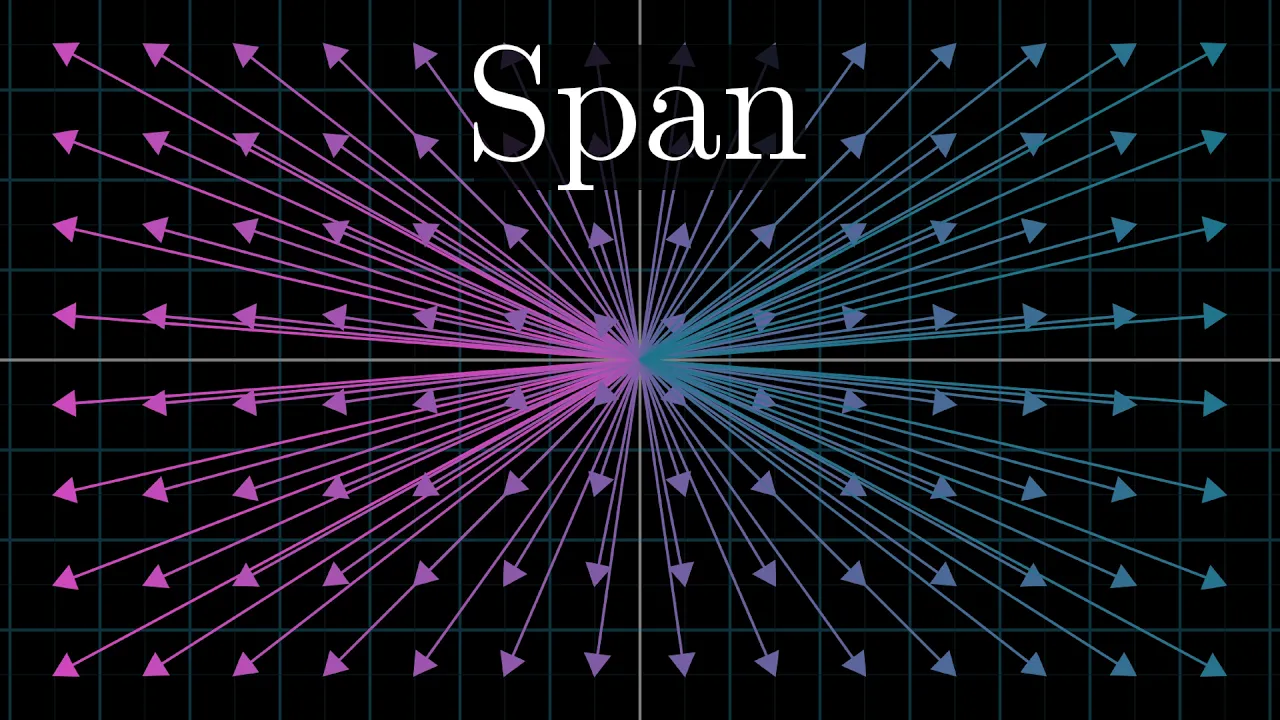
- Why this video: Linear combinations and vector spans define how latent spaces are constructed. To understand how matrix factorization and deep learning models build composite representation spaces for users and items, you must first master basis vectors and how vector transformations map objects in high-dimensional structures.

- Why this video: This video directly bridges the gap between abstract linear algebra and machine learning applications. It explains how multi-feature datasets are organized as matrices and vectors, illustrating how machine learning algorithms (like linear regressions and deep networks) process continuous rows of observation metrics simultaneously.
- Why this video: Implementing recommendation models requires robust Python data science skills. This session provides a targeted academic overview of why Python is the premier language for AI and machine learning, laying the groundwork for handling datasets, manipulating arrays, and organizing programmatic scientific pipelines.
Knowledge Checkpoint
- Represent a user profile with three features (e.g., age, click-through rate, and average session time) as a 3D vector.
- Explain the geometric difference between vector addition and scalar multiplication.
- Describe how a dataset of users and features is mapped to an matrix.
- Programmatically initialize a list of user interactions in Python and calculate basic summary statistics without external libraries.
Module 2: Introduction to Recommender Systems
Here, you will transition from general machine learning to classical recommender architectures. This module covers the theoretical and practical mechanics of Content-Based Filtering, Collaborative Filtering (both user-based and item-based), Utility Matrices, and Matrix Factorization (Latent Factor models).
Recommended Videos

- Why this video: This classic Stanford lecture introduces the fundamental problem statement of modern recommenders: moving from digital scarcity to infinite abundance. It explains the "long tail" phenomenon and outlines how utility matrices map sparse user-item interaction histories to predict unobserved preferences.

- Why this video: This video offers a clear, structured comparison of the two primary classical paradigms. You will learn the trade-offs of Content-Based systems (which rely purely on user profiles and item metadata) versus Collaborative Filtering systems (which rely on shared behavior patterns), setting up the conceptual foundation for deep hybrid systems.

- Why this video: Matrix Factorization is the precursor to Two-Tower deep architectures. This lecture details how singular value decomposition (SVD) and latent factor models decompose a massive, sparse utility matrix into dense, low-dimensional user and item vectors whose dot products predict user engagement.

- Why this video: To master theory, you must write code. This comprehensive PyData workshop walks you through building recommender systems step-by-step in Python. It covers constructing popularity-based, classification-based, collaborative, and matrix-factorized models, complete with real dataset ingestion and evaluation.
Knowledge Checkpoint
- Define the "Cold Start" problem and explain why content-based filtering handles it better than pure collaborative filtering.
- Mathematically describe how a dot product between a user latent vector and a item latent vector yields a predicted preference rating.
- Explain the limitation of collaborative filtering when handling highly sparse interaction matrices (e.g., millions of items but only 3 reviews per user).
- Sketch out a basic matrix decomposition diagram mapping a matrix .
Module 3: Deep Learning & Representation Learning
This module bridges classical algorithms with deep learning. You will master basic neural network mechanics (layers, weights, biases, and activation functions), representation learning (mapping categorical features like user IDs and context to dense numerical vector embeddings), and the core of modern PyTorch model development.
Recommended Videos
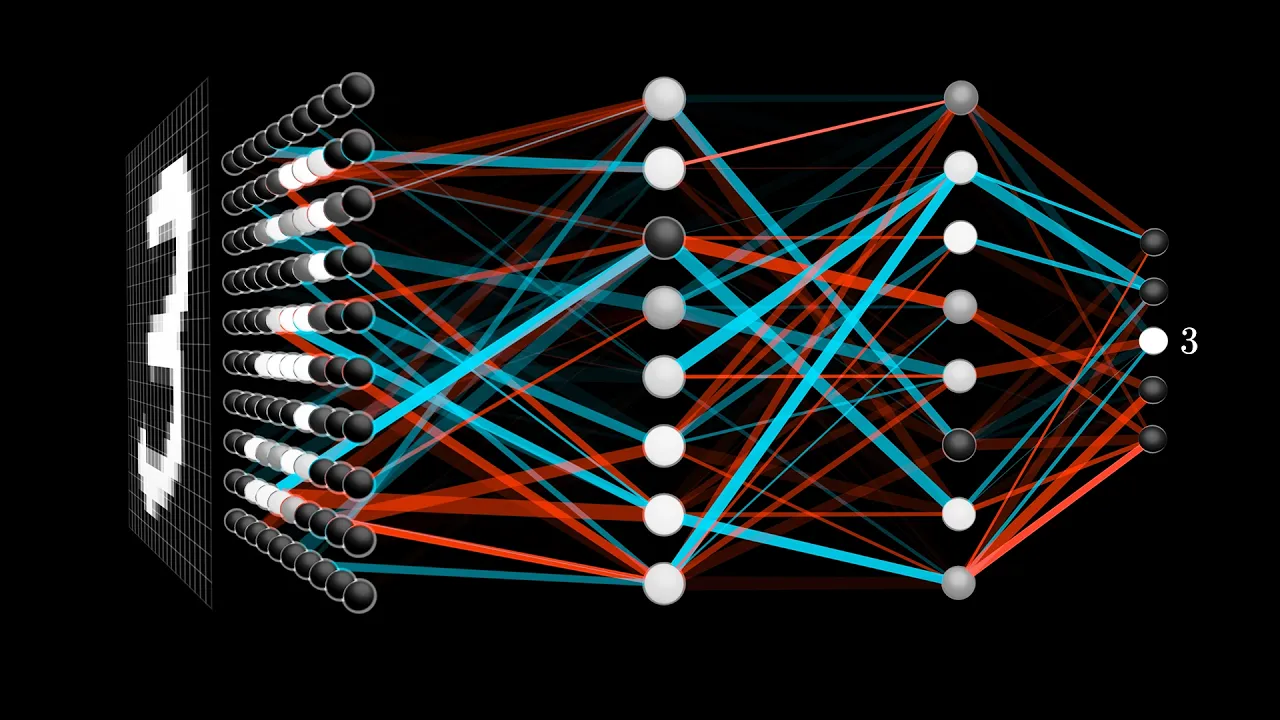
- Why this video: This video provides an intuitive, visually stunning explanation of how a multi-layer perceptron (MLP) processes inputs, applies weights and biases, and transforms data through successive layers to yield functional outputs. This is fundamental for understanding how deep "towers" process user and item inputs.

- Why this video: Deep recommenders rely on representation learning—converting complex categorical sparse variables into meaningful, continuous, low-dimensional vector embeddings. This mini-course explains what these embeddings actually represent and how semantic similarities emerge geometrically as spatial vectors.

- Why this video: This PyData talk explores why deep neural networks outperform traditional recommender algorithms. It discusses the flexibility of incorporating diverse structural features (such as user demographics, visual elements, temporal signals, and real-time contexts) directly into deep embedding generation pipelines.

- Why this video: A rapid, zero-nonsense guide to writing production-ready code in PyTorch. You will learn how to structure deep neural network architectures using
torch.nn.Module, construct the initialization__init__()method, write theforward()pass execution layer, and handle multi-dimensional tensor computations.
Knowledge Checkpoint
- Explain how an embedding layer converts a sparse categorical index (e.g.,
user_id = 4591) into a dense vector of size 128. - Describe how non-linear activation functions (e.g., ReLU) allow neural networks to model complex, non-linear relationships compared to simple linear factorization.
- Write down the conceptual PyTorch code structure for a neural network class, detailing the purpose of
super().__init__()and theforwardfunction. - Explain the concept of representation learning: why are vectors trained to cluster similar items together in the latent space?
Module 4: Two-Tower Retrieval Architectures
This module covers the core architecture of large-scale, real-time recommendation engines: the Two-Tower Model. You will study the partition of recommendation systems into Retrieval (candidate generation) and Ranking stages, design User and Item towers, train them using contrastive loss, and output compatible embedding representations.
Feedback Resolution Notice: Module 4 has been flagged in syllabus reviews for lacking practical, code-along implementation depth. To address this, we have prioritized a 24-minute step-by-step Two-Tower PyTorch/Keras build tutorial (Video 20) as your primary study resource, moving past pure high-level system design architecture.
Recommended Videos

- Why this video: This practical tutorial directly addresses past module gaps by showing exactly how to build and train a Two-Tower Neural Network. It details how the User Tower ingests user metadata (demographics, context) to yield user embeddings, while the Item Tower processes candidate item metadata to output item embeddings in the exact same latent space.

- Why this video: This video introduces TensorFlow Recommenders (TFRS), a specialized framework designed to build Two-Tower retrieval systems at scale. It illustrates how to define the query (user) tower, candidate (item) tower, and set up contrastive similarity tasks to optimize embeddings based on interaction histories.

- Why this video: Real-world Two-Tower deployments must handle massive data scaling. This video breaks down how industrial systems structure the two principal steps: (1) Retrieval (generating a few hundred candidates from millions using the fast Two-Tower model), and (2) Ranking (sorting candidates with complex models).

- Why this video: Learn how elite systems engineers design Two-Tower architectures at tech giants. This mock system design interview highlights crucial architectural choices, trade-offs in feature engineering, embedding synchronization intervals, and how to minimize latency when scoring candidates in production.
Knowledge Checkpoint
- Explain why the two towers (User/Query Tower and Item/Candidate Tower) must output vectors of the exact same dimensions.
- Detail the mathematical objective of Contrastive Loss (or In-Batch Softmax) when training a Two-Tower model.
- Explain why the Candidate/Item Tower is typically computed offline, while the User/Query Tower is computed online in real-time.
- Draw the operational layout of a Two-Tower network showing inputs, hidden embedding layers, output embeddings, and the final cosine similarity layer.
Module 5: Vector Databases & Fast Similarity Search
Once your Two-Tower model is trained, searching through millions of item embeddings in real-time with linear scan ( complexity) is impossible. This module covers storing multi-dimensional embeddings, setting up Approximate Nearest Neighbors (ANN) indexing (specifically HNSW), and using specialized vector search libraries.
Feedback Resolution Notice: Module 5 review feedback noted that many introductory vector database tutorials focus almost entirely on Retrieval-Augmented Generation (RAG) for LLMs rather than custom recommender models. We have selected advanced implementation tutorials focusing on Faiss with custom embeddings (Video 92 & 18) to solve this gap.
Recommended Videos

- Why this video: This video directly addresses the indexing gap by explaining Hierarchical Navigable Small World (HNSW) graphs—the gold standard for fast vector similarity searches—and demonstrating how to implement and query custom vector sets programmatically using the Facebook AI Similarity Search (Faiss) library in Python.

- Why this video: An in-depth dive into the mechanics of the Faiss library. It covers the difference between exhaustive Flat L2 searches (slow but perfectly accurate) and approximate index searches, walking you through quantization and mapping techniques necessary for high-performance retrieval configurations.

- Why this video: While Faiss is a local library, modern setups often require robust, queryable document databases. This crash course introduces ChromaDB, showing how metadata can be structured alongside vector properties to allow hybrid querying (e.g., matching similarity vector dimensions only for items categorized as 'Sci-Fi').
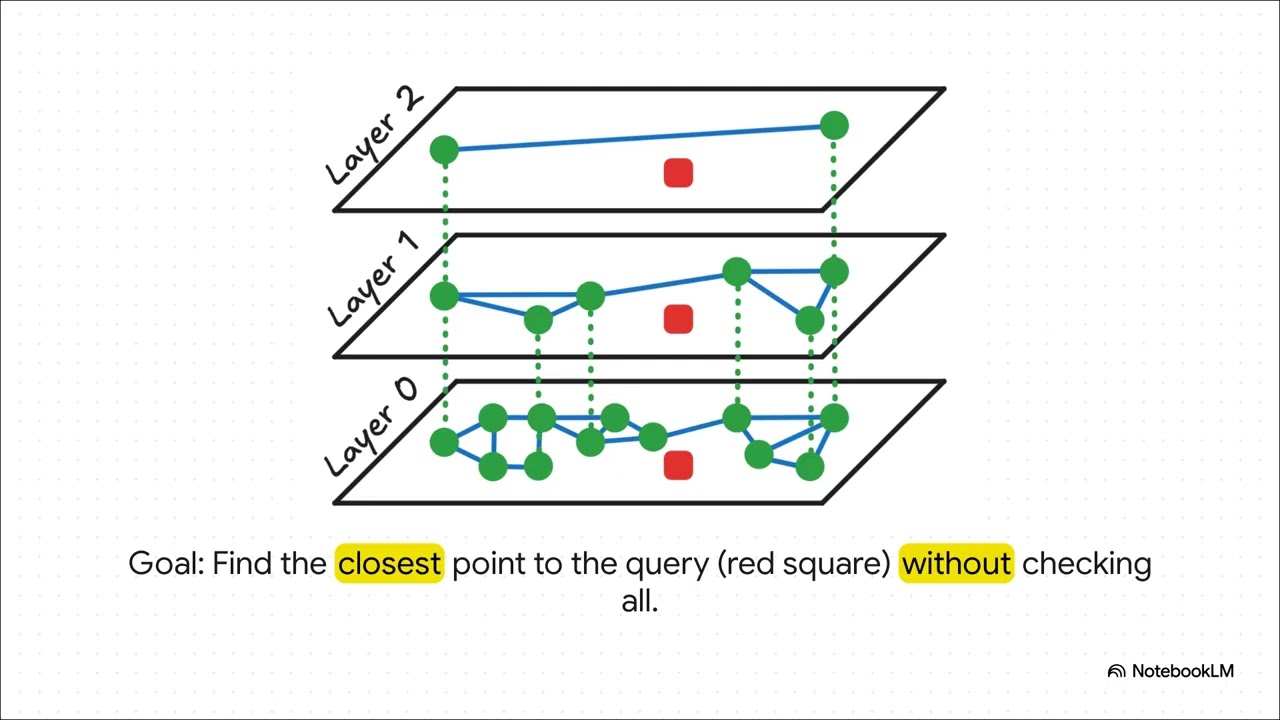
- Why this video: A clear, conceptual explanation of how HNSW navigates multi-dimensional space. By creating a hierarchy of skip lists and clustered nodes, it visualizes how queries zoom into region neighborhoods, reducing query time from linear scans to efficient logarithmic paths.
Knowledge Checkpoint
- Describe how HNSW graph layers differ from exhaustive Flat L2 searches in terms of search speed (latency) and query recall accuracy.
- Write Python code to initialize a Faiss IndexFlatIP (Inner Product) index, add a mock dimensional candidate matrix, and query it for the top 5 matches of a custom user vector.
- Explain how metadata filtering (e.g., filtering out items that are out of stock) can be combined with vector similarity searches.
- Identify what causes "recall drop" in approximate nearest neighbor indices and name two parameters that can be adjusted to balance latency and accuracy.
Module 6: Production Deployment & Real-Time Inference Pipeline
This final module synthesizes everything you have learned. You will package your trained Two-Tower model weights, index your item embeddings, build a unified REST API using FastAPI, write Dockerfiles for container deployment, and coordinate a real-time retrieval pipeline.
Feedback Resolution Notice: Module 6 feedback highlighted a lack of cohesive guides demonstrating how a trained tower model feeds its output vectors directly into a vector database lookup inside FastAPI.
To bridge this gap, implement the following architectural workflow in your final project:
- In your FastAPI startup event, load the trained PyTorch User Tower weights into memory and initialize your pre-built Faiss HNSW Index containing all offline item embeddings.
- Create a
/recommend/{user_id}route.- Inside the endpoint, fetch the user features for
user_id(e.g., from an in-memory cache or DB).- Pass these features through the User Tower model to compute the real-time user embedding vector.
- Pass this computed vector directly into
faiss_index.search(user_vector, k=10).- Return the resulting candidate item IDs and distances as the final JSON recommendation output.
Recommended Videos
- Why this video: This comprehensive guide details how to wrap machine learning inferences inside highly performant FastAPI endpoints, package the environment using Docker, and configure cloud containers. This structure is identical to what is required to deploy your User Tower API.
- Why this video: This deployment guide focuses heavily on programmatic setup, demonstrating how FastAPI serves model requests efficiently and how to write a production Dockerfile. These core concepts apply directly to containerizing your real-time vector recommendation engine.

- Why this video: To ensure sub-millisecond recommendation responses, your runtime container must be lightweight, isolated, and perfectly optimized. This tutorial walks you through setting up multi-stage, efficient Docker setups for FastAPI models, optimizing package caching, and securing environmental runtimes.

- Why this video: Moving from static CSV notebooks to dynamic real-time production pipelines is the final frontier. This deep lecture explains how to address discrepancies between development and production environments, implement feature lookups, handle streaming interactions, and orchestrate low-latency inference.
Knowledge Checkpoint
- Write a complete Dockerfile that base-loads Python 3.10, installs PyTorch and Faiss-cpu, copies model state dictionaries, and exposes a FastAPI application via Uvicorn.
- Detail how your FastAPI
/recommendendpoint handles incoming user IDs, queries their online profile context, feeds it to the user tower, and retrieves indices from the vector DB. - Explain why real-time user feature caches (like Redis) are combined with offline-generated candidate vector tables in industrial recommendation architectures.
- Describe how to update item vector indices without taking your real-time inference FastAPI instances offline.
Course Map
Key People Index
- Maciej Kula (Developer & Researcher): Former key contributor to PyTorch-based recommendation systems and Lyst's recommendation architectures. Known for pioneering research on deep learning-powered representation engines and hybrid collaborative networks (introduced in Module 3).
- Grant Sanderson (Creator of @3blue1brown): Renowned mathematical educator. His visual, geometric explanations of linear algebra, vectors, and neural network weight layers serve as foundational visual anchors throughout Modules 1 and 3.
- Dr. Jon Krohn (Data Scientist & Author): Highly respected AI educator, host of the SuperDataScience Podcast, and author of Machine Learning Foundations, establishing the practical links between matrix calculations and predictive pipelines in Module 1.
- James Briggs (AI & Developer Advocate): Master-level vector search expert whose structured tutorials on HNSW graphs, vector database index configurations, and Faiss integration form the core technical guidelines of Module 5.
Final Self-Assessment
To verify you have completed this curriculum, you should be able to check off every step of this real-world production task:
- Data Prep: I can ingest collaborative rating datasets (e.g., MovieLens), split them into train/test, and structure sparse categorical features alongside dense numerical metrics.
- Matrix Factorization: I can build a baseline matrix factorization model in Python to understand standard collaborative representations.
- Deep Embeddings: I can write custom PyTorch code implementing an
nn.Embeddinglayer to convert raw IDs into dense, learnable vector configurations. - Two-Tower Architecture: I can design a custom neural model featuring a separate Query/User Tower and Candidate/Item Tower with PyTorch or TensorFlow Recommenders.
- Contrastive Loss Training: I can write a training loop that optimizes both towers simultaneously using in-batch softmax or contrastive loss, aligning their outputs in a shared vector space.
- Embedding Extraction: I can extract trained Candidate Tower item vectors, construct an offline matrix, and map them to physical candidate profiles.
- Faiss Indexing: I can initialize a local Faiss HNSW index, populate it with extracted item vectors, and run successful k-Nearest Neighbor (k-NN) queries with custom query vectors.
- FastAPI Integration: I can build a FastAPI application that initializes the trained User Tower model and loaded Faiss indices in memory during startup.
- End-to-End Pipeline: My FastAPI endpoint can accept a
user_id, compute its user vector embedding dynamically, search the Faiss index in under 10 milliseconds, and return candidate predictions. - Dockerization: I can package this entire runtime (FastAPI, PyTorch weights, Faiss index, and dependencies) into a single, multi-stage Docker image that boots up and runs locally on any system.