


































The Hierarchical Navigable Small World (HNSW) algorithm is a graph-based search method that efficiently finds similar data points in massive, high-dimensional datasets by organizing data into a multi-layered hierarchical structure inspired by navigation systems. The top layers function as express highways for rapid long-distance traversal, while bottom layers serve as local streets for precise matching. Using greedy routing, the algorithm navigates from a random starting point, making successive jumps to increasingly closer neighbors across layers until reaching the closest match. This hierarchical approach achieves logarithmic search speed, dramatically outperforming brute-force methods while maintaining high accuracy (90-99% recall rate). The algorithm balances speed, accuracy, and memory usage through tunable parameters including connection count (M), construction quality (F_construction), and search quality (F_search).
HNSW Algorithm Explained: Hierarchical Navigable Small World for Similarity Search
Added:Welcome to the explainer. Today we're doing a study guide on HNSW.
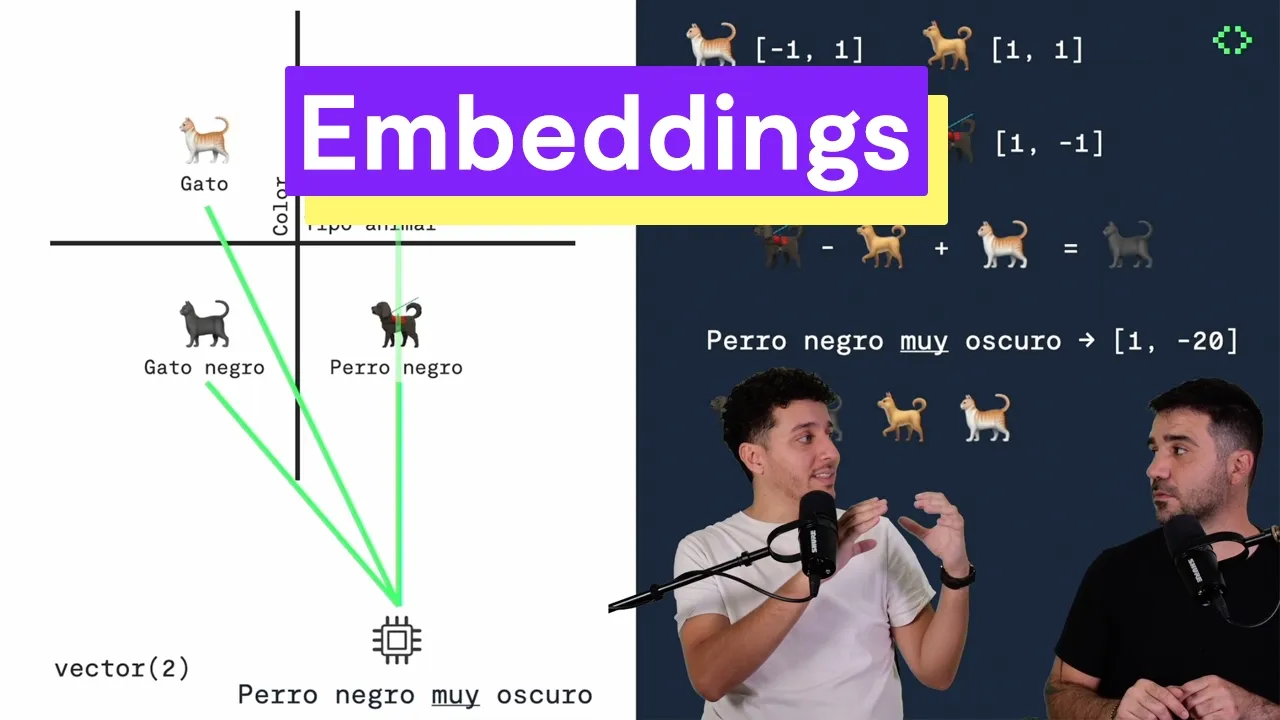
It's a really powerful algorithm that's quietly running behind the scenes in a ton of the apps you use every single day. You know, it's that little bit of magic that finds similar songs or products or even ideas in just the blink of an eye. I mean, think about it for a second. When you ask your music app to find a song that just sounds like another one you love, how does it do that? How does it sift through literally millions of options to give you a perfect match almost instantly? It's a huge problem, right? Like finding a single specific needle in a digital haststack that's billions of items tall.
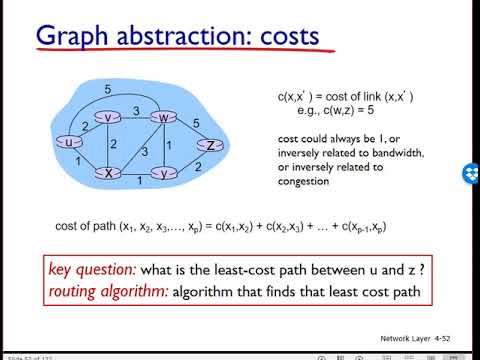
Well, the secret lies in an approach that works a lot like a navigation app, something like Google Maps. But instead of mapping out actual roads and cities, this algorithm creates a smart map for data. It lets us navigate through these huge, complex worlds of information with incredible speed. All right, since this is a study guide, here's our game plan.
We'll start with the problem it's trying to solve. Then we'll decode that crazy name. After that, we'll watch a search in action. See how the whole thing gets built. And finally, we'll get into the really important trade-offs between speed and getting the perfect answer.
Okay, first things first. Let's really pin down the problem HNSW was designed to solve. It's called similarity search.
And it's all about finding the closest matches to your query inside these gigantic databases. And we're not talking about simple data. We're talking about complex highdimensional stuff like the unique features of an image or the true meaning of a sentence or the pattern inside a piece of music. Okay, let's dive into this. The name hierarchical navigable small world. I know it's a mouthful. It sounds super intimidating, right? But it's actually a perfect and very literal description of how it works. We can break it down into three simple ideas. First up, small world. You've probably heard of the six degrees of separation idea, right? The theory that any two people on Earth are connected through a surprisingly short chain of friends. Well, HNSW applies that same concept to data, connecting similar points so you can jump from any point to any other in just a few hops.
Next up, navigable. This is key. The connections aren't random. They're intelligent. They're like road signs that always point you in the right direction, closer to your target. The algorithm does this using something called greedy routing where at every step it just makes the simple greedy choice to move to the neighbor that's closest to what you're looking for. And that brings us to the final and honestly the most clever part of the puzzle.
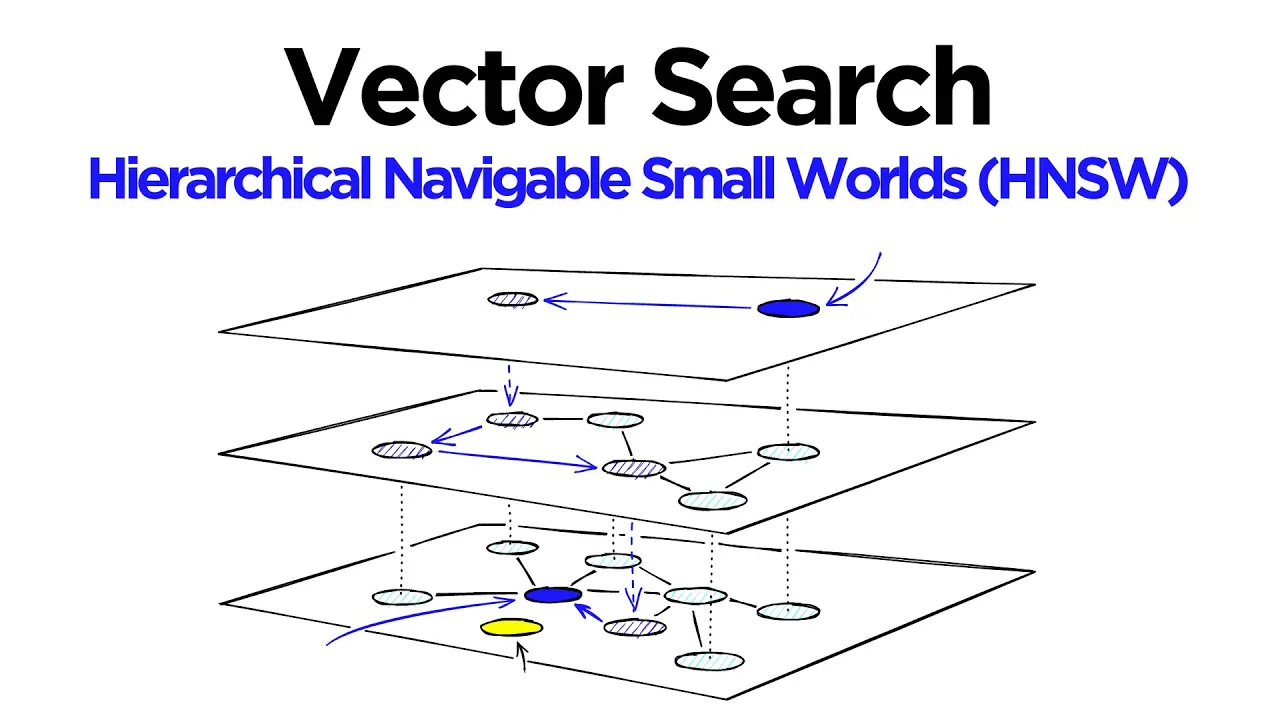
Hierarchical. See, instead of having just one flat map, HNSW builds this multi-layered structure exactly like a skyscraper. You can think of the top floors as being the express highways for really fast long-d distanceance travel and the bottom floors as the local streets for finding the exact address.
So, how does this actually work in a real search? Let's follow a query as it travels from the penthouse of our data skyscraper all the way down to the ground floor to find its closest match.
Okay, here's our map. The green circles are our data points. Our mission, should we choose to accept it, is to find the one closest to our query, which is that red square. Now, the brute force way would be to measure the distance to all 12 points. But HNSW is way smarter than that. The journey starts at the very top on layer 2, our express highway. We enter at a totally random point, in this case, 0.1. From there, the algorithm just looks at its neighbors and makes a jump to the one that's closer to our red square. That's point 2. This first big jump gets us into the right general neighborhood really fast. Now, from point 2, we can't get any closer on this top layer. So, what do we do? We take an exit ramp and drop down to layer 1, entering at that same point, number two.
This layer has more connections. It's like the main roads in a city. So, we can do a more refined search. Here on layer 1, we just repeat the process. We do another one of those greedy searches.
We look at the neighbors of 2 and find that hey 4 is even closer to our target.
So we jump there. After checking its neighbors, we realize we can't get any closer on this layer either. So it's time to go down again. And finally, we arrive at layer zero. This is the ground floor, the local streets where every single data point lives. We enter at point 4 and do one last greedy search.
We check its neighbors, find that 7 is the closest, and after a final check of its neighbors, we confirm it's the best match we can find. And just like that, the search is over. So, let's just pause and think about what happened. We found our answer with only eight distance checks. The brute force method would have taken 12. I know that doesn't sound like a huge difference here, but imagine if this was a map with millions or even billions of points. The efficiency gain isn't just a little better, it's monumental. So, now that we've seen how this search works, you're probably asking the obvious question. How is this incredible data skyscraper even built?
So, let's take a quick look at that construction process. It's basically a three-step process for every new piece of data. First, it gets randomly assigned a height, kind of like rolling a die to decide if a new building will be a skyscraper or just a bungalow.
Higher floors are much rarer. Then the algorithm searches from the top down to find the perfect spot for it. And finally, it connects that new point to its closest neighbors on every level it exists on, weaving it right into the network. Now, this next part is absolutely essential for our study guide. It's understanding that HNSW isn't a magic bullet. It's more like a high performance engine that's highly tunable. Its performance is all about a series of trade-offs that you can control to get the perfect balance of speed, accuracy, and memory usage for your needs. Because HSNSSW is an approximate algorithm, it doesn't guarantee the absolute 100% perfect match every single time. Instead, it makes a really smart trade-off. Its accuracy, or what's called its recall rate, is incredibly high. It usually finds the true nearest neighbor over 90 to 99% of the time. And for most things, giving up that tiny chance of perfection is more than worth it for the incredible boost in speed. And its impact has been just enormous. In the world of academic research, citations are how you measure influence. And the original 2016 paper on HNSW has been cited over 2,000 times.
that really cements its status as a foundational pillar of modern computer science. So, how do you actually tune this engine? Well, there are three main dials to control these trade-offs. The first one, M, sets the number of connections for each point. Think of it like adding more roads to your map. It improves accuracy but uses more memory.
Then there's F construction, which decides how carefully the map is built.
And finally, F search is the dial you can turn at query time, letting you decide on the fly if you need a faster, good enough search or a slower, more accurate one. So to bring this all together, the absolute genius of HNSW lies in this beautiful separation of scale. By combining those long-d distanceance highway jumps on the upper layers with meticulous local street searches on the bottom layer, it achieves something called logarithmic speed, which is just a fancy way of saying it can navigate unimaginably large data sets with truly breathtaking speed. And that leaves us with one final thought. HNSW is a brilliant map for the kind of data we have today. But as data becomes even more valuable, more complex, what new kinds of smart maps and navigational tools are we going to need to invent to explore the digital worlds of tomorrow?
Up Next

Build a Custom BitTorrent Client: Implementation Guide
@IAmManware
8.5K views•2025-11-02

Introduction to Secure Multiparty Computation with Yehuda Lindell
@fhe_org
7.7K views•2021-02-04

HTTP Requests Explained: GET, POST, PUT, DELETE
@codecademy
103.1K views•2021-10-07

Enigma Machine Mechanics: WWII Encryption Explained
@JaredOwen
13.2M views•2021-12-11
Related Study Plans & Knowledge Roadmaps
Structured learning paths in Computer Science