Latent Diffusion: PyTorch, UNet & CLIP
Learning Goal: Build and train a custom Latent Diffusion Model (LDM) from scratch using PyTorch for generating high-fidelity conditional images.
- Prerequisites: Strong programming foundations in Python, college-level linear algebra, multivariable calculus (chain rule), and basic probability.
- Estimated Total Study Time: 80 Hours
Module 1: Deep Learning & PyTorch Foundations
This module builds the mathematical and practical coding foundations necessary for deep learning. You will progress from the conceptual and geometric understanding of how neural networks learn via backpropagation to hands-on programming with PyTorch tensors, autograd, and network training loops. This module specifically addresses initial feedback by pairing theoretical deep-dives with a comprehensive coding boot camp.
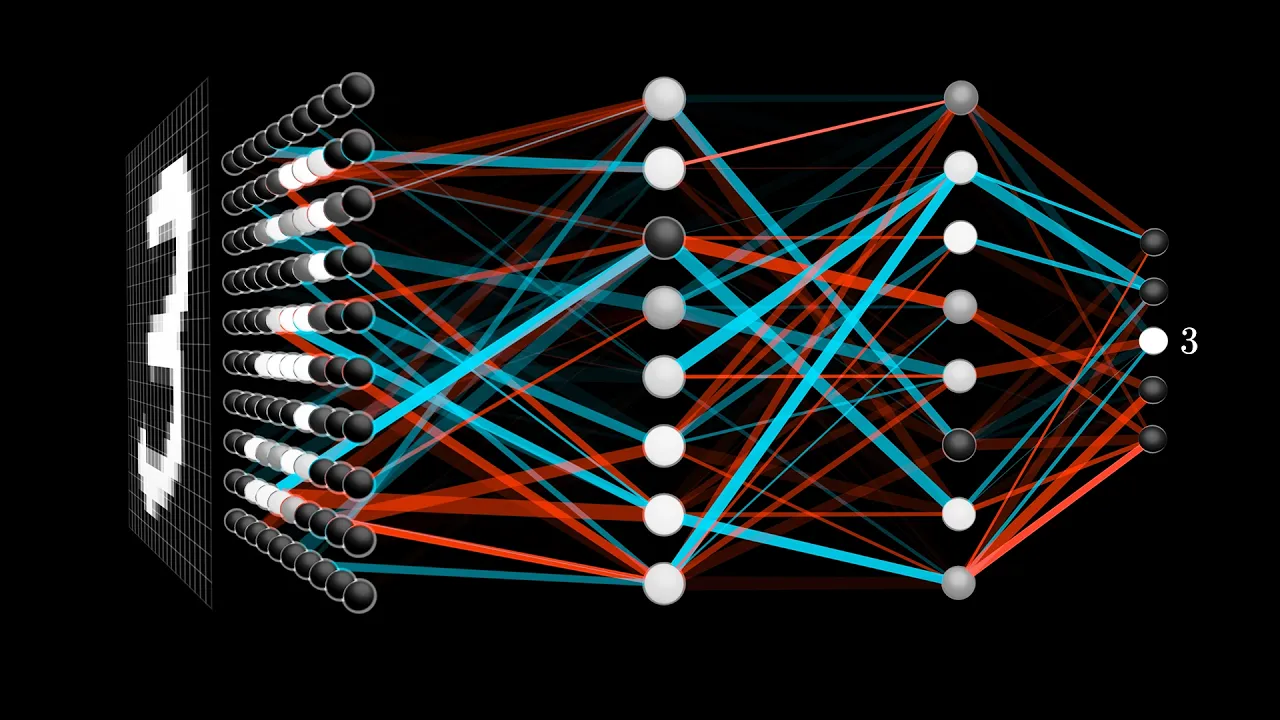
Why this video is valuable
This video by Grant Sanderson (3Blue1Brown) provides an unmatched visual introduction to neural networks. It explains how multi-layered perceptrons parse structures, define weights and biases, and mathematically organize activation vectors. This visualization is critical for developing a geometric intuition of high-dimensional transformations before writing code.
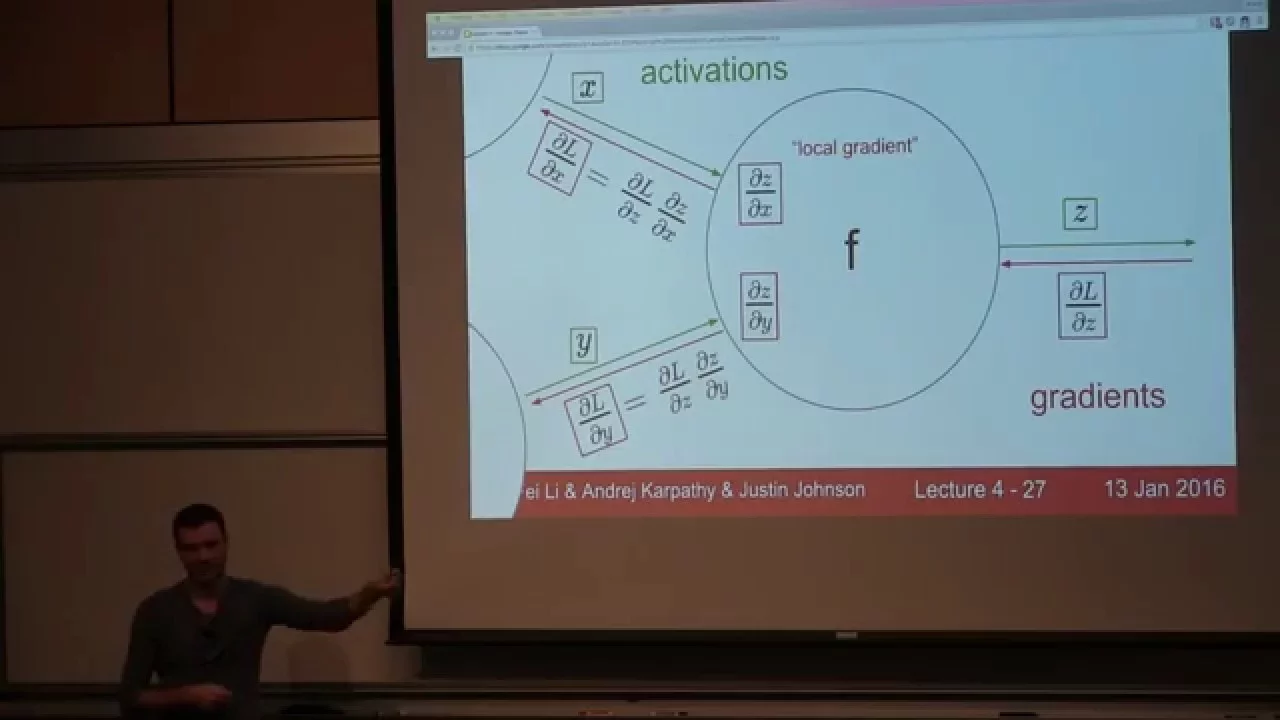
Why this video is valuable
Andrej Karpathy's Stanford lecture demystifies backpropagation. By analyzing computational graphs and applying the chain rule step-by-step, Karpathy teaches you how local gradients are calculated and propagated backward. This structural understanding is essential for writing custom autograd functions and debugging exploding/vanishing gradients in diffusion systems.
Why this video is valuable
Directly addressing the feedback gap for practical coding implementation, this hands-on PyTorch crash course transitions you from theory to software. It walks through tensor manipulation, automatic differentiation with autograd, datasets/dataloaders, and the construction of customizable nn.Module classes. You will write complete training loops, compute losses, and update weights using optimizers.
Knowledge Checkpoint
- Implement a custom PyTorch
nn.Modulewith parameterized linear layers and activation functions. - Explain how computational graphs track operations and calculate gradients via
.backward(). - Debug vanishing gradients using gradient clipping techniques.
- Build a training loop that processes batches of data, calculates cross-entropy loss, and updates weights.
Module 2: Convolutional Networks & Autoencoders
This module transitions from flat dense networks to spatially-aware architectures. You will explore Convolutional Neural Networks (CNNs) for image processing and learn to build autoencoders. This includes Variational Autoencoders (VAEs), which compress high-dimensional pixel matrices into a dense, continuous latent space distribution—the core foundation of Latent Diffusion Models.
Why this video is valuable
This tutorial explains convolution operations, sliding filters, feature maps, and spatial downsampling via pooling layers. It provides the core intuition for how networks extract hierarchical features from images without losing spatial coherence.

Why this video is valuable
Jeremy Howard explains the transition from traditional deep learning to the components that power Stable Diffusion. He breaks down how autoencoders map high-resolution pixel spaces to compressed latent representations (achieving ~48x compression), explaining both the mathematical utility and computational cost reduction of operating in latent spaces.
Why this video is valuable
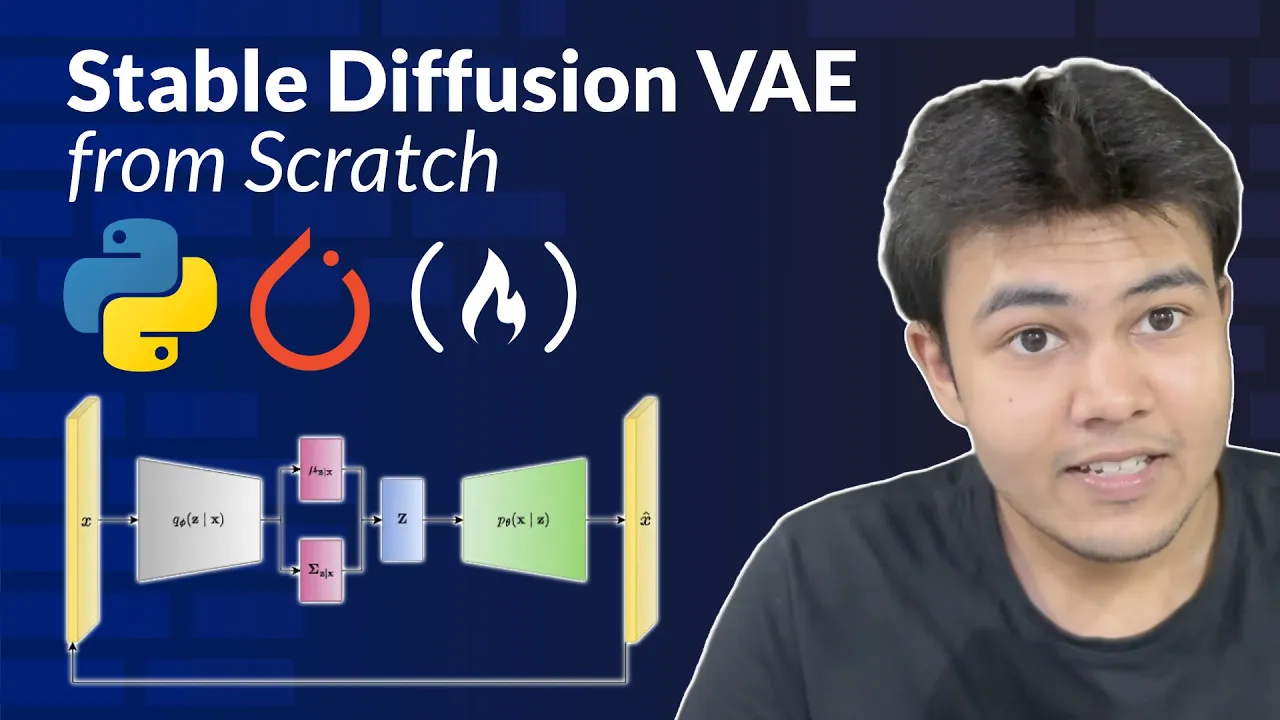
This code-along tutorial teaches you how to construct a complete Variational Autoencoder (VAE) matching the specifications used in Stable Diffusion. You will program the encoder, decoder, and the reparameterization trick (sampling from the distribution by utilizing predicted mean and variance vectors). This is a critical component for compressing image inputs before diffusion.
Knowledge Checkpoint
- Explain the difference between standard Autoencoders and Variational Autoencoders (VAEs).
- Code a custom 2D convolutional block in PyTorch with strides, padding, and batch normalization.
- Implement the Reparameterization Trick to make the bottleneck sampling step differentiable: .
- Write the mathematical loss function of a VAE, balancing reconstruction loss with Kullback-Leibler (KL) Divergence.
Module 3: The Math and Mechanics of Diffusion Models
This module establishes the core mathematical framework of Denoising Diffusion Probabilistic Models (DDPM). You will master the forward process (adding parameterized Gaussian noise to an image over time) and the reverse process (training a neural network to predict and remove noise step-by-step). This module addresses a critical curriculum gap by pairing comprehensive theoretical derivation with a full-length, scratch-built DDPM PyTorch code-along.
Why this video is valuable
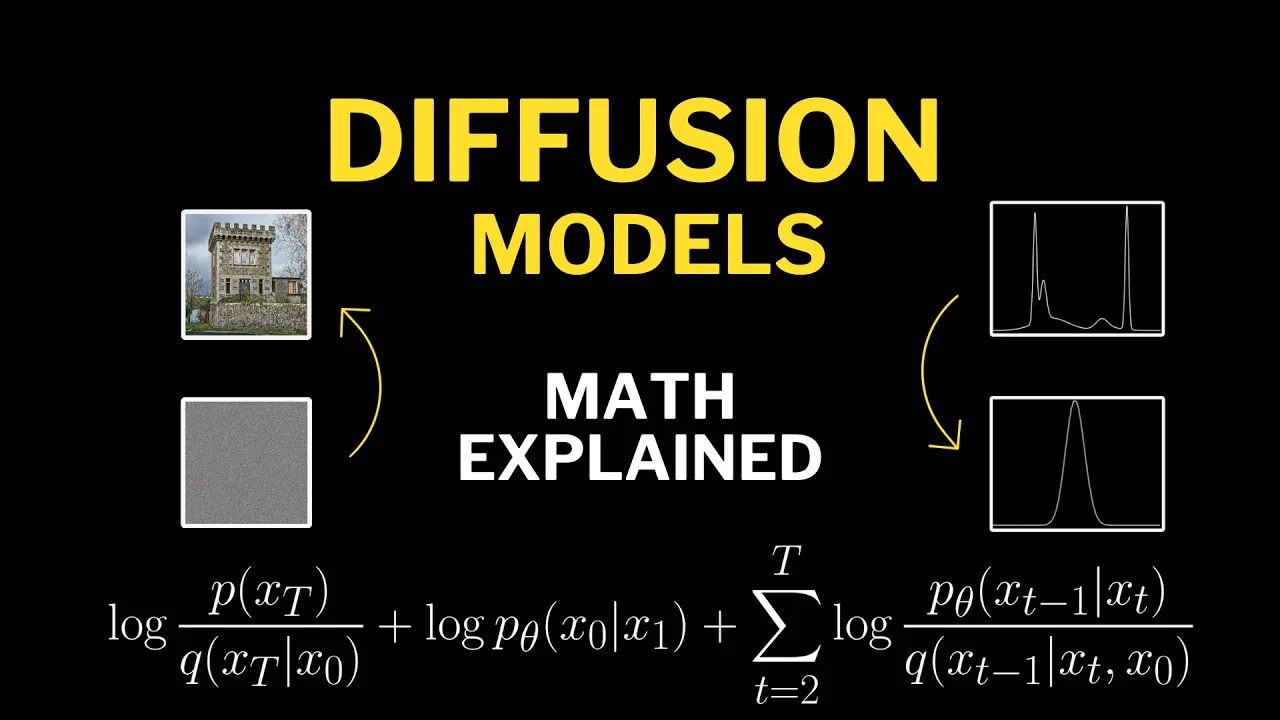
This video provides a comprehensive mathematical derivation of DDPMs. It explains the Markov chain formulation of the forward process, the closed-form equation to sample any arbitrary timestep directly using alpha-cumulating schedules (), and the derivation of the variational lower bound used to train the noise-predicting network.

Why this video is valuable
Directly resolving the lack of long-form DDPM coding tutorials noted in the review feedback, this video guides you through the process of programming a working DDPM from scratch in PyTorch. It demonstrates how to code the forward noise scheduling, implement the objective function, and construct the sampling loop step-by-step.

Why this video is valuable
This guest presentation on 3Blue1Brown provides geometric intuition for diffusion. It frames the reverse process as learning a time-varying vector field that guides points in a high-dimensional space back toward the high-probability manifold of real-world images. This visual bridge helps ground the mathematical abstractions of DDPMs.
Knowledge Checkpoint
- Calculate the forward noising step at timestep using the formula: .
- Explain why predicting noise () is mathematically equivalent to predicting the clean image ().
- Implement a linear or cosine variance schedule () in PyTorch.
- Write a custom DDPM sampling loop that iteratively denoises pure Gaussian noise into structured images.
Module 4: Designing UNet Architectures & Attention Mechanisms
The core engine of modern image generation is the UNet architecture combined with attention layers. This module teaches you how to construct the contracting and expanding paths of a UNet, implement skip connections to preserve high-frequency spatial details, and code Self-Attention and Cross-Attention blocks from scratch.

Why this video is valuable
This video explains the spatial layout of the UNet architecture. It covers how downsampling blocks compress images to extract context, how upsampling blocks reconstruct spatial dimensions, and how skip connections bridge the bottleneck to preserve fine details.
Why this video is valuable
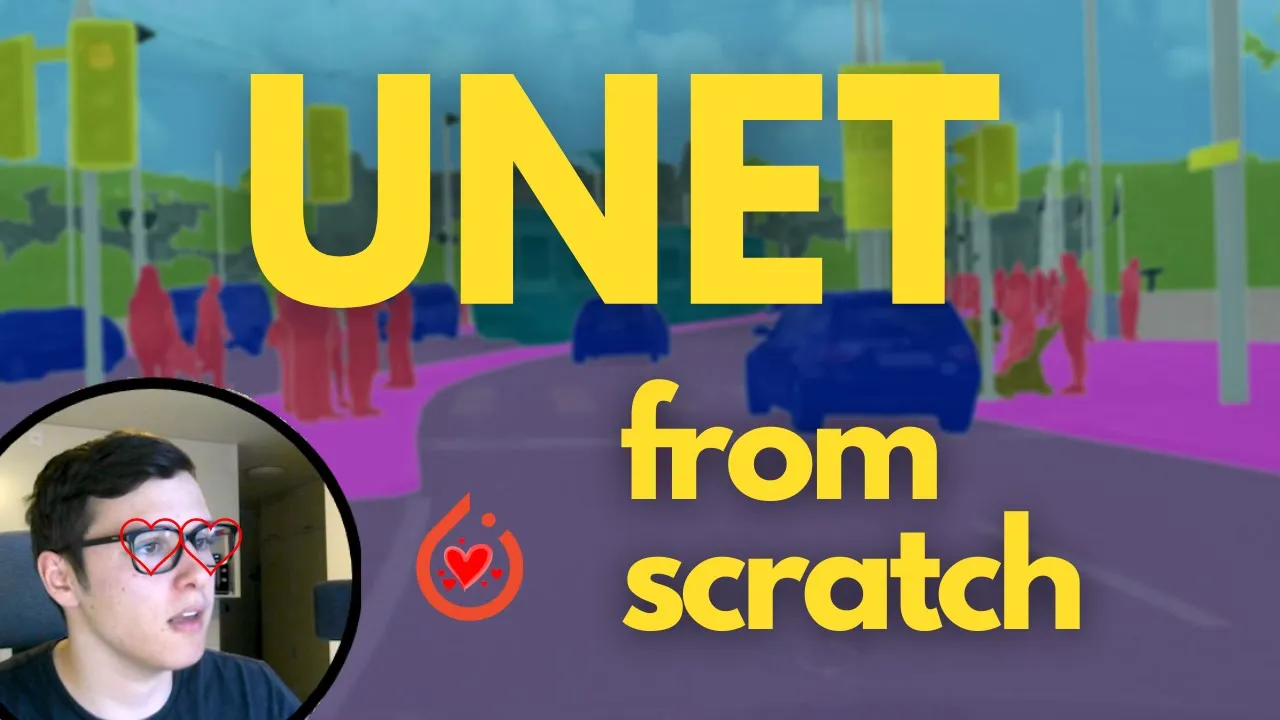
A thorough implementation guide that shows you how to program a complete UNet architecture in PyTorch from scratch. You will build double-convolution layers, downsampling operations, up-convolutions, and concatenate skip-connection tensors along the channel dimension.
Why this video is valuable
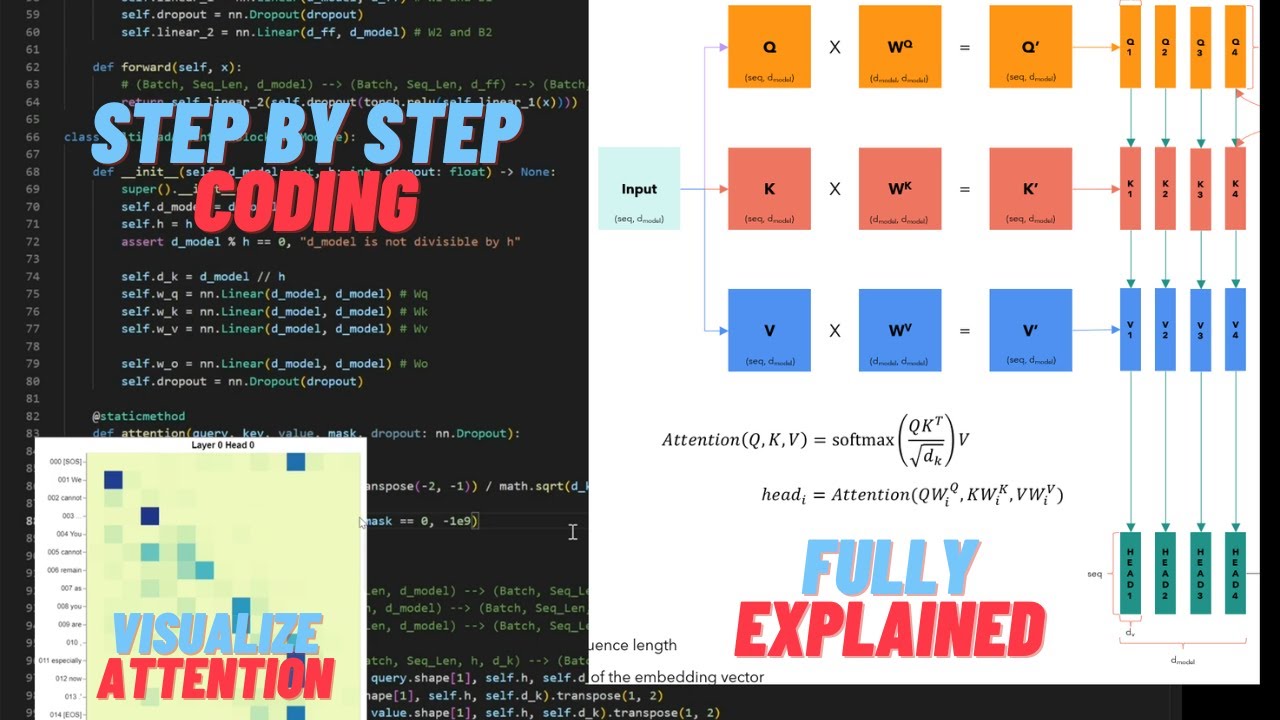
To make a UNet conditional, it must process text or image prompts. This is achieved using attention mechanisms. Umar Jamil's 3-hour masterclass teaches you how to build attention modules from scratch, including Query, Key, and Value () projections, scaled dot-product attention, and multi-head partitioning. This provides the code base needed to implement the Cross-Attention blocks that receive CLIP text embeddings.
Knowledge Checkpoint
- Code a PyTorch module that concatenates skip connections with upsampled feature maps.
- Explain the difference between Self-Attention (where come from the same image tensor) and Cross-Attention (where come from conditional embeddings).
- Implement scaled dot-product attention mathematically: .
- Incorporate time-step embeddings (via sinusoidal positional encodings) into UNet residual blocks.
Module 5: Latent Diffusion & Conditioning (CLIP)
This module integrates your VAE, UNet, and attention mechanics. You will study how Latent Diffusion Models (LDMs) run the diffusion process entirely within the continuous latent space of a pre-trained VAE, and how Contrastive Language-Image Pre-training (CLIP) formats textual descriptions to guide image generation. This module also addresses the mechanics of Classifier-Free Guidance (CFG).

Why this video is valuable
This visual breakdown explains the three primary engines of Stable Diffusion: the Autoencoder (VAE), the UNet backboned with cross-attention, and the CLIP text encoder. It explains how these systems cooperate to run diffusion processes inside a low-dimensional latent space.

Why this video is valuable
This presentation explains the architecture and training objective of CLIP. You will understand how joint contrastive training maps images and captions to a shared latent space, enabling textual descriptions to guide the UNet's reverse diffusion process.

Why this video is valuable
This MIT lecture segment addresses the CFG implementation details highlighted in the review feedback. It explains the mechanics of joint conditional-unconditional training. During training, the conditioning input (text embedding) is randomly zeroed out or replaced with a null token at a fixed probability (e.g., 10-20%). This enables a single model to perform both conditional and unconditional generation.

Why this video is valuable
This video explains the inference-time math of Classifier-Free Guidance. You will learn how to extrapolate noise predictions by combining conditional () and unconditional () directions: , where is the guidance scale.
Knowledge Checkpoint
- Explain how a pre-trained VAE encoder simplifies 512x512x3 images into 64x64x4 latent representations.
- Code a cross-attention layer that aligns UNet intermediate features with CLIP text embeddings.
- Implement Classifier-Free Guidance (CFG) in your sampling script using the extrapolation formula.
- Formulate a training batch where text embeddings are replaced with empty string representations () at a fixed dropout rate.
Module 6: Building and Training LDM from Scratch
This module brings together all the previous components: you will assemble, compile, train, and evaluate a custom conditional Latent Diffusion Model. This module addresses the feedback regarding custom dataset training by providing guides for dataset styling, PyTorch model construction, and training routines.
Why this video is valuable
This video walks through the structural implementation of Latent Diffusion Models. It reviews the integration of VAE latent projections, UNet noise estimation, and cross-attention conditioning, providing a blueprint for your custom system.
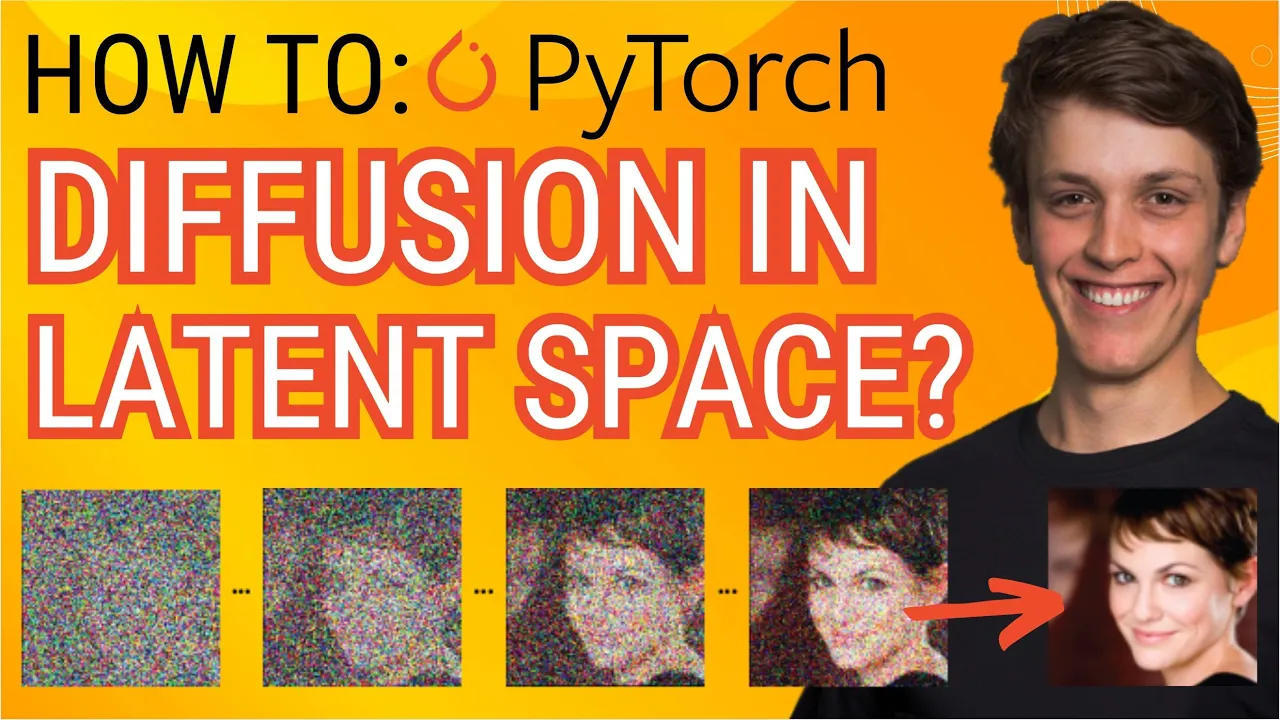
Why this video is valuable
A practical, deep coding tutorial focused on constructing and executing latent diffusion loops inside PyTorch. It demonstrates how to feed compressed latents through the denoising UNet, handle conditional variables, and reconstruct final generated samples back to pixel space using the VAE decoder.
Why this video is valuable
This tutorial addresses the feedback gap regarding custom dataset preparation. It covers formatting custom folders of images, pairing them with metadata text files, tokenizing captions, and feeding the paired datasets into a training script.
Instructional Note: Because fully training a CLIP text encoder and an autoencoder from scratch requires significant computational resources, you are encouraged to use a pre-trained VAE and a pre-trained CLIP model (e.g., from Hugging Face Transformers). Focus your compute budget on training the conditional cross-attention UNet on your custom dataset.
Knowledge Checkpoint
- Build a custom PyTorch
Datasetthat yields paired latent representations (via pre-trained VAE) and tokenized text embeddings (via pre-trained CLIP). - Write the training loss step using PyTorch AMP (Automatic Mixed Precision) to optimize VRAM utilization.
- Sample intermediate outputs during training to monitor the model's convergence and prompt adherence.
- Export your trained UNet weights and combine them with the pre-trained VAE decoder to create a standalone inference pipeline.
Course Map
This flowchart outlines the recommended learning path and dependency structure of the modules.
Key People Index
- Andrej Karpathy (@andrejkarpathy4906): Renowned educator, former Director of AI at Tesla and OpenAI co-founder. His clear explanations of backpropagation and deep learning systems are essential for understanding neural network fundamentals.
- Grant Sanderson (@3blue1brown): Creator of 3Blue1Brown. Known for his visual approaches to mathematics, linear algebra, and neural network mechanics.
- Jeremy Howard (@howardjeremyp): Co-founder of Fast.ai. A prominent educator who teaches top-down deep learning, specializing in making advanced architectures like stable diffusion accessible.
- Jonathan Ho: Lead author of the seminal paper "Denoising Diffusion Probabilistic Models" (DDPM, 2020), establishing the modern mathematical framework for diffusion-based generative AI.
- Robin Rombach: Lead author of the paper "High-Resolution Image Synthesis with Latent Diffusion Models" (CVPR 2022), which introduced the LDM paradigm (the foundation of Stable Diffusion) by shifting the diffusion process from pixel space to latent space.
Final Self-Assessment
Complete this comprehensive self-assessment to verify your mastery of the curriculum.
- I can write a custom autograd function in PyTorch and explain how backpropagation computes gradients across complex layers.
- I can build a 2D Convolutional layer and explain how stride, padding, and dilation impact input spatial dimensions.
- I can construct a Variational Autoencoder (VAE), write out its reparameterization step, and explain why it is continuous compared to standard autoencoders.
- I can explain the math behind the forward DDPM Markov chain and derive how to sample at any step in closed form.
- I can explain the difference between predicting noise () and predicting the clean image (), and implement both loss formulations.
- I can write a complete UNet architecture in PyTorch from scratch, complete with downsampling paths, upsampling paths, and skip connections.
- I can code Scaled Dot-Product Attention, Self-Attention, and Cross-Attention blocks using PyTorch tensor operations.
- I can explain how the CLIP model is trained contrastively and use a pre-trained CLIP model to encode text prompts into conditional embeddings.
- I can explain the training and inference-time math of Classifier-Free Guidance (CFG) and write a sampling script that utilizes it.
- I can write a pipeline that takes a text prompt, generates a latent vector using a custom trained UNet, and decodes that latent vector into a high-fidelity image using a pre-trained VAE.