![[Paper Review] Denoising Diffusion Probabilistic Models](https://i.ytimg.com/vi/_JQSMhqXw-4/maxresdefault.jpg)






![[M2L 2025] 5.2 Diffusion models - Sander Dieleman](https://i.ytimg.com/vi/R4VWB94RLv4/maxresdefault.jpg)


![[논문 리뷰] Diffusion Models Beat GAN on Image Synthesis - 김보민](https://i.ytimg.com/vi/gN1FQhQsUTE/maxresdefault.jpg)


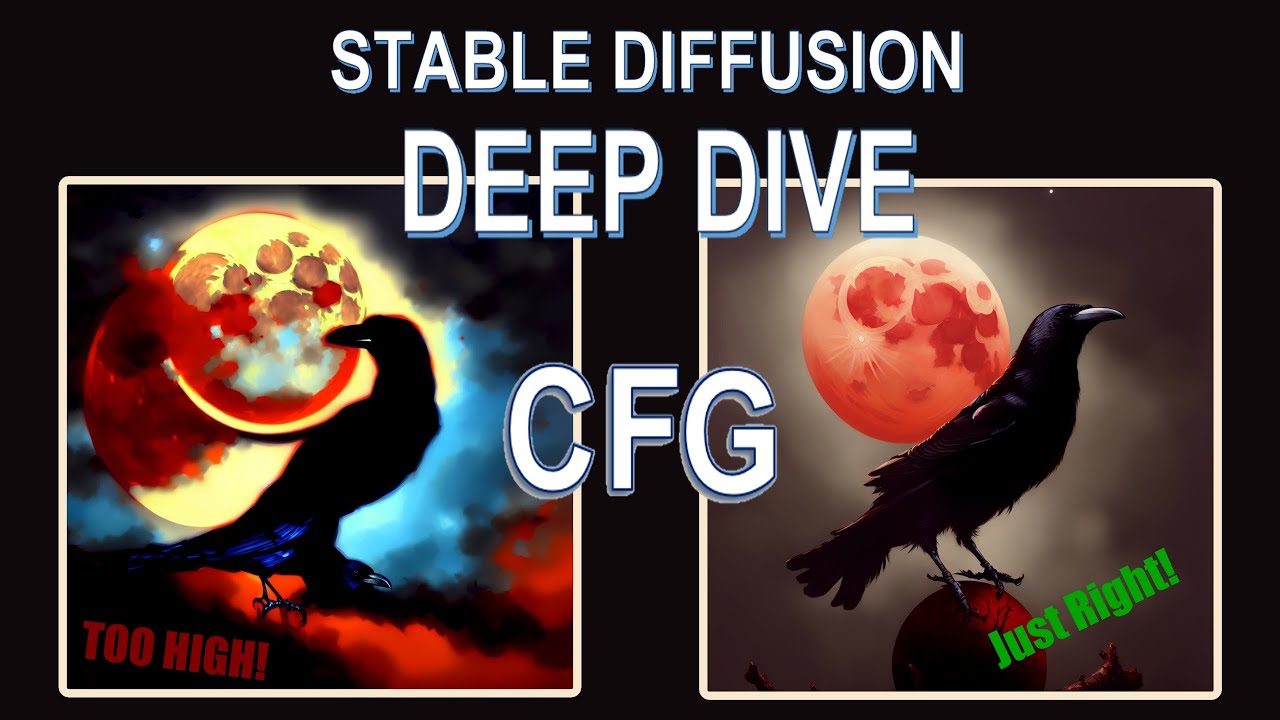


![[ML News] Text-to-Image models are taking over! (Imagen, DALL-E 2, Midjourney, CogView 2 & more)](https://i.ytimg.com/vi_webp/af6WPqvzjjk/maxresdefault.webp)

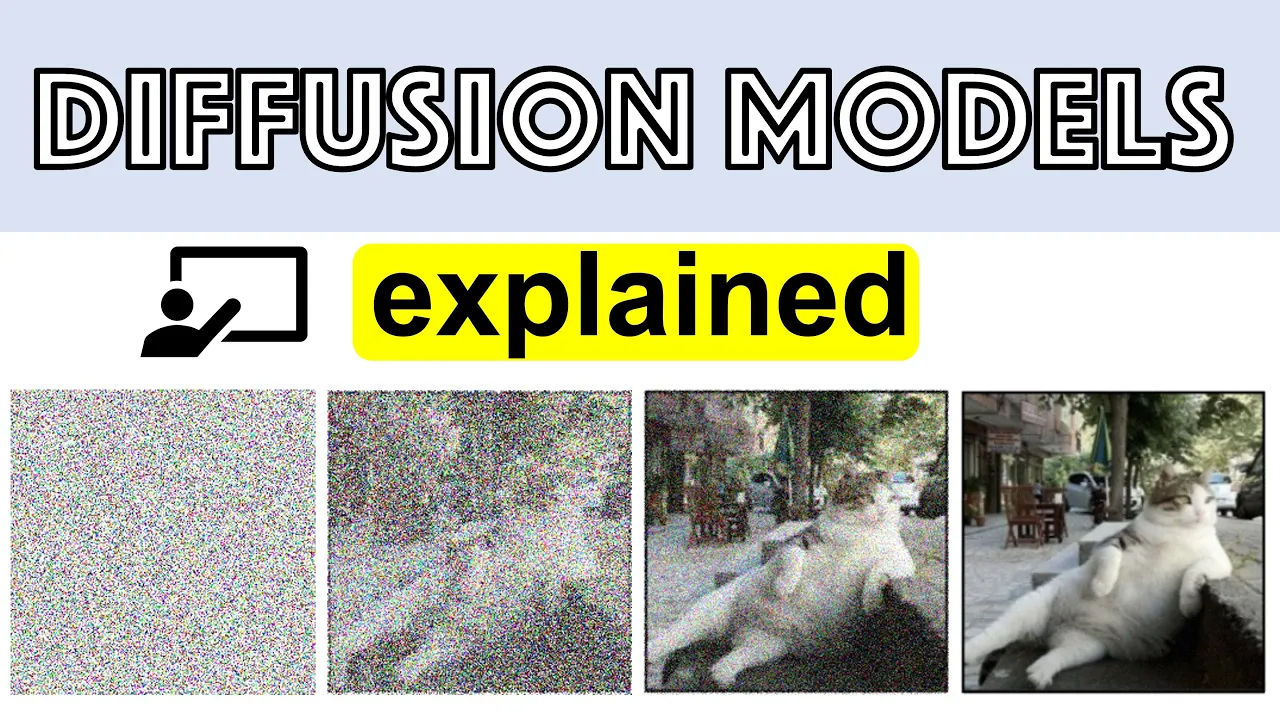

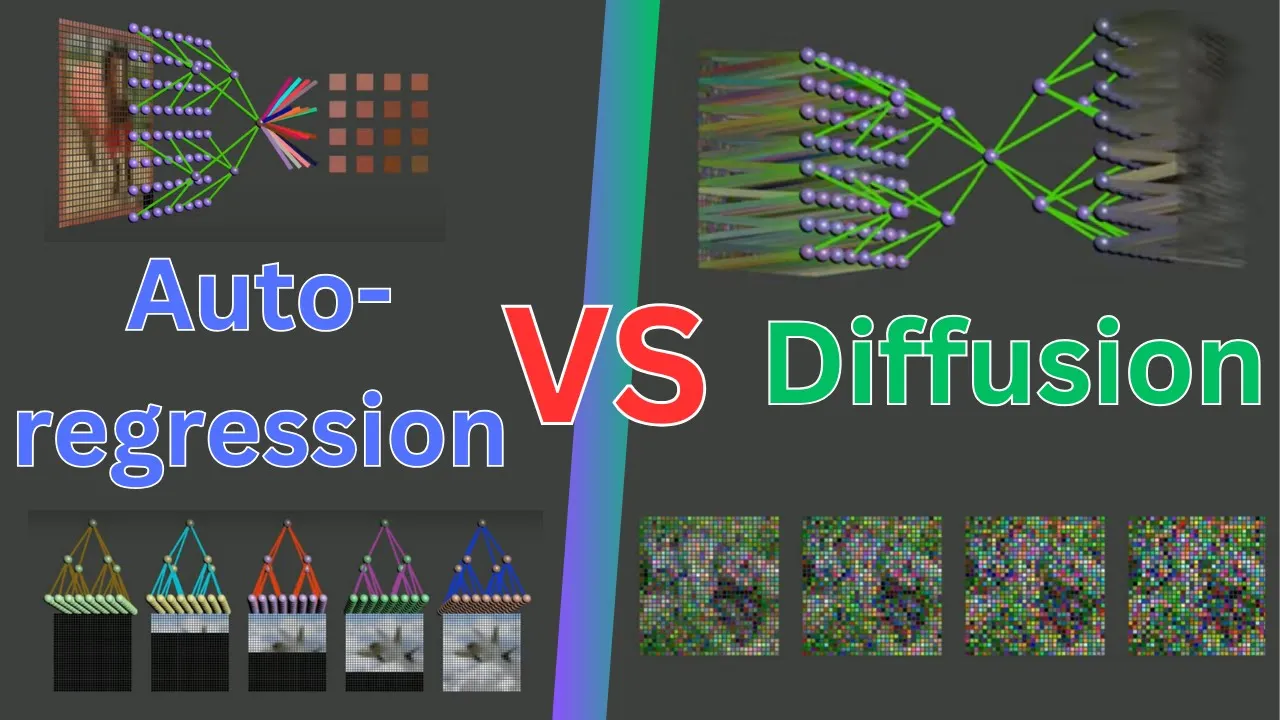


Classifier-free guidance is a technique that jointly trains conditional and unconditional diffusion models without using a separate classifier, combining their score estimates to achieve a trade-off between sample quality (measured by FID) and diversity (measured by IS) by selecting an appropriate guidance strength level.
Classifier-Free Guidance Diffusion Models Explained
Added:The fundamental mechanics of Denoising Diffusion Probabilistic Models (DDPM) and how the forward and reverse processes work.
The concept of score-based generative models and the definition of a 'score' as the gradient of the log probability density.
The difference between conditional and unconditional image generation techniques.
The theory of Classifier Guidance, specifically how an auxiliary classifier is used to guide the diffusion process gradient.
Practical applications of Classifier-Free Guidance in modern text-to-image architectures like Stable Diffusion, Midjourney, and Imagen.
Advanced tuning of the guidance scale, including dynamic thresholding techniques to prevent image oversaturation at high scales.
Methods for accelerating inference, since classifier-free guidance requires dual forward passes (conditional and unconditional) per step.
Alternative and newer guidance paradigms, such as Self-Guidance, Perturbed-Attention Guidance (PAG), and guidance in latent spaces.
103 views0likes5:38Original Release: 2025-09-29
In this video, I introduce a classifier free guidance diffusion models for image synthesis.
Classifier free guidance join a trains a conditional and unconditional diffusion model without using a classifier. And then the resulting conditional and unconditional growth are combined to obtain a trade-off between sample quality and diversity by selecting G level. Similar to classifier guidance, suppose that X is sampled from P and Z depend on lambda.
The diffusion process Q is a variance preserving mark of process as shown here. This is the transition.
P denotes the margin of Z when X is sampled from P and Z is sampled from Q as shown here. Lambda is a log signal to noise ratio and the diffusion processor runs in the direction from lambda maximum to lambda minimum.
Condition on a sample X. The diffusion process is described by the transition here.
The division mean and the variance in the division models are defined as here.
The reverse processes start from normal distribution and is a transition is defined as here where V is a hyperparameter using the rep parameterization.
Here the denoising square matching objective is defined about the denoising square E theta as here where E is a normal distribution and Z lambda is computed from X and E and the lambda is drawing from P lambda. The objective is the noises matching over multiple noise scales.
When P lambda is uniform, the objective is proportional to the variational lower band on the marginal log likelihood.
Similar to truncation in GA, the classifier guidance modifies the diffusion score E theta to include the gradient of the log likelihood of the markillary classifier model P theta as shown here. This is the grid of a classifier where C is a conditional information and the parameter omega controls the stress of the classifier guidance.
E S theta k replaces E set when sampling from the diffusion model as shown here because the classifier guidance mixes a score with a classifier gradient during sampling. Classifier guidance diffusion sampling can be interpreted as attempting to confuse a image classifier with a gradient based adversarial attack. Here is some samples generated by using classifier guidance diffusion model.
Passifier free guidance trace of inception grow and file inception distance grow by mixing the growth of a conditional and unconditional diffusion model instead of training a separate classifier. The classifier free guidance transfer and conditional den noiseise diffusion model P set theta parameterized through a zero estimate E theta together with a conditional model P theta parameterized through E theta.
A single neuronet network is used to parameterize both models where C is empty for the unconditional model EA and conditional and conditional models are joined trained by randomly setting C is empty with some probability P zero.
The modified scroll E theta t is computed by using this equation that is explained graphically in this figure.
Once fire free guidance can attain FID and is tradeoff.
Weaker stren reaches the bas f while strong stren reaches the b is grow.
Here are some samples generated by using classifier free by this diffusion model.
For more details please check with these references. Thank you.
Up Next
13:53
Latent Diffusion Models with U-Nets: A PyTorch Deep Learning Tutorial
@LukeDitria
2.6K views•2024-08-25

57:48
Secure Multiparty Computation (MPC): Foundations & Challenges
@SimonsInstitute
7.3K views•2015-05-28

13:03
Bypassing Tor Censorship: Bridges and Pluggable Transport Guide
@Coding_ForEveryone
397 views•2024-06-11
18:41
Neural Networks Explained: Math, Layers, and Learning Fundamentals
@3blue1brown
21.9M views•2017-10-05
Related Study Plans & Knowledge Roadmaps
Structured learning paths in Artificial Intelligence
artificial-intelligence
Aligning LLMs: DPO, TRL & Custom Datasets
01Foundations of Python & Machine Learning
02Transformers and Large Language Models (LLMs)
03Aligning LLMs: SFT and RLHF
+ 3 more learning modules
24h6 modules
Explore Roadmap
artificial-intelligence
Federated Learning: PyTorch, Flower & Privacy
01Python & Machine Learning Foundations
02Deep Learning Basics with PyTorch
03Introduction to Federated Learning
+ 2 more learning modules
35h5 modules
Explore Roadmap
artificial-intelligence
Securing LLMs: Guardrails AI & NeMo Gateway
01Introduction to LLMs, Python, and APIs
02Understanding LLM Vulnerabilities & Threats
03Defending LLMs with Guardrails AI
+ 2 more learning modules
15h5 modules
Explore Roadmap
artificial-intelligence
Building Recommenders: Two-Tower & Vector DBs
01Foundations of Python & Machine Learning Basics
02Introduction to Recommender Systems
03Deep Learning & Representation Learning
+ 3 more learning modules
75h6 modules
Explore Roadmap