Layer 2 solutions are scaling technologies built on top of Ethereum's Layer 1 network to address congestion and high transaction fees by processing transactions off-chain while maintaining security through periodic settlement to the main network; these solutions include rollups (which bundle transactions and submit proofs to L1), state channels (which enable direct peer-to-peer transactions with periodic state updates), and validiums (which store transaction data off-chain while only submitting proofs to L1), collectively enabling Ethereum to support more applications like DeFi, gaming, and NFTs while keeping over $30 billion in assets locked in the ecosystem.
Ethereum Layer 2 Scaling Solutions: Rollups, Sidechains, Validiums
Added:Deep Dive
Basic blockchain fundamentals, specifically how Ethereum operates, including gas fees, block times, and smart contracts.
Ethereum in 30 minutes by Vitalik Buterin | Devcon Bogotá
38.2K
Ethereum is a general purpose blockchain combining blockchains (consensus, censorship resistance, always available) with general purpose platforms (innovation, network effects). The architecture includes blocks created every 12 seconds containing transactions, with attestations from validators confirming blocks. The state consists of Externally Owned Accounts (user balances) and Contracts (self-executing programs with code and storage). Transactions follow a flow: sender pays fees, balance transfers to proposer, contract executes with encoded data. Gas measures resource consumption: base 21,000 gas, computational steps 2-10 gas, storage 5,000-20,000 gas, data 16 gas/byte. Max 30,000 gas per block allows ~1,400 simple transactions.
Click to watch →

ETHEREUM: COS'È e COME FUNZIONA SPIEGATO SEMPLICE | Corso BASE di Crypto Ep. 7
59.1K
Ethereum is a decentralized 'world computer' enabling programmable applications beyond simple value transfer. It operates as a state machine where each transaction changes the network's state, creating transitions from 'world state before' to 'world state after.' The network uses Proof of Work (transitioning to Proof of Stake) with memory-intensive mining requiring GPUs. Block time is 12 seconds with 15-20 transactions per second throughput. Ethereum has two account types: Externally Owned Accounts (EOAs) controlled by private keys, and Contract Accounts (Smart Contracts) controlled by code. Smart contracts are deployed at specific addresses with executable code that determines their behavior. The Ethereum Virtual Machine (EVM) executes smart contract code, processing inputs, modifying data within contract memory, and updating the network state. Decentralized applications (dApps) are composed of multiple interacting smart contracts including factory contracts, pool contracts, router contracts, and oracle contracts. Gas prevents network spam by assigning costs to all operations, with simple transfers costing 21,000 gas units and complex operations costing more. The gas price operates like an auction system where users compete by offering higher prices.
Click to watch →
XRP vs Ethereum: Which is the Better Investment?
4.7K
Ethereum was created because Bitcoin could only handle simple money transfers. Like a smartphone that can only make calls and send texts, Bitcoin's blockchain is limited to recording money transfers. Ethereum, created by Vitalik Buterin in 2015, is a programmable blockchain that can execute smart contracts—self-operating agreements written in code. This allows developers to build applications on top of the blockchain. Comparing the two: Bitcoin is like digital gold—a store of value with simple transactions. Ethereum is like digital oil powering a vast ecosystem of applications. Smart contracts are self-executing agreements written in code that live on the Ethereum blockchain. Once deployed, they run exactly as programmed without anyone being able to change or interfere with them. They execute automatically when conditions are met, eliminating the need for middlemen. Gas fees are the costs of running transactions and smart contracts on Ethereum, serving three purposes: preventing network spam, compensating validators, and allocating resources fairly. Simple transfers use ~21,000 gas units, while complex DeFi transactions can require 500,000+ gas units.
Click to watch →
Comprendre ETHEREUM (le web 3.0)
9.5K
Ethereum is a global, open-source platform for decentralized applications (dApps), functioning as a world computer that cannot be shut down. Smart contracts are programmable agreements that enable parties to define transaction conditions without trusting third parties, operating on 'if this, then that' principles. Ether (ETH) is the native currency used for transactions and paying gas fees. Gas represents the computational effort required for operations, with fees fluctuating based on network demand. Higher gas fees prioritize transactions during congestion, while lower fees result in longer processing times. This system enables automated, transparent financial services without intermediaries.
Click to watch →
Ethereum Explained! 🚀 (Ultimate Beginners’ Guide! 📚) How Ethereum Works 💻 & Why it's Undervalued 🤑
255.1K
This comprehensive section covers the foundational concepts of blockchain technology and Ethereum's role within the crypto ecosystem. It explains the three pillars of blockchain: decentralization (distributed data storage without central control), transparency (publicly accessible transaction records), and immutability (unmodifiable data through cryptography). Vitalik Buterin created Ethereum in 2013 as a blockchain-based software platform, distinguishing it from Bitcoin's role as digital currency. The section details how Ethereum enables decentralized applications (dapps) and smart contracts, while introducing Ether (ETH) as the native cryptocurrency that fuels network operations. It contrasts Bitcoin's fixed supply model with Ethereum's deflationary mechanism where network usage burns more Ether over time. Finally, it explains the gas fee system using Gwei units to calculate transaction costs based on computational complexity and bandwidth requirements.
Click to watch →
Deep Dive
The Blockchain Trilemma, which explains the trade-offs between decentralization, security, and scalability.

Silvio Micali: Cryptocurrency, Blockchain, Algorand, Bitcoin & Ethereum | Lex Fridman Podcast #168
526.2K
The blockchain trilemma states that achieving all three properties simultaneously is impossible: scalability (handling many transactions quickly), security (preventing tampering), and decentralization (distributed control). Most systems must sacrifice one property. Bitcoin prioritizes security and decentralization but sacrifices scalability, handling only ~7 transactions per second. Proof of Work solves consensus through cryptographic puzzles but creates centralization as mining becomes expensive. Delegated Proof of Stake selects representatives but remains highly centralized. Pure Proof of Stake uses random sampling of token holders to maintain decentralization while enabling fast transactions, addressing the trilemma through probabilistic methods rather than deterministic ones.
Click to watch →
7. Technical Challenges
264.3K
Vitalik Buterin's trilemma proposes that blockchain systems can achieve only two of three desirable properties simultaneously: decentralization, scalability, and security. This mirrors the contractor dilemma where good, cheap, and quick cannot all be achieved together. Real-world examples illustrate these trade-offs: Bitcoin handles ~7 TPS while Visa processes ~20,000 TPS; proof-of-work consumes energy equivalent to Austria's consumption; and regulatory demands for transparency conflict with privacy needs. The debate continues about whether technological advancement can eventually achieve all three properties, with some believing it will take decades while others remain optimistic about solutions emerging from computer science innovation.
Click to watch →

Lecon 01- Comprendre la blockchain avec Zafir SAWADOGO
3.8K
The blockchain trilemma describes three fundamental challenges developers must balance: decentralization (no single entity controls the network), security (preventing unauthorized modifications), and scalability (handling transaction volume). Decentralization ensures no single point of failure. Security prevents corruption and unauthorized access. Scalability determines how many transactions per second the network can process. Traditional payment processors like Visa handle ~15,000 transactions per second, while blockchains like Solana can process 175,000-200,000 transactions per second. Optimizing one element often impacts the others, requiring careful trade-offs in system design.
Click to watch →

POLKADOT, O FUTURO DAS BLOCKCHAINS ft Lauro Gripa | DOMINGÃO DO BITCÃO #110
53.6K
The blockchain trilemma is the fundamental challenge that blockchains face in balancing three competing properties: scalability (the ability to process many transactions quickly), security (protection against attacks and fraud), and decentralization (distributed control without central authority). Most blockchains can only achieve two of these three properties simultaneously. For example, Bitcoin prioritizes security and decentralization but sacrifices scalability, while Ethereum has focused on scalability through Layer 2 solutions.
Click to watch →

I CAN’T BELIEVE FIDELITY IS THIS BULLISH ON BITCOIN. 5 TRILLION AUM.
21.4K
This segment explains the fundamental trade-offs in blockchain design known as the trilemma. The three competing priorities are: (1) Security - how likely a network can be attacked or compromised; (2) Decentralization - how much control any single entity may have over the system; (3) Scalability - how well the network can handle growth and transaction volume. The report identifies scalability as Bitcoin's Achilles heel, noting that transaction fees spiked significantly during high-traffic periods like 2017 and 2021. The report uses Bitcoin Cash as a case study of the trade-offs involved in prioritizing scalability over security and decentralization. The report notes that despite these limitations, Bitcoin's market cap is over 100 times greater than Bitcoin Cash, indicating investor preference for security and decentralization over faster transactions.
Click to watch →
Deep Dive
The concept of Layer 1 (L1) mainnet settlement and why network congestion necessitates off-chain computation.

BITCOIN For Dummies: EVERYTHING You Need To Know
204
Layer 2s perform execution (smart contract calls, transfers) off-chain, then submit batched data to Layer 1 for settlement. This reduces Layer 1 load and costs. Layer 2s have their own fee pools and execution environments. The trade-off is that Layer 2s are more centralized and less secure than Layer 1s, as fewer nodes can compromise them.
Click to watch →

Stop Leaving Your Bitcoin on Exchanges (Do THIS Instead)
143
Layer 2 transactions ultimately settle on the base layer (Layer 1). A useful analogy is a restaurant tab: individual items ordered throughout the night (Layer 2 transactions) are processed on the restaurant's system, but only when the tab is closed out does the final transaction go to the bank (Layer 1 settlement). Similarly, Layer 2 transactions like Lightning payments are processed off-chain and only settle on the main Bitcoin blockchain when necessary.
Click to watch →
Blockchain Layers : L0, L1, L2, L3 — The Secret to Speed, Security & Scalability! 🔒 | InfoSecTube
151
Layer 1 is the actual blockchain where transactions happen and get recorded forever. Examples include Bitcoin (for digital money storage), Ethereum (for smart contracts and applications), Cardano, Solana, and BNB. The main problem with Layer 1 is that it can become slow and expensive when many users transact simultaneously, similar to a highway during rush hour with too much traffic and high gas fees. This congestion issue is the primary challenge that Layer 2 solutions aim to address.
Click to watch →

Why Bitcoin’s DeFi Moment Is Finally Here | Stacks Co-Founder Muneeb Ali | Exclusive
1.6K
A fundamental architectural distinction exists between the settlement layer (L1) and hot wallet layer (L2). The L1 is where Bitcoin is defined and lives - cold storage for savings accessed infrequently. The L2 is where most user activity happens - hot wallets for frequent transactions. This separation is mathematically necessary because a billion users cannot all own UTXOs on the main chain. The L2 provides faster, cheaper transactions while maintaining L1 security. This architecture addresses the security budget challenge where declining coinbase rewards and low fees threatened long-term network security.
Click to watch →
The Biggest Shift in Crypto’s History Is Here… and Everyone’s Distracted by Bitcoin & Ethereum
668
The breakthrough in crypto architecture is realizing that apps don't need to run inside one global execution environment. They just need a global database underneath them where they can post order transactions, verify state changes, and synchronize with other applications. In crypto terms, Layer 1 becomes a settlement and data availability layer, not an execution layer. Layer 2s become the actual app chains, and every fintech exchange, neo bank, and startup can operate as its own chain without rebuilding itself inside the EVM.
Click to watch →
Deep Dive
Elementary cryptography concepts, such as Merkle trees, hashing, and the basic premise of Zero-Knowledge proofs.
END SEM: Blockchain Unit 1 | Last Minute Revision | All Topics in 1 Shot
220
Cryptographic foundations enable blockchain security: (1) Hash functions - mathematical algorithms producing fixed-size outputs from any input; properties include determinism, fixed output size, fast computation, pre-image resistance, and collision resistance; used for block linking, data integrity, Merkle trees, and digital signatures; (2) Digital signatures - verify transaction authenticity using private key signing and public key verification; provide authentication, data integrity, and non-repudiation; (3) Public key cryptography - uses key pairs (private for signing, public for verification); enables trustless transactions without central authority. Key management is critical - losing a private key means permanent loss of funds, while exposing it allows theft. Merkle trees are binary tree data structures enabling efficient transaction verification: construction involves hashing each transaction to create leaf nodes, combining pairs recursively until a single root hash remains. Advantages include data integrity, scalability, compact storage, fast verification, and privacy. Zero-knowledge proofs (ZKPs) enable one party to prove a statement is true without revealing underlying information. Core properties: (1) Completeness - honest verifier convinced if statement true; (2) Soundness - no cheating prover can convince if statement false; (3) Zero-knowledge - verifier learns nothing beyond truth. Types include interactive and non-interactive. Applications in blockchain: (1) Privacy coins - proving transaction validity without revealing amounts or addresses; (2) Anonymous credentials - proving identity attributes without revealing personal information; (3) Confidential smart contracts - executing contracts without revealing sensitive data; (4) Secure voting - proving vote validity without revealing votes. Advantages include high privacy and no third-party verification needs, though limitations include high computational cost and complex implementation.
Click to watch →

Stanford Seminar: IPFS and the Future of the Permanent Web
103K
Merkle trees use cryptographic hashing to create content-addressable links. In HTTP, resources are addressed by location (IP address), but Merkle linking uses the content itself to determine the link. Cryptographic hashes have the critical property that no pre-image can produce the same hash value (breaking this would compromise systems like Bitcoin). If any bit of content changes, the cryptographic hash changes, making the link different. This immutability enables verification: anyone can verify that content hasn't changed by checking the hash. This is why systems like Git, Bitcoin, and IPFS rely on Merkle trees.
Click to watch →
Найдена "молекула памяти" в мозге | ПУШКА
400.7K
Zero-knowledge proof is a cryptographic concept that allows one party to prove they know specific information without revealing what that information actually is. This concept, which won the Abel Prize in mathematics, has revolutionized cryptography by enabling trust without information disclosure. The video illustrates this through a puzzle: 100 office workers, one stole a paperclip. Two colleagues independently suspect different people but don't want to reveal their suspicions. The solution involves assigning numbers to workers, writing suspected numbers on separate stickers, and having a trusted third party compare numbers. If numbers match, they suspect the same person; if different, they suspect different people. This demonstrates how to verify information without revealing the actual information.
Click to watch →

A Gentle Introduction to Merkle Trees
117
A Merkle tree is a binary tree data structure where leaf nodes store hashes of data chunks and internal nodes store hashes of their children, enabling efficient data compression and verification; the Merkle root serves as a succinct commitment to the entire dataset, and Merkle proofs of inclusion allow verification of data membership using only the data item and sibling hashes along the path to the root, with proof size logarithmic in the number of leaves.
Click to watch →
ZK8: SAFE: Faster and simpler hashing for ZKPs - JP Aumasson - Taurus
217
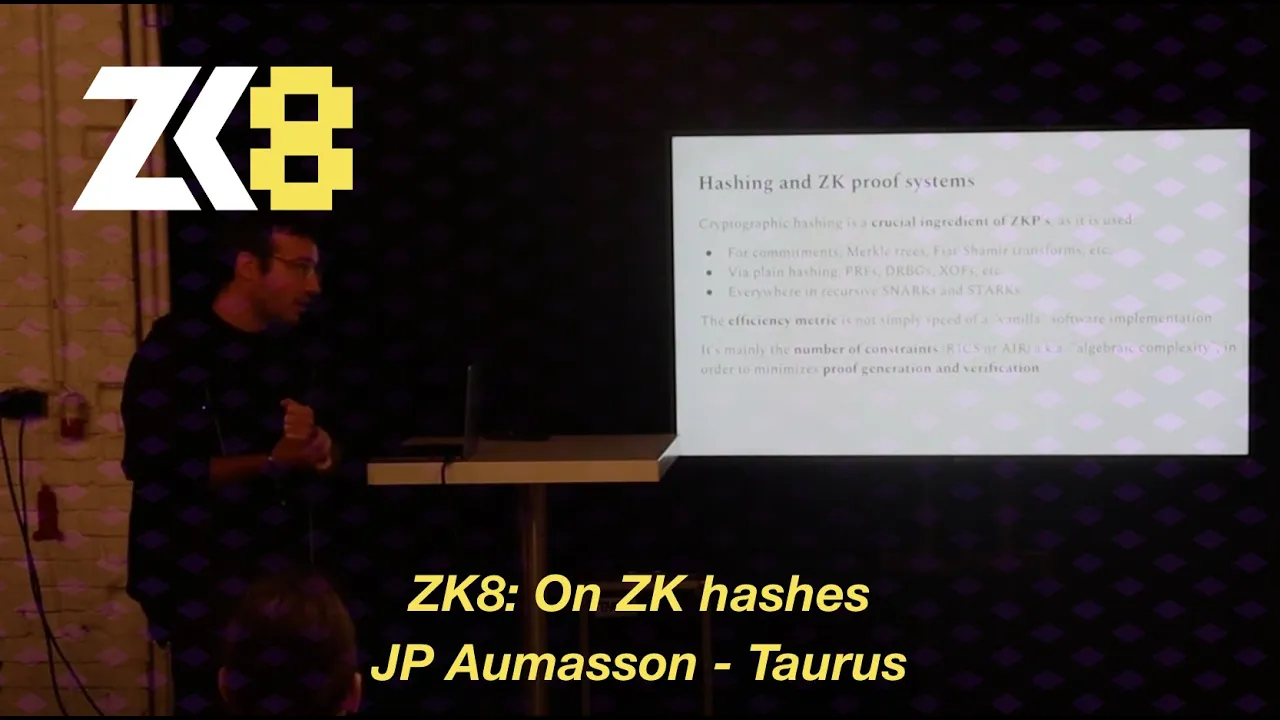
Hashing is fundamental to ZK proofs, appearing in commitments, Merkle trees, and transforming interactive protocols to non-interactive ones. General-purpose hash functions like Blake2 and SHA-256 are suboptimal because XOR operations are painful in finite fields, creating many constraints. ZK-friendly hash functions like Poseidon (designed in 2019) are orders of magnitude faster and smaller, specifically designed for algebraic structures in proof systems.
Click to watch →
Prerequisite Knowledge
- Concept 01Basic blockchain fundamentals, specifically how Ethereum operates, including gas fees, block times, and smart contracts.
- Concept 02The Blockchain Trilemma, which explains the trade-offs between decentralization, security, and scalability.
- Concept 03The concept of Layer 1 (L1) mainnet settlement and why network congestion necessitates off-chain computation.
- Concept 04Elementary cryptography concepts, such as Merkle trees, hashing, and the basic premise of Zero-Knowledge proofs.
Subsequent Learning
- Step 01A deep-dive comparative analysis of Optimistic Rollups (using fraud proofs) versus Zero-Knowledge Rollups (using validity proofs).
- Step 02The mechanics of cross-chain bridging, asset wrapping, and the associated security risks of moving liquidity between L1 and L2.
- Step 03Ethereum's data availability layer upgrades, specifically EIP-4844 (Proto-Danksharding) and its impact on L2 transaction costs.
- Step 04The design and trade-offs of Layer 3 (L3) solutions and application-specific blockchains (AppChains).
- Step 05The governance and centralization risks of L2s, such as single-sequencer reliance and the role of 'escape hatches' for user funds.
L2 Intro
L1 Limits
L2 Purpose
L2 Types
How They Link
Core Benefits
Adoption Stats
L2 Intro
0:05Playing Section
- 1
Video begins with data transfer on layer 2 solutions.
- 2
Focus shifts to core scaling problem and basic purpose.
Monolithic Layer 1 Scaling and L2 Fragmentation
While Ethereum's roadmap relies heavily on Layer 2 (L2) rollups, sidechains, and validiums to achieve scalability, critics argue this modular approach introduces severe trade-offs. Proponents of 'monolithic' Layer 1 (L1) blockchains (like Solana or Aptos) contend that scaling should be solved natively on a single, highly optimized base layer. They point out that Ethereum's L2 ecosystem fragments liquidity, splinters the developer and user experience, and introduces security vulnerabilities through bridging. Furthermore, many current L2s rely on centralized sequencers, which undermines Ethereum's core promise of decentralization and censorship resistance. From this perspective, a unified, high-performance L1 offers a more seamless, secure, and efficient scaling path than a complex web of secondary networks.
Deep Dive
A deep-dive comparative analysis of Optimistic Rollups (using fraud proofs) versus Zero-Knowledge Rollups (using validity proofs).
Nick White || COO of Celestia Labs: Modular Blockchains | Logan Jastremski Podcast #11
1.4K
Fraud proofs (optimistic roll-ups) assume an honest node watches and re-executes transactions, catching cheating through proofs. Validity proofs (zero-knowledge roll-ups) generate succinct proofs that execution is valid, verifiable without watching. The key distinction is where proofs are verified: client-side (sovereign rollups) or on a settlement layer like Ethereum (non-sovereign). Celestia supports both, enabling sovereign rollups that are independent blockchains sharing only the data availability layer.
Click to watch →

ZK Podcast: Optimistic vs ZK Rollup with John Adler
1.1K
Optimistic rollups use fraud proofs with optimistic updates (assuming validity until challenged), while ZK rollups use validity proofs (zero-knowledge proofs) for immediate finality; however, both approaches fundamentally face the same scalability limitations because full nodes must still download and verify all transaction data, meaning true scalability comes from execution model optimizations (like UTXO-based parallel processing) and segmented trust boundaries rather than proof type alone.
Click to watch →

Everything you need know to Spin Up Your Own Rollup - Uttam Singh
108
Optimistic rollups assume correctness with a 7-day challenge period using fraud proofs submitted by verifiers who re-run transactions. Delay attacks from spam proofs can prevent finalization, requiring permissionless fraud proofs. ZK rollups use validity proofs where provers generate mathematical proofs without revealing information. While historically expensive, ZK proofs are becoming cheaper and faster, with real-time Ethereum proving now possible in under 12 seconds.
Click to watch →

zkEVM L2s Will Scale Ethereum | Scroll
2.5K
Layer 2 scaling solutions are divided into two main categories: optimistic rollups and zero-knowledge (ZK) rollups. Both approaches involve sending transactions to a centralized Layer 2 node that generates blocks, then submitting proofs to the Layer 1 chain. The key difference lies in their proof mechanisms. ZK rollups use validity proofs - cryptographic proofs that mathematically guarantee all transactions in a block are correct. If the computation were incorrect, no valid proof could be generated. Optimistic rollups use fraud proofs, which rely on an economic challenge game where anyone can submit a transaction result and others can verify it locally. If discrepancies are found, they initiate a challenge period to determine validity, which introduces delays in withdrawal times.
Click to watch →

zku.ONE #06: Practical Session for Assignment 2
497
The instructor provides an in-depth comparison between optimistic and zero-knowledge rollups. Key distinctions include: (1) Time efficiency - zk-rollups offer faster finality while optimistic rollups require a one to two-week fraud challenge period; (2) The fraud challenge period is a system parameter representing estimated time sufficient for fraud detection; (3) Liquidity providers in optimistic rollups run their own L2 nodes to proactively verify transactions and charge fees for early withdrawal; (4) Collateralization can mitigate fraud risk but increases entry barriers and reduces liquidity; (5) Zero-knowledge proofs can provide security guarantees without requiring collateralization, improving system efficiency; (6) Many Layer 2 solutions sacrifice finality for speed, with transactions appearing final immediately but potentially being voided if fraud is detected.
Click to watch →
Deep Dive
The mechanics of cross-chain bridging, asset wrapping, and the associated security risks of moving liquidity between L1 and L2.

The Daily Gwei AMA Series #7 - 7th of August, 2021
7K
When bridging funds from L1 to L2, funds are sent to a bridge contract on Ethereum and locked there. The L2 network then looks at the contract state and mints equivalent funds on the L2. Withdrawal times vary: Optimistic rollups like Optimism have a 7-day withdrawal period, while zk rollups can be faster (hours to minutes). Side chains like Polygon POS have different security guarantees - if the side chain goes offline, funds may be stuck. The bridge process is decentralized and trustless, using call data to store L2 proofs on L1.
Click to watch →
LayerZero CEO Brian Pellegrino on Interoperability, Stablecoins, and Bringing TradFi On-Chain
139
Wrapped assets in cross-chain bridges create significant security risks because users no longer hold the actual underlying assets. When bridging assets between chains, the destination contract controls the assets, meaning users carry risk perpetually—not just during the bridging process but forever as long as they hold the asset. This risk can materialize through various scenarios: bugs in the destination contract, malicious upgrades, or compromised messaging protocols. Since users cannot directly interact with their assets, they are vulnerable to any issues in the supply chain. This fundamental shift in the user's relationship with their assets represents a critical security concern in the interoperability space.
Click to watch →

Entretien avec Ahmed Al-Balaghi CEO de Biconomy | ETHDenver 2022 Ξ
678
Bridge security is a critical priority in cross-chain infrastructure. Native bridges that use single-sided pools of the same asset on different chains offer lower security risks compared to traditional minting and wrapping bridges. These liquidity layers also enable faster transfers and cheaper costs, representing a fundamental trade-off in the bridging space that will evolve as the market matures.
Click to watch →
![리플 VS 솔라나 VS 이더리움 '이 코인' 불장 주인공된다! l [토크라운지 김남웅 풀버전]](https://i.ytimg.com/vi/kFajyMQR11A/maxresdefault.jpg)
리플 VS 솔라나 VS 이더리움 '이 코인' 불장 주인공된다! l [토크라운지 김남웅 풀버전]
44K
Cross-chain bridges that transfer assets between blockchains (like wrapped BTC on Ethereum) introduce security risks that must be carefully evaluated. Unlike native assets on their home chains, bridged assets rely on the security of the bridge protocol itself. If a bridge is compromised or forks unexpectedly, the bridged assets may be lost or duplicated. This risk is particularly relevant for assets like stBTC, which represents a bridge-based version of Bitcoin rather than native BTC, requiring careful consideration of the underlying security architecture.
Click to watch →

ROLLUP: 3AC Meltdown Continued | BlockFi Down Bad | Grayscale Sueing the SEC | Contagion Market?!
13.7K
Bridging to a layer 2 has different risks than bridging to an alternative layer 1 (like Solana or Avalanche). Layer 2 bridges are trustless and immutable, working regardless of security dependencies on the chain itself. Alternative layer 1 bridges can be destroyed if security assumptions on the other chain fail. Layer 2 bridges are always a bridge of last resort—if the bridge goes down, the whole network goes down, making them less risky.
Click to watch →
Deep Dive
Ethereum's data availability layer upgrades, specifically EIP-4844 (Proto-Danksharding) and its impact on L2 transaction costs.

Bitcoin, Something’s Not Right…
28K
EIP-4844, known as Proto-Danksharding, is the most significant change in the Cancun-Deneb upgrade. This execution layer improvement is designed to dramatically reduce transaction costs for Layer 2 roll-up solutions like Optimism and Arbitrum. By implementing this change, Layer 2 networks will become significantly cheaper to use than they are currently. This upgrade is part of a broader ecosystem-wide effort to lower transaction fees across the Ethereum network, making decentralized applications more accessible and cost-effective for users.
Click to watch →
Pantau Upgrade EIP 4844! Narasi Bullish L2 Ethereum? | Indonesia
6.9K
EIP-4844 is an Ethereum upgrade scheduled for mid-March 2024 that introduces 'blobs' (temporary data containers) to reduce Layer 2 transaction costs by separating data publication from permanent storage, making Ethereum more competitive against alternative data availability layers like Celestia and EigenDA while enabling Layer 2 rollups to publish data more efficiently without permanently burdening the main network.
Click to watch →
New blockchain network will make millionaires (Next Solana)
176.7K
EIP-4844 is a major network upgrade for Ethereum that introduced 'blobs' - a special footprint on the main Ethereum chain where layer 2 transactions have a dedicated space. This upgrade allows more data to be stored in that space, effectively reducing transaction costs for layer 2 networks like Base. The video notes that transaction fees on Base have dropped to one cent or sub-cent levels, making it highly competitive with networks like Solana.
Click to watch →

Polygon teams up w/ Reddit, Aztec Connect live - The Daily Gwei Refuel #402 - Ethereum Updates
3.3K
Proto-Danksharding (EIP-4844) is an Ethereum upgrade that dramatically reduces Layer 2 transaction costs by 50-100x, making decentralized finance more accessible while maintaining the security benefits of roll-ups through shared security with Ethereum and proof posting to Layer 1.
Click to watch →

129 - What Happened to Ethereum 2.0?! #eth2.0
9.9K
Proto-dank sharding is being proposed as a key first step toward full dank sharding implementation. It comes with Ethereum Improvement Proposal 4844, authored by Ethereum researcher Dank Rad Feist and co-founder Vitalik Buterin. The proposal involves adding a new transaction type called blob-carrying transactions to Ethereum. Currently, Ethereum blocks can carry 50-100 kilobytes of data, but under proto-dank sharding, they'll be able to carry closer to one megabyte—a 10 times increase in data availability. While this is less than the 16 megabytes projected under full dank sharding, it should significantly decrease the cost of using roll-ups and pave the way for cheaper, quicker layer 2 networks.
Click to watch →
Deep Dive
The design and trade-offs of Layer 3 (L3) solutions and application-specific blockchains (AppChains).

Dicussing the future of L1 and L2s | Tom Walton-Pocock, Co-founder, at Geometry
155
App chains represent a design philosophy where different applications use customized blockchain architectures suited to their specific requirements. The threshold for on-chain business remains expensive, creating a chicken-and-egg problem where high costs deter adoption while low adoption maintains high costs. L3 solutions aim to reduce data availability redundancy requirements, potentially bringing costs down to levels suitable for applications like social media and video streaming. Success requires timing the market when data availability costs remain sufficiently high to justify experimentation with alternative architectures.
Click to watch →

DyDx เปิดตัว App-chain จะรอดมั้ย ? | Roundup Podcast EP.8
1.2K
Layer 2 solutions and App chains represent different approaches to blockchain scalability with distinct trade-offs. Layer 2 solutions inherit security from their underlying Layer 1 but are constrained by the Layer 1's architecture and cannot customize consensus mechanisms. App chains can customize the entire stack but must sacrifice some decentralization and security guarantees. Interoperability between chains varies: Layer 2 solutions like Optimism and Arbitrum cannot directly communicate at 100% trust level because they rely on the same underlying Layer 1. Cosmos chains can communicate directly through IBC because they share the same consensus mechanism. The choice between them depends on security requirements, customization needs, and target use case.
Click to watch →

APPCHAINS: Le futur de l'écosystème Ethereum🔮
156
Appchains are specialized blockchains designed for specific use cases, representing a growing trend as applications migrate to this solution. Major projects like Uniswap and MakerDAO are developing their own appchains (Unichain and Layer 1 respectively) to consolidate their ecosystems. Cosmos implements a hub-and-spoke architecture with the Cosmos Hub connecting specialized blockchains. However, early adopters like DYDX faced challenges when migrating to Cosmos, as the ecosystem was losing momentum and the ATOM token did not capture value from applications. The key trade-off involves creating dedicated Layer 1s for complete control versus Layer 2 solutions that inherit underlying security. Appchains enable specialized risk management for markets like RWA, where traditional liquidity pools may not serve institutional needs adequately.
Click to watch →
Appchain or Layer3, Which One Will be More Widely Adopted
185
Appchains are specialized blockchains designed for specific applications that derive their security properties from underlying systems like Ethereum, while Layer 3 solutions focus on scaling and composability. The key distinction lies in security inheritance: appchains inherit security from their base layer, whereas Layer 3 solutions may offer more customization but require different trade-offs in terms of network quality units and centralization concerns. Adoption barriers include user experience complexity, regulatory challenges, and the need for abstraction layers to unify multi-chain interactions. ZK technology is predicted to dominate Layer 3 infrastructure, while appchains will continue to serve niche applications requiring specialized primitives like gaming systems.
Click to watch →

CRYPTO ÉVOLUTION / BLOCKCHAIN / TECHNOLOGIE ft Abdelhamid ✅
13.6K
This segment covers the emerging paradigm of Layer 3 architectures in blockchain development and the technical innovations enabling them. The speaker explains that Layer 3s represent a convergence of Layer 1 security and Layer 2 scalability, enabling appchains with custom consensus mechanisms and gas tokens. He argues that Layer 3s offer the 'best of both worlds' by allowing developers to customize protocols for specific use cases while inheriting security from Layer 1. The segment provides a deep dive into Cairo, a new programming language developed by Starkware for Starknet, and Kakarot, a Layer 3 project that implements an EVM-compatible virtual machine using Cairo. The speaker discusses how Layer 3s can offer custom consensus mechanisms like HotStuff from Aptos/Sui while maintaining Starknet compatibility. He mentions projects like Madara (using Substrate for Starknet sequencing) as examples of this emerging paradigm. The segment also covers the trade-offs between security and customization in Layer 3 architectures, noting that for applications like gaming or social media, the security requirements may be lower than for financial applications, making Layer 3s appropriate.
Click to watch →
Deep Dive
The governance and centralization risks of L2s, such as single-sequencer reliance and the role of 'escape hatches' for user funds.
Optimism’s Superchain, DeFi Mullets, and Scaling Ethereum with Sam McIngvale, OP Labs
3K
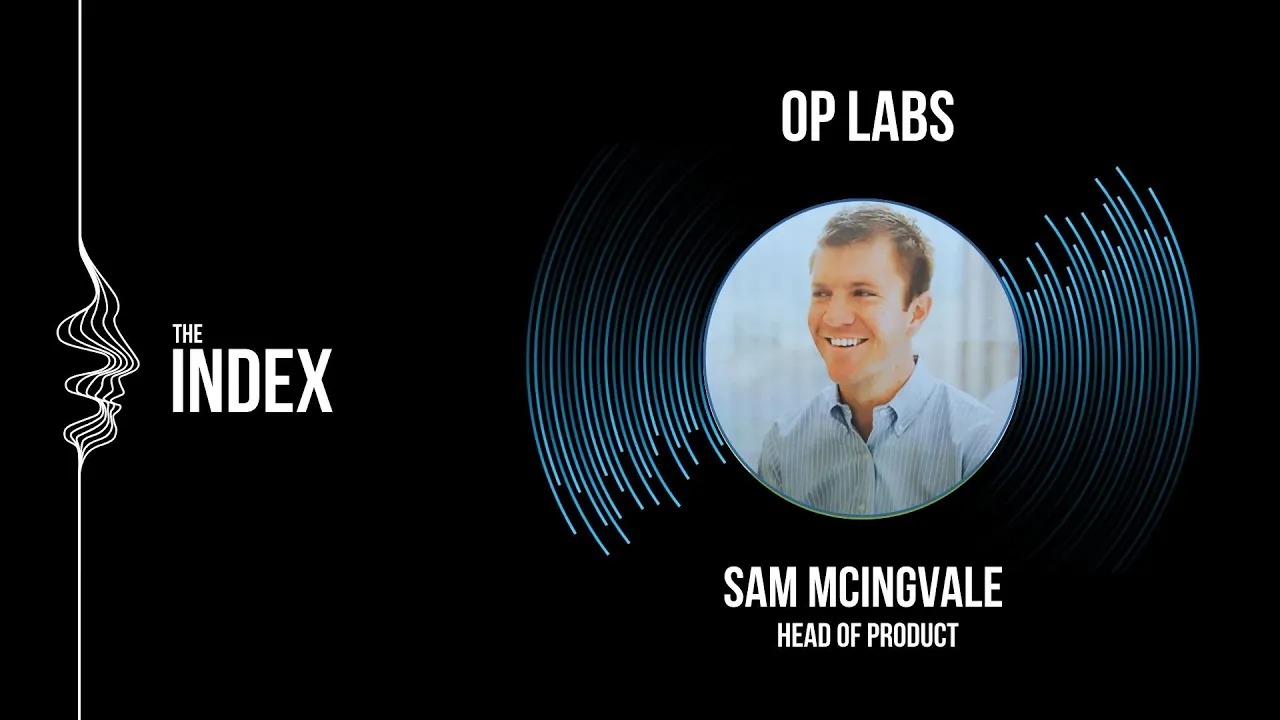
A fundamental challenge in L2 design is the centralization of sequencers, which contradicts Ethereum's decentralization ethos. Sequencers provide centralized performance benefits—faster confirmation, higher throughput, better UX—but introduce potential censorship risks. The escape hatch mechanism addresses this by ensuring L2 state is maintained on Ethereum, allowing users to always access their assets directly even if sequencers misbehave. This forces sequencers to behave properly because users can bypass them. The market appears to accept this trade-off, as evidenced by Base's rapid growth despite centralized sequencers. The escape hatch represents a fundamental safety mechanism that balances performance with decentralization.
Click to watch →

The zkEVM is Here | Alex Gluchowski of zkSync
19.4K
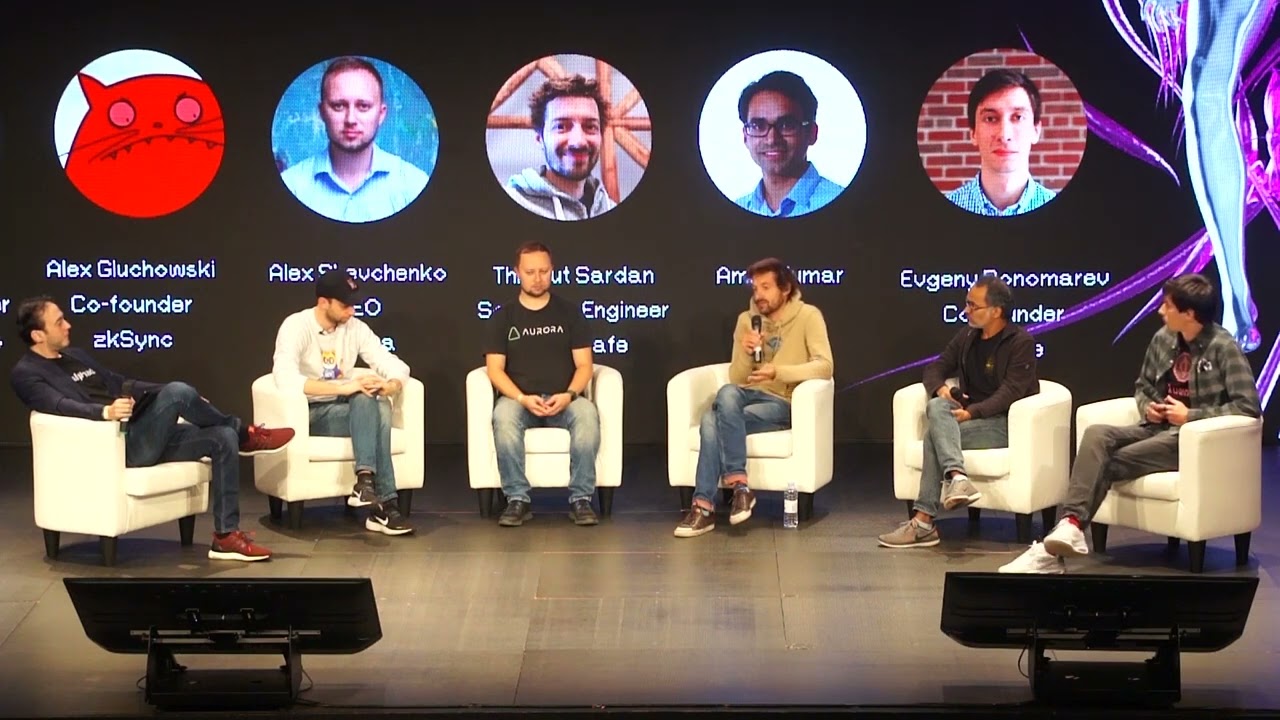
ZK Sync currently has a centralized sequencer, which is a common practice in early-stage roll-up development for efficiency and speed. However, the system includes escape hatches that allow users to enforce any transaction and withdraw assets to Ethereum if they don't trust the network anymore. This is achieved by proving that any transaction call was made from Ethereum mainnet through a priority queue, and proving the outcome of that call. This design ensures that even if the sequencer becomes malicious or the network is compromised, users can always recover their assets by going to Ethereum as a court of higher appeal. This differs from some other roll-up solutions that cannot currently implement such enforcement mechanisms.
Click to watch →
Andrew O'Neill (S&P Global Ratings) - Ethereum as a settlement layer for financial markets
234
L2 platforms are more centralized than L1s, with key risks including: (1) Centralized sequencer/proposer risk - if core development teams leave, users need mechanisms to continue operation; (2) Exit mechanisms - users need ability to exit if the chain is going in unwanted directions; (3) Smart contract modification risk. Validation is achieved through optimistic setups (simpler) or zero-knowledge setups (better for privacy). Banks are deploying products like JP Morgan's JPMD on Base, providing openness of crypto with most Ethereum security plus identifiable centralization that can be mitigated. This recreates a situation comparable to existing operational risk frameworks where contracts define remediation responsibilities.
Click to watch →
Protocol Berg: Elizabeth - Decentralized and Shared Sequencer Architecture
590
A rollup is a subset of L1 data defined by a state transition function, where users post data to L1 and rollup nodes execute based on that data. A sequencer handles batching, ordering, posting, and committing transactions to L1, making it central to censorship resistance and MEV extraction. Four sequencer architectures exist: centralized/non-shared, centralized/shared, decentralized/non-shared, and decentralized/shared. The industry is moving toward decentralized and shared architectures for censorship resistance, reduced MEV centralization, cross-rollup composability, and easier new rollup launches. Key design considerations include liveness, censorship resistance, data availability, faster than L1 block time, and good user experience. Alternative approaches include L1-sequenced rollups (limited by L1 block time), escape hatches for censorship (sacrifices economic benefits), and governance-controlled centralized sequencers (still centralized with governance delays). A staking-based selection mechanism enables permissionless participation through single leader election. For shared sequencers, lazy execution is necessary because executing rollup state machines directly would make the sequencer too heavy. The sequencer handles batching, ordering, and committing without executing rollup logic, treating transactions as opaque bytes. Rollup full nodes execute transactions lazily when needed, and the sequencer is agnostic to how state roots are committed (optimistic or ZK proofs).
Click to watch →

Solana Startup Series: Future of Trading with Tristan Frizza, CEO at Zeta Markets
1.9K
Sequencers are centralized components that order transactions before they are posted to the data availability layer. They enable pre-confirmation, allowing users to receive updates within milliseconds (5ms latency) before full consensus occurs. The sequencer acts as a gatekeeper, ordering transactions and sending them to proposers who post them to Solana. While centralized, there are escape hatches—users can always interact directly with L1 if the sequencer censors them. The architecture can transition to decentralized sequencers as technology matures.
Click to watch →
L2 Intro
L1 Limits
L2 Purpose
L2 Types
How They Link
Core Benefits
Adoption Stats
L2 Intro
0:05- 1
Video begins with data transfer on layer 2 solutions.
- 2
Focus shifts to core scaling problem and basic purpose.
Monolithic Layer 1 Scaling and L2 Fragmentation
While Ethereum's roadmap relies heavily on Layer 2 (L2) rollups, sidechains, and validiums to achieve scalability, critics argue this modular approach introduces severe trade-offs. Proponents of 'monolithic' Layer 1 (L1) blockchains (like Solana or Aptos) contend that scaling should be solved natively on a single, highly optimized base layer. They point out that Ethereum's L2 ecosystem fragments liquidity, splinters the developer and user experience, and introduces security vulnerabilities through bridging. Furthermore, many current L2s rely on centralized sequencers, which undermines Ethereum's core promise of decentralization and censorship resistance. From this perspective, a unified, high-performance L1 offers a more seamless, secure, and efficient scaling path than a complex web of secondary networks.
Basic blockchain fundamentals, specifically how Ethereum operates, including gas fees, block times, and smart contracts.
The Blockchain Trilemma, which explains the trade-offs between decentralization, security, and scalability.
The concept of Layer 1 (L1) mainnet settlement and why network congestion necessitates off-chain computation.
Elementary cryptography concepts, such as Merkle trees, hashing, and the basic premise of Zero-Knowledge proofs.
A deep-dive comparative analysis of Optimistic Rollups (using fraud proofs) versus Zero-Knowledge Rollups (using validity proofs).
The mechanics of cross-chain bridging, asset wrapping, and the associated security risks of moving liquidity between L1 and L2.
Ethereum's data availability layer upgrades, specifically EIP-4844 (Proto-Danksharding) and its impact on L2 transaction costs.
The design and trade-offs of Layer 3 (L3) solutions and application-specific blockchains (AppChains).
The governance and centralization risks of L2s, such as single-sequencer reliance and the role of 'escape hatches' for user funds.
763.2K views19.2Klikes1:43@TapSwapChannelOriginal Release: 2024-12-06
tappy activated hi my bite-sized friends today I'll transfer crucial data to you all you need to know about l2s basic information retrieved ethereum's main Network layer one is where transactions are processed and smart contracts run it's secure and reliable but it can get crowded leading to slow transactions and high fees to solve this layer 2 Solutions were created L2 helps ethereum scale to support more apps like defy gaming and nfts by reducing costs and easing congestion Solutions like rollups State channels and validium make ethereum more efficient and userfriendly a new info in flux L1 and L2 work together through bridging it lets users move assets like ether between the two L2 processes transactions offchain bundles them up and sends a summary back to L1 this setup keeps ethereum decentralized secure and scalable right now over $30 billion is locked in ethereum's L2 Solutions holy motherboard that's a lot let's take a break to recharge before more data is coming tapy deactivated
Up Next

9:35
Modular Blockchains Explained: Celestia and Data Availability
@CoinGecko
38.7K views•2023-12-18

52:00
Hybrid Key Establishment in Production: Post-Quantum Cryptography
@durumcrustulum
14.7K views•2025-08-27

64:25
Operational Security Essentials: A Guide for Hacktivists (OPSEC)
@hitbsecconf
157.4K views•2012-11-26
11:49
Understanding Ethereum: A Comprehensive Beginner's Overview
@99Bitcoins
3.1M views•2018-06-26
Related Study Plans & Knowledge Roadmaps
Structured learning paths in Blockchain & Crypto
blockchain-and-crypto
MPC Wallets: TSS, DKG & Secure Custody
01Foundations of Cryptography & Digital Signatures
02Secret Sharing & Introduction to MPC
03Distributed Key Generation (DKG)
+ 2 more learning modules
24h5 modules
Explore Roadmap
blockchain-and-crypto
ERC-4626: Yield Aggregators & Leverage
01Blockchain, Ethereum, and Solidity Foundations
02DeFi Primitives: Lending, Pools, and Yield Farming
03Mastering the ERC-4626 Tokenized Vault Standard
+ 3 more learning modules
35h6 modules
Explore Roadmap
blockchain-and-crypto
DePIN: IoT Registries, Proofs & Rewards
01Foundations of Blockchain & IoT
02Introduction to DePIN and the Flywheel Effect
03Designing IoT Device Registries & Secure Identity
+ 3 more learning modules
30h6 modules
Explore Roadmap
blockchain-and-crypto
Building EigenLayer AVS: Operators & Contracts
01Blockchain, Ethereum, and Smart Contract Basics
02Proof of Stake and Ethereum Staking
03Introduction to EigenLayer and Restaking
+ 3 more learning modules
24h6 modules
Explore Roadmap