








![[생방] 세일러가 팔수도 있다? 이더리움 업그레이드 | 2025.12.1](https://i.ytimg.com/vi/Jck6wXVZ6k0/maxresdefault.jpg)














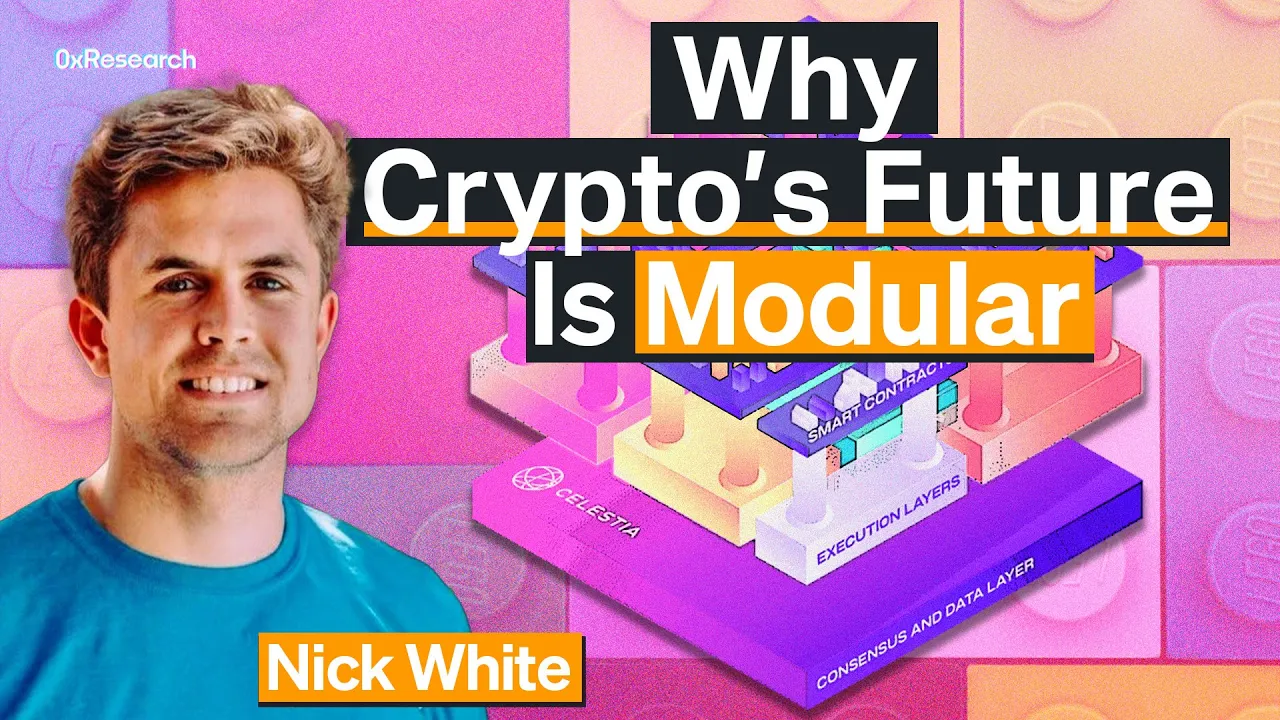
Modular blockchains address the blockchain trilemma by separating core functions—consensus, data availability, execution, and settlement—into specialized layers, allowing each component to be optimized independently; Celestia exemplifies this approach by focusing exclusively on consensus and data availability, utilizing Data Availability Sampling (DAS) to enable light nodes to verify block data integrity through random sampling rather than full downloads, thereby supporting larger block sizes without compromising decentralization.
Modular Blockchains Explained: Celestia and Data Availability
Added:The Blockchain Trilemma: The fundamental trade-off between scalability, security, and decentralization in distributed ledger technology.
Monolithic Blockchain Architecture: How traditional networks (like Bitcoin or Ethereum L1) integrate execution, consensus, settlement, and data availability into a single protocol layer.
Layer 2 Scaling and Rollups: The conceptual understanding of how Optimistic and Zero-Knowledge (ZK) rollups process transactions off-chain to scale networks.
Merkle Trees and Cryptographic Proofs: How data verification structures allow nodes to confirm transactions without possessing the entire blockchain ledger.
Erasure Coding and Data Availability Sampling (DAS): The mathematical principles (such as Reed-Solomon codes) that allow light clients to verify data integrity with minimal bandwidth.
Sovereign Rollups: The study of how modular execution environments define their own fork-choice rules and operate independently of a parent settlement layer.
Comparative DA Landscape: Analyzing the trade-offs, architecture, and security models of alternative solutions like EigenDA, Avail, and Ethereum's Danksharding (EIP-4844).
Modular Interoperability and Shared Security: Exploring how cross-chain communication protocols (like Cosmos IBC) enable secure, trust-minimized bridging between modular execution environments.
38.7K views1.2Klikes9:35Original Release: 2023-12-18
If you have not been caught up, Celestia’s mainnet has gone live, making it arguably the first modular blockchain network in the space.
Celestia’s mainnet launch has managed to garner itself a decent amount of hype. Not to mention Celestia’s token, $TIA’s recent jump in price likely means it’s not gonna get any less attention for a while.
But, what is a modular blockchain anyway, how does Celestia work and why is it important?
If blockchain innovation piques your interest, you don’t wanna miss this video. As mentioned, Celestia, previously known as LazyLedger, takes a “modular” approach to addressing the scalability and decentralization challenges faced by traditional blockchain systems. But before we get into the tech and explain “modularity”, let’s introduce Celestia’s impressive founding team.
First, Celestia Lab’s CTO is Ismail Khoffi, a former senior engineer at Tendermint and Interchain Foundation.
Second, Chief Research Officer, John Adler was previously a scalability researcher at ConsenSys and known for creating optimistic rollups.
Last but not least, the mastermind of Celestia Labs Mustafa Al-Bassam, also the co-founder of Chainspace, which was acquired by Facebook.
He is also a security researcher and hacker. In fact, at 16 years old Al-Bassam was actually the co-founder of hacker group Lulzsec, infamous for numerous high profile breaches such as Sony, Fox, FBI and even the CIA back in 2011.
That resulted in Al-Bassam receiving a 2 year legal ban from using the internet. Fast forward to this day, he now has a Phd. in blockchain scaling and is the CEO of Celestia Labs.
Besides what is a strong lineup at the helm of Celestia, the project is by no means lacking in funding. The recent funding round in October brought its total funding at about $57 million, including backing by numerous notable firms such as Galaxy, Bain Capital Crypto, Binance Labs, and Coinbase Ventures. Having a solid team and funding is great, but what exactly is Celestia doing to address the challenges that most blockchains face today? To understand, we first need to recap some blockchain basics.
Blockchains are made of several components: Execution, which deals with processing transactions; Settlement, which deals with dispute resolution, validity of blocks and acts as a bridging layer; Consensus, which orders transactions; and data availability, which ensures data from new blocks is available and published on-chain. Note that execution, settlement, and consensus all require DA.
Now, pay attention to the data availability part as it’s important to understand later on.
In “monolithic” blockchains, a single blockchain performs all of these functions on its own in a single layer. Examples include Bitcoin, Ethereum, or Solana (that is, excluding the layer 2s and other scaling solutions built on top).
This classic monolithic design is the reason for the infamous blockchain trilemma, which describes the problem where builders can only pick 2 out of the 3 main properties of a blockchain, and sacrifice the third, i.e. security, decentralization, and scalability.
Since blockchains cannot compromise on security, the most common choice is between scalability and decentralization.
For example, increases in block size to increase throughput leads to more expensive hardware requirements for nodes to validate the blockchain, resulting in a more centralized network as less people can afford the hardware to secure the network. This creates problems with scaling while keeping the blockchain secure and decentralized. Now, let’s look at where modular blockchains come into play. Modularity refers to designs which split a system into smaller, exchangeable or replaceable parts - allowing for more flexible and customizable designs.
Whereby monolithic blockchains need to do everything which reduces efficiency, modular ones can choose to specialize and optimize on only a few functions instead.
An example we are all familiar with are Ethereum rollups, which are modular blockchains which focus only on execution, while offloading settlement, consensus, and data availability to the mainnet.
What’s different with Celestia however, is that it focuses only on consensus and data availability, that is, ordering blocks and ensuring that block data is really published on-chain.
In traditional blockchains, how nodes ensure DA is by downloading the entire block’s data, which limits scalability.
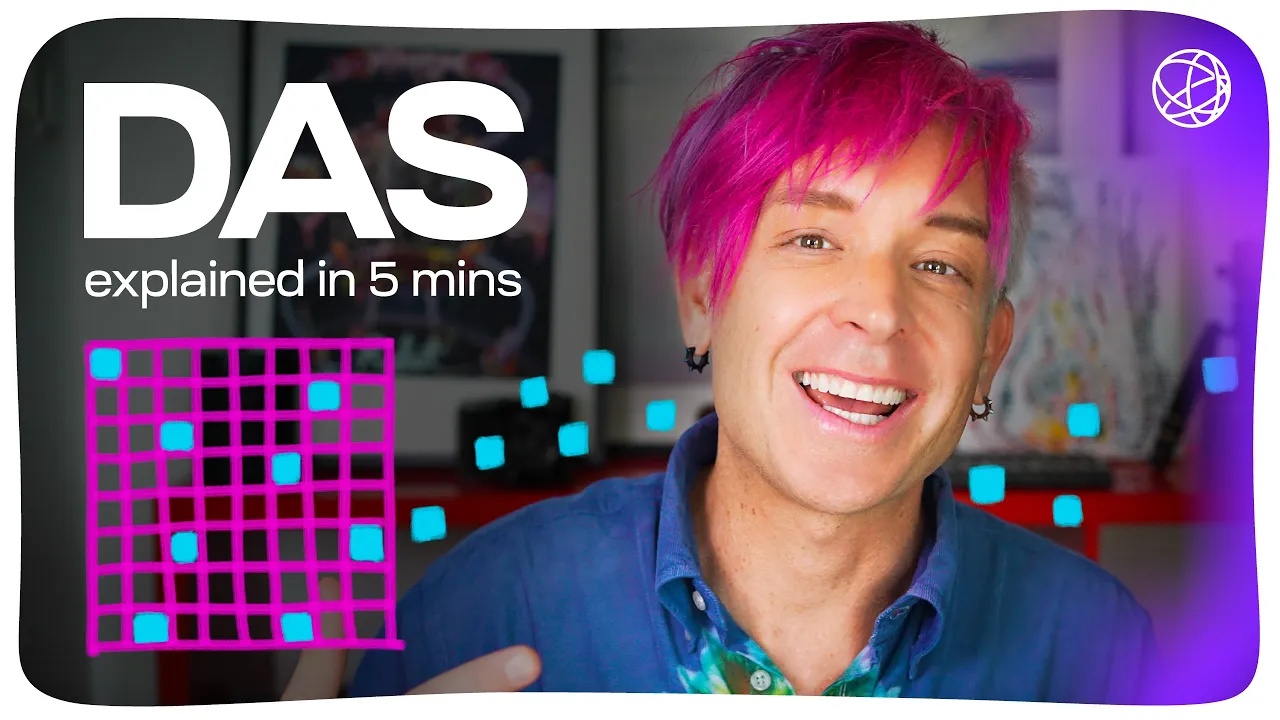
Celestia provides a solution to this by introducing and implementing a new feature, Data Availability Sampling or DAS, a concept formalized by Al-Bassam back in 2018.
As mentioned earlier, increasing block size in traditional blockchains compromises decentralization due to higher hardware requirements.
With the help of a data protection technique called erasure coding (which we won’t get into in this video) DAS provides a solution to this by allowing easily-deployed light nodes to randomly sample small amounts of block data in order to verify data availability.
As a light node repeatedly samples block data, it increases the confidence that data is available. Once the light node hits a particular confidence level (e.g., 99%), it then confirms the availability of the block data.
Furthermore, when the number of light nodes involved in sampling grows, so does the network's capacity to safely manage larger volumes of data and thus, enabling increases in block size without increasing the cost to secure the network.
This can all sound a little vague and confusing, so we’ve linked a tweet by Celestia COO Nick White which explains this process with a simple coin flip analogy.
All this provides a decentralized and secure way to publish and store block data, ensuring that the data is available for anyone to read and verify, which is crucial for maintaining the integrity and security of a blockchain.
Celestia’s modular approach also allows different dApps or execution environments to run on top of it without being limited by the constraints of the underlying blockchain.
This means anything from app-specific chains or even general purpose layer 2s which run on different VMs or programmed in different languages can be built on top of Celestia and benefit from the data availability provided.
Theoretically, the modular design inherently addresses scalability issues. Since Celestia only handles data availability and consensus, it can process and store large amounts of data more efficiently than traditional blockchains.
Celestia’s native token, TIA, will be used by rollup developers to pay for data availability on the network.
Besides that, TIA can also be delegated to a validator to secure the network while earning staking rewards, as well as voting in Celestia’s decentralized governance proposals.
Celestia has established a total supply of 1,000,000,000 TIA tokens at genesis with an inflation schedule of 8% in the first year, decreasing 10% per year until reaching an inflation floor of 1.5% annually.
As for token allocation, 17.6% is allocated to contributors of Celestia Labs, 35.6% is allocated to seed and early investors, 26.8% allocated for R&D and ecosystem, and 20% is reserved for public initiatives such as Celestia’s Genesis drop. Although Celestia’s mainnet went live not long ago on October 31st, its ecosystem is already hosting an abundance of apps and services.
At the time of writing, Celestia’s ecosystem web page currently features 57 apps and services with notable mentions such as Optimism’s OP stack and Cosmos SDK as rollup frameworks. Considering that Celestia's mainnet has only recently been launched, the full extent of innovation and possibilities enabled by its modular blockchain remains to be seen in the unfolding future.
Do you think modular blockchains like Celestia is the answer we need to solve the blockchain trilemma?
Perhaps you would like to refresh your understanding of how nodes in a blockchain work. Check out our explainer on blockchain nodes right here.
Up Next

100:15
Modular vs Monolithic Blockchains: Scaling Ethereum
@Bankless
29.9K views•2021-10-26

52:00
Hybrid Key Establishment in Production: Post-Quantum Cryptography
@durumcrustulum
14.7K views•2025-08-27

7:54
Ethereum Restaking and EigenLayer: An Academic Guide
@CoinGecko
25.4K views•2024-02-05

11:49
Understanding Ethereum: A Comprehensive Beginner's Overview
@99Bitcoins
3.1M views•2018-06-26
Related Study Plans & Knowledge Roadmaps
Structured learning paths in Blockchain & Crypto
blockchain-and-crypto
MPC Wallets: TSS, DKG & Secure Custody
01Foundations of Cryptography & Digital Signatures
02Secret Sharing & Introduction to MPC
03Distributed Key Generation (DKG)
+ 2 more learning modules
24h5 modules
Explore Roadmap
blockchain-and-crypto
ERC-4626: Yield Aggregators & Leverage
01Blockchain, Ethereum, and Solidity Foundations
02DeFi Primitives: Lending, Pools, and Yield Farming
03Mastering the ERC-4626 Tokenized Vault Standard
+ 3 more learning modules
35h6 modules
Explore Roadmap
blockchain-and-crypto
DePIN: IoT Registries, Proofs & Rewards
01Foundations of Blockchain & IoT
02Introduction to DePIN and the Flywheel Effect
03Designing IoT Device Registries & Secure Identity
+ 3 more learning modules
30h6 modules
Explore Roadmap
blockchain-and-crypto
Building EigenLayer AVS: Operators & Contracts
01Blockchain, Ethereum, and Smart Contract Basics
02Proof of Stake and Ethereum Staking
03Introduction to EigenLayer and Restaking
+ 3 more learning modules
24h6 modules
Explore Roadmap