


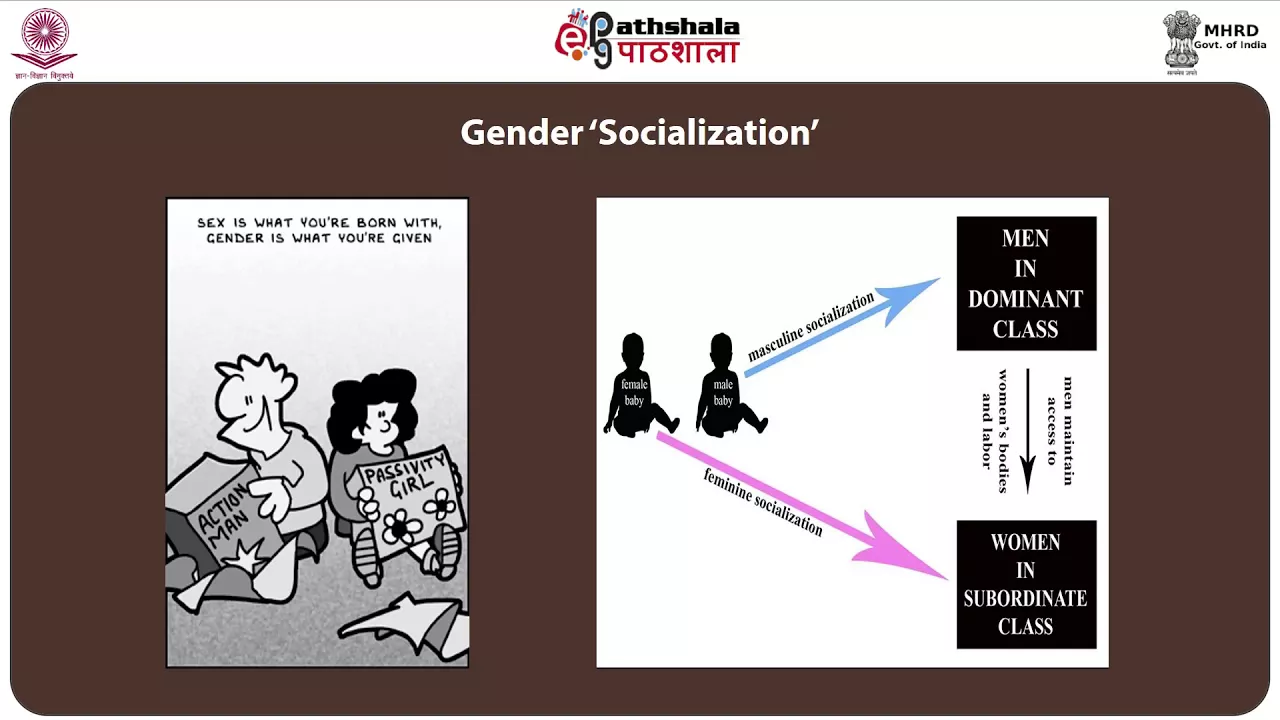























According to Deborah Tannen's 1990 theory, women and men communicate differently due to childhood socialization where parents use more emotional language with girls and action-oriented language with boys, resulting in six key differences: (1) men use language for status/assertion while women use it for support/consensus; (2) men value independence while women prioritize intimacy; (3) men seek advice/solutions while women seek understanding/empathy; (4) men focus on information/facts while women focus on feelings/emotions; (5) men use direct orders while women use indirect proposals; (6) men view conflict as normal interaction while women view it as threatening connection.
Language and Gender: Deborah Tannen's Six Differences
Added:Basic principles of sociolinguistics, specifically how social identity factors like gender, culture, and power influence communication patterns.
The distinction between sex (biological) and gender (socially constructed), which is fundamental to understanding gendered socialization.
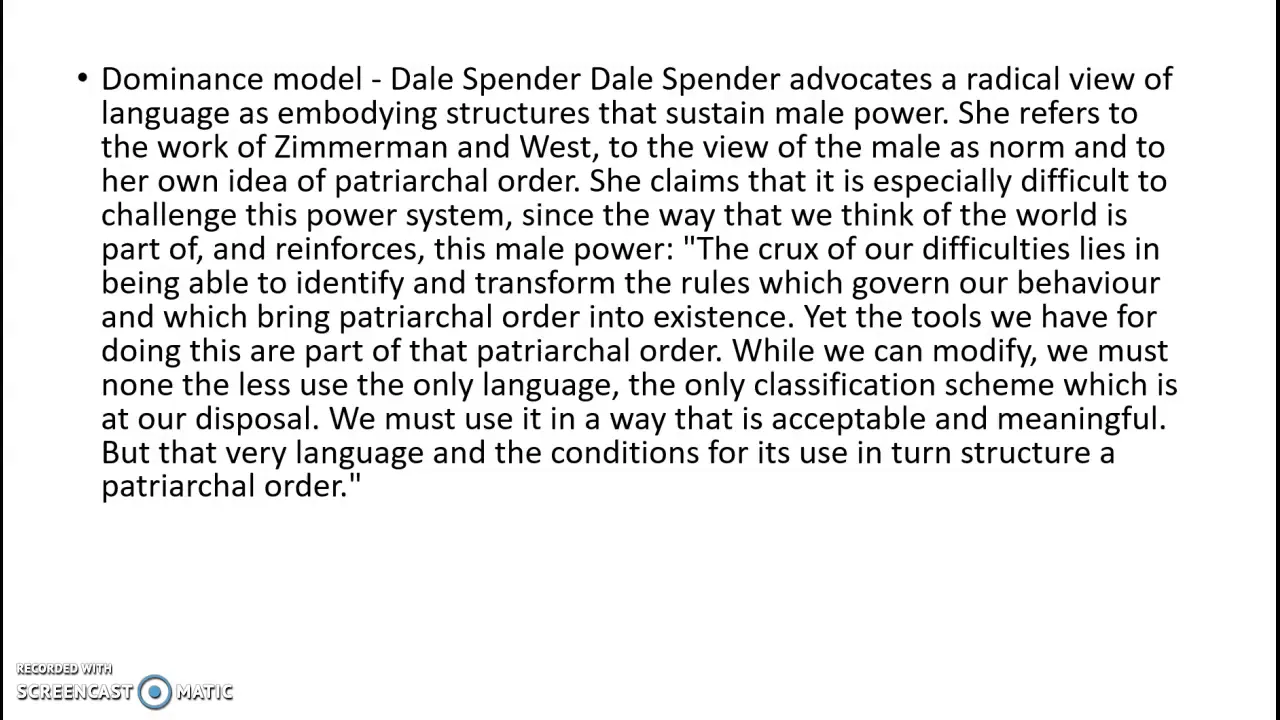
An overview of early language and gender theories, such as Robin Lakoff's Deficit Model and the Dominance Model proposed by researchers like Zimmerman and West.
Core concepts of pragmatics and communication theory, including the difference between the literal content of a message and its relational subtext.
Critical responses to Tannen's Difference Model, particularly Deborah Cameron's critique of gender essentialism and the 'gender similarities hypothesis'.
The concept of intersectionality in linguistics, exploring how race, ethnicity, socioeconomic class, and geographic location cross-cut and alter gendered language patterns.
Modern developments in Queer Linguistics, analyzing how non-binary, trans, and LGBTQ+ individuals navigate, subvert, or redefine gendered language norms.
Practical applications of gendered communication theories in professional contexts, such as corporate leadership styles, workplace conflict resolution, and modern digital communication.
186 views5likes13:25Original Release: 2022-04-19
good afternoon all now we want to present our material about the differences meant between women in their language according to deborah tennant 1919 and before we started i want to introduce our uh group member first is my name is kanekasnakarnika with last four digit number is one two two four as a first speaker and the second is putu arfan satya one with last four digit number is one two three three as second speaker and the last is with last four digit number is one two one three as the third speaker so that we started our presentation okay so deborah tentan is a university professional professor and professor of linguistics at georgetown university and author of many books and articles about how to how the language of everyday conversation affects relationship and one of her books is you just don't understand woman and men in conversation in her book on gender differences in communication deborah atanan purposed that women and men into interpret message along different dimensions intimacy and control and that this different interpretation makes intersex communication difficult and she believes the differences between how women and men talk and communicate start in childhood where parents use more word about feelings to girls and is more of a verb two boys and men and women belongs to different subculture and therefore speak differently deborah sorry speak differently and according to tanan 1990 said that there are six main differences between the ways male and female use language first is status versus support and the second is independent versus intimacy and the third is advice versus understanding fourth is information versus feelings five is order versus proposals and the last is conflict versus compromise so the first is status versus support here men see language as a means of asserting dominance but woman see it was a way of confirming or supporting ideas men grow up in the world in which a conversation is often a condensed contents and either to achieve the upper hand or to prevent other people from pushing them around and for women however talking is often a way to exchange confirmation and support and in short communication for men is a place to try to achieve and maintain status and for women is a network of connections seeking super unconscious consensus and from the explanation we may know that the boy's stories function as a direct challenge in negotiating current status within a hierarchical social order and the girl used stories as part of an instigating routine by which talking behind someone's back leads to future confrontation uh early stage in an ongoing process of negatively sanctioning behavior the girls seem inappropriate for example in this way a girl story can elicit a promise to confront the of offender and thereby spark a despite a dispatch that can mobilize the whole neighborhood whereas the boys are localized the girls this would extend over time and can lead to australism of from the group next is independence versus intimacy intimacy so since women often think in the in terms of closeness and support they struggle to pursue preserve intimacy men concerned with the status tend to focus more on independence and and these qualities can lead women and men historically different views of the same situation according to 10 1990 notes that the men are confused by the various ways women use conversation to be intimate with others for example there is a conversation called so woman for women trouble talk is talking about troubles is this a sense of connection i tell you my troubles you tell me your troubles and your clues and for men men have trouble stop as a request for advice so they uh respond with a solution when a man offered this kind of information the woman often feels as if he is trying to demean her problems or cut her off so that's all my explanation the next material will be presented by my friends our fun times is yours okay thank you vika at this time i would like to explain about advice versus understanding next this next this is okay thank you in this advice and understanding we see a difference with men and women for men men see a language as a problem-solving and men accompany is a challenge to come up with solution on the other hand for a woman she see it as a means of empathy and women are looking for emotional support not solutions for the example of this material is when a woman doesn't feel well her boyfriend offers to take her to the doctor however the the girl does doesn't mean that the way because the real thing is she wants her boyfriend's sympathy like a dialect example uh wife honey i'm not feeling well today husband let's go and see a doctor and wife rolling her eyes okay move to the next slide please now i will like to explain about information versus feeling go ahead please move the next in this material we can see difference between men and women for the first main concert with the facts and women are concerned uh concerned with feelings the difference has a term called report talk of and report thought of woman can be seen on the table below for a woman they are talk too much but men they are structuralist next is woman speak in private context but uh sorry for women it is speak in private context but men speak in public and the last is woman is overlapped overly overlapped like interrupt when speaking with someone when foreign men is speaking speak one at a time for the example for most men however talk is primarily a means to preserve independence and negotiate and maintain status in social order this is done by exhibiting knowledge and skill and by holding center state through verbal form performance such as storytelling joking or importing information and for a woman the language of conversation is primarily a language of a report like a way of establishing connection and negotiating relationship this is done by displaying similarities and matching experiences it is to build up the feeling of closeness and comfort to each other okay that's all about my material for the next material will be present by my friend vagus time is yours thank you okay thank you arfan and now i will present about order versus proposals in here men use imperatives while female use hidden's directives according to tannen 1990 says that being able to propose for a woman will give a chance to get support in doing things she wants they will feel very pleased when others do things in agreement with them meanwhile being able to order for men will give them power to tell others to do things they want these traits result in different ways of asking someone to do something that is by ordering direct way and by proposing in direct way for example a woman i'm sorry i made this mistake and for understand this uh sentence what's the woman propose by saying so we need to understand the meaning of this in her dialogue proposing is that we know it's in indirect way and for men let's go to sleep honey the man was using a direct way of saying what he wanted the message was clear and it was an order to do something okay mexico next is conflict versus compromise channel 1990 notes that for men being in conflict means being involved with each other conflict is the necessary means by which status is negotiated so it is to be accepted and may even be so embraced and enjoyed it is valued as a way of creating involvement with others and moment however conflict is the threat to connection it is to be avoided at all cause the spots are preferably settled without direct confrontation and for the example and i have a dialogue in here for men one why is this food so oily men too if you want to it just do it too many complaints and girl one don't forget to drink so you don't get horse and i think that's all for my presentation and i give the time back to ika he got time okay thank you so i will i will give conclusion so in conclusion we knew as the tenant said that women and men have a different language and women and mental and communicate starting in childhood where parents use more words about feelings to girls and use more verb two boys and men and women belongs to difference of culture and therefore speak differently so that's all our presentation uh thank you for your attention and have a good day
Up Next

7:36
Language Endangerment: Causes, Crisis, and Why It Matters
@evanashworth490
6.7K views•2023-11-22
36:52
Constraint Interaction in Optimality Theory: Epenthesis & Deletion
@Vidyamitra
180 views•2018-08-20

8:59
Forensic Linguistics: How Language Solves Crimes | PBS
@pbsstoried
1M views•2024-01-25

21:32
Accent Expert Explains U.S. Regional Dialects | Part 1
@WIRED
9.3M views•2021-01-21
Related Study Plans & Knowledge Roadmaps
Structured learning paths in Linguistics
linguistics
Optimality Theory: Tableaux & Constraints
01Phonological Basics: Sounds, Syllables & Rules
02Foundations of Optimality Theory: GEN, CON, and EVAL
03The Constraint Inventory: Markedness vs. Faithfulness
+ 2 more learning modules
15h5 modules
Explore Roadmap
linguistics
Morphosyntactic Alignment: S, A & P Systems
01Foundations of Syntax: Transitivity and Arguments
02The Linguistic Variables: Mapping S, A, and P
03Nominative-Accusative Alignment
+ 3 more learning modules
12h6 modules
Explore Roadmap
linguistics
Analyzing Sign Language: Phonology & Syntax
01Foundations of Sign Language Linguistics
02Phonology: The Five Parameters of a Sign
03Morphology: Word Formation and Classifiers
+ 2 more learning modules
14h5 modules
Explore Roadmap
linguistics
Pragmatics: Speech Acts, Grice & Politeness
01Introduction to Pragmatics: Meaning in Context
02Grice’s Cooperative Principle & Implicature
03Speech Act Theory
+ 2 more learning modules
14h5 modules
Explore Roadmap