Optimality Theory: Tableaux & Constraints
Learning Goal: Apply the framework of Optimality Theory (OT) to resolve phonological alternations and syllable structure typologies across diverse languages by constructing constraint tableaux and determining optimal rankings of markedness and faithfulness constraints.
Prerequisites
- Basic familiarity with language sound systems (phonetics).
- No advanced mathematical or logical background required, though structural/analytical thinking is highly beneficial.
Estimated Total Study Time
- 15 Hours (including video lectures, written supplemental explanations, and hands-on tableau construction exercises).
Module 1: Phonological Basics: Sounds, Syllables & Rules
Module Overview
Before transitioning to a constraint-based model like Optimality Theory, you must master classical rule-based generative phonology and basic prosodic structures. This module establishes what speech sounds are (phonetics), how they are abstractly organized in the mind (phonology), how syllables are structured hierarchically (onset, nucleus, coda), and how classical phonological rules historically attempted to derive pronunciation from underlying mental representations.
Recommended Videos

- Why this video is valuable: This video is a foundational resource for parsing the internal geography of a syllable. It cleanly demonstrates that a syllable is not a flat sequence of letters, but a structured hierarchy containing an optional initial consonant cluster (onset) and a rhyme (consisting of the obligatory vocalic nucleus and the optional terminal consonants or coda).
- Knowledge Checkpoint:
- Draw a hierarchical syllable tree diagram identifying the Rhyme, Nucleus, Onset, and Coda for the English word "strands".
- Define what can constitute a valid syllable nucleus versus what constitutes a coda.
- Explain why the onset is cross-linguistically preferred over the coda.
![[Introduction to Linguistics] Phonological Rules and Derivation](https://i.ytimg.com/vi_webp/McO4Bcfk3zc/maxresdefault.webp)
- Why this video is valuable: To appreciate why Optimality Theory was invented, you must first understand the rule-based generative model of Chomsky and Halle (SPE). This video teaches the formal rule notation (meaning sound becomes when preceded by and followed by ) and walks you through step-by-step phonological derivations.
- Knowledge Checkpoint:
- Translate a natural language sound change description into formal phonological rule notation.
- Explain the concept of an "underlying representation" (UR) versus a "surface representation" (SR).
- Illustrate how ordering two rules differently can yield radically different surface pronunciations.
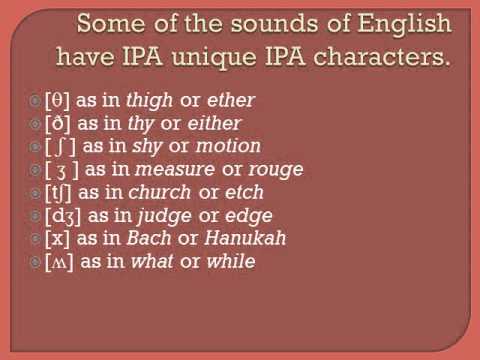
- Why this video is valuable: Provides a comprehensive high-level bridge between articulatory phonetics (how speech organs physically create sounds) and phonology (the cognitive systems that organize these sounds into contrasting phonemes). This distinction is critical because phonological constraints are deeply grounded in phonetic ease of articulation and perceptual clarity.
- Knowledge Checkpoint:
- Differentiate between a physical phone (enclosed in square brackets
[ ]) and a cognitive phoneme (enclosed in slashes/ /). - Describe how the International Phonetic Alphabet (IPA) categorizes consonants based on voicing, place, and manner of articulation.
- Differentiate between a physical phone (enclosed in square brackets
Module 2: Foundations of Optimality Theory: GEN, CON, and EVAL
Module Overview
This module introduces the conceptual leap from rule-based derivations to constraint-based evaluations. You will explore the architectural blueprint of Optimality Theory (OT) as established by Alan Prince and Paul Smolensky in 1993. Instead of applying sequential transformations, OT takes an input and evaluates an infinite pool of potential output candidates simultaneously against a set of ranked, universal, and violable constraints. You will master the three engine components of OT:
- GEN (Generator): Creates all logically possible output candidates for a given input.
- CON (Constraint Inventory): The universal set of conflicting linguistic pressures.
- EVAL (Evaluator): The mechanism that filters candidates to select the "optimal" surface form.
Recommended Videos
- Why this video is valuable: A highly engaging, visual conceptual overview of the core paradigm shift. It uses clear animations to show how classical linguistics relied on complex, language-specific, step-by-step "recipes" (rules), whereas Optimality Theory relies on universal "filters" (constraints) that are ranked differently by different languages.
- Knowledge Checkpoint:
- Contrast how a rule-based grammar and a constraint-based grammar would handle a sound sequence that is difficult to pronounce.
- Explain what is meant by the claim that constraints in Optimality Theory are universal but violable.
- Identify the core problem of "rule conspiracies" that OT was designed to solve.
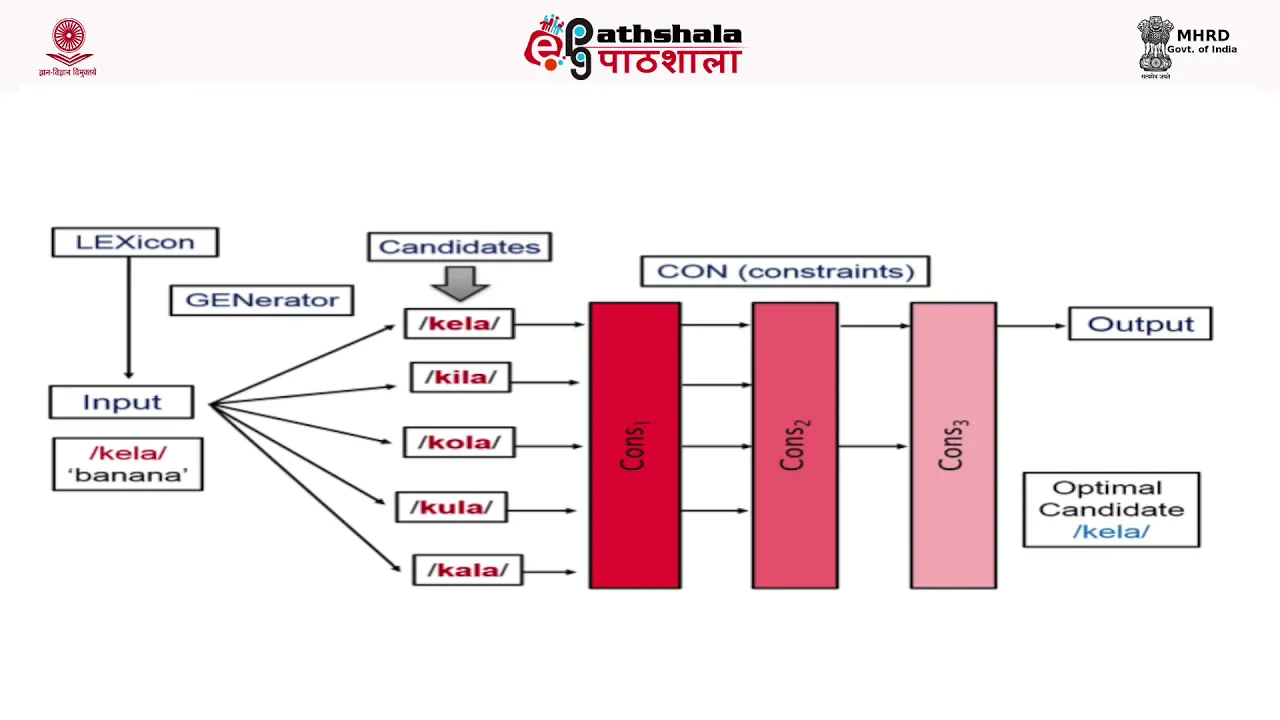
- Why this video is valuable: An academic lecture outlining the mathematical and structural design of the OT framework. It clearly defines the roles of the lexicon, GEN, CON, and EVAL, introducing how candidates are systematically filtered to leave only a single survivor.
- Knowledge Checkpoint:
- Define the mathematical concept of Freedom of the Inflow (or "Richness of the Base").
- Describe the process by which GEN creates candidates (e.g., insertion, deletion, feature-changing).
- State the primary function of EVAL in comparing relative violation profiles.
- Why this video is valuable: Delivered by MIT faculty, this deep-dive academic lecture walks through the formal transition of phonology from rules to constraints. It covers the limits of rule systems and introduces formal OT definitions with unmatched academic rigor.
- Knowledge Checkpoint:
- Explain why rule-based derivations often fail to explain why structural changes happen (the "functional target" issue).
- Define the formal relationship between the input, the output, and the evaluation metric.
Module 3: The Constraint Inventory: Markedness vs. Faithfulness
Module Overview
The entire engine of Optimality Theory runs on a structural tug-of-war between two diametrically opposed constraint families: Markedness and Faithfulness.
- Markedness constraints demand structural simplicity and phonetic ease. They are blind to the input and look only at the surface candidate, penalizing structures that are hard to produce or perceive (e.g., having a coda consonant, or lacking an onset vowel).
- Faithfulness constraints demand that the output candidate be identical to the input representation. They look at both the input and output, penalizing any changes made to resolve structural issues (e.g., deleting a sound, inserting a sound, or altering a phonetic feature).
In this module, you will analyze the formal properties of these families and get to know their most vital members, including the faithfulness triad: MAX (no deletion), DEP (no insertion), and IDENT (preserve feature identity).
Recommended Videos

- Why this video is valuable: A classic classroom lecture from UC Berkeley that introduces the specific mechanics of Markedness constraints like
ONSETand*CODAalongside Faithfulness constraints likeMAX-IO,DEP-IO, andIDENT-IO. It is highly focused and explicitly walks through how these constraints conflict with one another. - Knowledge Checkpoint:
- Formulate precise definitions for the following constraints:
ONSET,*CODA,MAX,DEP, andIDENT. - Classify a given list of constraints as either Faithfulness or Markedness.
- Explain the phonetic motivations behind syllable-markedness constraints (such as why codas are "marked").
- Formulate precise definitions for the following constraints:
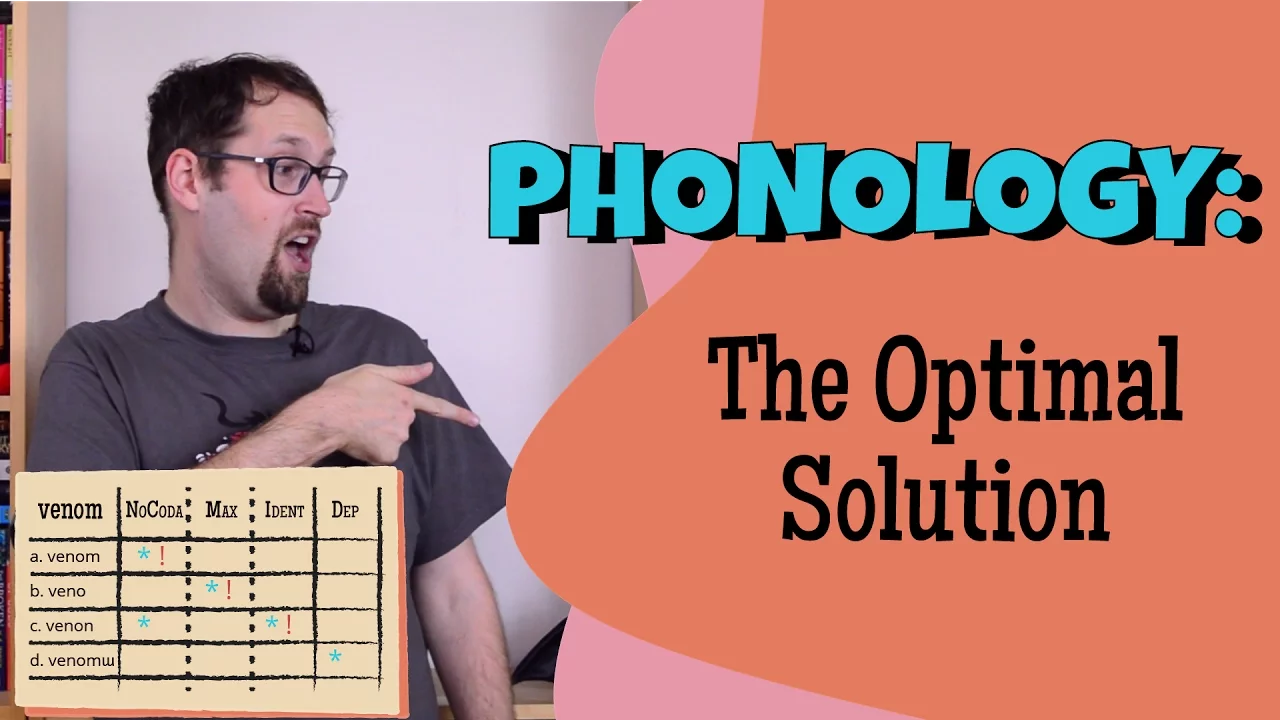
- Why this video is valuable: This video provides an elegant, highly clear discussion of constraint conflicts. It explains how child language development represents a stage where Markedness constraints are ranked high above Faithfulness, resulting in simplified speech forms (such as dropping codas to produce "cat" as
[kæ]). - Knowledge Checkpoint:
- Explain how the ranking
Markedness >> Faithfulnessexplains the simplified speech structures observed in young children. - Describe the tension between articulatory ease (markedness) and acoustic contrast preservation (faithfulness).
- Explain how the ranking
Module 4: Constructing Tableaux and Ranking Constraints
Module Overview
This module is the procedural heart of the curriculum. You will master the exact step-by-step mechanics of drawing a standard OT constraint tableau, plotting candidate outputs, assigning violation marks, locating fatal violations, and deriving constraint rankings from empirical linguistic data.
⚠️ CRITICAL SEARCH AND STUDY WARNING: When studying or searching for tutorials online, be highly careful to filter out search results that refer to "Tableaux" or "Optimality" in the context of Operations Research, the Simplex Method, or the Hungarian Assignment Method (such as Videos 2, 5, 15, 17, 18, 23, 61, 62, 75, 77, 82, 89, 96, and 97 in standard algorithms pools). These mathematical/programming optimization techniques are completely unrelated to linguistic Optimality Theory! Always include terms like "linguistics", "phonology", "markedness", or "faithfulness" in your queries.
Theoretical Breakdown: How to Read and Construct an OT Tableau
An OT Tableau is organized as a grid to evaluate candidates against ranked constraints.
+--------------------+------------+------------+ | Input: /input/ | CONSTR A | CONSTR B | +--------------------+------------+------------+ | ☞ a. Candidate A | | * | +--------------------+------------+------------+ | b. Candidate B | *! | | +--------------------+------------+------------+
- Top-Left Cell: Houses the abstract mental Input (underlying representation) enclosed in slashes (e.g.,
/pvtk/or/kæt/). - Top Row (Columns): Lists the relevant Constraints, ordered strictly from left to right in descending order of rank. A thick vertical line separates constraints whose ranking relative to each other is proven (e.g., ). A dashed line separates constraints whose ranking relative to each other cannot be determined from the data.
- Leftmost Column (Rows): Lists the surface Candidates generated by GEN (e.g.,
[patak],[ptak]). - Cells: Contain asterisks (
*) indicating violations. A single asterisk represents one violation. - The Fatal Exclamation (
*!): Placed next to a violation mark that knocks a candidate out of running. This occurs when a candidate violates a highly ranked constraint that a competing candidate managed to satisfy. - Shading: Shading is applied to cells in a row once that candidate has suffered a fatal violation. It visually demonstrates that the remaining lower-ranked constraints are irrelevant to that candidate's fate.
- The Pointing Finger (☞ or ☛): Placed in the leftmost column next to the winning candidate (the "optimal" candidate). The optimal candidate is the one that has the least offensive violation profile compared to its rivals under the specified ranking.
Recommended Videos
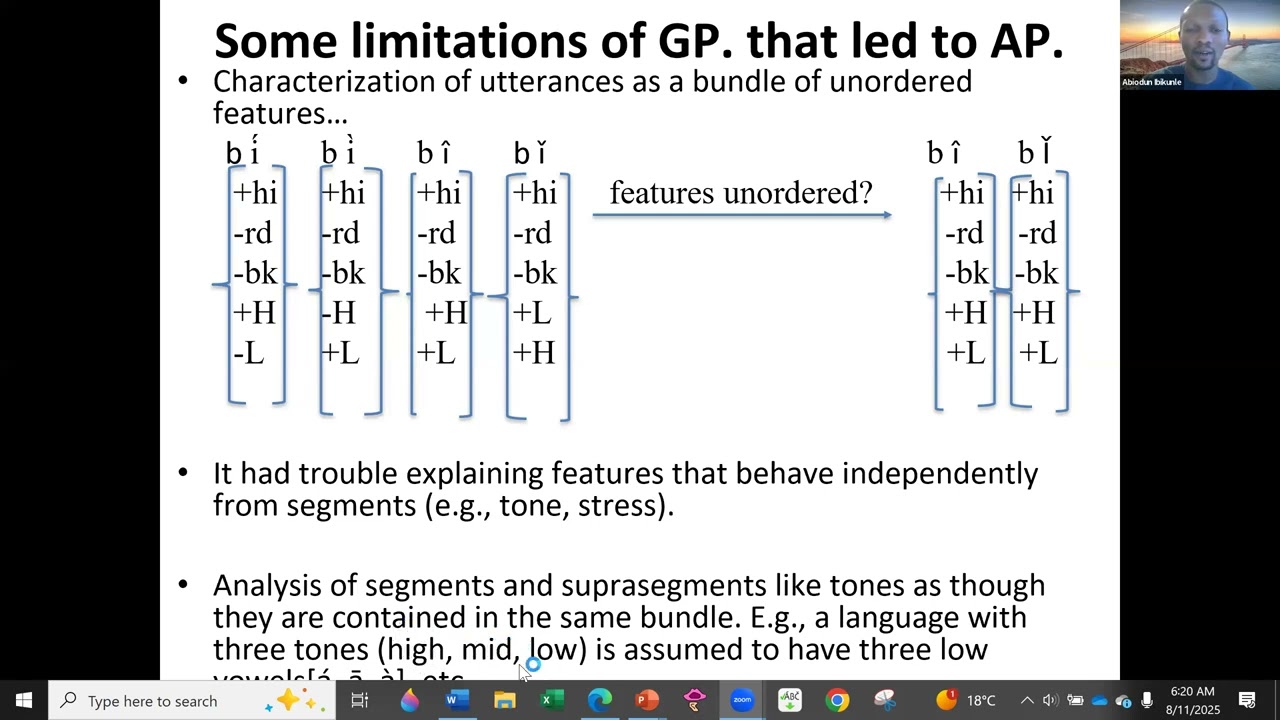
- Why this video is valuable: This extensive, deep lecture provides a complete masterclass on building OT tableaux. It bridges the gap between rule-based phonological operations and constraint evaluations, helping you visually grasp the step-by-step layout of constraint grids.
- Knowledge Checkpoint:
- Draw a blank standard OT tableau layout and label every structural component (input cell, candidate rows, constraint columns).
- Explain why a candidate can be optimal even if it violates multiple constraints (the concept of relative optimality).
- Define the difference between a solid vertical line and a dashed vertical line in an OT tableau.
- Why this video is valuable: A short snippet featuring Alan Prince himself, the co-founder of Optimality Theory, discussing Metrical Theory and ranking parameters. It serves as a direct historical connection to the formalization of "Elementary Ranking Conditions" (ERCs)—the mathematical core of how ranking arguments are structurally proven.
- Knowledge Checkpoint:
- State what an "Elementary Ranking Condition" (ERC) is.
- Explain how a comparison between a winning candidate and a losing candidate determines which constraint must be ranked higher.
Module 5: Syllable Typology and Factorial Typology
Module Overview
One of the most powerful claims of Optimality Theory is that the universal set of constraints () is shared by all human languages. If the constraints are identical, how do different languages exist? The answer lies in Factorial Typology: the permutation of constraint rankings.
If we have constraints, there are (N-factorial) possible ranking hierarchies. Each ranking corresponds to a potential human language grammar. By permuting a small set of syllable structure constraints, we can predict and generate the precise inventory of syllable typologies observed across all languages in the world.
Theoretical Breakdown: Mapping the Core Syllable Typologies
Let's consider four core constraints that regulate syllable structures:
- Markedness:
ONSET(Syllables must have an onset) - Markedness:
*CODA(Syllables must not have a coda) - Faithfulness:
MAX(No deletion) - Faithfulness:
DEP(No insertion/epenthesis)
By permuting the relative ranking of these four constraints, we can generate the exactly four core language typologies observed in nature regarding syllable structures.
Typology 1: No Codas, Onsets Mandatory (Strict Languages)
- Ranking:
ONSET,*CODAMAX,DEP - Phonological Behavior: If an input has a coda consonant or lacks an onset (e.g.,
/ab/), the grammar is forced to repair it. Because Markedness is ranked higher than Faithfulness, the language will use epenthesis or deletion to make sure every syllable is strictly consonant-vowel (). - Example Language: Senufo, Hua.
Typology 2: Codas Permitted, Onsets Mandatory ( or )
- Ranking:
ONSET,MAX,DEP*CODA - Phonological Behavior: Because Faithfulness to the input (, ) outranks the ban on codas (), an input word like
/ab/cannot delete or insert segments to fix the coda. However, sinceONSETremains highly ranked, onsetless syllables are still banned or repaired. - Example Language: Arabic (classical).
Typology 3: No Codas, Onsets Optional ( or )
- Ranking:
*CODA,MAX,DEPONSET - Phonological Behavior: Codas are completely banned because
*CODAis ranked above Faithfulness. However, becauseONSETis ranked lowly (below Faithfulness), syllables without onsets are tolerated without being repaired. - Example Language: Hawaiian.
Typology 4: Codas Permitted, Onsets Optional (, , , - Full Lax Typology)
- Ranking:
MAX,DEPONSET,*CODA - Phonological Behavior: Because Faithfulness to the underlying input dominates both markedness parameters, no structural repairs (such as epenthesis or deletion) are permitted. The language maps whatever input is provided directly to the surface, accepting onsets and codas alike.
- Example Language: English, German.
Recommended Videos
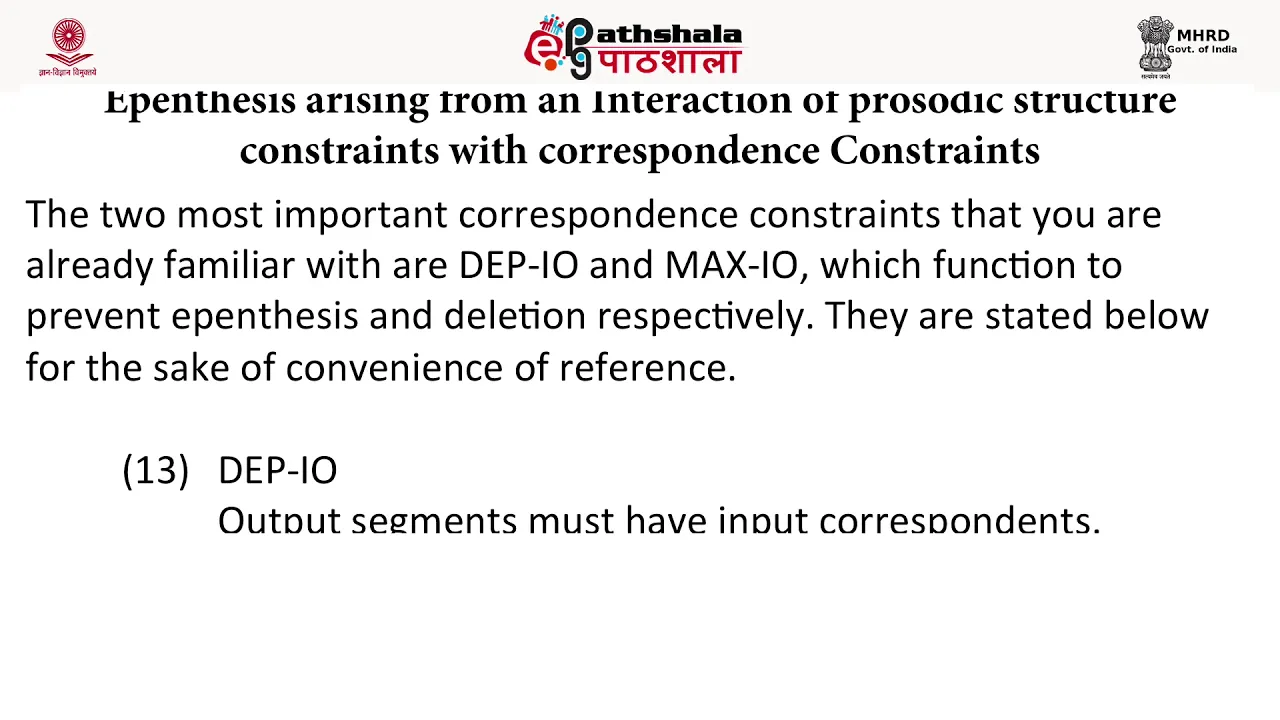
- Why this video is valuable: A highly academic and thorough video that directly explores the interaction of constraints in resolving epenthesis (segment insertion) and deletion phenomena. It links these actions to prosodic markedness constraints like
ONSETand*CODA, showing how ranking permutations result in different cross-linguistic repair strategies. - Knowledge Checkpoint:
- Determine whether a language will resolve a highly marked structure (like a coda) via deletion (violating
MAX) or epenthesis (violatingDEP) by analyzing its constraint hierarchy. - Set up an OT tableau showing that a ranking of
*CODA >> MAX >> DEPtriggers epenthesis rather than deletion to resolve a coda consonant. - Compute the total number of mathematically possible grammars that can be formed using a set of 5 constraints.
- Determine whether a language will resolve a highly marked structure (like a coda) via deletion (violating
Course Map
Below is a schematic flowchart of the curriculum's logical flow. Each module serves as a mandatory developmental step to build the analytical tools needed to resolve linguistic data using constraint-based grammars.
Key People Index
| Name | Association | Context & Contributions |
|---|---|---|
| Alan Prince | Rutgers University | Co-founder of Optimality Theory (1993 alongside Paul Smolensky). Developed Metrical Phonology and formally structured the mathematics of constraint interaction and Elementary Ranking Conditions (ERCs). |
| Paul Smolensky | Johns Hopkins / Microsoft Research | Co-founder of Optimality Theory. Brought computational insights and connectionist neural network principles into generative grammar, modeling language as harmonious state evaluations. |
| John McCarthy | University of Massachusetts Amherst | Pioneered the application of Optimality Theory to Semitic languages, morphological alternations, and developed crucial subsets of Faithfulness constraints (Correspondence Theory). |
Final Self-Assessment
To evaluate your mastery of the learning goal, work through the following self-assessment checklist. You should be able to confidently verify and complete every single task below.
- Syllable Diagnostics: I can segment any given string of phonetic sounds into its hierarchical syllable tree (identifying Onset, Nucleus, Coda, and Rhyme).
- Rule vs. Constraint Framing: I can explain the "rule conspiracy" problem and describe how Optimality Theory resolves it by using ranked, violable constraints rather than sequential instructions.
- Architectural Mechanics: I can detail the precise inputs, operations, and outputs of GEN, CON, and EVAL.
- Constraint Parsing: I can formulate definitions for the fundamental markedness constraints (
ONSET,*CODA,*COMPLEX) and faithfulness constraints (MAX-IO,DEP-IO,IDENT-IO). - Tableau Drafting: I can draw a standard, flawless OT tableau, including correct formatting for inputs, candidates, violation marks (
*), fatal violations (*!), and shading. - Ranking Arguments: I can extract formal constraint rankings (e.g., ) from a set of comparative linguistic data by identifying which constraint must dominate to rule out competing candidates.
- Factorial Permutation: I can explain how permuting the relative order of constraints yields distinct linguistic typologies (grammars).
- Typology Generation: I can construct the four core syllable typologies of human languages using permutations of
ONSET,*CODA,MAX, andDEP. - Repair Identification: I can analyze an empirical database of a foreign language and determine whether it resolves phonotactic violations via epenthesis, deletion, or featural alternation, and express this behavior as an OT tableau.