!["Optimality Theory in Generative Phonology" [a brief description on Optimality Theory]](https://i.ytimg.com/vi/1HwT3gFKli4/maxresdefault.jpg)













![[AFLA27] Tracing constraint movement: Austronesian binary feet and word minimality - Alexander Smith](https://i.ytimg.com/vi/BQHy93O7Qcc/maxresdefault.jpg)


In Optimality Theory, epenthesis (segment insertion) and deletion phenomena arise from the interaction between prosodic structure markedness constraints (such as onset, no coda, no complex onset, and no complex coda) and correspondence faithfulness constraints (DEP(IO) and MAX(IO)), where different constraint rankings determine whether epenthesis, deletion, or neither occurs, with the minimal violation principle ensuring that markedness constraints remain active even when not highest-ranked.
Constraint Interaction in Optimality Theory: Epenthesis & Deletion
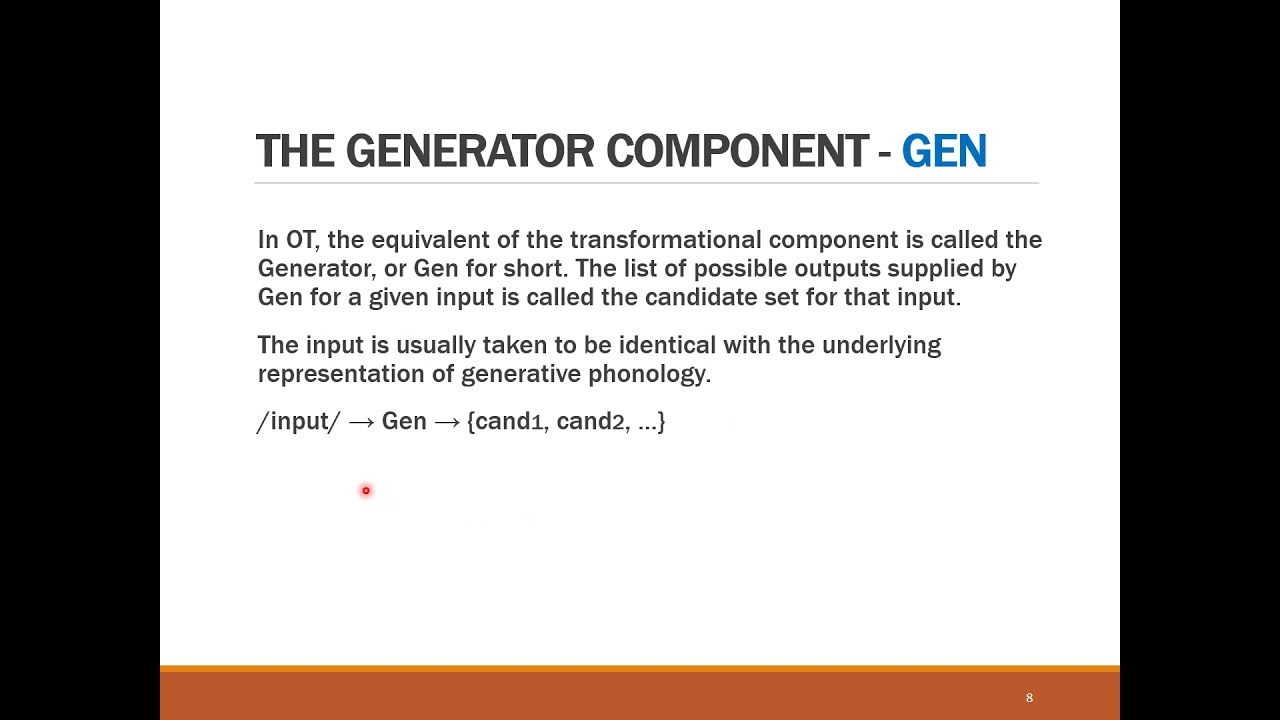
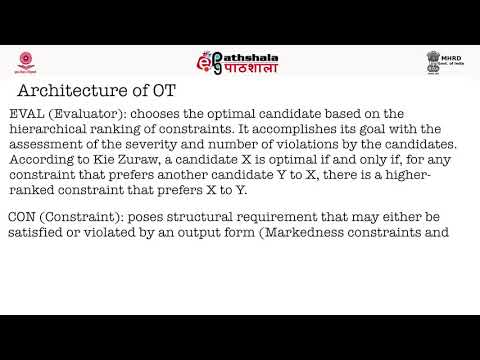
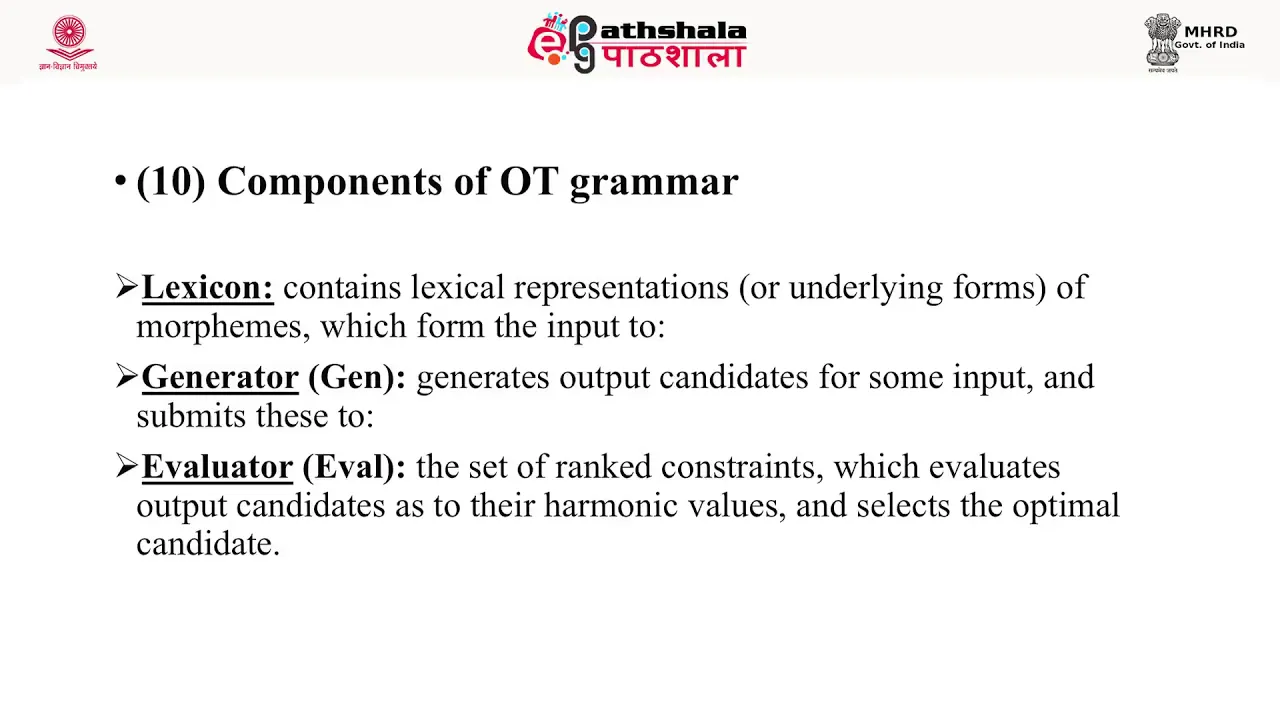
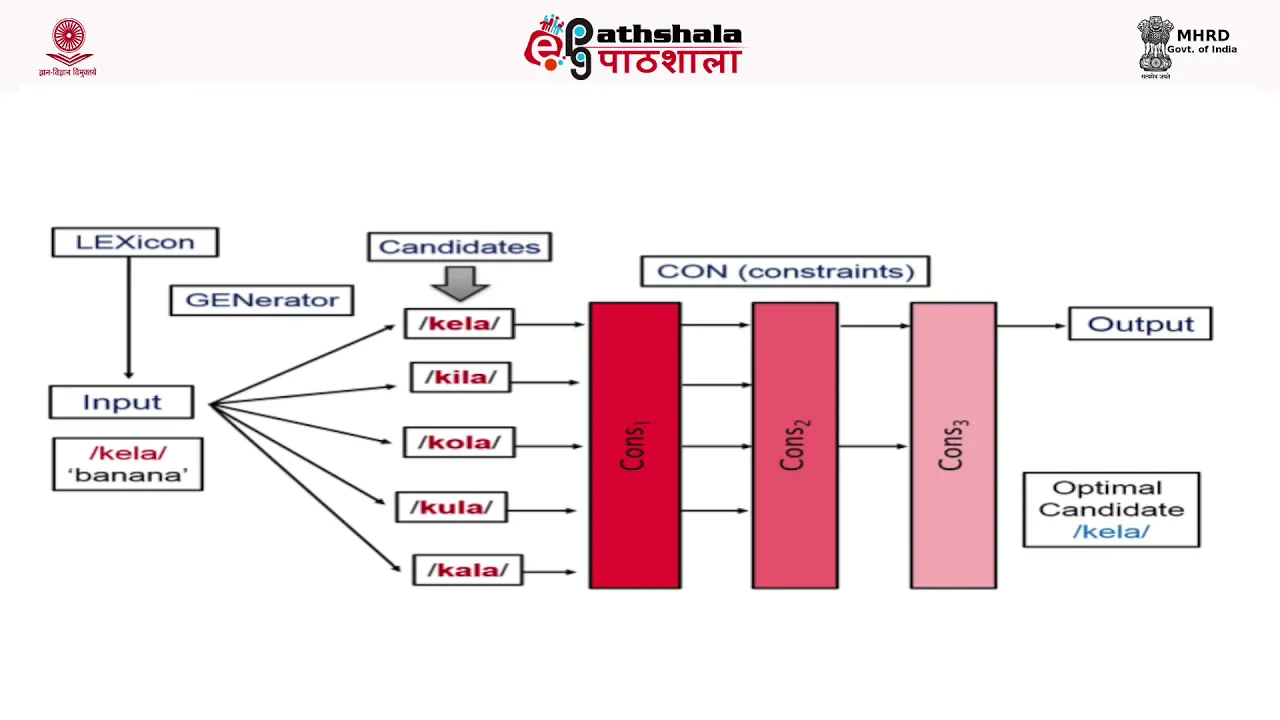
Added:Basic architecture of Optimality Theory (OT), including the functions of the Generator (GEN), the Evaluator (EVAL), and the constraint set (CON).
Familiarity with reading and constructing OT tableaux, including constraint ranking, violation marks, and selecting the optimal candidate.
Fundamental concepts of syllable structure and phonotactics, particularly the universal preferences for syllable shape (e.g., CV syllables).
Distinction between markedness constraints (which penalize complex structures) and faithfulness constraints (which penalize deviation from the input).
Exploring phonological opacity and how classical Optimality Theory handles opaque interactions through frameworks like Stratal OT or Sympathy Theory.
Advanced constraint interaction schemas, such as constraint local conjunction, harmonic serialism, and positional faithfulness.
Applying Optimality Theory to language acquisition (L1 and L2) to model how learners transition from an initial state to target constraint rankings.
Analyzing historical sound change and dialectal variation as cases of constraint reranking over time or space.
180 views2likes36:52Original Release: 2018-08-20
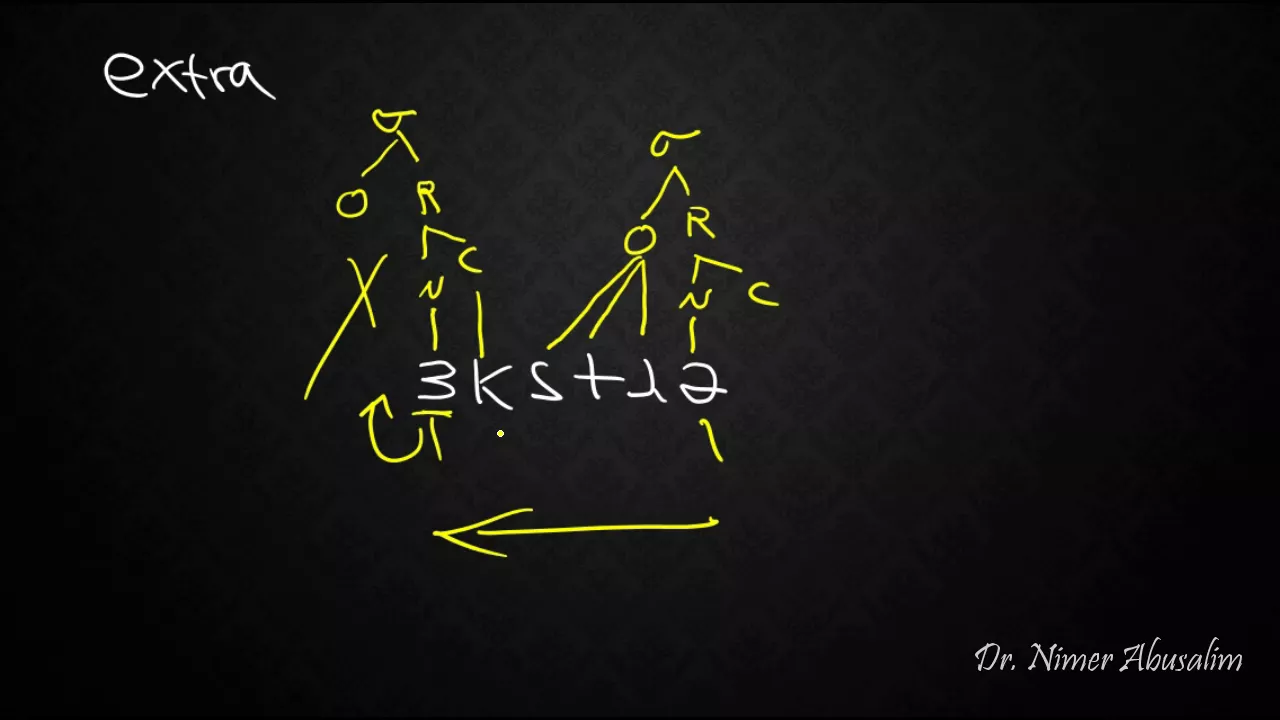
[Music] come to the epz bachelor program in linguistics I am promote Pandey Center for linguistics they are Lal Nehru University today we will discuss the topic constraint interaction in optimality theory this is a module of paper 5 advanced phonology in this module will be concerned with trying to see how the phenomena of parenthesis and deletion work in different languages the idea is to be able to understand how certain features of a pen thesis I realized in different languages on account of differences in constraint interaction take a look at some of these properties of apprentices the four main properties of apprentices which every analysis of apprentices or every explanation explanatory account of apprentices must take into consideration these are apprentices takes place in the context in which an input structure is marked such as the presence of Buddha's or lack of answers apprentices applies minimal although the input structure may contain multiple mark structures and although apprentices can apply in all those contexts it applies only to the extent that the input structure is not drastically changed apprentices does not apply ubiquitously so there are exceptions to the applet apprentices realized restricted Lee as the minimally marked segment in the system such as the neutral vowel uh or the hi friend wall-e is inserted as apprentices so car gage tries to show that all critical aspects of apprentices are explained in terms of the interaction among four groups of constructs these are personick structure markedness constraints of the syllable level correspondence faithfulness constraints alignment constraints and featural markedness constraints the various rankings among these constraints gives us all types of apprentices that are noted about that we mentioned with the features on the screen now let's begin with the interaction of syllable structure based markedness constraints and correspondence faithfulness constraints first of all the syllable structure based constraints these are as we know prasat neak structure constraint we have looked at the syllable structure in the earlier modules on Posada phonology and we saw that various types of phenomena at the word level such as phonotactic constraints etc take place in order to avoid you are already familiar with the tripartite syllable structure with the onset the nucleus and the coda we are also familiar with the hierarchical structure of the syllable that we saw in the earlier modules these are presented here on the screen for you look at these structures one this a syllable onset nucleus coda and then we have the same structure but we have another level below and then we have another hierarchical structure with rhyme occurring now all of all these structures we will take we will consider the structure in one a now the syllable structure constraints you are already familiar with at least two of the syllable structure constraints namely maximal onset principle and the sonority sequencing principle we looked at them in the module on metrical phonology the syllable now in OT we have those as well as some other constraints which are related to the syllable structure before we come to them we should try and see how these constraints are formulated the basic process involved in formulating constraints in proposing constraints is to be able to see the relationship between marked generalizations and unmarked generalizations what do we mean by mark generalizations let us say languages have nasal vowels as much less commonly than nasal sign languages having oral vowels now the presence of nasal vowels then implies that the oral vowels are also present so we will say then a constraint will be something like no nasal vowels a language that has nasal vowels will be violating that constraint now similarly we have other other types of relationships between marked and unmarked for example there are languages which lack an onset now syllables have onsets and that is a much less marked or unmarked situation than syllables having not having onset so if there's a language in which syllables do not have onsets then it implies that there are syllables in it which have concepts now so we have various implicational universals of Hindi in these different languages for example for syllable-final segments we have an implication of relations such as if a language has closed syllables then it also has open syllables onset complexity if a language allows complex answers then it also allows simple answers coda complexity if a language allows complex code does then it also allows simple coders now these implicational universals then translate into various constraints as you can see them on the screen onset that means syllables must have ons if there is a syllable in the language that does not have an onset that means it involves a violation of the constraint on set similarly we have these constraints no coda that is syllables are open in some languages which are very rare for example Malayalam about which we have spoken several times Malayalam in Malayalam there are no quotas so Malayalam involves a violation of the constraint no quota and then we have complex onset that means that aunts complex on sets are avoided which means that onsets are more simple the presence of complex on sets involves a violation of the constraint from no complex on set and we also have them no complex code does so languages which have complex code does then involve violation of the constraint no complex CUDA now we have on the screen various types of syllable structures which with the given constraints and you will we will see how these violate one or the other constraint take a look at these on your screen so we have CV no violation but that's the rarest thing here CBC involves a violation of no coda because there is a quota v violates the requirement for an on-set if we have BC then we have both on set and no code a violator if we have CC v then complex on set is violated if you have v bc then it is complex complex code up then no coda and then unset violator and so on now of this all it's only one that is C V type syllable which does not incur any violation and that's the optimum type the commonest type of syllable structure found in languages and this experiment this generalization also explains why when we have sequences such as cv cv there's the middle C between the two vowels goes as the onset of the following syllable rather than as the coda of the preceding syllable because of the the constraint code onset and the constant nokotta so they see the division of cv cv sequences into CV and CV then is what is expected from the universal constraints that of syllable structures that we have seen now it should be possible for us to see that the notion of constraints and optimality theories somehow is linked with the notion of violation that is every constraint can be violated in some language or the other and even in this case we have suppose we have a sequence cv cv then we expect that going by the theory and its position on the violation of constraints we should be able to find some some examples of cv cv being divided into cv c and v and that indeed is the case with in some languages if not everywhere at least in some contexts for example in kasi if we have a vowel being added to a CVC structure then in kasi there seems to be a difference between the stem and the suffix preserved so that cv c + p does not become cv cv but rather is kept as cv c + v now so we have this opportunity of taking a look at the various types of constraints and the way in which optimality theory looks at them now let us turn to consider the phenomena of FN thesis which arises out of an interaction between prosodic structure constraints that we have seen relating to the syllable onset no coda no complex onset no complex quota and correspondence constraints the two most well-known correspondence constraints that you may already be familiar with are the dip IO and Max I the dip io says that any segment on the in the output must be dependent in much sever defendant input so this allows for to prevent parentheses from taking place and then we have max IO that means every segment of the input must be realized as the output so the maximum structure of the input should be preserved should be found should be manifested in the output now this max IO constraint is which is responsible for the deletion not taking place so if there is appendages that means it involves a violation of dip IO and if there is deletion that means it involves a violation of max I on this way we understand the these phenomena now let's take a look at some examples of how the prosodic structure constraint and the these correspondence constraints operate there are two constraints the prosodic structure constraint on set and the correspondence constraint dip io now in this language when given the input of no new comma and then e what we find is that there is a certain difference in the between the input and the output what do you notice here we notice that in the output there is an insertion of today so we have Dinko Ning coma EEB emerging as Ning coma T why is that so because in this language the constraint dip io is lower than the constraint on said if if the input is allowed to surface on the in and on the output as it is that then this would mean that dip IO is higher rank than on set so you can have without onset syllable structures such as the final power but that doesn't happen so in this case vowel sequences are not allowed that means that dip IO is lower rank than is the the prosodic structure constraints now languages differ with regard to how these constraints interact now whether there is apprentices vowel apprentices or there is vowel deletion and there is neither a pen thesis or no vowel deletion all these are decided by the interaction and the constraint rankings amongst faithfulness constraints which are correspondence constraints and syllable structure constraints which are markedness constraints so look at the various rankings here on the screen to be able to see how the various rankings work so if the ranking is on set max io is higher than dip io then consonant apprentices takes place to create an on-set on the other hand if you have on set dip io being ranked higher than max i/o then bowel deletion takes place to avoid onset less syllable if max io and dip io are higher or dominating over onset that means neither deletion nor appendices can create on sale so this way we have various possibilities emerging on the output depending on the violation of these constraints and the ranking amongst these constraints based on these then we can work out the ranking among the nokotta and complex driven apprentices and delete deletion and we will see how the different rankings interaction with these constraints markedness constraints gives us different results you have them on this tree so in 17 you see no podía max io being ranked higher than de piyo which means vowel apprentices takes place to a white coda and so on you have concept consonant deletion to avoid coda and we have no coded f io being ranked higher than max max io so this way we have all these different possibilities of ranking and you you can easily do your work do your exercise to see how these different types of rankings can be worked out to predict what kinds of outputs are possible in different languages now to begin with in the Indies the example are given from the language arc in ninja compa with which we began where we saw the interaction between say onset and dip IO so the dip IO was lower than onset this is why we have Ning coma E emerging as lymphoma T now how about the ranking of Max io the ranking of Max io is higher than dip io and there is no wait for us to find out what the dip io and onset io have any ranking relationship amongst them they are being ranked equal and so the ranking of max max I owe above the bio means that the deletion a deletion cannot take place to preserve concept so if if we get the structure such as Ning kamati in preference to Ning coma II and Ning coma with the final deletion then the kind of ranking that emerges what you see on the screen now a question that arises at this point is at this point is that the lowest ranking case here is it the case that this lowest ranking deep io is not effective is inactive completely we find that that is not really so such constraints are actually quite active in different languages and even in in a single language where they do not appear to be active may actually be active we will try and see these examples here now as we noted at the beginning of this module that there are certain restrictions on the parenthesis although the input may violate various constraints markedness constraints but it is not the case that all the violations then are repaired by some constraint of the other being violated to keep the markedness constraints active in the language now take a look at the at the examples from the language lyrical where we have various marked structures coming as as as the input and then we will see how they are realized in the output with the minimal with the minimal violation of the markedness constraints take a look at the screen so we have here three examples one is up all the other is arc arc and the thirties come nah man no now when we have when we look at these three input forms we find that all of them seem to violate the general constraint about about complex so the so we have then in the first one third of all we have the first the beginning burner violating the complex and so we have an insertion so we get something like they're not world they please ignore the change from code to go it is on account of some other process that of voicing that takes place in this language between vowels or between two voiced consonants but we have only one so which means that complex answers are not being allowed throughout we will see that this is what is respected in all the cases our art is is something like our God garlic now there are cards so complex code as are also not allowed and then we have come here we have two parentheses in order to avoid complex forms now so the the complex then that is no complex on certain Buddha's are dominating deaf IO that means that they are dominating the constraint which does not allow fantasies now it is quite likely that these forms could have more could have multiple violations of the piyo and but the in this language that does not happen look at the data on the screen from Lerna Kelly so we have two columns possible forms with maximal appendices so our cart could be are regarding good but that's not the case and similarly the Nagoya could be Tina Golu call me Nima Nene now but what we have is the forms that have minimal apprentices in in the first two cases there is only in the first case there is one apprentices and in the second case there is two and so in the third case also there too now what it means is that if the minimal violation of DEP is taking place that means that appendices is not being is not applying unrestrictedly in all those cases that means that dip io is dominating another markedness constraint such as complex or whatever so dip io must be dominating let's take a look at the tableau that we have here on the tableau then we have these three constancy constraints complex no complex defy and milk odor so the first the first the one conflicts and no coda as you know our markedness constraints and dip io is a faithfulness constraint in this case what we find is the dip IO which is faithfulness constraint correspondence constraint is rag lower than no complex but it is ranked higher than no coda so Coda's are being allowed to appear in the in in Linacre now so when insertion takes place that then the Buddha's are tolerated only complex on sets and complex Coda's are not tolerated now one question that arises is if a constraint such as no coda is ranked the lowest is it the case that that it is in under knows it is of no value at all it is not active at all but that is not really so take a look at the at the screen for further examination of that issue what we find here is that there are cases such as the goal now the possibilities here are you could have what you could have picked novel you could have thin a goalie goalie and then you have thin a goal now when we compare the middle to two forms what we find is that the second form from top is preferred to the third from from top and one ground and that is that no coda in the third form is violated twice that means that the multiple violations of no coda are not being are not tolerated in this language which means that no coda is quite at in the language so in certain forms one against the idea that the lowest-ranked form is not active but that's not the case any constraint will may be active in the language now one of the simple test is to see if the multiple violations of that concept constraint are allowed or not if multiple constraints are the ones which make a choice between two forms and one which has less violations is preferred that means that constraint however low it is is still active in the language so we have looked at the issue of constant interaction today basically we looked at two kinds of constraints one was markedness constraints and the other was correspondence constraints which are faithfulness correspondence constraints we looked at the mainly the manifestation of apprentices and in various forms in different languages and how apprentices works in correspondence with the correspondence constraints of faithfulness constraints to to manifest itself in different forms and also to manifest itself in minimally in different forms all those four main features of apprentices were looked at in the module in the next module we will continue to look at constraint interaction with more and more data you are expected to look at the data and carry out the exercises that are given to you in order to have an insight into this issue thank you you
Up Next
147:51
Phonology Theories: Autosegmental to Optimality Theory | Lecture
@LinguisticsIsland
119 views•2025-08-14
53:56
Metrical Theory and Optimality Typology | Alan Prince Analysis
@MITLINGUISTICS
3.2K views•2013-10-18
19:00
Optimality Theory in Linguistics: Key Concepts & Architecture Explained
@Vidyamitra
14.1K views•2018-08-20

21:32
Accent Expert Explains U.S. Regional Dialects | Part 1
@WIRED
9.3M views•2021-01-21
Related Study Plans & Knowledge Roadmaps
Structured learning paths in Linguistics
linguistics
Optimality Theory: Tableaux & Constraints
01Phonological Basics: Sounds, Syllables & Rules
02Foundations of Optimality Theory: GEN, CON, and EVAL
03The Constraint Inventory: Markedness vs. Faithfulness
+ 2 more learning modules
15h5 modules
Explore Roadmap
linguistics
Morphosyntactic Alignment: S, A & P Systems
01Foundations of Syntax: Transitivity and Arguments
02The Linguistic Variables: Mapping S, A, and P
03Nominative-Accusative Alignment
+ 3 more learning modules
12h6 modules
Explore Roadmap
linguistics
Analyzing Sign Language: Phonology & Syntax
01Foundations of Sign Language Linguistics
02Phonology: The Five Parameters of a Sign
03Morphology: Word Formation and Classifiers
+ 2 more learning modules
14h5 modules
Explore Roadmap
linguistics
Pragmatics: Speech Acts, Grice & Politeness
01Introduction to Pragmatics: Meaning in Context
02Grice’s Cooperative Principle & Implicature
03Speech Act Theory
+ 2 more learning modules
14h5 modules
Explore Roadmap