









![CLAWS POS Tagger | Tagged Text Analysis with Antconc | C5 and C7 Tagset | [English]](https://i.ytimg.com/vi_webp/HPx39sq-_F4/maxresdefault.webp)

![Penelusuran korpus beranotasi POS tags [LK 107]](https://i.ytimg.com/vi/Y9wTSX_KWas/maxresdefault.jpg)
![Analisis kolokasi 2 [LK 118]](https://i.ytimg.com/vi/HGh-1KKtb-Y/maxresdefault.jpg)



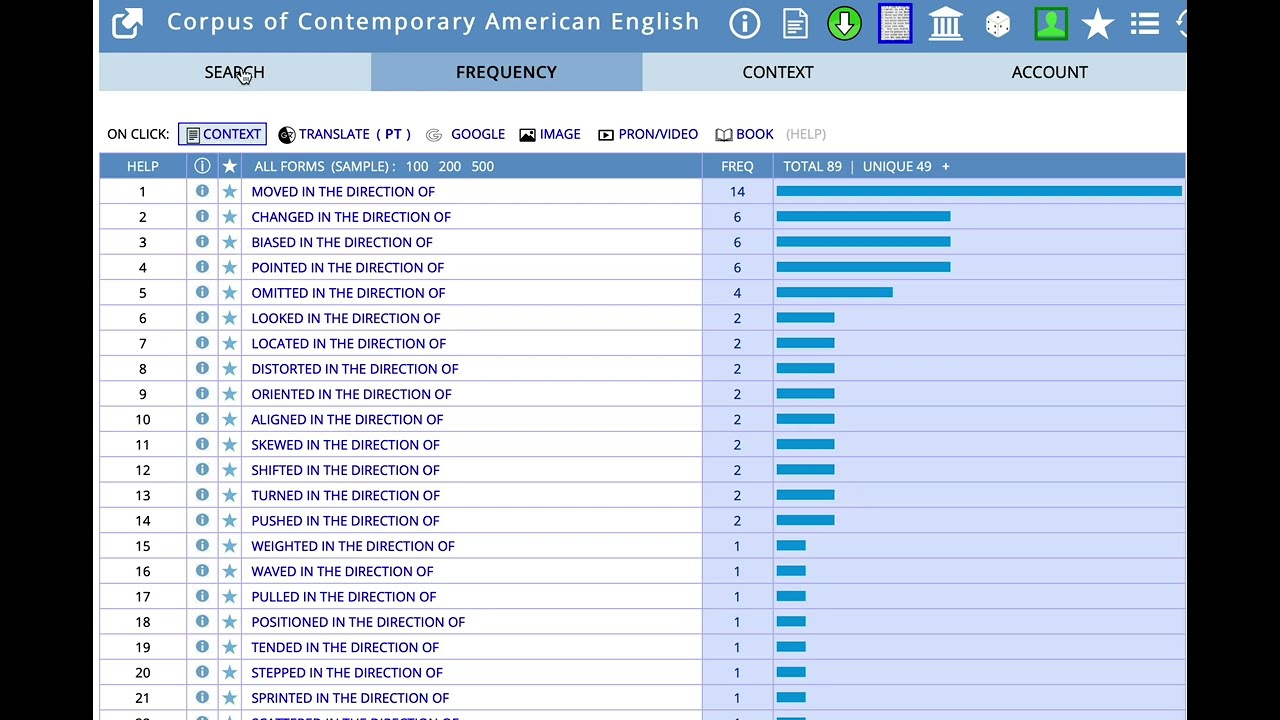

Part-of-speech tags in the Corpus of Contemporary American English (COCA) enable researchers to distinguish between multiple grammatical functions of words (such as differentiating the verb 'break' from the noun 'break') by using specific search syntax: placing a period between the word and its tag (e.g., fast.v) and enclosing words in square brackets to capture all forms; however, researchers must verify results through concordance analysis since automated tagging systems can misclassify ambiguous words, particularly those functioning as both adjectives and nouns.
Using Part-of-Speech Tags in COCA | Corpus Linguistics Basics
Added:Basic familiarity with the Corpus of Contemporary American English (COCA) interface and how to conduct simple word or phrase searches.
A clear understanding of fundamental English grammar and major parts of speech (such as nouns, verbs, adjectives, and adverbs).
The concept of lexical ambiguity, specifically how a single word (e.g., 'book' or 'run') can function as different parts of speech depending on the context.
A foundational understanding of what a corpus is and how it represents real-world language use.
Mastering the specific CLAWS tagset codes used by COCA to target highly specific grammatical sub-categories (e.g., plural nouns versus singular nouns).
Using POS tags in combination with collocates to analyze the typical grammatical environments of specific words.
Conducting lemma-based searches combined with POS tags to capture all morphological variations of a word in a specific grammatical role.
Applying refined COCA search techniques to practical research questions in sociolinguistics, lexicography, or language pedagogy.
23.6K views0likes10:37Original Release: 2012-08-14
in this video I'm going to show you how part of speech tags work in the corpus of contemporary American English and illustrate how they can be used to help us generate the data that is the most relevant to our research questions for example if we were interested in distributions of the verb break how could we differentiate this kind of break from this one or if we were interested in newer forms of the agitato fly a lot of money how would we isolate those from the far more common verb forms or noun forms also I want to talk about some of the issues and potential complications that we should look out for when we generate our data so let's get started before we start using the part of speech tags in coca I want to very briefly give you an idea of what a part of speech tag is a simple corpus can be composed of plain text files like this one it's the text of Shakespeare's Hamlet and we can use a computer to search and sort these files in various ways we can however add information to that plain text file to enable the computer to recognize anything that we think is important or relevant that information is contained in what are called tags here is the same play with tags added that identify things like stage directions speakers and lines for our purposes it's not necessary for you to know anything technical about tags but you should have a general idea of what they are so here is an example of a sentence and here is that same sentence after it has been tagged for parts of speech the angle brackets identify the tags so this bit marks the beginning of the part of speech tag and this bit that begins with the backslash marks the end of the tag this tag then identifies the as a determiner this one identifies student as a noun and so on although the markup can look really complicated the idea behind it is a rather simple one tags embed information into the texts that we can then retrieve in our sample sentence the tags connect words to part of speech information this is important partly because many words in English can function as multiple parts of speech you can chair a committee but you can also sit on one you can be fast but you can also fast bat and prison may be over when these pictures appear you can visit Google but you can also google information so whenever we are collecting data from a corpus we need to focus on what it is that we are searching for and do our best to limit irrelevant data that might distort our analysis part of speech tags are one tool that we can use to focus our searches so let's look at how we can use them first you don't need to memorize the tags on the left side of the interface among the various search options there is a part of speech list click on it and a drop-down menu will appear when you select a particular part of the speech the tag will appear in the search field so let's try one that I mentioned earlier fast as a verb versus fast as an adjective first I'll select all verbs from the drop-down menu this will generate a v-star enclosed in square brackets in the search field this is the symbol that tells Coca to search for all verb tags now I'll type fast inside square brackets I talked about this in the first video you use square brackets to limit eyes the results this will generate all forms of the verb and the results fasts fasting fasted not just fast and now we need to get our search syntax right in coca if we are searching for a word tagged as a specific part of speech we must put a period between the word and the tag without any space this is key you must connect the searched word in the tag with a period if you put a space between the searched word and the tag coca will generate that search word followed by all words tagged as that part of speech so in our case if we put a period between fast and the verb tag you will generate all instances of fast that are tagged as verbs if we put a space between fast and the tag we will generate all instances of fast followed by a verb here I'll show you here is what we generate with a period in our search string you and here is what we get with a space this kind of search string generates collocations and we'll use these a lot I'll talk more about collocation z' in the next video for now let's start by looking at instances of fast tagged as a verb well type in the search string and change the display to chart so we can look at distributions across text types here we find that as a verb fast is used most frequently in the magazine text type but is also quite frequent in academic text types by clicking on the header we find that in magazines it's most frequent in the religion subtype this should be surprising as fasting is a common religious practice if we look at the distribution in academic writing we find that although it is frequent in the philosophy religion subtype it is slightly more frequent in medicine as I noted in the first video it is always important to examine your concordance data so if we were doing an analysis of these distributions we would need to look at the key words in context if we click on the bar of the chart coca will give us the concordance lines from that part of the corpus the first few lines seem to be using the verb to indicate the religious ritual and its implications for patients with conditions like diabetes then however we have an entirely different use in these lines it describes molecules like blood and lipids in a particular metabolic state after a person hasn't eaten overnight or has completely digested a meal in this context then fast has a very technical meaning in addition to the more common one now let's look at distributions of fast as an adjective will leave fast and brackets so that we look for all forms including faster and fastest here the distribution is similar but slightly different it is also most common in magazine but it is far more common overall one way of exploring these distributions would be to look at the verbs and nouns that Kollek ate with fast in the different text types which we will do in the next video ok before we finish I want to call your attention to a couple of things the first is the importance of checking your concordance data for example at the beginning of the video I mentioned that fly can be used as an adjective to refer to dress style or self presentation let's see what we get if we search for fly tagged as an adjective we find that most of the entries for adjectives ofly are related to things like fly-fishing or baseball rather than looking fly but if we look through our concordance data we find examples of what we are looking for we would over represent the occurrences of a suitable fly if we didn't interrogate our quantitative results the final thing you should be aware of is the nature of automated tagging and the ambiguity of some of the part of speech categories a tagging system like claws is remarkably accurate this is particularly true with closed lexical categories and highly frequent tokens like determiners however some lexical categories are notoriously ambiguous and difficult to tag automatically again we can look at our results from adjectives ofly the concordance lines where fly collocates with fishing is referencing this invent this ball this and swatter this and in these instances fly is functioning to modify nouns like fishing vents ball or swatter although in these cases fly appears before the noun in attributed position that doesn't mean that fly is formerly an adjective by form adjectives have comparative forms you can have flyer close than someone but you can't have flyer fishing also adjectives can appear in predicative as well as attributed position in other words they can come after linking verbs like to be or to appear so you can have fly clothes and those clothes can be fly you can use a fly swatter but that fly swatter can't be fly so always be aware of what you're looking for is it okay to have data where fly as a modifier but is really a noun by form or do you only want examples of fly where it is strictly an adjective be aware then of the limits of part of speech tags most often this won't be a problem but sometimes particularly if you're looking at a small data set you might need to sort through your results okay let's review many words in English can function as multiple parts of speech part of speech tags therefore can help us refine our searches and generate the data that we are looking for in coca there is a part of speech drop-down list that has all of the tags available for our searches to search for a word tagged as a specific part of speech put a period between the word and the tag without any space if you are looking for all forms of a word don't forget to limit eyes your results by enclosing the word in square brackets that's it thanks for watching
Up Next

18:18
Corpus Linguistics: Corpus-Based Analysis and Move Analysis
@jmariannemae
2K views•2021-05-25

73:00
American English OKAY Over Time: A Diachronic Interactional Linguistic Study
@Abralin
1.2K views•2020-07-30

11:42
Guide to Collocations in COCA: Corpus Linguistics Tutorial
@TheGrammarLab
27.3K views•2012-08-21

21:32
Accent Expert Explains U.S. Regional Dialects | Part 1
@WIRED
9.3M views•2021-01-21
Related Study Plans & Knowledge Roadmaps
Structured learning paths in Linguistics
linguistics
Corpus Linguistics: AntConc, COCA & Collocation
01Introduction to Corpus Linguistics & Digital Corpora
02Navigating the Corpus of Contemporary American English (COCA)
03Concordancing and Lexical Collocations using AntConc
+ 2 more learning modules
12h5 modules
Explore Roadmap
linguistics
Optimality Theory: Tableaux & Constraints
01Phonological Basics: Sounds, Syllables & Rules
02Foundations of Optimality Theory: GEN, CON, and EVAL
03The Constraint Inventory: Markedness vs. Faithfulness
+ 2 more learning modules
15h5 modules
Explore Roadmap
linguistics
Morphosyntactic Alignment: S, A & P Systems
01Foundations of Syntax: Transitivity and Arguments
02The Linguistic Variables: Mapping S, A, and P
03Nominative-Accusative Alignment
+ 3 more learning modules
12h6 modules
Explore Roadmap
linguistics
Analyzing Sign Language: Phonology & Syntax
01Foundations of Sign Language Linguistics
02Phonology: The Five Parameters of a Sign
03Morphology: Word Formation and Classifiers
+ 2 more learning modules
14h5 modules
Explore Roadmap