Morphosyntactic Alignment: S, A & P Systems
Learning Goal: Classify and analyze morphosyntactic alignment systems across diverse world languages by mapping the grammatical relationships between intransitive subjects (), transitive agents (), and transitive patients () in nominative-accusative, ergative-absolutive, and tripartite structures.
Prerequisites
- Basic familiarity with word classes (nouns, verbs, pronouns)
- Introductory-level understanding of morphological case concepts (e.g., nominative vs. accusative in personal pronouns like "I" vs. "me")
Estimated Total Study Time
12 Hours
Module 1: Foundations of Syntax: Transitivity and Arguments
To study how languages organize grammatical relationships, we must first look at the core engine of the clause: the verb. This module establishes how verbs dictate the number and type of noun phrase arguments required to form grammatically complete sentences. We will deconstruct traditional notions of "subjects" and "objects" to prepare for more robust cross-linguistic frameworks.
Recommended Videos

Why this video
This short, conceptual video establishes the foundational rule of syntactic dependency: verbs serve as the structural core of a clause, determining exactly how many external arguments are required for syntactic grammaticality.

Why this video
This video explains the traditional notions of "Subject" and "Object" in basic clauses. It highlights how case systems are deployed by languages to distinguish these grammatical roles, laying the groundwork for the more advanced alignments we will see later.

Why this video
This video introduces the morphosyntactic mechanisms languages use to distinguish agents from patients. It compares word order in English, noun morphology (case suffixes) in German, and verb agreement morphology in Greenlandic, showing how syntax and morphology work together.
Knowledge Checkpoint
- Can you define "valency" and explain the difference between a core argument and an adjunct?
- Can you identify whether a verb is intransitive (valency of 1) or transitive (valency of 2) in a sample sentence?
- Do you understand how English uses word order to distinguish "Subject" from "Object," and how this contrasts with morphological case marking?
Module 2: The Linguistic Variables: Mapping S, A, and P
Traditional grammar terms like "subject" and "direct object" break down when comparing different languages. To analyze languages objectively, typologists use three comparative variables: S, A, and P (sometimes written as O). This module teaches you how to map these variables and distinguishes morphological alignment (noun case marking) from syntactic alignment (agreement, binding, and structural behavior).
INTRANSITIVE CLAUSE TRANSITIVE CLAUSE
  [ Subject ]                   [ Agent ]      [ Patient ]
       |                            |               |
       ▼                            ▼               ▼
     ( S )                        ( A )           ( P )
Recommended Videos
Why this video
This animation introduces the S, A, and P/O variables. It clearly explains the transition from semantic roles (who does what) to the abstract syntactic variables (, , and ) used to analyze morphosyntactic alignments worldwide.

Why this video
This deep-dive lecture covers morphological case systems and morphosyntactic alignment. It walks through how languages group , , and arguments using case marking, offering a comprehensive look at the mechanics of linguistic typology.
![Morphosyntactic Alignment [Syntax 3]](https://i.ytimg.com/vi/QSAxXcTsNv4/maxresdefault.jpg)
Why this video
This tutorial provides a solid visual breakdown of the structural groupings of , , and . It explains how these abstract relationships are marked through case, word order, and agreement systems, introducing the five major alignment types.
Knowledge Checkpoint
- Can you define the parameters of (sole argument of an intransitive clause), (agent-like argument of a transitive clause), and (patient-like argument of a transitive clause)?
- What is the difference between morphological alignment (case marking on nouns) and syntactic alignment (verbal agreement)?
- Why do linguists avoid using the term "subject" when analyzing cross-linguistic alignment structures?
Module 3: Nominative-Accusative Alignment
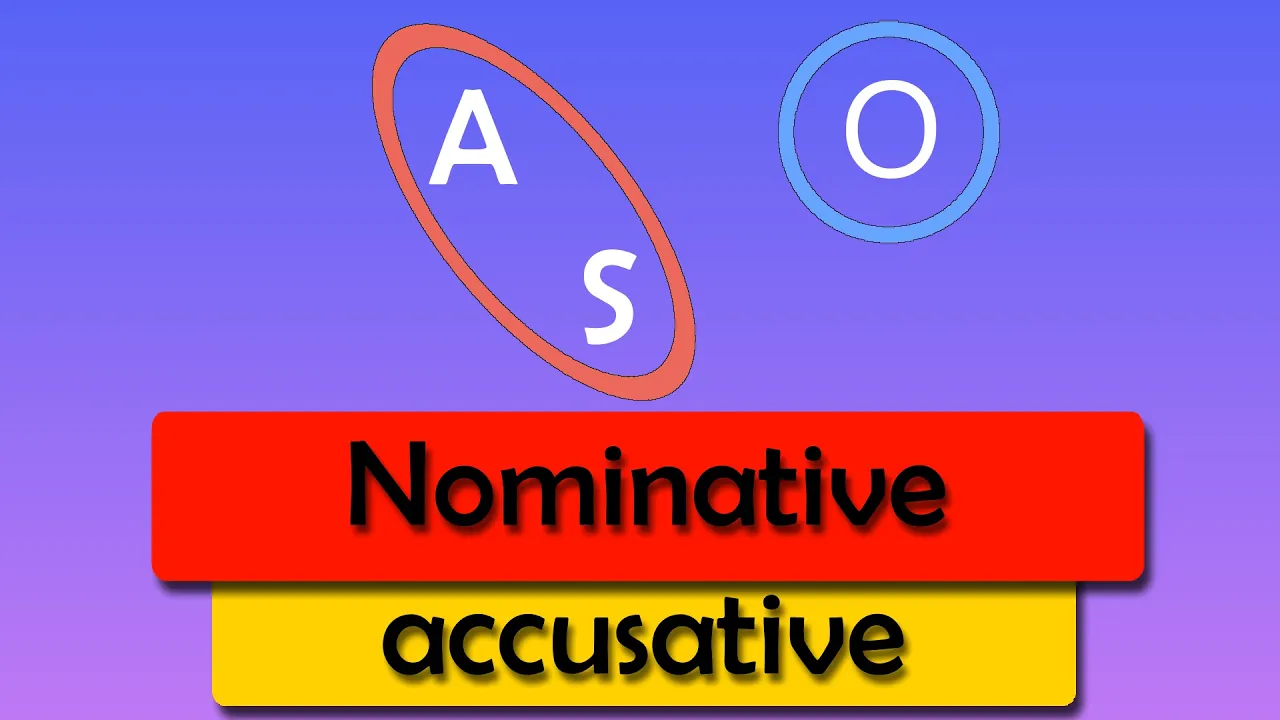
In a nominative-accusative alignment system, the subject of an intransitive verb () and the agent of a transitive verb () are marked identically, while the transitive patient () is marked differently. This is the most common system in natural languages and is used by English (in its pronoun system), Latin, German, and Esperanto.
NOMINATIVE-ACCUSATIVE SYSTEM
Intransitive: [ S ] (Nominative Case / Unmarked) | Transitive: [ A ] (Nominative Case / Unmarked) [ P ] (Accusative Case / Marked)
Recommended Videos
Why this video
This video explains how English uses an underlying nominative-accusative system. It uses English pronouns (e.g., "I" vs. "me", "she" vs. "her") to show how the language groups and together under the nominative case while marking with the accusative case.
Why this video
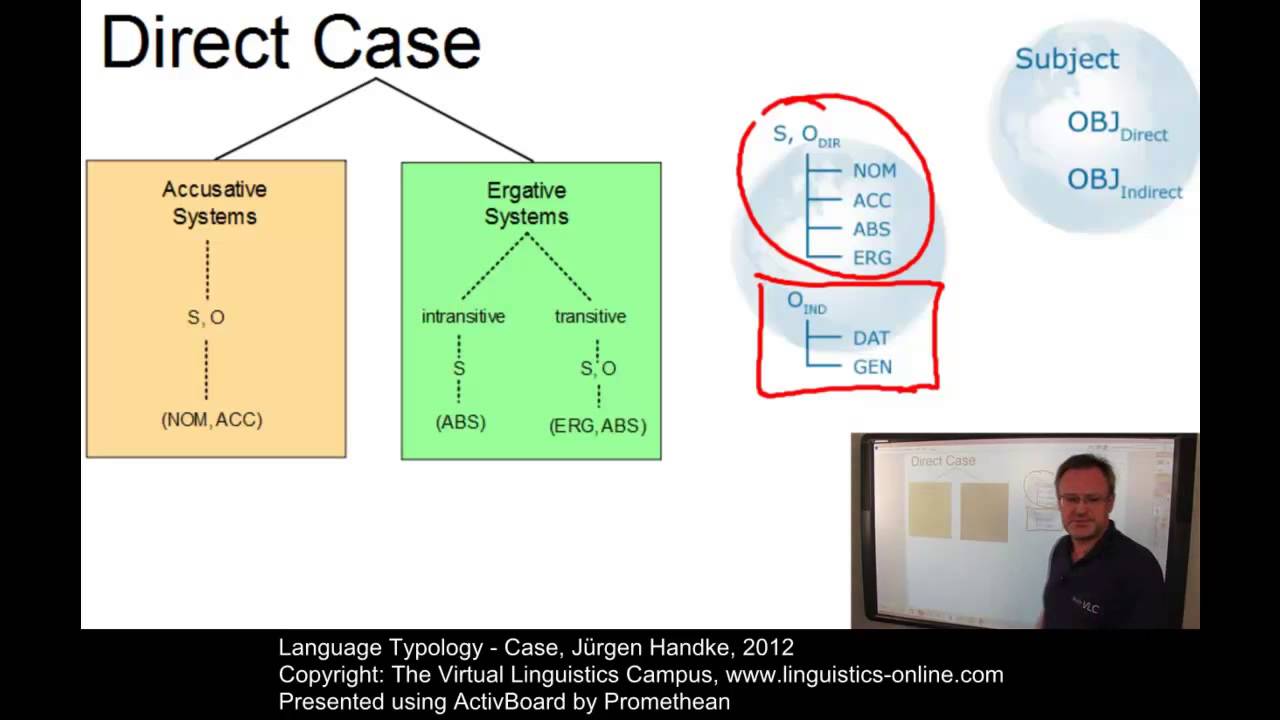
This grammatical typology video explains direct cases. It provides clear structural formulas showing how the accusative system distinguishes the nominative ( and ) from the accusative (), helping you understand morphological case-marking patterns.

Why this video
This concise guide explains how grammatical cases function across languages. It provides a helpful conceptual bridge by showing how accusative systems group intransitive subjects and transitive agents under the same umbrella.
Knowledge Checkpoint
- Can you sketch the grouping of , , and in a nominative-accusative language?
- In the English sentences "She fell" and "She kicked him," which pronoun represents , which represents , and which represents ?
- Why is the nominative case often marked with a "zero morpheme" (unmarked form) compared to the accusative case?
Module 4: Ergative-Absolutive Alignment
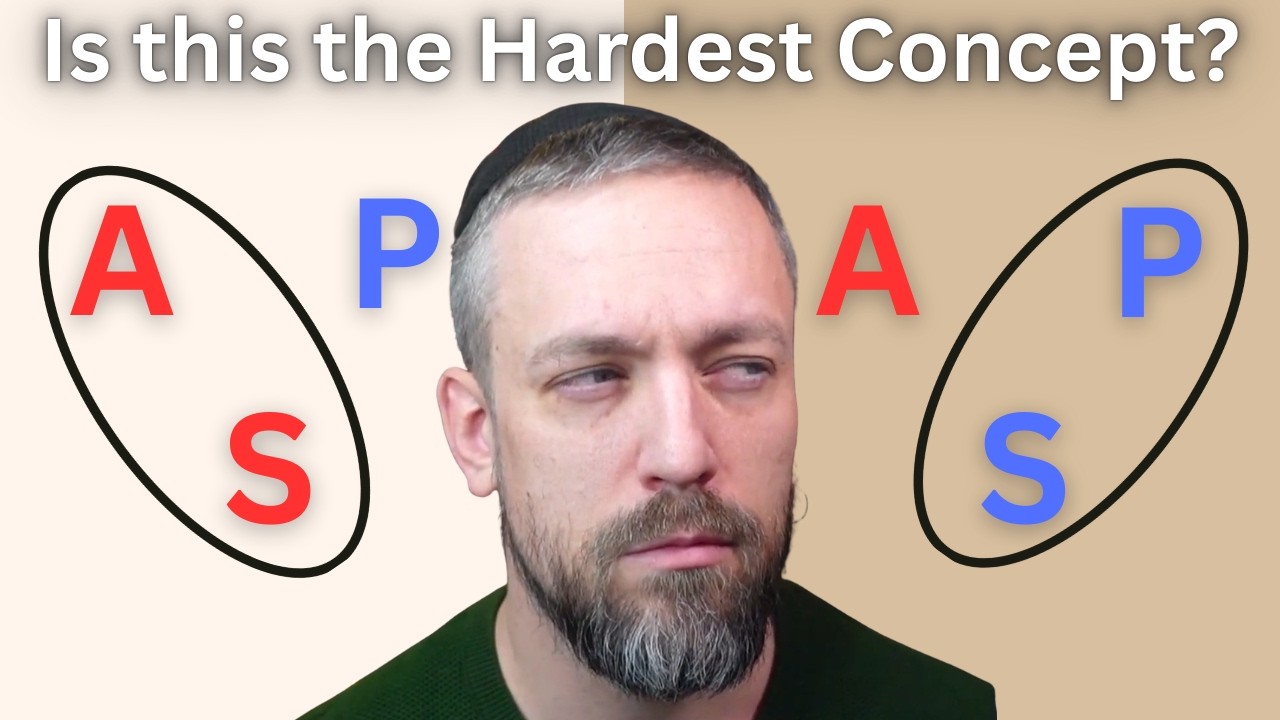
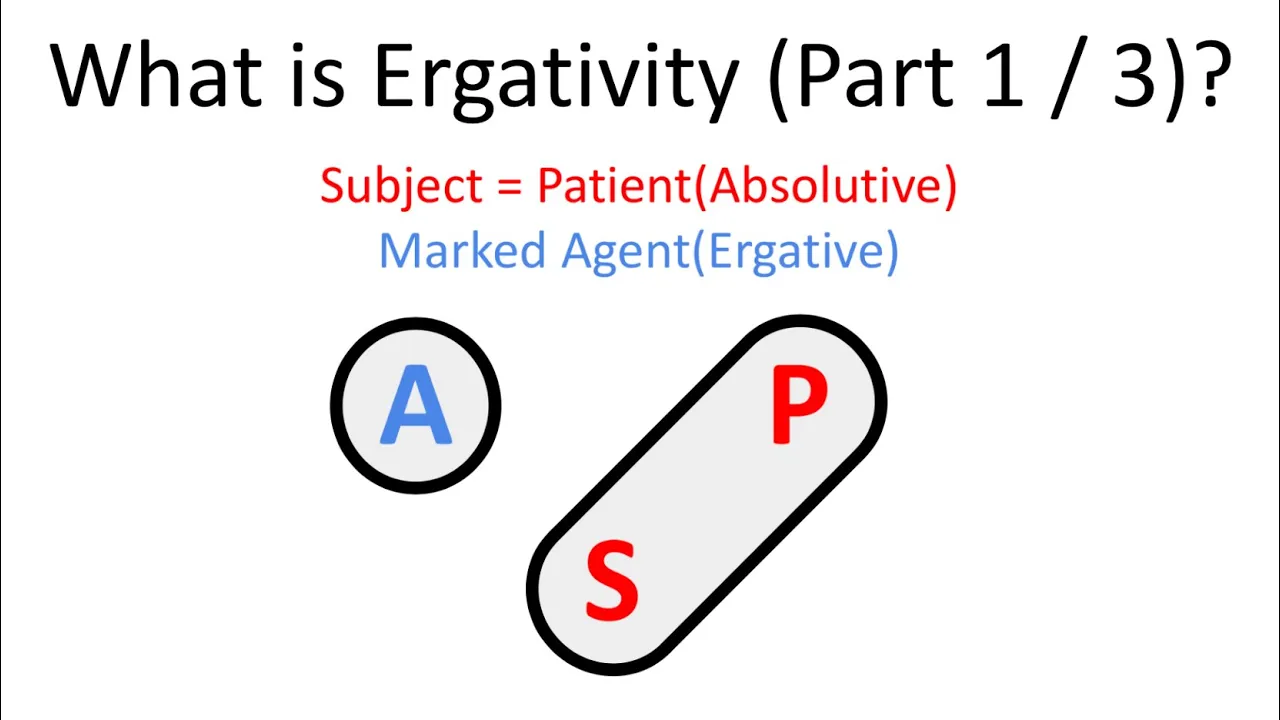
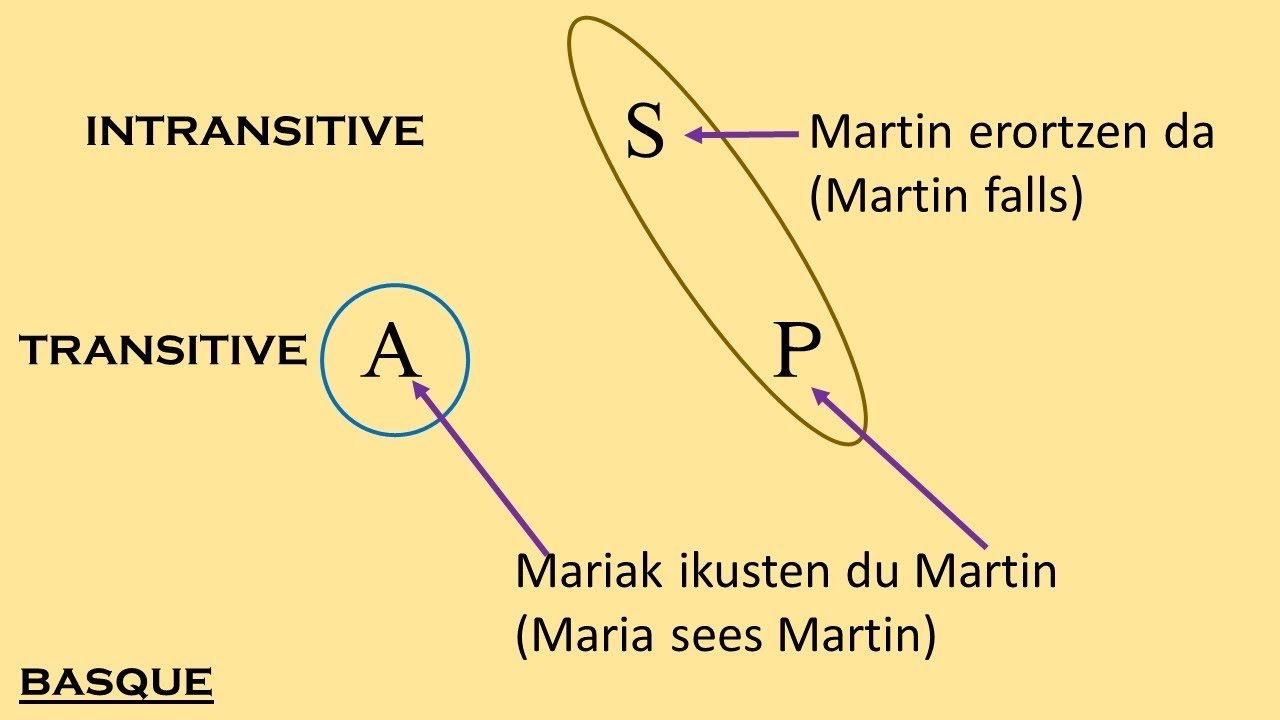
In an ergative-absolutive system, the intransitive subject () and the transitive patient () are treated the same way, while the transitive agent () is marked with a special case (the ergative). This alignment is common in languages like Basque, Georgian, Mayan, and many Indigenous Australian languages.
ERGATIVE-ABSOLUTIVE SYSTEM
Intransitive: [ S ] (Absolutive Case / Unmarked) | Transitive: [ P ] (Absolutive Case / Unmarked) [ A ] (Ergative Case / Marked)
Recommended Videos
Why this video
This video is a great introduction to ergative-absolutive alignment. It explains how these systems work by creating an "Ergative English" variant, making the unfamiliar case-marking pattern easier to understand.
Why this video
This video explains the mechanics of ergativity and its evolutionary origins. It shows how passive constructions can shift over time to become default transitive clauses, leading to the development of ergative-absolutive alignments.
Why this video
This video uses step-by-step morphology diagrams to compare nominative-accusative and ergative-absolutive case structures. It provides a clear visual breakdown of how these systems function.
Why this video
This deep-dive conversation covers the history and theory of morphosyntactic alignment. It traces the development of ergative alignment theory, helping you understand how these systems function across different language families.
Knowledge Checkpoint
- How does the grouping of and in an ergative-absolutive language differ from the grouping in a nominative-accusative language?
- Why is the absolutive case typically unmarked (zero-marked), while the ergative case requires a dedicated marker?
- If you translated "The glass broke" () and "She broke the glass" ( & ) into an ergative language, which arguments would share the same case ending?
Module 5: Tripartite, Split, and Rare Alignment Systems
Languages are rarely completely symmetrical. Some treat all three core arguments (, , and ) differently (tripartite alignment). Others use split systems, where alignment changes based on tense, aspect, or where the nouns fall on the animacy hierarchy (first/second person pronouns vs. inanimate nouns).
TRIPARTITE SYSTEM SPLIT-ERGATIVE SYSTEM (e.g., Pronoun Split)
Intransitive: [ S ] Pronouns: [ S & A ] (Nom-Acc) [ P ]
Transitive: [ A ]
[ P ] Full Nouns: [ S & P ] (Abs-Erg) [ A ]
Recommended Videos

Why this video
This mini-lesson explains the triggers for split ergativity. It focuses on the animacy hierarchy, showing why some languages use nominative-accusative structures for pronouns but shift to ergative-absolutive structures for full nouns.
Why this video
This video explains the relationship between the animacy hierarchy and split case-marking systems. It breaks down the ranking from highly animate speakers ( person) down to inanimate nouns, showing how this hierarchy shapes split alignments.

Why this video
This video profiles Georgian's famous aspect/tense-based split ergativity. In Georgian, the morphosyntactic treatment of subjects changes depending on whether the verb is in the present, past, or perfective tense-aspect categories.

Why this video
This video uses a constructed language to demonstrate a "fluid-S" active-stative alignment system. It shows how the single argument of an intransitive verb () can shift between being treated as an Agent () or a Patient () depending on how much control they have over the action.

Why this video
This lesson shifts the focus from subject alignments to object alignments. It explains how languages organize primary and secondary objects in ditransitive clauses (e.g., "give the book to her"), introducing dative and secundative object alignments.
Knowledge Checkpoint
- How does a tripartite system treat , , and differently?
- What are the three primary triggers for split-ergative systems (e.g., tense, aspect, animacy)?
- In a fluid-S / active-stative language, why might "I fell" and "I jumped" use different case markers for the pronoun "I"?
Module 6: Analyzing Morphosyntactic Alignment & The Leipzig Glossing Rules
To analyze real-world linguistic data, you need to understand the Leipzig Glossing Rules. This standard system uses multi-line glosses to show the morphological structure of a word or sentence. This module teaches you how to read, interpret, and use these glosses to identify the alignment systems of unfamiliar languages.
Analyzing Interlinear Glosses:
Line 1 (Source Language): Na-gosi na-u a-ka. Line 2 (Morpheme Breakdown): Na-gosi na-u a-ka Line 3 (Leipzig Glossing): PST-run.3SG ABS-1SG ERG-man ▲ ▲ ▲ Role Case Case
Recommended Videos

Why this video
This is a step-by-step guide to the Leipzig Glossing Rules. It explains how to match morphological tags to source words, how to represent grammatical categories (like case and number), and how to read the four standard lines of interlinear text.

Why this video
This lecture segment introduces the standard Leipzig Glossing Conventions for academic data presentation. It explains why uniform notation is essential for tracking morphosyntactic structures like word order and case markers.
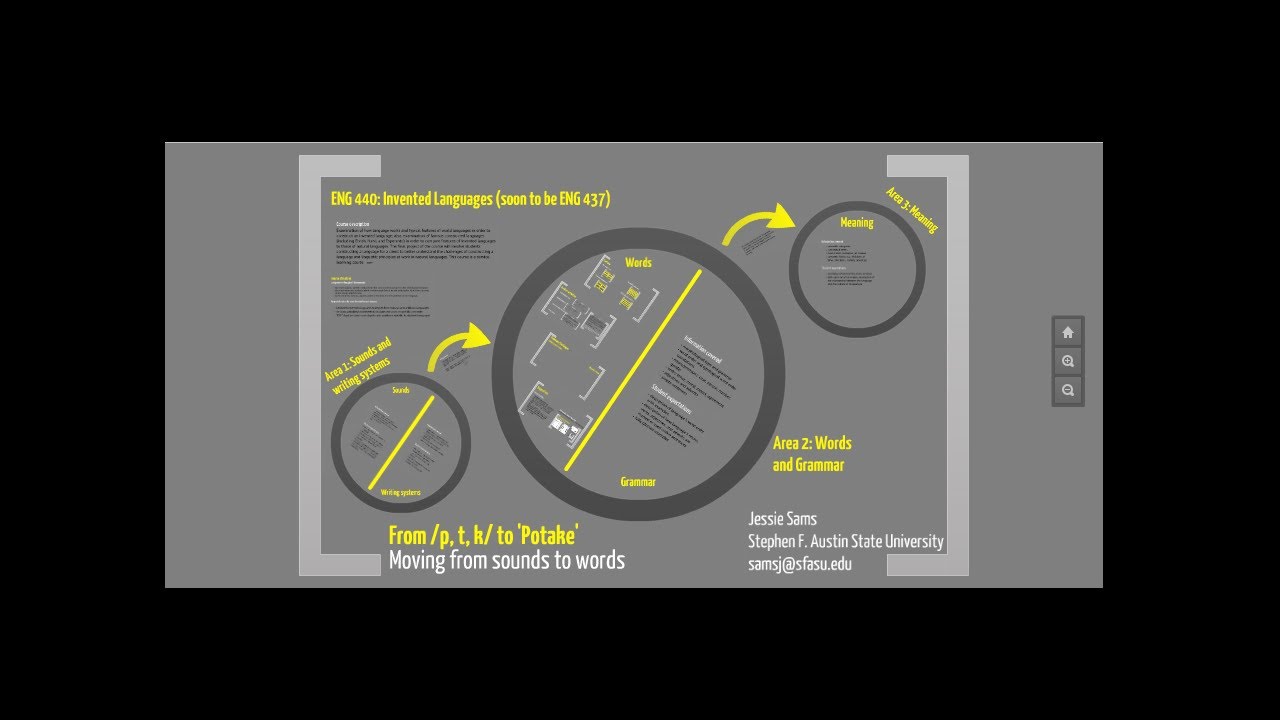
Why this video
This video explains how to create detailed grammatical glosses. It highlights the importance of explaining how base morphemes relate to their inflected forms, helping you build clear morphological breakdowns of your own.
Knowledge Checkpoint
- What is the purpose of the three distinct lines in an interlinear glossed text (IGT)?
- What do the abbreviations
NOM,ACC,ERG, andABSstand for under the Leipzig Conventions? - How can you tell if an unfamiliar, glossed language is ergative-absolutive by looking at how its case markers are distributed across transitive and intransitive clauses?
Course Map
This flowchart shows the recommended learning path and how the modules build on each other.
Key People Index
- Bernard Comrie
Context: A prominent typologist who formalized cross-linguistic alignment definitions. His research on Caucasian and Siberian languages helped establish the , , and framework as a standard in comparative linguistics. - Jessie Sams
Context: A linguist and language creator who specializes in morphology and syntax. She advocates for clear morphological glossing and structured dictionary building in conlanging. - Lutz Marten
Context: A professor of linguistics whose work on Bantu and general syntax focuses on how morphosyntactic structures are shaped by communicative efficiency.
Final Self-Assessment
Test your understanding of the entire course by completing this comprehensive checklist.
- Define the core comparative concepts: I can clearly explain the syntactic properties of , , and .
- Deconstruct "Subject": I can explain why traditional English grammatical "subjects" do not map directly to the case categories of non-accusative languages.
- Sketch Nominative-Accusative systems: I can illustrate how and are grouped together, distinct from , and list three languages that use this alignment.
- Sketch Ergative-Absolutive systems: I can illustrate how and are grouped together, distinct from , and list three languages that use this alignment.
- Recognize Tripartite marking: I can identify a clause structure where in morphological case marking.
- Identify Split-Ergative triggers: I can identify when a language shifts its alignment based on the animacy hierarchy (e.g., Dyirbal) or tense/aspect (e.g., Georgian).
- Distinguish Fluid-S systems: I can explain how active-stative languages assign different cases to the intransitive subject depending on their control over the action.
- Read Interlinear Glosses: I can parse a line of text glossed under the Leipzig rules and map abbreviations like
ERG,ABS,NOM, andACCto their corresponding words. - Determine Alignment from Raw Data: Given a set of three glossed sentences (one intransitive, one transitive active, and one transitive passive/stative), I can identify the language's morphosyntactic alignment system.