




















![A. François – [#T2] Relations actancielles – cours de Typologie linguistique](https://i.ytimg.com/vi/Ls40MWTFRaM/maxresdefault.jpg)


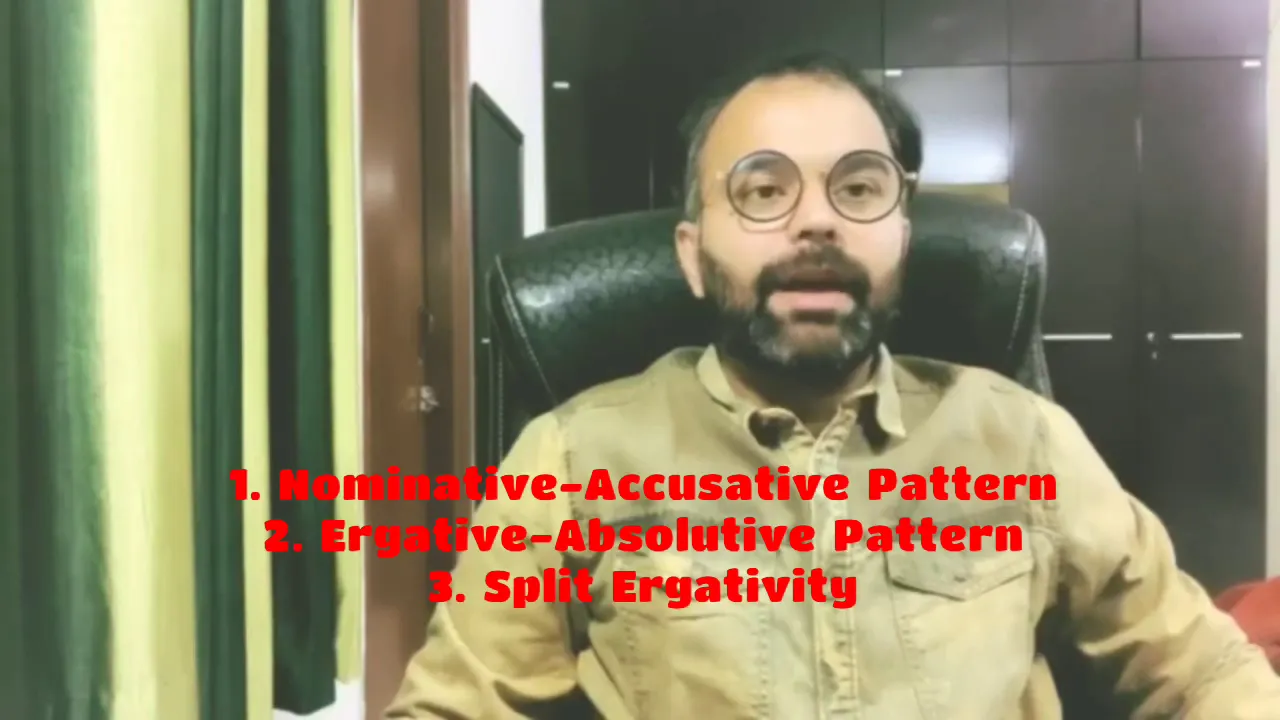
Morphosyntactic alignment refers to how languages mark the syntactic roles of sentence participants (subject, agent, object/patient) through word order, case marking, or agreement; the five main alignment types are Nominative-Accusative (treating subject and agent identically, as in English), Ergative-Absolutive (treating subject and object identically, common in languages like Georgian), Tripartite (marking all three roles separately), Active-Stative (where the subject's marking depends on whether it acts as agent or patient), and Split Ergativity (combining different alignments across different grammatical contexts).
Morphosyntactic Alignment Explained: Syntax
Added:Distinction between transitive and intransitive verbs and their core syntactic arguments (S, A, and P/O).
The concept of morphological case marking (e.g., nominative, accusative) and verbal agreement.
Basic syntactic terminology, including subject, direct object, and grammatical relations.
The difference between morphology (word structure) and syntax (sentence structure) as intersecting linguistic fields.
Split-ergativity systems, where a language shifts alignment based on tense, aspect, person, or NP animacy.
Syntactic alignment and 'pivots', exploring how alignment affects complex structures like coordination, subordination, and control.
Austronesian/Philippine-type alignment (symmetrical voice systems) which do not fit neatly into accusative or ergative categories.
Diachronic syntax and historical linguistics, focusing on how alignment systems evolve and shift over time within language families.
475 views28likes13:40Original Release: 2026-01-02
Hey, this is language shrimp and today we are talking about morph syntactic alignment. First, I'm going to go over some information needed to understand this video, then list a bunch of the pure alignment systems off, then go over some more complicated split alignment systems.
Firstly, before we can talk about morph syntactic alignment, we need a refresher on the difference between semantic, pragmatic, and syntactic role, talked about extensively in my basic syntax video. Very simply, semantic role is what the argument of a verb literally serves as in a sentence. Most notably, the agent and patient. The agent being the one who performs the action and the patient being the one who undergoes it.
Pragmatic role describes information structure i.e. what is being talked about the topic and what is being said about it, the comment. And finally, syntactic role, which is the arbitrary compromise languages make to express the other two roles.
Now, generally, semantic role is more important than pragmatic role in most languages. So syntactic role typically most resembles it. However, it is important to remember the distinctions.
One of the most crucial ways a language treats syntactic and semantic role differently is an intransitive verbs.
Now intransitive verbs are basically verbs with no direct object as opposed to transitive verbs which do have one.
For example, she walked and the cup broke are intransitive. But she walked the dog and she broke the cup are transitive. What you may notice is that in all intransitive situations in English, the subject place is filled and the subject is always a denominative case if it has a case. This may seem perfectly intuitive. And I mean, if it weren't intuitive, it probably wouldn't have evolved that way in so many languages, but it leads to weird stuff.
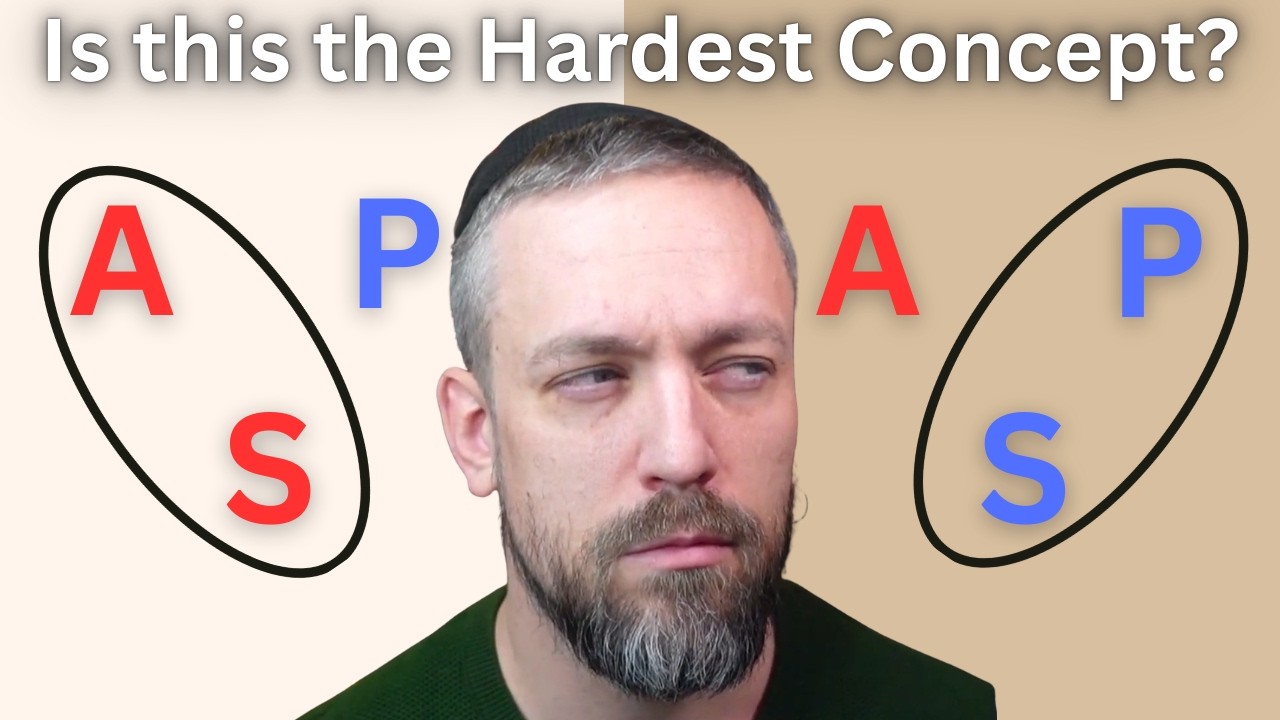
Take one of my example pairs from a few seconds ago. She broke the cup and the cup broke. Now, in both situations, it's pretty obvious that the cup is undergoing the action of breaking and is thus the patient. But in the transitive situation, it goes after the verb and English is object position. And in the intransitive situation, it goes before the verb and English is subject position. Now, if semantic role and syntactic role were perfectly identical and the subject was always an agent and the object always a patient, the sentence the cup broke would look like broke the cup with no subject. It is from this simple discrepancy between semantic and syntactic role that the entirety of morphos syntactic alignment derives. How does language differentiate between an intransitive subject, a transitive agent, and a transitive patient? What exactly different forms of this could look like will become more apparent as I start listing different alignments? The terminology around this is a bit weird, though. Typically, when talking about morph syntactic alignment, you use the term subject to mean specifically the subject of an intransitive verb. You use the term agent to refer to the subject of or agent of a transitive verb. And you use the term object or patient to refer to the object or patient of a transitive verb. I hesitate to use this though because it really muddies together the terminology of semantic and syntactic role. So for this video I will use the terms s argument, a argument and o argument respectively for these meanings.
Now one more thing before we start listening. I mentioned in my basic morphology video that there are three core ways to mark syntactic role. Word order or syntax, grammatical case or dependent marking and agreement or head marking. The reason that morphoso syntactic alignment is called morpho syntactic alignment is because it applies to systems beyond just syntax.
Most notably case but also agreement.
And languages that rely on more than one of these systems may have different alignments for each. So I will show for each alignment what it would look like if it was symmetrical across all systems. Then describe with examples what it looks like when only applied to some, which it often is.
Firstly, there is the default nominative accusative alignment where the S and A argument are treated the same way in contrast to the O argument. This is the alignment English pretty thoroughly ascribes to. So these examples may seem redundant, but overall when applied to word order, it results in your basic S so for head final languages and SVO, VSO and VOS for your head initial ones. When applied to case, it results in the S and A arguments both being put in the nominative case and the O argument in the accusative. And when applied to agreement, the agreement markers corresponding to the S and A argument on the verb are of the same form and in the same position. And the O argument has a different form and/or position if it is marked at all.
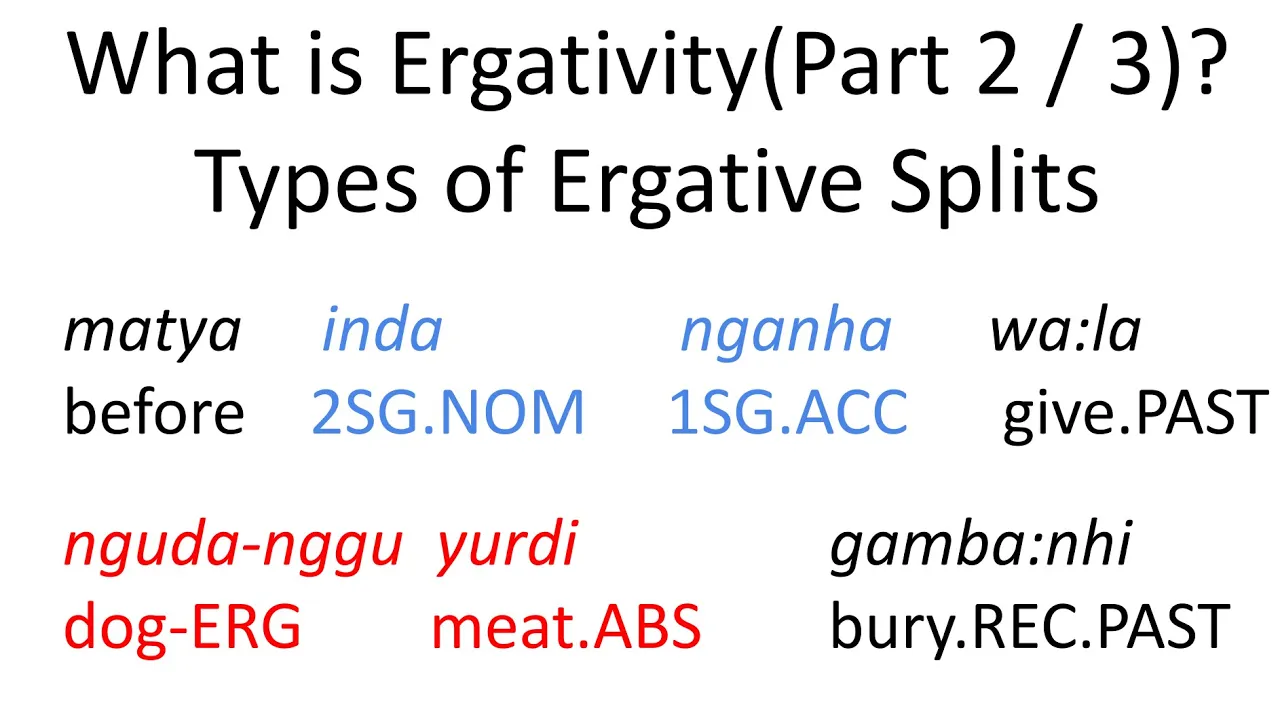
Next, there's the erative absolute of alignment found in the likes of Chukshi languages K system and Hisharayana's word order. Although it is more often than not found mixed with other alignment systems in various ways. This is where the S and O argument are treated the same way in contrast to the A argument. This alignment most commonly occurs in grammatical case and is also the root of many other alignment systems.
The way it comes about is generally that the passive voice construction described in my basic syntax video gets used so much that it sort of becomes the default. This is also usually occurs alongside the loss of complex grammatical voice morphology so that the passive voice both becomes more similar to the active voice and more simple thus allowing it to become the default construction.
Overall, when applied to word order, this results in the likes of OSV/SV and OVs/SV orders or the same verb initial orders theoretically, which are generally unstable and may quickly revert back to a more standard order.
When applied to case, this results in the S and O arguments being put in the unmarked absolutive case and the A argument being put in the erative case, which often derives from erative ad positions used in the original passive construction such as by. And when applied to agreement, the agreement markers corresponding to the S and O arguments are on the verb are of the same form and in the same position. And the corresponding A argument has a different form and/or position if it is marked at all. An arative language may also develop an anti-passive voice to show the meaning once conveyed by the active voice. I'll get more into this in future video on grammatical voice itself.
Next, we have tripartite alignment which can generally only be applied to case marking. It is often ascribed to Hindustani, although it only has it in certain situations and has mostly lost it in all but pronouns. It is when the S, A, and O arguments are all marked separately. Typically, the S argument is put in a case called the intransitive, nominative, or absolutive. The A argument is put in a case called the nominative or erative, and the O argument is put in a case called the absolutive or accusative. Which three cases are used may also depend on a split urgative system which I'll get into in a sec. Finally, there are the super rare, possibly not real, and extremely counterintuitive alignments.
The transitive and transitive alignment and the direct alignment. The transitive and transitive alignment marks the A and O arguments the same way and the S argument in a different way.
Effectively, arguments in a transitive sentence are all given the transitive case and arguments in an intransitive sentence are given the intransitive case. This is found in certain situations in the Rani language. And it makes sense that it's only in certain situations as it doesn't actually give you any more information because you can already tell the difference between a transitive and intransitive sentence by the number of arguments. It is likely that this simply evolved from phological changes rendering the erative and accusative cases in a tripartite system identical. The direct alignment is a very interesting one and it is effectively just a language that chooses not to solve the fundamental question of who did what to whom in a sentence leaving the S A and O arguments identical in word order and marking and leaving their role up to context. This is reportedly found in some Tibetto Burman languages according to multiple sources, but none of those sources have actually named me a language to look at.
So, it's kind of sketchy.
Now these five alignments are effectively your root alignments. But most languages that don't simply stick to nominative accusative alignment actually combine different alignments in what is called split erativity. This is when different alignments are used in different situations. I've already mentioned a systematic split where if a language has different systems between word order, case and agreement then the different systems will often be aligned differently. But there are other types beyond this.
Firstly, there's the active stative or active inactive alignment found in Lakota's agreement system and Basque's case system. This is when the A and O arguments both have different markings, but the S argument varies between being marked with the A or O argument depending on whether its semantic role is more agent-like or patient-like. This is further subdivided into split S active state of alignment and fluid S active state of alignment. In split S languages, each intransitive verb is either active or inactive. And this determines whether the s argument is treated as a or o like. For example, walk might be seen as an active verb because the subject is usually assumed to be performing the action. While broke may be inactive because the subject is usually assumed to be undergoing the action. Meanwhile, in fluid S languages, whether the S argument is marked with A or O depends on whether the S argument is in this specific instance seen as voluntarily performing the action as an agent or involuntarily undergoing the action as a patient. I.e. she broke implies she actively broke unspecified things while broke she implies she was broken by something.
Overall, when applied to word order, if any languages do this, which I'm not sure if they do, the order of transitive sentences might be a consistent AVO. But intransitive sentences might vary between SV or VS. When applied to case, the A argument would be put in the agentive, nominative, or erative case, and the O argument would be put in the patient, accusative, or absolutive case.
And the S argument would vary between the two cases. And in an agreement system, the A and O arguments agreement markers would both have their own agreement slots and or form. And the S argument would vary in which slot or form it used.
Next, we have a rather unique system that I'm not even sure counts as split erative. It's kind of its own thing. The symmetrical voice alignment, also sometimes called Aronesian alignment due to its near exclusive prevalence in the Aronesian languages like Talog.
Essentially, languages like this have a series of grammatical voices, sometimes renamed to triggers, which often are just limited to active/ aentive and passive/objective, but also often include many applicative voices associated with common cases, with each being associated with semantic role. Then the language has a direct case and/or syntactic slot and an indirect and sometimes oblique case and/or syntactic slot. The direct argument takes on the semantic role associated with the voice, while the indirect argument and oblique argument, if there is one, take on whatever other roles could be assumed based on specific rules, effectively having most case be marked on the verb instead of the noun.
It is also notable that the marking of the direct and indirect cases is different from most case marking as the particles that mark them tend to be related more to articles than adositions and behave much like them. The direct case marker is usually also the definite article and the indirect marker is the indefinite article if there is an indirect marker at all with the oblique marker being the most likely to actually relate to an ad position.
Then we have an actually slightly similar but more obviously split erative system hierarchical alignment or direct inverse alignment found in the likes of Navajo word order or plains agreement.
This usually only applies to word order agreement while symmetrical voice relates to case. Essentially in hierarchical alignment, the order of arguments in a sentence or agreement markers in a verb is based less on semantic and syntactic role like S, A or O arguments and more on other inherent properties of the argument such as their pragmatic role or topicality with the topic arguments coming before the common ones. their personality with second person pronouns being high highest rank followed by first person pronouns and third person pronouns than nouns. Noun class or animacy with the languages classes being ranked with more animate or respected classes generally coming first. Oviation where approximate argument pronouns rank higher than their obiate counterparts or quite often some combination of these that follow the guidelines. The way you then specify the semantic role of the arguments due to the fact that word order and agreement aren't used is through an inverse voice.
Generally, the default assumption in a transiff sentence is that the higher rank argument has the agent role while the lower rank argument has the patient role. But with the inverse voice, it flips allowing you to express both sides. [snorts] This inverse marker is of course usually related to similar things as the passive voice marker.
[snorts] And similarly to symmetrical voice alignment, you may have some applicative voices that correspond to other semantic roles.
Finally, we have something that is more a way to have different alignments in different parts of your language than it is a whole alignment in and of itself.
Aspect split alignment found in Hindustani pronouns case system and Georgian's case system. I've yet to put out my video on tense aspect mood, but essentially in some languages, verbs that are in different TAM categories might have different alignments for some of their systems with the most pastlike and perfective aspects having more erative alignments and more imperfect, present, or future-like aspects having more accusative alignments. If these languages have case, they will usually have at least three cases to deal with the different alignments. with an unmarked nominative or absolutive case, an erative or agentive case, and an accusative or patient case, which may double as or be renamed to the dative case. When applied to word order, this might look like a language having an OSV or ovs word order in the perfective aspect, but a S so or SVO order in the imperfective aspect, and similarly have different orders and types of agreement markers.
And that should be all for this video.
Thanks for watching.
Up Next
6:02
Nominative-Accusative Alignment in Morphosyntax | Explained with English & Russian Examples
@CuriousLinguistics
4.6K views•2025-12-26
36:52
Constraint Interaction in Optimality Theory: Epenthesis & Deletion
@Vidyamitra
180 views•2018-08-20

8:59
Forensic Linguistics: How Language Solves Crimes | PBS
@pbsstoried
1M views•2024-01-25

21:32
Accent Expert Explains U.S. Regional Dialects | Part 1
@WIRED
9.3M views•2021-01-21
Related Study Plans & Knowledge Roadmaps
Structured learning paths in Linguistics
linguistics
Optimality Theory: Tableaux & Constraints
01Phonological Basics: Sounds, Syllables & Rules
02Foundations of Optimality Theory: GEN, CON, and EVAL
03The Constraint Inventory: Markedness vs. Faithfulness
+ 2 more learning modules
15h5 modules
Explore Roadmap
linguistics
Morphosyntactic Alignment: S, A & P Systems
01Foundations of Syntax: Transitivity and Arguments
02The Linguistic Variables: Mapping S, A, and P
03Nominative-Accusative Alignment
+ 3 more learning modules
12h6 modules
Explore Roadmap
linguistics
Analyzing Sign Language: Phonology & Syntax
01Foundations of Sign Language Linguistics
02Phonology: The Five Parameters of a Sign
03Morphology: Word Formation and Classifiers
+ 2 more learning modules
14h5 modules
Explore Roadmap
linguistics
Pragmatics: Speech Acts, Grice & Politeness
01Introduction to Pragmatics: Meaning in Context
02Grice’s Cooperative Principle & Implicature
03Speech Act Theory
+ 2 more learning modules
14h5 modules
Explore Roadmap