



















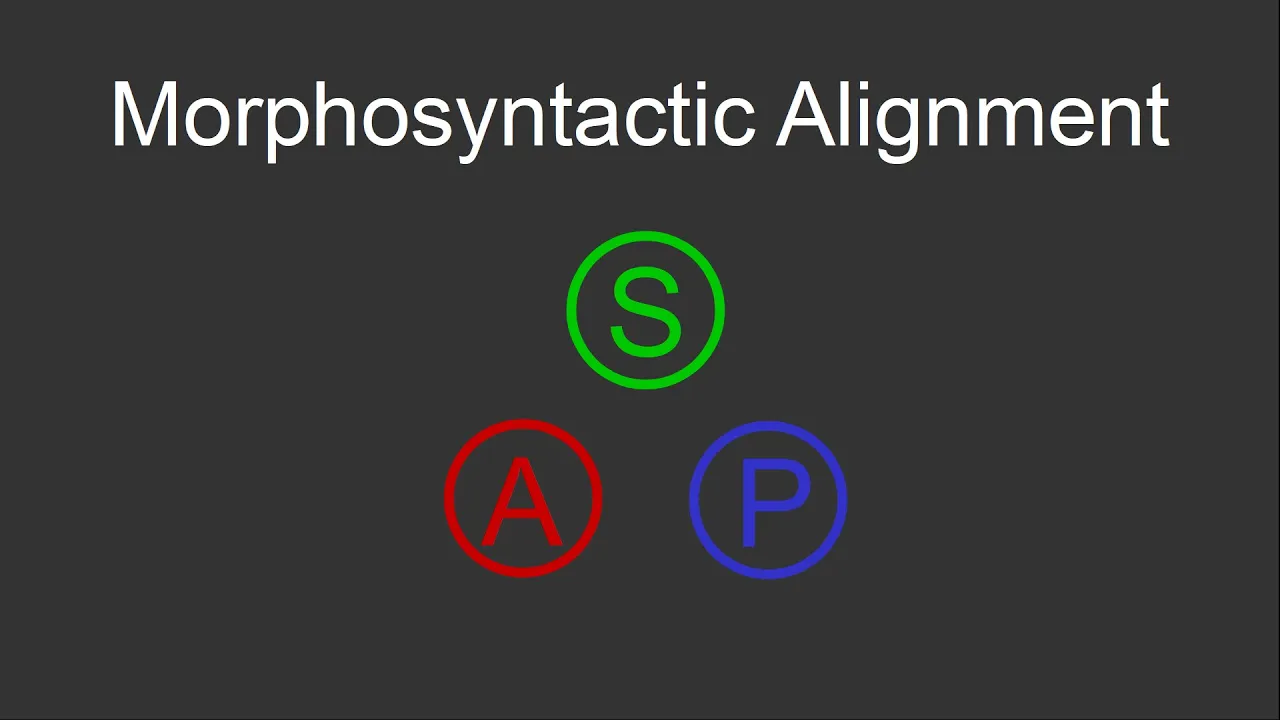



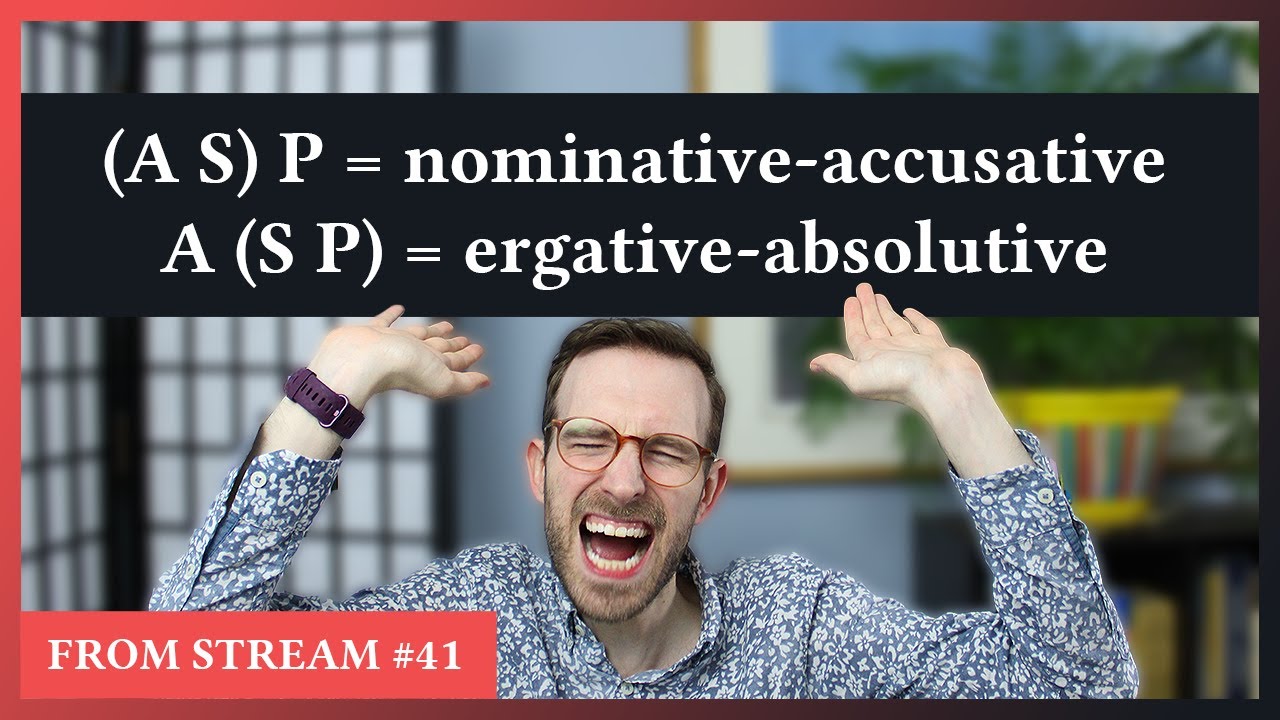



Nominative-accusative alignment is a morphosyntactic system where the subject of both transitive and intransitive verbs is marked identically, while the object of transitive verbs receives different marking; this is exemplified in English through pronouns (e.g., 'he' for subjects in both 'he slept' and 'he slapped Joe,' versus 'him' for objects in 'he slapped him'), and more overtly in languages like Russian where noun endings change based on whether a noun functions as subject or object.
Nominative-Accusative Alignment in Morphosyntax | Explained with English & Russian Examples
Added:The fundamental distinction between transitive verbs (taking both a subject and an object) and intransitive verbs (taking only a subject).
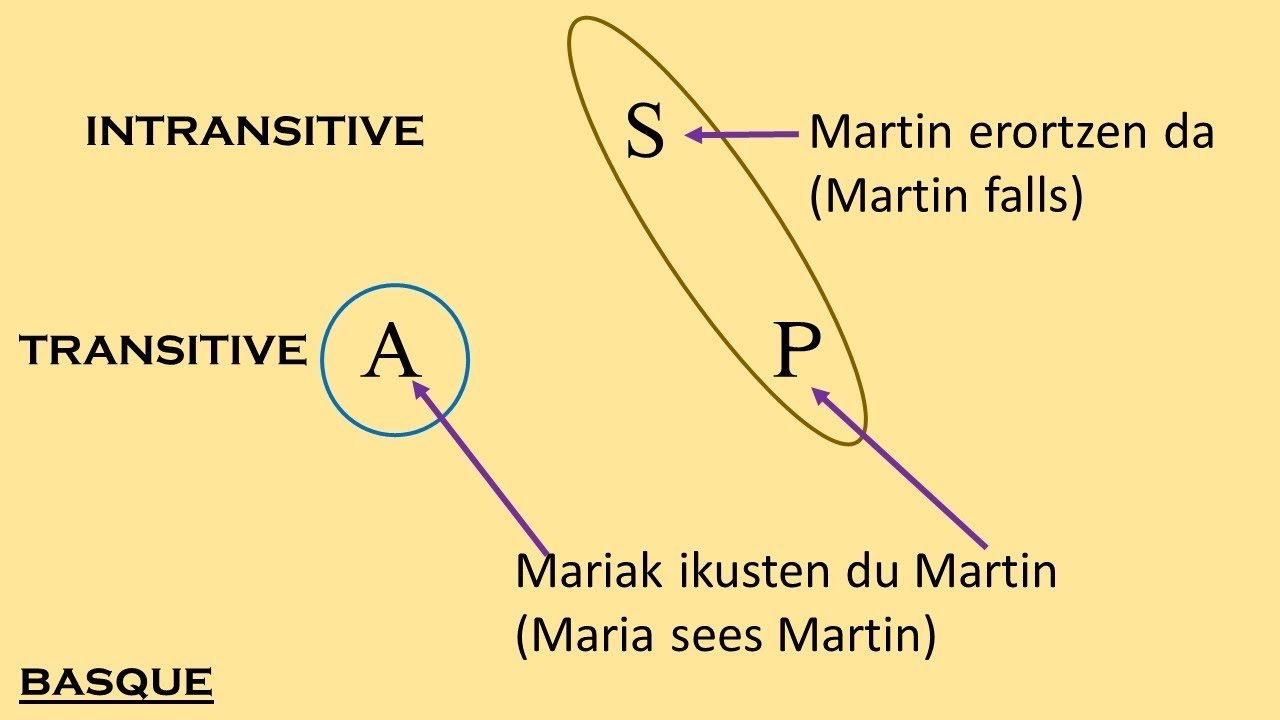
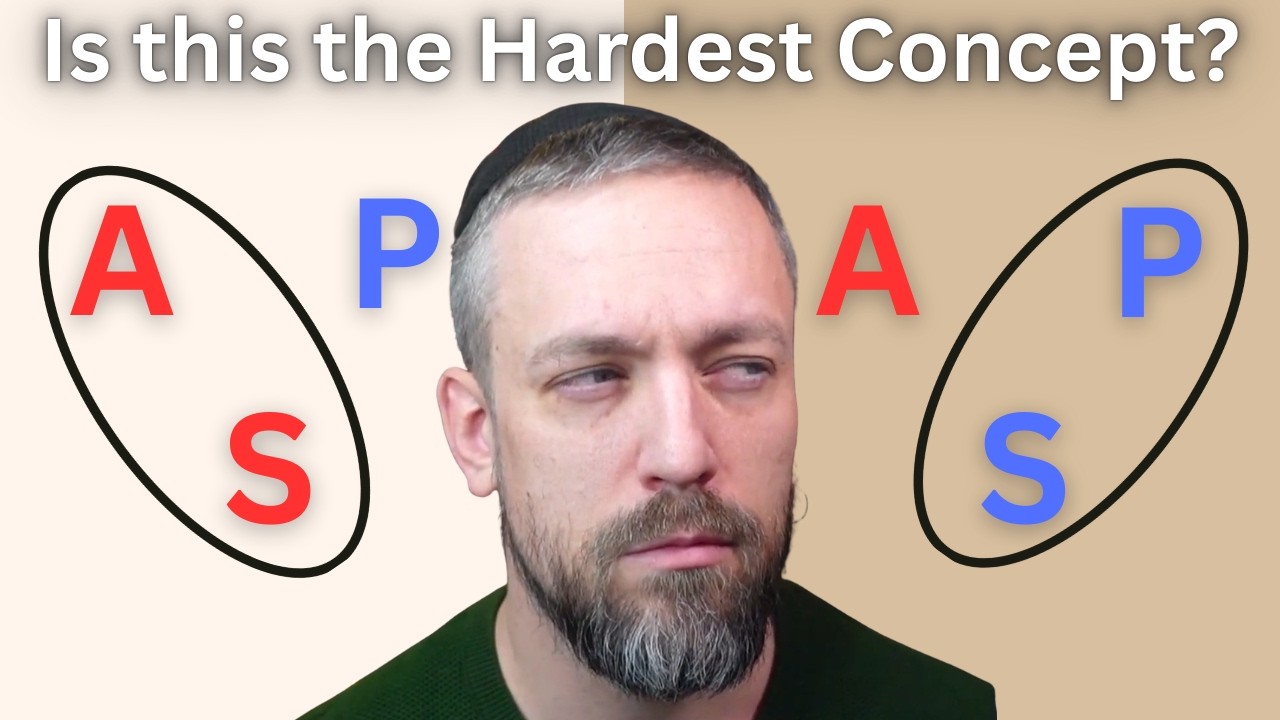
The core semantic roles of verbal arguments, specifically the Agent (A), the Patient/Undergoer (P or O), and the Single Intransitive Argument (S).
The concept of morphological case-marking and how languages inflect nouns or pronouns to indicate grammatical functions.
Basic syntactic typology, specifically how languages use word order versus morphological inflection to encode grammatical relations.
Ergative-Absolutive alignment, the primary typological alternative to nominative-accusative marking.
Split-ergativity and split-alignment systems, exploring how languages transition between alignment types based on aspect, tense, or nominal hierarchy.
The distinction between morphological alignment (case marking and agreement) and syntactic alignment (how grammar handles coordination, subordination, and passivization).
Atypical morphosyntactic alignments, such as Tripartite, Active-Stative (Split-S/Fluid-S), and Austronesian alignment systems.
4.6K views144likes6:02Original Release: 2025-12-26
Did you know that a lot of languages in the world have to follow the same logic when it comes to syntax? Today, let's talk about morphos syntactic. If this word scared you, don't worry. I'll explain everything so you can understand what I'm talking about and understand more about how languages work. In this video, I'll focus on the nominative accusative alignment, which is fun in English. But first, what is a morphos syntactic alignment? It's a fancy way to describe how arguments of a sentence are organized around a verb. And what do I mean by argument? Simply the subject and the object of a sentence or more precisely of a verb. Let's look at an example to make sure this is clear. In the sentence, I eat apples. Eat is the verb and I and apples are the arguments.
I is the subject. Apples is the object.
The verb tells us what action is performed while arguments tell us who is performing or who or what is impacted by the verb. In other words, verb and arguments tell us all the essential information of a sentence so we can understand it. As I mentioned, English is technically a nominative accusative language. Although it's not the most obvious case, we'll go back to that point in a moment. And you may wonder now, what does nominative accusative alignment mean? Languages that follow this alignment have the following characteristic. The subject of a transitive verb is marked the same way as the subject of an intrinsitive verb.
while the object of a transitive verb is marked differently. By the way, when talking about morphosynatic analments in linguistics, you likely see the letters S to represent the subject of an intransitive verb, the letter A for the subject of a transitive verb, A for agent, and O for object. And here's the last definition for this video, transitivity. For a verb, we talk about transitivity if there is an object in the sentence. Let's look at our example from earlier. I eat apples. In this case, eat is a transitive verb, meaning there is a subject and an object that are associated with the action. If I just said, I eat without any object, then the meaning would be different.
You'd understand that I'm currently eating, but you don't know what. When there's no object, we say that the verb is intritive.
Verbs are either transitive or intransitive. But you may notice that there are cases where a verb seems to be both. For the case of the verb eat, it looks like it can be either transitive or intrinsitive and the meaning of a sentence will be impacted. In a way, it's true depending on the sentence. But what's important here is that it's never both at the same time. Eat is either transitive or intrinsitive, but not both at the same time. Some verbs are easier to distinguish. For example, I arrived.
Arrive is always intrinsitive. I cannot add an object to this sentence because arriving only applies to me. I can add other information to that sentence, but it won't be an object. Arrive is always intrinsitive.
Other examples can include it rains or he runs. For verbs that are always transitive, there's like, for example, you cannot just say I like on its own.
You need an object to describe what you like. So verbs are either transitive or intrinsitive and sometimes it may look like it can be both. But keep in mind that they cannot be both at the same time. So let's go back to understand this nominative accusative thing. While English is a nominative accusative language, it's not too obvious most of the time except when looking at pronouns. So we'll first look into examples with English but then with another language to make sure the picture is clear for you. As I mentioned in this alignment, the subjects of transitive verbs and of intrinsitive verbs are treated the same way but not the object. Now let's look at an actual example with English. Henry slapped Joe.
Henry is the subject slapped the verb.
Joe the object. With this sentence, we understand that Henry is the one who hit Joe. Henry slept. Here we have an intritive verb. So just the subject Henry and the verb sleep. If I change these sentences by using the pronoun he, we will still have the same meaning and in other scenario Henry or he are the same. He slept Joe. He slept. The way they are marked whether Henry or he is with nothing. The marker is nothing. In some languages you can add a letter at the end or something similar. In English the marker nothing is what we call a non marker. Like I said, it's not too obvious. But what if I replace Joe with him? He slapped him. The meaning of the sentence is the same. Granted, we know what we are talking about, but Joe is not replaced by he in this case, but rather by him. This is where you can see that the object is following a different treatment than the subject. If it was the same, we would say he slapped he, but that's not the case. And this is what a nominative accusative language looks like. In sentences with transitive or intrinsitive verbs, the subject is marked the same way, but the object is not. But like I said, English is not the most obvious example of that. So, let's look at a different example from northern language to make sure everything is clear. Russian is a good example where the subject and object are marked in a more obvious manner than English. Subaka, the dog barks. Subaka vit. The dog sees me.
Subaku, I see the dog. With this example, we can see that the word for dog has a different ending depending on its role in the sentence, if it's the object or the subject. While English has a normal marker, the example of Russian allows us to see the marking in a slightly more obvious manner. I hope that you now understand what a nominative accusative language is. And if you have any questions, let me know in the comments.
Up Next
19:54
Understanding Grammatical Case: A Cross-Linguistic Study
@oer-vlc
13K views•2012-10-30
36:52
Constraint Interaction in Optimality Theory: Epenthesis & Deletion
@Vidyamitra
180 views•2018-08-20

8:59
Forensic Linguistics: How Language Solves Crimes | PBS
@pbsstoried
1M views•2024-01-25

21:32
Accent Expert Explains U.S. Regional Dialects | Part 1
@WIRED
9.3M views•2021-01-21
Related Study Plans & Knowledge Roadmaps
Structured learning paths in Linguistics
linguistics
Optimality Theory: Tableaux & Constraints
01Phonological Basics: Sounds, Syllables & Rules
02Foundations of Optimality Theory: GEN, CON, and EVAL
03The Constraint Inventory: Markedness vs. Faithfulness
+ 2 more learning modules
15h5 modules
Explore Roadmap
linguistics
Morphosyntactic Alignment: S, A & P Systems
01Foundations of Syntax: Transitivity and Arguments
02The Linguistic Variables: Mapping S, A, and P
03Nominative-Accusative Alignment
+ 3 more learning modules
12h6 modules
Explore Roadmap
linguistics
Analyzing Sign Language: Phonology & Syntax
01Foundations of Sign Language Linguistics
02Phonology: The Five Parameters of a Sign
03Morphology: Word Formation and Classifiers
+ 2 more learning modules
14h5 modules
Explore Roadmap
linguistics
Pragmatics: Speech Acts, Grice & Politeness
01Introduction to Pragmatics: Meaning in Context
02Grice’s Cooperative Principle & Implicature
03Speech Act Theory
+ 2 more learning modules
14h5 modules
Explore Roadmap