















In animacy-based split ergativity, noun phrases are ranked on an animacy hierarchy (first person > second person > third person > demonstratives > proper nouns > humans > animate nouns > inanimate nouns), where noun phrases on the left are more likely to be agents and receive nominative-accusative marking, while those on the right are more likely to be objects and receive ergative-absolutive marking; this creates systems where accusative marking extends from the left and ergative marking extends from the right, potentially meeting at a midpoint, and these systems most commonly manifest through case marking with three case markers (nominative/absolutive usually unmarked, ergative and accusative each having their own markers).
Split Ergativity: Animacy Hierarchies Explained
Added:Morphological Alignment: A solid understanding of how languages group grammatical arguments, specifically comparing nominative-accusative and ergative-absolutive systems.
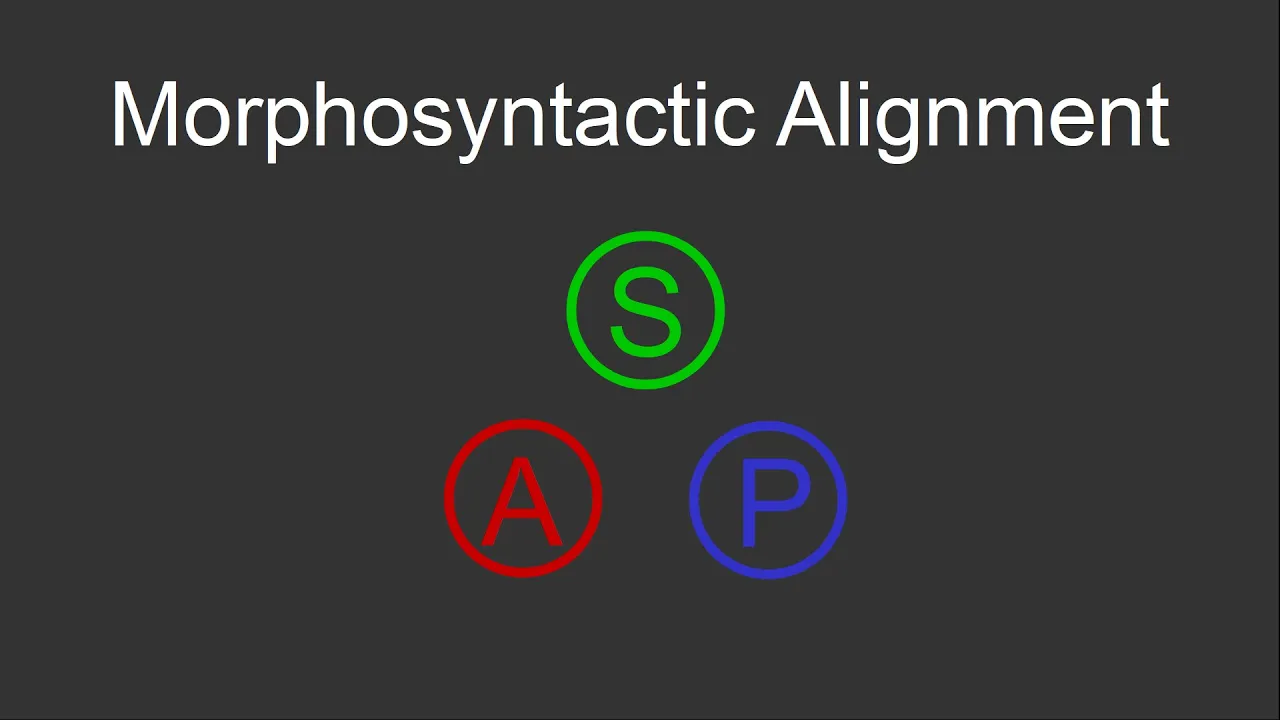
Core Syntactic Relations: Familiarity with the fundamental argument roles, specifically S (subject of an intransitive verb), A (agent of a transitive verb), and P/O (patient/object of a transitive verb).
Morphological Case Marking: Understanding how grammatical case (such as ergative, absolutive, nominative, and accusative) is marked on nouns and pronouns.
Concept of Semantic Hierarchies: A basic grasp of how semantic features like animacy, person, and definiteness form linguistic scales or hierarchies.
Other Split Ergativity Triggers: Investigating non-animacy split systems, such as those conditioned by tense, aspect, or clause type (e.g., main vs. subordinate clauses).
Differential Case Marking: Exploring the mechanics of Differential Object Marking (DOM) and Differential Subject Marking (DSM) across diverse language families.
Diachronic Syntax of Ergativity: Studying how split systems arise historically (e.g., passive-to-ergative reanalysis) and how they shift over time.
Theoretical Modeling: Examining how formal syntactic frameworks, such as Optimality Theory or the Minimalist Program, mathematically or structurally model hierarchy-driven alignment.
1.1K views88likes25:35Original Release: 2025-02-11
ergativity for novices part 2.2 this video is an adaptation of a thread called tivity for novices on the zbb written by Bradon who kindly permitted me to reproduce it in this form I have edited and trimmed it but it remains mostly the same you can find the links to part zero the introduction part one morphological ergativity and part 2.1 the previous section on split tivity in the description below which I highly recommend looking at for this one because it goes over certain terminology we'll be using this section is the second part of split ergativity so far we have covered one type of split tivity splits by the nature of the verb in those splits the S argument is grouped with either a or o depending on the choice of verb however there are several other types of split attested in the languages of the world here we will cover splits based on the nature of the noun phrase another very common type of split the animacy hierarchy for splits on the nature of noun phrases the key observation to make is that certain noun phrases are more likely to be agents whereas other noun phrases are more likely to be patients for instance the first person pronoun I is more likely to be an agent for example in the phrase I moved it's likely that I'm in control whereas an inanimate noun like the box is likely to be a patient for example in the phrase the Box moved it's likely that the box was moved by someone else rather than deciding to move of its own valtion we might also note that for some verbs the agent noun phrase is usually human such as for the verbs believe and decide while for other verbs the agent noun phrase is usually human or animate like the verbs see bite and run but there are almost zero verbs which are restricted to only inanimate noun phrases the opposite is true for object noun phrases some verbs can have any object like to see while some verbs usually have an inanimate object like pick up or throw though there do exist verbs which preferentially have a human or animate object such as spear or hunt but they are less common than the other types of verb if we combine all these observations we end up with a list of types of noun phrases where noun phrases on the left are more likely to be agents and noun phrases on the right are more likely to be objects first person then second person then third person and demonstratives then proper nouns then humans then animate nouns and lastly inanimate nouns this is known as the animacy hierarchy or nominal hierarchy but I will be using the former term it is easy to relate this hierarchy to split ergativity noun phrases on the left are prototypically agents so they should have an unmarked a role that is a nominative accusative system while noun phrases on the right are prototypically objects so they should have an unmarked o Ro that is an ergative absolute utive system we might think of accusative marking extending in from the left hand side and ergative marking extending in from the right hand side the simplest animacy based split would have them meeting at some point in the middle but there do exist more complex systems which will be covered later of course as with most topics in linguistics there is some variation in the animacy hierarchy between languages for instance this hierarchy here shows demonstratives to the left of proper nouns but occasionally we get personal names to the left of demonstratives some algonkian languages famously have second persons above first persons rather than the opposite although see will Oxford's paper Algonquian grammar myths for a much more detailed View and partial reputation of this there are also rare exceptions to the rule that accusative marking is used on the left of the hierarchy while ergative marking is used on the right for instance arent has an ergative Paradigm in the first person pronoun but an accusative Paradigm in the other pronouns while the sedic language nanasan has an accusative pattern in its nouns but no case marking in its pronouns which could be considered a rare example of a split accusative system suya has a particularly clear example of this in future and negative Clauses pronouns use an erative Paradigm but common nouns use an accusative Paradigm we have already seen that active state of systems split s and fluid s from the the previous video must often manifest their ergativity through verbal agreement rather than case marking as those varieties of split ergativity depend on the nature of the verb similarly animacy based split ergative systems most often manifest their ergativity through case marking as this variety of split ergativity depends on the nature of the noun however this is certainly not Universal Dixon lists chuki Coast Salish and chinuk as having an animacy based split system using verbally agreement when animacy based systems do use case marking they most commonly use three case markers the nominative and absolutive cases are usually unmarked making them syncretic as a side effect as is usual for those cases while the ergative and accusative cases each get their own case markers for instance in diable the nominative and accusative cases are both null the ergative is and the accusative case is na of course languages can diverge from this model especially in more complex splits such as those I'll outline later but from a conlanging perspective this sort of system is a good place to start a final interesting point about these sort of animacy based splits is their interaction with case Concord in some languages modifiers such as adjectives and relative clauses Exhibit case Concord that is they agree in case with the modified noun however if the modifier and head are on opposite sides of the animacy split then they can disagree in case even though case Concord applies for instance in the following diable sentence the a argument is a pronoun which has a nominative accusative alignment and thus gets nominative marking as it is an a argument but the adjective modifying it has ergative absolutive alignment and thus gets ergative marking given that noun phrases at the left of the animacy hierarchy are more likely to be agents and noun phrases at the right are more likely to be patience one could imagine a system where the a and o noun phrases are determined purely by their relative positions on the animacy hierarchy such systems do exist and are known as direct inverse systems due to their unique set of verb affixes when the direct affix is used a is the noun phrase Which is higher on the animacy hierarchy and O is the noun phrase which is lower on the animacy hierarchy but when the inverse AIX is used a is the noun phrase which is lower on the animacy hierarchy and O is the noun phrase Which is higher on the animacy hierarchy for instance first person singular second person singular see direct would mean I see you because the first person sits above the second person in the animacy hierarchy whereas first person singular second person singular see inverted would mean you see me direct inverse systems are fascinating but they aren really split ergative systems as such so I won't go into detail about them splits on the animacy hierarchy earlier we mentioned one example of a split using the animacy hierarchy this shows a split between third person pronouns and demonstratives and proper nouns the result is that pronouns can get accusative marking while nouns get ergative marking this system is used in many languages for example di however there are other possible splits for example another commonplace a split is between first and second person pronouns and all other nouns as in this diagram other locations for splits seem to be rarer but do exist most notably hittite had a split between accusative marking for all pronouns humans and animates but used ergative marking for all Newton nouns which of course are mostly inanimate possibly the Rarity of other split locations is due to the fact that it is rare for a language to have such a Simple and Clean split between accusative and ergative marking most animacy based splits tend to have at least a little more complexity and these more complex languages often do show splits at other points now these systems are pretty simple but there certainly exist more complex ones we know that accusatives in from the left of the hierarchy while ergativity extends in from the right but there's no reason why those paradigms have to meet at the same point thus it is relatively common to get systems like this one from cashwa here first and second person pronouns get accusative marking while proper and common nouns get ergative marking however the two systems overlap at the third person giving it tripartite marking the idea of accusative marking plus ergative marking giving tripartite marking is borne out by the nature of the case marking the first and second pronouns Mark accusative case with an a suffix nouns Mark ergative Case via nasalization of the final vowel and the sa AO forms of the third person pronoun are Habu Habu and ha respectively although I said previously that dible has a split between accusative marking for pronouns but erative marking for nouns there is in fact one place where it has tripartite marking this being for the human interrogative form W this is precisely in accord with what the animacy hierarchy predicts additionally proper names can take optional tripartite marking as will be described later for Yin but there do exist languages with a completely exclusive split between accusative and ergative paradigms with no overlap for instance Kuku yalanji and Mamba a similar but more complex system is found in Yin this system is interesting in that the accusative marking seems to fade out towards the right of the hierarchy this system goes from accusative marking for first and second person pronouns to Tri partite marking for human deictics and the human interrogative and indefinite who or someone to tripartite marking with accusative marking optional for inanimate dat itics and proper names I.E o can be marked either by the unmarked s form or with the accusative case to fully ergative marking for everything else we will discuss similar systems more fully later in the section on differential case marking the wagger wagger language has another unusual variation with tripartite marking at the left and middle of the hierarchy and ergative marking at the right but no purely accusative marking anywhere similarly to how accusative and ative marking overlap to get tripartite marking we might expect the opposite variety of a system to be attested as well with accusative and ergative marking never meeting and direct marking instead of tripartite marking in the center but I can't find an example of such a system although admittedly I haven't looked very hard on the other hand this sort of system can be used to explain situations such as that found in many Indo-European languages where masculine and feminine nouns and pronouns have distinct nominative and accusative forms but neuter or inanimate nouns have no case marking here there is accusative marking extending in from the left but no ergative marking on the right there are also a few other factors which can influence more complex splits of these the most prominent is number for instance arabana shows a system in which non-s singular pronouns take accusative marking singular pronouns and proper nouns take tripartite marking and common nouns take ergative marking at first this would seem like a straightforward extension of the animacy hierarchy if we put plurals to the left of pronouns however Dixon suggests that it is invalid to place non-singular nouns on the animacy hierarchy and that such systems are simply a result of the general typological principle that more morphological distinctions are made in the singular than in the plural semantically not placing non singular nouns on the animac hierarchy Mak sense plurals are no more or less animate than singulars and cannot readily be placed on the animacy hierarchy this is supported by systems such as that of Kala laga yya from The tor's Straits in Australia this system uses tripartite marking for singular pronouns direct marking for dual pronouns accusative marking for singular and dual names ergative marking for common nouns and direct marking for all plurals of course the earlier comment about the general typological principle of the plural having less distinctions than singular is only a generalization for instance the gobang language uses ergative alignment for first person dual and second person singular but tripartite alignment for first person singular and plural and second person dual and plural similarly imas uses accusative alignment for first person dual but tripartite alignment for first person singular and plural besides number another factor which can influence a split is definiteness generally the further left a noun phrase is on the animacy hierarchy the more likely it is to be definite pronouns and demonstratives are always definite humans are usually definite and inanimate noun phrases are usually indefinite due to this definite noun phrases are usually associated with animacy and accusative Alignment while indefinite noun phrases are associated with inan animacy and ergative Alignment although the correlation of definiteness with animacy seems to be well known there appear to be few languages which use it as a component of an animacy based split however it seems that definiteness is often a component of splits involving differential case marking wait until a bit later on for more details on differential case marking finally remember that all these Tendencies related to the animacy hierarchy number and definiteness are just generalizations for instance Dr uses a complex split between ergative tripartite and accusative alignments where ergative alignment is used for male personal names and singular common nouns tripartite alignment is used for female personal names non singular common nouns singular first and second person pronouns and all third person pronouns and accusative Alignment is used for non-singular first and second person pronouns I suppose the lesson here is that although the majority of languages work according to the animacy hierarchy and similar Concepts a split system can be arbitrarily complex within reasonable limits of course Bound free splits earlier I mentioned that agreement and case marking generally occur together only in specific ways in particular there is a universal if a language has accusative case marking then it cannot have any form of ergative verbal agreement at the time I had stated that however a fuller discussion of the theory behind why the universal is true will have to wait until split ergativity and the animacy hierarchy are discussed later the discussion thus far is probably sufficient for now but now that we know about these Concepts we can explain this Universal the explanation relies on dionic consider a language with an animacy based split between accusative pronouns and erative nouns now it is fairly common for pronouns to citize onto the verb and then develop into agreement affixes of course since the pronouns in this system follow an accusative pattern the agreement affixes should also follow an accusative pattern by using one set for S and a arguments and another set for o arguments but now let's say the noun phrase case system undergoes leveling the ergative case system used with nouns is generalized to pronouns as well however by this point the agreement system is now fully grammaticalized and separate from the noun case system which means that it is still accusative so we get an accusative agreement system with an ergative noun case system on the other hand to get to split the other way around ergative agreement with accusative case a language would need to start with an animacy based split with ergative for pronouns and accusative for nouns but the split would be the wrong way round so to speak which is why such a system is never seen that process of evolution is pretty much what happened in World to get ergative case marking and accusative agreement in that language but there's several other languages like this the papuan language guku which has sa agreement prefixes and O agreement suffixes but an ergative case marking system I think it's likely that they underwent a similar process for instance possibly another source could be word order if an ergative language with svavo word order had its pronouns criticize onto a verb it could get agreement prefixes and suffixes similar to those from guku I'm sure that there are numerous other processes which could yield a similar split but for now I'll focus on the animacy based process as seen in w py so to summarize in a language with an animacy based split pronouns are generally accusative and a largely accusative case marking system and agreement markers can derive from pronouns so accusative agreement can co-occur with ergative case but not the other way around differential case marking occasionally split ergative systems show differential case marking this refers to a situation where an argument is marked in two or more different ways depending on the situation in particular there are two relatively common variations of differential case marking which occur in Split ergative systems optional ergative marking and differential ergative marking note differential case marking isn't particularly closely related to animacy at all but it is common to have ergative languages which have differential case systems distributed according to the animacy hierarchy so I will include it in the section here for lack of a better place to put it optional ergative marking refers to a situation in which the ergative case may or may not be marked for instance consider the following two sentences from Lassa deeton both of these sentences have the basic meaning he prepares the meals but are different in connotation number one is a neutral statement as would be used to answer a question what does he do while number two places contrastive evidence as tornado calls it on the fact that it is him who prepares the meals as opposed to say lob sang who serves the food optional ergative marking is fairly common McGregor reports that it is found in more than a 100 languages worldwide as always the extent of optional ergative marking varies in some languages like WWA and gandi it can occur in any environment whereas in other languages it is found only in some environments frequently this restriction is animacy based on the animacy hierarchy optional ergative marking is usually found to the left of obligatory ergative marking but to the right of any region of absent erative marking if it exists for example umamu shows obligatory ergative marking for inanimate noun phrases but optional ergative marking for all other noun phrases ad has a similar but more complex split obligatory marking is used for most nouns some proper names and pronouns neutral marking is used for first and second person pronouns and optional ergative marking is used for noun phrases which are between those regions on the animacy hierarchy I.E for some proper names and the animate interrogative who or what and even in languages like gandi with optional ergative marking everywhere it is more common to admit the ergative on more animate noun phrases and as with everything else there are always exceptions for example yug bu jalong has obligatory ergative marking for pronouns optional ergative marking on human nouns and noun for large animals and no artive marking on inanimates and lower order animates as outlined earlier for Tibetan there is certainly some motivation for the presence or absence of the ergative marker in a language with optional ergative marking however exactly what this motivation is seems to be hard to pin down and several different explanations have been proposed one explanation is that the ergative is more likely to be marked when focusing on the agent or when emphasizing the agency valtion or willfulness of the agent the absence of erative can have various meanings depending on the language including a neutral interpretation topic continuity or downplaying individual will this seems to be the case for Lassa Tibetan and in the language monen a according to McGregor the unmarked ergative has the interesting implication of designating an agent acting in accordance with social expectations and gives the example of chicken non- ergative eating Patty which they've been fed versus chickens ergative eating Patty which they are stealing this sort of Distinction can have a pragmatic function by designating a focus or topic or semantic function by marking agentivity similar to fluid s systems on the other hand there are language in which it is an absence of ergative marking which is Meaningful whereas the presence of ergative marking is neutral generally the absence of ergative marking downplays agency or backgrounds the agent as mentioned earlier another relatively common form of differential case marking in ergative languages is differential ergative marking this is a situation in which a language has two or more distinct markers for ergative case note that these are separate markers rather than simply two alamor of the same marker the latter is common and unremarkable whereas the former is much rarer unlike optional ergative marking differential case marking can have a variety of semantic meanings for instance in one ergative marker n ma is neutral in meaning whereas the other marker ma is a focal ergative marker that Accords contrastive information Focus to the agent and all focalizes its agency both ergative markers can be used for any noun phrase similar Notions of focus and control are used in kaluli Kuku yanii also has two ergative markers really two sets of allomorphs determined by vowel Harmony pronouns human nouns and the human interrogative who can only take the ergative marker unu and the inanimate interrogative what and nouns denoting plants and tools can only take the other ergative marker bu or du nouns which are intermediate on the animacy hierarchy between these sets can take either ative marker use of the former indicates agentivity valtion and Independence whereas use of the latter marker is neutral in wajar one ergative marker L is normally used with proper nouns while another is used with common nouns but the speaker can use Lu with common nouns to give the connotation that they are personally evolved in the event or the event is particularly relevant to them or to show difference McGregor gives the example of using L to indicate that the event involves the speaker's spouse rather than just any woman sahaptin is Tri partite rather than ergative but its ergative marker also shows a differential system the two ergative case markers in and N or M have an unusual distribution reminiscent of an algonkin direct inverse system in is used when o is third person whereas ni or M is used when o is first or second person it is clear from this list that differential ergative marking shows a greater variety of implications and distributions than optional NE ative marking which on the whole is generally restricted to a specific meaning focusing or backgrounding the agent or its agentivity and a specific Distribution on the animacy hierarchy between absent ergative marking and obligatory ergative marking however there are certainly some general Tendencies which can be seen here for instance there is a tendency for one ergative marker to be used on one part of the animacy hierarchy while another ergative marker is used on another part of the animacy hierarchy additionally one netive marker usually has a more neutral meaning while the other encompasses or emphasizes the agent and its agentivity finally I will note that these forms of differential case marking are not mutually exclusive in fact it is possible for both to occur in the same language for instance WWA has both optional and differential ergative marking and that's it for this video I hope it was helpful and next time we'll be looking at Splits according to tense aspect and mood thanks for watching and as always don't like and don't subscribe
Up Next
8:41
Why Georgian Is Hard and Worth Learning: A Linguistic Analysis
@polyglotdreams
2.9K views•2025-06-07
36:52
Constraint Interaction in Optimality Theory: Epenthesis & Deletion
@Vidyamitra
180 views•2018-08-20

8:59
Forensic Linguistics: How Language Solves Crimes | PBS
@pbsstoried
1M views•2024-01-25

21:32
Accent Expert Explains U.S. Regional Dialects | Part 1
@WIRED
9.3M views•2021-01-21
Related Study Plans & Knowledge Roadmaps
Structured learning paths in Linguistics
linguistics
Optimality Theory: Tableaux & Constraints
01Phonological Basics: Sounds, Syllables & Rules
02Foundations of Optimality Theory: GEN, CON, and EVAL
03The Constraint Inventory: Markedness vs. Faithfulness
+ 2 more learning modules
15h5 modules
Explore Roadmap
linguistics
Morphosyntactic Alignment: S, A & P Systems
01Foundations of Syntax: Transitivity and Arguments
02The Linguistic Variables: Mapping S, A, and P
03Nominative-Accusative Alignment
+ 3 more learning modules
12h6 modules
Explore Roadmap
linguistics
Analyzing Sign Language: Phonology & Syntax
01Foundations of Sign Language Linguistics
02Phonology: The Five Parameters of a Sign
03Morphology: Word Formation and Classifiers
+ 2 more learning modules
14h5 modules
Explore Roadmap
linguistics
Pragmatics: Speech Acts, Grice & Politeness
01Introduction to Pragmatics: Meaning in Context
02Grice’s Cooperative Principle & Implicature
03Speech Act Theory
+ 2 more learning modules
14h5 modules
Explore Roadmap