







![[Syntax] Case Theory](https://i.ytimg.com/vi_webp/7X7V8wpjaGI/maxresdefault.webp)





![[AFLA27] Absolutive movement in Polynesian: Syntactic ergativity and word order - Lauren Clemens](https://i.ytimg.com/vi/i2eXiK_7zxo/maxresdefault.jpg)



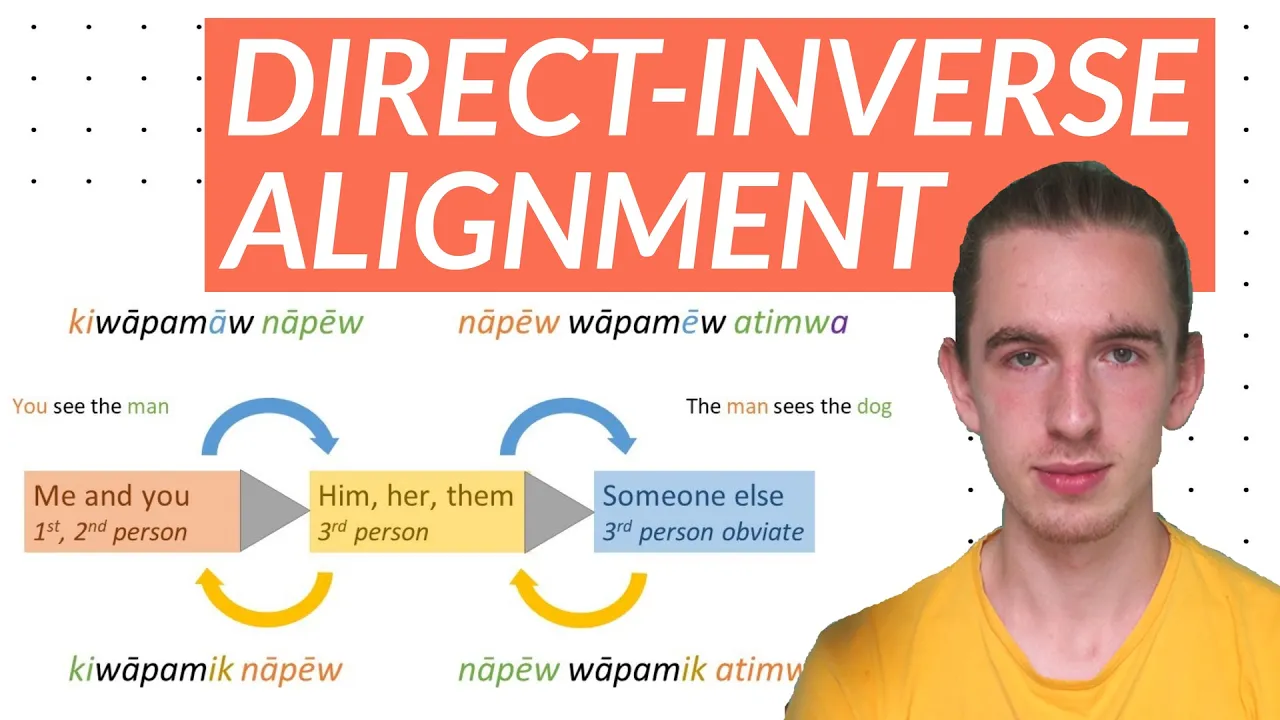


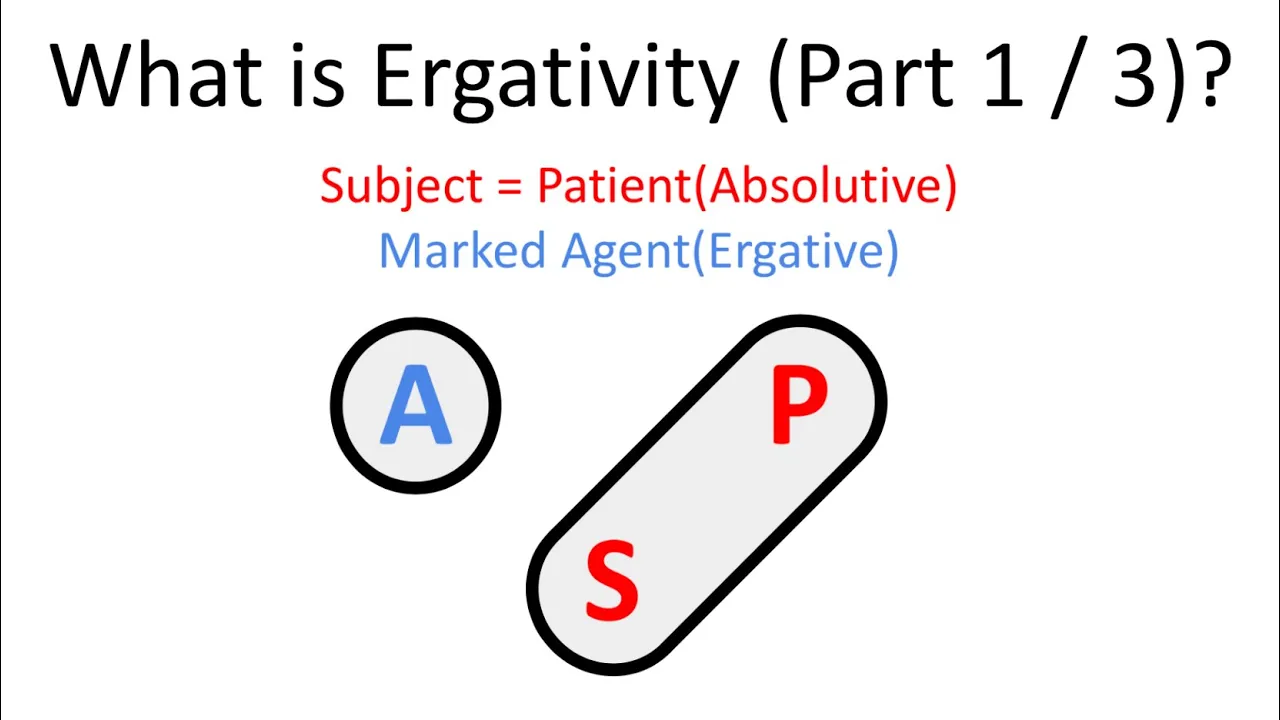
Ergativity is a grammatical phenomenon where the subject of an intransitive verb (like 'I laugh') patterns with the object of a transitive verb (like 'me') rather than the subject (like 'I'), which is the opposite of the default pattern found in English and many other languages. In ergative-absolutive alignment, the actor (ergative) is marked differently from the patient (absolutive), whereas in nominative-accusative alignment (used by English), the subject and object share the same form. Ergativity is found in approximately 400 of the world's 7,100 languages, primarily in Southeast Asia, Australia, and Papua New Guinea, and can manifest in various forms including split ergativity (where marking applies only in certain contexts like past tense or with pronouns) and antipassive constructions.
Ergativity Explained: Language's Hidden Alignment System
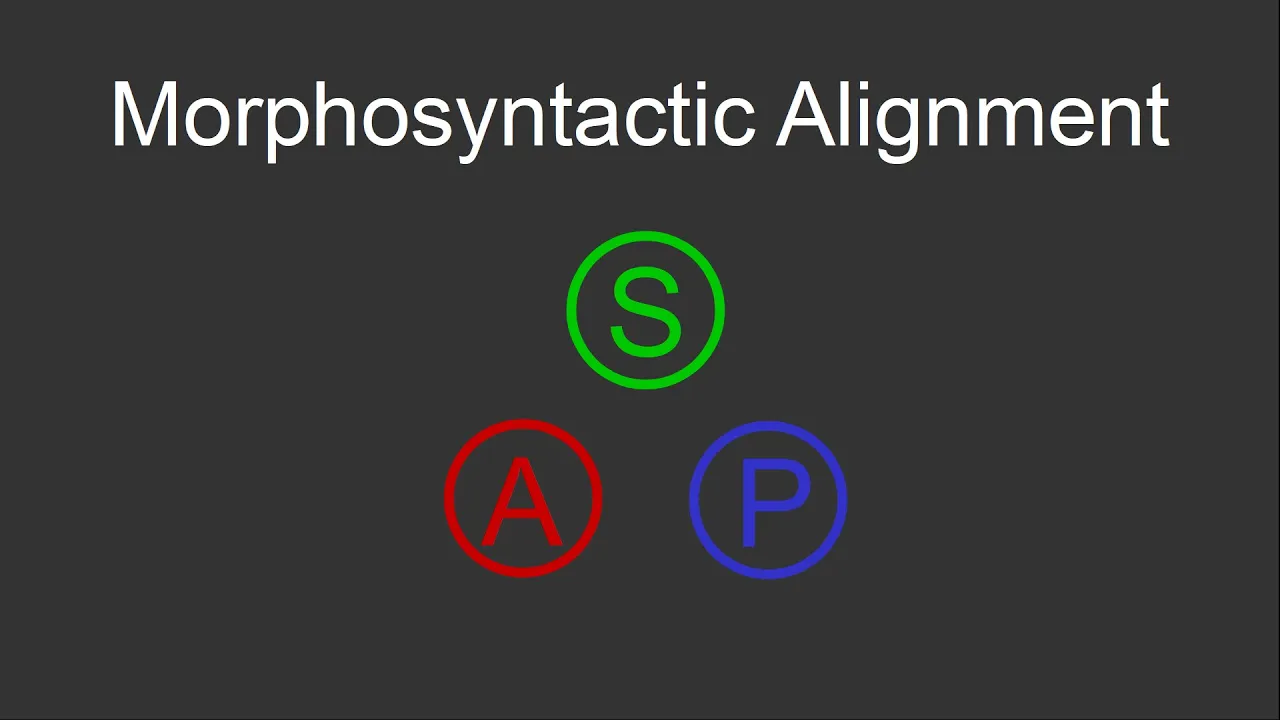
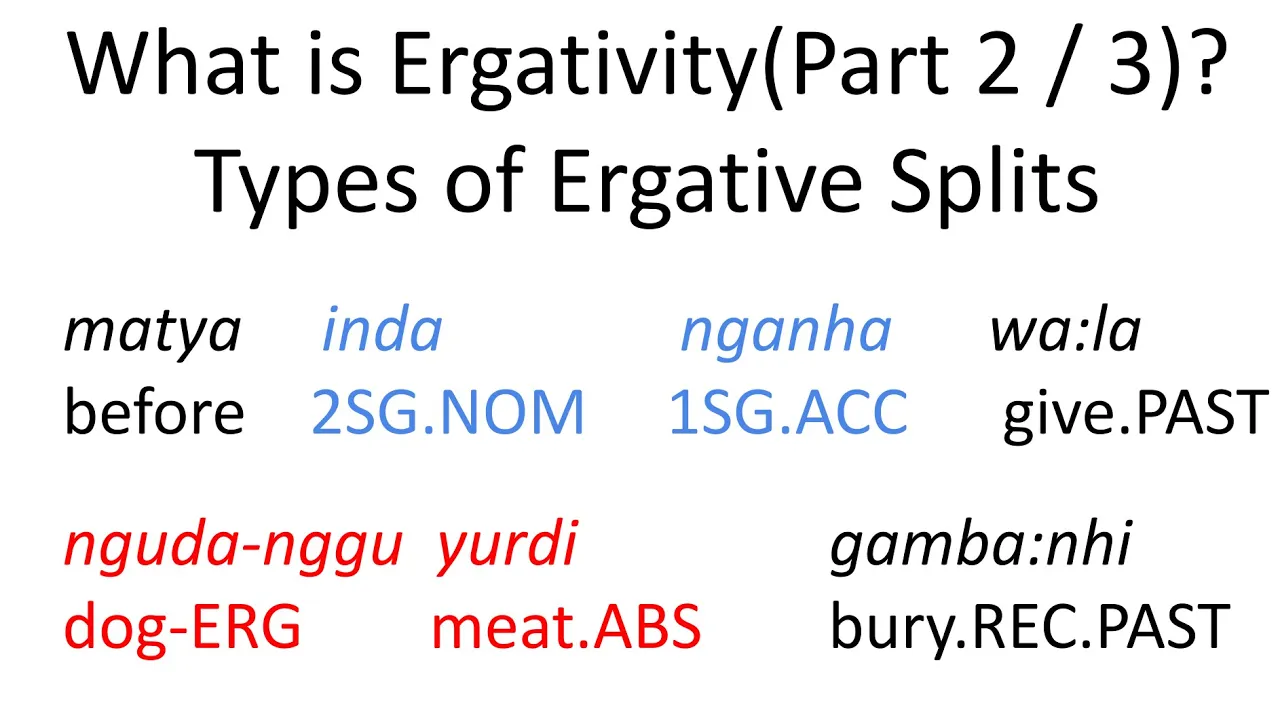
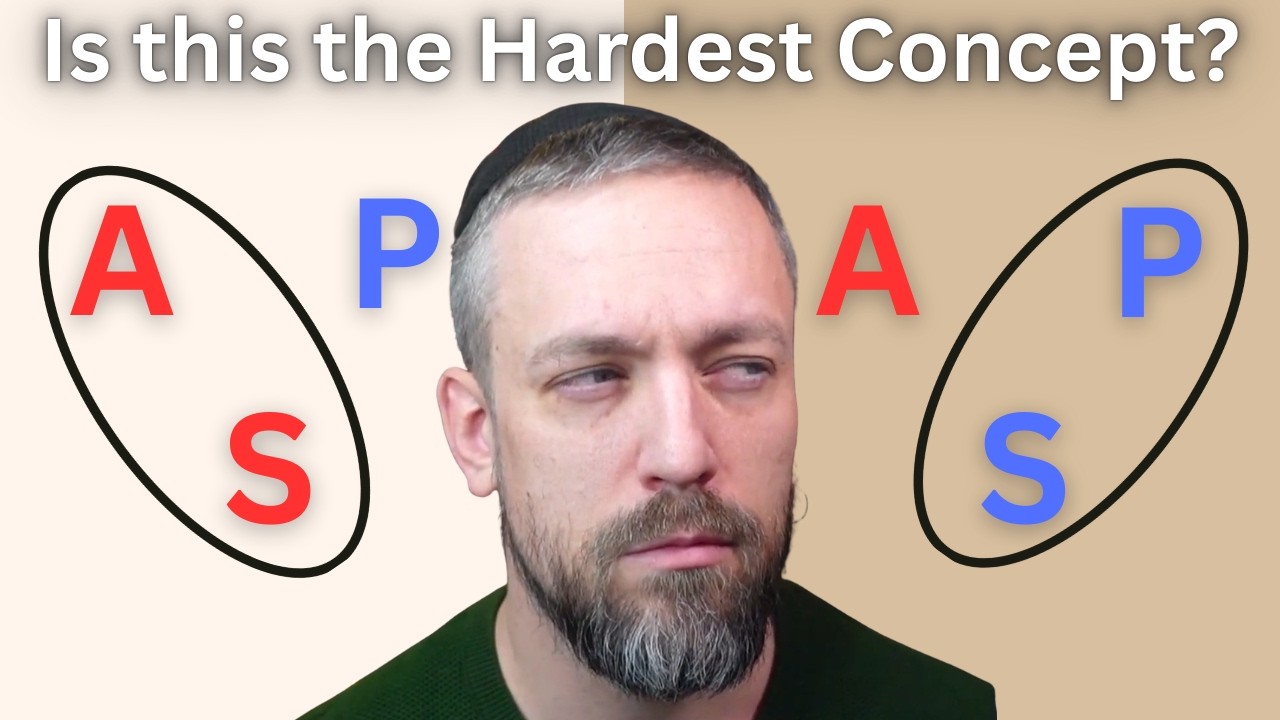
Added:[Music] welcome to enthusiasm a podcast that's enthusiastic about Linguistics I'm Lauren gor and I'm Gretchen mullik and today we're getting enthusiastic about ergativity but first next month November is enthusiasms anniversary month it's been s years for our anniversary month we ask you to share your favorite episode or just share some enthusiasm in general most people still find podcasts through word of mouth and a lot of them don't get realize they could have a fun Linguistics chat in their ears every month or in their eyes since all Enthusiasm episodes have transcripts so we're asking you to help connect us with people who would be totally into a Linguistics podcast If Only They Knew it existed the other day I shared our color episode with a stylist because we were talking about the strange history of the color orange oo it's so fun to find that perfect episode to recommend to someone and we've touched on so many different topics over the last seven years and I'm always sending people to our episode on turn taking and conversational Styles because there's this comment that keeps coming up on social media about having to hold up the entire conversation by yourselves or not being able to get a word in edgewise and that's a Linguistics thing that's been described and you could listen to an episode about it we've asked you to do this every year on our I and we always see it in the stats so your recommendations really do help more people find the show if you share us on social media you can tag ATL enthusiasm on basically all of the social media sites so we can see it and reply or like it or reshare as appropriate if you share it in private we won't necessarily know but you can feel a warm glow of satisfaction or you can tell us about it on social media if you still want to be thanked in what is becoming another anniversary tradition we are doing our second listener survey this year this is is our chance to learn all about your linguistic interests and we have a new set of linguistics experiments for you to contribute to if you did the survey last year the experiment questions are different this year so feel free to take it again you can hear about the results of last year's survey in a bonus episode and we'll be sharing the results of the new experiments next year this year we also wrote an academic article about the process of making L enthusiasm which featured some of your answers from the previous survey so you are officially contributing to academic research and because of this we have ethics board approval from latro University for this survey to do the survey or read more details go to bit. l/ lingthusiasm survey 23 that's all lowercase and with the numbers in their numeric values not written out as words or follow the links from our website and social media our most recent bonus episode was a recap of Gretchen's time at the 2023 Linguistics Institute which is a monthlong Linguistics summer course was I jealous yes was I delighted to hear about it yes go to patreon.com for this and many other bonus episodes our patrons really do let us keep making this podcast so we really appreciate any level of [Music] support you know Gretchen in some ways tivity is the basis of our lingom friendship you know you're right about that so I think it's start started in 2014 right yeah I had been getting a sort of higher than usual number of questions about Linguistics topics on my blog all things linguistic and I decided look I don't have time to answer all of these but I know that there are other linguists on Tumblr who do sometimes have areas of expertise that I don't or maybe just have more time and so I put this post out saying I want to try to be a bit of a Connecting Point for people who have questions about Linguistics topics that aren't currently very well explained online and then to encourage people who had answers to those to either write a blog post or especially contribute to Wikipedia for those particular topic so that there'll be sort of better information about various Linguistics topics on the internet and I was in grad school at the time so while my supervisors probably thought I didn't have the time I certainly had the enthusiasm and someone had specifically asked a question about ergativity and said look I've read the Wikipedia articles about this but I still feel confused can anybody help me understand this phenomenon and look we can definitely say that this was to answer the question that someone had asked but also I found it really helpful to write this incredibly long form back to First principl blog post about what ergativity is to really help keep it in my mind while I was working on some of my cours work for grad school so it benefited everyone and it also allowed me to see where there were some parts of the Wikipedia page that I could contribute to so those edits are still up there as well amazing and subsequently I did some more Wikipedia workshops and I reached out to you to get involved with those because I saw that you had edited Wikipedia before and I was like oo this person seems responsible and reliable and maybe I can nerd sniper into doing more things she blogs she wikipedias uh and eventually that led to the podcast and it's all because I'm a bit of an ergative devote an ergativity devote indeed so I recognize that we are saying the word tivity a lot and we're not explaining what it is yet and I promise we will get to that but I also want to point out that ergativity has a certain level of linguistic cultural cache this is true it's a term that's only used in linguistics and it's one of those things that you can sort of throw into conversation and you'll sound like you know some Linguistics if you say it in an appropriate context so we are here to give you the ability to casually toss ergativity into conversation and my favorite example of that currently although who knows there could be more examples in future I hope there are is an XKCD comic called the Tower of Babel um I think we should narrate it I dramatic reading of an XKCD comic let's do this so first of all there's more than two characters in this comic so we're just going to it it'll be fine we'll make it work uh one of those characters though I should point out is a curlyhair linguist M who Bears a striking resemblance to you I will be playing that character yes Gretchen will be playing Gretchen uh Lauren will be playing all of the other characters great okay we ready yeah the Tower of Babel is complete let's go meet God hi God oh wow nice Tower you did a great job I'm so proud thanks I'm going to give you a reward what do you like about the world hm words are really cool oh God no wait great I'm going to give you lots of languages to study each with its own phenology word ordering morphosyntactic alignment yes oh we should not have brought a linguist uh so technically the curlyhair linguist character is not named but I think of her as a kindred spirit um and morphosyntactic Alignment is the broader concept that ergativity is an example of so this is going to be an episode where you can listen to half an hour of explanations you can understand two words in a comic strip are we ready we are so ready and if you don't retain every bit of detail about this don't worry I was multiple years into a PhD before tivity really clicked for me the thing to really retain is that sentences have this organizing principle that's different in different languages if the exact details are something that takes a while to sink in that's totally okay we are going to explore some cool languages doing cool stuff this episode all right let's start with English just to give ourselves a bit of a outg grounding so when you have a sentence let's take a very basic sentence Gretchen visits Lauren Y which is a thing that has happened and obviously we need to distinguish that from Lauren visits Gretchen which in English we do by the order that the words come in right and this lets us know you know who's going to Australia who's going to Canada otherwise you could end up buying some very confusing airline tickets mhm and we could also do a of the sentence that doesn't use names you could say I visit them they visit me and here we have both the word order and the form of the words themselves I versus me and they versus them that's telling us who's doing what to who very convenient thank you English pronouns for helping here if I visit them I can say I arrive and we have i at the start of each of those sentences in English we wouldn't say me arrive right or them arrive but in principle we could right like it would be confusing if we started going around saying like me visit they because then you wouldn't know which of the clues to follow but it actually is not confusing to say me arrive or them arrive instead of I arrive and they arrive because there's only one person or entity doing a thing in each of those sentences yeah so when we have two different people or groups acting on each other when we have two different roles in the sentence we need to distinguish what between them grammatically either with word order or by changing the shape of the word but when we only have one person or group one role doing an action then that solo entity can kind of cluster with either of the forms in the sentence where we have two of them we should use some kind of visual metaphor here to help show the relationship between these three different roles that you can have in a sentence so I first learned this relationship between roles by having somebody draw a little triangle on a piece of paper with these three different possible roles and doing a circle around like which ones are clustered together in which language I did that on my blog post and I love using some very Nifty color coding when I teach this with slides but uh we don't have access to that this is an audio podcast um so instead we thought we would send everybody something in the mail so you could have visual oh we could launch a massive advertising campaign imagine the day where we have morphosyntactic Billboards in Time Square we could just you know all of the bus shelters we could just pay for advertising so you can see this diagram if you're listening to this podcast while you're walking the dog I think this may this may be getting out of hand here you know because we have such a massive budget Lauren I going to have to break the sad news to you that we're going to have to use something that is a little bit closer to home and a little bit more on budget okay okay okay let's try um if you look at your hand uh-huh well Bor someone else's or borrow someone else's consensually if you like um we can put these two people with their two roles in the one sentence on two different fingers okay so if we have Gretchen visits Lauren we can put the doer the visitor that's me on the index finger yep and the VII that's you Lauren on the pinky finger right okay I've got a little like metal hand gesture here yeah you're sort of doing the you know horns horns thing and then for the one person in a sentence all by itself like I arrive the only thing acting that's going to be on the thumb sticking out on its own I like that because with I arrive there's only one role happening there the thumb kind of sticks out on its own right the thumb is sort of its own solo player we're just ignoring the middle and the ring fingers that's more complicated sentences for a future episode there are certainly other things you can put in a sentence and we're not going to look at those things/ fingers right now right but the Nifty thing about this metaphor so again we've got the index finger which is the visitor the picky finger which is the visite and the arriving person uh over here in the thumb Ary Arvey and so the thumb can touch the index finger mhm like when you're making an okay sign yeah and that represents when you group together I arrive and I visit the way English does yep those are pattering together and you have the pinky finger that's all by itself doing its own thing that's me and then you can also have the thumb touch flat against the pinky finger Yep this represents when the Arvey and the visity are doing the same thing so that would be visit me and me arrive yeah in a languish something like that and then the index finger is all by itself and it's doing its own thing so it's doing for example I you know what it's a lot more Awkward for me to touch my index finger and my pinky finger together right and those don't really touch together very well you can kind of brush the sides a bit um but they don't touch flat as easily as the thumb does and that represents how you really don't want to Mark the two roles in the same sentence with the exact same marking because then you don't know who's visiting who de Fates the purpose of distinguishing who's doing what in a sentence right so this is our sort of visual metaphor using something that hopefully everybody has access to unfortunately uh the enthusiasm budget does not stretch to billboards no but it does stretch to hoping that people have hands yes the other thing that's Nifty about your metaphor Gretchen is that okay is a meaningful gesture in English in a way that touching the thumb and Pinky together is not so you know the way that they line up in English is for the thumb and the index finger to go together I arrive and I visit gron oh because that's a gesture that we have I can't guarantee that all of the cultures that do have the okay handshake do have this uh exact morphosyntactic alignment it only works if you're trying to remember things for an exam in English and the other thing that's the case at least for me is I find it's a bit easier and more comfortable to tap my thumb to my index finger than to tap my thumb to my pinky and I feel like this represents as a neotic how this grouping of the visitor and the Arvey together is a bit more common cross linguistically the other one is still in a bunch of languages and we're going to talk about that but it's a bit more common to have the index and the thumb group together the other thing really like about this is that putting the pinky and the thumb together is now like cool new linguist greeting yeah so okay already has a meaning but the pinky thumb together this could be a cool new linguistic handshape gesture you could do a little tapy tap of your thumb against your index and your pinky finger in succession and you could use this as a cool hand gesture to flag down linguist in public are you a fan of morphosyntactic alignment yeah it's like the live long and prosper gesture for Linguistics I love it if you're if you're at a bar and you're trying to like find a discreet way of finding out if someone's a linguist and you like don't want to just ask them I don't know why you wouldn't just ask them but like you could do this little gesture no no no I if you're at a bar and you want to find all the linguists in a noisy environment is what you're trying to say there right right exactly yeah so I hope this catches on I did just make this up I can't guarantee other linguist will recognize it but maybe it seems pretty useful so in English we tend to keep the thumb and the index finger together I visit Gretchen I arrive in other languages you can have it as the thumb and the pinky together and it's Gretchen visits me or me arrive exactly and even though that's not the way it works in English that is the way it works in other languages and that is known as otive well so this whole thing is morphosyntactic alignment and a part of this is ergativity MHM and specifically we're used to doing this default okay sign the index and thumb together this has a name it's called nominative ACC accusative alignment because those are two different groups and then the pinky and thumb together is called ergative absolutive alignment but it often just gets shorten to ergativity because that's like the most Salient piece of this entire edifice mhm and people tend to name the like most exciting bit of course you got to stick with the exciting bit scratching so when you have the thumb and Pinky touching the person who's visiting is left doing all of the work of packing their bags and getting on the flight and the other people are like I'm just here I'm getting visited like I arrive who knows how that happens but the visitor has to do all of this stuff and so the entity that's doing all the work is called the ergative and the etymology of ergative that urg there is from a Greek root that comes from the form ergon which is work yeah so an ergonomic chair is I guess a chair that sort of works well for you huh yeah makes sense or like the urg which is pronounced slightly differently in sinergy Synergy syy syy I guess it is syy working together working together that's nice yeah there's some real Synergy to that atmology and I think ultimately the Proto indoeuropean root work a meaning to do which is the origin of urg as an ergative and sin ergy also also energy ah energy does the work is also the origin of the English word work cool yeah that was a fun little eological rabbit hole to go down so the erative or to use an English root the worka the work that would be so good I should just call it the worka now we already have enough going on here terminologically to not re angiz it but it is one of those pieces of terminology that was created in the 20th century as part of this formalization of linguistic terminology and that's why it has this Greek root and also kind of why it doesn't show up in other branches of Sciences CU we didn't borrow it from physics or biology was created within Linguistics right whereas compared to something like morphology which refers to the shape of words but can also be used in like metals and geography the shapes of other other things ergative is specifically used for the grammatical concept and only the grammatical concept so you really look like you know what you're talking about if you can use this word so let's stop making up fake English tives and start looking at tivity in some languages that actually have it as part of the grammar and I think we'll just start with one of the poster children languages for tivity which is BAS so Basque is a language that's spoken in Europe but is not ancestrally related to any of the Indo-European languages so it's not related to Spanish or Catalan or French or any of the languages that are spoken in that region of sort of Spain and France and it's also not related to like Greek which has this common ancestor with English this work ergative urg connection and so it sort of gets a lot of people very excited because it's a language that's convenient for People based in Europe to work on but is not related to the other languages in its neighborhood although of course it's done a certain amount of borrowing because of contact later so first cool bask fact it's an isolate second cool Basque fact it has ergative when most other European languages don't show anything like this third cool Bas fact is like you might expect for a language that is very different from all the languages in its neighborhood it's been undergoing language revitalization movements since like the 1970s and 1980s and we're going to talk a lot more about that in a very soon upcoming episode so stay tuned for way more about Basque but as the poster child for ergativity let's talk about what it specifically looks like so for our verb arrived it looks very much like English if we're talking about Martin Martin Martin has arrived but if we have a verb that has two roles in it in this example we have Martin has seen Diego we have Martin Diego IU and here we have this e on Martin right because you have the E which is the ergative marker on the one sort of solitary there's Martin being his index finger all alone compared to Martin with no marking on on the end and Diego with no marking on the end which are the other form that's called the absolutive the one that isn't doing as much of the work and that's the one that's not ergative and those are the two forms that are sort of linked together your pinky and your thumb touching each other mhm and we see exactly the same pattern in the language Aranda which is from Central Australia in Northern Territory where if a child is sitting the the child is marked as a but if a child is chasing a dog it's so again there's a suffix on the role that is doing something to something else so that index finger is marked different from the pinky finger and the thumb and again we see something that's very common with ativity and this sort of makes sense when you think of sort of an efficiency perspective when you have just one role or one person you know the child the dog Martin doing something all by itself you don't need to add anything to the end of it to indicate who's doing what to who you can just say it and it's fine yeah and it's the case when you have two different entities you need to Mark at least one of them so that you can tell who's doing what and so you pick one to Mark and for languages that are ergative you pick the one that's doing the action and you mark that one the other one is unmarked and then for implicitly for languages that are the other category that aren't ergative you pick the one that's being acted upon to add the mark Maring tool though in English that's less clear because we're sort of using word order and we're using these sort of relics of markings on the pronouns so that's not as clear in this case but in the poster child orative languages it's very clear that you have this one entity that's got a suffix on it or potentially a prefix or something like that and then the other one just doesn't have any marking on it at all you mentioned earlier that tivity is not as common as the English style of marking and I thought this was a really good reason to visit our new friend gr bank and see in a big database of languages just how common each of these patterns were so before we visit gr Bank let's just test our cross linguistic intuitions do you think of tivity as pretty common not that common like what's your sense of it just based on the languages you're familiar with I think of it as pretty common but I know I have a bit of an area bias because I work in Nepal where there are a lot of languages that have ergative marking and then being in Australia a lot of my colleagues work on Australian languages and languages of Papa New Guinea and it's relatively common in those language groups as well uh so I think it's common but I think that's my bias showing well yeah because my gut feeling what tivity is it's not super common like I know it's in the Mayan languages uh we just talked with Pedro Mato Pedro and the May languages that he works on all hity and in Basque which I talked with someone else who we're going to have an interview about shortly okay so based on Enthusiasm episodes this year in incredibly strong preference for tivity that might be the reason we decided we needed an tivity episode I'm just say but other than that I don't feel like I have a lot of like languages I could name off the top of my head that I'm like oh yeah that one's super erative oh well let's have a look at the numbers there are around 1,00 languages in this part of the grand Bank database 150 of those they couldn't tell from the resources they had so of the ones that are left otive is found in 390 and it's not found in around 13400 so that's about 400 with ergativity and 14400 without ergativity that's you know I would say quite a lot not super common but quite a lot which is about what we thought between us the great thing about gr bank is that there is a little interactive map you can zoom in on and when you zoom in you can see that three real hot beds of tivity are the napole part of Southeast Asia Australia and then various little clusters in Papu New Guinea so I was pretty spot on about my aerial bias yeah and there's like some in Central America but not a ton so there's your May languages and you can certainly see where Basque is in a map of Europe because it is an ergative language in a sea of not ergative languages there it is right on the border of France and Spain tivity as if we weren't having enough fun more fun let's have more fun so tivity is also really neat because we've done basic tivity but it also shows up in different ways across different languages it shows up in so many cool and different ways and it's really one of those things like if you've met one ergative language you've met one ergative language the thing with ergativity is again it's that sort of clustering of the pinky finger and the and the Thumb Rolls in the sentence but some languages have that clustering in some context and the more Tross linguistically common clustering of the index singer and thumb together in other context these are languages that flip between those two different hand gestures in different contexts one of the reasons why the sort of exciting version of the phenomenon that gets talked about is tivity rather than like nominativ which is the englishy pattern is that there are lots of languages like English where you basically just have only these two entities patterning together H but languages that are ergative are often partially ergative or what they call split ergative so again that's the sort of exciting one and they often have a little bit of the other system in there as well and they can split in different ways which is why it's fun to look at tivity in each individual language because they're often doing slightly different things do you have some examples of split otive systems for us I have so many examples of split otive systems I'm very excited to share with you uh one that is actually common enough that the world atlas of linguistic structures has different Maps is that some languages will do ativity in pronouns but not in common nouns or the other way around so walls actually has different maps for whether a language is otive in nouns or otive in pronouns I guess that sort of makes sense to me because English has you know pronouns change their shape depending on whether they're the subject the object or something but our nouns just really do not change their shape so you could imagine that but for tives yeah pronouns have their own history and way of being made and they tend to kind of keep features for a long time whereas you can add new suffixes to things all the time and change it up so common nouns and pronouns can kind of go off on their own Journeys with one being otive and the other one being not so that's one way that the split can happen there's also splits that are based on meaning which I really find fascinating yeah I have one here in a language called Dan from Papu New Guinea which is where you are more likely to get something marked as ergative if it's an action that is uncommon so if it's describing something that's like unexpected yeah then it's ergative what would be an example of that the example that I have from the class that I teach on syntax is that it would be uncommon if you had a sentence like the python ate the man but it would be more common if you had a sentence like the man ate the python and so you wouldn't Mark that second one as otive okay so in this culture it is common for humans to eat pythons but mercifully uncommon for pythons to eat humans yes I feel like I've learned some interesting things about Deni culture as well yeah I really like this one because what counts is uncommon surely varies quite a lot from culture to culture to linguistic context I feel like I'm remembering this sort of saying about headlines where like if a dog bites a man that's not a newspaper headline but if a man bites a dog that is a newspaper headline and you should market erative and that's interesting because in this case it's the human biting the animal that's left common so it's not just like a human non-human animacy thing it's really like in this culture humans don't bite dogs but they do eat pythons and again it's the interesting case that gets this otive marking added to it because the otive is like the worka so it's when you want to call attention to something that's doing a particular job another time you see a split across languages is depending on the tents of the verb and you're more likely to get something that's split in a way where the otive is in the past and you have a non orative in present or future or however else the language segments up time and Nepali is a language that has otive in the past ah okay so what does that look like so because it's Nepali I use it as a chance to use Momo in my examples which are a delicious dumpling very delicious so if I say tomorrow my sister will eat Momos okay that's future I would say Momoa so D is Sister nothing marked there but if I were to say yesterday my sister ate Momos I would say he's your D Momo ah so instead of D which is just sister without a marking you have D which is Sister plus ergative and in both cases Momo is not marked y so I assume maybe it's that they're in a certain W order that's telling you that your sister ate Momos and also that Momos are this delicious dumpling that are not anime and can't go around eating your sister yes what hopes I guess if my sister was tragically eaten Yesterday by a Momo I would still mark it as ergative but only because it's in the past and nothing to do with how unusual that situation is okay so you would need to Mark Momo with an ergative because that sure is doing something but not actually because of the surprise Factor no because in the past with Nepali and Nepali is an Indo Aran language so it is part of this larger indoeuropean family but I don't completely different end of the geographic Spectrum to English because it's in Nepal do we know why Nepali has an ergative even though most of the other induran languages don't I don't know what the exact mechanism is but there are a whole bunch of features of Nepali that are very similar to languages from other families in the area including the tibeto bman languages that I work with so it's possibly some kind of contact influence happening there that makes sense so we have have ergative for nouns and pronouns we have ergative for unusual events we have ergative for past any more kinds of split ergative systems so everything we've talked about so far is very much if it's this form do this if it's this form do that so if it's a pronoun do this or if it's a past tense do this there are ergative systems where it's not a hard and fast rule of the grammar it all depends on the context and these are called optional systems oh this is so exciting and the languages that I work with have these optional systems so you can't make a grammatical rule that's like in the past you must use otive or you must use otive with pronouns instead what happens is if you look across a corpus sometimes you'll get ergative sometimes you won't and it really depends on like a range of different factors so do they have to do with trying to emphasize who's doing the work yeah they touch on some of the things we've talked about so so far so you are more likely to get an ergative in the past because something has very clearly been done the the work the active role has been done you're much more likely to get it with something that was intentional okay sure or that is unusual you also get things like you're more likely to have otive if it's not a habitual action if it's a slightly unusual or uncommon action that someone's performing okay or if they're more animate so you're more likely to get otive with a human than an animal and more likely with an animal than something like a tree makes sense but this is not 100% of the time you need to collect a really large Corpus of people talking about all kinds of different contexts to see where you're more likely to get an ergative or not and this also sounds like it has potential to be somewhat cultural because what people think of as a habitual action or what people usually do versus less commonly do seems like it would have some relationships with culture and this is also why it's really important to not just give people a bunch of sentences to read and translate because if I give people a list of sentences to read and translate they'll just give the otive in all the situations where you have someone acting on something else so where you would expect there to be that index finger role acting on something else but then you hear a story and you're like where did that otive go and it's because it's being used optionally and strategically which makes it very cool and fun to try and figure out the patterns so when I ner sniped you n years ago into writing a blog post and updating the Wikipedia article about ergative I was really like touching into something that was very near and dear to your heart indeed and since then I've also written the entire yolmo language page in much more detail that also touches on a little bit of this otive structuring excellent while we're talking about ways that you could organize how you know who does what to who you know you can group the person who's by themselves in a sentence with only one role with the one side of the verb with two or with the other side of the verb with two but in principle you don't actually need to make it pattern with anything you could have a system that has all three different roles marked in three different ways does that ever happen it does indeed it's known as a tripartite system because there are three parts each doing their own thing do you have an example of a language that does that conveniently I have one from wamara which is a language of Queensland in Australia and they have three different pronouns depending on what role is in the sentence Oh okay very neat so for something like I arrived our thumb form would be okay for the i in I visited you it would be okay in English they're just both I but they're both different but then if it was you visiting me instead of me it's so it's three different pronouns for the three different roles soiu Anda like three different forms so you know none of the fingers are touching each other you know I think we could do this in pseudo English if we wanted to we would just have to invent an extra pronoun form yeah that makes sense so we could have like I visit them they visit me but then like MO arrives and though arrives excellent and those you'd have like I me and mo they them and though or something like this and that would be your extra form all by itself doing its own thing in the sentence where it's the only one I love that if you hold up your thumb index and Pinky and make sure none of them touch each other you can make the I love you gesture that's based on the ASL form of the verb I love you it's like I love you tripartite systems that is really great I love the tripartite system so much I'm making the I love you handshape so while we're on linguistic phenomena that are a little bit complicated but have really cool names okay are we into the deepest otive deep cut that we can make the deepest otive de cut has one of my favorite names of a grammatical phenomenon ever and we have to talk about it because it just sounds so cool okay in English we have uh you can have a sentence like Gretchen visited Lauren which is the active sentence and you can also have a version of that where you put more emphasis on the visity by having Lauren is visited by Gretchen and that's the passive version of the sentence we're moving fingers around on hands here moving fingers around on hands here so you can sort of promote that visity person to a more prominent position for reasons of emphasis thankfully the enthusiasm budget does not extend to hand surgery so you're just going to have to imagine the fingers moving around yeah where this is going to get a kind of gross Halloweeny metaphor here but in erative languages because of the ways that the subject and object relate are different instead of having a passive we have an anti- passive yeah and I think there should be more specialized terminology that begins with antie cuz I feel like like having antimatter but for Linguistics see I always think of like antipasto share plates when I hear anti passive and they're delicious so I have positive feelings towards the anti passive the delicious platter with olives and Arch chokes and cured meats on it I don't want to go straight from cured meats to fingers but I can explain how the anti passive works if we like okay just give us the brief anti passive rundown while we're here because I think it's such a cool piece of terminology so I'll do a translated example fromal which is a language spoken in Queensland in Australia because this is the first language the anti passive was described for so it shows up in a lot of examples okay so if a man was cutting the tree we have man and tree and it's an ergative sentence so the index finger man is marked otive it's distinct and different gotcha in the same way with a passive you get rid of focusing on one of the fingers in the sentence we can get rid of the tree and just have the man was cutting but in didal you can't have the man still be otive CU now there's only one oh thing that's in the sentence and so you have to make the man even though he's still cutting and we think of cutting as having two things we now make it look like the non orative so that absolutive so it looks like a thumb and is therefore more focused so in the same way that in a non non ergative language like English you can have Gretchen visits Lauren or I visit them you can change that into the Passive by going Lauren is visited yeah and there you are all by yourself yes in the sentence or they are visited there you are all by yourself in a sentence yeah and in this case the man was cutting the tree instead of promoting the tree and going the tree was being cut which You' be do if it was a passive you have the man was cutting but now you have to take the ergative off the man because otherwise he was previously being marked with ergative yes and in a language like theal it's completely normal sounding in a way that a passive sounds normal in English even though you've gotten rid of one of the roles because you changed the marking it makes complete sense it sounds very grammatical and it just makes the man even more of a focus and what is being cut is less of a focus and so in the way that a passive gets rid of the original subject the anti- passive makes the original subject like subject Plus+ that's why it's anti- passive if you put a passive and an anti- passive in the same sentence would it cause an explosion so we've talked about all of these like interesting tivity can sort of pop up in various little bits of the grammar in different languages but what if I were to tell you that there's actually a little teeny tiny bit of English that is actually ergative it was here all along the ergativity was inside the house all along uh pleas share okay so you know how in English we have like a double e ending that goes on certain nouns so you can have things like retiree or Escape or employee we've had devote and R in this episode so far that's true so this is a thing that goes on nouns but they're all nouns that come from a verb and so if you have a verb like employ and if you say Gretchen employs Laura then Lauren is the employee employee of the month I would hard I don't actually employ you but you are the employee of the month in my heart oh thanks and the same thing is if I visit you you're the visite if I pay you you're the pay if I nominate you you're the nominee and so on so there are two roles in this sentence right and the one that is acted upon is the one that when you make it into a noun with e that's it means mhm but there's another set of verbs that you can also use e with if we decide that we want to retire from making enthusiasm which we have no intention to do but we would then be retirees mm and we're the only entity in this action you know Gretchen is a retiree Lauren is a retiree I have retired you have retired I'm not retiring you so there's only one roll I've got my thumb and that's marked with this e yeah if you were trying to escape you could be Escape true and it's not like I escape you it's just you escape now you're an escape and again so here's this thumb and here's this pinky that can both get the E marking on them wait a second that's my ergative handshape correction that's my ergative handshape that employee and retiree and escape and visity Arvey all get the E marking on them and the one that's left over that's the exception is things like employer and visitor and nominator these ones that do the action that are the ergative ones that are doing the work did all the work of nominating you that's the one that has the or ending which is the ergative one there we go there was a tiny bit of tivity in English all along and we should note that not all words that end in e are examples of this particular phenomenon in English Okay so you know you have mentor and mentee you don't have for example chimpan or and chimpanzee chior and chick okay that is definitely looking for morphology that is not there frisar and frisbee come on the frisar is the person that throws the Frisbee yeah yeah yeah and then the frisbe is the one that receives it all right okay yeah uh that is definitely some interesting morphological Ray analysis there I think it works great but you know it doesn't it doesn't happen for every instance of the E ending but it does happen in a bunch of them and so here's this example of a tiny tiny way in which English has a split orative [Music] system faling enthusiasm and links to all the things mentioned in this episode go to L enthusiasm.com you can listen to us on all the podcast platforms or L enthusiasm.com you can get transcripts of every episode on lingthusiasm tocom transcripts and you can follow at lingthusiasm on all the social media sites you can get scarves with lots of linguistics patterns on them including IPA branching tree diagrams Boo and Kiki and our favorite esoteric Unicode symbols plus other enthusiasm merch like our new atmology isn't Destiny t-shirts and aesthetic IPA posters at L enthusiasm.com merch my social media and blog is super lingo links to my social media can be found at Gretch mic.com my blog is all things linguistic tocom and my book about internet language is called because internet enthusiasm is able to keep existing thanks to the support of our patrons if you want to get an extra lingthusiasm episode to listen to every month our entire Archive of bonus episodes to listen to right now or if you just want to help keep the show running ad free go to patreon.com or follow the links from our website patrons can also get access access to our Discord chat room to talk with other Linguistics fans and be the first to find out about new merch and other announcements recent bonus topics include what I learned at linguist summer camp how we make the enthusiasm transcripts and doing linguistic field work can't afford to pledge that's okay too we also really appreciate if you can recommend lingthusiasm to anyone in your life who's curious about language especially this month in honor of our 7th anniversary the lingthusiasm survey is open till December 15th 2023 anywhere on Earth and it's available at bit. l/ lingthusiasm survey 3 enthusiasm is created and produced by Gretch mullik and Lauren gor our senior producer is CLA G our editorial producer is Sarah Della our production assistant is Martha susui billins and our editorial assistant is John crook our music is ancient city by the triangles stale [Music] enthusiastic oh
Up Next
Split Ergativity: Animacy Hierarchies Explained
@Lichenthefictioneer
1.1K views•2025-02-11
Constraint Interaction in Optimality Theory: Epenthesis & Deletion
@Vidyamitra
180 views•2018-08-20

International Phonetic Alphabet Explained | Linguistics Phonetics
@Lingthusiasm
8.2K views•2017-03-16

Accent Expert Explains U.S. Regional Dialects | Part 1
@WIRED
9.3M views•2021-01-21
Related Study Plans & Knowledge Roadmaps
Structured learning paths in Linguistics