


![Chapter 6 | Morphology | Complete with Solved Study Questions | The Study of Language | [ ENGLISH ]](https://i.ytimg.com/vi/37Ip6q30TOs/maxresdefault.jpg)



![Morphology: Intro to Linguistics [video 4]](https://i.ytimg.com/vi_webp/oqO3zKxSeGE/maxresdefault.webp)














Interlinear glossing is a method for analyzing linguistic examples through four lines: (1) transcription of the original phrase, (2) morpheme breakdown showing underlying structure, (3) morpheme glosses using small letters for lexical items and small caps for grammatical morphemes, separated by hyphens for morpheme boundaries, equal signs for clitics, and full stops for multiple meanings; and (4) a free translation into the meta-language. Key principles include treating glosses as analytical choices reflecting the researcher's interpretation, maintaining consistency in labeling, aligning morphemes with their glosses, and prioritizing readability while being as specific as possible in morpheme classification.
Interlinear Glossing: Methods, Conventions, and Best Practices
Added:Basic concepts in morphology, including the distinction between roots, stems, prefixes, suffixes, and bound versus free morphemes.
Familiarity with common grammatical categories such as tense, aspect, mood, case, number, and person.
An understanding of basic linguistic typology, particularly how different languages structure words and sentences (e.g., isolating vs. synthetic languages).
The fundamental purpose of language documentation and grammatical description in linguistic research.
Handling advanced glossing challenges, such as representing clitics, infixes, reduplication, and portmanteau morphemes.
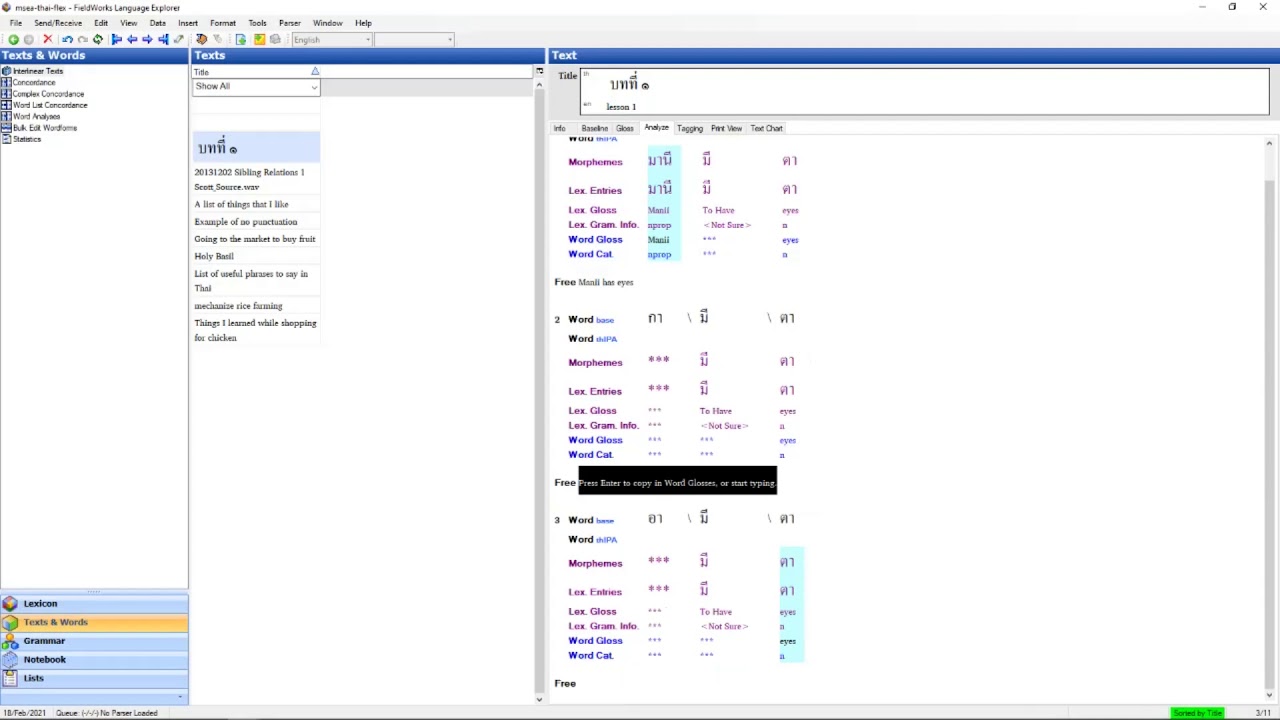
Proficiency in linguistic software tools designed for corpus creation and glossing, such as FLEx (FieldWorks Language Explorer) or ELAN.
Formatting and aligning interlinear glosses in academic publishing using LaTeX packages (such as expex or gb4e) or word processor styles.
Applying glossing conventions to field linguistics, transcribing, and analyzing primary data from under-documented or endangered languages.
1K views32likes10:39Original Release: 2025-01-24
Hello, my name is Jenneke van der Wal and I'm Allen Asiimwe and this video is about interlinear glossing. Linguistic examples are typically not just translated but also glossed a bit-by-bit translation, as it were. But what makes a good gloss? That is what we show you in this video. We even have a first-aid glossing kit! We use illustrations from Bantu languages here, but the principles apply to all linguistic examples. First, however, we need to know what the lines of the example are. Let's look at this Kîîtharaka example: the first line is a transcription of the phrase or sentence in the language under study. This can be an IPA, in your own system, or in the language's orthography. Here, the Kîîtharaka orthography uses circumflex diacritics for different vowels.
If the language is tonal you may want to include tonal marking to help linguistic analysis.
The second line is a breakdown of the sentence into its underlying morphemes. This may be different from the surface form. For example, the underlying form of the prefix mû- plus the stem -ana are pronounced as 'mwaana'.
Now that we have the building blocks, we can gloss them in the third line. Lexical morphemes such as 'child' or 'swim' are in small letters. Grammatical morphemes like PRS for 'present' and DEM for 'demonstrative' are glossed in small caps. This gives you the function of the morpheme. Finally, the last line provides a free translation into the meta-language you are writing in, in this case English.
Only use normal sentences here because you want to capture what the sentence in the original language expresses.
The literal translation can be added separately. Use single quotation marks for this free translation.
This seems straightforward, but glossing can easily go wrong! How do you decide on the label in the gloss and how do we make glosses readable?
First on the readability: fortunately there are conventions for linguistic glossing - check the Leipzig glossing rules.
So when do you use a hyphen, an equal sign, or a full stop?
The hyphen separates morphemes in the second line and the corresponding glosses in the third line.
In this Kinyakyusa word, we indicate two prefixes: a determiner called the augment and then the noun class marker, followed by the stem.
And very important: always check that you have the same number of hyphens in lines two and three!
The equal sign is used for clitics, which attach to whole words.
In Makhuwa, the repetitive enclitic =tho can be added to both nouns like 'today' and verbs like 'you have eaten'.
In this example, the clitic follows the final inflection -ale on the verb and is separated with an equal sign in both lines two and three.
Now, what do we do with a morpheme that captures multiple meanings? This is where we use the full stop.
In Rukiga, 'ti' is the negative copula. We indicate both negation and the copular function for this morpheme and separate the glosses with a full stop. Sometimes people use a colon to separate grammatical glosses. The same goes for lexical meaning: the verb stem -yosy- corresponds to two English words: 'become' and 'hot', with a full stop between them. Do not use a space!
So we have the hyphen, the equal sign, and the full stop to separate glosses. To further increase readability, make sure that the words in line two are neatly aligned with the glosses in line three. Software like LaTeX will automatically align examples and in word processors you can use tabs or tables for aligning glosses.
Alright, so now we know about the four lines and how to make them readable, but you can still end up with a bad glossing!
How do we choose the gloss for each morpheme? The first point I want you to remember is that a gloss is an analysis.
Let me show you by examining the first example. I gloss the first morpheme kû- as a subject marker of class 17. However, as this morpheme behaves like expletive agreement in Kîîtharaka, I could have chosen the label EXPL - it depends on the analysis.
Similarly, rî-na consists of 'be' plus 'with' but together it means 'to have'.
Do we split these up or gloss them together?
Another choice was made for the morpheme -ra. This is a distal demonstrative, but it became clear that its use as a relative marker is grammaticalised, so later on we chose to gloss it as RM for relative marker. There are many other choices in these glosses but they all show the same point: a gloss is never a neutral label. As the author, YOU make the analysis and your gloss reflects that analysis. That does not mean that you should shy away from analysis. An important guideline is to be as precise as you can be, while keeping in mind readability. What do I mean by that?
Take the example of the first prefix on Kinyakyusa words. There are many non-helpful ways to gloss this. 'Ju' in 'jumundu' can be glossed the same as the noun class prefix, as '1'. This at least gives us the information that the prefix varies with noun class. We could also simply say PX for prefix, or 'ju' in small capitals, which doesn't help at all! A gloss like DET for determiner gives us some idea of the grammatical function but most helpful is to indicate that this prefix brings about an exhaustive interpretation: *only* a person, in addition to indicating the noun class. This is the most precise gloss we can give.
Of course, before this label could be determined, a lot of research was needed, so again: a gloss is an analysis.
Once you have found the right labels, you want to be consistent.
Use the same gloss for the same morpheme throughout and use the same conventions.
Can you spot what's wrong in this Bemba example?
First, we see that the order is not consistent: the noun class number precedes the subject marker but follows the object marker. Let's change that. Then, we see two different glosses for the object marker: OM and OBJ. Better to choose one and stick with it! There we go. Now our glossing is consistent.
And do the same for lexical items: in certain environments we could translate the stem -peel- as 'hand to someone' or 'provide', but the gloss remains the same: 'give'.
I'm sure there other questions about glossing. Yes - this is where our glossing first-aid kit comes in!
Great! How can I deal with a different script, for example?
Well, you can either add a line or replace the first line by the language in its own script.
Many authors also simply omit the original script of a language using only a transliteration What do we do with zero morphemes? You can gloss the meaning along with another morpheme, for example 'gari' in Kiswahili contains both the lexical meaning 'car' and grammatical information that it is in noun class five.
Alternatively you can indicate a zero morpheme by the empty-set symbol and gloss that.
In this Rukiga example, we see the near past morpheme between the subject marker and the stem.
By analogy, we could posit an unpronounced morpheme in the same slot including habitual.
And if the morpheme is just a tone? Then you indicate that tone in the morpheme break.
For example, in Kirundi, relativisation is marked by a high tone and this is marked as superscript H and glossed as relative.
But should everything be written out and glossed? Well, in principle, yes.
However it should still be readable. Here, for example, you may want to prioritise clarity over completeness.
A final question: can I modify glosses from other sources?
You want to be careful with that, because as said, a gloss is an analysis.
You can, however, make the glosses consistent and indicate that in the reference, like so.
Okay, so when we are glossing, we use hyphens, equal signs and full stops for different functions; we want to be as specific as we can in the label that we choose; we align the glosses nicely; and we make sure that everything is consistent.
Now it's up to you. Good luck!
Up Next
30:50
Mohawk Language: Phonology, Morphology, Syntax & Culture
@intercycles8039
2.2K views•2019-02-03
36:52
Constraint Interaction in Optimality Theory: Epenthesis & Deletion
@Vidyamitra
180 views•2018-08-20

8:59
Forensic Linguistics: How Language Solves Crimes | PBS
@pbsstoried
1M views•2024-01-25

21:32
Accent Expert Explains U.S. Regional Dialects | Part 1
@WIRED
9.3M views•2021-01-21
Related Study Plans & Knowledge Roadmaps
Structured learning paths in Linguistics
linguistics
Optimality Theory: Tableaux & Constraints
01Phonological Basics: Sounds, Syllables & Rules
02Foundations of Optimality Theory: GEN, CON, and EVAL
03The Constraint Inventory: Markedness vs. Faithfulness
+ 2 more learning modules
15h5 modules
Explore Roadmap
linguistics
Morphosyntactic Alignment: S, A & P Systems
01Foundations of Syntax: Transitivity and Arguments
02The Linguistic Variables: Mapping S, A, and P
03Nominative-Accusative Alignment
+ 3 more learning modules
12h6 modules
Explore Roadmap
linguistics
Analyzing Sign Language: Phonology & Syntax
01Foundations of Sign Language Linguistics
02Phonology: The Five Parameters of a Sign
03Morphology: Word Formation and Classifiers
+ 2 more learning modules
14h5 modules
Explore Roadmap
linguistics
Pragmatics: Speech Acts, Grice & Politeness
01Introduction to Pragmatics: Meaning in Context
02Grice’s Cooperative Principle & Implicature
03Speech Act Theory
+ 2 more learning modules
14h5 modules
Explore Roadmap