















Mohawk is a polysynthetic indigenous language of the Iroquois Confederacy, spoken by the Six Nations peoples, characterized by its complex phonology (10 consonants, 4 oral vowels, 2 nasal vowels, and 3 tones), highly productive morphology with words often containing 4-9 morphemes (including noun incorporation), and a flexible syntax where word order varies to emphasize different sentence elements; this linguistic structure reflects cultural values such as matrilineal social organization and the central importance of relationships in Mohawk society.
Mohawk Language: Phonology, Morphology, Syntax & Culture
Added:Basic understanding of linguistic subfields, particularly the definitions of phonology, morphology, and syntax.
Familiarity with morphological typology, specifically the concepts of polysynthetic and agglutinative languages.
Introductory knowledge of phonetics and the International Phonetic Alphabet (IPA), including concepts like glottal stops and vowel length.
A general awareness of the Iroquoian language family and the historical geographic distribution of its speakers.
Advanced study of Mohawk morphosyntax, focusing on polypersonal agreement and noun incorporation mechanisms.
Investigation into Mohawk language revitalization efforts, community-led immersion programs, and orthography standardization.
Comparative analysis of Iroquoian languages (e.g., comparing Mohawk with Oneida, Seneca, or Cherokee) to study historical linguistics and sound changes.
Exploration of the relationship between Kanien'kéha (Mohawk language) structure and cultural worldview, such as in traditional speeches and oral histories.
2.2K views67likes30:50Original Release: 2019-02-03
[Music] be on colony languages like English French and Spanish roughly 300 mutually unintelligible languages were spoken by the indigenous nations of North America at the time of first European contact most of them are no longer spoken used the colony on extermination of the speakers these languages are distributed over roughly 50 language families controls only three in Europe showing that these languages are not primitive dialects but full-fledged languages sometimes even more complex than the European languages we will focus on the Iroquois languages the speakers occupied mainly the Great Lake area in green on the map the Iroquois language family contains different languages and this tree diagram represents its internal structure today's subject Mohawk belongs to the Six Nations subdivision indeed the Iroquois are famous for having formed in the 14th century a powerful confederation composed of the Mohawks or naida's Onondagas Kyrgyz Senecas and Tuscaroras these languages are thus fairly close and some are mutually intelligible to some extent but they each have specific features because of European colonization the more people was driven away from his ancestral homeland in the Mohawk River Valley in present-day northern new york state different communities were located throughout Ontario Quebec in New York State leading to the split of Mohawk into different dialect remarks made here are valid for all of them as they are extremely similar but examples are more specifically drawn from Darla's to the Six Nations reserve in southern Ontario we will respect the orthographic conventions of a starlet if asked by the French Jesuit missionaries during the 17th Mohawk is annex in him that is a name given by other people and not the Mohawks themselves it comes from a derogatory term meaning cannibal given to more people by the Algonquian enemies and which was later adopted by the dutch colonizers Mohawks self-identified as con younger Haga meaning people of the Flint place because they traded the Flint with neighboring nations they refer to the language our second young girl meaning way of the Flint people let us first look at the phonology of the mark language the phonology of a language is its sound system we will first look at the consonants of milk there are ten consonants in Mohawk jaw as in John her as in house yeah as in yes that's a special sound called Yad ker which can also be pronounced go no as in no bra which is a special sound called alveolar approximant roughly between Italian thrilled her an English L as in low sir which can also be pronounced sir-sir which can also be pronounced the what as in way and which is a special sound called glottal stop found for example in the middle of London English button in Mohawk as in most languages consonants can muster in sequences common instances are sir Tosca sure Mia and court as in Qin wish we like you clusters of more than two continents are possible and in what cured I write in milk there are no labial consonants that means that there are no sounds involving the lips in their articulation for example be pmf1153 this creates pairs of consonants like good and the whose members differ only in their voicing the first member is voiceless but the second member is voiced they are otherwise identical in their articulation these voicing contrasts are called contrastive in some languages whether suffice to distinguish two words this is for example the case in English were the words town and down and distinguished only by the voicing the first sound under a tea or a tea however in Mohawk these sounds are not contrastive but rather two versions of the same underlying sound which sound ends up being produced depends on the environment they will be Vorst intervocalic li that is between vowels which are always voiced but voiceless next other voiceless consonants this is because it is easier to pronounce sequences of sounds if they have the same voicing for example it is easy to pronounce a sequence of vowel consonant vowel if the consonant is voiced because if it was voiceless the vocal folds would have to stop for bracing for the consonant and restart for the vowel which requires more effort importantly Mohawk speakers view and as the same sound whereas English speakers view them as different sounds this is reflected in Mohawk orthography for example gone knocked up bed is pronounced with a T and then a D but they are essentially the same son written with the same letter K let us now look at the vowels of Mohawk mohawk therefore all of ours that has vowels where there is no air flow going through the nose e as in beat a as in bet R as in bulk and O as in French book and there are also two nasal vowels where there is an air flow going through the nose o as in French and mmm as in French nasal vowels are written with an N as in French because French Jesuit missionaries or the Philippines France rather language based on their own dialect let's finally look at the tones of Mohawk Moke is a tonal language as his each word with more than one syllable has a stressed syllable which bears a tone they are three different tone types short rising tone the veldt state short and the intonation rises as in gang adulterer book long rising tone the vowel lengthens and the intonation rises as in ganado town and finally the long falling tone the vowel lengthens and the intonation falls as in a yarder buddy these stones are crucial as they can suffice to distinguish two words for example or Munda means mountain or Hill for us or Munda means breast or milk let's now look at the morphology of mohawk the morphology language is the internal structure of its words words can be decomposed into more things often defined as the smallest subunit within the word which has its own meaning that is the building blocks of world for example we can decompose immobilization into four morphemes in mobile is an Asian languages of the world can be classified according to their typology that is the richness and type of their morphology they are often placed on a continuum based on the degree of synthesis the more morphemes per world a language has on average the higher its degree of synthesis we can identify three main degrees of synthesis forming three language types analytic languages are morphologically poor with a degree of synthesis around one morpheme per word this means that almost all words are invariant as in Mandarin Chinese synthetic languages have a medium degree of synthesis with around two or three morphemes per word this is the case in Romance languages like French for example fully synthetic languages have a very high degree of synthesis with an average four or five morphemes per word and some words that can have many more like eight or nine Iroquois languages and this morgue are an example of this language type the fact that who is a police in thetic language means now we often find very long words that can correspond to a whole sentence in English indeed many things expressed by independent words in English are expressed at morale by prefixes and suffixes added to the root for example Nigeria dr. Nina che is one word and it means I will buy books for her again another phenomenon that contributes to this morphological which is noun incorporation the direct object that is the thing that undergoes the action can be incorporated inside the verb rather than forming a separate word as in English for example from the sentence as again Nino's shape nagoya Dussehra out of buy books for her again we can form the single word as I get here dr. ah Nino I will go book buying for her again simply by incorporating the noun Chaya don't set up inside the verb not again mean Russia these morphological processes are highly productive that is very frequently used including on new words indeed when boring a foreign concept Mohawk speakers routinely used the rich morphology of the language to describe it in detail in a verb rather than boring the foreign word along with it for example Joo Eun dong stock WA means the place where one washes eventually that is the bathroom moreover all the words expressing native concepts are similarly constructed for example I want is they were garden one droney literally I want the earth to provide for me and I'm going to the loo is on guard oxide which literally means I'm going to hide myself these idiomatic expressions that is a way of saying something specific to a language are very interesting because they potentially provide information about the way more speakers view the world and express their thoughts within their culture indeed we may for instance interpret their way of saying I want a suggesting that they considered the earth as the primary source of their earthly possessions these highly figurative expressions have contributed to the image of Native American languages as being very metaphorical however it is important to note that these processes are not necessarily conscious often without self introspection speakers are not aware that they are literally saying I want the earth to provide for me as far as they're concerned they're simply saying I want what is interesting is rather the origin and historical process that created this expression in this case we say that the expression has been lexicalized its internal structure is no longer readily retrievable by speakers most mohawk words remain shorter than these examples but the language is still extremely rich morphologically speaking almost all words can be broken down into morphemes whose meaning are known because they occur in other words as well this allows us to constantly make new connections between seemingly unrelated words and to view the meaning of words in light of other ones for noun roots others frequently incorporated in mohawk verbs allowing us to establish connections in mohawk which are totally irrelevant in English and further informing us on their way of thinking and forming words the first word is a yarder body whose root is found for example in going up - Nora it is fast and high yarder one someone him the second word is opening over whose root is found in marketing 101 I have a big mind I am intelligent and were gonna walk so I have a bad mind I am sad the third word is oriwa matter subject thing which is found in for example okay waagh the matter is on me about me for me and carry us it is a long matter a long time the fourth and final word is o Yanna but which is found in for example your yarn in it there is a path to it it is good and the uncle yarn er she has a bath clan mother a female Tifton let's now give a closer look at the structure of Mohawk words nouns contain at least three morphemes the prefix is the first morpheme that determines the gender of the noun and often adds an eighth meaning to it gender in languages is not necessarily a feminine masculine distinction with any principle for categorizing nouns into classes in Mohawk we have all nouns which are natural entities created by the creator and whose essence cannot be altered by humans they comprise most animal and vegetal words for example or aqua Sun a nouns are man-made objects that can be handled and used individually it comprised most nouns for tools and clothes for some a dog act gaunt nouns are bigger man-made for structures that are other used collectively such as buildings and transportation means for example Gotham where you bugged this categorization reflects the cultural emphasis placed on nature as a cycle to which man entirely belongs and cannot modify it will human is an old word in with the group there is the primary meaning of the noun this is the element that can be inserted inside verbs and to which perfect season suffixes are added the suffix is merely an ending that signals the nominal status of the word basically it just tells us that this is a noun for example in gun or shop we have got the gender prefix mu CH the root and our noun ending other prefix suffixes can be added to the root for example in son Lucia we have the processive prefix sure meaning your house in gonna see your we have the adjectival suffix E your meaning good so this is a good house a beautiful house and finally in Ghana charcoal we have the suffix Argyll which is the locative inside meaning inside the house like nouns verbs must have at least three morphemes the first morpheme is a predominant prefix or pronoun there are three different pronoun categories subjective pronouns express the relationship between someone and something as in not goth dos I see it objective pronouns expressed the relationship between something and someone for example in one of gothos it sees me transitive pronouns expressed the relationship between two individuals or groups con yoga told ICU subjective and objective pronouns are also distinguished by the idea of control the former are used when the subject willfully initiates the action whereas the latter are used when the subject involuntarily undergoes the action for example in God our wash I swim there is a subjective prefix for us in Morgan walk Donnie I am sick there is an objective prefix mo who pronouns express nuances that can only be paraphrased in English there is a dual number two people and an inclusive exclusive distinction in the first person pronouns inclusive pronouns include the heareth whereas exclusive pronoun stunts this means for example that there are four ways of saying we in Mohawk they need you and on yoga knee someone a9 they were you all annoying and aqua they annoy again the group merely carries the primary meaning of the verb there are five different route tubs depending on the first sound a consonant are e a and all which determine the form that the predominant prefix will take again the suffix merely indicates the aspect of the verb so ganache we have sir which is the habitual aspect meaning that an action takes place Arbeit really to an even greater degree than for nouns many previous and suffixes can be added to verb roots to modify their meanings verbs others extremely complex in Mohawk as they all have several hundred percival forms below is a list of prefixes interfaces and suffixes that we can find in Mohawk verbs let us now turn to the syntax of Mohawk and is the structure of its sentences we will first focus on World Order some linguists claim that all languages are equally complex and that as a consequence if some part of a language is complex and another will be simpler to compensate either be careful because this is a highly controversial idea still in Mohawk we could see how this could work its morphology is very complex but it's in taxes rather simple indeed the word order is not subject to strict rules as in English there is no fixed order order different ones are possible depending on what you want to say in the different word orders are chosen depending on the meaning of the sentence so the word orders actually mean things that are expressed through intonation in English more precisely the first word of the sentence is often the most important that bears the accent in English for example in questions the first word is the thing being asked about let's look at an example in Mohawk there will be five ways of asking whether you make this bread eg got washy corny meaty gum gonadal did you make this bread and not your brother washy koni koni Teagan gonadal did you make this bread and not ate it t gong-gong washy Kuhn evening or na dhanam did you make this bread and not the other one over there go now don't go rushing Kumi did you make red and at the cake and finally what he not wrong Inka did you make bread and not watch the film with non incorporation more than linguistics especially since norm Chomsky started working on his theories in the fifties and sixties is now based on the idea that sentences are characterized by a hierarchical structure rather than linear word order latest syntactic theories are well advanced in explaining familiar european languages but struggled to account for less well-known polysynthetic languages like mohawk indeed while the hierarchical structure of a firewall sentence seems easy to establish acting when applying the same method to a language in which the corresponding sentence contains I mean one word this is a question linguists have been trying to answer for decades and we cannot tackle it here we will simply give a quick example let's now look at world categories in mohawk there are only three verbs are the core element of sentences containing information about the subject the object and the action on description itself nouns can express subjects and objects and describe the environment particles are short and in variant words often difficult to translate because they have a syntactic function rather than the meaning like English words two of the and a let's give a few examples it all means now here there go indicates a yes/no question me introduces a new piece of information nearly introduces a relative clause or not means now then when and G introduces a place or the other world categories found in English such as adjectives adverbs and prepositions don't exist in mobile and they are replaced by the existing categories objectives are replaced by nominal services or verbal descriptions for example gun she or it is a nice house we have an objective or suffix and in your dakshana Ginoza we have a verb adverbs are often replaced by verbs for example Yoshinori i'm gonna gear argh I will drink so the ocean all it literally means it is fast prepositions are often replaced by locative surfaces and nouns all the meaning may be contained in pronouns for example ganar Dargo means in town and we have this locative suffix argan and our guinea pig a dog there okay Neha means I will drink with my father but literally means he and I we will drink my father because it is contained in the pronoun word categories are also used differently in mobile as compared to English verbs are much more common this reports our idea that mug speakers prefer to innovate a verbal description rather than boring a for a noun for example my father is a mobile teacher would begun younger shark or even Yanni new dog anyhow literally meaning mohawk he teaches them my father so using the verb to teach rather than a noun teacher all mohawk verbs must be conjugated and there are there's no infinitives they are mostly replaced by conditional verbs so for example I want to study Mohawk with the infinitive verb study would be eager a hunger day when youngster being a young girl literally I want I would study no hook with the conditional would finally there is no copula be in Mohawk that is the verb to be used as an equal sign between two things instead Mohawk speakers used during the prefixes on lands which add and it is meaning to the nouns all they used verbs meaning to be something so for example the word Ginoza means house or can also mean it is a house because we have this got plenty of three things which doesn't it is meaning to the noun also we have shanidar Scots which means you are good-looking because the verb that literally means to be good-looking so the copula is included in the verb root let's now consider how we can relate the language with the culture so first let's recap what we've seen so far so we've seen at different places that studying the Mohawk language can inform us on more culture for example idiomatic expressions through their internal structure can reflect a unique way of conceptualizing an action and also we've seen that known agendas reflects a cultural categorization of entities we'll try to do the same thing with different elements but careful we're not establishing causation relationships but simply correlations we simply do not have enough data to prove that such cultural aspect determines such linguistic aspect or vice-versa rather we are merely outlining significant parallels in the two systems first an interesting element would be that future verbs cannot be negated and must be transformed into conditionals so this may be taken to reflect the cultural principle that one cannot predict the future and thus cannot negate future verbs so for example gun engage again I will be here with the future tense on is in the negation yaar don't talk very shaky I will or would not be here with the conditional aspect ii was referring to physical objects have wider meanings suggesting that such items have a lower cultural value that is in mohawk culture people place a low emphasis on material objects so for example and jarred that we basically means a piece of clothing covering the upper body because he can be translated to english as shirt t-shirt jacket coat etc furthermore you may have noticed that the feminine gender is often used for floral as well indeed feminine pronouns in Mohawk are by default used when the real gender is unknown and meaning someone and for plural best the prominent profession yonder day she they someone do her them someone can naturally mean nine things when translated into English also questions about the identity of the subjects forced the pronoun to be feminine oh sorry neoteny Asha new yoga guru you who has more than three children in this question that because the question is about the subject the verb is forced to take the feminine gender so the specularity is may be linked to the cultural importance of women in mohawk society women owned the land and buildings and choose the Chiefs it is also through them that plan descend this straight this is called a matrilineal society contrary to patrilineal european societies an important domain in which language and culture are related is the kinship system so kinship terms in mohawk used transitive rather than process of graphics --is meaning that my father actually means he is father to me Roget niha some roads are very directional it can be used to mean to kinship statuses that is both ends of a kinship relationship depending on the pronoun used so we yaaaa I am his parent my son get yaaaa I am her parent my daughter and young Noah they are my parents my parents the route yaaaaa with us directly refer to the parent-child relationship rather than to the status of parent or child and then which status is referred to will depend on which pronoun is used the pronoun always expresses the relationship from the senior member to the junior member of the relationship and respects as sex the only exception to these rules are older female relatives for which possessive rather than transitive preferences are used this supports our theory whereby the political power of women is reflected in the language so my mother is Agata NuStar literally my mother no trick that is a direct translation from English to mohawk the word for mother in the vocative case that is when we call them as aunt mum is also used with one's aunts this reflects a matrilocal society where husbands moving with their wives family sisters end up living together and our all considered mother's father children who can see that each other as brothers and sisters even if they are biologically cousins so each stop can mean mum or auntie globally we can see that the concept of relationship is very important in moral culture indeed kinship terms cannot be used without pronouns in other word there is no way of saying father one can only say my or your or our Father moreover there is no stand-alone pronouns like in English I or you pronouns in milk always Express the relationship between I owe you and something or someone here you can see a list of resources one can use to learn Mohawk and also a list of sources are used to prepare this video we will finish this video by washing a short extract one of the cutscenes of Assassin's Creed 3 in which the characters speak the mark language Rawdon Hager don't got no car no a new shot cough fatigue agari wire on each stone but doing hits work a not doing what God will do with a judoka Argonaut don't master of New York under hmm don't own a TV I don't know where easy not the Honda the tunas Korean civic artery under a new easy Kyani al-hajjaj is a technical reason made oh sorry Vienna Inquirer Horlicks don't know I adore don't unknown next he does share didn't eat neither they ought to turn you ha Jung hoon dogged I know ya pound or are you God are set to Hager yeah I took it's got the gate and I got a harder than I at the wat want on it oh yeah oh darling siegy oh I do Erin offset yeah a huge arity is that Eddie was in the army either gonna talk waning TT hua Danny your hearts our ego or sets hearted in a hoarders s sucks teeth Cardiff winner cause tour no eddakath Cortana got acquired on its toe Negi girl oh where are we oh gosh Naja near dishonest AHA shocked Oceana Yama [Music] seryozha Dorgan Nick tickets hani solji Essos are hard washes of könig rdy units to SATA hot sorry [Music]
Up Next
13:29
Syntax Introduction and Glossing: Linguistics Basics
@Trevtutor
107.5K views•2017-04-23
36:52
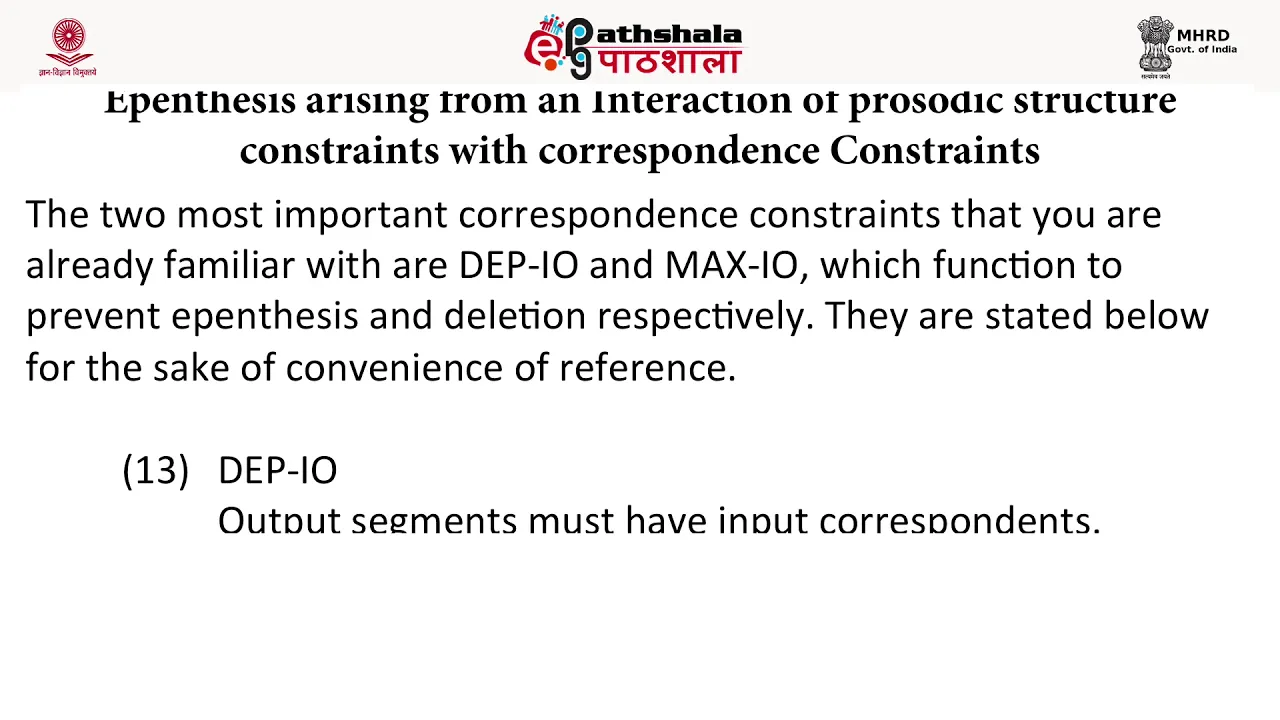
Constraint Interaction in Optimality Theory: Epenthesis & Deletion
@Vidyamitra
180 views•2018-08-20

8:59
Forensic Linguistics: How Language Solves Crimes | PBS
@pbsstoried
1M views•2024-01-25

21:32
Accent Expert Explains U.S. Regional Dialects | Part 1
@WIRED
9.3M views•2021-01-21
Related Study Plans & Knowledge Roadmaps
Structured learning paths in Linguistics
linguistics
Optimality Theory: Tableaux & Constraints
01Phonological Basics: Sounds, Syllables & Rules
02Foundations of Optimality Theory: GEN, CON, and EVAL
03The Constraint Inventory: Markedness vs. Faithfulness
+ 2 more learning modules
15h5 modules
Explore Roadmap
linguistics
Morphosyntactic Alignment: S, A & P Systems
01Foundations of Syntax: Transitivity and Arguments
02The Linguistic Variables: Mapping S, A, and P
03Nominative-Accusative Alignment
+ 3 more learning modules
12h6 modules
Explore Roadmap
linguistics
Analyzing Sign Language: Phonology & Syntax
01Foundations of Sign Language Linguistics
02Phonology: The Five Parameters of a Sign
03Morphology: Word Formation and Classifiers
+ 2 more learning modules
14h5 modules
Explore Roadmap
linguistics
Pragmatics: Speech Acts, Grice & Politeness
01Introduction to Pragmatics: Meaning in Context
02Grice’s Cooperative Principle & Implicature
03Speech Act Theory
+ 2 more learning modules
14h5 modules
Explore Roadmap