Pragmatics: Speech Acts, Grice & Politeness
Learning Goal: Analyze conversational interaction by applying Grice’s Cooperative Principle, Speech Act Theory, and Brown and Levinson's Politeness Theory to map how speakers negotiate non-literal meaning, directness, and social face in cooperative and non-cooperative dialogue.
- Prerequisites: None (Linguistic foundations are introduced in Module 1).
- Estimated Total Study Time: 14 hours.
Module 1: Introduction to Pragmatics: Meaning in Context
Understand the foundational difference between literal semantic meaning and contextual pragmatic meaning in human communication. This module introduces the core definition of pragmatics as the study of speaker meaning and explores how the exact same words change meaning when deployed in different social environments.

Why this video
This video is essential for establishing the baseline division in linguistic science between semantics and pragmatics. It systematically illustrates that while semantics is concerned with the abstract, truth-conditional, and dictionary-level meaning of expressions in isolation, pragmatics concerns how real-world contexts, physical settings, and speaker intentions alter how those expressions are understood.
Knowledge Checkpoint
- Explain the core difference between sentence meaning (semantics) and utterance meaning (pragmatics).
- Identify how social and physical environments impact word interpretation.
- Distinguish truth-conditional meanings from context-dependent inferences.
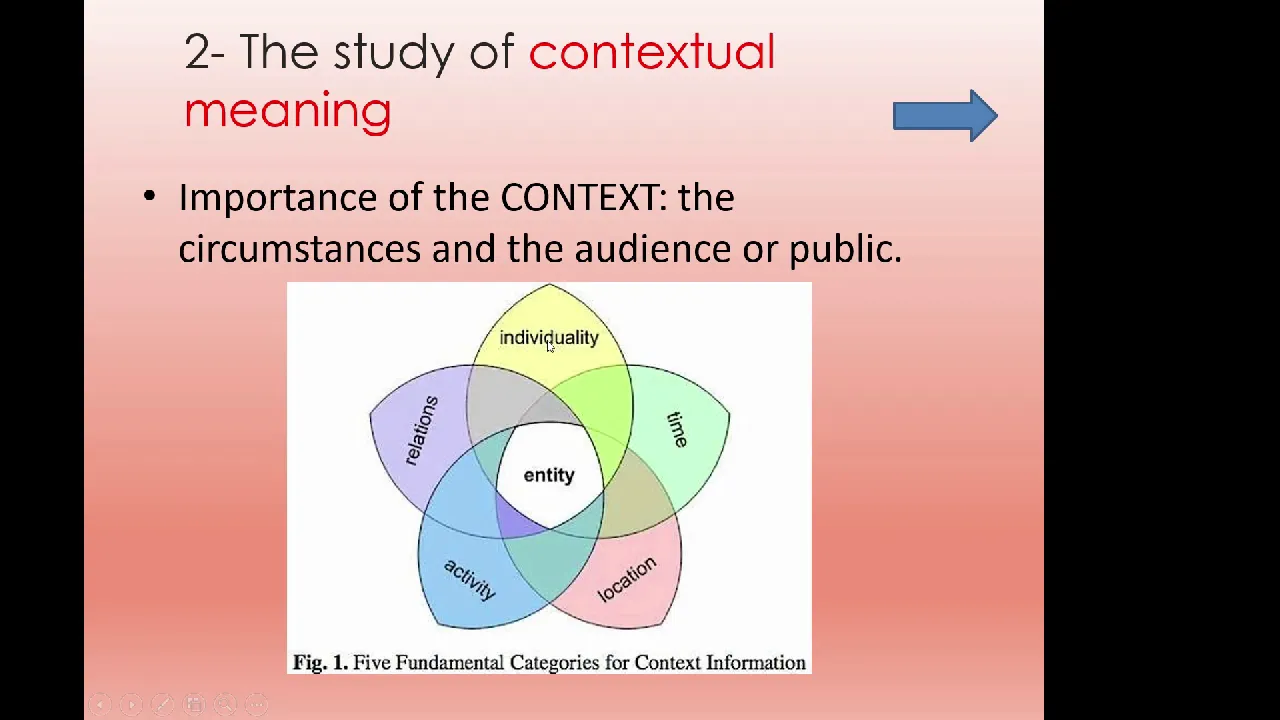
Why this video
This video deepens your understanding of how meaning is dynamically co-constructed between speaker and listener. It focuses on the elements of context (physical, epistemic, linguistic, and social) and introduces how deictic expressions, reference, and inference establish a shared cognitive environment between conversational agents.
Knowledge Checkpoint
- Define what a "speaker's meaning" is compared to the literal dictionary definition of the words used.
- List the four major types of context (physical, social, epistemic, linguistic) and provide an example of each.
- Define reference and inference as cooperative acts between a speaker and listener.

Why this video
This video contextualizes pragmatics within the broader framework of the cognitive and social sciences of linguistics. By watching this video, you will understand how pragmatics interfaces with syntax, semantics, and sociolinguistics to form a comprehensive model of human communication.
Knowledge Checkpoint
- Situate pragmatics within the traditional levels of linguistic analysis (phonology, syntax, semantics).
- Describe how social context and non-literal structures, such as metaphors, are evaluated using pragmatic rules.
- Recognize how linguistic subfields cooperate to map human communicative competence.
Module 2: Grice’s Cooperative Principle & Implicature
Master how speakers navigate the four conversational maxims (Quantity, Quality, Relation, Manner) and generate non-literal meaning (implicature) by flouting them under the assumption of mutual cooperation.

Why this video
Tom Scott provides a clear, high-level, and highly engaging introduction to Paul Grice's Cooperative Principle. This video demonstrates why conversational breakdowns are rare: humans inherently operate under the assumption that their partners are trying to be cooperative, allowing us to read between the lines when maxims are violated.
Knowledge Checkpoint
- List and define Grice's four conversational maxims: Quantity, Quality, Relation, and Manner.
- Explain how a listener infers extra meaning when a speaker appears to violate a maxim on the surface.
- Define the term "cooperative principle" in your own words.
Why this video
This video offers an academically rigorous and detailed breakdown of Gricean Pragmatics. It specifically distinguishes between different types of maxim violations, notably the difference between violating a maxim (to deceive or fail uncooperatively) and flouting a maxim (flagrantly breaking it to force the listener to generate a conversational implicature).
Knowledge Checkpoint
- Differentiate between "violating" a maxim (e.g., lying) and "flouting" a maxim (e.g., sarcasm).
- Define "conversational implicature" and explain how it differs from literal entailment.
- Analyze an utterance to show which specific maxim is being flouted to produce a non-literal meaning.
Why this video
This lecture connects Grice's theoretical frameworks directly to the psychological processes of everyday communication. It walks through complex real-life dialogues, explaining how speakers leverage indirectness to achieve social safety, irony, humor, and strategic ambiguity without breaking the unspoken covenant of cooperation.
Knowledge Checkpoint
- Explain how sarcasm and irony are constructed using Grice's Cooperative Principle.
- Describe how listeners use the assumption of cooperation to decode confusing or apparently irrelevant statements.
- Trace the step-by-step cognitive path a listener takes from identifying a flouted maxim to arriving at the implied meaning.
Module 3: Speech Act Theory
Learn how we perform physical actions through utterances, analyzing locutionary, illocutionary, and perlocutionary forces alongside the mechanics of direct and indirect speech acts.

Why this video
This video outlines the intellectual history and fundamental mechanics of Speech Act Theory, pioneered by John Austin and refined by John Searle. It details how language does not merely describe the world but actively changes reality and forces actions.
Knowledge Checkpoint
- State the core thesis of John Austin's "How to Do Things with Words."
- Define and distinguish the three levels of a speech act: locutionary (the saying), illocutionary (the force/intent), and perlocutionary (the effect).
- Identify the conditions (felicity conditions) required for a speech act to successfully execute an action.
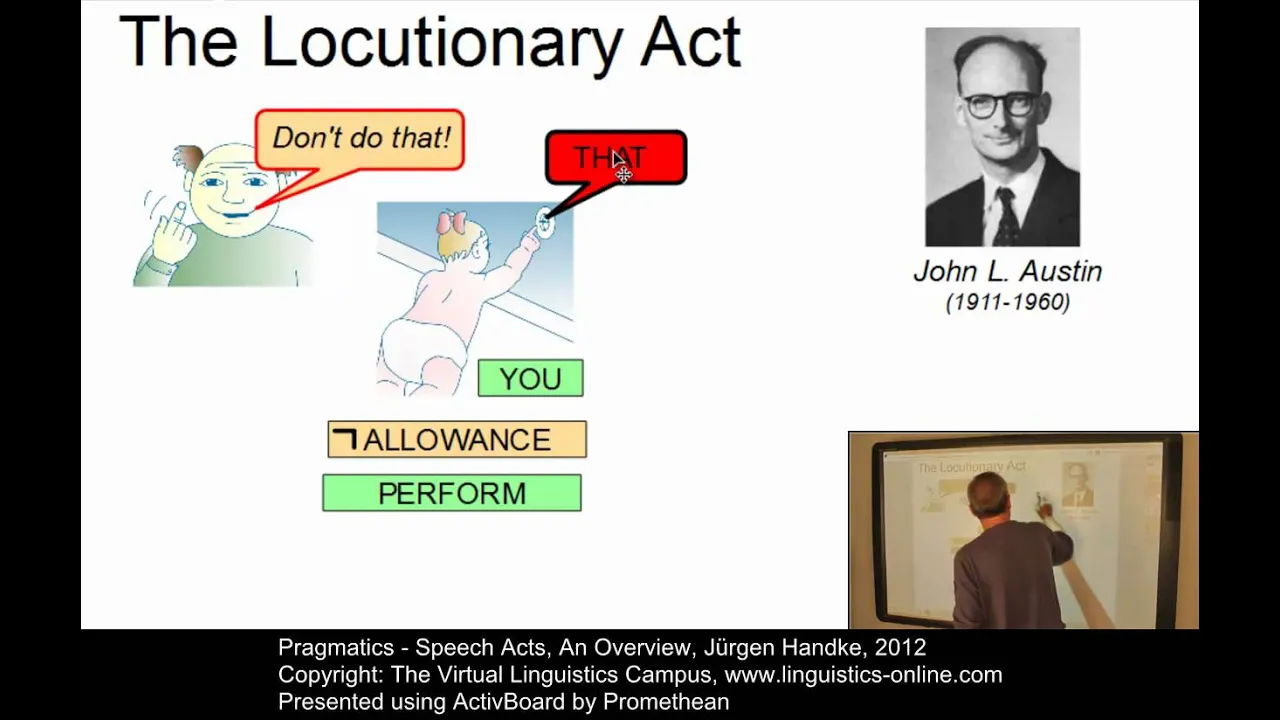
Why this video
This academic lecture provides a structured, formal overview of the distinction between sentence meaning and utterance meaning through the lens of performative verbs. It is highly valuable for its clear categorization of performative versus constative utterances and its deep dive into Searle's speech act taxonomy.
Knowledge Checkpoint
- Explain the difference between constative utterances (which describe or report) and performative utterances (which perform acts).
- Classify a given speech act into one of Searle's major categories: Representatives, Directives, Commissives, Expressives, or Declarations.
- Identify performative verbs within a discourse and explain how they signal the illocutionary force of an utterance.
Why this video
This video bridges the gap between pure theory and practical discourse analysis. It focuses heavily on the mechanics of indirect speech acts—where a speaker uses one structural form (e.g., a question: "Can you reach the salt?") to perform a different pragmatic function (e.g., a request to pass the salt).
Knowledge Checkpoint
- Contrast a direct speech act (structural-functional alignment) with an indirect speech act (structural-functional mismatch).
- Explain why speakers use indirect speech acts instead of direct, explicit commands in polite society.
- Analyze a sample transcript to map the target locutions to their true illocutionary forces.
Module 4: Politeness Theory and Social Face
Explore how speakers manage interpersonal relationships by protecting or threatening "positive" and "negative" social face using the specific mitigation strategies proposed by Brown and Levinson.
Why this video
This detailed video acts as an exceptional deep-dive into Penelope Brown and Stephen Levinson's four fundamental politeness strategies. It explains the constant structural tension in human communication between being highly efficient (going bald on-record) and preserving the social comfort of our conversational partners.
Knowledge Checkpoint
- Define positive face (the desire to be liked/approved of) and negative face (the desire to be autonomous/unimpeded).
- Identify and explain Brown and Levinson's four politeness strategies: Bald On-Record, Positive Politeness, Negative Politeness, and Off-Record (Indirect).
- Give examples of linguistic markers used to signal positive politeness (e.g., compliments, inclusive language) and negative politeness (e.g., hedging, apologizing).

Why this video
This video focuses explicitly on "Face-Threatening Acts" (FTAs). It systematically categorizes which communicative acts inherently threaten a hearer's positive face (e.g., insults, disagreements) or negative face (e.g., orders, requests), and maps out how speakers choose specific linguistic strategies to save face.
Knowledge Checkpoint
- Define a "Face-Threatening Act" (FTA) and explain how it affects social equilibrium.
- Categorize common speech acts (like inviting, ordering, criticizing, or complaining) by which aspect of face they threaten.
- Evaluate how relative power, social distance, and the absolute ranking of an imposition influence the level of politeness used.

Why this video
This video applies Brown and Levinson's Politeness Theory to real-world, cross-cultural comparative situations. By contrasting British and American apology and politeness norms, it shows how face-saving strategies are not uniform but are shaped by cultural schemas and expectations of social distance.
Knowledge Checkpoint
- Describe how different cultures interpret positive and negative face threats in public interactions.
- Explain how "hedging" and "apologetic padding" function as negative politeness tools to preserve the interlocutor's autonomy.
- Assess how cultural variations in politeness strategies can lead to cross-cultural misunderstandings.
Module 5: Applied Pragmatics: Discourse Analysis and Strategic Dialogue
Synthesize Grice's Maxims, Speech Act Theory, and Politeness/Face Theory to map cooperative and uncooperative exchanges, political evasion, strategic manipulation, and conversational breakdown.
Academic Synthesis & Hostile Pragmatics Coverage Gap Please note: While the curated video pool provides exceptional examples of real-world discourse analysis, political evasion, and stylistic structures, there is a lack of high-view, structured academic YouTube tutorials that directly synthesize Grice, Speech Acts, and Politeness Theory into a unified, step-by-step framework in a single clip.
To fill this pedagogical gap, we highly recommend searching academic libraries or independent search engines for the following queries:
"Applying Speech Acts and Grice's Maxims to dialogue analysis""Pragmatics of uncooperative and hostile discourse""Pragmatic analysis of political evasion and manipulation"
Why this video
This video is a brilliant introduction to Pragmatic Stylistics. It teaches you how to utilize tools from Conversation Analysis (including turn-taking, transition relevance places, and power dynamics) alongside Grice's Maxims and presupposition to analyze interactions in a systematic, objective manner.
Knowledge Checkpoint
- Explain how turn-taking patterns and conversational control reflect underlying social power dynamics.
- Analyze how literary and real-world characters manipulate Gricean maxims strategically to achieve personal goals.
- Define "presupposition" and describe how it limits the options of a conversational partner.
Why this video
To conduct a real-world pragmatic synthesis, you need a methodology to transcribe and segment speech. This video provides a structured guide to Conversation Analysis (CA), detailing how naturalistic recordings are evaluated to observe the structural patterns of human talk-in-interaction.
Knowledge Checkpoint
- Describe the systematic, empirical goals of Conversation Analysis.
- Identify adjacency pairs (e.g., question-answer, offer-acceptance) and explain how they construct dialogue sequences.
- Define "preferred" versus "dispreferred" responses in conversational structures.
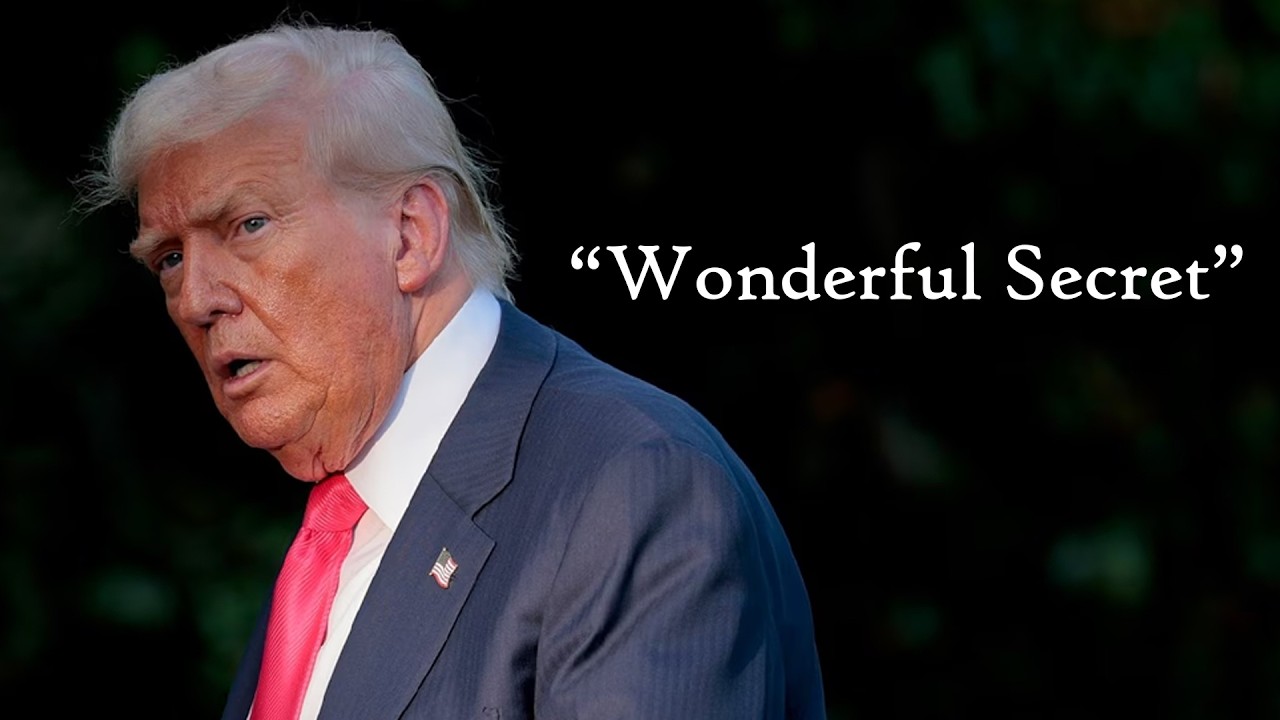
Why this video
This short, sharp clip illustrates how political figures use strategic evasion. By analyzing the dialogue pragmatically, you can see how public figures deliberately violate the maxims of Quantity and Relation ("taking things on notice" or using repetitive, circular phrasing) to avoid cooperative answers without appearing explicitly hostile.
Knowledge Checkpoint
- Identify how political figures exploit strategic ambiguity to avoid making truth-conditional claims.
- Map out which Gricean maxims are violated when an public figure uses evasion.
- Connect political evasion to negative face-saving strategies (avoiding committing to a future course of action).
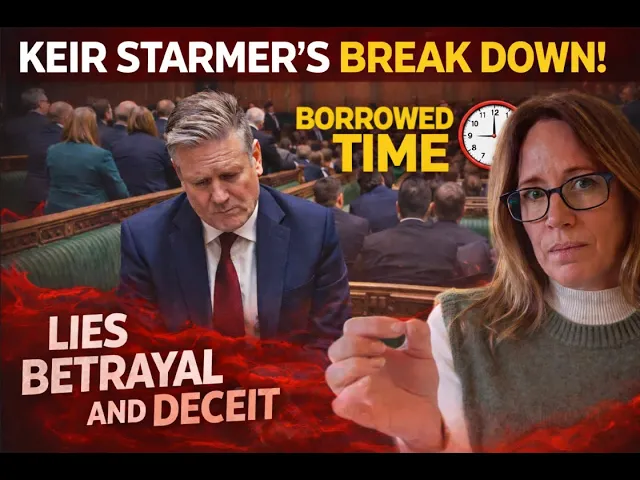
Why this video
This political interaction functions as a perfect laboratory for hostile, non-cooperative dialogue analysis. It shows how politicians hide behind procedural, legalistic, or institutionalized language to create a "smoke screen," completely ignoring the illocutionary force of direct questions from opponents.
Knowledge Checkpoint
- Define "smokescreen language" or procedural evasion in pragmatic terms.
- Analyze how a speaker can physically remain in a conversation while functionally opting out of the Cooperative Principle.
- Explain how institutional settings (like parliaments or courts) alter the standard expectations of cooperative turn-taking and conversational politeness.
Course Map
This flowchart maps the logical dependency and progression of concepts across the five modules, showing how introductory foundations build toward highly complex discourse analysis.
Key People Index
| Scholar / Researcher | Core Theory / Conceptual Contribution | Historical Context & Pragmatic Value |
|---|---|---|
| Paul Grice | Cooperative Principle & Conversational Maxims (Quantity, Quality, Relation, Manner) | Philosopher of language whose work in the 1960s-70s shifted linguistics from semantic literalism to cognitive, inferential models of meaning. |
| John L. Austin | Speech Act Theory (Locutionary, Illocutionary, Perlocutionary forces; Performatives) | Oxford philosopher who proved that utterances do not merely describe states of affairs but are actions in themselves ("How to Do Things with Words", 1962). |
| John Searle | Taxonomy of Speech Acts & Felicity Conditions | American philosopher who systematized Austin's work into five clean categories (Representatives, Directives, Commissives, Expressives, Declarations). |
| Penelope Brown & Stephen Levinson | Politeness Theory & Positive/Negative Face | Sociolinguists who developed the definitive framework (1978/1987) mapping how politeness serves as a universal engine to mitigate face-threatening acts. |
Final Self-Assessment
Test your mastery of the entire curriculum by answering or executing these tasks:
- Distinguish Semantics and Pragmatics: Can you explain why the statement "It's cold in here" has a semantic meaning regarding temperature, but a pragmatic meaning equivalent to a request to close a window?
- Identify the Four Maxims: Can you define Grice's maxims of Quantity, Quality, Relation, and Manner from memory?
- Analyze a Flout: Given a dialogue where Person A asks "Do you like my new haircut?" and Person B responds "It's very unique!", can you identify which maxim is flouted and what conversational implicature is generated?
- Classify Speech Act Forces: Can you break down a wedding officiant saying "I now pronounce you husband and wife" into its locutionary, illocutionary, and perlocutionary components?
- Categorize Searle's Taxonomy: Can you correctly classify "I promise to pay you back tomorrow" as a commissive and "I state that the Earth is round" as a representative?
- Define positive and negative face: Can you explain how a positive face threat (e.g., criticizing someone's work) differs fundamentally from a negative face threat (e.g., demanding they complete a task immediately)?
- Diagnose Politeness Strategies: If a speaker says, "I'm terribly sorry to bother you, but would you mind if I borrowed your pen for just a second?", can you prove why this is a negative politeness strategy using Brown and Levinson's framework?
- Evaluate Political Evasion: Can you watch a political debate and analyze how a candidate uses "smokescreen" procedural language to flout the Maxim of Relation (evading the question) while preserving negative face (avoiding accountability)?
- Transcribe and Segment Dialogue: Can you use Conversation Analysis tools to map out how turn-taking control, pauses, and adjacency pairs reveal which speaker holds social power in a hostile interaction?