











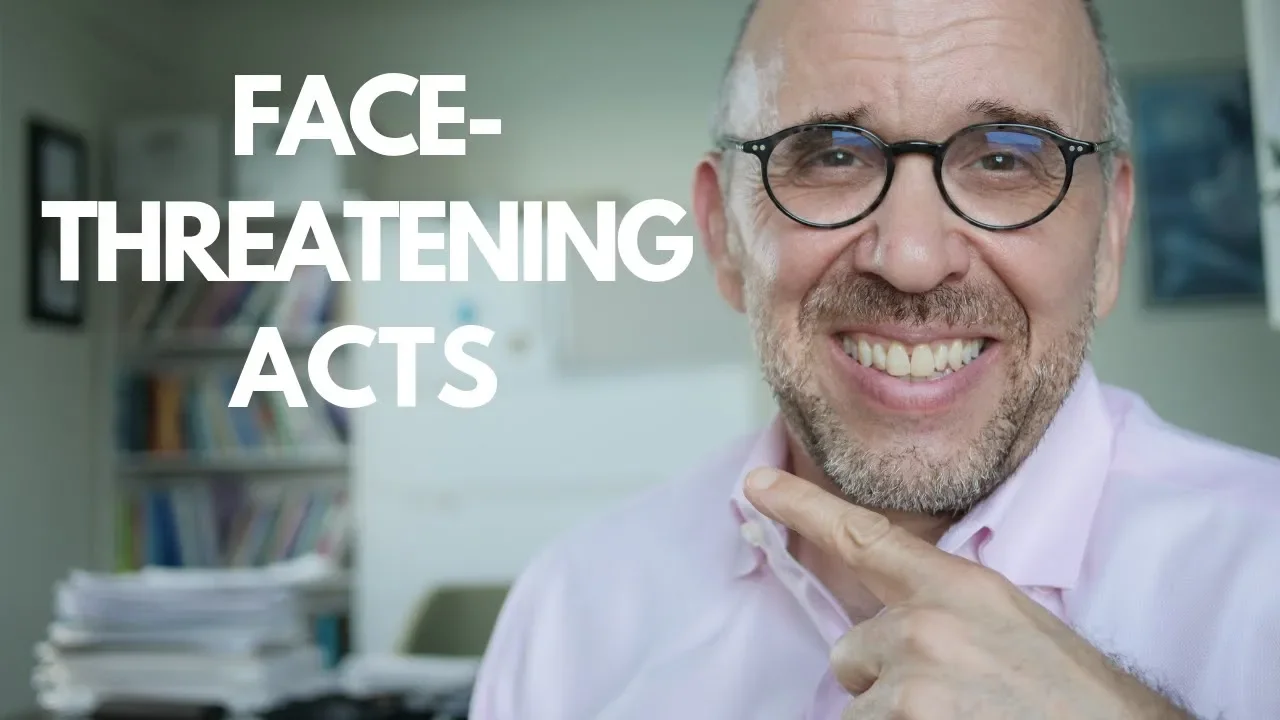





Brown and Levinson's Face Theory explains how speakers navigate social interactions by protecting others' 'face'—the desire to be liked (positive face) and to maintain independence (negative face). A face-threatening act occurs when speech threatens either desire, causing embarrassment or offense, while face-saving acts use strategies like giving reasons, using interrogatives, or employing modal verbs to soften demands and preserve the listener's dignity. Understanding this theory helps analyze how language choices affect social relationships and power dynamics in communication.
Face Theory Explained: Positive & Negative Face (A-Level English Language)
Added:An understanding of basic Pragmatics, specifically how context, speaker intention, and social relationships influence the meaning of language.
Familiarity with H.P. Grice's Cooperative Principle and the Conversational Maxims, as politeness strategies often explain why speakers flout these maxims.
A foundational grasp of Sociolinguistics, particularly how power dynamics and social distance shape communication.
An awareness of Erving Goffman's original sociological concept of 'face' as an individual's self-presentation and public image.
Application of Brown and Levinson's four main politeness strategies (bald on-record, positive politeness, negative politeness, and off-record/indirect) to spoken and written texts.
Evaluation of the three sociological variables that determine the weight of a Face-Threatening Act: Power (P), Distance (D), and Rank of imposition (R).
Exploration of Impoliteness Theory (such as Jonathan Culpeper's framework) to analyze hostile communication, conflict, and intentional face-attacks.
Critical analysis of the limitations of Face Theory, including its Western/individualistic bias and how 'face' is constructed differently in collectivist cultures.
24.8K views580likes10:56Original Release: 2021-04-18
hi everyone and welcome to this video which will go over brown and leveson's face theory which is a really useful theory to be aware of and can be applied to lots of aspects of english language so today we will cover what are positive and negative face what is a face threatening act examples of faith threatening acts and faith saving acts and how would you write about face theory in a nutshell then positive face is the desire to be liked and appreciated and negative face is the desire to be independent and not be imposed upon and a face threatening act is when something threatens our positive or our negative face don't worry right now if you're thinking you still don't quite know what that looks like in terms of speaking and writing but the key thing to remember and the statements i always come back to when i need reminding of the difference between positive and negative face is that if positive face is threatened we might feel ashamed or embarrassed and if negative faces threatened we might feel offended or imposed upon and i would actually recommend writing these statements down somewhere maybe with one or two of the examples we're going to look at next to them just so that you have a reference point to come back to so starting with positive face then which as we've said is the desire to be liked and appreciated and to feel part of a group all the statements below which for now we'll imagine our spoken language rather than written are examples of where you might see someone's positive face being threatened perhaps because they might embarrass the person you're talking to they might make them feel ashamed or potentially another negative emotion associated with positive face so the first one tim is having a party but he told me he is not inviting you it's quite clearly a face threatening act as it is purposely excluding someone from a group going against that want of being liked and included perhaps with the intention to embarrass them for their perceived lack of popularity the second example we have we have two speakers here we have nick saying maggie's a bit weird isn't she and dan then saying no i think she's nice we'll look at how to write about this one shortly but again this response is most likely going to make nick feel either embarrassed or ashamed of what he has said or both of these things as dan refuses to agree with his comment our next example i don't think your work is good enough this again is a potential face threatening act as it goes against that feeling of wanting to be appreciated whether it's a piece of work that has taken a lot of time and so you feel upset that it's not good enough or if it's something the listener hasn't spent time on so they may feel ashamed or embarrassed and finally this last one i bet you'd never go to festivals we go to you wouldn't like it here the speaker is giving their opinion to the listener and very much excluding them from the group with the statement they are making and in this case they might get a defensive reaction from the listener and the statement could cause upset at the assumption that they are different to the group if the statement is being posed as a negative thing obviously as always context is key and we are just looking at some isolated examples here while we get used to this theory so if we now move on to think about a face saving act which is saying something to lessen any threat to someone's positive or negative face we have the same topics as previously but i've changed the speech around slightly so they move from being a face threatening act to a face saving act so the first one tim is having a party but he can only invite 20 guests so he can't invite you this now gives a reason behind the lack of invite and the perceived exclusion from the group and won't leave the listener necessarily feeling like they aren't liked or there is anything to be embarrassed about example two becomes nick saying maggie is a bit weird isn't she so the same as before dan then saying actually once you get to know her better i think you'll like her and now even though dan still isn't agreeing with nick he's giving a reason for why he might not be right and so nick is performing a face saving act by allowing dan to then change his view or comment over time the last two you'll notice have now become interrogative statements if you aren't sure what an interrogative statement is then please watch my video that goes through different sentence types so they now read did you have difficulty understanding the task and do you think you'd enjoy those types of festivals so instead of excluding someone from the group or making it feel as if their work is not appreciated it now gives the listeners more of a chance to respond and therefore stops it becoming a situation where their positive face is potentially threatened as always i'll spend a section of this video showing you how you can then take what we've gone through and apply it to your writing so here we have the face threatening act from earlier nick saying maggie is a bit weird isn't she and dan's saying no i think she's nice and what i focus on in my answer alongside face theory is the idea that gossiping about someone which is what nick is intending to do here is seen as a way of bonding with people because talking about someone else in a negative way can be seen as a taboo but also implies that you are trusting the person you're speaking to with this opinion it's something you might look at in more detail if you're going to study gendered language at some point so this is what i would say about it nick intends to engage down in into a conversation about maggie using a declarative statement and stating that he thinks she's a bit weird finishing this utterance with the tag question isn't she so to elicit a response from dan nick most likely assumes dan will agree and they will create a bond through the taboo of gossiping however dan threatens nick's positive face when he disagrees by saying no i think she's nice this face-threatening act leaves nick potentially feeling embarrassed and ashamed of what he has said about maggie due to the way dan has directly disagreed with him and we can assume the conversation between the two speakers may break down at this point so this is what i would say um it's quite a short response here but hopefully it shows you how you can talk about face theory within your writing we will now move on to focus on negative face which is the desire to be pen independent and have freedom of action and if your negative face is threatened you might feel offended or imposed upon again some examples for you to look at are face threatening acts this first one is saying my food is cold what are you going to do about it you can imagine this being said in a restaurant most likely to a waiter who is not the one that has made the food and this statement is taking away any freedom of action that the listener might have as the question demands an immediate answer making the listener feel imposed upon it also i think comes across as a little aggressive um the second one you can see you should call your grandma here's the phone do it now is similar in the fact it takes away the listeners freedom of action forcing them to do something and imposing an opinion and action on them then we have we're going for everyone later we both need it now here you can definitely imagine someone feeling perhaps a little offended by the idea that they need to go for a run maybe implying they've put on weight or are less fit than before and also it takes away their choice in the matter imposing on them once again and this final one thank you in advance for your help which is probably more likely to be a written communication rather than spoken potentially in an email it takes that independence and freedom away from someone by assuming they are going to help with whatever it is without actually asking them if they will or if they want to our final section on face saving acts then and like before i've taken the statements we've just seen and changed them from face threatening acts to face saving acts the first one now becoming my food is cold would the chef be able to redo it it's still an interrogative statement but it is now much less aggressive and implies the waiter has a choice with what they do even though what the speaker wants them to do is very clear the second example becomes you should call your grandma this week and just takes away that forceful action the previous example has where they were being handed the phone and told to do it now giving them that freedom to decide when they do it example three do you want to go for a run together later i feel like i need it is a classic face saving act where the speaker or writer is making out the listener would be doing them a favor if they came with them and that it's because the speaker needs to run rather than the listener taking away any chance for fence and also not imposing on them that they have to go on the run now the final one you may notice is actually the same as the previous example thank you in advance for your help because as i said earlier it's so important to remember how vital context is to all examples of face threatening or saving acts before we read this as a face threatening act as it's assuming someone will do what is asked even if they don't want to but here you could also read it as a face saving act as it could be adding a politeness marker at the end of an email maybe for example if a boss were to email someone on their team about their work but ended it with this it's seen as a way of appreciating them and acknowledging them with what they're doing so what i would say is treat every example you see based on the context it is in and above all use common sense to work out if it's a face threatening act a face saving act or if it's neither our final example today then is how to write about a face saving act again looking back at one of the examples we've just discussed so my food is cold would the chef be able to redo it and here's what i would say about that the speaker here attempts a face saving act when talking to a waiter about his disappointing meal he directly states that his food is cold ending with the interrogative would the chef be able to redo it the use of the softer modal verb would makes this question less confrontational than it could be and by posing this as a question rather than a direct order it leaves the listener to feel they have a choice in what they say and do next even if there is only one option which will please the speaker and therefore protects the waiter's negative face so again hopefully you can see that's quite a simple straightforward response but clearly talks about face saving acts i've also gone into a bit of detail by picking out a modal verb if you're not sure what that is then again i have a video on this that you can go and refer to as well so i hope you found today's lesson useful face theory did take me a while to get my head around so i'd recommend watching this video a few times and looking up more examples online if you're still having trouble with it please feel free to give this video a thumbs up and subscribe to my channel
Up Next
18:23
Politeness Strategies in Communication: Brown & Levinson's 4 Types Explained
@HowCommunicationWorks
32K views•2018-04-10
36:52
Constraint Interaction in Optimality Theory: Epenthesis & Deletion
@Vidyamitra
180 views•2018-08-20

8:59
Forensic Linguistics: How Language Solves Crimes | PBS
@pbsstoried
1M views•2024-01-25

21:32
Accent Expert Explains U.S. Regional Dialects | Part 1
@WIRED
9.3M views•2021-01-21
Related Study Plans & Knowledge Roadmaps
Structured learning paths in Linguistics
linguistics
Optimality Theory: Tableaux & Constraints
01Phonological Basics: Sounds, Syllables & Rules
02Foundations of Optimality Theory: GEN, CON, and EVAL
03The Constraint Inventory: Markedness vs. Faithfulness
+ 2 more learning modules
15h5 modules
Explore Roadmap
linguistics
Morphosyntactic Alignment: S, A & P Systems
01Foundations of Syntax: Transitivity and Arguments
02The Linguistic Variables: Mapping S, A, and P
03Nominative-Accusative Alignment
+ 3 more learning modules
12h6 modules
Explore Roadmap
linguistics
Analyzing Sign Language: Phonology & Syntax
01Foundations of Sign Language Linguistics
02Phonology: The Five Parameters of a Sign
03Morphology: Word Formation and Classifiers
+ 2 more learning modules
14h5 modules
Explore Roadmap
linguistics
Pragmatics: Speech Acts, Grice & Politeness
01Introduction to Pragmatics: Meaning in Context
02Grice’s Cooperative Principle & Implicature
03Speech Act Theory
+ 2 more learning modules
14h5 modules
Explore Roadmap