


![PHILOSOPHY - Language: Gricean Pragmatics [HD]](https://i.ytimg.com/vi_webp/we6uSVf4qss/maxresdefault.webp)








![PHILOSOPHY - Language: Conventional Implicature [HD]](https://i.ytimg.com/vi_webp/YD82l_bUhLc/maxresdefault.webp)






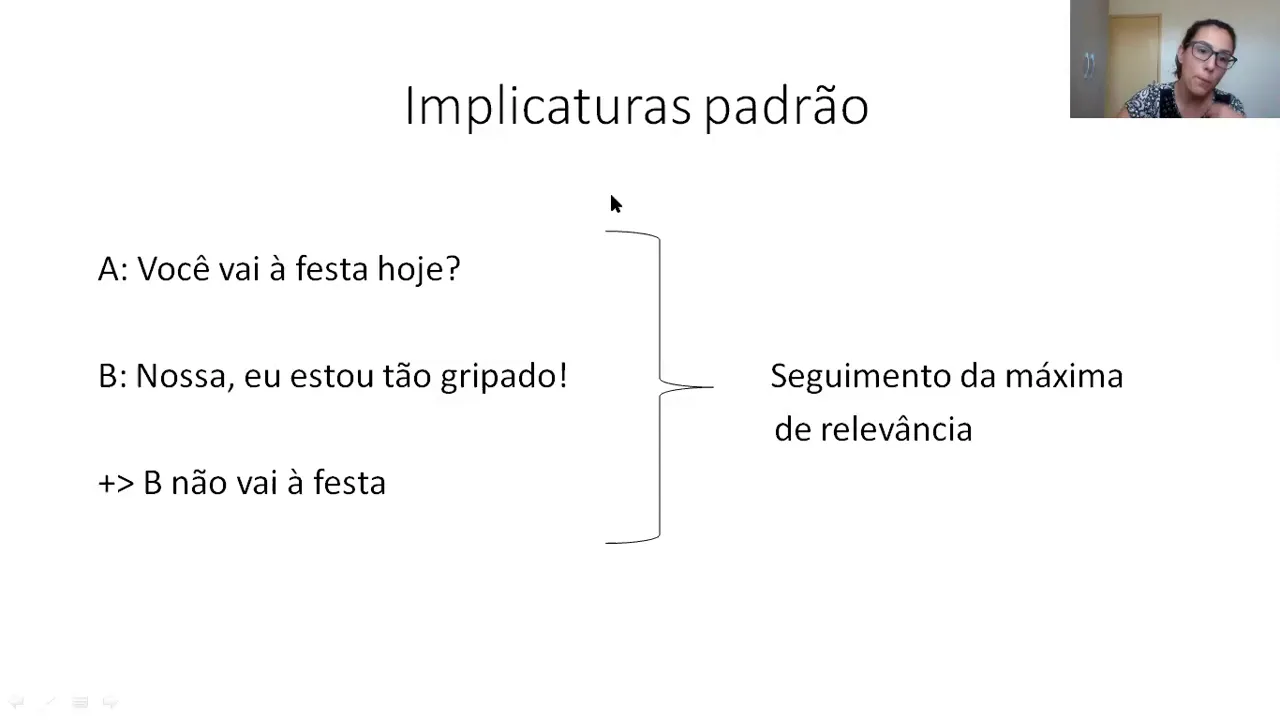

Flouting conversational maxims occurs when speakers intentionally appear to violate a maxim but expect hearers to infer the implicit meaning, as opposed to violating maxims which involves deception; when a maxim is flouted, the hearer must reconcile the apparent violation with the Cooperative Principle by determining the hidden message or implicature.
Flouting Conversational Maxims: Implicature Explained
Added:The distinction between semantics (literal meaning) and pragmatics (speaker meaning in context).
Paul Grice's Cooperative Principle and the general expectation of cooperative communication.
The four Conversational Maxims: Quantity, Quality, Relation, and Manner.
The basic definition of 'implicature' as the difference between what is literally said and what is meant.
Distinguishing 'flouting' from other ways of non-observing maxims, such as violating, opting out, or coping with a clash.
The difference between conversational implicature (context-dependent) and conventional implicature (inherent to specific words).
Alternative modern pragmatic frameworks, such as Relevance Theory or Neo-Gricean pragmatics.
Applying implicature analysis to understand complex linguistic phenomena like irony, sarcasm, metaphor, and polite evasion.
13K views176likes6:59Original Release: 2013-01-29
in previous Clips I've introduced Grace's conversational maxims and I've discussed how these maxims can be observed or violated in this presentation I'm going to discuss flouting maxims which is really where the fun begins cutting defines flouting maxims for us when speakers appear not to follow the maxims but expect hearers to appreciate the meaning implied we say that they are flouting the maxims the speakers assume the speaker assumes that the hearer knows that their words should not be taken at face value and that they can infer the implicit meaning so this isn't quite the same as uh violating a maxim when your buddy violates a maxim he intends to be deceptive in that he doesn't intend for you to recognize that a maxim has been violated so when you ask what did you do last night and he says I stayed in even though he went out he's lying and violating the maximum of quality now on the other hand if he says jokingly you know what a shy well- behaved guy I am I just stayed home and took care of my sick mother and you know he's not shy or well- behaved and that his mother is in excellent health and he knows that you know this then you know he's flouting a maxim he's not following the maxim of quality in such a way that produces he's not following the maximum of quality and he's not following it produces an implicature he's not telling you the truth but he's doing it in such a way that tells you that he's saying something else now it's your job to figure out what the implicatum that he's producing is now whenever a maxim is flouted the heer is faced with a minor problem how can his saying what he did say be Rec reconciled with the supposition that he OBS is observing the overall Cooperative principle if You' forgotten what the Cooperative principle is review the first clip in this series but in brief it's the belief that people engaged in a conversation will be honest informative relevant and clear so when someone doesn't appear on the surface to be honest informative relevant and clear and yet you believe they're still operating in good faith and trying to communicate you can ask yourself what are they really trying to say here here or you could ask yourself what is the implicatum of this implicature but I doubt you'd really ask yourself that because nobody really talks to themselves like that right you understand the idea though when someone seems to be playing with the rules not breaking the rules you have to ask yourself what the hidden message is let's try a few I ask you how do I look and you answer your shoes are nice what are you trying to say you've created an implicature by flouting the maximum of quantity that is you're not giving me the information that I want so what's the implicatum my shoes are nice but the rest of me looks like I grabbed my clothes from the laundry hamper is that it it's not very nice of you to say it might be true but not very nice can you shut that door mikang Yobo Yobo can you shut that door so I don't hear the beeping and the beep beep with the machine yeah I know okay I'm going to start again okay in the first one we pretty much know that you don't love being woken up at 4:00 a.m. by the fire alarm so why are you lying okay well maybe lying is a bit harsh why are you flouting the maximum of quality because you're being sarcastic that's why in the next one you say to someone you're nasty mean and your roommate says there's somebody at the door and you reply I'm in the bath if your roommate answers so what does being in the bath have to do with being at the door or someone being at the door then get a new roommate because this one is too stupid for words best get a roommate that understands when you're flouting the maximum of relation and saying something that only appears to be unrelated but is obviously relevant if he or she would just spend a little bit of time to connect the dots could you take the dog for w k now why would you just why wouldn't you just uh why would you spell dog and walk spelling it out takes more time so you aren't being brief so you're flouting the maximum of manner but you'd be flouting the maximum of manner because your dog knows the word dog and walk and apparently being a bit slower than other dogs his age hasn't learned to spell so let's go back to the maxim that we started with in the first clip in this series Andy asks Bill how how does Chris like his new job at the bank and Bill answers oh quite well I think he gets along with his colleagues and he hasn't been to prison yet in giving you this additional bit of seemingly unrelated information that Chris hasn't been to prison yet I would suggest that bill is flouting the maxim of relation and creating an implicature with the implicatum that Chris is dishonest and steals from work as Grace explains a might reason as follow one B has apparently violated the maxim be relevant and so may be regarded as having flouted one of the maxims conjoining perspicuity yet I have no reason to suppose that he is opting out from the operation of the Cooperative principle two given the circumstances I can regard his irrelevance as only apparent if and only if I suppose him to think that c is being potentially diss that c is potentially dishonest and three B knows that I'm capable of working out step two so B implicates that c is potentially dishonest now if you asked me at this point whether making these three Clips on conversational maxims was fun and I answered yes but I'm a nerd it would be hard it wouldn't be hard for you to work out which Maxum I'm flouting to create an implicature and what the implicatum is wouldn't it I'll leave that one with you for now t for now
Up Next
17:56
Understanding Face-Threatening Acts: Navigating Social Embarrassment
@HowCommunicationWorks
93.8K views•2019-07-20
36:52
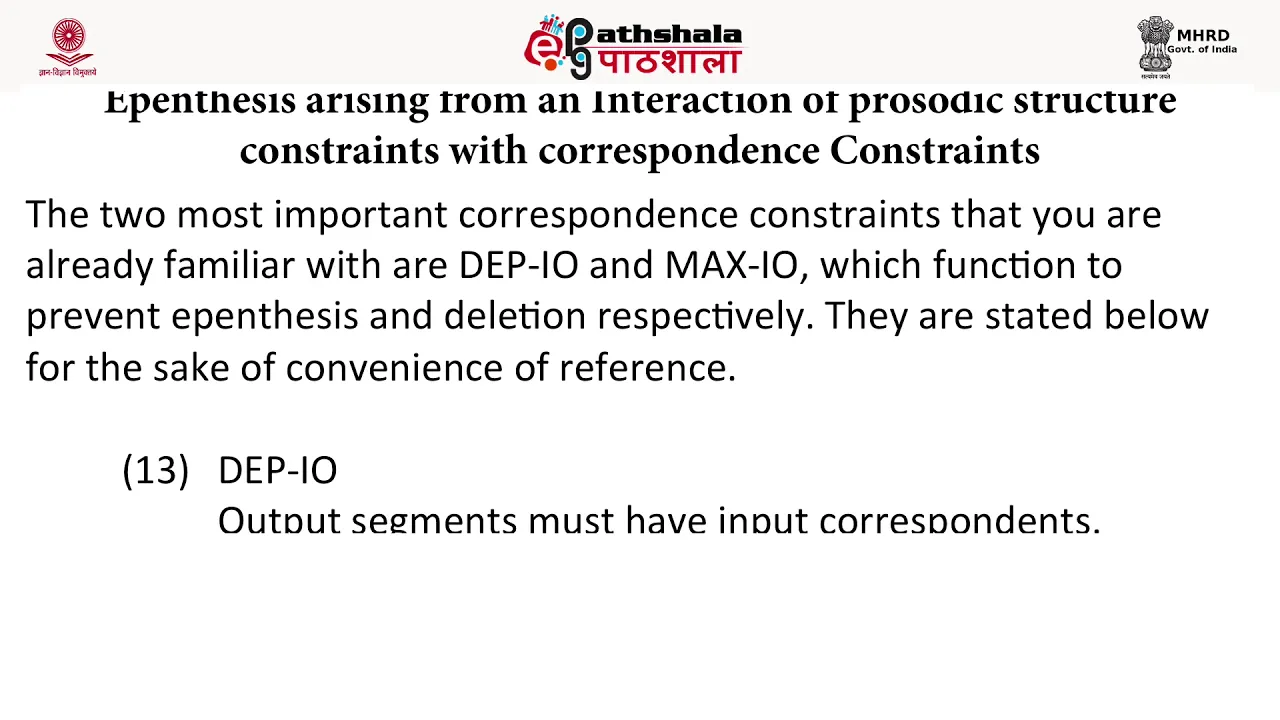
Constraint Interaction in Optimality Theory: Epenthesis & Deletion
@Vidyamitra
180 views•2018-08-20

8:59
Forensic Linguistics: How Language Solves Crimes | PBS
@pbsstoried
1M views•2024-01-25

21:32
Accent Expert Explains U.S. Regional Dialects | Part 1
@WIRED
9.3M views•2021-01-21
Related Study Plans & Knowledge Roadmaps
Structured learning paths in Linguistics
linguistics
Optimality Theory: Tableaux & Constraints
01Phonological Basics: Sounds, Syllables & Rules
02Foundations of Optimality Theory: GEN, CON, and EVAL
03The Constraint Inventory: Markedness vs. Faithfulness
+ 2 more learning modules
15h5 modules
Explore Roadmap
linguistics
Morphosyntactic Alignment: S, A & P Systems
01Foundations of Syntax: Transitivity and Arguments
02The Linguistic Variables: Mapping S, A, and P
03Nominative-Accusative Alignment
+ 3 more learning modules
12h6 modules
Explore Roadmap
linguistics
Analyzing Sign Language: Phonology & Syntax
01Foundations of Sign Language Linguistics
02Phonology: The Five Parameters of a Sign
03Morphology: Word Formation and Classifiers
+ 2 more learning modules
14h5 modules
Explore Roadmap
linguistics
Pragmatics: Speech Acts, Grice & Politeness
01Introduction to Pragmatics: Meaning in Context
02Grice’s Cooperative Principle & Implicature
03Speech Act Theory
+ 2 more learning modules
14h5 modules
Explore Roadmap