Implicature is a pragmatic concept where an utterance conveys meaning beyond its literal proposition; Paul Grice classified implicatures into conversational (using cooperative principles) and conventional types, with conversational implicatures further divided into generalized (context-independent, like definite articles), particular (context-dependent, like indirect answers), and scalar (degree-based, like 'some' implying not 'all').
Implicature in Pragmatics: Types & Examples Explained
Added:Deep Dive
The fundamental distinction between Semantics (literal meaning) and Pragmatics (contextual meaning).

Linguistics : Phonetics, phonology, morphology, syntax, semantics, pragmatics in hindi
452.5K
Language comprises three components: sound, form, and meaning. Semantics studies literal meaning—the dictionary definition that emerges directly from language structure. Pragmatics studies contextual meaning, which depends on situation, speaker intent, and surrounding context. The sentence 'Burger ate man' demonstrates this distinction: syntactically correct but semantically problematic (a burger cannot eat a human), yet pragmatically acceptable as metaphorical expression about overeating.
Click to watch →

Pstet English 2026 | Pstet 2026 English Top Mcq's | Important MCQs with Solutions By Isha Mam
19.8K
Semantics deals with literal meaning of words and sentences, while pragmatics deals with meaning in context. When meaning depends on context, pragmatics is the relevant field. For example, the word 'mouse' can mean an animal or a computer device depending on context. Understanding pragmatics helps in interpreting language appropriately in different situations.
Click to watch →

Semantics and Pragmatics / Overview (Clip 1)
76.1K
Semantics is defined as the study of meaning in language, while pragmatics is defined as the study of what people mean by the language they use. Both fields concern meaning but differ in their focus: semantics examines inherent meaning within language structures, whereas pragmatics examines how context influences interpretation.
Click to watch →

Yapay Gerizeka - Olmaz Öyle Zeka - Dr. Sena Arslan & Yasin Taşdemir - B01
101.7K
Semantics deals with literal word meanings, while pragmatics examines how context influences interpretation. The distinction between extension (actual referents in the world) and intension (concepts associated with words) is fundamental to understanding meaning. Language models operate primarily on extensions—they can manipulate sets of referents but don't grasp intensions or conceptual content. Human language involves both mental representations and external references, while AI models manipulate these representations mathematically without genuine understanding. This reveals fundamental differences between human and AI cognition.
Click to watch →

مدخل عام إلى اللسانيات - الفصل الأول الجامعي S1
192.1K
Semantics analyzes the literal meaning of linguistic expressions and describes word and sentence meanings. Pragmatics studies communicative situations, including speaker, listener, and context, which give language specific meanings.
Click to watch →
Deep Dive
Paul Grice's Cooperative Principle and the four conversational maxims (Quantity, Quality, Relation, and Manner).

「大事なお知らせ」とかいう Youtuber について
115K
Linguist Paul Grice proposed that humans follow the Cooperative Principle in communication, which consists of four maxims: (1) Maxim of Quantity - provide necessary information without over or under-sharing; (2) Maxim of Quality - tell the truth and do not say what you believe to be false; (3) Maxim of Relevance - say what is relevant to the conversation; (4) Maxim of Manner - be clear, concise, and avoid ambiguity. These maxims guide effective communication, though they are often violated in everyday speech.
Click to watch →
Language Games • Eli Holderness • GOTO 2024
6.7K
Philosopher Paul Grice developed the Cooperative Principle and its four maxims for effective communication: Quantity (be informative but not overly so), Truth (only say what you believe to be true), Relevance (include only relevant information), and Clarity (avoid unnecessary obscurity). These principles describe behaviors observed in cooperative communication where parties share goals and work earnestly to communicate effectively with each other.
Click to watch →

جورج يول-الفصل الحادي عشر-تحليل الخطاب
10.9K
An underlying assumption in most conversational exchanges is that participants are cooperating with each other. This principle, described by philosopher Paul Grice, states that conversational contributions should be such as are required at the stage at which they occur by the accepted purpose or direction of the talk exchange. Grice's four maxims guide cooperative conversation: Maxim of Quantity (make contributions as informative as required), Maxim of Quality (make contributions true), Maxim of Relation (be relevant), and Maxim of Manner (be clear, brief, and orderly).
Click to watch →
Piers Debates Tucker And Realizes He's A Pro-Russian Shill...
207.6K
The video explains Grice's Cooperative Principle, which states that effective communication requires speakers to follow four maxims: Quantity (providing as much information as needed, no more), Quality (being truthful and not lying), Relation (staying relevant to the topic), and Manner (being clear, brief, and orderly). The speaker notes that in bad-faith conversations, participants deliberately break these maxims to manipulate meaning and avoid genuine understanding.
Click to watch →

4) EDİM BİLİM TÜRKÇE ÖABT DİL BİLİM SORU ÇÖZÜMÜ DEVAMI
4.8K
Paul Grice proposed that for successful communication, speakers and listeners must cooperate with each other. He established four maxims that guide effective communication: (1) Quantity Maxim - provide sufficient but not excessive information, (2) Quality Maxim - provide truthful and verified information, (3) Relation Maxim - stay on topic and maintain relevance, (4) Manner Maxim - be clear, orderly, and avoid ambiguity. These maxims establish the foundation for understanding how communication works at a pragmatic level and help speakers and listeners achieve their communicative goals.
Click to watch →
Deep Dive
The concept of 'speaker meaning' versus 'sentence meaning' in linguistic communication.

הרצאת פתיחה: מה המשמעות של ״משמעות״?
111
Linguistic meaning is a property of words and sentences that exists independently of any speaker's intention or communication, whereas speaker meaning requires intentional communication; for example, the sentence 'The number 13 is a prime number' has linguistic meaning even if no one ever utters it, but only acquires speaker meaning when someone intentionally communicates it.
Click to watch →

Life-Changing Philosophy Books (that you haven’t heard of)
60.8K
Paul Grice distinguishes between utterance meaning (the literal contents of a sentence) and speaker meaning (what the speaker intends to say). For example, saying 'it's hot in here' when windows are shut may intend to express 'open a window.' This divergence can be extreme, such as in British English where 'not bad' can mean 'I want to kiss your big beautiful brain.'
Click to watch →
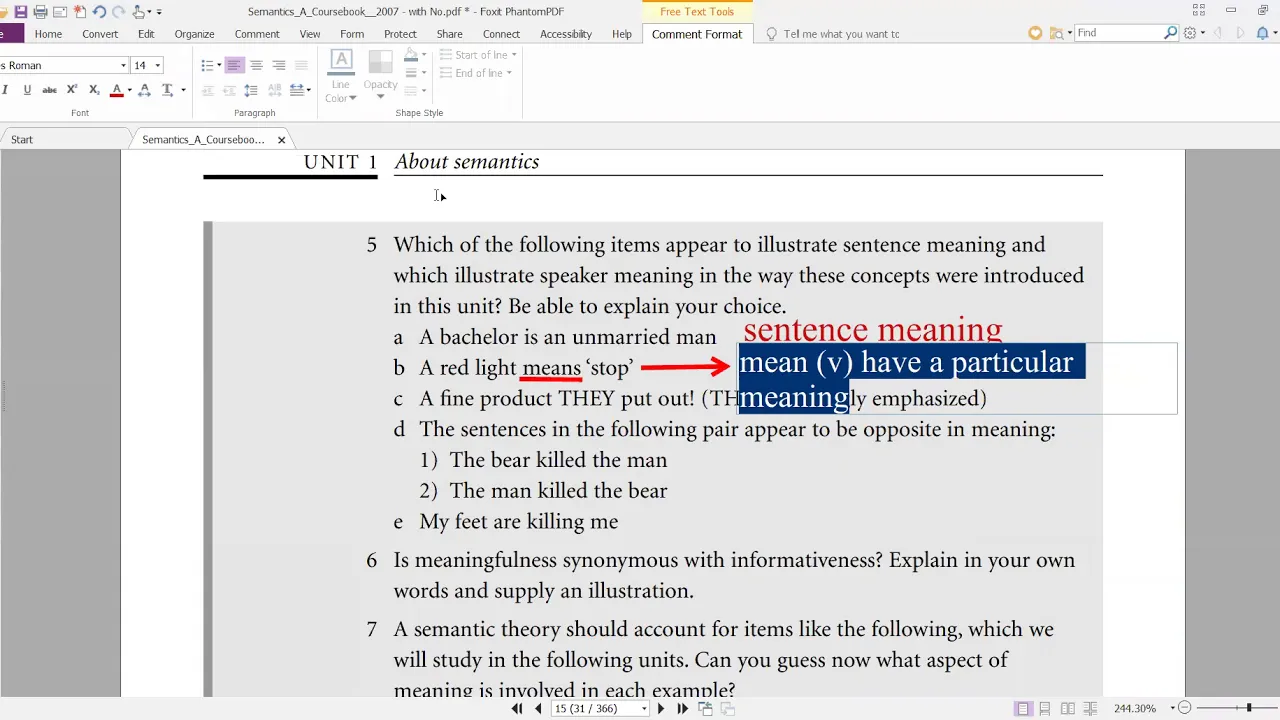
Semantics (2020-21) D01 04.12.2020 #1
1.6K
In semantics, speaker meaning refers to the intended message or purpose behind what a speaker communicates, while sentence meaning refers to the literal or conventional meaning of the words and grammatical structure. Understanding the distinction between these two types of meaning is crucial for effective communication, as speakers often convey meaning beyond the literal interpretation of their words, requiring listeners to consider context, intention, and communicative purpose to fully comprehend the intended message.
Click to watch →
Searle: Philosophy of Language, lecture 1
107.9K
This section introduces three fundamental distinctions in linguistic analysis. Syntax concerns formal structure—word arrangement and sentence composition. Semantics deals with meaning—the content conveyed by linguistic expressions. Pragmatics addresses how utterances are used in context. A crucial distinction is between sentence meaning (literal semantic content) and speaker meaning (what the speaker intends to communicate). This distinction explains phenomena like indirect speech acts (saying 'Can you pass the salt?' to request action) and sarcasm (saying 'Oh, he's very intelligent' to mean the opposite). Understanding requires recognizing that speaker meaning often exceeds sentence meaning.
Click to watch →

الاستعارات: نماذج معرفية في تشكيل المعاني الثقافية أ.د عبدالمالك بالخيري
190
This section establishes a fundamental distinction between sentence meaning (what linguistic content states) and speaker meaning (what the speaker intends to communicate). The speaker explains that sentence meaning operates through linguistic and compositional rules, while speaker meaning requires additional contextual and pragmatic elements. The lecture emphasizes that understanding communication requires distinguishing between these two levels, as the same sentence can convey different meanings depending on the speaker's intent and the communicative context.
Click to watch →
Deep Dive
Basic comprehension of how context and shared background knowledge influence the interpretation of utterances.

1 The Creation of Meaning Lecture 1 Part 1
339
Understanding utterances requires contextual assumptions - bringing all kinds of background knowledge to bear on interpretation. The degree to which interpretation is constrained depends on the form of the utterance and the context. Even unfamiliar forms can be understood if we can infer the speaker's intention. For example, Australian English uses different grammatical patterns and tense than American English, yet speakers can still understand each other by inferring intentions from context.
Click to watch →

Uncertainty in Language and Thought
145
Background knowledge about categories (typical prices, typical opinions) shapes how people interpret utterances. The same numerical utterance ('$10,000') is interpreted differently depending on whether it refers to an electric kettle, laptop, or watch. This demonstrates that interpretation depends on contextually appropriate background knowledge.
Click to watch →

ENG508_Topic098
723
Understanding context is key to interpreting speech acts. Violations of conversational maxims occur in close relationships with shared background knowledge, like spouses or family members. Context includes social, physical, and verbal elements, along with social, political, and cultural norms. Background knowledge and linguistic context collaborate to create meaning. Meaning creation is a collaborative activity involving human interaction within social, political, and cultural frameworks.
Click to watch →
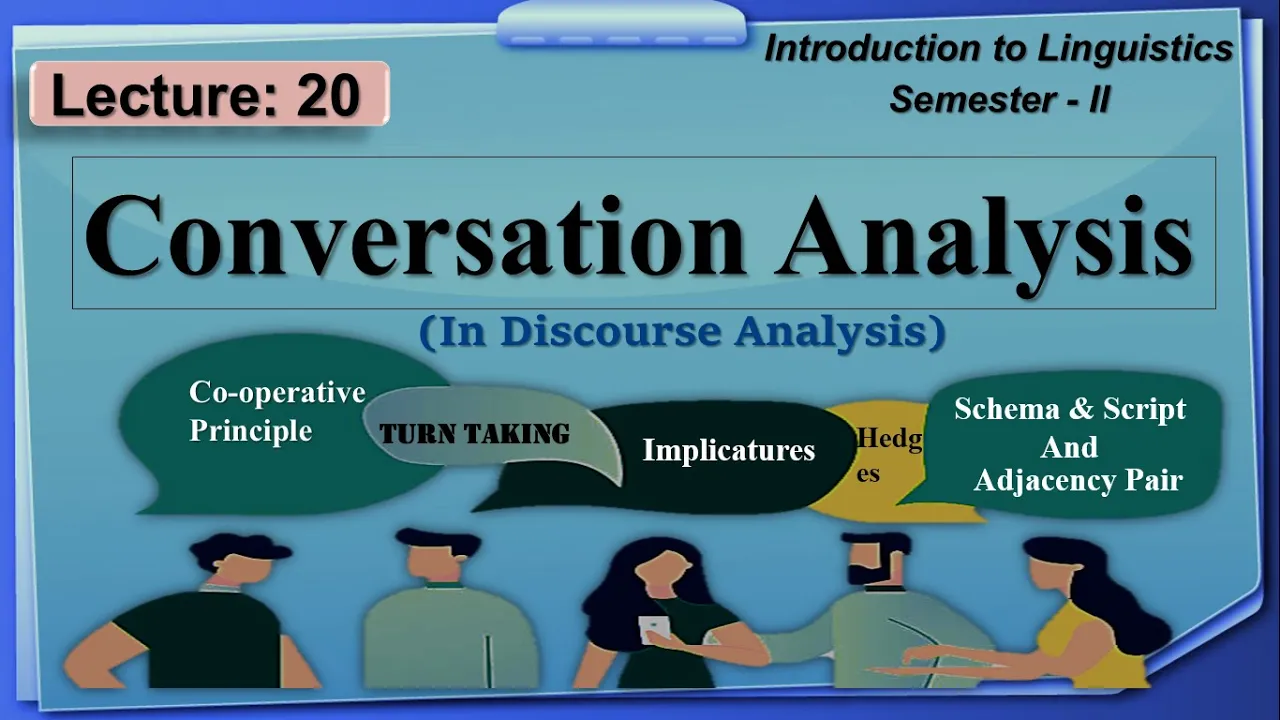
Conversation Analysis in Discourse Analysis | Lecture: 20 | Linguistics-II
6.7K
Understanding conversational implicatures requires appealing to shared background knowledge about topics like exams, studying, and partying that must be shared by conversational participants. Investigating how we use our background knowledge to arrive at interpretations of what we hear and read is a critical part of doing discourse analysis.
Click to watch →

Introduction to Pragmatics
2.1K
Listeners make inferences based on their knowledge about the speaker, the context, and their world knowledge. Without knowing the context of a conversation, multiple interpretations of an utterance are possible. For example, the exchange 'A rough b yes' could be interpreted as students in a classroom hearing about going out somewhere, or as a group discussing holidays. The correct interpretation requires knowing the conversation's context.
Click to watch →
Prerequisite Knowledge
- Concept 01The fundamental distinction between Semantics (literal meaning) and Pragmatics (contextual meaning).
- Concept 02Paul Grice's Cooperative Principle and the four conversational maxims (Quantity, Quality, Relation, and Manner).
- Concept 03The concept of 'speaker meaning' versus 'sentence meaning' in linguistic communication.
- Concept 04Basic comprehension of how context and shared background knowledge influence the interpretation of utterances.
Subsequent Learning
- Step 01The distinction between Particularized and Generalized Conversational Implicatures.
- Step 02An in-depth analysis of 'flouting' versus 'violating' maxims and how these actions strategically generate non-literal meaning.
- Step 03Neo-Gricean pragmatic frameworks, such as Laurence Horn's scalar implicature scales (Horn scales) and Stephen Levinson's three heuristics.
- Step 04Relevance Theory (Sperber & Wilson) as a major cognitive alternative to Gricean pragmatics.
- Step 05Applications of implicature in computational linguistics, natural language processing (NLP), and legal/forensic linguistics.
Implicature Basics
Conversational Types
Implicature Basics
0:00Playing Section
- 1
Defines implicature as meaning beyond literal proposition.
- 2
Divides implicature into conversational and conventional types.
Relevance Theory
While Paul Grice’s theory of implicature relies on the Cooperative Principle and a specific set of conversational maxims, Relevance Theory—developed by Dan Sperber and Deirdre Wilson—presents a major cognitive alternative. Relevance Theory argues that Grice's multi-maxim framework is theoretically redundant and psychologically implausible. Instead, it proposes that human communication is governed by a single, biologically rooted cognitive principle: the pursuit of 'optimal relevance.' According to this view, listeners automatically attempt to derive the maximum cognitive effects from an utterance with the least possible processing effort. This theory fundamentally challenges the Gricean distinction between 'what is said' (literal semantics) and 'what is implicated' (pragmatics). Relevance theorists argue that pragmatic enrichment (which they call 'explicature') directly shapes the basic truth-conditional meaning of a statement during initial processing, rather than merely acting as a secondary layer of implied meaning decoded after semantic interpretation.
Deep Dive
The distinction between Particularized and Generalized Conversational Implicatures.

CONVERSATIONAL IMPLICATURE (Almer-Siswa SMAN 1 Kota Serang di STBA Technokrat Tangerang
421
Conversational implicature divides into particular and generalized types. Particular implicatures depend on specific contexts and change meaning based on situation (e.g., 'let's go get coffee' implying 'I don't want to discuss the boss'). Generalized implicatures have consistent meanings regardless of context, including indefinite implicatures (using 'a/an' implies non-possessive) and quantifier implicatures (e.g., 'some' implies 'not all'). These types explain how we convey complex meanings through seemingly simple statements.
Click to watch →
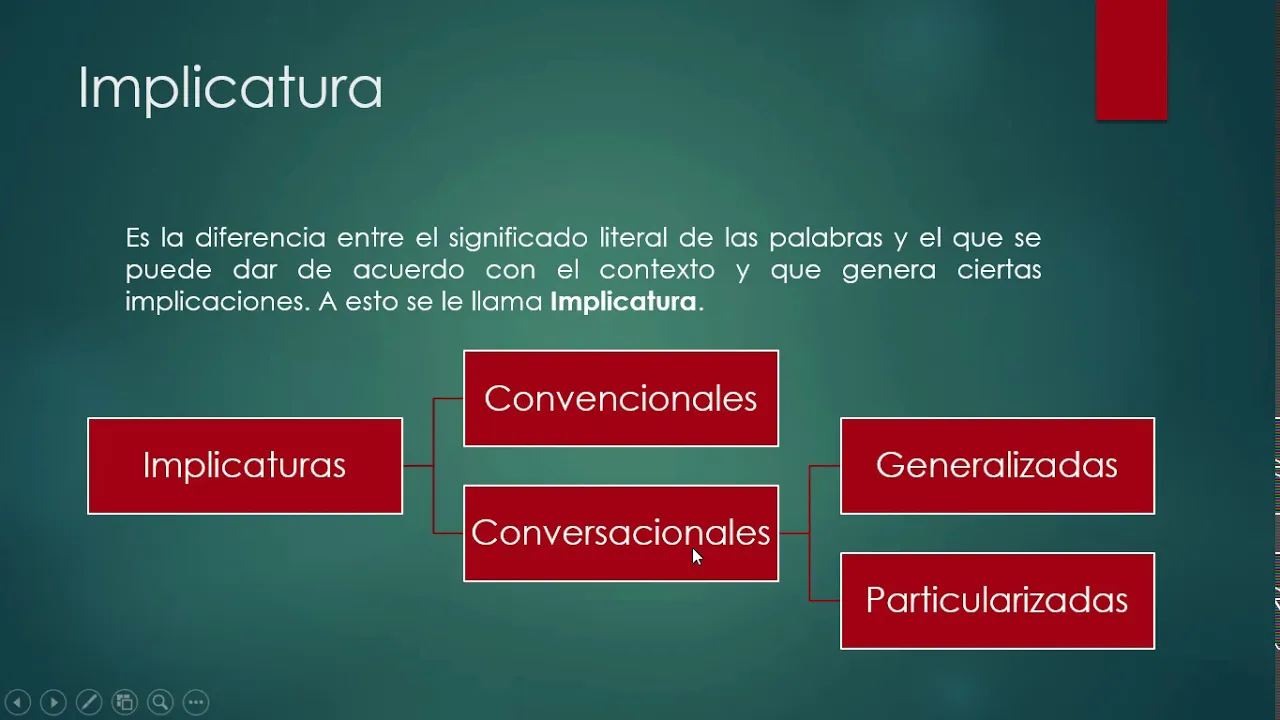
implicaturas
8K
Conversational implicature is categorized into generalized and particularized types. Generalized implicature does not depend on specific context and is understood through general principles like sarcasm or double meanings. Particularized implicature is defined by the specific context and can convey different meanings with identical words depending on circumstances. For example, 'You're a master of experiments' can be sincere praise or sarcastic criticism based on context. Understanding these distinctions helps analyze how meaning is constructed in communication beyond literal word meanings.
Click to watch →

Group 10-Conventional and Conversational Implicatures | Semantics and Pragmatics
734
In conversational implicature, the speaker communicates meaning through inference while the listener recognizes it through inference. This process is independent of assumptions about rational conversational exchange. Conversational implicatures are derived from Grice's Cooperative Principle and four maxims: Quality (truthfulness), Relevance (pertinence), Quantity (appropriate information), and Manner (clarity). Generalized conversational implicatures occur without reference to particular contextual features, being conclusions that occur by default in all contexts. Particularized conversational implicatures depend on specific contextual features and are called 'implicatures of hedgehog' because they occur in specific contexts. Examples include: 'Beberapa tamu sudah pergi' (Some guests have left) implying either that not all guests have left (generalized) or that it must be late (particularized).
Click to watch →

Let's Read! H. Paul Grice, 1975, "Logic and Conversation"
5.3K
This section examines how speakers strategically use language to communicate beyond literal meaning. Deliberate ambiguity and obscurity generate implicatures: speaking obscurely to prevent a third party from understanding thereby implicates that the content shouldn't be shared with that third party. Generalized conversational implicatures are normally carried by certain expressions regardless of context—for example, saying 'X is meeting a woman this evening' normally implicates that the person being met is not X's wife, mother, boss, or other closely connected individuals, since those could have been specified just as easily. These generalized implicatures arise because failing to specify close connections suggests the speaker doesn't have information about those specific people. The calculation of generalized implicatures requires knowing what could have been said but wasn't, and assuming the speaker is not in a position to be more specific.
Click to watch →

ENG524_Topic068
328
Two popular types of conversational implicature exist: conventional and particularized. Conventional implicatures rely on words with fixed meanings (e.g., 'but' signals contrast, 'anyway' signals returning to main topic). Particularized implicatures depend heavily on context and require understanding the relevance of statements within specific communicative goals. The shopkeeper example demonstrates how context creates particularized meaning.
Click to watch →
Deep Dive
An in-depth analysis of 'flouting' versus 'violating' maxims and how these actions strategically generate non-literal meaning.

Introduction to Linguistics: Pragmatics 2
13K
Speakers can strategically violate maxims in obvious ways to create special implicatures—a technique called flouting. When Alice asks 'Isn't Charlie the biggest jerk?' and Bob responds 'The weather is nice,' he conspicuously violates relevance, signaling they should stop discussing Charlie (who might be nearby). When describing poor singing, Alice says 'produced a series of sounds' instead of 'sang,' flouting manner to imply incompetence. When Bob replies 'Yeah, and I'm the Queen of England,' he flouts quality to express disbelief. The key distinction between entailment and implicature lies in cancellation: implicatures can be cancelled without contradiction, while entailments cannot. If Alice concludes Bob hasn't finished all homework from 'Bob finished his history homework,' Bob can cancel this by adding 'In fact, I've finished all my homework.' But if Alice concludes Bob has at least five children from 'Bob has six children,' Bob cannot cancel this entailment by saying 'In fact, I have less than five.'
Click to watch →
Understanding Grice's Cooperative Principle and Maxims of Conversation
187.3K
Grice's Cooperative Principle states that effective communication requires speakers to cooperate by following four maxims: Quality (tell the truth), Quantity (be concise), Relevance (stay on topic), and Manner (be clear and orderly); violations of these maxims can be unintentional (lying), deliberate (flouting), or strategic (opting out), and understanding these principles helps explain how we infer meaning beyond literal statements through implicatures.
Click to watch →

Pragmatics:Speech Act Theory,Gricean Maxims,Relevance Theory,Politeness Theory,Discourse#linguistics
263
Paul Grice's cooperative principle (1975) establishes that successful communication requires speakers to cooperate by contributing appropriately to the conversation's purpose. This creates mutual trust between communicators. The four maxims guide cooperation: quantity (be informative but not excessive), quality (tell truth with evidence), relation (stay relevant), and manner (be clear and orderly). When maxims appear violated, listeners infer hidden meanings through conversational implicature. Implicature divides into conventional (automatic from language, like 'but' implying contrast) and conversational (context-dependent, cancellable). Scalar implicature involves quantity maxims (e.g., 'some' implies not all). Flouting deliberately violates maxims for strategic effects, requiring listeners to infer alternative meanings.
Click to watch →
147. Grice's Maxims of Conversation | THUNK
7.4K
Philosopher Paul Grice proposed that conversation operates under a Cooperative Principle, which he broke down into four maxims—Quantity (providing the right amount of information), Quality (being truthful), Relation (staying on topic), and Manner (speaking clearly)—that guide how people communicate; when speakers deliberately flout these maxims rather than simply violating them, they create conversational implicatures, meaning that what isn't explicitly stated can still convey important information through implication.
Click to watch →

PHL2026 Grice and Conversational Implicature
8.7K
Conversational implicature is the phenomenon where speakers communicate additional meaning beyond what they literally say, identified by Paul Grice as a fundamental aspect of language use that operates through four maxims (Quantity, Quality, Relation, Manner) of cooperative communication; unlike conventional implicature which is fixed by linguistic convention, conversational implicatures are cancellable, non-detachable, reinforceable, and calculable through reasoning about how speakers are following these maxims.
Click to watch →
Deep Dive
Neo-Gricean pragmatic frameworks, such as Laurence Horn's scalar implicature scales (Horn scales) and Stephen Levinson's three heuristics.

Pragmatics: Neo-Gricean Theories of Conversational Implicature (Horn, Levinson)
1.9K
Neo-Gricean theories, developed by scholars like Laurens Horn and Stephen Levinson, provide frameworks for understanding how speakers and hearers derive meaning beyond literal utterances through principles of conversation. Horn's approach reduces Grice's four maxims to two fundamental principles—the Cue Principle (Q) covering quantity and relevance, and the Horn Principle (R) addressing informativeness and manner—that work in opposition to limit each other's effects. Scalar implicatures emerge from Horn scales, which are semantic hierarchies of related terms differing in intensity (e.g., warm/hot), where choosing a weaker term licenses the inference that stronger alternatives are false. Levinson's alternative framework introduces three principles (QED, AI, AM) with specific inference rules, emphasizing the relationship between literal meaning and contextual speaker meaning.
Click to watch →

A Brief Introduction to Neo-Gricean Pragmatics
3.6K
Neo-Gricean pragmatics, founded by Lawrence Horn, Steven Levinson, and Jay Atlas, streamlines H.P. Grice's original four maxims (quality, quantity, relation, manner) into two core principles: Q (say enough, meaning provide as much information as required) and R (don't say too much, meaning avoid unnecessary elaboration). These two principles create a tension that pushes speakers toward a middle ground where they provide just the right amount of information, enabling hearers to infer additional meaning (implicatures) beyond what was explicitly stated. Quality operates hierarchically above the other maxims, taking precedence when conflicts arise, while the manner sub-maxims are considered less useful for generating implicatures.
Click to watch →

Scalar implicature
1.3K
Scalar implicature is a pragmatic phenomenon where a speaker's choice of a weaker term on a scale (such as 'some' instead of 'all') implicitly communicates that none of the stronger alternatives on that scale apply, based on the Gricean maxim of quantity which states that speakers should be as informative as required; for example, saying 'I have some of my money in cash' suggests the speaker does not have all their money in cash, even though 'some' logically allows for 'all' to be true.
Click to watch →

P.Grundy: Optimality in Neo-Gricean Pragmatics: the Challenge for E2L Users
2.5K
Neo-Gricean pragmatics updates Grice's original theory by focusing on context-independent, optimality-oriented form-meaning pairings. Unlike post-Gricean pragmatics which emphasizes relevance and context sensitivity, neo-Gricean work centers on Grice's Maxims of Quantity and Manner. The core insight is that speakers make optimal choices between competing meanings, and hearers infer these optimal interpretations. This framework provides a systematic approach to understanding how speakers select among multiple possible meanings and how listeners decode these choices.
Click to watch →
Fundamentos de Pragmática - AULA 4
1.2K
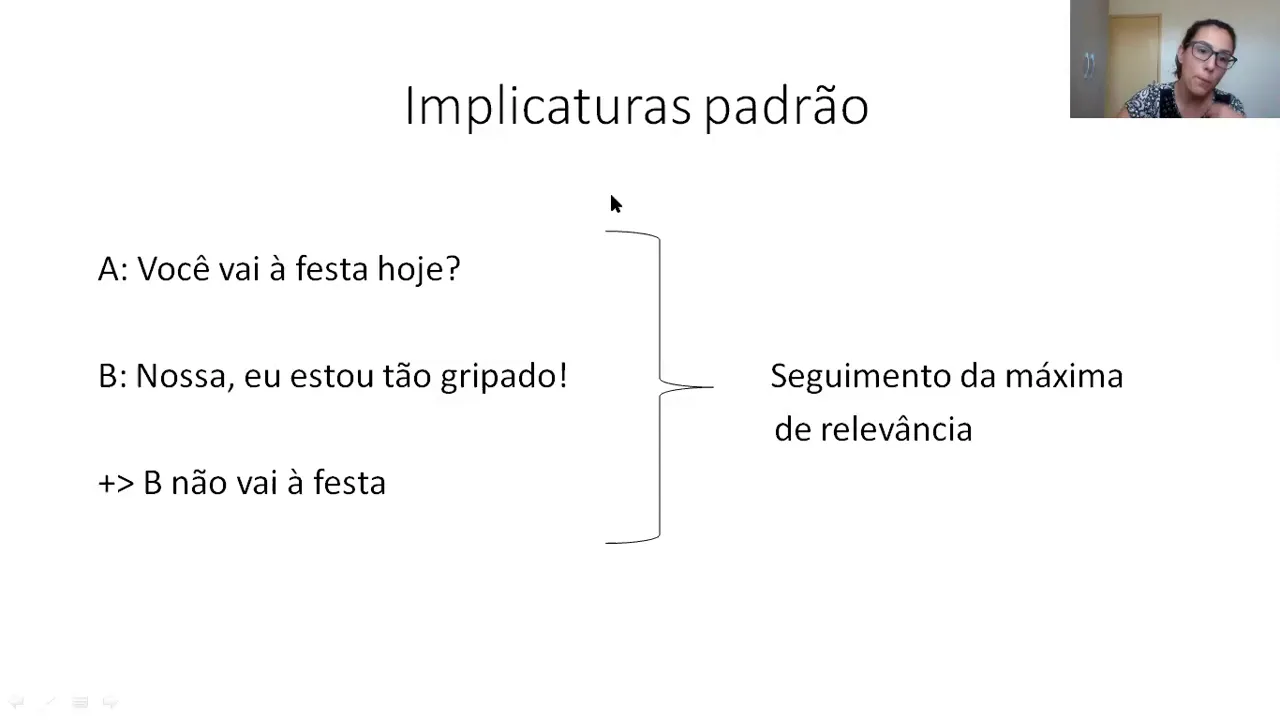
Scalar implicature is a type of standard implicature generated from the Maxim of Quantity. When someone says 'I did some exercises,' the implicature is that they did not do all exercises. This occurs because there is a scale of values (all, most, some, few, none) and when a weaker term is used, it implies the stronger terms are not true. The implicature flows from left to right on the scale, excluding the stronger terms.
Click to watch →
Deep Dive
Relevance Theory (Sperber & Wilson) as a major cognitive alternative to Gricean pragmatics.

Relevance Theory -- Sperber & Wilson
7K
Relevance Theory, developed by Dan Sperber and Deirdre Wilson in 2002, proposes that relevance serves as the unifying principle underlying all communication, replacing Grice's four maxims (quality, quantity, relevance, manner) with a single relevance principle; according to this theory, human cognition naturally seeks to maximize relevance, meaning that speakers encode messages considering their audience's socio-cultural context and cognitive abilities, while listeners decode utterances by applying cognitive effort to infer the speaker's intended meaning, with more explicit messages being more relevant and requiring less cognitive processing than implicit ones using metonymies, similes, or irony.
Click to watch →

Relevance theory | Wikipedia audio article
316
Relevance theory, developed by Dan Sperber and Deirdre Wilson, is a pragmatic framework that explains how speakers convey meaning by providing just enough information for hearers to infer their intended meaning, based on the presumption that every utterance is optimally relevant—worth the cognitive effort required to process it—while relying on shared context and mutual cognitive environments between communicators.
Click to watch →

Relevance Theory Part 1 || Pragmatics
528
Relevance Theory, developed by Sperber and Wilson as a reaction to Grice's Cooperative Principle, proposes that human cognition is designed to maximize relevance during communication. The theory consists of two key principles: the Cognitive Principle of Relevance, which states that human cognition is geared toward maximizing relevance, and the Communicative Principle of Relevance, which explains how speakers and listeners coordinate to achieve this goal. Relevance is defined as a matter of degree, representing a balance between cognitive effect (the result of new information interacting with existing assumptions) and processing effort (the cognitive work required to interpret incoming information). The theory explains that the same information can have different relevance levels depending on context, as demonstrated by examples showing how background knowledge and situational factors influence interpretation.
Click to watch →

PD. Presentación de Pragmática del Discurso
2.1K
The course covers four major theories of traditional pragmatics: (1) Speech Act Theory (Austin, Searle) - the performative nature of language where utterances function as actions, (2) Grice's Theory of Implicature - rules for conversational exchanges and violations that create implied meanings, (3) Relevance Theory (Sperber, Wilson) - extending and modifying Grice's ideas, and (4) Politeness Theory (Brown, Levinson) - linguistic aspects of politeness and face management. These theories form the foundation of contemporary pragmatics and explain how language conveys meaning beyond literal content.
Click to watch →

Cap 7- Las cosas del decir- Calsamiglia y Tusón
251
Paul Grice proposed that for conversations to succeed, participants cooperate by making contributions appropriate to the conversation's stage and purpose. This principle unfolds in four maxims: Quantity (be as informative as necessary, not more than needed); Quality (don't say what you believe false, don't say without evidence); Relation (be relevant, get to point); Manner (avoid obscurity, ambiguity, be concise, proceed orderly). While we don't always observe all maxims, transgressions can trigger special inferences called conversational implicatures when done intentionally for the listener to discover. Relevance theory, developed by Sperber and Wilson, offers a cognitive orientation within pragmatics. The primary function of language is information processing, not communication per se. Communication is ostensive-inferential: the code triggers an inferential process. Relevance is the general principle guiding both speaker formulations and listener interpretations. Human minds are equipped to interpret statements through chains of inference, seeking the most accessible interpretation with minimum processing cost. The most relevant proposition in a given context is the one requiring least processing effort. When maxims are transgressed, it is precisely because doing so increases relevance—statements appeal to shared cognitive contexts with minimum interpretation effort. This explains much of misunderstandings and incomprehensions through miscalculation between what the speaker assumes the listener knows and what the listener actually knows.
Click to watch →
Deep Dive
Applications of implicature in computational linguistics, natural language processing (NLP), and legal/forensic linguistics.
![SFU LING 100 - [10] Forensic Linguistics](https://i.ytimg.com/vi/3QHl5HfG5V4/hqdefault.jpg?sqp=-oaymwEmCOADEOgC8quKqQMa8AEB-AH-CYAC0AWKAgwIABABGHIgRSg9MA8=&rs=AOn4CLAjUAeBLnbV2sFTOFIwSaksjwFuRg)
SFU LING 100 - [10] Forensic Linguistics
703
This comprehensive section covers Computational Linguistics and Forensic Linguistics. CALL systems focus on helping students learn languages by addressing knowledge retention, pronunciation feedback, and personalized learning. Tools like Anki use spaced repetition systems incorporating psychological research. Virtual reality platforms enable immersive language practice. Intelligent CALL (iCALL) uses artificial intelligence to analyze user input using part-of-speech tagging and sentence structure analysis, identifying errors and providing tailored feedback. Forensic Linguistics applies linguistic knowledge to legal matters, with linguists serving as lawyers, consultants, or researchers. Morphological analysis in trademark disputes (McDonald's case) demonstrates how linguistic evidence interacts with public perception. Phonetics analysis (Gak vs. Guck case) examines vowel sounds to determine if product names cause confusion. Syntax analysis reveals how complex legal documents with nested clauses can be difficult for ordinary people to understand. Semantics in legal cases (SIDS life insurance case) demonstrates how precise word definitions determine outcomes. Research on discourse memory shows people cannot remember conversations word-for-word even immediately after hearing them, with implications for court evidence. Cultural differences in communication (question response patterns, gratuitous concurrence) affect legal proceedings.
Click to watch →

Natural Language Processing 4, Prof. Dr. Vera Demberg
765
Conversational implicatures are additional meanings derived from utterances beyond literal content, requiring three conditions: speaker follows cooperative principles, listener assumes speaker believes what they say, and speaker believes this assumption is necessary. Standard implicatures arise from maxim adherence (e.g., 'I'm running out of gas' implies knowledge of nearby stations). Non-standard implicatures emerge from intentional violations (e.g., 'I don't love you' implies the stronger meaning because a truthful 'I do love you' would contradict beliefs). Three types exist: particle-based (context-dependent), generalized (consistent across contexts), and presuppositional (background assumptions). Pragmatics resolves ambiguity without requiring massively ambiguous lexicons.
Click to watch →
![PHILOSOPHY - Language: Gricean Pragmatics [HD]](https://i.ytimg.com/vi_webp/we6uSVf4qss/maxresdefault.webp)
PHILOSOPHY - Language: Gricean Pragmatics [HD]
129K
Listeners calculate implicatures by assuming speakers obey the cooperative principle and maxims, combined with knowledge about conversation purpose, context, and world knowledge. When someone says 'I'm going to Montreal this week' and 'my mother lives there,' listeners infer the speaker is visiting their mother because that's the only way the facts connect. Saying 'I have to work' when asked about a party implies inability to attend—violating relevance and quantity maxims. A professor writing 'Bob has wonderful penmanship' in a philosophy recommendation letter communicates lack of merit because this violates quantity (insufficient information) and relevance (irrelevant to philosophy). The same words ('attic or bedroom') can communicate uncertainty in one context or helpful hint in another, depending on conversational purpose.
Click to watch →

LANGUAGE, TECHNOLOGY AND THE DIGITAL DIVIDE | SCIENCE AGAINST CAPITALISM
799
Computational linguistics, also called natural language processing (NLP) or human language technology, is best understood as a subfield of artificial intelligence rather than linguistics. Language can be studied from eight perspectives: linguistics (systematic conventions), cognitive science (mental processing), computational linguistics (treating language as data), social linguistics (communication between people), and anthropological linguistics (worldview categorization). NLP applications include spell checking, speech recognition, sentiment analysis, document classification, hate speech detection, language documentation, speech synthesis, text summarization, question answering, intelligent assistance, and machine translation. Before the 21st century, NLP relied on brittle rule-based systems requiring expert-crafted rules. Around 20 years ago, machine learning transformed NLP by using massive data rather than hand-crafted rules, with modern systems using neural networks with billions of parameters that remain opaque even to developers.
Click to watch →

Forensic Linguistics for Kurdish EFL Researchers
471
Forensic linguistics serves diverse legal applications including authorship attribution for plagiarism detection, word meaning interpretation in contracts and statutes, trademark disputes, criminal activities like bribery and extortion, contract disputes including insurance fraud, jury instructions, non-English language cases, perjury detection, copyright infringement, and plain language versus legal language analysis. The discipline employs comprehensive micro-linguistic approaches covering phonetics, phonology, morphology, syntax, semantics, pragmatics, and discourse analysis. Speech act theory helps identify confessions, threats, and conspiratorial language. Linguistic evidence encompasses author identification, forensic stylistics, discourse analysis, and dialectology, which tracks regional speech patterns to identify perpetrators.
Click to watch →
Implicature Basics
Conversational Types
Implicature Basics
0:00- 1
Defines implicature as meaning beyond literal proposition.
- 2
Divides implicature into conversational and conventional types.
Relevance Theory
While Paul Grice’s theory of implicature relies on the Cooperative Principle and a specific set of conversational maxims, Relevance Theory—developed by Dan Sperber and Deirdre Wilson—presents a major cognitive alternative. Relevance Theory argues that Grice's multi-maxim framework is theoretically redundant and psychologically implausible. Instead, it proposes that human communication is governed by a single, biologically rooted cognitive principle: the pursuit of 'optimal relevance.' According to this view, listeners automatically attempt to derive the maximum cognitive effects from an utterance with the least possible processing effort. This theory fundamentally challenges the Gricean distinction between 'what is said' (literal semantics) and 'what is implicated' (pragmatics). Relevance theorists argue that pragmatic enrichment (which they call 'explicature') directly shapes the basic truth-conditional meaning of a statement during initial processing, rather than merely acting as a secondary layer of implied meaning decoded after semantic interpretation.
The fundamental distinction between Semantics (literal meaning) and Pragmatics (contextual meaning).
Paul Grice's Cooperative Principle and the four conversational maxims (Quantity, Quality, Relation, and Manner).
The concept of 'speaker meaning' versus 'sentence meaning' in linguistic communication.
Basic comprehension of how context and shared background knowledge influence the interpretation of utterances.
The distinction between Particularized and Generalized Conversational Implicatures.
An in-depth analysis of 'flouting' versus 'violating' maxims and how these actions strategically generate non-literal meaning.
Neo-Gricean pragmatic frameworks, such as Laurence Horn's scalar implicature scales (Horn scales) and Stephen Levinson's three heuristics.
Relevance Theory (Sperber & Wilson) as a major cognitive alternative to Gricean pragmatics.
Applications of implicature in computational linguistics, natural language processing (NLP), and legal/forensic linguistics.
112.1K views2.2Klikes3:54@PhlonemeOriginal Release: 2013-05-03
Welcome avid learner of linguistics.
This video is going to feature this wicked pragmatics thingy that people call implicature. Off we go. And as usual, we should start out with defining what we want to talk about. An implicature is an utterance which conveys meaning beyond its proposition.
And there we have yet another word we have no clue about. A proposition refers to the semantic content of a sentence.
Anyway, whenever we use an implicature, it's like we can draw a conclusion from what is said and therefore deduce more meaning than is actually encoded. Pretty neat, isn't it? Now, Paul Grace, the father, or should I say grandfather of pragmatics, subdivides implicature into two types, conversational and conventional. Conversational implicatures are special in that they employ the cooperative principle and the maxims of conversation. If you don't know what that is, there's a green button below.
So logically, if conversational implicatures have to do with the cooperative principle, conventional implicatures do not. They actually try to make a point about a contrast. And very often you can be tipped off by words like but or yet. However, many people wouldn't go for a classification into conventional implicatures simply because if we're honest, you can find maxims of conversation everywhere.
which is why I'm going to leave out these rudimental implicatures further on. On the next level, we can subdivide as well. Specifically, conversational implicature can be subdivided into three types. The first one is the generalized conversational implicature. Generalized means it doesn't depend that much on the context. Even by definite articles or tenses, you can implicate certain things like in the following sentence. The arsonist put a house on fire. If you don't know what an arsonist is, pause the video and look that up now. Done.
Okay. So, this sentence features a generalized implicature simply by using the article. H. The implication behind it is simply that it is not his own house the arsonist is burning down. It could be any house really, but not his.
The next type is the particular conversational implicature, which this time strongly depends on the context to implicate correctly. Look at this dialogue.
Do you want to go to the cinema tonight?
My little sister is coming for a visit.
On the surface, Bee's reply doesn't seem to be a relevant answer to A's question, which is why Bee just violated a maxim.
However, what Bee wanted to implicate is that she wouldn't have time to go to the cinema because she's busy with performing shaman rituals with her sister or so.
So to use and point out the implicature B flatouts the maxim of relevance. Now why is this an example for a particular implicature? Well simply because we wouldn't have a clue what B's utterance is about if we didn't have A's question.
The last type is called scalar implicature. Whenever we use a word that expresses a degree, you automatically implicate that the thing you're talking about isn't of any higher degree. So here you have a scale going from none to all. And now have a look at the sentence.
I had some buttered scon for tea. The word some is in the middle of our scale meaning that you just had some but not all buttered scon because they're really high and fat and you really wouldn't want to eat them all. So this was it.
For a final test, try to identify the implicatures in the following example.
If you like this video or my amiable voice or or even both, please give me a thumbs up and subscribe to my channel.
Bye.
Up Next
6:59
Flouting Conversational Maxims: Implicature Explained
@TrevorGulliver
13K views•2013-01-29
36:52
Constraint Interaction in Optimality Theory: Epenthesis & Deletion
@Vidyamitra
180 views•2018-08-20
4:12
Metaphor in Linguistics: Source and Target Domains Explained
@Phloneme
46.3K views•2012-11-15

21:32
Accent Expert Explains U.S. Regional Dialects | Part 1
@WIRED
9.3M views•2021-01-21
Related Study Plans & Knowledge Roadmaps
Structured learning paths in Linguistics
linguistics
Optimality Theory: Tableaux & Constraints
01Phonological Basics: Sounds, Syllables & Rules
02Foundations of Optimality Theory: GEN, CON, and EVAL
03The Constraint Inventory: Markedness vs. Faithfulness
+ 2 more learning modules
15h5 modules
Explore Roadmap
linguistics
Morphosyntactic Alignment: S, A & P Systems
01Foundations of Syntax: Transitivity and Arguments
02The Linguistic Variables: Mapping S, A, and P
03Nominative-Accusative Alignment
+ 3 more learning modules
12h6 modules
Explore Roadmap
linguistics
Analyzing Sign Language: Phonology & Syntax
01Foundations of Sign Language Linguistics
02Phonology: The Five Parameters of a Sign
03Morphology: Word Formation and Classifiers
+ 2 more learning modules
14h5 modules
Explore Roadmap
linguistics
Pragmatics: Speech Acts, Grice & Politeness
01Introduction to Pragmatics: Meaning in Context
02Grice’s Cooperative Principle & Implicature
03Speech Act Theory
+ 2 more learning modules
14h5 modules
Explore Roadmap