A conceptual metaphor is a cognitive mechanism where meaning is transferred from a source domain (a concrete, familiar concept) to a target domain (an abstract or unfamiliar concept), enabling us to understand abstract ideas by relating them to concrete experiences; this transfer operates through three key features: systematicity (the two domains function as analogous systems), abstraction (the concepts share structural similarities without direct connection), and asymmetry (the transfer always flows from source to target, never the reverse).
Metaphor in Linguistics: Source and Target Domains Explained
Added:Deep Dive
Basic understanding of literal versus figurative language, specifically the traditional literary definition of a metaphor.
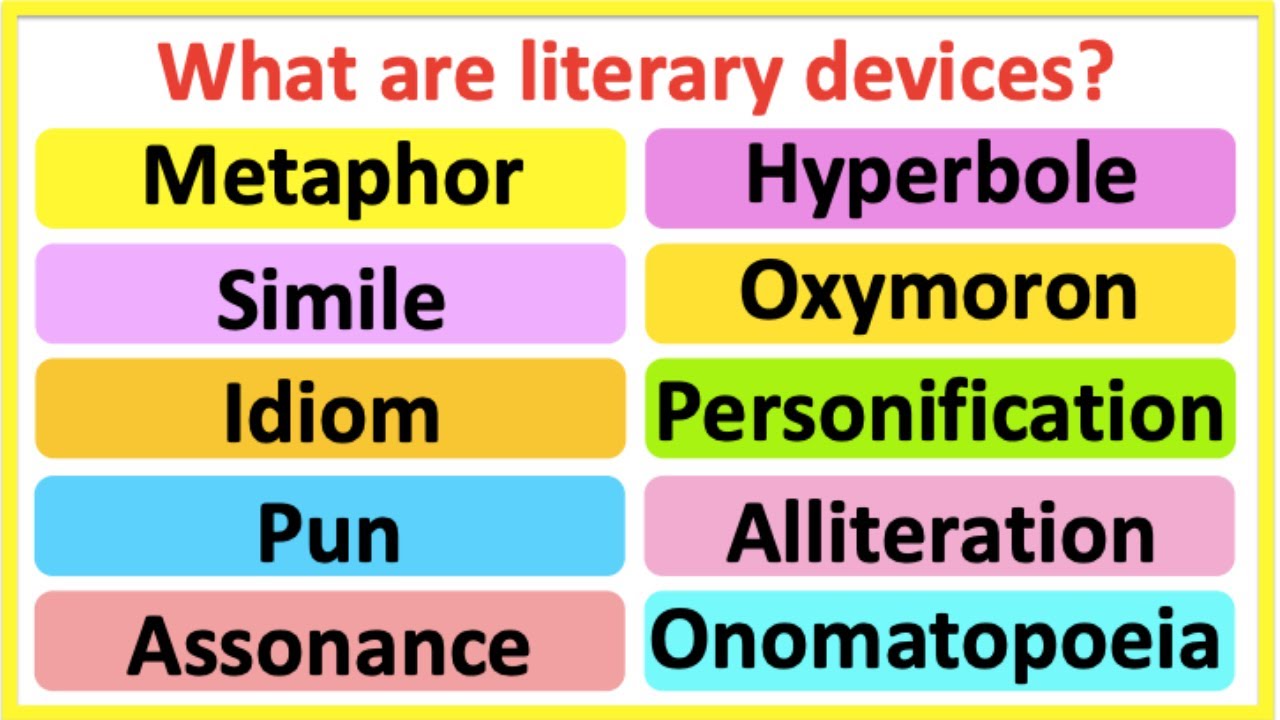
LITERARY DEVICES | Learn about literary devices in English | Learn with examples | Figure of speech
2.3M
A metaphor is a figure of speech that compares two different things (objects, ideas, feelings, or thoughts) by stating that one thing is another. The comparison is based on a common characteristic between them. For example, 'Jim is a giraffe' doesn't mean Jim literally is a giraffe; instead, it compares Jim to a giraffe because both share the characteristic of being very tall. Unlike literal statements, metaphors should not be taken literally as they convey different meanings through figurative language.
Click to watch →

Diferencias entre Literal y Figurado || Parodiadera
116K
Literal language refers to the exact, original meaning of words as they are written or spoken, while figurative language uses metaphors, symbols, and contextual meanings to convey ideas beyond the literal definition; for example, saying 'Pamela puso una muralla entre nosotros' figuratively means she created emotional distance, not a physical wall, and 'esa casa es un nido de culebra' figuratively means the house is inhabited by envious people, not actual snakes.
Click to watch →

Retrospectiva 2025 - Português - Prof. Felipe Luccas
5.6K
Language can be literal (denotative, proper, or logical sense) or figurative (connotative, symbolic, or metaphorical). To determine if language is figurative, ask if you can take it literally. Examples include: 'o leão é a fera mais perigosa' (literal), 'minha mãe fica uma fera' (figurative - metaphor), 'o número de desempregados é o termômetro' (figurative - metaphor), 'o mercado é devorador' (figurative - metonymy), 'as águas do amor são como um oceano' (figurative - metaphor).
Click to watch →

LITERAL & FIGURATIVE LANGUAGES | Literature | Instructional Material | ELC
35.8K
Literal language uses words in their dictionary definitions to convey direct, straightforward meaning, while figurative language employs figures of speech such as simile, metaphor, personification, and hyperbole to create deeper, more imaginative meanings that require careful analysis to interpret; literal language is typically used in casual conversations, whereas figurative language is commonly found in literary works.
Click to watch →

تعرف على شرح الاستعارة المكنية والتصريحية والتمثيلية بأسهل طريقة
3.5K
Metaphor (Al-Istara) is defined as a rhetorical figure that is essentially a complete simile with one of its two essential components removed. The two essential components are the 'mushab' (the thing being compared) and the 'mushab bihi' (the thing being compared to). The linguistic meaning of metaphor is to take something temporarily and return it later, as when describing a soldier as 'roaring'—borrowing a characteristic from lions. When both components are present, the figure is a simile; when one is omitted, it becomes a metaphor. Metaphor Makhniyah (Hidden Metaphor) omits the 'mushab bihi' and uses its characteristics instead, while Metaphor Tasrihiyah (Explicit Metaphor) omits the 'mushab' but explicitly states the 'mushab bihi'. This foundational understanding distinguishes metaphor from other rhetorical figures.
Click to watch →
Deep Dive
Fundamentals of cognitive linguistics, which views language as an instrument for organizing, processing, and conveying information.

Lingüística cognitiva: fundamentos teóricos
3.6K
Cognitive linguistics is a theoretical framework that proposes three main postulates: (1) language is not an autonomous cognitive faculty but shares cognitive mechanisms with other mental processes, (2) all grammar involves conceptualization rather than abstract rule application, and (3) linguistic knowledge emerges from language use rather than innate abstraction. This model rejects the separation between syntax and semantics, instead viewing language as a continuous system grounded in bodily experience and conceptual structures. Key theoretical foundations include prototype theory (which views categories as graded continua rather than discrete sets), frame semantics (which organizes meaning around experiential frameworks), and metaphor theory (which treats metaphor as a fundamental cognitive phenomenon underlying everyday language). Construction grammar further develops this by proposing that linguistic patterns are cognitive constructions derived from basic experiential schemes, such as possession and spatial relations, which generate more complex linguistic forms through inheritance principles.
Click to watch →

Lingüística Cognitiva: Presente y Futuro.wmv
1.4K
Cognitive linguistics proposes that language is fundamentally symbolic and cognitive, with meaning emerging from the interaction between thought, language, and bodily experience; it rejects the autonomy of grammar and the arbitrariness of language, instead viewing language as inherently motivated through cognitive processes like metaphor and metonymy, where meaning cannot be understood in isolation but must be analyzed within context and as part of a continuous, fuzzy system where all grammatical components are interconnected.
Click to watch →

Cognitive linguistics in "The Way We Think"(G. Fauconnier/Mark Turner). With Dr Afaf Mougou#mind
181
Cognitive linguistics represents a fundamental paradigm shift from traditional structuralism, which treated language as a closed abstract system of symbols. Instead, this field studies language scientifically based on neurology and cognitive psychology, particularly neuroplasticity. The core insight is that language forms themselves contain no inherent meaning or power—they are merely tools whose true power resides entirely in the mind of the user. Cognitive linguistics views language as a surface expression of complex cognitive processes, studying the mind that utilizes language rather than analyzing language structures in isolation. The field identifies three fundamental operations underlying all language and meaning: identity (recognition of sameness and equivalence), integration (finding connections between concepts), and imagination (creative construction). These unconscious, powerful, and complex processes exist at the heart of even the simplest meanings, operating not only in creative arts but in everyday speech.
Click to watch →

OFICINA VI - LINGUÍSTICA COGNITIVA
1.2K
Cognitive linguistics focuses on general cognitive processes and the construction of linguistic meaning, examining how humans reconstruct meaning from linguistic items through cognitive processes. The primary function of language is the construction of meaning, where humans actively construct meaning through interaction rather than simply transmitting it. Communication involves two participants: a speaker who produces the message and a listener who interprets it. Anticipation is the human capacity to predict information in communication situations, while reconstruction involves interpreting and building meaning from actual communication. Grammar is understood as an emergent system sensitive to people's use of language in daily life, viewing grammar as a plastic system that develops from human interactions. When humans interact using a specific language in a particular cultural environment, this use generates regularities in mental processing. Children learn language through acquisition of structures, discovering grammatical regularities through repeated exposure. Language use involves cognitive skills such as memory and attention that are essential for effective communication. Shared attention is a cognitive skill where two people focus on the same object, with adults directing children's attention to objects through pointing and verbal cues. Memory involves processing information and storing it in short-term and long-term storage, with the brain filtering out unnecessary details and consolidating important memories. When perceiving objects, humans process multiple information types including color, texture, size, shape, and depth, captured by sensory systems and processed through cognitive mechanisms.
Click to watch →

Cognitive Linguistics: An Introduction to Key Concepts
96.1K
Cognitive Linguistics is the study of language through general cognitive processes such as categorization, schematization, and analogy, which are not restricted to language but operate across all human cognitive tasks; it differs from psycholinguistics by focusing on language structures and their implications for cognition rather than processing mechanisms, and from generative linguistics by rejecting universal grammar and modular architecture while emphasizing that language knowledge emerges from usage and experience.
Click to watch →
Deep Dive
The distinction between concrete concepts (physical, sensory experiences) and abstract concepts (ideas, emotions, time).

NUMERACIÓN (PARTE 1) | CAMBIOS DE BASE | TEORÍA COMPLETA
53.7K
Abstract concepts are ideas, feelings, and emotions that cannot be directly perceived with the senses (such as love, beauty, loyalty). Concrete concepts are things that can be perceived with the senses or defined (such as a pen, which can be seen, touched, and defined). Numbers fall into the abstract category because they represent ideas of quantity rather than physical objects.
Click to watch →

Stop Translating Literally – Learn to Think Abstractly in German
1.5K
Abstract concepts are ideas, feelings, or concepts that cannot be seen, touched, or physically experienced. Concrete concepts are tangible objects that can be perceived through the senses. Examples of abstract concepts include freedom, love, time, justice, hope, fear, and happiness. Examples of concrete concepts include physical objects like chairs.
Click to watch →
#497 On Going Activities (worksheet) | LiveStream Class | Mark Kulek ESL
5.2K
Some concepts are concrete (physical objects we can see and touch), while others are abstract (ideas or feelings we cannot physically perceive). For example, 'alcohol' and 'drugs' are concrete substances, while 'relationship' is an abstract concept. Understanding this distinction helps categorize words and identify differences between items in a group.
Click to watch →

🎯CTET|||. 📌CTET SEPTEMBER 🔥|||📚 JEAN PIAGET||| CHILD DEVELOPMENT AND PEDAGOGY
2.6K
Concrete concepts are things that can be touched and felt, such as a pen, a microphone, or a phone screen. Abstract concepts are ideas or concepts that cannot be physically touched or felt, such as love, air, or Bitcoin. Concrete concepts exist in the physical world and can be directly experienced, while abstract concepts exist in imagination, ideas, or feelings.
Click to watch →

مراجعه ليله الامتحان | للصف الاول الثانوي | فلسفه ومنطق
17.6K
Concrete concepts (مفاهيم) refer to things that exist in reality and can be experienced (مصادق), while abstract concepts (مفاهيم) refer to ideas that exist only in the mind and cannot be directly experienced. For example, 'a bride' is a concrete concept, while 'a philosophy teacher' is an abstract concept.
Click to watch →
Deep Dive
Introduction to semantic fields and how words and meanings are grouped in the human mind.

Chroma key,letras y lenguas español
164
A semantic field is a set of words or significant elements with related meanings that share something in common. Despite each word having its own individual meaning, they are grouped together because they belong to the same category. Examples include transportation (airplane, bus, bicycle), writing tools (pencil, eraser), kitchen utensils (utensils, knife), and sports (soccer, basketball). The common feature is that they share grammatical categories (nouns, adjectives, verbs), while differential features distinguish them (aerial vs. terrestrial, writing vs. erasing, cutting vs. serving). Semantic fields can be grammatical fields when words share the same grammatical category and relationship.
Click to watch →

semantics 2
149
Words are stored in the mind in the form of semantic fields, which are groups of similar words with similar meanings. This organization helps in understanding and processing language efficiently.
Click to watch →

Los campos semánticos - segundo grado de primaria
521
Semantic fields (campos semánticos) are groups of words that are related by their meanings. Words are grouped together in a semantic field because they share a common characteristic or use that connects them, not simply because they are used together. For example, the semantic field 'family' includes words like mamá, papá, hermanos, tíos, and primos because they all refer to family members.
Click to watch →
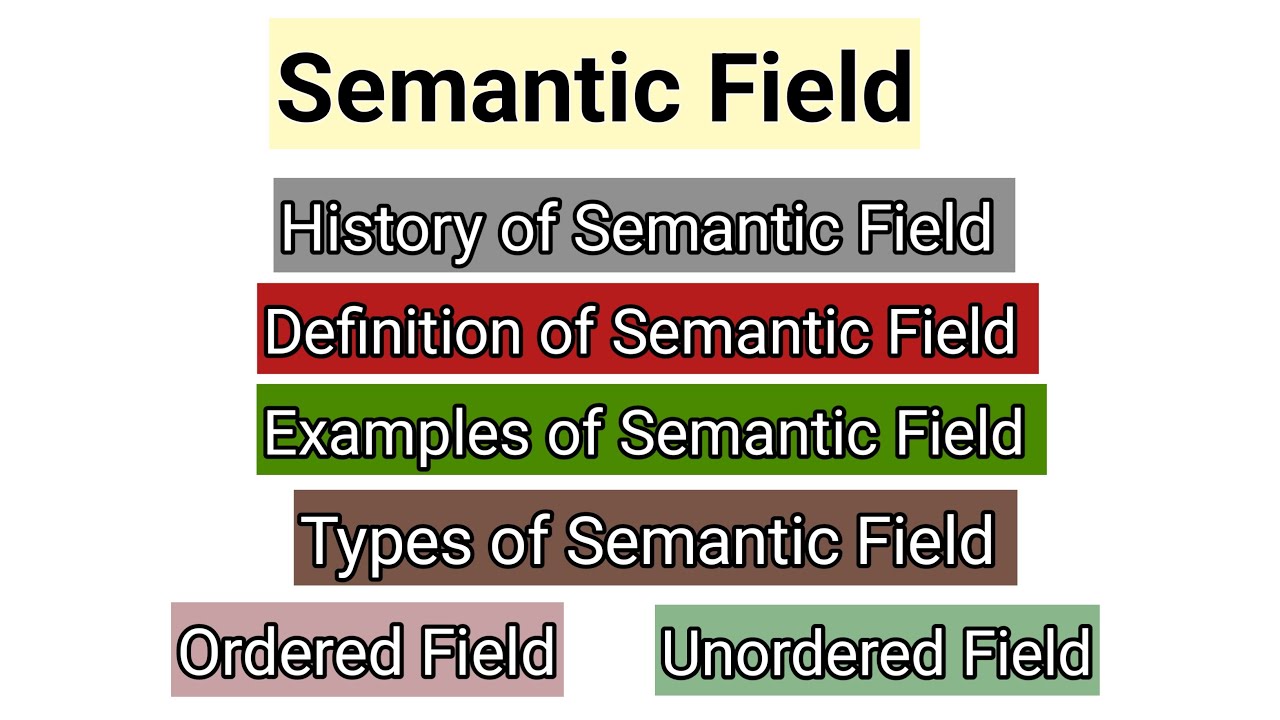
semantic field | semantic field theory | what is semantic field | semantic field & lexical semantics
330
A semantic field is a group of related words that share similar meanings and refer to a specific subject or category, introduced by J. Epstein and George Trubetzkoy in 1930; there are two types: ordered semantic fields (like days of the week that follow a specific sequence) and unordered semantic fields (like animals that can be arranged alphabetically or by family).
Click to watch →

PG TRB ENGLISH | FREE CLASS | Day 1| Unit 9 | Linguistics | Semantics
30K
A semantic field is a classification of words associated by their meanings. For example, words related to body parts (eye, nose, ear, head) form a semantic field. Similarly, words related to clothing (shirt, pants, skirt, blouse) form another semantic field. This shows how language organizes vocabulary thematically.
Click to watch →
Prerequisite Knowledge
- Concept 01Basic understanding of literal versus figurative language, specifically the traditional literary definition of a metaphor.
- Concept 02Fundamentals of cognitive linguistics, which views language as an instrument for organizing, processing, and conveying information.
- Concept 03The distinction between concrete concepts (physical, sensory experiences) and abstract concepts (ideas, emotions, time).
- Concept 04Introduction to semantic fields and how words and meanings are grouped in the human mind.
Subsequent Learning
- Step 01George Lakoff and Mark Johnson’s 'Conceptual Metaphor Theory' (CMT) as detailed in their seminal work, 'Metaphors We Live By'.
- Step 02The concept of Embodied Cognition, which explores how human physical experiences in the world shape our abstract conceptual mappings.
- Step 03Conceptual Blending Theory (Fauconnier and Turner), which expands two-domain mapping into multi-space integration networks.
- Step 04Application of conceptual metaphor analysis in Critical Discourse Analysis (CDA), examining how political and media narratives use metaphor to shape public opinion.
- Step 05Cross-cultural linguistics to study how different cultures utilize distinct source domains for the same target domains.
Poetic roots
Core concepts
Real-life use
Poetic roots
0:01Playing Section
- 1
Finds metaphor in poetry, using Sonnet 18 as example.
- 2
Explains source and target domains with comparison.
- 3
Metaphor transfers meaning from known to unknown.
The Class-Inclusion Theory of Metaphor
While Conceptual Metaphor Theory (CMT) asserts that metaphors map knowledge from a concrete 'source' domain to an abstract 'target' domain, Sam Glucksberg's Class-Inclusion Theory offers a prominent alternative. This model argues that metaphors are not processed via cross-domain mappings, but are instead understood as direct assertions of category membership. For example, in the metaphor 'my job is a jail,' the listener does not map the domain of physical prisons onto the domain of occupations. Instead, 'jail' acts as a vehicle for an ad-hoc, superordinate category representing 'any confining and inescapable situation,' of which 'my job' is classified as a member. This critique suggests that metaphor comprehension relies on standard, dynamic categorization and pragmatic attribution processes rather than permanent, hard-wired cognitive mappings between domains.
Deep Dive
George Lakoff and Mark Johnson’s 'Conceptual Metaphor Theory' (CMT) as detailed in their seminal work, 'Metaphors We Live By'.

71. Metafore e analogie VS Logica formale e matematica
235
George Lakoff and Mark Johnson argue that the essence of metaphor is to understand and live one type of thing in terms of another type of thing. Metaphor is not decorative but part of conceptual systems that highlight some aspects and hide others. Conceptual metaphors can be described at the neural level as mappings between conceptual domains where structures of the source domain are reused to reason about the target domain. These mappings are typically partial and learned automatically without consciousness. In 'Where Mathematics Comes From', they argue that many mathematical ideas use conceptual metaphors to make available inferential structures, and concepts like actual infinity would be fundamentally metaphorical constructions distinct from potential infinity understood as an endless process.
Click to watch →
Reacting to the most insane philosophy papers ever written
28.9K
Conceptual metaphor theory, pioneered by George Lakoff and Mark Johnson in 1980, examines how our underlying conceptual frameworks shape understanding. Examples include military metaphors in debate (winning, attacking, defeating) versus alternative metaphors like argument as dance or argument as building, showing how different conceptual frameworks produce different understandings of the same phenomena.
Click to watch →
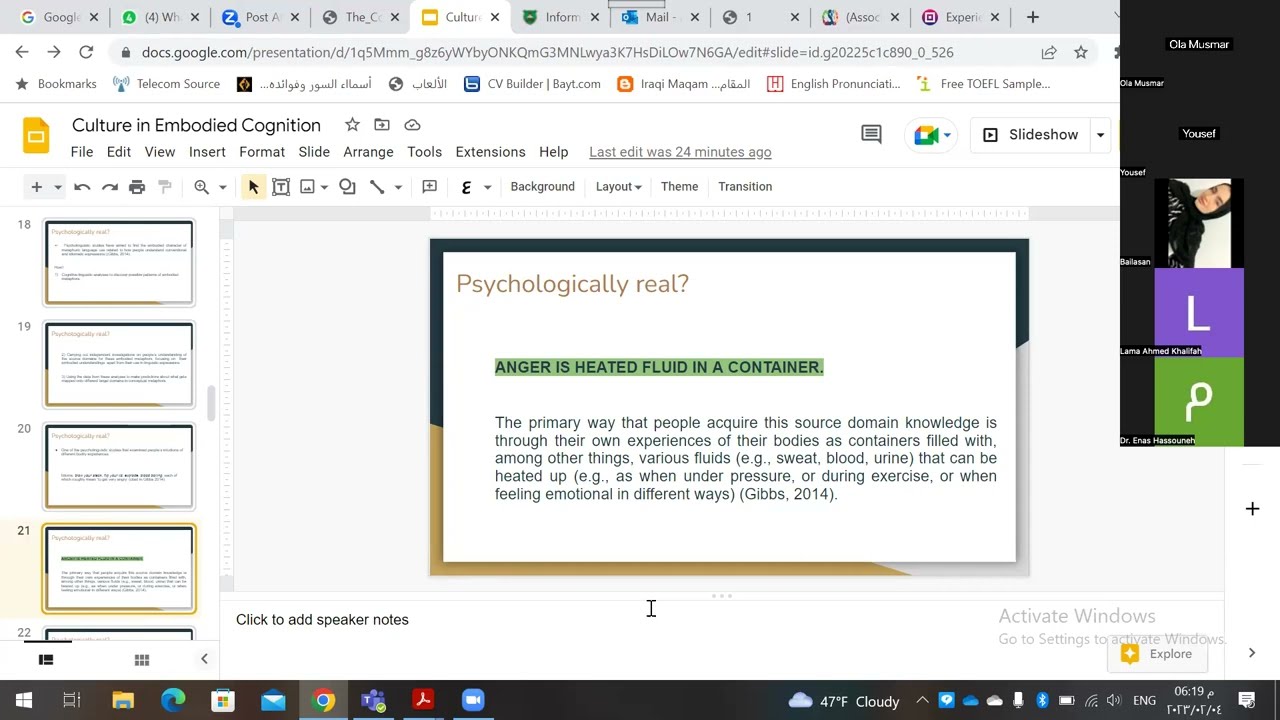
Culture in Embodied Cognition: A View from the World of Metaphor and Metonymy. Doctor Aseel Zabin
198
The traditional view treats metaphor as a figure of speech—a property of language that is not motivated and may be arbitrary, arising from similarity. Only great poets and novelists can produce metaphors. The cognitive view, championed by Lakoff and Johnson, sees metaphor as a property of concepts that plays a fundamental role in understanding and reasoning. Conceptual Metaphor Theory (CMT) defines metaphor as 'understanding one conceptual domain in terms of another.' Examples include 'life is a journey' (reached a dead end, at a crossroads), 'arguments are war' (attacked my argument, lost to him), and 'love is a journey' (going nowhere). This theory has been refined by scholars like Kövecses to include image schemas, domains, frames, and mental spaces.
Click to watch →

Metaphors We Live By: George Lakoff and Mark Johnson
97.6K
Metaphors are not merely rhetorical devices but fundamental components of human cognition, serving as the primary mechanism through which we conceptualize abstract experiences by mapping them onto more concrete, experiential domains; this metaphorical thinking shapes how we perceive, navigate, and interact with the world, as demonstrated by common metaphors like 'argument is war' and 'time is money' that structure our very thought processes.
Click to watch →

Диалог красивых вещей (Инна Веселова)
2.7K
Linguists George Lakoff and Mark Johnson proposed that conceptual metaphors form the foundation of human thought and language. They argue that our conceptual system plays a central role in determining everyday reality, and that we constantly use metaphorical language to understand abstract concepts. Many conceptual metaphors have physical and physiological foundations—for example, we describe emotions as 'up' or 'down' because physical experiences of strength and weakness naturally map onto abstract emotional states. These metaphors operate largely automatically in everyday thought and behavior, often without conscious awareness, meaning that the metaphorical frameworks underlying folk art and cultural symbols are deeply embedded in how people naturally perceive and interpret the world.
Click to watch →
Deep Dive
The concept of Embodied Cognition, which explores how human physical experiences in the world shape our abstract conceptual mappings.

Journey Into the Human Brain: An In-Depth Guide to Your Amazing Brain!
41.4K
One leading theory explaining how we experience abstract concepts is embodied cognition. This theory suggests that all our experiences ultimately relate back to physical experiences and interactions with the world. Thoughts would be too abstract to mean anything without grounded experience in the real world. For example, when someone tells you a story about walking through the woods, you understand it by visualizing and feeling the neurons that would fire if you were walking through the woods yourself. Abstract quantities like numbers must also relate back to physical experiences.
Click to watch →

A course in Cognitive Linguistics: Metaphor
58.9K
Before Lakoff and Johnson, the dominant 'literal meaning first hypothesis' held that metaphor understanding required first computing a literal meaning that failed, then inferring a metaphorical meaning. However, psychological research has demonstrated that metaphorical meanings are understood directly and that conceptual metaphors are deeply embodied. Experiments show that imagining social exclusion causes people to perceive room temperatures as colder, while literally excluding participants from games increases their desire for warm drinks. Conversely, holding a warm cup of coffee makes people rate others as more friendly, intelligent, and competent, and increases generosity toward others. These bidirectional connections between physical experience and abstract conceptualization support the revolutionary claim that abstract human thought is grounded in bodily experience, and that conceptual metaphors operate as deeply ingrained patterns of association connecting physical sensations to social and emotional understanding.
Click to watch →
137. Embodied Cognition | THUNK
41.9K
This section presents key evidence supporting embodied cognition through cross-cultural analysis of metaphors. George Lakoff and Mark Johnson discovered that happiness is universally described using 'up' metaphors (over the moon, on top of the world) while sadness uses 'down' metaphors (down in the dumps, feeling like dirt), consistent across English, Chinese, and Persian languages. Additional patterns include warmth representing compassion, cold representing animosity, control as being over something, and love as energy. These clustered metaphors suggest that abstract concepts are constructed from physical sensations, with up-ness being necessary for conceiving happiness.
Click to watch →

مقدمة في علم النفس (جامعة إم آي تي) المحاضرة 02: العلم والبحث
10.5K
Embodied cognition is the theory that physical experiences influence abstract thinking and social judgments. In experiments, participants who held a warm cup of coffee were more likely to describe a person as 'warm' compared to those who held a cold cup. This demonstrates that physical sensations can unconsciously influence social judgments, suggesting that our understanding of abstract concepts is grounded in bodily experiences.
Click to watch →

Metaphor and the Political War
362.8K
Metaphors aren't just linguistic—they're embodied in our physical experiences. Research shows that when we talk about friendly people as warm, holding a hot coffee makes us judge others as warmer and more generous. Holding heavier objects makes us rate issues as more serious, demonstrating that the abstract concept of importance is grounded in bodily experiences of weight. Studies also show that recalling unethical behavior makes people perceive their surroundings as darker, while remembering moral behavior makes them perceive things as brighter. This demonstrates that goodness equals light and evil equals darkness isn't just a literary trope—it's how our brains work.
Click to watch →
Deep Dive
Conceptual Blending Theory (Fauconnier and Turner), which expands two-domain mapping into multi-space integration networks.

The Past and Future of Blending Theory. Intro by Mark Turner. 2 day symposium at ICLC17, 2025-07-14.
172
Conceptual Blending Theory, developed by Mark Turner and Gilles Fauconnier over 30 years, proposes that advanced human cognition relies on a fundamental cognitive process called 'blending'—the integration of multiple mental spaces into emergent structures that enable creative thinking, language comprehension, and problem-solving across diverse domains including mathematics, art, science, and AI. Unlike traditional cognitive approaches that treat different mental operations as separate, blending theory argues that humans use the same core cognitive mechanism for all advanced cognitive tasks, from understanding metaphors to planning futures, making it a foundational framework for a unified science of human cognition.
Click to watch →

Thomas Herbst
856
Conceptual blending (Fauconnier & Turner) applies to combining construction meanings, both conventional and creative. Input spaces map to blended spaces through cross-space projection, explaining how 'feel guilty' and 'have a conscience' combine to 'have a guilty conscience.' This framework accounts for creativity within constraints. The constructicon integrates all constructions, with some having strong lexical bias (like 'give' dominating ditransitive) and others minimal bias. This integration enables pedagogical applications, helping teachers show how each construction contributes to sentence meaning and form, bridging theoretical analysis with practical language instruction.
Click to watch →
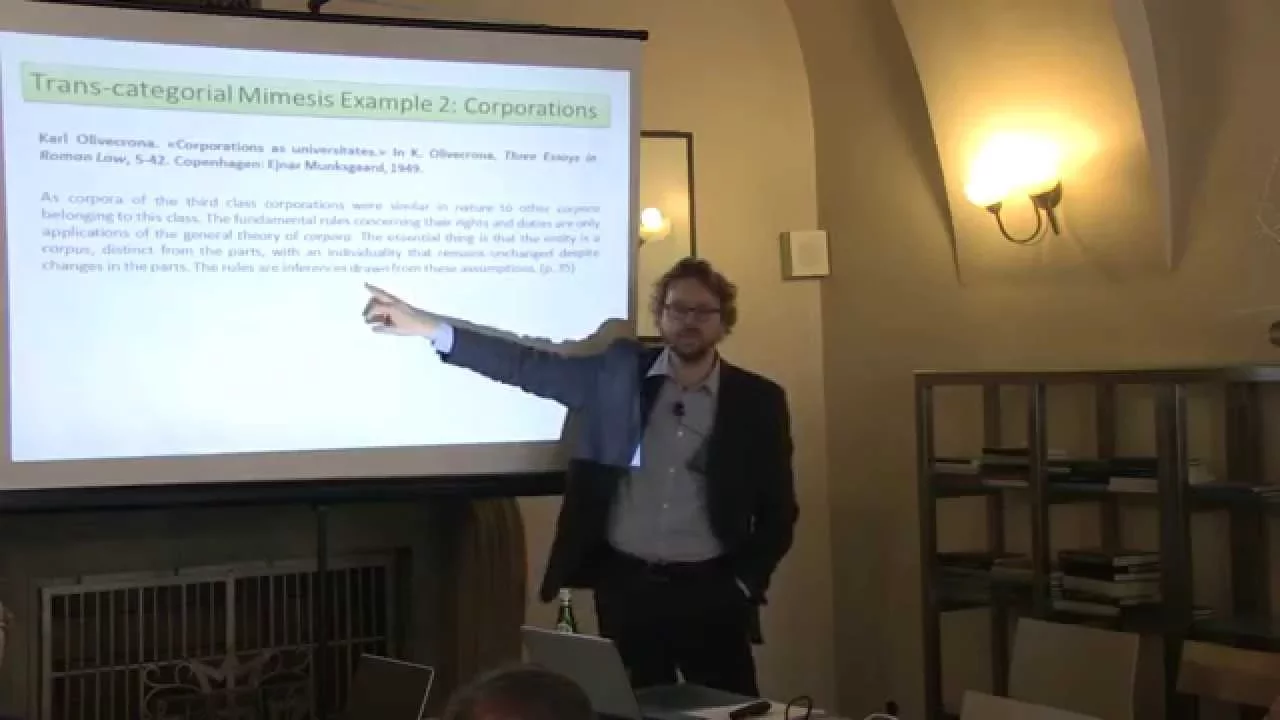
Institutional Mimesis and Conceptual Blending, Corrado Roversi
535
This section develops conceptual blending theory (Fauconnier & Turner) as the cognitive mechanism explaining institutional mimesis. The theory explains how abstract legal concepts emerge from blending concrete physical concepts through double scope integration networks matching mental spaces containing physical regularities with institutional concepts. This creates emergent structures enabling new kinds of reasoning impossible from physical regularities alone. The speaker applies this to reconstructing the state concept: mapping causal influences onto legal powers creates ordered structures where superordinate entities have power over subordinates. Similarly, corporations emerge from blending natural corpora concepts. This leads to memetic ontology—understanding legal normativity as metaphorical transformation from factual normality to normative necessity. The framework proposes normativity as pneumatic, created through intention-rooted processes involving conceptual blending, representing historical ontology explaining how we conceptualize our world in historical terms and impacting future developments.
Click to watch →

Conceptual Blending
6.9K
Traditional higher education has been dominated by a print culture where students passively replicate what professors teach, regurgitating information on tests. Despite technological advances enabling mass production and rapid spread of ideas, this model persists because textbooks are still treated as infallible authorities. The Society for Conceptual Logistics and Communication Research addresses this problem through conceptual blending, a pedagogical technique derived from linguists Fauconnier and Turner's theory of mental spaces. Mental spaces are small packets of concepts used in local conversations, and when they overlap, they create blended locations. Conceptual blending combines multiple concepts into brand new conceptions. The three-step exercise involves students visualizing two separate concepts and then creating a third visualization that integrates their interaction, forcing engagement with important cognitive processes.
Click to watch →

Approaches to creative metaphors
129
This section details the mechanics of conceptual blending. We have input spaces (surgeon and butcher) with mappings between them, plus a blended space that inherits elements from both. The blended space has structure from each input: it inherits the surgeon, patient, and goal of healing from the surgery space, but the role of butchery and means of cutting from the butcher space. This creates a new space where a surgeon uses butchery means for healing, leading to the interpretation of incompetence. The video emphasizes that emergent structure is unique to the blend.
Click to watch →
Deep Dive
Application of conceptual metaphor analysis in Critical Discourse Analysis (CDA), examining how political and media narratives use metaphor to shape public opinion.

Nga truku i gjuhës së Ramës tek zbërthimi i fenomenit Mimoza Ahmeti. Pedagogia analizon…
1K
Critical Discourse Analysis (CDA) is an academic discipline examining how political language influences society. Developed over 20-30 years, it focuses on political speech and communication. Political language is fundamental because all political processes begin with communication. Identities are not fixed but change based on what is emphasized in communication. According to CDA, nothing in political speech occurs by chance; everything serves a specific ideology. Populist politicians use jargon to create connections with ordinary people. Political metaphors become powerful tools shaping public perception, as demonstrated by Prime Minister Edi Rama's 'media is a cauldron' metaphor. Reality TV shows like Big Brother and Farm of Animals originate from Orwell's '1984' (1949), which warned about surveillance in dictatorial regimes.
Click to watch →

ENG524_Topic073
344
Metaphor analysis in critical discourse studies reveals how metaphors function as cognitive markers that shape thought processes and strategically construct ideological worldviews, extending beyond decorative language to expose hidden power relations and socio-cultural meanings in discourse.
Click to watch →
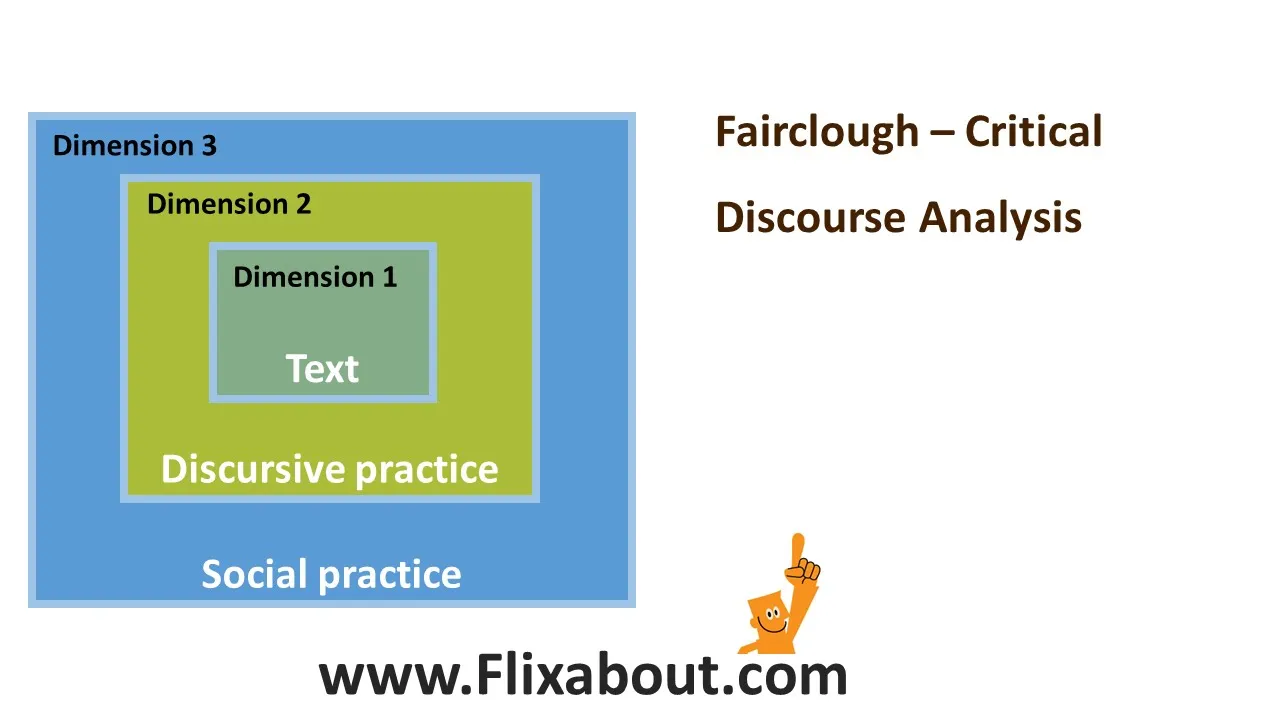
Fairclough Critical Discourse Analysis
242.6K
Fairclough's critical discourse analysis is useful for determining what the sender wants to convey to recipients and what behavior the sender wants from recipients. This makes CDA valuable for analyzing organizational communication, political discourse, media messages, and other forms of strategic communication.
Click to watch →
Psychology of Thinking (3130) 2025, Lecture 5
124
Conceptual metaphors use physical action language to describe abstract mental processes. Examples include 'I jog my memory' (mental exertion), 'I'm running out of steam' (mental fatigue), and 'jump to conclusions' (rapid idea transitions). Political communication exploits these mechanisms: 'fair and balanced' implies other sources are unfair; 'war on Iraq' versus 'war in Iraq' suggests invasion versus legitimate conflict. Language frames discourse by directing inference, allowing communicators to let audiences arrive at conclusions themselves, making them more likely to trust their own reasoning.
Click to watch →

Murmurations #10: Language, metaphor and society - with Dr Veronika Koller
572
Metaphor analysis reveals how political discourse shapes public understanding through figurative language. In Brexit campaigns, rhetoric escalated from 'people who may be coming' to 'invaders' threatening to 'overrun' Britain, demonstrating how metaphorical language increases perceived threat levels. Pandemic narratives similarly use sea journey metaphors where everyone shares a boat navigating a storm, though critics adapt this to highlight inequalities between those in luxury yachts versus dinghies. War metaphors in crisis response transform government-citizen relationships, positioning citizens as 'foot soldiers' following orders rather than democratic participants. Effective discourse analysis requires understanding that ideology operates under specific contextual conditions rather than being passively absorbed, recognizing that individuals may genuinely hold problematic views based on legitimate grievances.
Click to watch →
Deep Dive
Cross-cultural linguistics to study how different cultures utilize distinct source domains for the same target domains.

Humanity Chapter 3
134
Social linguistics studies how language meaning is shaped during enculturation, what social situations people speak in, and how power is reflected in language. It examines whether men and women communicate differently and if hierarchies are involved. When different racial groups have social intercourse, there is often a hierarchy in how they speak. Actions from different cultural standpoints may be unaware of how they may offend the receiver. Diversity is important not just for having different people and faces, but as an opportunity to learn from others and become true cosmopolitan citizens. When we learn from other people, we understand their semantic domains - classes of things or properties perceived as alike in some fundamental respect, hierarchically organized. What we call things is arbitrary and conventional according to our culture - in Spanish, a table is 'mesa' and a chair is 'silla'. These domains depend on the importance of objects or actions in people's lives.
Click to watch →

IV Jornada de Estudos de Linguagem - Mesa 1
786
Domínios transculturais (turismo, futebol, Copa do Mundo) têm padrões definidos transculturalmente (ex: FIFA tem 55 páginas definindo termos oficiais). Isso facilita modelagem multilíngua porque padrões são consistentes. A solução proposta é modelar um único frame que pode ser evocado por itens lexicais nas três línguas, criando cópias de cada frame nos três idiomas para que usuários leiam definições na língua deles, e alinhando recursos no nível das unidades lexicais. Discrepâncias de valência ocorrem quando padrões sintáticos diferem entre línguas (ex: 'desfrutar de uma atração' em português tem objeto regido, 'enjoy an attraction' em inglês tem objeto direto). Discrepâncias de background ocorrem quando frames por trás são diferentes.
Click to watch →

IPR Webinar | How Language Shapes Brands, Business, and Public Perception
100
Beyond the five main domains, linguists study additional areas including: (1) Social Linguistics - how language is used or changes depending on social context such as different situations, social interactions, or political circumstances; (2) Paralanguage - non-verbal elements that accompany speech such as emoticons in text, voice tone, and other behaviors that reflect something beyond what is literally being said; and (3) Cross-cultural Linguistics - how culture affects the way we speak and understand language, including differences between age groups and subcultures.
Click to watch →

Introduction to Cultural Linguistics
152
Cultural linguistics has practical applications in multiple areas: (1) Teaching intercultural communication to reduce misunderstandings between cultures; (2) Integrating cultural meanings into language teaching to facilitate learning; (3) Understanding World Englishes by examining localized conceptualizations of cultures; (4) Translation studies, where understanding cultural metaphors of source and target languages enables more accurate translations.
Click to watch →

Jesuit on Iroquoian language/dunking on other Jesuits.
4K
When peoples with vastly different language structures attempt to communicate, fundamental barriers emerge. Speakers cannot simply transfer knowledge between languages due to divergent grammatical frameworks. Trade jargons emerge as practical solutions, combining words from multiple languages with simplified grammar and heavy reliance on gestures. These hybrid systems serve immediate commercial needs but lack formal coherence. The five Iroquois nations alone form five distinct dialects as different from each other as French, Spanish, and Italian. Pronunciation varies dramatically—from the guttural sounds of Cayuga and Seneca to the softer tones of Mohawk and Onondaga. Subjective judgments about language quality exist, with some tribes mocking others for speaking crudely. Despite these variations, all languages remain dynamic, constantly evolving with new words emerging while others fall into disuse.
Click to watch →
Poetic roots
Core concepts
Real-life use
Poetic roots
0:01- 1
Finds metaphor in poetry, using Sonnet 18 as example.
- 2
Explains source and target domains with comparison.
- 3
Metaphor transfers meaning from known to unknown.
The Class-Inclusion Theory of Metaphor
While Conceptual Metaphor Theory (CMT) asserts that metaphors map knowledge from a concrete 'source' domain to an abstract 'target' domain, Sam Glucksberg's Class-Inclusion Theory offers a prominent alternative. This model argues that metaphors are not processed via cross-domain mappings, but are instead understood as direct assertions of category membership. For example, in the metaphor 'my job is a jail,' the listener does not map the domain of physical prisons onto the domain of occupations. Instead, 'jail' acts as a vehicle for an ad-hoc, superordinate category representing 'any confining and inescapable situation,' of which 'my job' is classified as a member. This critique suggests that metaphor comprehension relies on standard, dynamic categorization and pragmatic attribution processes rather than permanent, hard-wired cognitive mappings between domains.
Basic understanding of literal versus figurative language, specifically the traditional literary definition of a metaphor.
Fundamentals of cognitive linguistics, which views language as an instrument for organizing, processing, and conveying information.
The distinction between concrete concepts (physical, sensory experiences) and abstract concepts (ideas, emotions, time).
Introduction to semantic fields and how words and meanings are grouped in the human mind.
George Lakoff and Mark Johnson’s 'Conceptual Metaphor Theory' (CMT) as detailed in their seminal work, 'Metaphors We Live By'.
The concept of Embodied Cognition, which explores how human physical experiences in the world shape our abstract conceptual mappings.
Conceptual Blending Theory (Fauconnier and Turner), which expands two-domain mapping into multi-space integration networks.
Application of conceptual metaphor analysis in Critical Discourse Analysis (CDA), examining how political and media narratives use metaphor to shape public opinion.
Cross-cultural linguistics to study how different cultures utilize distinct source domains for the same target domains.
46.3K views588likes4:12@PhlonemeOriginal Release: 2012-11-15
Welcome, avid learner of linguistics! In this video you're going to learn about the conceptual metaphor and what it can do for you So let's get cracking!
First of all we should ask ourselves where we can find a metaphor, just to have something nice at hand.
And the key answer that is and always will be correct is: in poetry!
So: Why not take a glimpse at this bloke's Sonnet 18!
Let's start reading... Shall I compare thee to a summer's day... Hold it! There we have it already a metaphor!
Why should we compare someone to a summer's day?
Simply because we have no idea what said person looks like.
The idea of the summer's day, however, gives us a clue off what the person is not: a freezing-cold blizzard beast with icicles for boobies... We think of this summer's day that it's warm and nice; everyone likes it and it's pretty... So this is what this person is like.
Now, let's come to the grey-matter part.
The word "metaphor" comes from Greek "metaphero" which means "to carry over" or "transfer".
The idea is actually pretty simple: In a metaphor we have two domains that we employ in the transfer of meaning.
The source domain from which we draw a concept and the target domaine of which we have no clue what it actually is and into which the concept from the source domain is being transferred.
Let me give you an example: Time. What is time?
You see, we don't really know what time is but somehow we want to talk about it.
As you see here on the target domain there isn't a picture of time because you simply can't find one.
But what if i present to you our source domain "money"?
We all have a pretty clear idea of how money works: you can spend it you can win it steal it, earn it, save it lose it and so on... And this is where metaphor kicks in: We can get a nice picture of time by resorting to the concept of money.
When thinking that time is money, we can say we can spend time steel time save time waste time and so on.
Do you see it?
This is our metaphor!
"Time is Money"!
And it works so well because time and money are analogous systems.
That means they both react in similar ways.
This is a feature metaphor called systematicity.
Another feature of metaphor is abstraction which means that the two concepts employed in a metaphor behave similarly, but have no real connection.
Their connection is an abstract one.
The third feature is asymmetry, which means that the transfer works only from the concrete concept to the abstract concept and not the other way round.
The process of metaphor is always directed from the source to the target domain.
Now you know how metaphors work.
So why don't you have a look at this?
The famous metaphor from the film "Forrest Gump": Life is like a box of chocolates.
And if you have some spare time left, you can think about the philosophical question of how metaphor actually shapes and buy some degree restricts our perception and our way of thinking.
Now that we had done with metaphor why don't we talk about metaphor's best friend metonomy?
If you want to know what metonymy is, click the "what the heck is metonymy?" button!
See you!
Up Next
83:36
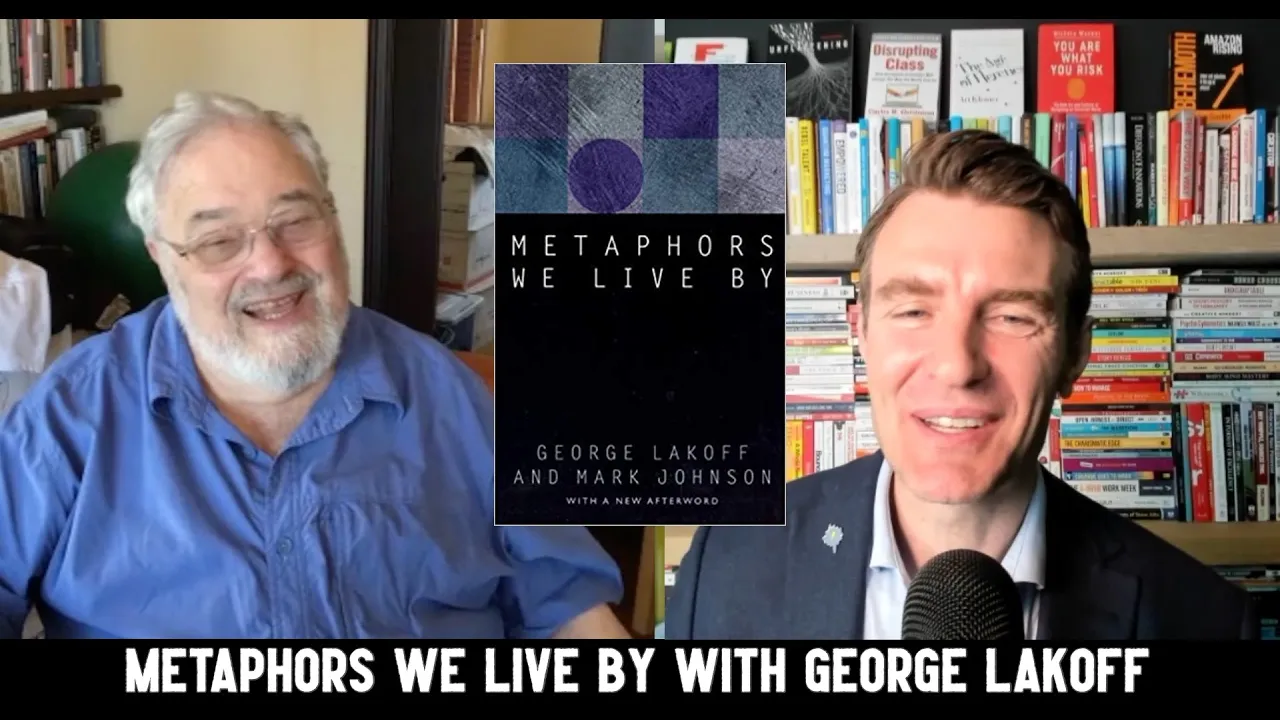
George Lakoff on Metaphors We Live By | Cognitive Linguistics
@TheInnovationShow
28.7K views•2021-10-04
36:52
Constraint Interaction in Optimality Theory: Epenthesis & Deletion
@Vidyamitra
180 views•2018-08-20
3:54
Implicature in Pragmatics: Types & Examples Explained
@Phloneme
112.1K views•2013-05-03

21:32
Accent Expert Explains U.S. Regional Dialects | Part 1
@WIRED
9.3M views•2021-01-21
Related Study Plans & Knowledge Roadmaps
Structured learning paths in Linguistics
linguistics
Optimality Theory: Tableaux & Constraints
01Phonological Basics: Sounds, Syllables & Rules
02Foundations of Optimality Theory: GEN, CON, and EVAL
03The Constraint Inventory: Markedness vs. Faithfulness
+ 2 more learning modules
15h5 modules
Explore Roadmap
linguistics
Morphosyntactic Alignment: S, A & P Systems
01Foundations of Syntax: Transitivity and Arguments
02The Linguistic Variables: Mapping S, A, and P
03Nominative-Accusative Alignment
+ 3 more learning modules
12h6 modules
Explore Roadmap
linguistics
Analyzing Sign Language: Phonology & Syntax
01Foundations of Sign Language Linguistics
02Phonology: The Five Parameters of a Sign
03Morphology: Word Formation and Classifiers
+ 2 more learning modules
14h5 modules
Explore Roadmap
linguistics
Pragmatics: Speech Acts, Grice & Politeness
01Introduction to Pragmatics: Meaning in Context
02Grice’s Cooperative Principle & Implicature
03Speech Act Theory
+ 2 more learning modules
14h5 modules
Explore Roadmap