Code-Switching: Syntax, Poplack & MLF Model
Learning Goal: Analyze the syntactic constraints and sociolinguistic motivations of bilingual code-switching by applying Poplack's grammatical constraints and Myers-Scotton's Matrix Language Frame (MLF) model to real-world conversational data.
- Prerequisites: Introduction to general linguistics, basic morphology (understanding of morphemes, free vs. bound distinction), and basic syntactic structures (word order, parts of speech).
- Estimated Total Study Time: 15 hours
Module 1: Foundations of Bilingualism and Language Contact
This module establishes the foundational sociolinguistic framework necessary to study bilingual language production. You will explore how languages interact when speakers of different tongues make contact, and establish a clear, scientifically rigorous distinction between code-switching (the fluid, rule-governed alternating of two or more languages in speech) and lexical borrowing (the structural integration of foreign words into a host language).
Recommended Videos
Why this video
This lecture provides an academic-grade introduction to language contact phenomena. It outlines the core terminology of sociolinguistic dynamics, including diglossia (stable bilingualism where languages serve distinct social registers), language change, and borrowing, preparing you with the necessary vocabulary to discuss grammatical models of code-switching.
Knowledge Checkpoint
- Define language contact and explain how diglossia differs from individual bilingualism.
- Distinguish between structural borrowing, lexical borrowing, and code-switching.
- Describe the societal and historical conditions that initiate language contact.
Why this video
Presented by a leading researcher in code-switching, this video addresses the complex linguistic debate around separating lexical borrowings from authentic code-switches. It introduces the methodological challenge of classifying "single-word switches" versus "integrated loanwords" in corpus linguistics.
Knowledge Checkpoint
- Explain why single-word insertions present a classification challenge for bilingual researchers.
- Detail the criteria used to determine whether a word has been fully integrated into a recipient language's phonology and morphology.
- Articulate the theoretical implications of the borrowing vs. switching debate in syntactic modeling.

Why this video
This clip features Shana Poplack herself explaining how code-switching preserves the morphology and syntax of both donor languages. It directly refutes the common deficit-based myth that code-switching is a sign of "broken" language or cognitive confusion.
Knowledge Checkpoint
- Explain Poplack’s definition of code-switching as a structured juxtaposition of grammatical systems.
- Identify the primary difference between how a borrowed word and a code-switched word behave syntactically within a sentence.
- Refute the "language deficit" myth using empirical grammatical evidence.
Module 2: Sociolinguistic Motivations of Code-Switching
Before diving into the syntax, this module analyzes the pragmatic and social dimensions of bilingual speech. You will study how speakers use language alternation to express identity, signal group membership, and execute conversational strategies. We explore the classic Gumperzian framework of situational vs. metaphorical code-switching, examining how contextual shifts motivate bilingual speakers to cross linguistic boundaries.
Recommended Videos
Why this video
This video categorizes the primary linguistic classifications of code-switching: tag-switching, intersentential (between sentences), and intrasentential (within a single sentence). It also introduces the psychological and situational motivations behind these speech patterns.
Knowledge Checkpoint
- Define and provide structural examples of tag-switching, intersentential switching, and intrasentential switching.
- Differentiate between situational switching (driven by external setting/participants) and metaphorical switching (driven by topical and stylistic goals).
- Understand how a speaker's dominant language shapes their switching frequency.

Why this video
This video offers a concrete, real-world case study of code-switching between regional Sicilian and standard Italian. It demonstrates how sociolinguistic prestige, formal vs. informal social environments, and topic complexity demand distinct patterns of switching.
Knowledge Checkpoint
- Analyze how structural imbalances and social prestige dictate when a speaker shifts from a regional language to a national standard.
- Describe how formal settings (e.g., job interviews) restrict code-switching compared to conversational family environments.
- Identify the role of language dominance in regional diglossic communities.

Why this video
This video examines the sociolinguistic stakes of bidialectal code-switching between African American Vernacular English (AAVE) and Mainstream American English (MAE). It highlights how code-switching functions as a survival mechanism and identity negotiator in professional settings.
Knowledge Checkpoint
- Explain how code-switching applies bidialectally between AAVE and MAE.
- Define the concept of linguistic "accommodation" and its psychological costs for minority speakers.
- Detail how institutional power structures dictate the perceived "standard" register in professional domains.
Module 3: Poplack's Grammatical Constraints
Here, we begin our formal syntactic analysis. Shana Poplack proposed that intrasentential code-switching is strictly governed by universal syntactic boundaries. You will study her two famous constraints:
- The Free Morpheme Constraint: Code-switching cannot occur between a bound morpheme and a lexical stem unless the stem has been phonologically integrated into the language of the bound morpheme.
- The Equivalence Constraint: Code-switching occurs only at points where the surface structures of both languages map onto each other linearly without violating the grammar of either language.
Syntactic Deep Dive: Poplack's Framework
Equivalence Constraint Example (Spanish/English alignment): English: I saw the [red car] (Noun-Adjective ordering mismatch) Spanish: Yo vi el [carro rojo] (Noun-Adjective ordering mismatch) *Switch Point blocked inside the bracketed NP because word orders clash: *I saw the carro rojo <- syntactically awkward if "rojo" is treated as adjective in English position. Instead, valid switch points occur where linear word order matches: "Yo vi [the red car]" or "I saw [el carro rojo]"
🔍 Linguistic Gap Callout: No video in the pool walks through the formal syntactic proofs of Poplack's constraints. To master this, you must supplement these videos with written literature. Search for "Poplack 1980 constraints on code-switching" to read her seminal paper "Sometimes I'll start a sentence in Spanish Y TERMINO EN ESPAÑOL".
Recommended Videos
Why this video
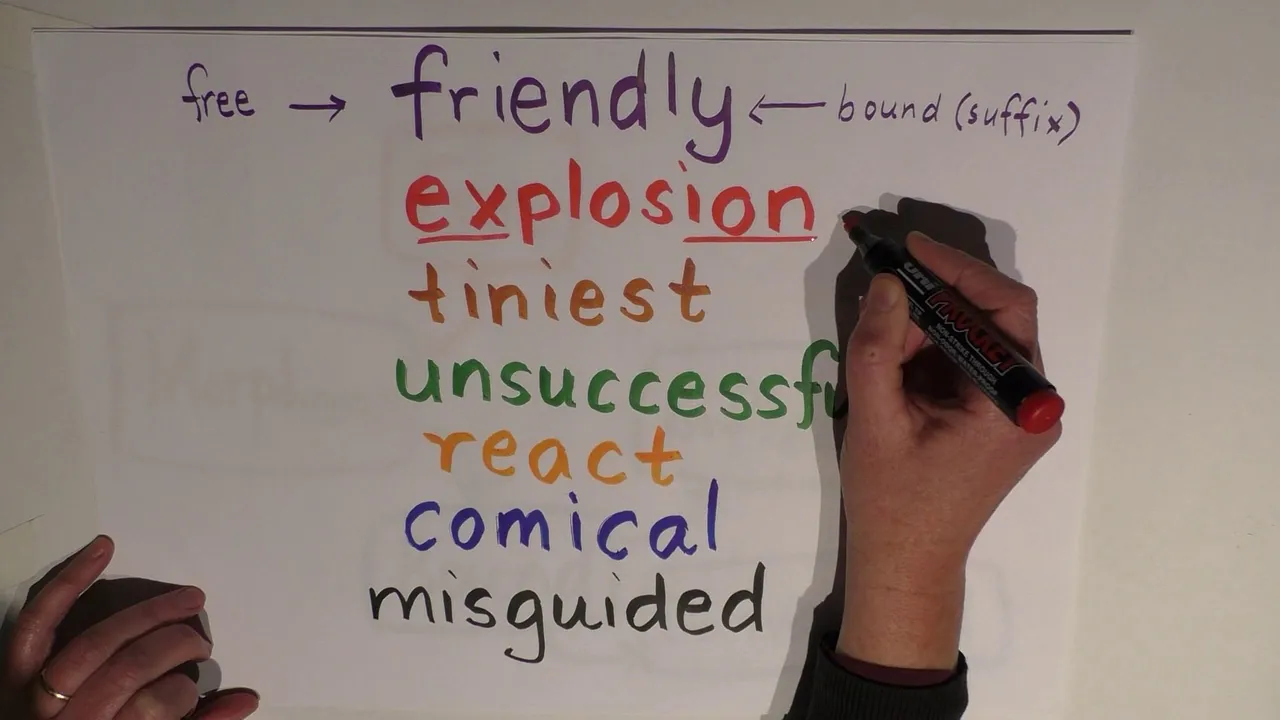
To understand Poplack's Free Morpheme Constraint, you must first master morphological structures. This video outlines the essential definitions of free morphemes (can stand alone as words) versus bound morphemes (must be attached to stems, like prefixes or suffixes).
Knowledge Checkpoint
- Define a free morpheme and a bound morpheme.
- Give examples of derivational and inflectional bound morphemes.
- Explain why a switch like "run-iendo" (English verb stem + Spanish progressive suffix) violates Poplack's Free Morpheme Constraint.
Why this video
This tutorial reinforces morphological concepts, showing how languages combine bound morphemes to form grammatical structures. This serves as the baseline for assessing why bound morphemes resist switching across languages unless full phonological adaptation occurs.
Knowledge Checkpoint
- Differentiate between roots, bases, and affixes.
- Explain why prefixing a Spanish negative marker like des- to an English root like believable (des-believable) is typologically constrained under Poplack's model.
- Describe the process of lexical integration of a foreign root word.

Why this video
This concise video reinforces the behavior of free morphemes. Free morphemes are the primary sites where grammatical code-switching can safely occur without violating morphological boundaries.
Knowledge Checkpoint
- Define open-class vs. closed-class free morphemes.
- Explain why switching is highly common between nouns and verbs (open-class free morphemes) but restricted for determiners and conjunctions (closed-class) under linear mapping constraints.
Module 4: Myers-Scotton's Matrix Language Frame (MLF) Model
Carol Myers-Scotton developed the Matrix Language Frame (MLF) model as an alternative to Poplack’s constraints. It handles asymmetric code-switching, proposing that one language acts as the host (Matrix Language, or ML) that establishes the grammar frame, while the other language (Embedded Language, or EL) merely inserts content.
Theoretical Breakdown of MLF
- Matrix Language (ML) vs. Embedded Language (EL): The ML provides the structural frame. The EL only provides insertions.
- System Morpheme Principle: All structurally active system morphemes (such as tense inflections, agreement markers, and determiners) must come from the Matrix Language.
- Morpheme Order Principle: The linear order of morphemes in a mixed constituent must conform to the grammar rules of the Matrix Language.
- Content vs. System Morphemes: Content morphemes project semantic roles (nouns, verbs, adjectives). System morphemes express grammatical relationships (inflections, pronouns, complementizers).
MLF Structural Parsing (Sheng Example): Sheng mixes English (EL) into Kiswahili (ML). Kiswahili (ML) verb structure: A-na-ma-play (He-is-them-play)
- "A-" (subject prefix), "-na-" (tense marker), "-ma-" (object prefix) are System Morphemes -> Must come from ML (Kiswahili).
- "play" is a Content Morpheme -> Inserted from EL (English). Result matches System Morpheme Principle!
🔍 Linguistic Gap Callout: Standard linguistics curricula require deep study of Myers-Scotton's text Duelling Languages. Because video tutorials on this model are rare, study the two adjacent videos below, and search separately for "Myers-Scotton System Morpheme Principle tutorial" and "Content vs System Morphemes in MLF".
Recommended Videos
Why this video
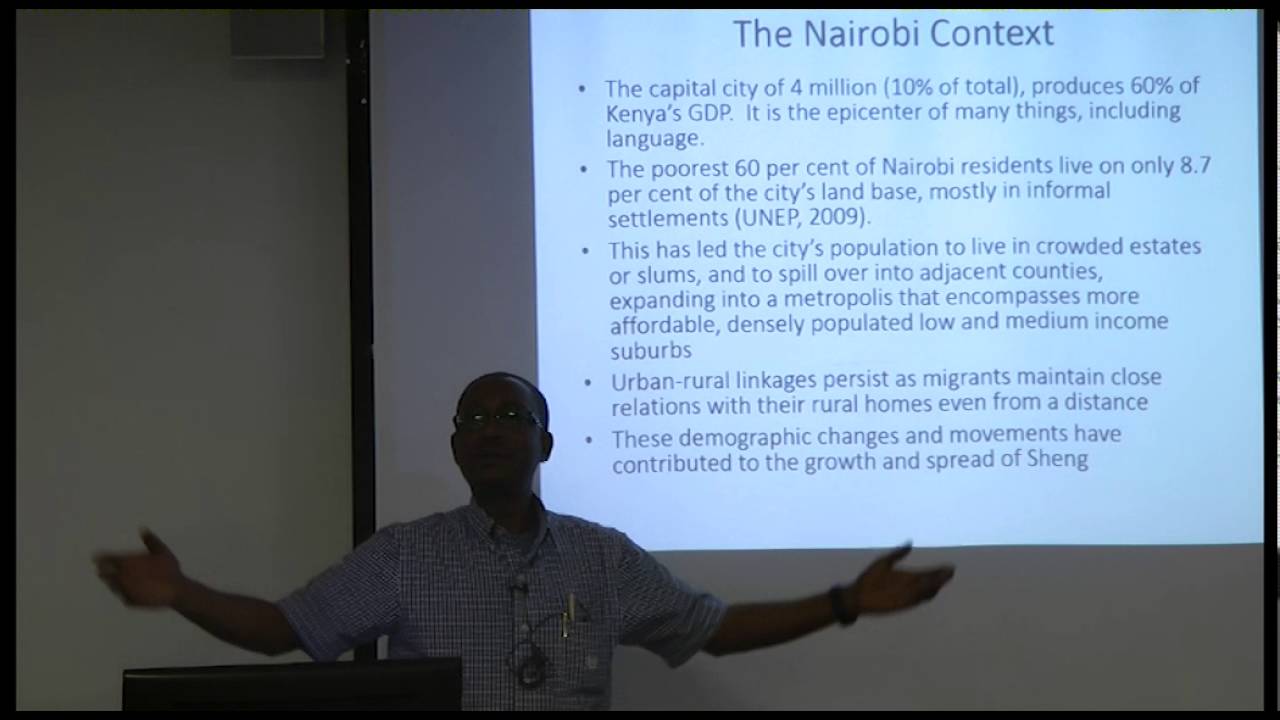
This SOAS lecture clip introduces Sheng (a Kiswahili-English code-switched variety spoken in Kenya). It explains how Myers-Scotton formulated her Matrix Language Frame model by studying how English content morphemes fit into Bantu grammatical structures.
Knowledge Checkpoint
- Identify the Matrix Language (ML) and Embedded Language (EL) in Sheng.
- Explain how Kenyan urban youth varieties illustrate the systemic nature of code-switching.
- Contrast how a symmetrical bilingual model (like Poplack's) differs from an asymmetrical model (like MLF).

Why this video
To apply the System Morpheme Principle, you must distinguish between content and system (function) morphemes. This lecture segment provides clear, psychological-grounding definitions of both types.
Knowledge Checkpoint
- Define content morphemes and identify which parts of speech belong to this category.
- Define system (function) morphemes and explain their grammatical role.
- Apply this distinction to explain why auxiliary verbs and articles are rarely switched independently in the MLF model.
Module 5: Analyzing Real-World Conversational Data
In this final module, you will apply the theories of Poplack and Myers-Scotton to real bilingual conversation data. You will analyze transcriptions of actual dialogue to determine which model best explains the observed switch patterns.
Step-by-Step Corpus Analysis Guide
When analyzing conversational code-switching data, follow these five analytical steps:
- Transcription: Transcribe the bilingual utterance, keeping phonetic and pause details intact.
- Language Coding: Color-code or label every word/morpheme by its language of origin (e.g., = English, = Spanish).
- Identify Switch Points: Locate every boundary where a transition between and occurs. Note whether these transitions happen between sentences (intersentential) or within a sentence (intrasentential).
- Determine ML vs. EL (MLF Analysis): Count the number of system morphemes in the clause. The language supplying the inflectional system morphemes (tense, agreement, aspect) is the Matrix Language.
- Constraint Verification:
- Check Poplack: Does a switch occur across a bound morpheme boundary? (Does it violate the Free Morpheme Constraint?) Does the syntactic order of and match at the boundary? (Does it violate the Equivalence Constraint?)
- Check MLF: Did any system morphemes come from the Embedded Language? (Does it violate the System Morpheme Principle?)
Case Study: Multi-Language Switch Corpus
Let's apply these steps to an actual multi-language transcript. Observe the complex switching in this multilingual discourse segment:

Why this video
This video provides rich, multi-language conversational data. It features speakers switching rapidly between Portuguese, English, Spanish, and Italian. It serves as an excellent complex data set for testing syntactic theories.
Practical Analysis Walkthrough
Let's analyze a segment from the video where Portuguese serves as the base, with English insertions:
- Utterance: "Eu vou fazer o download do arquivo." (I am going to download the file.)
- Language Coding: [Eu] (Port) [vou] (Port) [fazer] (Port) [o] (Port) [download] (Eng) [do] (Port) [arquivo] (Port).
- Identify Switch Points: The switch point is around the noun phrase [download].
- Determine ML vs. EL: All grammatical system morphemes (Eu, vou, fazer, o, do) are Portuguese. Therefore, Portuguese = Matrix Language (ML), and English = Embedded Language (EL).
- Constraint Verification:
- Poplack: "Download" is a free morpheme, so it respects the Free Morpheme Constraint. The linear word order of noun placement matches in both English and Portuguese, satisfying the Equivalence Constraint.
- MLF: The content morpheme "download" is inserted into a Portuguese syntactic frame. The determiner "o" is Portuguese, satisfying the System Morpheme Principle.
Knowledge Checkpoint
- Transcribe and code a 30-second sequence from the video.
- Identify the Matrix Language of your chosen segment by locating inflectional system morphemes.
- Determine if any single-word insertions are lexical borrowings or true grammatical code-switches.

Why this video
In this video, Kim Potowski explains how Spanish-English code-switching is a rule-governed linguistic system. She illustrates that switching requires a high level of syntactic mastery in both languages, and is never arbitrary.
Knowledge Checkpoint
- Explain why a bilingual speaker must have strong grammatical competence in both languages to code-switch.
- Give examples of illegal switch points in Spanish-English based on syntactic clashing.
- Explain how code-switching demonstrates cognitive flexibility.
Course Map
Below is the recommended sequence of study. Each module builds the syntactic and conceptual skills needed to perform the final corpus analysis.
Key People Index
| Researcher | Context & Contribution | Key Theoretical Concepts |
|---|---|---|
| Shana Poplack | Canadian sociolinguist who established code-switching as a systematic, rule-governed area of study. | Free Morpheme Constraint, Equivalence Constraint, borrowing vs. switching distinction. |
| Carol Myers-Scotton | American linguist who developed a structural framework for asymmetrical language mixing. | Matrix Language Frame (MLF) model, Matrix vs. Embedded languages, System Morpheme Principle. |
| John Gumperz | Pioneer of interactional sociolinguistics who studied the social motivations of language selection. | Situational vs. Metaphorical code-switching, "We-code" vs. "They-code" dichotomy. |
Final Self-Assessment
Complete this comprehensive self-assessment to verify that you have achieved the course learning goal.
- Explain the structural difference between a code-switch and a lexical borrowing using phonological, morphological, and syntactic criteria.
- Differentiate between situational and metaphorical code-switching using Gumperz's sociolinguistic framework.
- State Poplack's Free Morpheme Constraint and explain why a structure like "cook-ando" (English verb stem + Spanish progressive suffix) violates it.
- State Poplack's Equivalence Constraint and construct an example of an illegal switch point between two languages with clashing word orders (e.g., adjective-noun position).
- Define the Matrix Language (ML) and Embedded Language (EL) in Myers-Scotton's MLF model.
- Distinguish between Content Morphemes and System Morphemes and list which parts of speech belong to each.
- Explain how Myers-Scotton's System Morpheme Principle regulates grammatical inflections in mixed constituents.
- Perform a step-by-step syntactic analysis on a raw bilingual conversational transcript. Identify the Matrix Language, map the switch points, and test them against both Poplack's and Myers-Scotton's models.