





![[NCLC 2024] The Power of Language: Consequences of Bilingualism for Cognition and the Brain](https://i.ytimg.com/vi/LQQ_OKqg-w8/maxresdefault.jpg)





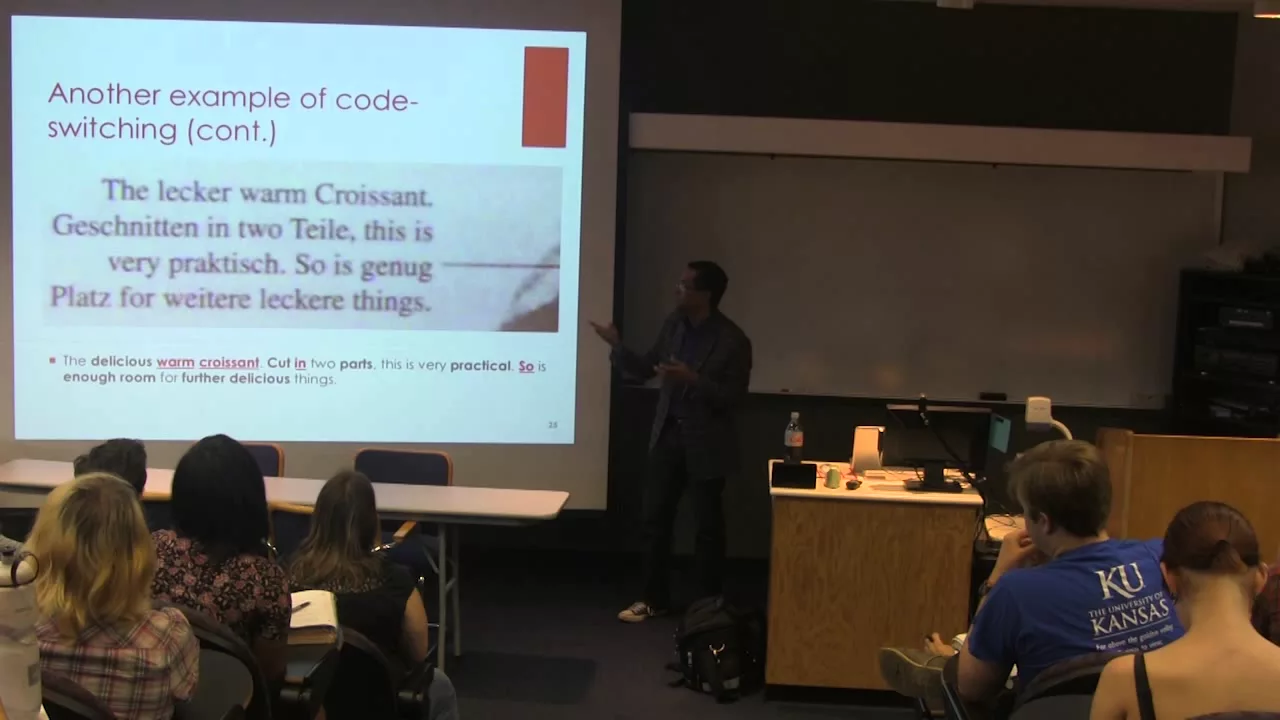





Code-switching is the linguistic phenomenon where bilingual or multilingual speakers alternate between two or more languages within a single conversation, often unconsciously, serving various communicative functions such as expressing identity, emphasizing points, or facilitating understanding; it differs from diglossia in that it occurs within a single interaction rather than across different social contexts, and takes forms including intersentential switching (entire sentences), intrasentential switching (within sentences), and tag-switching (language tags inserted mid-sentence).
Code-Switching in Bilingual Speakers: Definition, Types, and Examples
Added:Basic concepts of bilingualism and multilingualism, including varying levels of linguistic proficiency and language acquisition.
An introduction to sociolinguistics, specifically how social context, identity, and cultural factors influence language use.
Fundamental linguistic structure terminology, such as syntax, morphology, and grammar, to understand where language shifts occur.
The concept of communicative competence—the intuitive knowledge of how to use language appropriately in different social situations.
The cognitive science of bilingualism, including executive function, brain activation patterns, and cognitive advantages of managing multiple languages.
Advanced linguistic phenomena arising from language contact, such as lexical borrowing, pidginization, creolization, and language attrition.
Translanguaging as a pedagogical practice in educational settings, examining how bilingual students utilize their entire linguistic repertoire to learn.
The role of code-switching in digital discourse, social media, and modern literature, and its impact on identity construction and group solidarity.
502.4K views16.6Klikes10:21Original Release: 2017-01-25
Follow Langfocus on Facebook, Twitter and Instagram.
Hello everyone, (see screen) Some people are monolingual and speak just one language.
Other people are bilingual or multilingual and speak more than one language.
Bilingual or multilingual people sometimes switch back and forth between two or more different languages.
This is called code switching.
One situation in which code switching is common is within immigrant families.
For example let’s imagine a Russian family moves from Russia to the United States and the children grow up speaking Russian as their native language but they learn English outside of their home.
When the children of that home speak to their sibling, they might code switch between Russian and English.
Another situation where code switching is common is in certain countries where a native language is spoken alongside a former colonial language.
One example that comes to mind is in India where Hindi-English code switching is common.
And another example is in the Philippines where Tagalog-English code switching is common.
You may have seen my earlier video on “Diglossia”, which means switching between 2 different languages or 2 different forms of a language in different situations.
For example, formal versus informal situations.
Code switching is different in that people switch languages in a single situation within a single conversation and sometimes within a single sentence.
Code switching is largely unpredictable and speakers often impulsively switch languages without any conscious choice.
In code switching one language is the dominant language, normally the native language of the group.
This is sometimes called the matrix language and the additional language is called the embedded language.
The matrix language lays out the basis for the communication and then utterances from the additional language are embedded into the matrix language.
There are various reasons why people might switch from their matrix language to an embedded language.
Number one: Directive function.
People switch languages to either include or exclude other people from the conversation.
Maybe you want to tell secrets, so you switch to a language that the people around you don’t understand or maybe the opposite.
Maybe you want to end the private conversation and re-engage with the people around you, so you switch to a language that they do understand.
Number two: Expressive function.
People include the embedded language in order to express some part of their identity.
For example, they want to show their connection to a certain country or culture.
And in some cases it might be an expression of status through association with the prestigious outgroup.
Number three: Referential function.
Someone who is unable to express an idea easily in one language, switches to the other language in order to express it more easily.
This seems to be very common among bilingual children and immigrant families.
Number four: Phatic function.
Sometimes the speaker switches languages or repeats something both languages in order to emphasize it.
Number five: Metalinguistic function.
This is reporting something in the other language, or commenting on something said in the other language.
For example, you’re speaking in Japanese but then you quote a lyric from an English language song, without translating it.
Maybe you say something in the embedded language but then you explain it or add further commentary in the matrix language.
Number six: Poetic function.
The speaker says certain words or makes jokes in the embedded language for amusement or for some kind of artistic purpose.
Code switching takes a few different forms. Here are some of the main ones.
Number one: Intersentential switching, in which the language switched for entire sentences or clauses.
For example, a bilingual Spanish-English speaker says: ”Sometimes I’ll start a sentence in English y termino en español.” Number two: intrasentential switching, the speaker switched languages within a clause or sentence boundary.
Here’s an example from a bilingual English-Portuguese speaker’s speech: “I don’t know o meu lugar nesse mundo”.
This means :”I don’t know my place in this world”.
Number three: Extra-sentential or “tag-switching”.
A tag from one language is inserted into an utterance in another language.
For example a bilingual English-Japanese speaker might say: “It’s a good movie, deshou?” meaning, it’s a good movie right?
Let’s look at a couple of cases of code switching.
The first one is from the Indian movie: “The Three Idiots”.
The matrix language is Hindi and the embedded language is English.
The background to the scene is that the director of the university is welcoming the incoming freshmen students.
"Don’t forget के हरै साल ICE में चारे लाख select होते हैं। you!
Now let’s take a look at the sentence we just heard.
The sentence means: “Don’t forget, ICE receives 400 000 applications a year, and of those only 200 are selected: YOU!” The first clause of this sentence, “don’t forget”, is in English, this is intersentential code-switching because the switching occurs at the clause boundary.
This is probably done to draw attention to the phrase, which is the phatic function.
“Applications” is also in English, switching within the clause or sentence boundaries.
I suspect that this word is in English because it’s referring to college applications and words related to academic affairs are probably said very frequently in English.
“Select” is also in English, this is intrasentential switching again.
The speaker or the scriptwriters probably chose to say this word in English in order to emphasize the importance of this action of selecting the freshman students.
And of course “You” is in English.
This is intersentential because it occurs at the clause boundary.
This word was probably set apart and said in English in order to emphasize the selection of these particular students.
So again that’s the phatic function.
In general the speaker in this scene might be using English because he’s the director of a university and English is seen as an integral part of academic life.
Let’s look at a second example, this time from the Filipino movie: “My Babe Love”.
Now the background to the scene is that the young woman’s father and the young man’s aunt have started dating each other.
Let’s take a look at the whole scene first.
Guy: “ So, ok lang ba sa iyo yung Dad mo sa ka young...” Girl: “Of course not! Nothing personal ha pero excuse me ang ganda ng mommy ko.” Guy: “So, ano ang ibig sabihin?” Girl: “Wala. Sinasabi ko ang magandang mommy ko.” Guy: “So, aunty ko hindi?” Girl: “Well, mas maganda ang mommy ko.” Guy: ”Well, mabait ang aunty ko.” Girl: “Still mas maganda ang mommy ko.” Guy: ”Fine!” Girl: “And besides, ayo ko rin naman Aunty mo para sa Daddy ko. if that what you wanted to hear.” Guy: ”Edi good. At least we agreed on something.” Girl: “I have to go now. Baka hinahanap na ako ng... Bye.
Now let’s look at a few parts of that scene again and break them down.
Guy: “ So, ok lang ba sa iyo yung Dad mo sa ka young...” Girl: “Of course not! Nothing personal ha pero excuse me ang ganda ng mommy ko.” Here we see intrasentential switching with English phrases embedded into a Tagalog sentence.
In her reply I think the woman switched to English to emphasize certain points.
The main message of her reply, that her mother is beautiful, is in Tagalog but this is an emotional conversation and the English phrases draw attention to how she’s feeling.
Guy: “So, ano ang ibig sabihin?” Girl: “Wala. Sinasabi ko ang magandang mommy ko.” Guy: “ So, aunty ko hindi?” Girl: “Well, mas maganda ang mommy ko.” Here we see extra-sentential switching or tag switching.
The interjection “well” is in English, but the rest of the sentence is in Tagalog.
“Well” is a word that often comes before a correction or something the other person has said.
She says it with some obvious annoyance, so again I think she’s using the English word to draw attention to the fact that she’s correcting this guy.
Guy:” Well, mabait ang aunty ko.” Girl: “Still mas maganda ang mommy ko.” Guy: ”Fine!” Here we see the same kind of tag switching with “Still”.
That word basically rejects the guy’s response.
And by doing it in English she’s drawing attention to that rejection.
Girl: “And besides, ayo ko rin naman Aunty mo para sa Daddy ko. If that what you wanted to hear.” The first sentence here too begins with tag switching and then she switched to English again for the entire second sentence.
Her second sentence is spoken with some resentment and I think it’s said in English to emphasize that.
Guy: ”Edi good. At least we agreed on something.” The first interjection, “Edi good”, means good then, and is a kind of vindictive expression and then in the second sentence the guy speaks entirely in English.
I think this shows that he’s starting to lose his cool and get annoyed.
Making his speech more emphatic.
Girl: “I have to go now. Baka hinahanap na ako ng... Bye.” In this final comment from the woman we see intersentential switching.
And I think she basically emphasizes the important point by using English and de-emphasizes the less important point by using Tagalog.
The important point is that she’s leaving and the reason for leaving is unimportant.
And she may even want it to be obvious that the reason is a made-up excuse.
She quickly rushes through her excuse in Tagalog. Almost too quickly to even understand.
This kind of code switching using basically fifty percent English and fifty percent Tagalog is quite common in the Philippines especially amongst middle-class and upper-class people.
The reason for switching is not always emotional like in that scene but it’s more often an expression of identity and status.
Code switching is very common in certain bilingual or multilingual environments.
And I hope that these examples gave you some insight into how and why it’s used in certain situations.
The question of the day,for people who live in a bilingual environment: “Do you often code switch between 2 different languages? Tell us a little bit about how and why you code switch.” Be sure to follow Langfocus on facebook, twitter and Instagram.
And once again I’d like to say thank you to all of my fantastic patreon supporters, especially these ones right here on the screen.
Thank you for watching and have a nice day.
Up Next

17:10
AAVE: African American Vernacular English — Ling 101
@Langfocus
1M views•2020-07-03
36:52
Constraint Interaction in Optimality Theory: Epenthesis & Deletion
@Vidyamitra
180 views•2018-08-20

15:23
Tok Pisin: An English-Based Creole Language of Papua New Guinea
@Langfocus
272K views•2019-09-03

21:32
Accent Expert Explains U.S. Regional Dialects | Part 1
@WIRED
9.3M views•2021-01-21
Related Study Plans & Knowledge Roadmaps
Structured learning paths in Linguistics
linguistics
Optimality Theory: Tableaux & Constraints
01Phonological Basics: Sounds, Syllables & Rules
02Foundations of Optimality Theory: GEN, CON, and EVAL
03The Constraint Inventory: Markedness vs. Faithfulness
+ 2 more learning modules
15h5 modules
Explore Roadmap
linguistics
Morphosyntactic Alignment: S, A & P Systems
01Foundations of Syntax: Transitivity and Arguments
02The Linguistic Variables: Mapping S, A, and P
03Nominative-Accusative Alignment
+ 3 more learning modules
12h6 modules
Explore Roadmap
linguistics
Analyzing Sign Language: Phonology & Syntax
01Foundations of Sign Language Linguistics
02Phonology: The Five Parameters of a Sign
03Morphology: Word Formation and Classifiers
+ 2 more learning modules
14h5 modules
Explore Roadmap
linguistics
Pragmatics: Speech Acts, Grice & Politeness
01Introduction to Pragmatics: Meaning in Context
02Grice’s Cooperative Principle & Implicature
03Speech Act Theory
+ 2 more learning modules
14h5 modules
Explore Roadmap