











![The most cursed language (I actually got cursed) [CCC4]](https://i.ytimg.com/vi/ZdyVgmRqUgw/maxresdefault.jpg)





Code-switching research requires questioning fundamental assumptions: (1) Intra-clausal switches should be defined by linguistic material inserted into a morphosyntactic frame rather than just linear switch points; (2) Valid criteria for distinguishing switches from borrowings require subtle peripheral measures of integration (like soft mutation in Welsh) rather than general morphosyntactic integration; (3) Community-specific norms significantly influence code-switching patterns, with Welsh speakers showing strong preference for Welsh matrix language while Miami Spanish-English speakers show no such preference, and these norms appear to be acquired early in childhood.
Code-Switching Research: Assumptions, Borrowings & Community Norms
Added:The foundational definition of code-switching as the alternating use of two or more languages or dialects within a single conversation.
The basic linguistic distinction between lexical borrowing (morphological and phonological integration of foreign words) and code-switching.
Fundamental concepts in sociolinguistics, particularly the definition of speech communities, linguistic repertoires, and communicative competence.
An understanding of basic linguistic research methodologies, including corpus linguistics and elicitation techniques.
Advanced theoretical frameworks of code-switching, such as Carol Myers-Scotton's Matrix Language Frame (MLF) model and Poplack's Constraint Model.
The paradigm of translanguaging, which views a bilingual's languages as one integrated cognitive system rather than two separate systems.
The study of psycholinguistic mechanisms behind language activation, inhibition, and cognitive control in bilingual speakers.
Applied research on how community-specific bilingual norms influence language policy, standardization, and bilingual education systems.
961 views23likes1:41:50Original Release: 2020-07-08
you you you you you you aleni can start okay okay good morning everyone we're all here today for another great talk which is available for us because of an amazing initiatives namely a burning of vivo the series of talks is possible to a conjoint effort from a Berlin ssso Mozilla linguistica with several international associations among which the committee intl per human named Allen West the Association the linguistica if you know he died America latina associate dad Argentina de studios linguistically the Sociedad Espanola the linguistica the linguistic Society of America the linguistics Association of Great Britain the Australian linguistic Society and the British Association for applied linguistics I think a Berlin's director Miguel Rivera jr. for this wonderful work it is a pleasure to present you professor Margaret Tucker Margaret Tucker is an emeritus professor in linguistics at Bangor University UK and affiliated lecturer at University of Cambridge her research career has included a focus on British sign language biding requisition and most recently code switching at Bangor University she was the founder director of the Center for Research on bilingualism where she also had a research group which collected the data she will be drawing on in her talk today professor Margaret would like to divide her talk in three sessions with three different topics you may prepare your questions to the end of each session not only for the end of the entire talk so thank you professor Margaret for being here with us today Mangia obrigada pelican vici so I'm sharing my screen I'm not sure if you can see it not yet ok I will have another try yes you can see it now yes oh yeah ok so as you know my title is questioning assumptions in code-switching research and I'm going to be addressing three particular questions corresponding to the sections that Alena mentions and these three questions are what is code-switching or CS as you'll sometimes see the abbreviation secondly what are valid criteria to distinguish switches from borrowings and thirdly what evidence is there for community specific norms in code switching patterns so code switching is often defined as involving the use of more than one language in a conversation or another speech event and by now it's really become an established area of linguistics it marks a departure from centuries of study which focused mostly on just one language at a time and it arguably provides new perspectives for fundamental questions such as what is a language what does it mean to be bilingual or how is language contact related to language variation and change bye bye now so much has been written on code-switching that some of the concepts will doubtless be familiar to many in the audience but some of the most familiar concepts are not as transparent as they seem so in this talk I plan to revisit some familiar concepts from a critical point of view and also to introduce less familiar ideas that I think merit more attention so these are the three questions that I'm dealing with today but before I embark on trying to address them I must acknowledge the funders for much of my research the Arts and Humanities Research Council of the UK and the Economic and Social Research Council of the UK and also Bangor University on the right hand side of the slide you'll see quite a long list as well of many collaborators with whom I've had the pleasure to work largely at the bilingualism Center in Bangor but also in other places since then so I would really like to express my gratitude and I'd like you to bear in mind that the findings I'm going to talk about are the result of collaboration I also want to show you this website we call it banger talk and you can see the actual website at the top of the slide because here we have deposited the data that my research group the corpus based group collected and most of the examples that I'll be using today you can actually find by looking at the corpora on this website not only the transcripts but also the sound so please feel free to make use of that as a resource you'll see on that website and also this slide gives you an idea of the three corpora that we have collects and which you can find there and these are corpora involving by bilingual speech from Wales involving Welsh and English from Florida USA a Miami involving Spanish in English and from Patagonia Argentina involving Welsh and Spanish and today I'm going to be talking in particular about the two corpora listed at the top Spanish English and Welsh English and just in case you need a reminder where Wales is it's to the West of England in the United Kingdom and probably Miami is quite familiar to many people but that's a map of Florida showing the position of Miami just so that you know where the recordings were made that I'm going to be referring to so let me start with my first question what exactly is code-switching and it is defined as I mentioned broadly as the use of more than one language in the same conversation and I would like you to listen to a short fragment of a conversation which we collected in Miami between two young men discussing a film they've just been to please just listen at first some of you will understand Spanish but if you don't it doesn't matter just listen out for the English part and notice went the way the language changes it was like like a motor for them he was like a murder a murder yeah c'mon asesino okay yeah after yong-su come on - come on Eli yeah you know they were like living like no yeah but they're crazy they kill people like no they don't kill people they don't kill you know Madonna so preventing a Madonna la gente como no photo pero exactly that's like that's killing people because there were still some survivors lot so just a reminder where those data were collected and here is a transcript of what you heard you won't be able to see it in detail but I would like you to listen to the recording once more just noticing that there is switching back and forth and on this slide the parts outlined in blue are where the speakers are mostly speaking English and red Spanish and I just want you to get an idea of the back and forth so just once more of that conversation now it was like like a motor for them he was like a murder a murder yeah come on one sec no okay guy often yong-su the money to come only i yeah you know they were like living like no yeah but they're crazy they kill people like no they don't kill people they don't kill you know Madonna so preventing a Madonna la gente como no father pero exactly that's like that's killing people because so um that fragments I think most people would agree involves code-switching but what do we actually mean by a switch and this is something I don't think has been discussed a lot it's taken for granted but is it actually a point in an utterance where the language changes or is it the actual material resulting from a switch so if we go back to this transcript and we consider could switches be the actual points at which the language changes which some researchers seem to suggest then we could insert arrows at the main changes between Spanish and English and that would be one way of defining a switch but will that always work for all kinds of data and I'm now going to play you a recording we made in Wales so Welsh and English speakers unless you are a Welsh speaker you may not be able to follow much of it but do please listen out for the English words or phrases Singapore never ever feed you about covering don't say spiel I already just felt like Cringer of course because I have spiders little umbrella I am more faith a lot of us wish it were me so here's the fragments of what you heard and just like before I've marked English in blue and the other language in this case Welsh in red and you can see that there's quite a lot of changing from one language to the other even within the same utterance the same clause and I think you'll notice this is a quite different kind of code switching from the Spanish English example I gave you so what happens if we try to find the points of switching if we see switches as points here well we need arrows at all the changes between the red and the blue between the Welsh and the English and in fact what we've been seeing are two different types of code switching those two examples I played you one from Wales and the other from Miami and the Welsh English examples were what we would call intra clausal code switching switching insider clause here's another example from Welsh we are on some pipe so the speaker is saying referring to somebody waiting for a plane ticket probably my you're on standby he is on standby whereas another example that I'll play you from Spanish and English is quite different in structure a simple my complete oh I see so I said to him talk to me in two more years so the speaker starts off with an entire clause in Spanish and cm pyramid accompli the sassy and then she goes on to another clause in fact a complex one in English and it's very common to draw distinction between those two types of clause the intra clausel and the inter clausal and they may be different in terms of how you identify the switches so I'm going to concentrate now mostly on the intra clause or type of switching because that is where you've got both languages in the same Clause and hence if you like the two grammars come up against one another and it's a very interesting question what the switch where the switch is located so I want to consider whether the linear approach that we looked at in the Spanish English data where you've got clauses and switches between them will work with this kind of intra causal switching or switching inside the clause so here let's try this approach so in this linear way of looking at things so which is a scene as points in time and we've got some more data from Welsh and English where the speaker in the first example says my own who and right sort of brown the other speaker says only just vellum clean jaw and I was just cringing and the third speaker says Argan and hooray wolf spider named through Beth Beth Lee and they have some wolf spiders or something like that so if you look at these three examples well the first one has just one switch points between the Welsh and the English part so maybe that doesn't work too badly I finding a switch point but then the second one we've got a switch point just before the verb cringe and then we've got another switch point afterwards because cringe is followed by a Welsh verbal suffix which indicates a non-finite verb and then in the third example we've got arguably two switch points one before the phrase wolf spider and the other one after it and this kind of example leads me to ask what does it mean when researchers say as they increasingly do in published work there is directionality of switching here what kind of directionality are we talking about are we saying in these examples that we start off in Welsh and then go back to English well that works for the first one but for the other two examples it seems that we start in Welsh go back to English and then go to Welsh again is there another way of viewing switches well looking at intra clausal switches of this kind we can look at them instead of points which I've now crossed out in the red box we can see that the switches as involving inserted linguistic material so this is a more syntactic approach it's not just kind of one thing after the other and oh we've got to switch and then we've got another switch and in the sequence of events in time instead we're actually looking at the syntax and we're looking at the fact that in these cases we can see if we're familiar with Welsh which I appreciate many people may not be but if we look at the first example just to take that one Welsh clauses start with the verb so Welsh is a verb subject object language unlike English which is subject verb object and the first word is a verb and the speaker is talking about something that is sort of brown and that is an inserted adjective or phrase on the other hand the second speaker she uses a non-finite verb from English cringe but all the syntactic structure otherwise is Welsh so she starts off again with a verb and she has the subject agreeing with the verb and so you can see cringe as an insertion rather than a switch to English and then a switch back to Welsh some people who are listening might think well that obvious but it's not always obvious in the literature which is why I thought it worth discussing and then in the third example we've got an insertion of an English noun phrase will spider in an otherwise Welsh multi syntactic structure so I want to just outline a fairly well-known syntactic approach to identify switches that some of you may be very familiar with so bear with me if you're familiar with it because I think it's important to understand to contrast with a linear approach to code switching and it's something that we have applied to both our Welsh English and our spanish english data i'm going to describe it perhaps fairly unusually as in terms of the method that's involved to make it simpler and practical and so what we do when we're trying to identify to use a matrix language frame to identify switches the first thing we do is to extract all the clauses in the data which contained finite verbs and we look at both on a lingual and bilingual data we then identify the morphosyntactic frame of the clause otherwise known as the matrix language and I'll tell you about that in more detail very shortly and then we identify the insertions which we find in the matrix language in other words those parts of the clause which are not in the matrix language we identify them and switches from the other language and the other language is sometimes referred to as the embedded language of the e/l and then having done all that we can code the clause as monolingual or bilingual and on the slide I've got in more detail the morpheme order principle which comes from Mayas Cotton's work since she formulated the matrix language frame approach which has to do with identifying the word order and then the system morpheme principle which has to do with identifying the grammatical types of morphemes for example the finite verb inflection so it's probably clearest if I use some examples to illustrate how that works and we'll take the example you've already seen my or on standby and in this example in identifying the matrix language you look at the word order and we see that the verb comes first followed by the subject that is not in normal English order accepting questions this is not a question it's a statement so that looks rather Welsh like at least more Welsh like in English and then we look at the finite verb and we see that it's my the verb to be which is in this case in the form of the third-person singular present tense and we can then conclude that we've got in this example a Welsh matrix language and English is the embedded language because we have an English embedded chunk another example fairly unusual type of utterance in our data but occasionally found it's not on or gooble where a speaker is saying something is not really acceptable it's not on or Google means at all in Welsh but the morphosyntactic structure is English rather than Welsh we've got the subject preceding the verb as happens normally in English and we've got the finite verb is third-person singular present tense and so we can conclude we've got an English matrix language with a Welsh insertion third example or third slide with two examples on it is from Spanish and English just in case you might get the impression that Spanish English code switching is never intercourse or what it is you saw an inter clausal example right at the beginning but here just to show you two examples with different matrix languages the first one again from the Miami data my mum got the Manguera so you can probably hear quite clearly that you've got an english morphosyntax ik frame there you've got English word order which actually is not all that different from Spanish you've got an English finite verb and then you've just got one noun inserted after an English definite article my mum got the Mangueira so here we've got an English matrix language and a Spanish embedded language or Spanish insertion second example is quite the other way around a software and in front desk at no reception meaning that was at the front desk in the reception here the Spanish the matrix language is Spanish given that you've got the finite verb for a third-person singular past tense and you've got the definite articles in Spanish as well the embedded language provides just one phrase and one noun both of which are inserted after Spanish determinants or articles so that's just another a couple of examples to show you how you identify the morphosyntactic frame or matrix language so you're going back to our question about what exactly are switches we've seen two alternatives we've seen switches which were identified simply as points in time a linear approach and then we've seen a more syntactic approach where switches are seen as linguistic material inserted in a morphosyntax frame well doesn't make a difference I mean does it really matter what we call it maybe both approaches are directly mapable from one to the other maybe they're actually equivalent so if we go back to these two examples we've just seen from Spanish and English and we put in arrows to show the switch points maybe it's just the case that an insertion viewed in a syntactic type of way just comes after a swish point switch point sequentially well that seems to work for the first example my mum got the maenge arrow we've got the switch point and then we've got the insertion after it so maybe we can just say okay wherever there's a switch point and insertion follows well does that work with the second example a software no front desk and a reception well it works a lot too badly until you get to front desk because you've got a switch point then you've got an insertion but then you've got to have another switch point because you're going back from English to Spanish and then well no that doesn't really work because the next insertion is reception syntactically so they really don't correspond and the problem gets worse if you have examples where what you would syntactically identify as an insertion appears at the beginning of the clause so from our data from Miami we find in whoever's I have a train amazing meeting meaning on Thursday I have a trainer meeting well the adverbial and whoever's the time the meeting takes place Thursday happens to be placed at the beginning of the clause but it could appear at the end you could imagine the speaker might say I have a trainer meeting and whoever's and so would you define the switch differently on the switch point approach because you've got an whoever's in different positions so you'd have an arrow to show the switch point here but then the material where would it be are we talking in terms of directionality which is often mentioned used as a term in the literature have we got to switch from Spanish to English or what and what about this second example la comida you have here two that also appears in our data meaning the food you have here - well you might hear somebody say you have lack or me though because la comida here is an argument of the verb it's the object it's been put in a focus position at the beginning of the clause does that mean that you want to say there's a switch from Spanish to English well in terms of switch points you probably would but in terms of assertion insertions you'd say something different because you'd want to say that I have a trainer meeting shows the order and the finite verb show its English matrix language or morphosyntax frame and we've got a Spanish insertion and the same with the other example you have here - la comida has been put first and so from a directional point of view a live tournament as a linear switch from Spanish to English or do you mean actually there's an English matrix language and then switch and Spanish so I've noticed recently that there's a problem with in this notion of directionality and I just want to give you one example where I think it's really quite unclear it's not the only example in the literature there are many but it happens to come from the recent paper reporting on a psycho linguistic study by Adler at all and there's a sentence describing the stimuli and the sentence says for the code-switch materials all sentences began in Spanish and ended English on the grounds that spanish-english bilingual is in the u.s.
code-switch in this language direction but then the question is what is actually meant by the language direction does it mean inland your terms that people start off in Spanish and finish in English and if you look at the stimuli sentences which very correctly and helpfully the authors have provided every single one in their appendix you see that indeed they're using a switch points notion because every stimulus sentence starts in Spanish and finishes in English well what's wrong with that if it's clear that's fine but they then mentioned that the evidence for the directionality of Spanish English switching is provided by various papers including one by Haring at all but if you look at the paper you actually find that the paper says that the general trend in Spanish English code switching is for Spanish to be the matrix language so and English the embedded language so that would include examples like awareness I have no I'm sorry that would not clued in those examples it would include examples where you have an English insertion at the beginning and a Spanish matrix language afterwards one of the examples of the sentences are causa is a casa de la palin and yellow melted a yellow melted in the freezer due to the blackout the ice melted in the freezer so in terms of switch points that does indeed follow the direction from spanish to english but in terms of matrix language it would be in english not a spanish matrix language so the model really is that when one looks at how what's meant by directionality one needs to be clear what's being talked about and in the end it may be a confusing term more than a helpful one so there are these two alternative ways of understanding the term directionality and they may cause confusion if we disentangle them so now I have come to the end of the first section and just to summarize what I've tried to say about what is meant by code-switching I have said that linear only approaches to code-switching based on switch points ignore important information about the syntactic hierarchy and that instead intra clausal switches are generally best defined in terms of material from the speaker's other language inserted in the morphosyntactic frame of a recipient or matrix language and i've suggested that references to notions like the directionality of switching will be unclear or at worst misleading so i guess if there are any questions so far I'd be happy to take one or two you before moving on okay we have one question from the audience okay Edouard is asking is there a reason why people code-switch ah well I don't think I can give a quick answer to that certainly the early work on color switching by scholars such as John Gompers had many ideas about that and provided a long list of all kinds of reasons which could include repeating ones message or highlighting what wants to say and while that may be the case in some kinds of code switching I think in other communities there's not necessarily a particular meaning for every code switch it's simply the speaker selects that item from the other language at that moment maybe because it's more accessible they've heard it frequently recently for example that could be the reason but there there is quite a lot of literature on this topic okay great now I have a question observing your data uh when when people code switch there is I'm thinking of Synthetica structures they kind of break them so they choose a determinant from one language and then the name from another language what do you think this means in terms of syntax well I have worked of that with a couple of colleagues Jeffrey blocks Allah and my carmine Polito Kuh tool and we also founded the other paper I mentioned by Haring and others that the determiner the language of the determiner tends to match the matrix language and the language of the noun will tend to be from the their language so it fits in with the matrix language frame approach okay thank you we have another question from Clarissa the kind of code switching speakers sorry the kind of code switching speakers do has something to do with the kind of language we are dealing that's a that is a very interesting question and several proposals have been made to suggest that but I think that what's quite interesting in particularly Spanish English code switching is that some researchers are coming up with differences even perhaps fairly subtle differences in terms of constructions used in the types of constructions used in different communities that nevertheless share the same language pairs I'll be talking a bit more about community norms towards the end although not specifically answering that question and maybe I should move on now to the second section if that's okay with you yes great yep okay thank you so the second question I want to address is the question of what's the valid criteria are two distinguished switches from borrowings and this is an extremely controversial question that there really is no consensus on in the literature and I think that we need to find creative ways of trying to resolve it why is it important I've written on this slide what is the big deal quite informally because it is such a big deal it seems researchers debate it continually but it can't just be ignored I would argue as an issue because it has implications for theoretical we'll work as well as practical applications so in the area of theory there are questions of interest like do borrowings start off the switches do they suddenly appear as switches and then gradually become accepted in the language and that will tell us something about language change or secondly is the amount of linguistic integration into a recipient or matrix language a way of distinguishing between code-switching and borrowing and then from the psycho linguistic point of view are switches and borrowings assigned to different languages in the bilinguals mind are there different lists if you like of lexical items and other aspects of the grammar in the bilinguals mind according to which language they're choosing and there are very practical questions that I'm well aware of from collecting and transcribing data is not only which data is actually relevant to test our theory but in the process of transcribing it and marking the language to which individual items belong how do we decide whether they're part of the recipient languages borrowing or actually switching switches from another language so in addressing that question it may be useful to look at this example from Welsh English where the speaker is talking about photography and I'll just play the example Mukunda Miller wide-angle lenses tucking in position under so in this example the speaker is using a Welsh morphosyntactic frame or matrix language and inserting some English phrases and words the phrase wide-angle lenses a type of camera lens and also inserting an English verb and an English noun and so the question is all those actually switches into English or are they borrowings that by now like many English words are accepted as part of the Welsh language and we're fortunate in the case of Welsh to have access to an authoritative and reliable Welsh language dictionary and so the team transcribing Welsh and English would use that to look up these English words and see whether they appear in the Welsh language dictionary because if they appear in the Welsh language dictionary you cannot reliable say that you've got a switch you may have to say well this could be a borrowing and so here you've got a screenshot of the Gary added previs called criminy the Welsh universe University of Wales dictionary and in the search box the white box on the top left you'll see that I've typed in the word emphasize and I have not found it in the dictionary you will see it in English as part of the translation of the verb Kenne which is found in the dictionary and which belongs to Welsh and so we can decide that emphasize is a switch into English on the grounds that it does not appear in the Welsh dictionary and it so happens that the word foreground is also not in the Welsh dictionary so we can can with confidence say that belongs to English and is a switch and then the phrase wide-angle lenses will phrases are in general less likely to be borrowed and it's sometimes easier in the majority of cases in fact I think it's easier to identify them as being switches because the internal syntax the word order of this phrase wide-angle lens has a noun head and a modifier wide-angle which appears before the noun just as you expect in English syntax whereas in Welsh syntax it actually would be the other way around with the main now first and the modifier second so we can resolve in this case in this example the status of those English words or phrases and say they are switches they do belong to English here's another example where the speaker is talking about treatment in a spa and says mine hoon exfoliate yakity Gunter I can sponge or he draws or gyntaf meaning they exfoliate you first and spongy over first well once again we need to look up these English words in the dictionary the Welsh dictionary to see if they could have been borrowed into Welsh and here I'm showing you the results of looking in the dictionary for the word sponge you can act it actually says in Welsh that it's a borrowing from English and we've got the Welsh spelling of the verb to sponge here sponge all so once we find that we have to identify this word as a borrowing because it appears in the Welsh dictionary and so this second example has had the status of the English words resolved in two different directions exfoliate is certainly an English switch it doesn't appear in the dictionary we didn't find it there although I didn't show you the fact that I couldn't find it and but I did show you that I could find sponge oh and that is a borrowing so we do not count it as a switch but this is all very well looking at what dictionaries say what about the actual evidence for distinguishing borrowings from switches so one problem may be that some languages are not codified in dictionaries in fact many languages of varieties are not or the dictionary may not be up-to-date or reliable and as we've seen it's those single word items that are particularly problematic I'll be using the term lolly for loan other language items in other words single words and we'll be looking at the difficulty of identifying whether they're switching or borrowing we often in work on code switching consider that integration of a another language word into the recipient language the language that now uses it is a good criterion for borrowings but the problem is as we shall see what kind of integration is actually relevant we also want to know if borrowings are indeed more integrated than switches and in terms of types of integration phonological integration is actually controversial although it is sometimes used and the reason for that is that some bilinguals will have learned one language later than the other and they may have what you might call a foreign language accent in one of their languages and they may not actually have the option of deciding whether or not deciding unconsciously of course to pronounce a foreign or other language word as in the recipient language but morphosyntactic integration is used more widely and is less controversial but the problem with that as we shall see is that the matrix language frame approach and the left for short suggests that this also applies to switches so what I want to do is to look at two divergent views on the role of morphosyntactic integration of these loan other language items and see what we find which we actually find evidence for and I'll be referring to Welsh English data so the first view comes from work by popular comedian suggesting that any type of morphosyntactic integration into a recipient or matrix language identifies alone other language item as a borrowing rather than a switch so for them we can use all forms of morphosyntactic integration to identify borrowings the second view held by - cotton is that you can divide morphosyntax ik integration into two times a central type and a peripheral type and the central type you would expect because that's what happens to all other language words she would argue in the matrix language frame and so we need another kind of integration more for syntactic integration which is not so central which she calls peripheral and that may be relevant to distinguishing between switches and borrowings so what we'll try to make this more concrete by looking at an actual study but first I just want to identify the two different views more clearly so pop-locking region and pop like Indian for example advocate using a variation aestethic which I would agree it's very useful they compare the morphosyntactic patterns of both languages involved in code switching and in looking at these candidate lone other language items or lollies they try to work out whether this lone other language item shows the pattern of the recipient or matrix language or whether it shows the pattern the more syntactic patterns of the donor or other language and if they find that this lolly behaves like the recipient or matrix language they say well then it must be a borrowing because it's integrated and if it doesn't if it shows morphosyntax it characteristics of the language of origin the donor language then they'll say it's a switch and from many of their studies using this method they conclude that in general single other language items are borrowed and they deal with the problem that some of these other language items might not be in the dictionary might not be well known might even appear only once and they call these nonce borrowings borrowings for the fall for the one occasion if you like so that would be their view and their method and the alternative view says well actually not all morphosyntax ik integration counts because all lollies all loan other language items all single words which originally either in the past or in the present moment come from another language all of those are going to be subject to some morphosyntax ik integration and are going to in general for example follows a word order of the matrix language and are going to be adapted morphologically so we've seen that already in the example ex foliate which had the derivational suffix eel added on the end to indicate presumably that it's a verb because in welsh endings of non-finite verbs are very often eel that happens when English words are inserted which are going to be used as verbs but the second view proposed by - cotton is that even though they will always be some kinds of obligatory more for syntactic integration for lollies we could find other types of morphosyntactic integration which are not obligatory and which may be a very good way of distinguishing between switches and borrowings and if that finds support then the logical consequence is that we don't need a category of nonce borrowings because what popped like in median would cool nonce borrowings become borrowings if they're fully integrated but as you'll see it depends how you define integration or how you apply integration so let's look at which of these two views is best supported by some evidence from Welsh and English of course this is got to be supported by other studies and so far we're only talking about Welsh and English and we're using as data the corpus of the Welsh English bilingual speech that I mentioned that you can find on our website Bangla talk and we're looking at both Welsh and English verbs to see what morphosyntactic patterns they show in Welsh morphosyntactic frames and we're going to be asking our English origin verbs actually borrowing or switches we're using a quantitative method comparing morphology of English origin verbs quantitatively with that of indigenous Welsh verbs and we're using two measures of integration of English origin verbs on the one hand derivational morphology this yo ending for verbal suffixes and something I'll explain called initial soft mutation and this is based on work that I did with Jonathan stammers so let's look at the predictions regarding the integration of English origin verbs by these two means on the one hand Welsh derivational morphology and mutation so under view one Welsh derivation of morphology that is the additional the addition of a verbal suffix the EO suffix according to view one English origin verbs in Welsh will behave categorically either like Welsh verbs or like English verbs and that will help distinguish whether they're switches or borrowings on the other hand of you to says that all English origin verbs would be expected to have Welsh derivational morphology categorically as predicted by the matrix language frame so there are different predictions about derivational morphology and if we look at mutation presumably the new one would say that English origin verbs would be classed as borrowings if they have both Welsh derivational morphology and a mutated like Welsh verbs so there would be no distinction drawn between those two types of integration and if they have the integration they'll be borrowings if they don't they'll be switches but if you two would say in contrast that in terms of mutation we want to compare these English origin verbs with Welsh verbs and we'll count modes borrowings if they behave in the same way as Welsh verbs so according to view 1 both types of integration are relevant to distinguish switches and borings and according to view two of those two types of integration only mutation will be relevant to distinguish switches and borings I haven't yet explained how mutation works but that's coming up but first of all want to tell you what types of verbs we looked at so we extracted three types of verbs from the Welsh and English corpus data we the first type was a Welsh origin verb like coffee or which means to remembrance an indigenous verb that's not taken from English the second type was an English origin verb which is originally from English but has become established in the Welsh language found in the Welsh dictionary the word kostial meaning to cost is an example and then the third type was a verb that was not listed in the Welsh dictionary but was used with verbal suffix or could be used with a verbal suffix ile as long as concentrate CO and just to show you how these non-finite verbs with an EO ending are used in constructions in Welsh I'm showing you here an example of what we call a pair of a peripheral construction so sorry I mean a periphrastic construction and the speaker says a duck in Devon fel remote in Eagle meaning and you use the individual remote talking about how to make TV work for example and the way this periphrastic construction works it's got an auxiliary verb coming first or near the beginning of the clause and then as part of that construction we also have the non-finite verb so the the verb to use in Welsh is made up of an auxiliary and a non-finite verb a bit like the do construction in English except you which if you say you do use the individual remote that would be emphasizing it but it's obligatory in the Welsh periphrastic construction to have an auxilary and then the non-finite verb so that's how that works and then to give you the example you've already seen just to remind you my own exfoliat League and tuff so you've got again the axillary starting the sentence and then you've got the non-finite verb in construction to mean to exfoliate so we did two studies looking at possible ways of defining integration the first one looked at the integration of English origin verbs with a Welsh verb or suffix of English origin verbs and we looked at 184 tokens of English origin verbs some were listed in the Welsh dictionary for example carrier meaning to carry partial meaning to pass so these are if you like candidate borrowings the dictionary concealers and borrowings and others were not in the Welsh dictionary if you like candidate switches so activate EO text EO babysit EO meaning as he might guess to activate to text to babysit and 97 percent of these 184 tokens we found did indeed have the Welsh derivational suffix eel so we hardly ever got those English verbs being used in a Welsh more the syntactic frame without this eel suffix and so our conclusion was that Welsh derivational suffixes apply virtually categorically to all English origin verbs used in Welsh whether or not they're listed in the Welsh dictionary and of course according to the Welsh according to the matrix language frame framework we would expect this because we would expect the morphology of Welsh derivational verbs to be added to these English verbs so if you won on the other hand would say okay the fact that we've got Oh suffix means that these English origin verbs are borrowings but according to view - we haven't really yet distinguished between switches or borrowings because all of them we would expect to be integrated into the matrix language which in our data is Welsh so we looked then it's another possible way a peripheral way if you like a non central form of morphosyntactic integration that occurs in Welsh called soft mutation and this is actually a morphological process involving changes in word initial consonants and it occurs in specific morphosyntactic environments so which consonants are we talking about well we're talking about voiceless stops becoming voiced so Kurt becomes good voice stops becoming fricatives so death becomes there and which environments are we talking about well I've just got some examples here it's actually quite complex but following certain prepositions we get this mutation following verbs in construction with the auxiliary verb Nate meaning to do and following the third-person singular masculine object pronoun a so it's actually a variable process in both Welsh and English origin verbs as I'll show and this is worth bearing in mind but what we need to do is compare what happens in indigenous Welsh verbs and what happens in English origin verbs of the two types so just to give you an example Kurt becomes good cut initially following a preposition so in Welsh the preposition e means to teo in english and you can listen to this example where are we going we feel mushy so the speaker's saying it will cost eight thousand and this verb kostial becomes gaw steel with agar because it follows the preposition e and here's an example with the verb date to say so this has an initial der which becomes a fricative and this is reflected as it happens in the Welsh orthography nish Eve age do you fancy a pint on Wednesday we'll just play that you see there are two concept is on Wednesday so here you've got initial mutation once again in the environment of this construction with the verb need and then here you've got an example of Curt occur once again following a masculine pronoun a and in this case the particular verb connects you to connect is not in the Welsh dictionary so you can listen to that that's automatically connected printer computer server at admin they can connect their printer computer and just to emphasize mutation is variable which means we need to do a quantitative study so just to show you that you sometimes get mutation and you sometimes don't in this example the carriage to walk to walk is used and this is an indigenous Welsh verb and it changes to get of it after the preposition e Imanol means together them to do it they edit okay but there's another verb Pony which in this particular instance not always does not mutate to boy knee even though it's in the same environment as carrot following the e the preposition if you listen you you'll hear POI and you will not here boy neither voiced equivalent this DVD boy you got okay so that's the roughly what mutation involves and what did we do we searched for all tokens or verbs in the Welsh English corpus which ended in the verbal suffix E or and we identified those which occurred in those environments that I've outlined with examples known to trigger mutation we coded each token as either mutated or not mutated and we classified the tokens as that from their type that I mentioned before the three types like the Welsh indigenous English origin in the Welsh dictionary or English origin not in the Welsh dictionary and you'll see there the numbers we had 506 tokens all together of which 143 were Welsh indigenous verbs 302 English origin verbs in the Welsh dictionary and 61 English origin verbs not in the Welsh dictionary and so these were tokens of verbs ending in eel and occurring in mutation triggering environments in our corpus and here are the results so what this shows for each of the categories of verbs so we've got the Welsh verbs at the top the English verbs in the dictionary in the middle and the English verbs not in addiction at the bottom and then the blue shading shows the percentage of occurrence of mutation in those environments where you might expect it to occur so what for some people is surprising for the Welsh verbs is that they only mutate when expected to mutate in about 70% of environments actually this is not as surprising as you might think because it's recently been discovered by a former PhD student at Bangor University Moberg grease that mutation is very much associated with formal context and it's a marker of informal context to actually variably drop some of the mutation and all of these data wearing were recorded in informal conversational environments so we get a 70% rate of application of mutation we're expected in the Welsh verbs and actually not a much lower rate of mutation in those English verbs in the Welsh dictionary so we it's about 65% but notice the dramatic difference if you compare the English verbs not in the dictionary with those that are in the dictionary there's really a very low rate of mutation below 20% and so what these results show and we argue is that English verbs differ according to whether or not their borrowings or switches were over listed or not and if they are if they have a rate of mutation which is close to that of Welsh verbs then we can feel justified in coloring the borrowings whereas if they're radically different then we consider them to be switches so our conclusions are that there is support for the second view that not all integration is relevant because the different types of integration integration had different results study one showed that derivational morphology in the form of a suffix eel applied to all verbs as predicted by the matrix language frame theory and study 2 showed on the other hand that English origin verbs in the Welsh dictionary we were mutated similarly to Welsh verbs and so could be considered borrowings while English origin verbs not in the Welsh dictionary were mutated much less and could reasonably be called switches so just to summarize the answer that I'm proposing to my second question and then I'll be interested in your comments and questions we actually need subtle or in other words peripheral measures of integration to distinguish borrowings from switches the general process of morphosyntactic integration proposed by the matrix language frame whereby the matrix language imposes its morphosyntax in general terms it's really not suitable for distinguishing borrowing and switches and if we can find such a subtle measures of integration as we've seen in this case they may not be categorical in their application but they can be studied quantitatively clearly I've only been talking about Welsh and English and work is needed on other language pairs and some interesting work has appeared recently by for example Bessette Spanish and English and possible ways of identifying what we could call peripheral integration okay I'll stop there if I may and see if there are any questions arising okay we have one question from Jana she's from Germany and she's asking um there are some English words that see that is a nice Queens weird which are used in German speaking just like German words that is even in their comparative this is boring isn't it thank you for that question yeah I'm very very interested to hear that so I think it's oh it's amazing like over my lifetime I've noticed how much English is being integrated into German and that is a difficult question because I would imagine I don't know whether the questioner has in mind bilinguals who speak both German and English but I'm suspecting that she does because many German speakers do speak English as well so one would need to have a look to look for some criteria in the instances where these uses occur one would need to see whether there are indications of morphosyntactic integration and I would need to think about how we might try to find that okay I have several examples from Portugal bilinguals Portuguese English but we can talk another time okay you can move on you got go on yes okay fine thank you so the last question I want to address today is the one of what evidence there is for community specific norms in code switching patterns I think this is something which is only beginning to be addressed recently so I'm looking forward to seeing what research comes out in these kind of areas so thinking about norms in bilingual communities most of the work to date has been on norms of grammaticality that's partly to do with the history of how code switching research began and how it looked at structural patterns and in the attempt to establish what patterns represent rule the rule govern nature of code switching so one example of a possible norm of grammaticality is the idea that in many corpora you can identify within clauses a matrix language versus an embedded language that's something that's been widely debated but there's a lot of corpora where that does seem to apply and where it's more difficult to apply this maybe because the languages are either close to one another or their structural characteristics require newer criteria to identify matrix languages but this is where so in structural norms quite a lot of work has been done we know less I would suggest about norms of language choice of course the early work of people like Joshua Fishman looked at choice of specific languages but what about choice of morphosyntactic frames of bilingual clauses or choice of monolingual versus bilingual clauses I don't think we know a lot about what proportion of speech in community actually involves code-switching and or how the matrix language is distributed in bilingual versus monolingual clauses these are areas I think we know relatively little about and we also know don't know very much about how such norms of language choice are shared whether they are shared whether they're uniform across the community or whether they vary according to external factors like gender or age and addressing these questions I think depends on the availability of naturalistic corpus with open access to researchers I think it's really important that people they who have data available can make them accessible because you'll have interesting interests of different kinds and we can try to answer our questions looking comparatively at a whole range of corpora but just to start with I would like to speak about the corpora I'm somewhat familiar with and just to address a couple of very simple questions that I think I'd be interested in knowing the answers to in relation to many corpora I've seen mentioned in the literature so I'd like to know how much code-switching there is and secondly is one language more frequently selected than another and if it is how variable is this so that's what I am interested in at the moment just in relation to two corpora the Welsh English corpus and the Spanish English corpus that we collected with colleagues and I'll start off with the first question how much intricate Mazal code-switching is there so I'm just looking at the question of intro clausel code-switching there is another interesting question about how much intercourse or code switching there is or switching between clauses but this is a fairly simple measure to look at if you've got a way of separating your data into clauses and we did that in both the Welsh English data that I'm referring to and the Spanish English data on the basis of finite verbs and splitting the clauses where there were finite verbs and then as I described before coding these clauses as either bilingual or monolingual and so comparing the Spanish English and the Welsh English data you can see that they look quite similar from this point of view in terms of how much inter clause and code switching there is it's it's around 10% and that's something that it would be interesting to compare with other corpora something which is more different between the two corpora which is quite interesting however is once you've divided the corpus into one or lingual and bilingual classes and identified the matrix language of each clause you see quite a difference so in the data collected in Wales what these graphs show is the percentage of clauses in monolingual clauses in blue in both cases and bilingual clauses in orange so you can see that in the Welsh data if you look at the blue the monolingual clauses you get an enormous preponderance of Welsh matrix language so in other words mostly people are producing monolingual clauses in Welsh and just a few very small number of monolingual clauses in English but larger in number than in proportion in than the clauses that are monolingual English are clauses that have a Welsh matrix language or morphosyntax frame with English insertions and that was what made up that 9% you saw in the previous diagram there were a very very tiny number of bilingual clauses with English ml but they're so small that they don't show up on a chart of this size if you magnified it you would just about see it but it's really very little so in general Welsh speakers are mostly using Welsh monolingual clauses with some insertions from English in Miami the data look quite different though because if you look first of all at the monolingual clauses you'll see that the English matrix language makes up the largest proportion of monolingual clauses if you compare it with the Spanish monolingual clauses but the pattern is actually reversed when you look at bilingual clauses you can see that there are more Spanish builing there are more Spanish Spanish matrix language bilingual clauses that is bilingual clauses that have a Spanish matrix language or more distinctive morphosyntax frame then there are English matrix language clauses that are bilingual so this suggests perhaps two contrasting norms in the two communities regarding language choice but an important question is is this because of individual variability well I don't have time to look at this in great detail but one obvious factor that one might look at is how the home language is distributed between the two communities and if you look at the left hand chart you can see that Welsh is the most common home language the language that people were exposed to at home over 60% of speakers had Welsh only Welsh at home just under 30% had both English in Welsh and the smaller proportion 10% had English at home when they were children and in Miami actually it's a really similar looking pattern at first sight so Spanish seems to be the most common home language followed by both languages followed by English so if the home language were the factor that made a difference in the choice of matrix language we'd expect that to be reflected in the distribution of a matrix language but here you can see the distribution of the matrix language which I showed you before is quite contrasting in Wales and Miami and you can see the information on the home language and so in Wales you can see that the most common Welsh home language Welsh matches the Welsh matrix language being the most common in Wales but in Miami that's not the case because Spanish is the most common home language and yet overall English clauses with English matrix language in monolingual clauses are the most common although Spanish are the most common are the clauses courses with Spanish matrix language are the most common in bilingual clauses so it may be it's too early to say but it may be that there are some specific community norms that people acquire as they grow up in terms of the input they hear not only from their parents but from the community and this is certainly something worth looking at so overall the proposals that I would have at this stage regarding the community norms in both Wales and Miami are that in Wales there's a strong preference for Welsh or symmetric language when communicating with bilinguals and there are English insertions in a Welsh morphosyntactic frame up to 10% of the time in Miami on the other hand there is no strong preference like there is in Wales for Spanish or English matrix language when addressing bilinguals but if Spanish is selected as the matrix language then speakers are significantly more likely to codes which well if there are such norms how do they arise and one place to look I suggest is in bilingual acquisition there's increasing evidence that input to children is reflected in their productions and I'm wondering if this is the case with norms regarding the distribution of the matrix language so recently I did a pilot study on the acquisition of Welsh in English with Shannon Phillips and we used child data on Welsh English acquisition collected in the 1990s we used the Welsh English corpus that we collected from adults as a proxy for the input because the age range of people in that corpus was quite similar to the age of adults in the 1990s because the Welsh English corpus was collected not more than ten years later and just to remind you in the bottom right hand part of the slide you can see the overwhelming predominance of the Welsh matrix language in the adult data so what we're interest what we were interested in was whether this gets reflected in child data in early productions of children acquiring both Welsh and English and here's a list of the children whose data we looked at they were collected in a project by Welsh on Welsh acquisition and English acquisition by Bob Bosley Bob Maurice Jones Michele Aldridge and others and you can find the data at the link that I've given you and they were collected in Bangor and Aberystwyth both cities University cities in fact in North Wales and you can see that the children are quite young starting from as young as one year and five months and the data collection period ending when they were around two and a half so we analyzed the data by taking child turns turns that the children produced in their recordings as the unit of analysis and treating it as equivalent to adult clauses and we extracted just the mixed clauses so the focus here was not on monolingual clauses but on the patterns within the mixed clauses that is clauses containing words from or at least one word from each language so you might have had a two-word utterance with one Welsh and one English word I'll show you some examples in a minute and then we identified the matrix language for each mix clause and as far as possible we use the same criteria as those used in looking at the matrix language in adult speech that is the morpheme order principle looking at the order of words and the system system morphing principle looking at the finite verb and any subject verb agreement so just to show you some examples here were some of the utterances and just looking at the word order which was one of the ways in which we were able to identify a matrix language so dare we for example produced the utterance fishbat meaning a small fish with one word from English fish and the other from Welsh and because the order of the noun an adjective was similar to its order in Welsh we identified Welsh matrix language here and the same for this other example bubble V meaning my bubble where the possessive V occurs after the noun in Welsh whereas it would be normally before in English so we identified this utterance as having a Welsh matrix language on the other hand the utterance Bower fish big fish with the adjectives Mao and meaning big in Welsh before the noun fish that was identified as having English matrix language and then looking at the second principle the system morpheme principle where we looked for finite verbs and subjects they'd agreed with them here is an example my fish where you've got the verb to be third-person singular you've got the subject masculine in fact and fish is a word from English that looks like Welsh syntax in order and in terms of the form of the verb and so that utterance would have been coded as having Welsh matrix language and so the results of the child data analysis actually in the end showed that all of the clauses in the child data had a Welsh matrix language and this is on the left hand side that you can see that chart whereas on the right hand side that is the adult data and it's very very close it's 99 percent and of course there were far there were five thousand nine hundred nate clauses in the adult data compared with only 172 in the children but what we did seem to be finding was a very similar pattern in the children's and the adult speech so our conclusion on the acquisition of community norms was that preliminary results suggest children may acquire the bilingual norm self the community starting as young as two years old and so far there's very little research on other corpora but one exception is hips work on the acquisition of Cantonese English norms in Hong Kong and par to total on the influence of the community language in code switching patterns by developing children in France Germany in Italy and of course we need research in a much wider range of other communities including communities sharing a language pair like Spanish and English so finally I think I will summarize my answers to all of the three questions that I've been talking about today and then I will be happy to respond to any questions in common I guess on all the themes or just on the last one depending what you prefer so just to summarize the answers so the first question to do with what is a switch I've argued that intra clause and switches are most clearly defined in terms of material from the speaker's of the language inserted in the morphosyntactic frame of a recipient language in relation to the second question I've argued that borrowings are more integrated linguistically than switches but the means of integration are subtle and may not be categorical and in relation to the last question I've suggested that a clause based analysis of bilingual data is likely to show a symmetry between a matrix language and an embedded language but in addition there may be community norms regarding the selection of the matrix language in both monolingual and bilingual clauses and here I have some references that you may want to look at later in more detail but I'd like to thank you very much for your attention obrigada okay we have some more questions for you before ending okay that question is regarding the second part of your speech did adjectives or adverbs also showed an imitation or integration as the verbs do in English Welsh data okay so first of all we need that's a very good question thank you for that and you might be wondering why we focused on on verbs of course we needed to find items that would be subject to mutation adjectives in Welsh are subject to mutation if they begin with the appropriate consonants and if they want if they mark feminine gender however the gender marking system in adjectives is not very active that is not many only in a few adjectives do people really still make a gender difference so one example would be mouth meaning Biggs it begins with a Amer and if somebody is talking about a thing a feminine if it if mouth follows a feminine nod it would be mutated to a word with an initial labia dental fricative vowed now it becomes vowel but there are so few examples of that another problem with looking at adjectives is that actually in informal speech speakers don't normally even in monolingual speech use a very large number of attributive adjectives those occurring with nouns and they may not switch very many we have some examples in Welsh but really mutation I don't think applied to any of those so we weren't able to look at that adverbs yes adverbs are often formed by a particle urn which is about Y n followed by an adjective and there is regular mutation of that but I don't think we have very many examples of English adverbs and they probably would be inserted without the welsh particle but thank you for those suggestions if anybody would like to look at the data and find these adjectives or adverbs they they would be very welcome you can actually go to the Bangor talk website and you can search for specific items there so any research would be of great interest to us nice havea for a research yeah have you ever come across the term trans language what's the difference between translanguaging and code-switching well that's a very interesting term we I in Cambridge I co organize a group of people some of whom I think are probably here who we all discuss various articles and we have looked at someone translanguaging I think there's a wide divergence of opinion I can see the use of translanguaging in education as I would see it almost as an ideological position that multilingualism in the classroom should be encouraged but in terms of replacing code-switching or being synonymous to it I'm not sure that in terms of the kind of research I've talked about that translanguaging is a very useful concept but I'm happy to because otherwise persuaded and I it may be that in the realm of education or educational discourse it's a useful concept I'm yet to be enlightened about it shall we say ok great well you would like to thank again professor Margaret for this brilliant talk we're over I think you all for being here with us today and for the questions I'll just I would I'd also like to remind you of the importance of affiliating to Abilene tree strength in the area and I invite you all to continue watching the talks and disseminating the series among your colleagues our professor Margaret we'd like to say some words well I'd like to thank you for inviting me and giving me the challenge of trying to present my research in a way which would be intelligible to people who are not familiar with code-switching as well as interesting to people who are quite specialists in the field so whether or not I've succeeded maybe I shall discover in feedback later but I look forward to hearing from any colleagues or students who would like to get in touch I guess you probably have my I didn't put my email on my slide but I guess you would be able to make it available is that correct yeah I can do that yes okay you all again sorry I just said thank you oh my god thank you all again and goodbyes see you have the next to talk okay thank you very much goodbye bye bye
Up Next

58:48
Sociolinguist Shana Poplack Debunks Language Myths
@Canguroenglish
25.8K views•2020-11-19
36:52
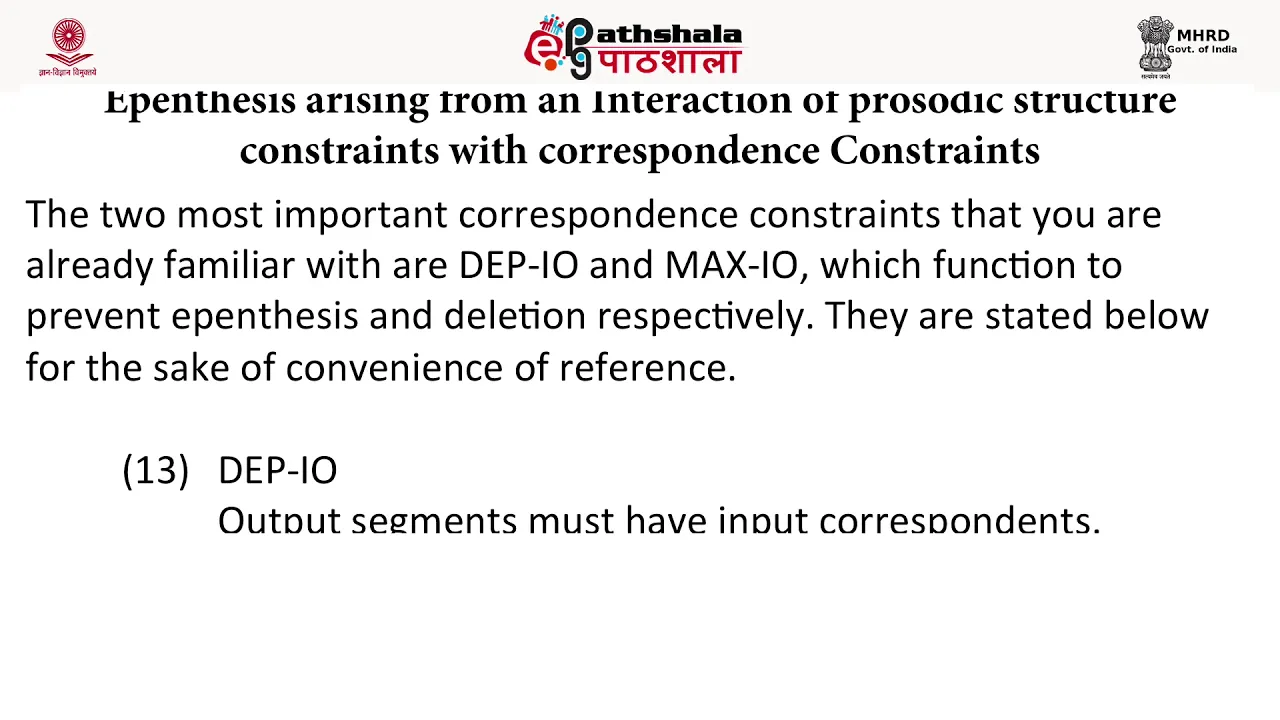
Constraint Interaction in Optimality Theory: Epenthesis & Deletion
@Vidyamitra
180 views•2018-08-20

98:26
Sign Language Negation: Typology and Grammaticalization
@Abralin
1K views•2021-06-09

21:32
Accent Expert Explains U.S. Regional Dialects | Part 1
@WIRED
9.3M views•2021-01-21
Related Study Plans & Knowledge Roadmaps
Structured learning paths in Linguistics
linguistics
Optimality Theory: Tableaux & Constraints
01Phonological Basics: Sounds, Syllables & Rules
02Foundations of Optimality Theory: GEN, CON, and EVAL
03The Constraint Inventory: Markedness vs. Faithfulness
+ 2 more learning modules
15h5 modules
Explore Roadmap
linguistics
Morphosyntactic Alignment: S, A & P Systems
01Foundations of Syntax: Transitivity and Arguments
02The Linguistic Variables: Mapping S, A, and P
03Nominative-Accusative Alignment
+ 3 more learning modules
12h6 modules
Explore Roadmap
linguistics
Analyzing Sign Language: Phonology & Syntax
01Foundations of Sign Language Linguistics
02Phonology: The Five Parameters of a Sign
03Morphology: Word Formation and Classifiers
+ 2 more learning modules
14h5 modules
Explore Roadmap
linguistics
Pragmatics: Speech Acts, Grice & Politeness
01Introduction to Pragmatics: Meaning in Context
02Grice’s Cooperative Principle & Implicature
03Speech Act Theory
+ 2 more learning modules
14h5 modules
Explore Roadmap