Conversation Analysis is a linguistic research methodology that studies social interactions and talk by examining recordings of naturalistic conversations to understand how participants organize communication through four key domains: turn-taking (when speakers know when to speak or listen), repair (how participants solve problems and resume activities), action formation (how speakers produce and recipients understand interactional actions), and action sequencing (how actions are organized into structured sequences that enable mutual understanding).
Conversation Analysis: Key Concepts & Research Domains in Linguistics
Added:Deep Dive
An understanding of basic Sociolinguistics and how language functions in social contexts.
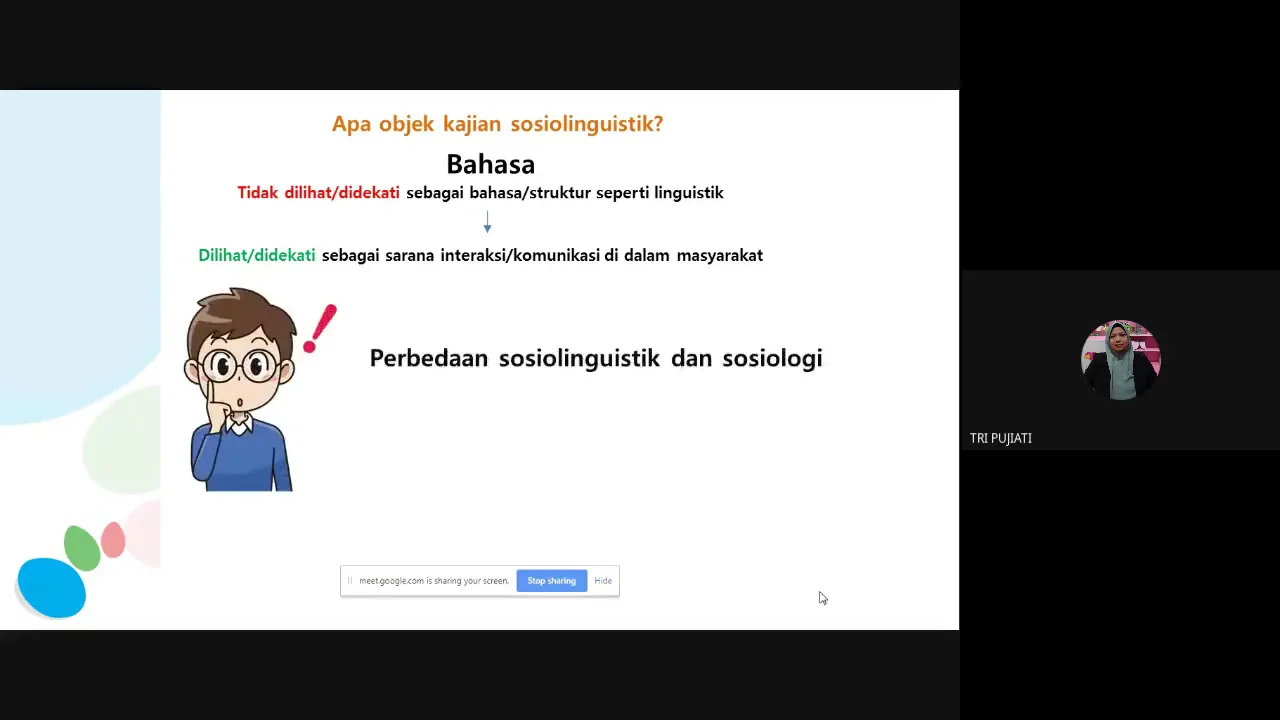
SOSIOLINGUISTIK PERTEMUAN 1
2.3K
Sociolinguistics is a 2-credit course examining language in social contexts. Language functions as a communication tool analyzed internally (phonology, morphology, syntax) or externally (social factors). The speaker (penutur) and addressee (petutur) are fundamental communication roles. Sociolinguistics combines linguistics with sociology, falling under macro linguistics. Key problems include speaker identity (age, education, background), addressee identity, social context, dialectal variation, social evaluation of speech, linguistic diversity, and practical research applications. This interdisciplinary field examines how social factors influence language choice and usage.
Click to watch →

Audiobook: Introduction to Sociolinguistics by J.Holmes. Chapter 1 ' What do Sociolinguists study?'
1.1K
Sociolinguistics studies the relationship between language and society, examining why people speak differently in various social contexts. Language serves multiple functions simultaneously, conveying both information and emotional expressions. People use different styles in different social contexts, and their speech reveals aspects of social identity including relationships, background, and experiences. The same message may be expressed very differently depending on who is listening, where the conversation takes place, and the speaker's emotional state. This foundational understanding establishes that language is never neutral but always carries social meaning shaped by context and relationships.
Click to watch →
Sociolinguistics
596
Sociolinguistics investigates the relationship between language and society, examining how language functions within social contexts. It distinguishes between micro linguistics (individual-level aspects like phonetics, phonology, grammar, and semantics) and macro linguistics (comparative study across languages and families). The field explains why people speak differently in various social contexts and identifies social functions of language. Key social variables influencing language use include ethnicity, religion, gender, education level, and age. Sociolinguistics helps us understand how society affects language and how language conveys social meaning, revealing the dynamic interplay between linguistic forms and social structures.
Click to watch →
An introduction to sociolinguistics: language in society
636
Sociolinguistics is the study of the relationship between language and society, examining why we speak differently in various social contexts and what the social functions of language are; it focuses on language as the central element, distinguishing it from sociology of language which focuses on society, and explores how language reflects and shapes cultural norms, traditions, and social interactions.
Click to watch →

Konsep Dasar Sosiolinguistik
475
Sociolinguistics focuses on how language functions within society. It examines the roles and functions of language in social contexts, including how language is used in different social situations. The field studies how humans use language rules appropriately in various social situations, recognizing that humans are social beings who need communication and interaction with others.
Click to watch →
Deep Dive
Fundamentals of Pragmatics, specifically how context contributes to meaning beyond the literal definitions of words.

Fundamentos de Pragmática - AULA 1
2.5K
Semantics studies linguistic expressions extracted from communication contexts, analyzing meaning outside effective communication and focusing on textual context while ignoring extralinguistic factors. A proposition is an abstract idea that never changes regardless of expression. Pragmatics studies variable meaning influenced by extralinguistic context and communication context. The word 'pragmatics' derives from Greek 'pragma' meaning signification or action. Focus corresponds to new information while topic corresponds to old information, determining how responses are evaluated. The sentence 'The door is open' has identical semantic meaning but varying pragmatic meaning depending on context. Pragmatics began in the 20th century with philosophers like Morrie Secar and was consolidated through Grice's conversational implicatures and Austin and Searle's speech act theory. Contextual elements include social roles, space-time localization, and formality levels. Presupposition is a semantico-pragmatic phenomenon where contextual information is presupposed but triggered by semantic elements. Speech act theory states that utterances perform actions, and for these actions to succeed, speakers must have appropriate authority over listeners. A practical definition of pragmatics is the study of the relationship between meaning and language use. Evidence suggests pragmatics operates at competence level, not just performance, as focus can interfere with truth value of sentences.
Click to watch →

The Science of Linguistics: Language, Dialects, and Communication Science
36K
Pragmatics studies how both literal and non-literal aspects of communicated meaning are determined by principles referring to the physical or social context in which language is used. For example, a speaker saying 'there's no language in which a double negative can mean a positive' is an example of pragmatics, where tone and context determine meaning beyond the literal words.
Click to watch →
![PHILOSOPHY - Language: Gricean Pragmatics [HD]](https://i.ytimg.com/vi_webp/we6uSVf4qss/maxresdefault.webp)
PHILOSOPHY - Language: Gricean Pragmatics [HD]
129K
H.P. Grice's theory of pragmatics explains how people communicate more than the literal meanings of their words by following four rational conversational maxims (Quantity, Quality, Relation, and Manner) under the Cooperative Principle, allowing listeners to infer implicatures—meanings suggested or implied rather than explicitly stated—based on conversational context, purpose, and shared world knowledge.
Click to watch →
Pragmatics
169K
Pragmatics examines how context shapes meaning in communication. Key concepts include schemas (mental frameworks for organizing information), context (surrounding circumstances influencing interpretation), deixis (words dependent on speaker's perspective like 'this' or 'now'), inference (deriving unstated meanings from evidence), presupposition (assumptions taken for granted in statements), and speech acts (utterances performing actions beyond conveying information). Understanding these principles reveals how the same words can convey vastly different meanings depending on situational context, demonstrating that effective communication requires awareness of both linguistic form and communicative context.
Click to watch →
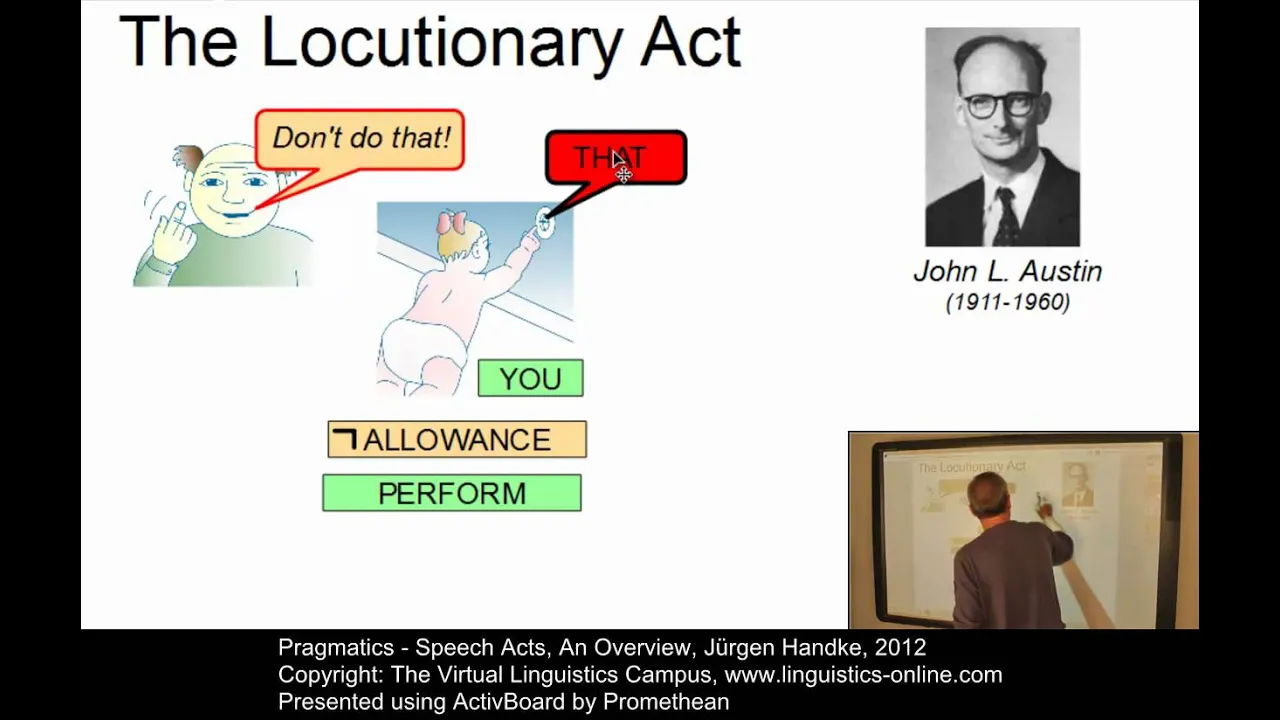
Speech Acts Overview | Pragmatics & Language Use
213.8K
Pragmatics studies how language functions in context, addressing non-truth-functional aspects of meaning. Charles Morris defined pragmatics as the study of signs in relation to interpreters. A fundamental distinction exists between sentence meaning (the abstract meaning of words/sentences) and utterance meaning (meaning in specific contexts). For example, 'it's fairly hot in here' has a plain meaning about temperature, but its use could indicate someone wants the window opened. This distinction between meaning and use is controversial among linguists but essential for understanding how language achieves effects beyond literal content.
Click to watch →
Deep Dive
The distinction between formal, prescriptive grammar and the descriptive study of naturally occurring spoken language.
Descriptive and Prescriptive Grammar
78.1K
Linguistics distinguishes between prescriptive grammar (rules that dictate how language should be used, such as avoiding preposition stranding or splitting infinitives, which are taught and can be broken) and descriptive grammar (rules that describe how language is actually used, which are acquired unconsciously and cannot be disobeyed, forming the scientific foundation of language study).
Click to watch →
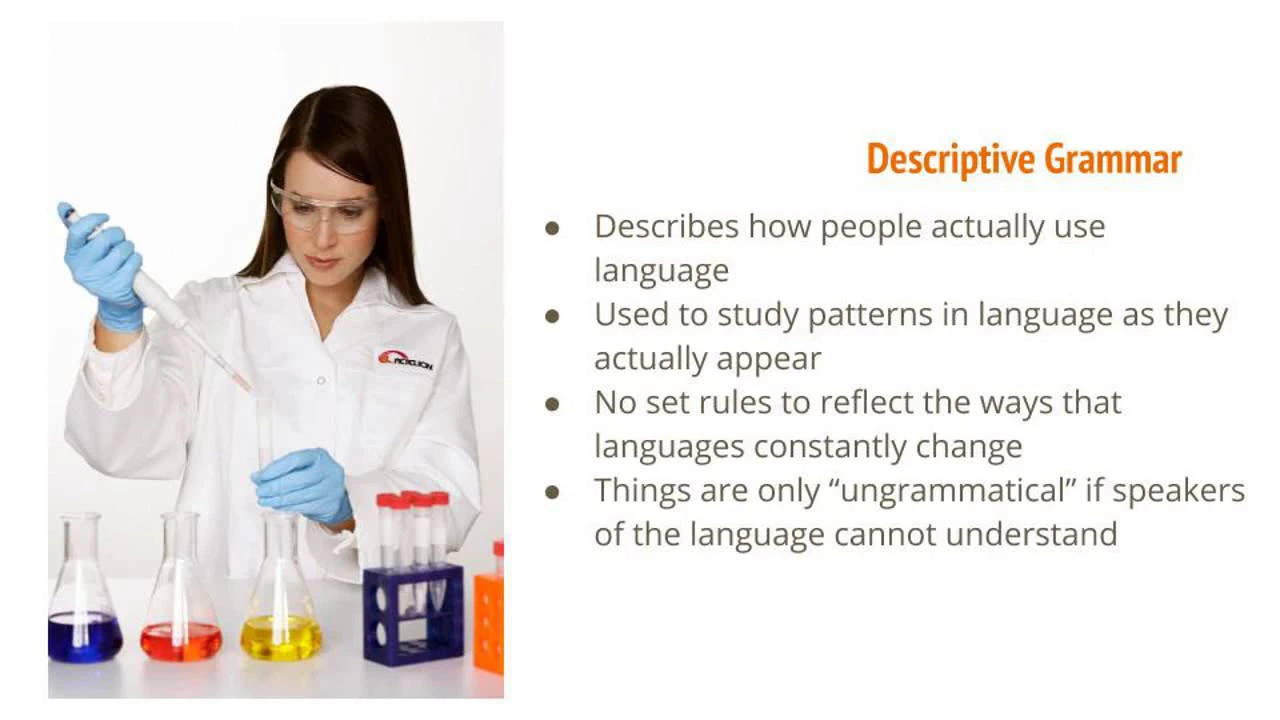
Prescriptive vs Descriptive Grammar | Linguistics 101
12.1K
Prescriptive grammar establishes rules for 'correct' language use (often taught in schools), while descriptive grammar observes how people actually speak and write; both approaches serve different purposes, with prescriptive grammar being useful for teaching language basics and creating rules that can later be creatively broken, while descriptive grammar acknowledges language evolution, dialects, and regional variations, allowing writers to choose appropriate language styles based on their audience and context.
Click to watch →

Prescriptive Vs. Descriptive Grammar | Linguistics | by Muhammad Tayyab
75.4K
Prescriptive grammar prescribes rules about how language should be used, telling learners what is correct or incorrect based on established guidelines, while descriptive grammar observes and analyzes how language is actually used by native speakers without making value judgments about correctness; in prescriptive grammar, rules come first and use follows, whereas in descriptive grammar, use comes first and rules are derived from observed patterns in language usage.
Click to watch →

Steven Pinker: Linguistics as a Window to Understanding the Brain | Big Think
4M
Linguists distinguish between descriptive grammar (rules characterizing how people actually speak) and prescriptive grammar (rules prescribing how people ought to speak in careful written prose). Many prescriptive rules make no logical sense. For example, the rule against splitting infinitives (as in 'to boldly go') was based on a clumsy analogy with Latin, where infinitives are single words. Similarly, the prohibition against double negatives like 'I can't get no satisfaction' reflects historical dialect preferences rather than logical principles, as 'can't' and 'any' function identically to 'can't' and 'no' in terms of meaning.
Click to watch →

「これだけは語らせて!」卒論発表で使えなかったスライドをお見せします
61K
Prescriptive grammar (規範文法) establishes what is considered correct usage and often criticizes deviations from these rules. Descriptive grammar (記述文法) documents how language is actually used, including deviations and innovations. For example, '抜き言葉' (omitted subject) is often criticized by prescriptive grammar but is actually common in modern Japanese speech, which descriptive grammar would document as a valid usage pattern.
Click to watch →
Deep Dive
A basic familiarity with qualitative research methodologies in linguistics and the social sciences.

SLAT7806 Week 04 Lecture - Qualitative Research
490
Qualitative research in Linguistics and Applied Linguistics is an exploratory approach that focuses on meaning-making through in-depth examination of participants' experiences, interactions, and perspectives in natural settings, employing methods such as case studies, ethnography, observation, interviews, and discourse analysis to generate rich, descriptive data that provides contextualized understanding of linguistic phenomena without aiming for statistical generalization.
Click to watch →
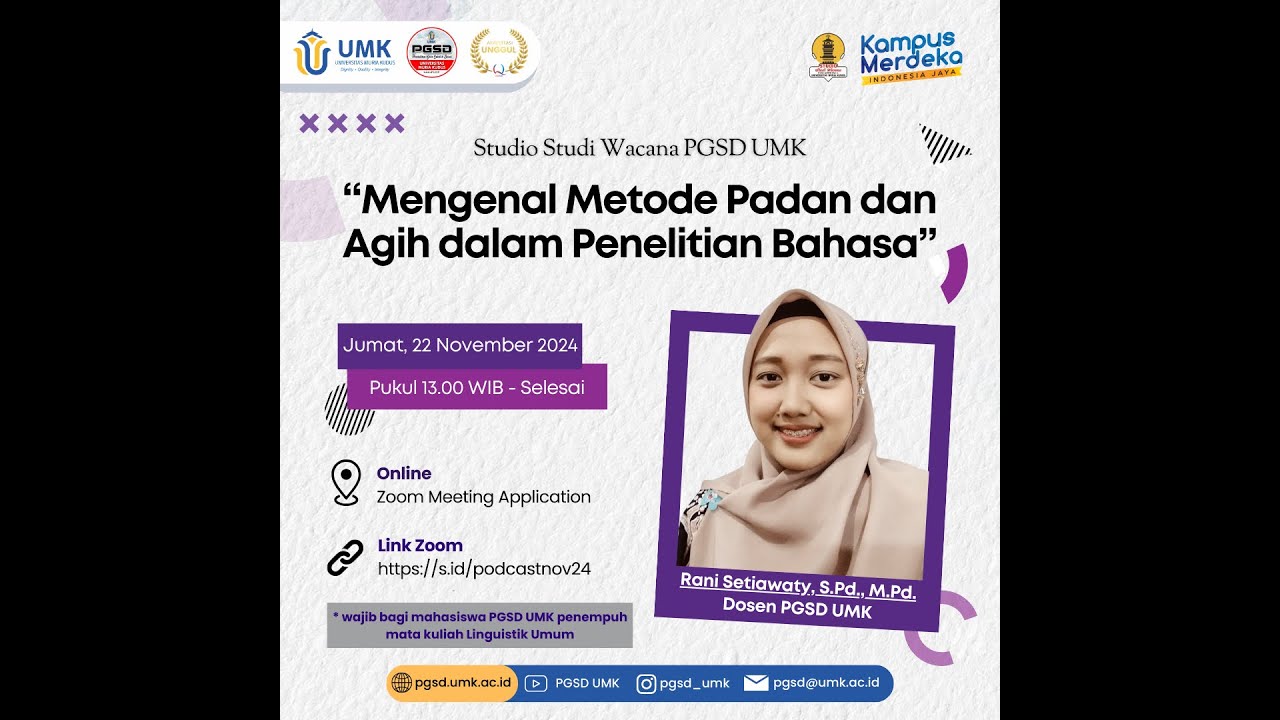
"Mengenal Metode Padan dan Agih dalam Penelitian Bahasa"
122
Video documentation is acceptable in qualitative research. When analyzing recorded classroom interactions, researchers use: recording (rekap), note-taking (catat), and observation without participation (Simak Bebas Libat Cakap). For linguistics research: (1) Research problem: language phenomena; (2) Approach: qualitative; (3) Data collection: observation, interview, documentation; (4) Analysis: Padan or Agih methods; (5) Validation: triangulation. The design must align with research objectives.
Click to watch →
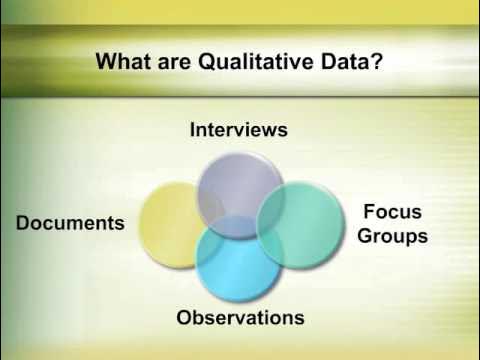
Overview of Qualitative Research Methods
1.2M
Qualitative research is an organized, systematic, and disciplined approach to understanding human experience through rich description, focusing on generating meaning and exploring complex social environments rather than measuring quantities; it differs from quantitative research in its philosophical foundation (constructivism/interpretivism vs. positivism), goals (understanding/generating meaning vs. prediction/testing), and methods (flexible, researcher-as-instrument vs. structured, external instruments), with validity ensured through strategies like prolonged engagement, thick description, triangulation, member checking, and peer debriefing.
Click to watch →

Introduction to qualitative research methods
951
Qualitative research is an interpretive, naturalist methodology that studies phenomena in natural settings to understand how people interpret their own realities, characterized by inductive reasoning, minimal manipulation of settings, flexible open-ended methods, and emphasis on researcher-participant interaction; it encompasses various types including case studies, ethnography, ethnomethodology, symbolic interactionism, phenomenology, narrative analysis, grounded theory, participatory action research, cultural studies, and gender studies, offering strengths such as reducing theory-practice gaps, providing insider perspectives, enabling participant empowerment, and generating rich holistic data, while facing challenges including limited generalizability, difficulty in quantitative predictions, time-consuming data collection, and potential researcher bias.
Click to watch →

Linguistics INTRODUCTION ENG504 LECTURE in Hindi Urdu 01
3.9K
Linguistics is a social science because it studies language as a form of social behavior existing in interaction between human beings in society. People use language to interact, sometimes changing their language, words, sentences, and gestures. In multicultural environments, people need to learn languages, words, sounds, and gestures of other cultures. Language changes depending on the needs and requirements of human beings living in certain societies. Empirical sciences use inductive procedures where phenomena are observed and data is collected without preconceived ideas or theories. Scientists start by directly observing phenomena and collecting data objectively, then analyze it and come up with theories. Deductive procedures are the opposite - researchers first have a statement or hypothesis in mind, then collect data to prove that idea. If results contradict the preconceived idea, researchers must reconsider their approach. The deductive method has been criticized because preconceived ideas may introduce subjectivity in data collection. Karl Popper observed that no observation can be free of some theory - researchers always have some concept in their mind when observing phenomena. Linguistics embodies both inductive and deductive procedures, as some aspects of language can be observed objectively without preconceived ideas, while explaining data requires tentative working hypotheses.
Click to watch →
Prerequisite Knowledge
- Concept 01An understanding of basic Sociolinguistics and how language functions in social contexts.
- Concept 02Fundamentals of Pragmatics, specifically how context contributes to meaning beyond the literal definitions of words.
- Concept 03The distinction between formal, prescriptive grammar and the descriptive study of naturally occurring spoken language.
- Concept 04A basic familiarity with qualitative research methodologies in linguistics and the social sciences.
Subsequent Learning
- Step 01Mastery of the Jefferson Transcription System to accurately record the fine-grained details of spoken interaction.
- Step 02Analyzing Institutional Interaction, applying CA principles to professional settings such as doctor-patient consultations, courtroom trials, and classrooms.
- Step 03Multimodal Conversation Analysis, which integrates non-verbal communication like gaze, gesture, and body orientation with spoken turns.
- Step 04Applied Conversation Analysis (ACA) to design better human-AI conversational interfaces or to improve professional communication training.
- Step 05Exploring Membership Categorization Analysis (MCA) to examine how social identities and categories are built and managed in discourse.
Foundations
Core Concepts
Foundations
0:04Playing Section
- 1
Defines conversation analysis and its core focus on studying naturalistic talk-in-interaction through detailed recordings.
- 2
Outlines the four major research domains: turn-taking, repair, action formation, and action sequencing.
Critical Discourse Analysis and the Macro-Contextual Critique
Critical Discourse Analysis (CDA) and macro-sociolinguistics offer a major counterpoint to Conversation Analysis (CA). While CA strictly limits its focus to the micro-level mechanics of talk (such as turn-taking and repair) based solely on what participants explicitly orient to, CDA argues that this approach is blind to broader social realities. Critics argue that CA ignores institutional power dynamics, gender inequality, systemic racism, and ideological structures that shape human interaction even when they are not overtly articulated by the speakers. Furthermore, critics from cognitive linguistics and traditional pragmatics argue that CA's purely inductive, anti-cognitive stance ignores the essential role of internal mental states, speaker intentions, and cognitive representations in communication. By focusing exclusively on the sequential organization of talk, CA is criticized for providing a highly detailed but socially and psychologically decontextualized view of human interaction.
Deep Dive
Mastery of the Jefferson Transcription System to accurately record the fine-grained details of spoken interaction.
Jefferson Transcription 101: How conversation analysts transcribe
61.9K
Conversation analysts use specialized transcription symbols to capture the detailed acoustic and temporal features of spoken interaction, including square brackets for overlaps, brackets with tenths of a second for silences, underlines for emphasis, increasing capitals for volume, angle brackets for speed stretch, colons for pitch changes, punctuation marks for prosodic cues, and parentheses for uncertain or peripheral elements, allowing researchers to study the systematic patterns of real-time talk that differ from scripted interactions.
Click to watch →

Step by Step Guide to Conversation Analysis
123
Transcription is a critical step in conversation analysis that transforms spoken interaction into written form suitable for detailed analysis. The Jefferson transcription system is widely used because it captures fine-grained details such as pauses, overlaps, pitch changes, and even laughter. This transcription approach goes far beyond simple typing—it is itself an analytical act that helps researchers notice interactional structures within the data. Modern specialized software tools like ELAN and Praat can assist researchers in producing precise and consistent transcripts, enhancing both efficiency and accuracy in the transcription process.
Click to watch →

Discourse Analysis
160.9K
Gail Jefferson devised an elaborate transcription system that can be used to track many details that go on in a conversation, including changes in pitch, length of pauses, and overlapping speech. This detailed transcription method allows researchers to analyze conversations with high precision, capturing subtle aspects of spoken interaction that would be lost in ordinary writing.
Click to watch →

Introduction to Conversation Analysis - University of Oxford
3.9K
Jeffersonian transcription is a specialized transcription system uniquely developed for conversation analysis research. It represents a distinctive approach to representing spoken interaction in written form, capturing the precise timing, intonation, and structure of conversational exchanges. This transcription method is considered essential training for anyone undertaking conversation analysis research, requiring dedicated instructional time of one to two hours to master effectively.
Click to watch →

A Practical Approach to doing Applied Conversation Analysis
9.3K
Jeffersonian transcription captures not just what is said but how it is said, including pauses, intonation, and other interactionally relevant features. This is important because certain features (like hesitation before answering) can signal trouble in talk and are interactionally relevant. The system has expanded to include nuanced representations of laughter, crying, sniffing, and other sounds. Professional transcriptionists often create verbatim transcripts, which then require adding Jeffersonian symbols—a process that requires repeated listening to ensure accurate representation.
Click to watch →
Deep Dive
Analyzing Institutional Interaction, applying CA principles to professional settings such as doctor-patient consultations, courtroom trials, and classrooms.
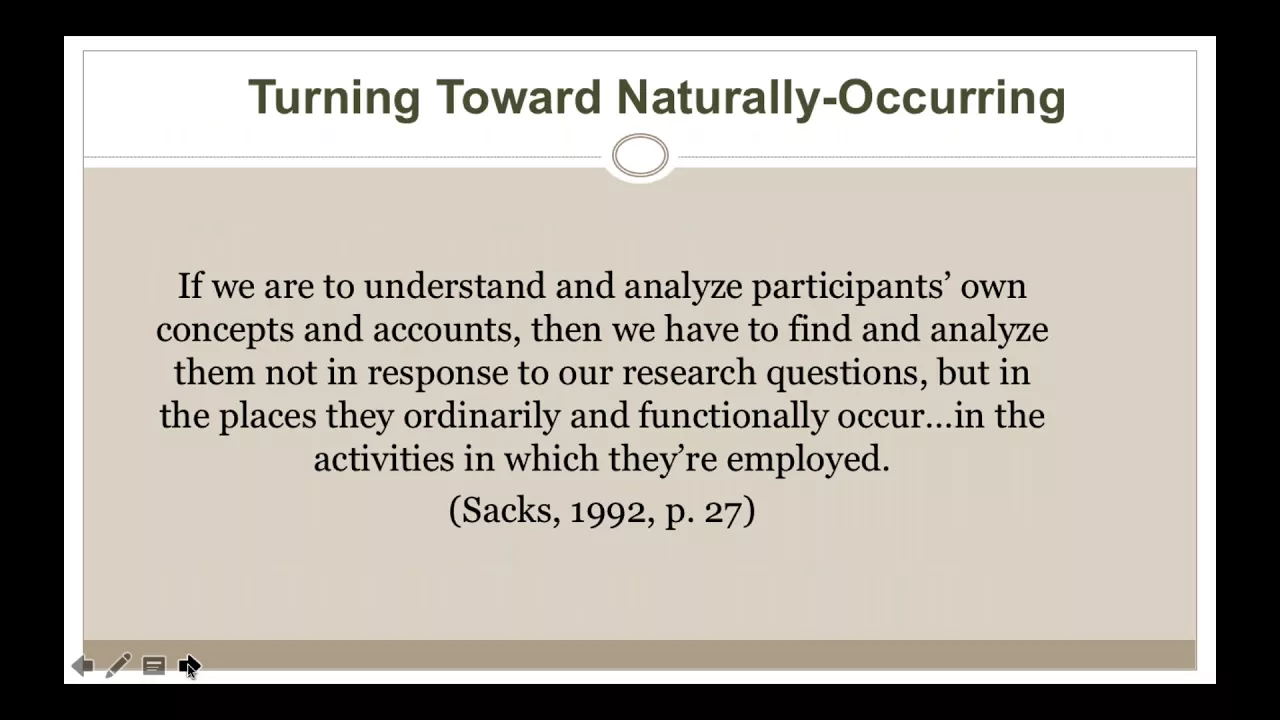
Jessica Nina Lester, Practical Considerations for Doing Applied Conversation Analysis
992
Professor Ontake has identified six different conceptualizations of applied CA: (1) Foundational applied CA seeks to reframe or repurpose foundational concepts within disciplines like psychiatry, such as Edward and Potter's discursive psychology which positions constructs like memory as fundamentally interactional rather than internal. (2) Social problem-oriented applied CA aims to better understand social problems and institutions, addressing macro issues like class, gender, and power—exemplified by Kitzinger's work on heteronormativity and feminist CA. (3) Communication applied CA attends to disorder talk to understand its features and challenge how disorders have been classified, highlighting communicational competence of individuals who might otherwise be assumed incompetent. (4) Diagnostic applied CA attempts to correlate speech organization with underlying disorders, though this is controversial—Schwab's work on diagnosing epilepsy exemplifies this approach. (5) Institutional applied CA focuses on studying how institutions carry out their work, examining courtroom, classroom, and mental health interactions. (6) Interventionist applied CA attends to pre-existing problems with the aim of intervening with findings to provide solutions.
Click to watch →

Conversation Analysis in Discourse Analysis | Background and Introduction | Pragamatics
4.4K
Conversation analysis is an approach to analyzing spoken discourse that examines how people manage their everyday conversational interactions, originating from ethnomethodology at UCLA in the 1960s; it investigates social order through systematic patterns in talk such as adjacency pairs, turn-taking, feedback, and repair, and has been applied to diverse settings including doctor-patient consultations, legal hearings, and classroom interactions.
Click to watch →

Applying Conversation Analysis to Healthcare Interaction -- Dr. Jeffrey Robinson, PhD
1.4K
Sequential effects in healthcare communication are largely causal effects rooted in interaction rules rather than individual differences in personality or psychology. Across numerous studies, psychological and demographic variables rarely affect these effects. Participants can be trained to employ CA-derived strategies, and these training effects endure over time. These sequential effects can then be associated with distal health outcomes like patient satisfaction and treatment compliance. CA accounts for embodiment including body language, eye contact, and physical positioning, which affect interaction flow. Cultural factors are difficult to identify in interaction since people rarely explicitly invoke cultural identity, though cultural understanding matters in how medical advice is implemented—for example, doctors recommending vegetables didn't realize patients only ate fried vegetables until explicitly asked about preparation methods.
Click to watch →
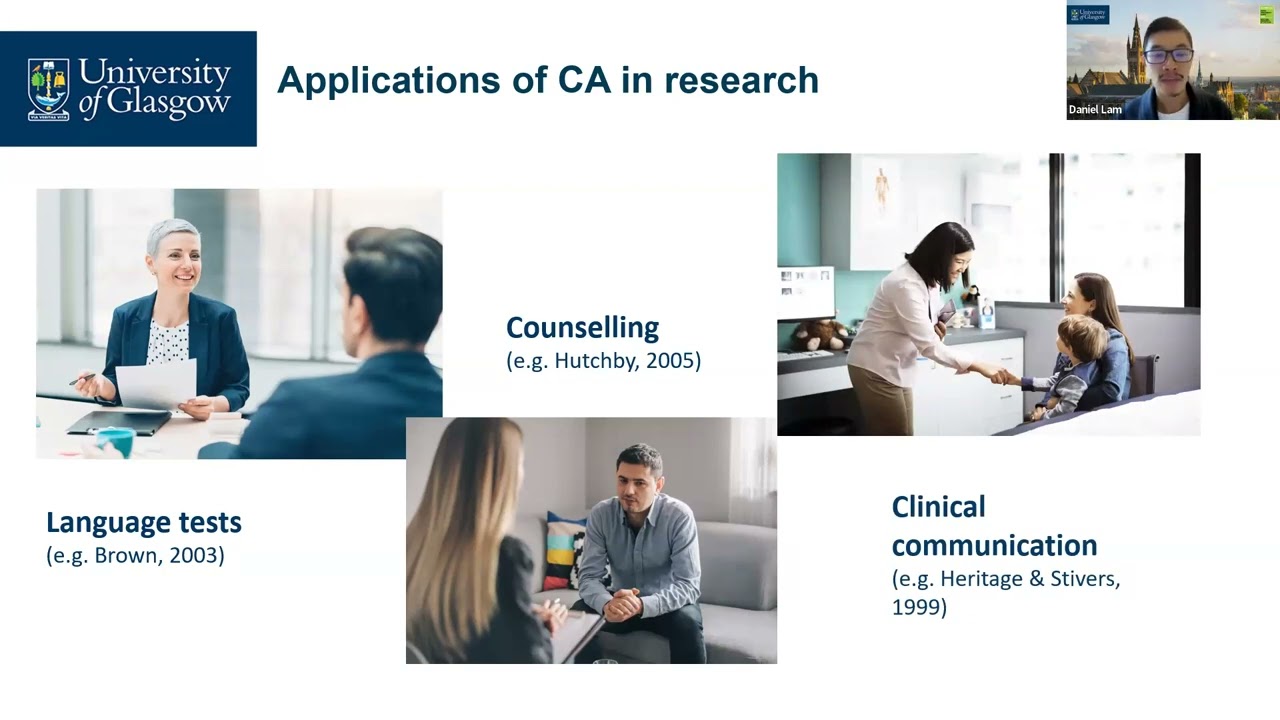
Open Lectures in Educational Research Methods - 15 Nov 2023: Conversation Analysis
130
Conversation Analysis has been applied across various institutional settings with significant findings: (1) In language speaking tests, examiner behavior (enthusiastic vs. disinterested responses) affects candidate performance; (2) In counseling, counselors use paraphrasing to demonstrate active listening and redirect conversations; (3) In clinical communication, doctors' online commentaries during examinations shape parents' treatment expectations by validating concerns while managing expectations for non-aggressive treatments. These applications demonstrate how CA reveals hidden interactional dynamics that influence institutional outcomes.
Click to watch →

Discourse Analysis Part 2: Foucauldian Approaches
109K
Discourses are not just ways of speaking and writing—they are bound up with institutional practices, ways of organizing, regulating, and administering social life. These include the medical profession, scientific profession, legal profession, politics, and media. Being positioned as a patient in a medical discourse means one's body becomes an object of legitimate interest to doctors and nurses, who may expose, touch, invade, treat, operate on, and administer drugs to the patient. These institutional practices come with specific discourses and subject positions (doctor, nurse, patient, victim).
Click to watch →
Deep Dive
Multimodal Conversation Analysis, which integrates non-verbal communication like gaze, gesture, and body orientation with spoken turns.
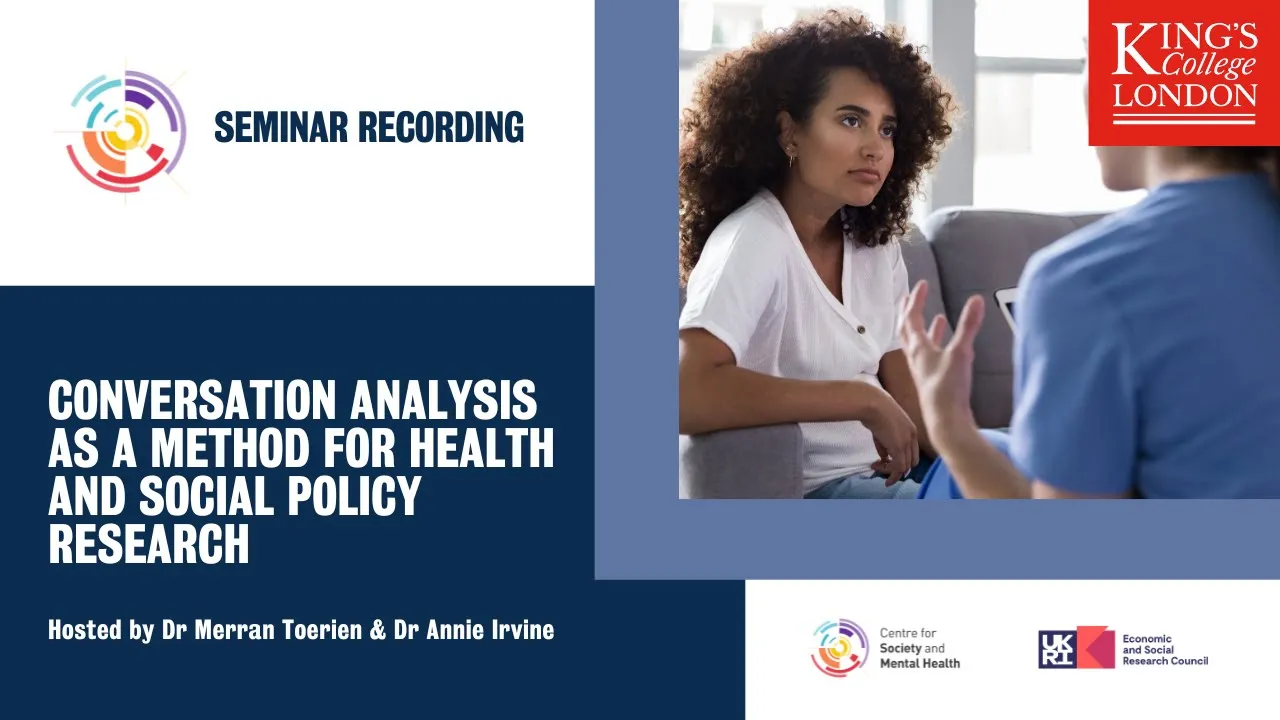
Conversation analysis as a method for health and social policy research
482
Modern CA increasingly integrates non-vocal elements (eye gaze, gestures, body position) with vocal elements, recognizing they are laminated onto each other rather than separate phenomena. Some transcription systems now show non-vocal elements alongside talk lines, showing precise timing of gaze shifts and gestures relative to speech. However, integration remains challenging and varies by research question complexity.
Click to watch →
#19 INTRODUCTION A LA LINGUISTIQUE DU DISCOURS Deuxième Partie
5.1K
The Lyon school introduced a significant concept in conversation analysis called the multimodal approach to conversation. This approach enabled researchers to move beyond the intrinsic analysis of linguistic units by integrating acoustic and gestural aspects as parameters of analysis, which had previously been neglected. The fundamental hypothesis is that the conversational flux is constantly managed by coordinated activities of the speaker and listener. Verbal exchanges allow describing interaction as a progressive construction assured by joint and coordinated activities of partners. This perspective requires describing and comparing all regulatory signals—both non-verbal (expressive gaze, smile, motor head nods) and verbal (verbal regulators like 'oui', 'ouais', 'c'est vrai')—which punctuate all verbal production and serve as reference points for listeners.
Click to watch →
A Practical Approach to doing Applied Conversation Analysis
9.3K
CA can extend to capture nonverbal communication through video recording, including gaze direction, pointing gestures, body positioning, and subtle movements. This is particularly important for studying groups like autistic children who rely heavily on nonverbal cues. Capturing these elements requires mapping visual aspects onto transcripts, making analysis even more labor-intensive than traditional Jeffersonian transcription. Researchers like Paul Dickerson have used video-based CA to study how children interact with robots using gaze and pointing.
Click to watch →

Semiótica y Análisis del Discurso
1.2K
Conversation analysis, originating in the US in the mid-1960s, studies turn-taking and the roles of verbal and non-verbal elements in social interactions. The interest in multimodal approaches emerged in recent decades to analyze additional resources beyond speech, including posture, body movements, gestures, eye contact, and proxemics (use of space). This multimodal conversation analysis examines how people coordinate multiple semiotic resources simultaneously during face-to-face interactions, representing a sophisticated form of multimodal communication.
Click to watch →

【踏み出せ!「ガクモン」の未来〜大学ラボ最前線〜vol.12】同志社大学 文学部英文学科 杉浦秀行 准教授『会話分析』のこれから。
316
Multimodal analysis is an approach within conversation analysis that examines communication resources beyond spoken language. This includes gestures, eye gaze, body positioning, and objects in the immediate environment. These elements are treated as communication resources that participants combine and coordinate during interaction. Multimodal analysis became a significant focus in conversation analysis research around the 2000s, particularly in Japan around 2010.
Click to watch →
Deep Dive
Applied Conversation Analysis (ACA) to design better human-AI conversational interfaces or to improve professional communication training.
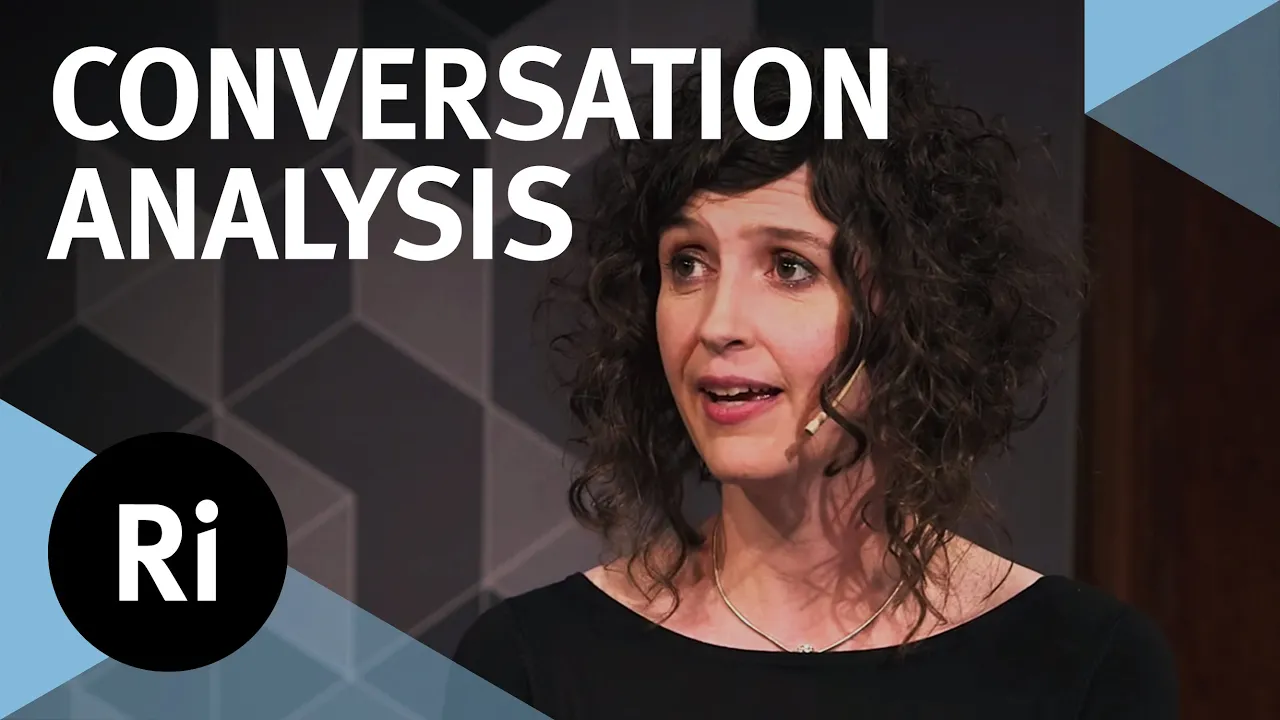
The Interactional 'Nudge' - Talking About Talk
73.6K
Conversation analysis provides empirically grounded guidance for improving professional communication across healthcare, law enforcement, and service industries. Research reveals that real police interviews differ significantly from simulated ones, with real officers using modal verbs and specific reference points that elicit better accounts. Similarly, GP telephone consultations with high patient burden correlate with poor patient experience scores. These findings demonstrate that systematically analyzing naturally occurring data reveals practical improvements that intuition cannot identify, enabling evidence-based communication training and policy development.
Click to watch →
Cathy Pearl - How can conversation analysis be applied to conversation design?
489
Conversation design, which focuses on how humans communicate with computers through voice assistants and chatbots, can be significantly improved by applying insights from conversation analysis—the scientific study of how humans talk to each other in natural settings. By analyzing real-life conversations between people, designers can identify key patterns such as question intonation variations, appropriate interruption timing, and self-repair mechanisms that should be incorporated into conversational interfaces. This approach recognizes that while humans engage in conversation daily without consciously understanding the underlying rules, conversation analysts have systematically studied these patterns, providing valuable data that can inform more natural and effective human-computer interactions.
Click to watch →

Should Conversational User interfaces have a personality - Saul Albert/Cathy Pearl/Elizabeth Stokoe
486
This comprehensive section establishes the theoretical foundation of conversation analysis—a 50-year-old interdisciplinary field spanning sociology, psychology, and linguistics that investigates real-world social interactions through detailed transcription and analysis. The panelists introduce key concepts including segments (high-level customer categorizations) and personas (fictional character representations), then pivot to recipient design—the critical observation that effective interactions are designed as best fit for participants through word selection, intonation, prosody, and embodied resources. Through comparative analysis of human and AI interactions, the section demonstrates how recipient design enables frictionless, efficient interactions that adapt to each participant's emerging evidence. The research reveals that conversation has systematic order beneath apparent messiness, and that effective practitioners continuously adapt their approaches based on unfolding interaction dynamics rather than applying uniform strategies.
Click to watch →

Three meeting points between conversation analysis and artificial intelligence
329
This comprehensive section establishes the theoretical foundation for approaching AI through conversation analysis. It begins with Sachs' seminal metaphor of the 'talking and doing machine,' illustrating how disciplinary assumptions create artificial research problems—researchers who understand only one aspect of a system assume its purpose, while sociologists explore discrepancies between linguistic descriptions and practical actions. Garfinkel's criticism extends this critique, arguing that sociological models exist primarily to be studied rather than to explain reality. The section traces how Lucy Suchman's ethnomethodological work at Xerox PARC demonstrated fundamental differences between designers' ontologies and users' situated actions, inspiring researchers to reframe technology design questions as studies of work practices. Button and Dourish articulated twin paradoxes: modifying technology based on user studies reflexively changes the practices that generated those insights, while without existing systems, where does design begin? The section culminates with empirical application to Google Duplex, revealing how CA methods can identify structural features like the 'anchor position' without anthropomorphizing AI, demonstrating that AI systems can reproduce natural conversation patterns including prosodic elements.
Click to watch →
A Practical Approach to doing Applied Conversation Analysis
9.3K
Applied Conversation Analysis (ACA) is a qualitative research methodology that analyzes naturally occurring spoken interactions to understand how social actions are performed through language in real-world settings. Unlike traditional research methods that rely on self-reports or structured interviews, ACA focuses on the sequential organization of talk, examining how participants negotiate meaning turn-by-turn in everyday and institutional contexts. The approach uses Jeffersonian transcription to capture not just what is said but also how it is said, including intonation, pauses, and other interactional features. ACA has been successfully applied across diverse fields such as healthcare (mental health assessments, clinical consultations), education (online discussion forums, classroom interactions), and social work. Key practical considerations include obtaining appropriate ethical clearance for recording interactions, collecting sufficient data to identify patterns, and disseminating findings to both academic and practitioner audiences. Learning ACA requires extensive practice with real data, engagement with seminal literature, and participation in collaborative data analysis sessions.
Click to watch →
Deep Dive
Exploring Membership Categorization Analysis (MCA) to examine how social identities and categories are built and managed in discourse.

Membership Categorisation Analysis: Peter Eglin
3.9K
Membership Categorization Analysis (MCA) is a sociolinguistic methodology that examines how members of society use category systems (such as occupational roles like 'police officer') to make sense of each other's actions; these categories come with attached predicates (activities, knowledge, motivations) that create bidirectional inference—when we observe someone performing a category-tied activity (like arresting), we identify them as belonging to that category, and conversely, when we identify someone as belonging to a category, we expect them to perform its associated activities, enabling members to observe, identify, and report on social actions in real-time.
Click to watch →

Sandeep Chaudhary: क्यों याद आए पिछड़े और दलित? | Akhilesh Yadav | UP Politics | Congress | BJP
108.1K
The MCA expansion included 6 new ministers and 2 promotions, totaling 8 new faces. The composition was: 5 OBC (backward classes), 2 Dalits, 1 Brahmin. This breakdown is presented as evidence of BJP's 'social engineering' to balance the MCA with PDA communities. The total MCA size became 60 ministers, with 8 being new additions.
Click to watch →

Conversation analysis
17.6K
CA has been employed in feminist linguistics and integrated with membership categorization analysis (MCA), which examines how categories hierarchically link together in social organization. Membership categorization devices (MCDs) represent central machinery of social organization, storing much of society's knowledge about itself. For instance, 'mommy' is interpreted as the mother of the baby by native speakers, demonstrating how categories enable practical inferences about social reality. This compatibility with feminist studies allows examination of how social categories shape interactional practices and power relations. Key phenomena in CA literature include turn-taking (allocation of participation rights), repair (mechanisms for handling interactional troubles), preference organization (structural preferences for certain actions), and sequence organization (ordering of interactional actions). These phenomena represent fundamental building blocks for understanding systematic organization of social interactions.
Click to watch →

MAGDA full video
13.6K
This segment explores how individuals construct and negotiate their social identities within group contexts. Characters demonstrate how group membership shapes self-perception, how social labels affect how others treat individuals, and how individuals seek to establish their identity within social hierarchies. The segment shows how group belonging can provide identity and security, but also how social categorization can create vulnerability and discrimination.
Click to watch →
AI-Análisis de Componentes Principales (2022)
1.2K
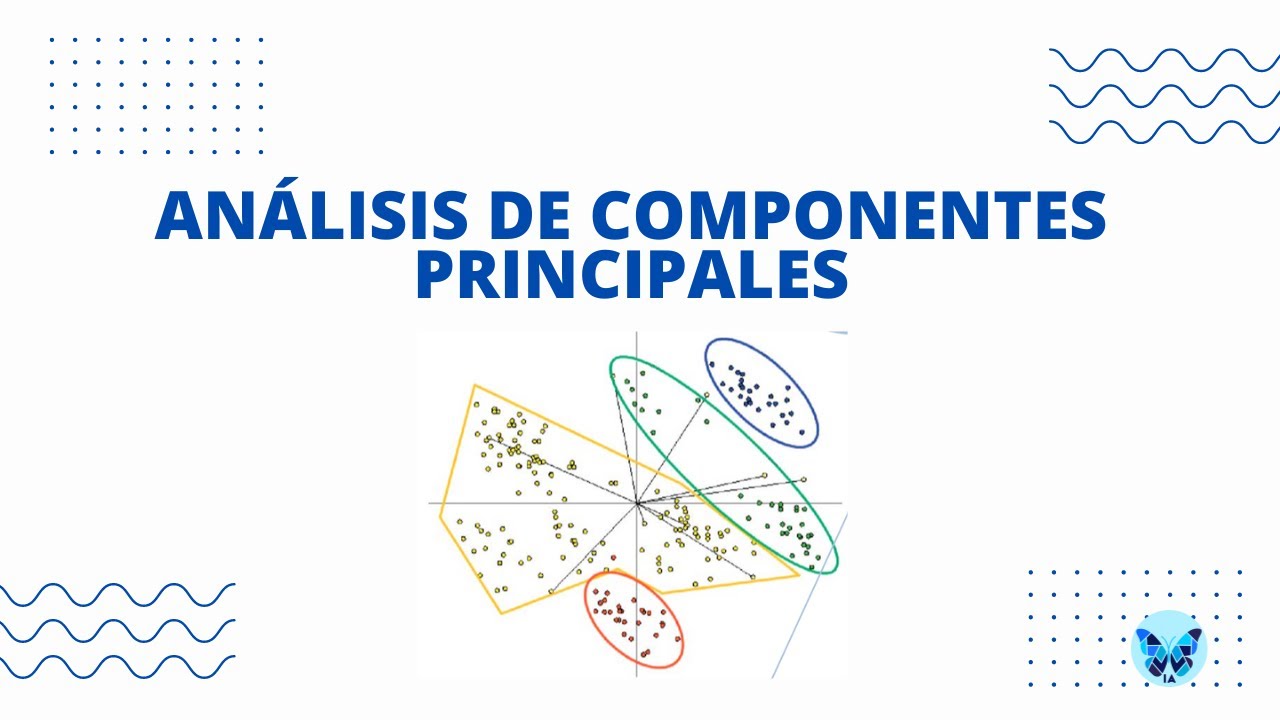
MCA results are interpreted by examining positions of categories in the factorial space. Categories close together have similar profiles. The contribution of each category to each axis indicates its importance in defining that dimension. The cos² values (squared cosines) indicate how well each category is represented in the projection. Categories far from the average profile show strong associations.
Click to watch →
Foundations
Core Concepts
Foundations
0:04- 1
Defines conversation analysis and its core focus on studying naturalistic talk-in-interaction through detailed recordings.
- 2
Outlines the four major research domains: turn-taking, repair, action formation, and action sequencing.
Critical Discourse Analysis and the Macro-Contextual Critique
Critical Discourse Analysis (CDA) and macro-sociolinguistics offer a major counterpoint to Conversation Analysis (CA). While CA strictly limits its focus to the micro-level mechanics of talk (such as turn-taking and repair) based solely on what participants explicitly orient to, CDA argues that this approach is blind to broader social realities. Critics argue that CA ignores institutional power dynamics, gender inequality, systemic racism, and ideological structures that shape human interaction even when they are not overtly articulated by the speakers. Furthermore, critics from cognitive linguistics and traditional pragmatics argue that CA's purely inductive, anti-cognitive stance ignores the essential role of internal mental states, speaker intentions, and cognitive representations in communication. By focusing exclusively on the sequential organization of talk, CA is criticized for providing a highly detailed but socially and psychologically decontextualized view of human interaction.
An understanding of basic Sociolinguistics and how language functions in social contexts.
Fundamentals of Pragmatics, specifically how context contributes to meaning beyond the literal definitions of words.
The distinction between formal, prescriptive grammar and the descriptive study of naturally occurring spoken language.
A basic familiarity with qualitative research methodologies in linguistics and the social sciences.
Mastery of the Jefferson Transcription System to accurately record the fine-grained details of spoken interaction.
Analyzing Institutional Interaction, applying CA principles to professional settings such as doctor-patient consultations, courtroom trials, and classrooms.
Multimodal Conversation Analysis, which integrates non-verbal communication like gaze, gesture, and body orientation with spoken turns.
Applied Conversation Analysis (ACA) to design better human-AI conversational interfaces or to improve professional communication training.
Exploring Membership Categorization Analysis (MCA) to examine how social identities and categories are built and managed in discourse.
9K views122likes4:04@pointstoponder5186Original Release: 2020-12-30
good morning everyone welcome back to our channel today the point to ponder over its conversation analysis term conversation analysis is related to the field of linguistics conversational analysis is an approach to study social interactions and in particular talk and interaction conversation analysis describes the way as a speaker we interact and in particular it examines the organization of interactions by drawing on recordings of naturalistic interaction this recording could be only audio or also video in addition conversation analysis examines recovering pattern across this collection of cases that we can find in speech the four major domains of research within conversation analysis are turn taking repair action formation and action sequencing we will now see each one of them very briefly the process of turn-taking refers to speakers knowledge of when his turn to speak in particular when we are analyzing turn-taking we are trying to understand how do participants understand when is their turn to speak or when is their turn to listen as defined by sex turn-taking in conversation it's locally managed partly administered and interactionally control it is a specific and local activity for every speech and dialogue [Music] second major domain within research in conversation analysis is repair the pair refers to the process by which participants in conversation solve problems that arise in the interaction and studies the way they resume whatever activity they were engaged before the trouble repair can be either initiated or it can be self-repair other initiated repair means someone is correcting me well while i'm speaking instead self-repair means i'm understanding i need for some reason or for some mistake to change my turn and i will stop and start my turn again in a different way their domain in research within conversation analysis is action formation action information refers to the way in which speakers produce and recipients understand the terms that are taking place in an interaction and these turns are understood as action by which they can achieve their interactional goals the fourth domain is action sequences action sequencing studies the way these actions are organized into sequences that create a structure of the interaction uh such an architecture of inter subjectivities this could be understood as a basis for mutual understanding in conversation think about the way a speaker asks a question and the usual answer the turn that it's following it's an answer to such question this process is called urgency pair so these are terms that usually occur one after the other thank you very much for listening today this was a very brief introduction on the term conversation analysis and on the main domains in research within conversation analysis we hope you enjoyed this talk thank you very much for your attention you
Up Next
34:16
How Language Shapes Reality: Oppression and Liberation
@Kathrin_yt
13.6K views•2025-01-30
36:52
Constraint Interaction in Optimality Theory: Epenthesis & Deletion
@Vidyamitra
180 views•2018-08-20

8:59
Forensic Linguistics: How Language Solves Crimes | PBS
@pbsstoried
1M views•2024-01-25

21:32
Accent Expert Explains U.S. Regional Dialects | Part 1
@WIRED
9.3M views•2021-01-21
Related Study Plans & Knowledge Roadmaps
Structured learning paths in Linguistics
linguistics
Optimality Theory: Tableaux & Constraints
01Phonological Basics: Sounds, Syllables & Rules
02Foundations of Optimality Theory: GEN, CON, and EVAL
03The Constraint Inventory: Markedness vs. Faithfulness
+ 2 more learning modules
15h5 modules
Explore Roadmap
linguistics
Morphosyntactic Alignment: S, A & P Systems
01Foundations of Syntax: Transitivity and Arguments
02The Linguistic Variables: Mapping S, A, and P
03Nominative-Accusative Alignment
+ 3 more learning modules
12h6 modules
Explore Roadmap
linguistics
Analyzing Sign Language: Phonology & Syntax
01Foundations of Sign Language Linguistics
02Phonology: The Five Parameters of a Sign
03Morphology: Word Formation and Classifiers
+ 2 more learning modules
14h5 modules
Explore Roadmap
linguistics
Pragmatics: Speech Acts, Grice & Politeness
01Introduction to Pragmatics: Meaning in Context
02Grice’s Cooperative Principle & Implicature
03Speech Act Theory
+ 2 more learning modules
14h5 modules
Explore Roadmap