Speech Acts are actions performed through language, categorized into three types: locutionary acts (the literal meaning of words), illocutionary acts (the speaker's intended meaning or purpose, such as requesting or ordering), and perlocutionary acts (the effect produced on the listener). This theory, developed by Austin and Searle, challenges the logical positivist view that language only describes facts, demonstrating that language can be used to perform actions like giving orders, making requests, or offering advice.
Speech Act Theory in Discourse Analysis | Austin & Searle
Added:Deep Dive
A basic understanding of Pragmatics, specifically how context influences the interpretation of meaning.

Pragmatics Definition, Speech Act Theory Explanation, Pragmatics vs Semantics in Urdu and Hindi. PDF
67.2K
Pragmatics is the branch of linguistics that studies how context influences the interpretation of meaning, distinguishing it from semantics which focuses on dictionary or literal meanings. While semantics examines what words mean in isolation, pragmatics explores how speaker intent, social situations, and contextual factors shape actual communication. A key concept in pragmatics is speech act theory, developed by John Austin, which categorizes utterances into locutionary acts (what is said), illocutionary acts (what is done in saying it, such as asserting, directing, committing, expressing, or declaring), and perlocutionary acts (the effects produced on listeners). For example, the word 'push' has a literal dictionary meaning but gains specific pragmatic meaning based on context—whether it refers to physical movement, emotional pressure, or social encouragement depends entirely on the situation and speaker's intention.
Click to watch →
Pragmatics
169K
Pragmatics examines how context shapes meaning in communication. Key concepts include schemas (mental frameworks for organizing information), context (surrounding circumstances influencing interpretation), deixis (words dependent on speaker's perspective like 'this' or 'now'), inference (deriving unstated meanings from evidence), presupposition (assumptions taken for granted in statements), and speech acts (utterances performing actions beyond conveying information). Understanding these principles reveals how the same words can convey vastly different meanings depending on situational context, demonstrating that effective communication requires awareness of both linguistic form and communicative context.
Click to watch →
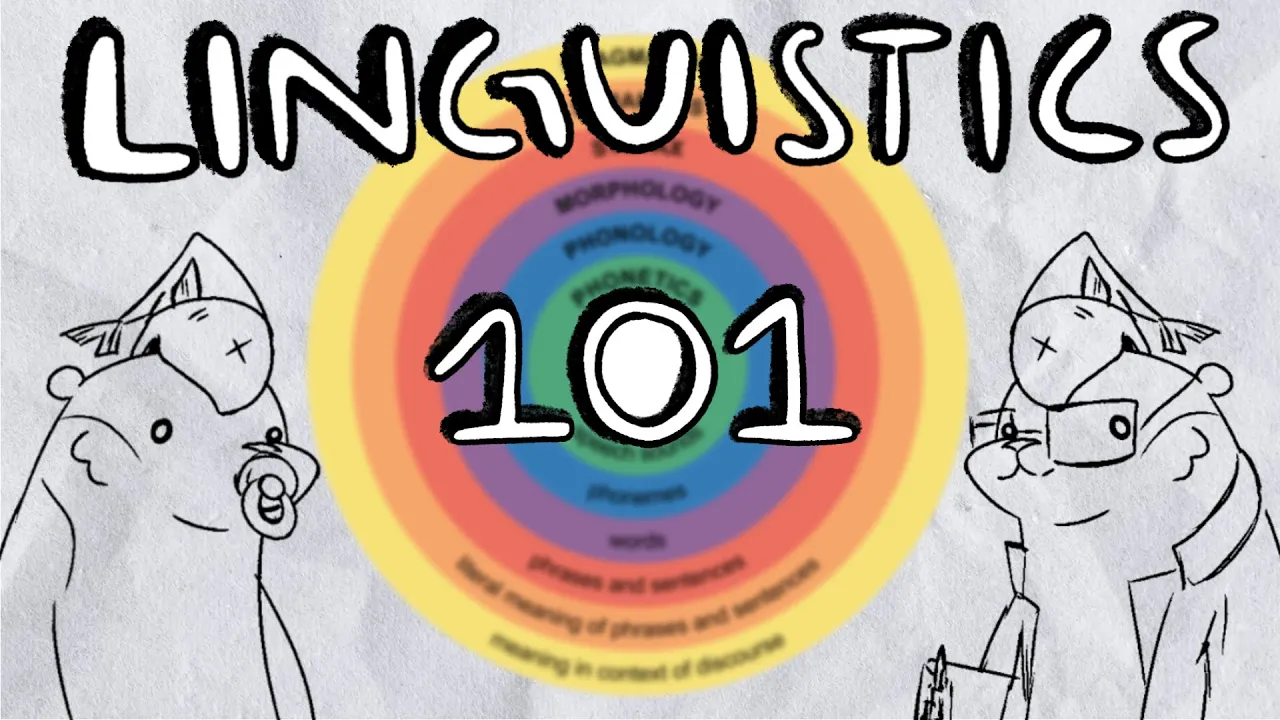
A Linguistics Guide for Beginners!
173.4K
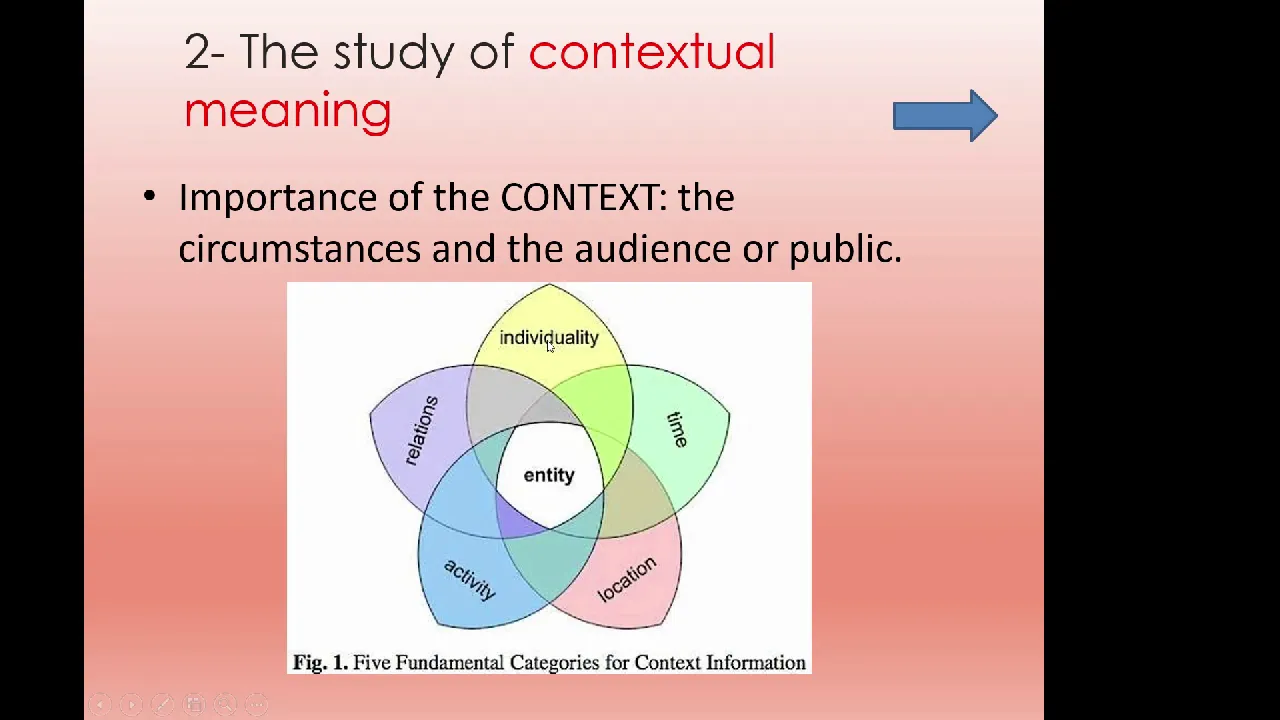
Pragmatics is the study of meaning in context, distinguishing it from semantics which focuses on literal meaning. While semantics looks at what words literally mean, pragmatics examines how context affects interpretation. Key contextual factors include who is speaking, who they are addressing, where and when the conversation occurs, cultural background, speaker intentions, and the relationship between participants. For example, the sentence 'Nice job!' literally means the job was nice, but in context, it could genuinely congratulate someone or sarcastically mock them for dropping something. This demonstrates how the same words can convey opposite meanings depending on surrounding circumstances.
Click to watch →
Why You Can't Understand Sentences (Even Though You Know All the Words)
261.7K
Pragmatics is the field of linguistics that studies how the specific context in which language is used changes meaning. Vocabulary and grammar alone are insufficient for understanding sentences; learners must combine them with contextual knowledge. Examples include: 'Crack the window' can mean either 'open slightly' (in a hot car) or 'shatter' (for burglars); 'I could sleep for a week' literally means sleeping continuously for seven days but figuratively means being very tired; 'She hasn't showered' typically implies she hasn't showered recently, not never. Fluent speakers use extensive contextual knowledge about common expressions, idioms, and what information tends to be left implicit versus stated explicitly in their language.
Click to watch →

Pragmatics: Lesson 2: Context (Co text) سياق الكلام
56.6K
In pragmatics, context (contexto) plays a crucial role in determining the meaning of words, as the same word can have different interpretations depending on the surrounding linguistic and physical context; this lesson distinguishes between linguistic context (contexto lingüístico) and physical context (contexto físico) as two key factors that influence how words are understood in communication.
Click to watch →
Deep Dive
The fundamental distinction between semantics (literal meaning of words) and pragmatics (speaker's intended meaning).

PD. Presentación de Pragmática del Discurso
2.1K
Semantics studies literal meaning and truth conditions of propositions, while pragmatics studies speaker meaning and communicative functions. A key distinction is that semantics deals with context-independent meaning (like 'All men are mortal'), while pragmatics deals with context-dependent meaning (like 'I am a linguist'—the pronoun 'I' refers to different people depending on context). Semantics describes meanings using logical forms, while pragmatics studies how those meanings are used in communication. Sentences can perform various speech act functions beyond asserting truth: expressing wishes, requesting information, or giving orders.
Click to watch →

Pragmatics| definition| semantics vs pragmatics | importance
335
Semantics studies internal/dictionary meaning of words and sentences, while pragmatics studies contextual/societal meaning. Both are subfields of linguistics linked by their focus on meaning but operate at different levels. Semantics focuses on literal meaning encoded in sentences, independent of context, while pragmatics deals with usage, social language skills, and non-literal meanings determined by utterance context. Semantic meaning is rule-based, while pragmatic meaning follows principles based on social dynamics.
Click to watch →
Semantics -- An Introduction & Levels of Meaning
3.5K
Semantics deals with expression meaning (dictionary meaning of words, phrases, and sentences in isolation) and utterance meaning (meaning determined through context including reference and truth value). Pragmatics deals with communicative meaning, which requires understanding the full context of communication including speaker intentions, purposes, and social functions. The key difference is that semantics focuses on meaning within language itself, while pragmatics examines how meaning is constructed through social interaction and context.
Click to watch →
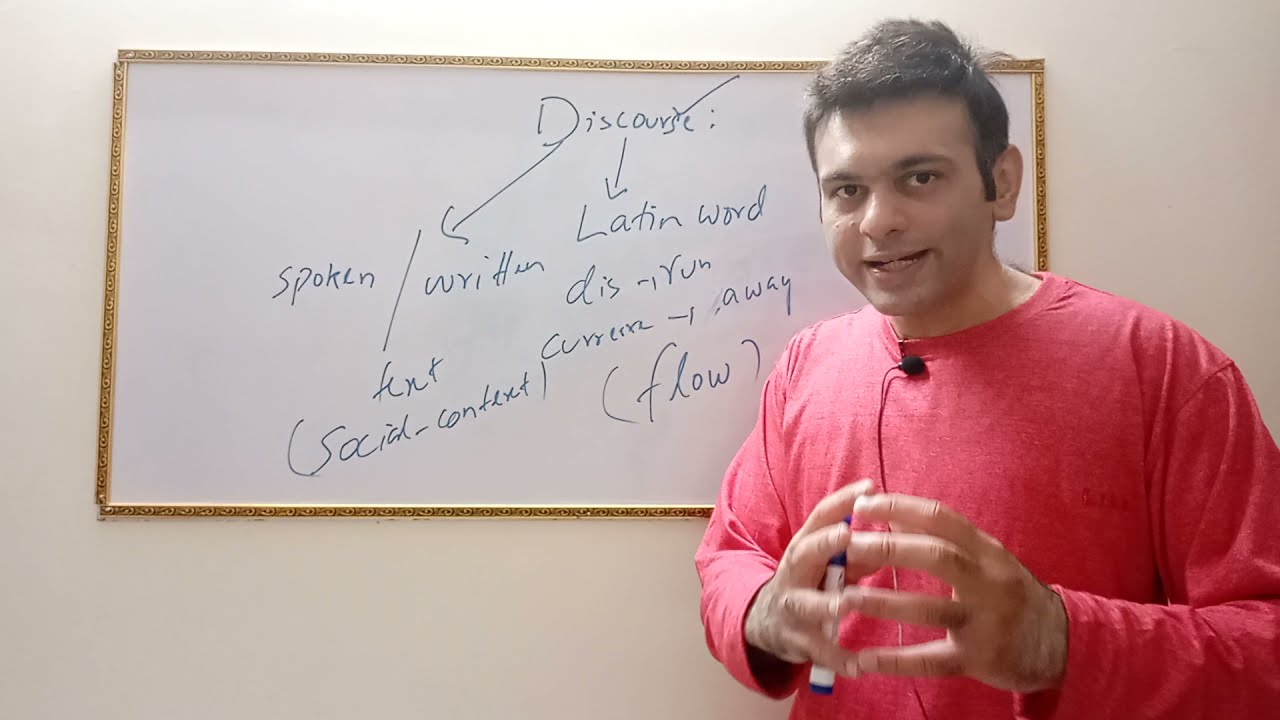
Pragmatics and Discourse
1.3K
Pragmatics is the study of intended meaning, distinguishing it from semantics which studies surface meaning. The key difference lies in pragmatics focusing on deep meaning and speaker's intended meaning, while semantics focuses on literal meaning. Context and situation are the two most prominent factors in pragmatics, as one cannot decipher a message without thorough contextual analysis. The primary concern involves lexemes (words) and utterances (sentences), which must be understood within the same context and situation. The line between semantics and pragmatics is thin and arbitrary, but pragmatics focuses on interpretation and understanding hidden meanings that speakers intend to convey.
Click to watch →

Semantics and Pragmatics S6 : Differences Between Semantics and Pragmatics
3.3K
Semantics is not about defining words but about explicating the knowledge speakers possess that enables communication of facts, feelings, intentions, and imagination. Understanding word meaning is easier than defining it, as different people provide different definitions for the same word. Semantics involves dividing word meanings into component parts—for example, 'love' can be analyzed as a positive feeling existing between two people or between a person and something. Meaning is relative and influenced by context and culture, as demonstrated by how upbringing affects how we understand and express love. Semantics is concerned with the language system that people have in common, which enables communication. Pragmatics, in contrast, is about the interaction of semantic knowledge with knowledge of the world, including context, views, culture, society, and how language is actually used. Semantics studies how we understand language, while pragmatics studies how we use language.
Click to watch →
Deep Dive
An introduction to Discourse Analysis and how language functions in social interactions beyond mere grammatical structure.

ENG524_Topic001
5K
Discourse analysis, introduced by Zellig Harris in the mid-20th century, extends linguistic analysis beyond sentence level to examine how language functions in real communication contexts, including paralinguistic factors like tone and delivery, contextual influences on meaning, and the role of language in constructing social realities and identities; it operates on the principle that language is inherently ambiguous and inseparable from social and cultural contexts, requiring analysis of both textual structure and socio-cultural environment to fully understand communicative intent.
Click to watch →
شرح مادة discourse analysis تحليل الخطاب l لطلاب الفرقة الرابعه اداب وتربيه انجليزى 2025
1.9K
Discourse analysis is the study of language in use, examining how language functions beyond the sentence level. It emerged in the late 1960s and early 1970s as a response to traditional linguistics. Discourse encompasses any form of language that conveys ideas or messages to a recipient, including both verbal and non-verbal communication. The field studies how language is actually used in social situations to create meaning, transfer information, persuade, and facilitate social interaction. Discourse is context-dependent, varying according to the situation in which it is used, such as political discourse, media discourse, or environmental discourse.
Click to watch →

Discourse analysis
34.5K
According to Brown and U in 1983, discourse analysis is necessarily the analysis of language in use to understand how language functions. Context—physical, social, mental worlds, or roles of participants—highly influences what is said and how it is interpreted. Meaning is created through interactions between speaker and listener in spoken communications and writer and reader in written communications. Two forms of discourse exist: transactional discourse involves expressing content and transmitting information based on facts or propositions, where the mode is message-oriented; interactional discourse involves expressing social relations and personal attitudes, using language to form and preserve social relationships. Sociologists and anthropologists emphasize that common interactions symbolize the interpersonal use of language.
Click to watch →
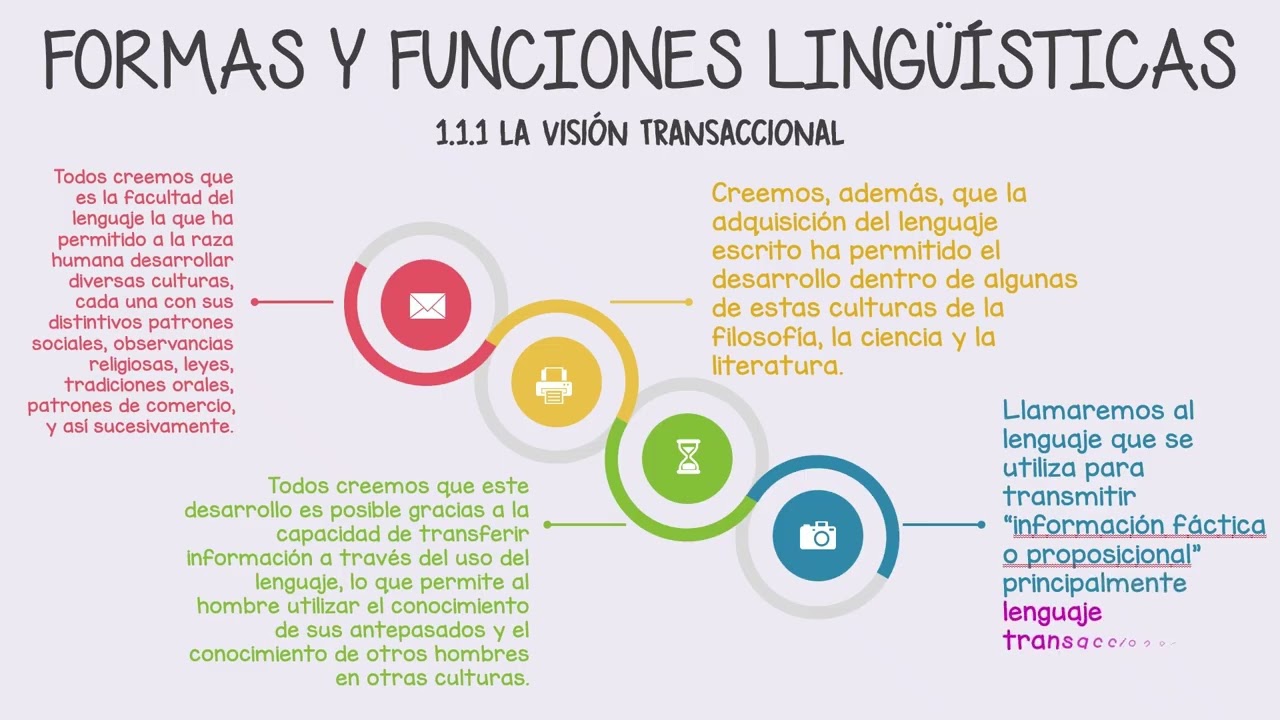
Formas Y Funciones Lingüísticas | Función Transaccional Y Función Interaccional.
124
Discourse analysis examines language in use rather than formal properties alone. Language serves two primary functions: transaccional (transmitting factual/propositional information) and interaccional (expressing social relationships and attitudes). These correspond to functional dichotomies in Bulla, Jacobson, Holiday, and Lions. Lions emphasizes intentional information transmission, while Benet focuses on speaker-listener cooperation. Language enables human cultural development by allowing knowledge transfer across generations and cultures, facilitating philosophy, science, and literature.
Click to watch →

1_Discourse Analysis_Things to do with language_Lifeworld Discourse_Areas of reality DA_Hari Madhab
150
Discourse analysis focuses on knowledge about language beyond word, clause, phrase, and sentence needed for successful communication. It examines patterns of language across text and social/cultural context, viewing language as a social and cultural construct. It examines both spoken and written text, looking at language-identity relationships and how people perform social and gender identities. Discourse analysis is interdisciplinary, spanning social linguistics, sociology, social psychology, and anthropology. The term was introduced by Zellig Harris in 1952, who examined language beyond sentence level and the relationship between linguistic and non-linguistic behavior. It focuses on functional rather than formal aspects of language to provide deeper understanding of how texts become meaningful to users.
Click to watch →
Deep Dive
Familiarity with logical positivism and the traditional philosophical view that language is primarily used to make true or false statements.

Beginner-Friendly Philosophy Books (From Every Era of History)
163.2K
A.J. Ayer's 'Language, Truth and Logic' presents logical positivism, which held that only language verifiable by science or experience was meaningful—a radical empiricism about meaning itself. While few philosophers take this view seriously today, studying where a philosopher takes a radical idea and runs with its consequences is a powerful exercise for beginners. Ayer is credited with making Vienna Circle ideas accessible to English-language readers and college undergraduates.
Click to watch →
"Philosophy is a Waste of Time" | Language, Truth, and Logic
70.3K
In early 20th century Vienna, philosophers recognized that traditional philosophy had become plagued by 'intellectual bloat'—ambitious metaphysical projects asserting fundamental truths beyond science using vague intuition. The Vienna Circle emerged as a counter-movement, comprising philosophers, scientists, and mathematicians who sought to make philosophy respectable for the modern age by aligning it with modern science. They called themselves Logical Empiricists or Logical Positivists. Ayer joined this movement, inspired by David Hume's dismissal of metaphysics, and wrote 'Language, Truth and Logic' to purge philosophy of what he saw as mystical metaphysics, replacing it with rigorous logical analysis of important ideas focused on language, truth, and logic.
Click to watch →
BPSC TRE 4.0 Philosophy | BPSC TRE 3.0 Varg (11-12) Philosophy Previous Year Paper Solution
235
This segment covers logical positivism and analytic philosophy: A.J. Ayer's 'Language, Truth and Logic' (1936) presents verification theory—statements are meaningful only if analytic truths or empirically verifiable. Logical positivism rejects traditional metaphysics as meaningless. The view that philosophy's function is logical analysis is held by Ayer, Wittgenstein, and Russell. Kant's philosophy is called 'Criticism' because he critically examined reason's limits. Russell is associated with analytic philosophy and logical atomism.
Click to watch →
Daniel Lopez EXPÕE Mitos da Idade Média para Igor no Flow
100.6K
Gottlob Frege distinguished between 'sense' (meaning) and 'reference' (what a statement points to). Bertrand Russell argued that demonstrative pronouns are the only truly proper nouns because they directly point to objects. Wittgenstein's pictorial theory of language proposes that language can represent the world because both share similar organizational structures. Logical positivism, influenced by Auguste Comte, holds that only scientifically provable statements can be considered true, viewing religion as 'infancy' and science as 'maturity.'
Click to watch →

8 Philosophy Books You Need to Read
440.5K
AJ Ayer's Language, Truth and Logic introduces the movement of logical positivism, which sought to establish strict criteria for meaningful philosophical statements. While this movement is considered disastrous by some philosophers, reading Ayer's work helps readers understand what analytic philosophy wanted to achieve and potentially avoid its limitations. The book provides valuable context for understanding the development of analytic philosophy.
Click to watch →
Prerequisite Knowledge
- Concept 01A basic understanding of Pragmatics, specifically how context influences the interpretation of meaning.
- Concept 02The fundamental distinction between semantics (literal meaning of words) and pragmatics (speaker's intended meaning).
- Concept 03An introduction to Discourse Analysis and how language functions in social interactions beyond mere grammatical structure.
- Concept 04Familiarity with logical positivism and the traditional philosophical view that language is primarily used to make true or false statements.
Subsequent Learning
- Step 01John Searle's Classification of Speech Acts (assertives, directives, commissives, expressives, and declarations).
- Step 02The concept of 'Felicity Conditions' and the specific contextual rules required for a speech act to be valid and effective.
- Step 03Indirect Speech Acts and how they relate to Politeness Theory (Brown and Levinson) in social interactions.
- Step 04Paul Grice's Cooperative Principle and Conversational Implicature, explaining how implied meaning is negotiated.
- Step 05Practical applications of Speech Act Theory in Computational Linguistics, particularly in dialogue state tracking for virtual assistants and chatbots.
Pragmatics Roots
Meaning Layers
Speech In Action
Pragmatics Roots
0:41Playing Section
- 1
Examines pragmatics and discourse against logical positivism.
- 2
Challenges the view that language solely describes facts.
Conversation Analysis and the Sequential Critique
While Austin and Searle's Speech Act Theory focuses on the speaker's internal intentions and classifies utterances into discrete, isolated categories, Conversation Analysis (CA)—pioneered by Harvey Sacks and Emmanuel Schegloff—offers a major counterpoint. CA critics argue that Speech Act Theory is overly cognitive and dependent on invented, decontextualized sentences. Instead, CA asserts that meaning in discourse is not determined solely by a single speaker’s intent, but is sequentially and collaboratively co-constructed by participants in real-time interaction. In actual conversation, an utterance's function depends heavily on its placement within a sequence (such as adjacency pairs) and how the recipient subsequently responds to it. Consequently, CA rejects the rigid, individualistic taxonomy of isolated speech acts, advocating instead for the empirical study of naturally occurring talk-in-interaction to understand how social action is dynamically achieved.
Deep Dive
John Searle's Classification of Speech Acts (assertives, directives, commissives, expressives, and declarations).
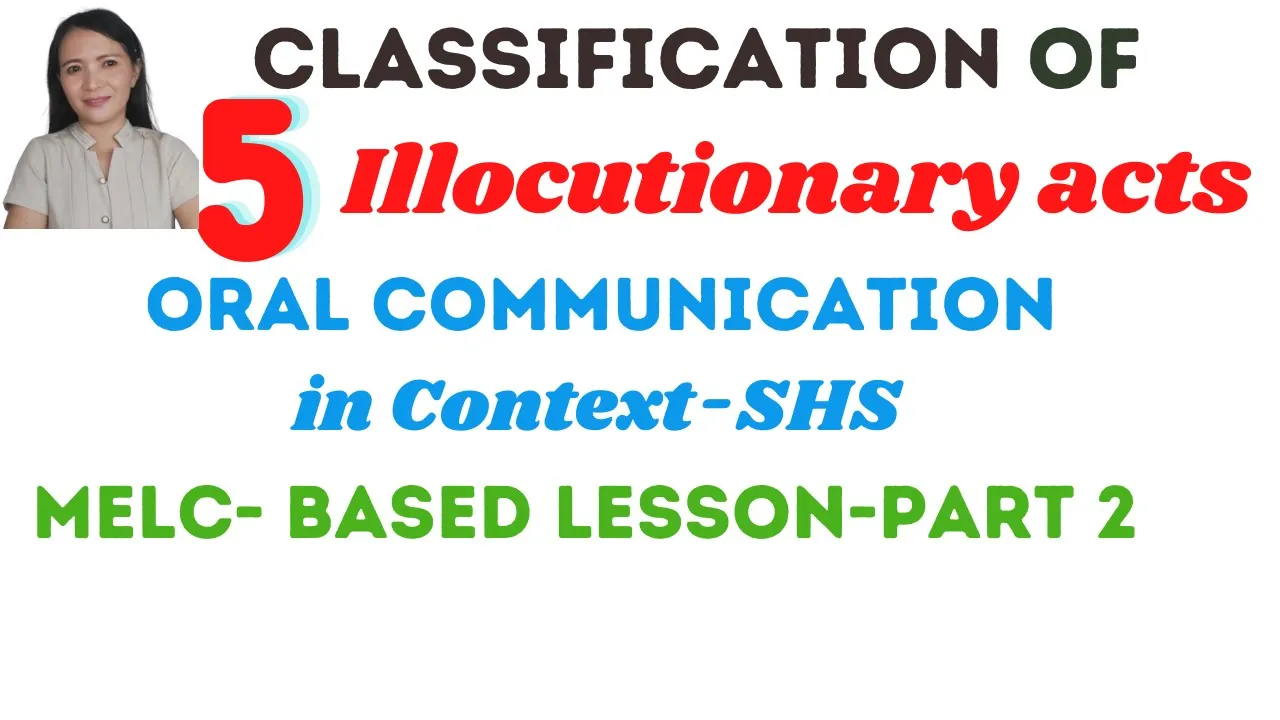
classification of illocutionary speech acts by Searle| Oral Communication in Context
115.6K
John Searle classified illocutionary speech acts into five categories: (1) Assertive - statements that represent reality and commit the speaker to truth (e.g., 'Rodrigo Duterte is the president of the Philippines'), (2) Directive - utterances that prompt the hearer to perform an action (e.g., 'Please vote for me'), (3) Commissive - utterances that commit the speaker to a future action (e.g., 'I promise to wake up early'), (4) Expressive - utterances that reveal the speaker's attitudes and emotions (e.g., 'Thank you dear students'), and (5) Declaration - utterances that bring about a change in the external situation by representing it as changed (e.g., 'I hereby declare a total lockdown').
Click to watch →

Searle: Philosophy of Language, lecture 3
25.5K
Speech acts can be divided into five main classes based on illocutionary point, direction of fit, and sincerity conditions. (1) Assertives represent how things are in the world, commit the speaker to truth, have word-to-world direction of fit, and express belief. (2) Directives attempt to get the hearer to do something, have world-to-word direction of fit, express desire, and require future voluntary action by the hearer. (3) Commissives commit the speaker to future action, express intention, and include promises, vows, threats, and pledges. (4) Expressives express psychological states like gratitude or regret, have presupposed fit, and content must be associated with the speaker or hearer. (5) Declarations change reality by representing it as having been changed, have double direction of fit, require institutions, and create institutional facts. This taxonomy follows from the nature of meaning itself and provides a rational classification of speech acts.
Click to watch →

Speech Acts | Speech Acts Examples | Oral Communication in Context
69.4K
John Searle classified illocutionary acts into five distinct categories: (1) Assertive - expressing belief about the truth of a proposition (suggesting, putting forward, swearing, boasting, concluding); (2) Directive - trying to make the addressee perform an action (asking, ordering, requesting, inviting, advising, begging); (3) Expressive - expressing feelings and emotional reactions (thinking, apologizing, welcoming, deploring); (4) Commissive - committing the speaker to doing something in the future (promising, planning, vowing, betting); (5) Declaration - bringing a change in the external situation (blessing, baptizing, bidding, passing a sentence, excommunicating).
Click to watch →
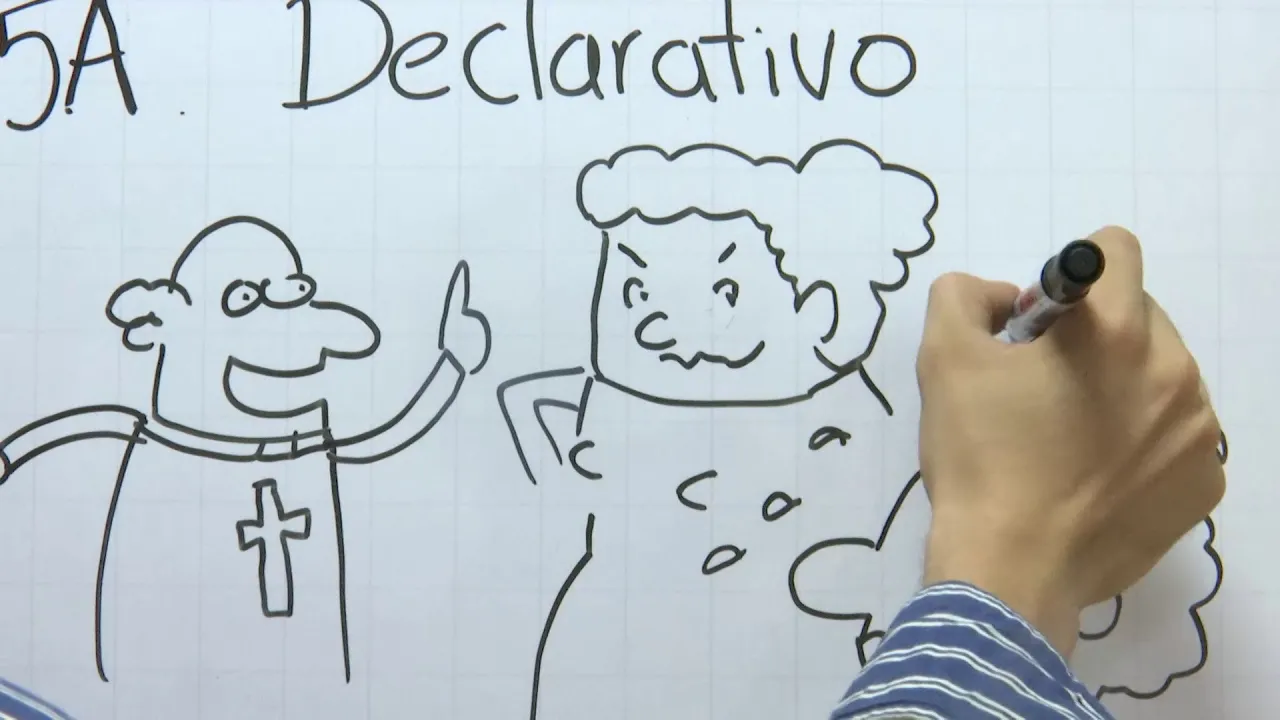
Actos de Habla según John Searle
30.2K
John Searle's classification of speech acts includes five types: assertives (statements about how things are), directives (attempts to get someone to do something), commissives (commitments to perform actions), expressives (manifestation of feelings and attitudes), and declaratives (producing changes through authoritative statements).
Click to watch →

Lesson 7: Speech Acts | Oral Communication in Context
55.3K
John Searle classified speech acts into five categories: (1) Assertive - expressing belief about truth or facts, such as making suggestions, boasting, or swearing; (2) Directive - trying to make the receiver perform an action, including asking, ordering, or begging; (3) Commissive - committing to do something in the future, such as promising, planning, vowing, or betting; (4) Expressive - expressing feelings or emotions, such as apologizing or thanking someone; (5) Declaration/Declarative - changing the state of the world immediately, such as baptizing someone, bidding for items, or firing employees. Each classification represents a different type of communicative intention.
Click to watch →
Deep Dive
The concept of 'Felicity Conditions' and the specific contextual rules required for a speech act to be valid and effective.

Transphobia Makes You Stupid
10.1K
Performative speech acts perform actions through speech, like a priest pronouncing marriage. However, success requires engaging a social matrix correctly - specific conditions must be met (presence, agreement, witnesses). Random declarations fail because they don't meet felicity conditions. Similarly, declaring oneself a woman fails because social meanings don't allow gender determination by mere statement. This demonstrates that performativity requires contextual engagement, not arbitrary assertion.
Click to watch →
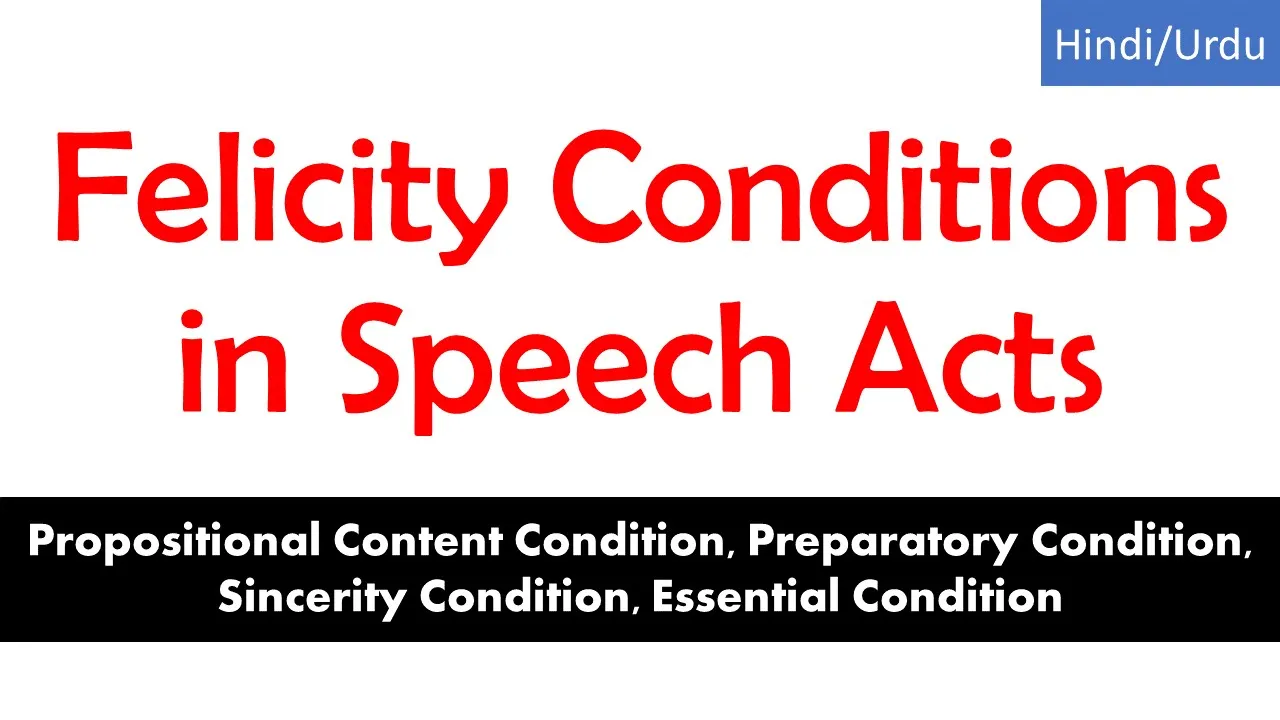
Felicity Conditions in Speech Acts - Types of Felicity Conditions - Pragmatics - Speech Acts
28.5K
In speech act theory, felicity conditions are requirements that must be met for a speech act to succeed; these include (1) Propositional content condition - the locution must have conventionally acceptable words for the speech act, (2) Preparatory condition - specific requirements must exist such as the speaker having authority and the utterance being made in appropriate circumstances, and (3) Essential condition - the speaker must commit themselves to the speech act and take responsibility for carrying it out.
Click to watch →

Pragmatics - Speech Acts Theory
25.4K
For speech acts to succeed, felicity conditions must be met: appropriate persons and circumstances, correct procedure execution by all participants. Violations cause misfire (failure to execute properly) or abuse (intending to do something different). John Searle further developed these conditions for promising, requiring future acts, speaker intent, and proper timing. These conditions ensure speech acts achieve their intended effects.
Click to watch →
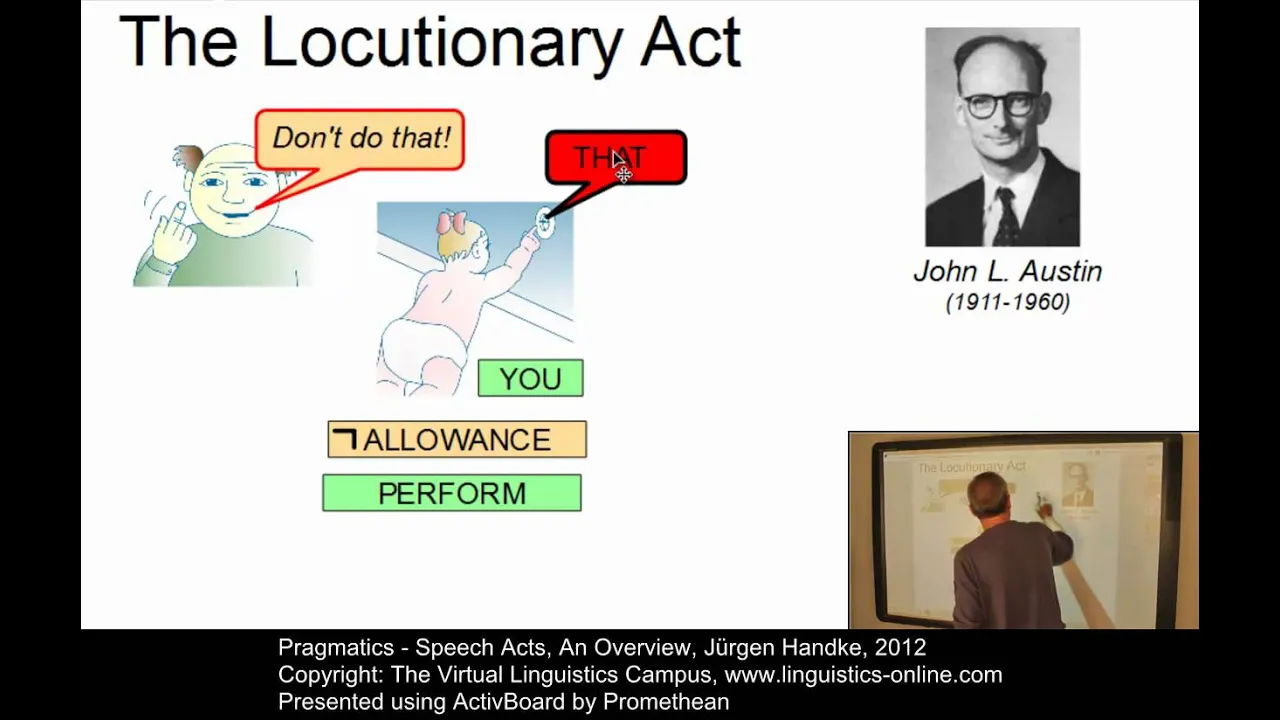
Speech Acts Overview | Pragmatics & Language Use
213.8K
Pragmatics examines how language achieves effects beyond literal meaning by distinguishing between sentence meaning (the abstract, truth-conditional content of words and sentences) and utterance meaning (the contextualized use of language in specific situations). Speech act theory, developed by John Austin and refined by John Searle, identifies three types of speech acts: locutionary acts (the act of uttering a sentence with its meaning), illocutionary acts (the action performed by uttering, such as commanding, promising, or warning), and perlocutionary acts (the effects produced on the listener). Searle further categorizes illocutionary acts into five main types: representatives (statements), directives (commands), commissives (promises), expressives (emotional responses), and declarations (statements that change the world). These acts must satisfy felicity conditions to be recognized as intended, including requirements about the speaker's identity, context, and the relationship between the utterance and the world.
Click to watch →
Pragmatics: Lesson 17: Felicity Conditions
27.7K
Felicity conditions are the necessary requirements that must be satisfied for a speech act to be successful and achieve its intended purpose; these conditions include having the appropriate speaker (someone authorized to perform the act), being in the correct context or location, speaking at the right time, and following established procedures or conventions. When any of these conditions are not met, the speech act is considered infelicitous or unsuccessful.
Click to watch →
Deep Dive
Indirect Speech Acts and how they relate to Politeness Theory (Brown and Levinson) in social interactions.
Etudes Anglaises Semester 4 Introduction to Linguistics, Prof Aziz Driouch Flash UIZ
4.5K
Speech act theory examines three components: locution (physical act of speaking with grammatical structure expressing literal meaning), illocution (intended meaning behind the utterance), and perlocution (effect the utterance has on the hearer). Direct speech acts have a direct relationship between structure and function (e.g., 'Did you eat pizza?' as a question). Indirect speech acts use form differently than function (e.g., 'Can you pass me the salt?' as a request), which are generally more polite. Politeness comprises linguistic and non-linguistic behavior showing awareness and consideration to others' feelings. Face refers to self-esteem or self-image that people want to be seen in a good way during social interaction. Face-threatening acts damage face, while face-saving acts maintain good self-image.
Click to watch →

جورج يول-الفصل العاشر- البراغماتية
15.8K
Speech acts are actions performed by speakers within utterances, such as requesting, commanding, questioning, or informing. When saying 'I'll be there at six,' you're performing the action of promising, not just speaking. Speech acts can be direct (syntactic structure matches function) or indirect. Politeness involves showing awareness of others' face—their public self-image that everyone expects others to recognize. Face-threatening acts threaten self-image, while face-saving acts lessen threats. Politeness encompasses both negative face (need for independence) and positive face (need for connection). Cultural differences exist in appropriate language for politeness. Understanding speech acts and politeness reveals how language functions as social action rather than mere information transfer.
Click to watch →
Politeness in Linguistics: An overview
78.5K
Brown and Levinson's politeness theory proposes that all social interactions involve managing face—the public self-image individuals want others to recognize. Two fundamental types of face exist: positive face (desire to be liked and belong to groups) and negative face (desire for independence and freedom from imposition). A Face-Threatening Act occurs when one person's speech threatens another's face. To manage these threats, speakers employ either positive politeness strategies (appealing to positive face through closeness and appreciation) or negative politeness strategies (showing awareness of negative face through hedging and indirectness). This theoretical framework explains how language functions to preserve social harmony in everyday interactions.
Click to watch →
Why the British Rarely Say What They Mean (and How to Understand Them Anyway)
142.4K
Politeness functions as social armor protecting individuals' 'face' - their dignity and social standing. According to Brown and Levinson's theory, everyone has positive face (desire to be liked) and negative face (desire for autonomy). In British culture, negative face dominates, meaning independence and avoiding imposition are prioritized. This explains why British people use indirect language, soft speech, and mitigation to protect others' autonomy and maintain social harmony.
Click to watch →
Pragmatic Stylistics (Part 2) -- Politeness Theory, Speech Acts, FTAs, Form & Function
2.5K
Brown and Levinson's politeness theory explains how we navigate social interactions through two face needs: positive face (desire to be liked) and negative face (desire to act freely without interference). Grice's maxims (quality, quantity, relevance, manner) create conversational expectations, but humans intentionally violate them for politeness. Face-threatening acts (FTAs) threaten these face needs, requiring mitigation through indirect language. The core principle is inverse: direct language equals impoliteness; indirect language equals politeness. This framework applies universally across languages including Urdu, Punjabi, and Pashto, explaining why we soften requests and apologize when we sense face threats.
Click to watch →
Deep Dive
Paul Grice's Cooperative Principle and Conversational Implicature, explaining how implied meaning is negotiated.

Pragmatics:Speech Act Theory,Gricean Maxims,Relevance Theory,Politeness Theory,Discourse#linguistics
263
Paul Grice's cooperative principle (1975) establishes that successful communication requires speakers to cooperate by contributing appropriately to the conversation's purpose. This creates mutual trust between communicators. The four maxims guide cooperation: quantity (be informative but not excessive), quality (tell truth with evidence), relation (stay relevant), and manner (be clear and orderly). When maxims appear violated, listeners infer hidden meanings through conversational implicature. Implicature divides into conventional (automatic from language, like 'but' implying contrast) and conversational (context-dependent, cancellable). Scalar implicature involves quantity maxims (e.g., 'some' implies not all). Flouting deliberately violates maxims for strategic effects, requiring listeners to infer alternative meanings.
Click to watch →
Cooperative Principle
17.3K
The Cooperative Principle, formulated by philosopher Paul Grice, states that successful communication assumes speakers are trying to communicate effectively by following four maxims: Quality (tell the truth), Quantity (provide necessary information without excess), Relevance (stay on topic), and Manner (avoid obscurity). When speakers appear to violate these maxims, listeners infer additional unstated meanings called conversational implicatures, which allow us to understand the true intended meaning of statements that seem incomplete or indirect, such as answering 'yes' to 'do you know what time it is?' when the real answer is 'no' (you don't know the time).
Click to watch →

4) EDİM BİLİM TÜRKÇE ÖABT DİL BİLİM SORU ÇÖZÜMÜ DEVAMI
4.8K
Paul Grice proposed that successful communication requires speakers and listeners to cooperate through four maxims: Quantity (provide sufficient but not excessive information), Quality (provide truthful and verified information), Relation (stay on topic and maintain relevance), and Manner (be clear, orderly, and avoid ambiguity). When speakers violate these maxims, listeners can detect violations through conversational implicature (sezdirim), which refers to implied meanings beyond literal words. For example, when someone mentions a conflict of interest, they may be implying they cannot fulfill a request without explicitly stating it. This pragmatic understanding allows listeners to interpret communicative intentions even when speakers do not follow the maxims explicitly.
Click to watch →
Co-operative Principles -- Maxims of Quality, Quantity, Relevance & Manner, Flouting & Implicature
3.9K
Paul Grice's Cooperative Principles (1975) propose that effective communication follows four maxims: Quality (truthfulness), Quantity (adequate information), Relevance (on-topic), and Manner (clarity and brevity). When speakers flout these maxims intentionally without deceptive intent, listeners infer implied meanings through conversational implicature, using contextual information to understand the speaker's true message. This differs from violation, where the speaker's intention is to deceive. Understanding these principles helps explain how we derive meaning beyond literal word choices in everyday interactions.
Click to watch →
Mamen Horno | La teoría de la cooperación que cumplimos hasta con los hablantes que nos caen mal
231
Paul Grice proposed that conversation is an act of cooperation between allies, governed by four maxims: Quality (truthfulness), Quantity (appropriate information), Relevance (contextual appropriateness), and Manner (clarity). This principle operates unconsciously. Grice identified two types of conversational implicature: (1) Resolving ambiguity—when statements are literally ambiguous, we infer meaning based on cooperative assumptions (e.g., 'I saw Juan with a woman' implies an affair); (2) Causal inference—we assume the first mentioned event caused the second (e.g., 'She fell and broke her hip' implies falling first).
Click to watch →
Deep Dive
Practical applications of Speech Act Theory in Computational Linguistics, particularly in dialogue state tracking for virtual assistants and chatbots.

Allen Simon Cog Systems
114
This section explains how researchers connected language and reasoning by encoding mental states—goals, intentions, and plans. A plan is a sequence of actions transforming an initial state to a goal state, with actions having preconditions and effects. Speech acts (informing, requesting, promising) were formalized as actions performed by speaking. This enabled plan-based conversational agents that listen, infer intentions, identify obstacles, and plan responses. This model explains phenomena like helpful responses in fragmented conversations (e.g., 'black beans' → 'aisle three') and indirect speech acts (e.g., 'can you pass the salt' as a request).
Click to watch →
![SFU LING 100 - [9] Computational Linguistics](https://i.ytimg.com/vi/jDRkw8FRAuA/maxresdefault.jpg)
SFU LING 100 - [9] Computational Linguistics
4.2K
Speech acts are the communicative functions of language, including statements, questions, promises, apologies, and acknowledgments. Chatbots need to understand not just what words are used, but the purpose of the speech act to respond appropriately. For example, when someone asks a question, the bot should respond with an answer; when someone apologizes, the bot should acknowledge the apology. This requires understanding intent beyond just word meanings, which is why many chatbots don't sound like real humans—they struggle with understanding the purpose behind what is being said.
Click to watch →
Лекция 2
250
Dialogue systems can be categorized into chatbots (conversational agents without specific goals) and goal-oriented agents (designed to accomplish specific tasks). Chatbots maximize conversational turns, while goal-oriented agents minimize them to complete tasks efficiently. A key challenge is determining when to respond—systems must recognize when users have finished speaking. Research has revealed that dialogue patterns are highly predictable: questions are typically followed by answers, and greetings by responses. Speech Act Theory, developed by J.L. Austin, posits that when people speak, they perform actions beyond conveying information. Speech acts are categorized into five main classes: Expressives (expressing psychological states), Directives (attempting to get listeners to do something), Declarations (utterances that change reality), Commissives (commitments to future actions), and Representatives (statements describing reality).
Click to watch →
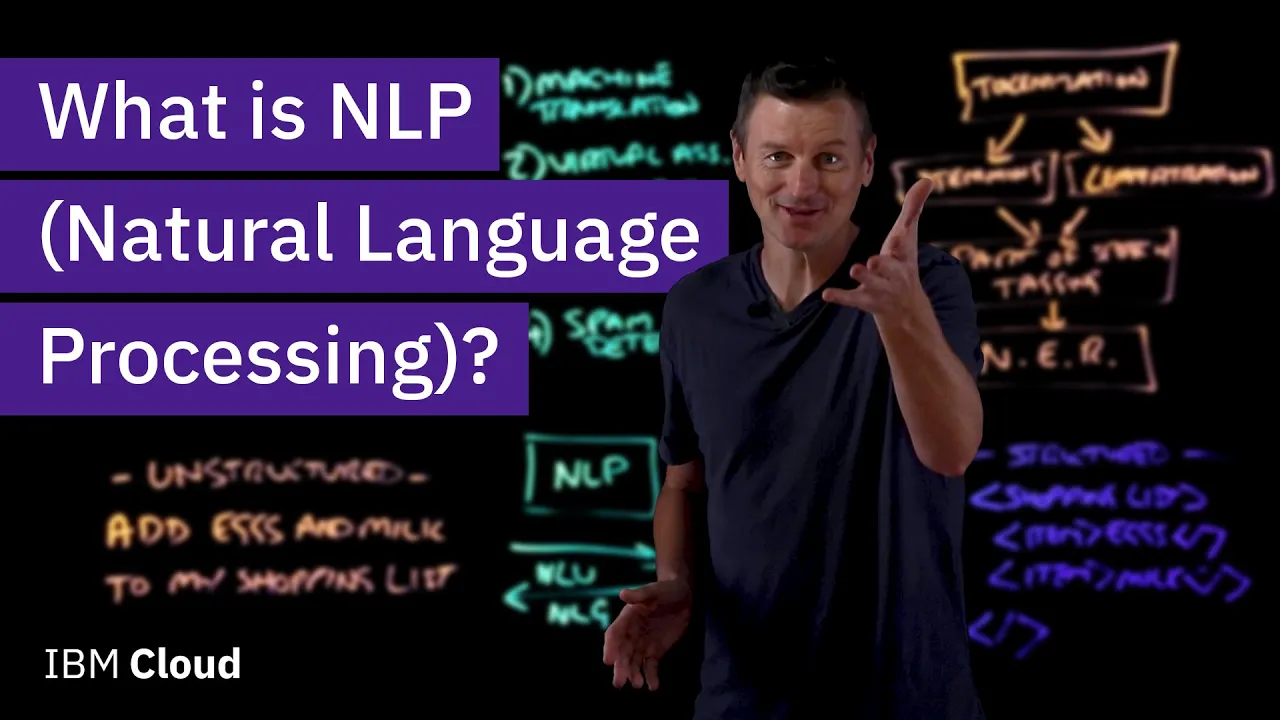
NLP Explained: Natural Language Processing Basics for Beginners
464.6K
Virtual assistants (like Siri or Alexa) and chatbots represent practical applications of NLP technology. These systems take human utterances—whether spoken or written—and derive actionable commands from them. Virtual assistants process spoken language to execute tasks on devices, while chatbots analyze written text to traverse decision trees and determine appropriate responses or actions. Both applications rely on NLP to interpret user intent and generate meaningful interactions.
Click to watch →
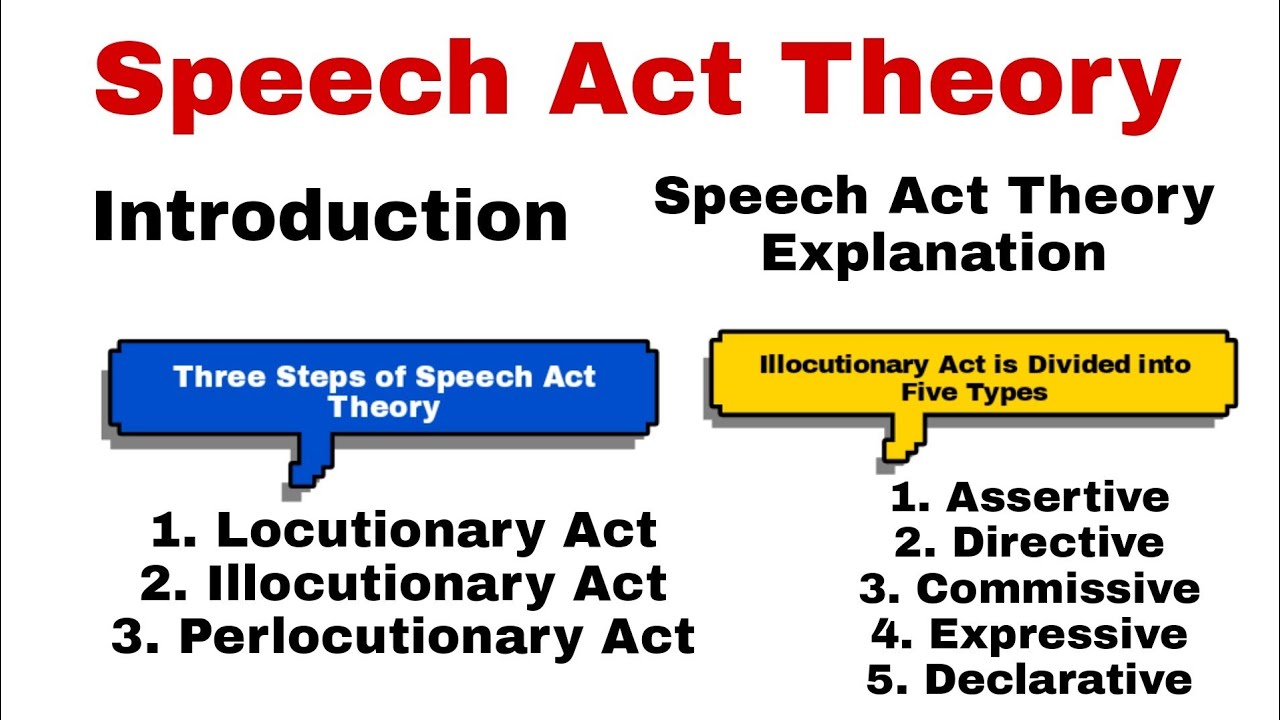
Speech Act Theory| Speech Act Theory in Discourse Studies| Speech Acts| Types of Speech Act Theory.
83.8K
Speech act theory, introduced by John L. Austin in his 1975 work 'How to Do Things with Words,' proposes that language performs actions beyond mere information transfer. Words carry out functions like requesting, commanding, promising, and declaring. Language serves dual purposes: conveying information while simultaneously performing actions. This theory was further developed by J.R. Searle, who analyzed how speakers use language to achieve various communicative goals through intentional utterances.
Click to watch →
Pragmatics Roots
Meaning Layers
Speech In Action
Pragmatics Roots
0:41- 1
Examines pragmatics and discourse against logical positivism.
- 2
Challenges the view that language solely describes facts.
Conversation Analysis and the Sequential Critique
While Austin and Searle's Speech Act Theory focuses on the speaker's internal intentions and classifies utterances into discrete, isolated categories, Conversation Analysis (CA)—pioneered by Harvey Sacks and Emmanuel Schegloff—offers a major counterpoint. CA critics argue that Speech Act Theory is overly cognitive and dependent on invented, decontextualized sentences. Instead, CA asserts that meaning in discourse is not determined solely by a single speaker’s intent, but is sequentially and collaboratively co-constructed by participants in real-time interaction. In actual conversation, an utterance's function depends heavily on its placement within a sequence (such as adjacency pairs) and how the recipient subsequently responds to it. Consequently, CA rejects the rigid, individualistic taxonomy of isolated speech acts, advocating instead for the empirical study of naturally occurring talk-in-interaction to understand how social action is dynamically achieved.
A basic understanding of Pragmatics, specifically how context influences the interpretation of meaning.
The fundamental distinction between semantics (literal meaning of words) and pragmatics (speaker's intended meaning).
An introduction to Discourse Analysis and how language functions in social interactions beyond mere grammatical structure.
Familiarity with logical positivism and the traditional philosophical view that language is primarily used to make true or false statements.
John Searle's Classification of Speech Acts (assertives, directives, commissives, expressives, and declarations).
The concept of 'Felicity Conditions' and the specific contextual rules required for a speech act to be valid and effective.
Indirect Speech Acts and how they relate to Politeness Theory (Brown and Levinson) in social interactions.
Paul Grice's Cooperative Principle and Conversational Implicature, explaining how implied meaning is negotiated.
Practical applications of Speech Act Theory in Computational Linguistics, particularly in dialogue state tracking for virtual assistants and chatbots.
47.8K views962likes9:06@usamatahir1995Original Release: 2021-05-18
[Music] language is used to do things two influential works in the area of pragmatics relevant to the area of discourse their work appeared at the time when logical positivism was a prevailing view in the philosophy of language a different point of view the logical positivist view argued that language is always used to describe some fact or situation language you have effective situations say i am sick i am going to school i am hungry what are you you know is statements yeah it is hard today and unless a statement can be tested for truth or falsity it is basically meaningless between what is said and what is intended by the speakers a central issue which underlies this is the relationship between the literal meaning or the propositional content of what someone says and what the person intended by what he or she they are not only referring to the temperature but they may also be requesting someone to do something that such as turn on the air conditioning but it requests their action performed what we say then often has a has both a literal meaning little meaning to hay and illocutionary meaning or that meaning which goes beyond what someone says in a literal sense has studied any intended meaning meaning direct meaning these are the locationary act the illocutionary act and the perlocutionary the location react refer to the literal meaning of the actual words it's hot in there oscar actual meaning he's talking about the temperature such as it's hot in here referring foreign can i take your order please foreign with egg and bacon means he's requesting to get these things tikka or parlo questioning hooper with cheese foreign large fries please give me fries please would you like any drinks or dessert with that it's a keep watching my videos thank you allah
Up Next
7:58
Pragmatics in Linguistics: Speaker Meaning and Context
@exploringscience3979
14.8K views•2020-03-16
36:52
Constraint Interaction in Optimality Theory: Epenthesis & Deletion
@Vidyamitra
180 views•2018-08-20
13:56
First Language vs Second Language Acquisition: L1 & L2 Key Differences
@usamatahir1995
63.2K views•2020-11-05

21:32
Accent Expert Explains U.S. Regional Dialects | Part 1
@WIRED
9.3M views•2021-01-21
Related Study Plans & Knowledge Roadmaps
Structured learning paths in Linguistics
linguistics
Optimality Theory: Tableaux & Constraints
01Phonological Basics: Sounds, Syllables & Rules
02Foundations of Optimality Theory: GEN, CON, and EVAL
03The Constraint Inventory: Markedness vs. Faithfulness
+ 2 more learning modules
15h5 modules
Explore Roadmap
linguistics
Morphosyntactic Alignment: S, A & P Systems
01Foundations of Syntax: Transitivity and Arguments
02The Linguistic Variables: Mapping S, A, and P
03Nominative-Accusative Alignment
+ 3 more learning modules
12h6 modules
Explore Roadmap
linguistics
Analyzing Sign Language: Phonology & Syntax
01Foundations of Sign Language Linguistics
02Phonology: The Five Parameters of a Sign
03Morphology: Word Formation and Classifiers
+ 2 more learning modules
14h5 modules
Explore Roadmap
linguistics
Pragmatics: Speech Acts, Grice & Politeness
01Introduction to Pragmatics: Meaning in Context
02Grice’s Cooperative Principle & Implicature
03Speech Act Theory
+ 2 more learning modules
14h5 modules
Explore Roadmap