First language (L1) acquisition is an unconscious process that occurs naturally from birth through immersion, typically taking up to six years to complete, while second language (L2) learning is a conscious process involving deliberate study of grammatical rules, vocabulary, syntax, and phonology, which can never fully match the native-like proficiency achieved in L1 acquisition.
First Language vs Second Language Acquisition: L1 & L2 Key Differences
Added:Deep Dive
The basic distinction between language acquisition (unconscious assimilation) and language learning (formal instruction).

𝐂𝐓𝐄𝐓 𝟐𝟎𝟐𝟓 𝐒𝐘𝐋𝐋𝐀𝐁𝐔𝐒 | 𝐇𝐈𝐍𝐃𝐈 𝐏𝐀𝐏𝐄𝐑 𝟏 & 𝟐 | C𝐓𝐄𝐓 𝐊𝐈 𝐓𝐀𝐈𝐘𝐀𝐑𝐈 𝐊𝐀𝐈𝐒𝐄 𝐊𝐀𝐑𝐄 |𝐂𝐓𝐄𝐓 𝐍𝐎𝐓𝐈𝐅𝐈𝐂𝐀𝐓𝐈𝐎𝐍|𝐁𝐘 𝐒𝐖𝐄𝐄𝐓𝐘 𝐌𝐀𝐌
55.7K
Language Acquisition (भाषा अर्जन) is the natural, unconscious process of learning a language, typically occurring in childhood without formal instruction. It happens automatically through natural exposure in the environment. Language Learning (भाषा अधिगम) is the conscious, effortful process of learning a language through formal education, rules, and structured study. The key distinction is that acquisition is unconscious (अवचेतन) and natural (स्वाभाविक), while learning is conscious (सचेतन) and deliberate. First language acquisition is natural and unconscious, while second language learning typically requires formal instruction.
Click to watch →

English Pedagogy | English Pedagogy for LTR main | One Shot | English Pedagogy by Sushanta Sir
42.1K
Language acquisition is the natural, subconscious process of acquiring language, similar to how children learn their first language. Language learning is the conscious, formal process of studying language rules and vocabulary. Acquisition happens implicitly through exposure and use, while learning happens explicitly through instruction. This distinction is fundamental to understanding how languages are learned and taught.
Click to watch →

CTET, CGTET, शिक्षक भर्ती परीक्षा हेतु || English Pedagogy || Topic-01 || Learning & Acquisition
77.3K
The basic differences between acquisition and learning are: (1) Acquisition refers to children's first language acquisition (mother tongue), while learning refers to formal knowledge of language. (2) Acquisition is natural and subconscious, while learning is formal and conscious. (3) Acquisition involves picking up language naturally, while learning involves deliberate study. (4) Acquisition is subconscious, while learning is conscious. (5) Acquisition does not require formal teaching, while learning requires formal instruction. (6) Acquisition involves implicit knowledge (unconscious understanding), while learning involves explicit knowledge (conscious understanding). (7) Formal teaching helps in learning, while acquisition occurs through informal processes.
Click to watch →

CTET Feb 2026 | हिंदी Pedagogy एक दिन में | भाषा और अधिगम | Topic-wise Theory | Most Important PYQ
35.1K
The fundamental differences between language acquisition and learning include: (1) Naturalness - acquisition is spontaneous, learning requires conscious effort; (2) Formality - learning involves rules and grammar, acquisition is informal; (3) Consciousness - learning requires attention, acquisition is unconscious; (4) Environment - acquisition happens through natural exposure, learning requires structured opportunities; (5) Reward/punishment - learning may involve these, acquisition does not; (6) Grammar - learning involves explicit instruction, acquisition develops grammar implicitly.
Click to watch →

CTET SEP 2026 | HINDI | भाषा अर्जन और भाषा अधिगम 2011-2026 PYQs | By Deepika Mam
13.2K
Language acquisition (भाषा अर्जन) is a natural, unconscious process where children learn their mother tongue through environmental interaction without formal training. Language learning (भाषा अधिगम) is a conscious, effortful process involving grammar, books, and teacher guidance. Acquisition occurs in the unconscious state, while learning occurs in the conscious state. Acquisition is associated with the mother tongue, while learning is associated with target languages. Acquisition is informal and spontaneous, while learning is formal and structured.
Click to watch →
Deep Dive
The Critical Period Hypothesis, which suggests there is a biological window for native-like language acquisition.

اللغة العربية؛ هُويّة تُعاش | د.بندر الغميز بودكاست جولان
203.5K
Chomsky proposes that there is a critical period for language acquisition, typically from birth to around 18 years of age. During this period, children can acquire any language with native-like proficiency. After this period, language acquisition becomes more difficult and typically results in non-native proficiency. This critical period hypothesis has been supported by research on cases of children raised in isolation who later learned language, showing that the critical period is a biological constraint on language learning.
Click to watch →

NOAM CHOMSKY | Linguistics | Theory of universal grammar
73.5K
The Critical Period Hypothesis states that there is a specific window of time (approximately ages 0-5) during which children can acquire languages most easily and completely. After this period, typically around adolescence, the brain's plasticity decreases significantly, making it much more difficult to learn new languages to native-like proficiency.
Click to watch →

Adquisición del lenguaje según el Innatismo
64.5K
The Critical Period Hypothesis states that there is a biologically determined window during which language acquisition must occur for normal proficiency. If the Language Acquisition Device is not stimulated during early childhood, the resulting language will have significant limitations. This hypothesis is supported by case studies of children who were isolated from human contact during critical developmental periods.
Click to watch →

하나님이 한 사람을 만들어가는 과정, 정말 흥미진진하고 끝내 감동이 밀려온다_담당 PD 편집 후기ㅣ정철 젭스 이사장ㅣ새롭게하소서
823.5K
Children have a critical period for language acquisition, typically lasting until about 12-13 years of age. During this period, children can acquire languages naturally and effectively. This biological window explains why early childhood is the optimal time for language learning and why children often achieve native-like proficiency when exposed to a language during this period.
Click to watch →

Капица.С.П и Черниговская.Т.В - Мышление и язык
848.7K
The critical period hypothesis states that there is a biologically determined window during early childhood when the brain is particularly plastic and receptive to language acquisition. This period typically spans the first three to five years of life. During this time, children can acquire languages with remarkable ease and achieve native-like proficiency. However, if a child does not receive adequate linguistic input during this critical period, they may never fully develop normal language abilities, even if they learn to communicate later in life.
Click to watch →
Deep Dive
Fundamental linguistic terms such as syntax, phonology, and semantics.

UP GIC 2026 | UP GIC English Vocab & Grammar Marathon 2026 | UP GIC English Classes By Deepak Sir
2.2K
Phonology is the study of sounds in language. Morphology is the study of how words are formed. Semantics is the study of word meanings. Pragmatics is the study of how context contributes to meaning. These are fundamental linguistic concepts that students must understand for language analysis.
Click to watch →

Lecture-33, PSTET English Grammar Special, MCQs Asked Multiple Times
879
Syntax is the study of sentence structure and how words are arranged to form grammatically correct sentences. Semantics is the study of meaning of words and how meaning is conveyed in language. Phonology is the study of sound patterns and the sound system of a language. These three branches of linguistics work together to analyze how language functions at different levels: structure, meaning, and sound.
Click to watch →

Introduction to English Linguistics 英語学概論 5月1日
432
The scientific study of language involves three main areas: phonology (sound system), syntax (grammar), and semantics (meaning). These correspond to the three components of words: sound, grammar, and meaning.
Click to watch →

Competence, Performance, Encode, and Decode -Psikolinguistik
261
Language structure consists of three components: Syntax (sintaksis) relates to grammatical rules and sentence structure; Semantics (semantik) relates to meaning and conceptual understanding; Phonology (fonologi) relates to the sound system and how concepts are articulated. Syntax and Semantics are abstract components (Deep Structure) because they exist only in the mind during thinking and cannot be directly observed. Phonology is a concrete component (Surface Structure) because it involves actual sounds that can be heard and perceived through speech organs.
Click to watch →

Introducción. Devitt y Sterelny, 1: Filosofía del lenguaje, lingüística. ¿Qué es el lenguaje?
422
Linguists study language through three main aspects: (1) Phonology - the study of sounds, (2) Syntax - the study of grammar and rules for forming sentences and phrases, and (3) Semantics - the study of meaning. Syntax provides rules for constructing grammatically correct sentences, while semantics addresses fundamental philosophical questions about what meaning is and how words and sentences acquire meaning.
Click to watch →
Deep Dive
Basic cognitive development differences between infants/children and adolescents/adults.
![[ติวครูผู้ช่วย กทม.68] EP.1 ภาค ข วิชาการศึกษา By...อ.เทพติวเตอร์](https://i.ytimg.com/vi/3xEEcGHCuyg/maxresdefault.jpg)
[ติวครูผู้ช่วย กทม.68] EP.1 ภาค ข วิชาการศึกษา By...อ.เทพติวเตอร์
1.5K
A key difference between adolescents (teenagers) and younger children lies in their cognitive thinking processes. Adolescents (ages 11-15) are in the formal operational stage and think abstractly, considering future possibilities and hypothetical scenarios. In contrast, younger children (ages 7-11) are in the concrete operational stage and think in terms of tangible, concrete experiences. This distinction is significant for educational planning and understanding developmental differences.
Click to watch →

Estudio de casos para la protección de los derechos de niños, niñas y adolescentes/Defensoría
198
Adolescents, despite their physical size, are still in a developmental process at cognitive and emotional levels. Adults cannot compare their maturity and analytical capabilities with adolescents. Adolescents may easily be manipulated because they lack the experience to distinguish right from wrong. This developmental difference requires special attention and protection strategies.
Click to watch →

BASIC CONCEPTS & ISSUES OF HUMAN DEVELOPMENT
915
Cognitive development involves growth and change in intellectual capabilities that influence behavior. Infants and toddlers learn rapidly, particularly in language development. Young children show huge differences in ability to think logically about the concrete world compared to middle childhood. Adolescents develop the ability to think logically about abstract concepts and may debate matters with adults as they exercise new cognitive skills.
Click to watch →

Child, Adolescent, Adult: Life Stages or Different Species? (South East European University, SEEU)
10.5K
Children operate passively, waiting for caregivers to provide food, change diapers, and notice them. They follow an action-reaction pattern with no agency. Adolescents develop cognitive abilities to actively impact their environment, influence others, and shape outcomes. This transition from passive recipients to active agents represents a fundamental developmental shift. Children view themselves as elements within others' stories, while adolescents believe their own story is paramount - everyone else exists only within it. This 'personal fable' includes the fantasy that eliminating your story would make everyone disappear. This narcissistic worldview persists in some adults as full-blown narcissism. The brain develops in ways that create fundamental discontinuities between developmental stages. At birth, the brain is only 40% developed, continuing to grow outside the womb. By age 3, it reaches 80%; by age 5, 90%. However, the child's brain consists of two largely independent hemispheres with minimal connection, creating chaos where different brain parts operate independently. The adolescent brain develops strong connections between hemispheres, enabling unified processing. Critically, the limbic system (emotions) develops early while the prefrontal cortex (executive function) remains underdeveloped until age 25-30. Dopamine levels also vary dramatically: children have almost none, adolescents produce excessive amounts, and adults have normal levels.
Click to watch →

Duygusal Olarak Olgunlaşmak | Rehber - 22.05.2026
133
Cognitive development occurs in distinct stages: (1) Sensorimotor stage (birth to 2 years) - reflexive movements and basic sensory experiences; (2) Preoperational stage (2-7 years) - symbolic thinking begins but is limited; (3) Concrete operational stage (7-11 years) - logical thinking about concrete events; (4) Formal operational stage (12+ years) - abstract and hypothetical thinking develops. These stages explain why children and adolescents process information differently from adults.
Click to watch →
Prerequisite Knowledge
- Concept 01The basic distinction between language acquisition (unconscious assimilation) and language learning (formal instruction).
- Concept 02The Critical Period Hypothesis, which suggests there is a biological window for native-like language acquisition.
- Concept 03Fundamental linguistic terms such as syntax, phonology, and semantics.
- Concept 04Basic cognitive development differences between infants/children and adolescents/adults.
Subsequent Learning
- Step 01Stephen Krashen's Input Hypothesis and other Monitor Model hypotheses in second language acquisition.
- Step 02The concept of 'Interlanguage' and how L2 learners construct a temporary, evolving language system.
- Step 03Practical applications in pedagogy, such as communicative language teaching (CLT) versus traditional grammar-translation methods.
- Step 04The cognitive and neurological effects of bilingualism and multilingualism on the brain.
Language Basics
Acquisition Gap
Learning Focus
Native Status
Time Frame
Language Basics
0:42Playing Section
- 1
Defines first and second language distinctions clearly.
- 2
Explains unconscious acquisition of the native tongue.
The Connectionist and Unified Model Perspective
While traditional theories draw a sharp distinction between unconscious L1 acquisition and conscious L2 learning, usage-based and connectionist perspectives, such as Brian MacWhinney’s Unified Model, argue that both rely on the same fundamental cognitive mechanisms. According to this view, language development is a continuous process driven by general-purpose cognitive systems—like statistical learning, pattern recognition, and associative mapping—rather than a dedicated, age-sensitive Language Acquisition Device (LAD). The observed differences in L2 proficiency outcomes are not due to a shift in how the brain learns, but rather to cognitive variables such as 'entrenchment' (the deeply ingrained neural pathways of the L1), native language transfer, and different social learning contexts. Consequently, this counterpoint suggests that the process of acquiring any language remains qualitatively similar throughout life, challenging the strict dichotomy between L1 acquisition and L2 learning.
Deep Dive
Stephen Krashen's Input Hypothesis and other Monitor Model hypotheses in second language acquisition.

Monitor Model Theory by Stephen Krashen
24.3K
The Monitor Model Theory, developed by Stephen Krashen, proposes that second language acquisition occurs through subconscious acquisition rather than conscious learning, with the 'monitor' being a conscious system that edits and corrects language output but does not generate language; the theory emphasizes that comprehensible input is essential for language acquisition, and that the affective filter (emotional state) significantly impacts learning effectiveness.
Click to watch →

شرح مبسط لنظريه كراشن طرق تدريس تخصص انجليزي مسابقه 30 الف معلم التربية والتعليم
17.6K
Krashen's Monitor Model is a comprehensive theory of second language acquisition consisting of five interconnected hypotheses. The Affective Filter Hypothesis explains that emotional factors like confidence and motivation act as a filter that either allows or blocks language input. The Input Hypothesis states that acquisition occurs through comprehensible input slightly above current proficiency (i+1). The Natural Order Hypothesis proposes that language structures are acquired in a predictable sequence regardless of teaching order. The Acquisition-Learning Hypothesis distinguishes between subconscious acquisition (natural communication) and conscious learning (studying rules). The Monitor Hypothesis explains how conscious knowledge edits language output, with learners being over-monitors, under-monitors, or optimal monitors. Together, these hypotheses provide a framework for understanding how humans acquire languages naturally.
Click to watch →

CTET 2026 | All Thinkers | सभी भाषा विद्वान एक साथ | ONE SHOT | LIVE 🛑 | BY DHEERAJ SIR जल्दी देखें
142.5K
Stephen Krashen, an American linguist, developed the Second Language Acquisition (SLA) theory explaining how people learn a second language. His theory includes five key hypotheses: the Acquisition-Learning Hypothesis (distinguishing subconscious acquisition from conscious learning), the Monitor Hypothesis (explaining how learned knowledge corrects language), the Input Hypothesis (i+1 theory stating acquisition occurs through comprehensible input slightly beyond current level), the Natural Order Hypothesis (grammatical structures are acquired in a predictable sequence), and the Affective Filter Hypothesis (emotional factors affect language acquisition).
Click to watch →

CTET 21 JAN TOPIC 6 by Sachin choudhary live 8pm
775.3K
Stephen Krashen proposed five hypotheses explaining second language acquisition: (1) Acquisition-Learning Hypothesis distinguishes subconscious acquisition from conscious learning; (2) Monitor Hypothesis explains how learners use rules to edit speech; (3) Natural Order Hypothesis states grammatical structures are acquired in a predictable sequence; (4) Input Hypothesis (i+1) states learners acquire language through comprehensible input slightly beyond their level; (5) Affective Filter Hypothesis states emotional states affect acquisition. These hypotheses emphasize that language acquisition occurs naturally through meaningful communication, not formal instruction.
Click to watch →

CTET 2024 महत्वपूर्ण मनोवैज्ञानिक/भाषाविद by Sachin choudhary live 8pm
692.5K
Stephen Krashen proposed five hypotheses explaining second language acquisition: Acquisition-Learning Hypothesis (natural acquisition vs. formal learning), Monitor Hypothesis (learned language as editor), Natural Order Hypothesis (predictable sequence of rule acquisition), Input Hypothesis (comprehensible input i+1), and Affective Filter Hypothesis (emotional factors affecting learning). He argued that language acquisition occurs through natural exposure to comprehensible input, not through formal instruction. The 'i+1' concept represents input slightly beyond the learner's current level, enabling natural language development.
Click to watch →
Deep Dive
The concept of 'Interlanguage' and how L2 learners construct a temporary, evolving language system.

Pstet English 2026 | Pstet 2026 English 100 MCQ's By Isha Maam
35K
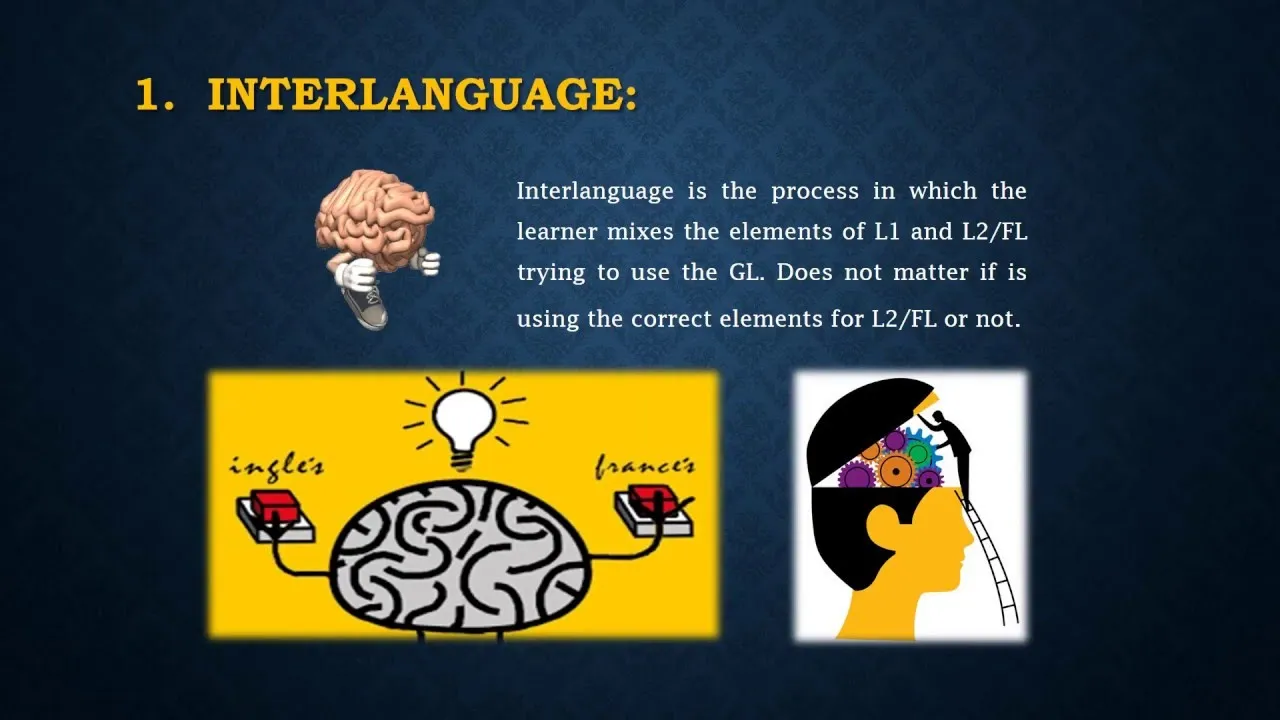
Interlanguage is the developing linguistic system that learners construct as they acquire a second language. It represents a unique language system that is neither the learner's native language nor the target language. Interlanguage has its own rules, patterns, and structures that may differ from both the source and target languages. This concept, developed by Selinker, helps explain why learners make systematic errors and how their language ability evolves over time.
Click to watch →
Interlanguage theory #what_is_interlanguage_in Bengali #interlanguage #ইন্টারলেংগুয়েজ #ESL #ELT
353
Interlanguage is a temporary, evolving language system that learners create during the process of learning a new language, which represents a unique mixture of their native language (L1) and the target language (L2), containing elements from both languages plus unique rules and patterns developed by the learner themselves; it serves as a bridge between the learner's first language and the language they are learning, and as learners improve, their interlanguage gradually becomes closer to the correct form of the target language.
Click to watch →

ENGLISH PEDAGOGY -Topic Wise Questions |CTET SEP 2026 |छ.ग. शिक्षक भर्ती |#ctet #ctet2026 #cgvyapam
542
Interlanguage is a transitional language system created by second language learners that blends elements from both their native language (L1) and target language (L2). It represents a hybrid linguistic stage between complete L1 fluency and complete L2 proficiency. Interlanguage includes phenomena like code switching, code mixing, and translanguage. It is dynamic and evolves as learners receive new input, following consistent patterns in errors and corrections. Key characteristics include being a temporary evolving system, influenced by L1 transfer, and involving overgeneralization of L2 rules.
Click to watch →

what is interlanguage?
48.1K
Interlanguage is a transitional linguistic system that learners develop when acquiring a second language, characterized by unique speech patterns combining elements from their native language with target language features, featuring its own rule system that differs from both native and target languages, and serving as a valuable analytical framework for understanding cognitive and social processes in language learning.
Click to watch →

Interlanguage & Fossilization
15.5K
Interlanguage is the intermediate linguistic system that second language learners construct during the process of acquiring a target language, characterized by errors arising from L1 interference, rule overgeneralization, or faulty learning, and it varies significantly among individual learners; fossilization occurs when a learner stops progressing toward native-like proficiency and remains at a fixed competence level, with the timing of fossilization varying from learner to learner, and research indicates that most second language learners rarely achieve native-like proficiency and may remain in the interlanguage stage indefinitely.
Click to watch →
Deep Dive
Practical applications in pedagogy, such as communicative language teaching (CLT) versus traditional grammar-translation methods.

REET English Practice Questions : Formative ,Summative Assessment ,CLT , Principles of Teaching
10.8K
This extensive section covers Communicative Language Teaching (CLT), which emerged as a response to traditional grammar-translation methods. CLT emphasizes communicative competence—the ability to use language effectively for interaction, not just grammatical accuracy. CLT replaced the Situational Approach as the dominant methodology. The four components of communicative competence are: (1) Linguistic competence (grammatical knowledge), (2) Sociolinguistic competence (understanding social contexts), (3) Strategic competence (communication strategies for difficulties), and (4) Discourse competence (coherent text production). In CLT, the teacher's role is that of a facilitator who creates learning environments for student-centered communication. CLT addresses the problem that students often struggle to speak even simple sentences in the target language, focusing on developing practical communication skills.
Click to watch →

CTET Hindi Pedagogy Complete Preparation |हिंदी शिक्षण शास्त्र Class
74.9K
Three main language teaching methods exist: Grammar-Translation Method (oldest) - uses mother tongue to teach second language through word-for-word translation; Direct Method - teaches target language exclusively without mother tongue; Communicative Method - emphasizes conversation and communication skills. Additionally, Inductive Method (examples first, then rules) is best for primary levels, while Deductive Method (rules first, then examples) suits higher grades.
Click to watch →

REET Online Classes | 29 January 2018 | 1st & 2nd Level English| Bhisham Soni Sir
44K
This segment covers major language teaching methods: (1) Audio-Lingual Method (ALM) - based on behaviorist psychology, no mother tongue use, no grammatical explanation, memorization of structure-based dialogues, focuses on speech habits; (2) Grammar-Translation Method (GTM) - extensive mother tongue use, deductive grammar teaching, memorization of rules, translation exercises, focuses on reading and writing; (3) Prose teaching objectives - understanding passages, enriching vocabulary, cultivating reading habit; (4) Prose teaching methods - model reading, silent reading, explanation of new words; (5) Communicative Approach (CLT) - interaction as means and goal, use of real-life situations, learner-centered approach. The segment explains how to evaluate statements about these methods correctly.
Click to watch →

An Introduction to Communicative Language Teaching in SEVEN (magnificent) chapters!
12.1K
Communicative Language Teaching (CLT) is an approach that emphasizes meaningful language use over rote learning, contrasting with the Grammar Translation Method. CLT centers on seven key principles: (1) More student talk and less teacher lecture, (2) Personalization with relevant and interesting topics, (3) Contextualized language learning starting from real situations, (4) Use of authentic language materials, (5) Teaching grammar where it's useful for communication rather than as an isolated academic exercise, (6) Emphasis on teaching vocabulary chunks and collocations rather than single words, and (7) A functional approach focusing on language needed for specific situations and purposes.
Click to watch →

Teaching Meathods (Communicative Approach) Part -2
10.1K
Communicative Language Teaching (CLT) is an approach where language is taught for effective communication in real-world contexts, focusing on four essential skills: listening (receptive), speaking (productive), reading (receptive), and writing (productive). Unlike traditional grammar-translation methods, CLT emphasizes meaning-based learning and student-centered interaction, enabling learners to use language effectively in social contexts beyond the classroom. This approach evolved from earlier methods like the Grammar-Translation Method and was influenced by linguists such as Noam Chomsky, who proposed that humans have an innate Language Acquisition Device (LAD) that facilitates natural language learning.
Click to watch →
Deep Dive
The cognitive and neurological effects of bilingualism and multilingualism on the brain.

Bilingual Brain: Top 5 Ways Bilingualism Changes Your Brain (And Why It's Not Too Late to Start!)
2.6K
Being bilingual or multilingual transforms the brain in five scientifically-backed ways: (1) Enhanced executive function through constant language switching improves multitasking and cognitive flexibility; (2) Delayed onset of dementia and Alzheimer's disease by up to five years due to increased cognitive reserve; (3) Improved social and emotional intelligence from navigating different cultural norms and perspectives; (4) Increased creativity and divergent thinking from approaching problems from multiple linguistic angles; (5) Greater cognitive resilience that helps the brain recover faster from injury or cognitive decline. These benefits apply to both children and adults at any age due to neuroplasticity, making it never too late to start learning a new language.
Click to watch →

Tu mamá TIENE que hacer esto - CIENCIA SIMPLIFICADA EP76
132.9K
Studies have found that bilingual and multilingual individuals have greater neural connectivity in certain brain regions and more efficient neural processing in executive control tasks. They also tend to experience delayed onset of clinical dementia symptoms. This suggests that the cognitive training provided by managing multiple languages creates lasting structural and functional changes in the brain that provide protection against cognitive decline.
Click to watch →
![[NCLC 2024] The Power of Language: Consequences of Bilingualism for Cognition and the Brain](https://i.ytimg.com/vi/LQQ_OKqg-w8/maxresdefault.jpg)
[NCLC 2024] The Power of Language: Consequences of Bilingualism for Cognition and the Brain
1.3K
Bilingual and multilingual individuals process all their languages simultaneously in parallel rather than switching them off, which develops enhanced cognitive control abilities that translate into advantages in inhibitory control, creativity, decision-making, and memory, while also providing neuroprotection against dementia by delaying its onset by approximately four to six years.
Click to watch →

🧠 ¿Cómo cambia tu cerebro al aprender varios idiomas? Mi experiencia ;)
27.7K
Learning multiple languages enhances brain plasticity, increases gray matter density and white matter integrity, improves concentration and multitasking abilities, delays Alzheimer's onset by 4-5 years, reduces cognitive damage after strokes, and provides cognitive benefits regardless of whether the second language is learned in childhood or adulthood; however, potential disadvantages include language interference between similar languages and occasional tip-of-the-tongue phenomena.
Click to watch →

How Speaking TWO LANGUAGES Makes Your Brain Stronger
45.2K
Bilingual and multilingual individuals develop enhanced executive control functions because their brains constantly practice suppressing one language while using another, which provides significant cognitive advantages and can delay the onset of diseases like Alzheimer's and dementia by up to five years.
Click to watch →
Language Basics
Acquisition Gap
Learning Focus
Native Status
Time Frame
Language Basics
0:42- 1
Defines first and second language distinctions clearly.
- 2
Explains unconscious acquisition of the native tongue.
The Connectionist and Unified Model Perspective
While traditional theories draw a sharp distinction between unconscious L1 acquisition and conscious L2 learning, usage-based and connectionist perspectives, such as Brian MacWhinney’s Unified Model, argue that both rely on the same fundamental cognitive mechanisms. According to this view, language development is a continuous process driven by general-purpose cognitive systems—like statistical learning, pattern recognition, and associative mapping—rather than a dedicated, age-sensitive Language Acquisition Device (LAD). The observed differences in L2 proficiency outcomes are not due to a shift in how the brain learns, but rather to cognitive variables such as 'entrenchment' (the deeply ingrained neural pathways of the L1), native language transfer, and different social learning contexts. Consequently, this counterpoint suggests that the process of acquiring any language remains qualitatively similar throughout life, challenging the strict dichotomy between L1 acquisition and L2 learning.
The basic distinction between language acquisition (unconscious assimilation) and language learning (formal instruction).
The Critical Period Hypothesis, which suggests there is a biological window for native-like language acquisition.
Fundamental linguistic terms such as syntax, phonology, and semantics.
Basic cognitive development differences between infants/children and adolescents/adults.
Stephen Krashen's Input Hypothesis and other Monitor Model hypotheses in second language acquisition.
The concept of 'Interlanguage' and how L2 learners construct a temporary, evolving language system.
Practical applications in pedagogy, such as communicative language teaching (CLT) versus traditional grammar-translation methods.
The cognitive and neurological effects of bilingualism and multilingualism on the brain.
63.2K views997likes13:56@usamatahir1995Original Release: 2020-11-05
foreign so what are the different differences okay in this in these two uh languages let's start learning so first language versus second language l1 first language second language so l1 is simply unconscious [Music] completely acquired with 100 [Music] learners can never match with l1 consciously proficiency but it could be highly yes focus upon grammatical rules structures patterns syntax and other morphological aspects of language you try to master the language by learning rules vocabulary syntax and other morphological aspects along with phonology of the language it's a stress-free it becomes your native language as well but may or may not be native speakers i've been some cases native speakers or in some cases because we just say language secrets it takes maximum six years to fully acquire the language most maximum time period six years older lincoln altoona there is no definite you know you are just exposed it is quite foreign [Music] so subscribe this channel subscribe this channel and subscribe
Up Next
10:44
Lenneberg Critical Period Hypothesis in Language Acquisition
@jovaniegaray368
5.5K views•2021-11-17
36:52
Constraint Interaction in Optimality Theory: Epenthesis & Deletion
@Vidyamitra
180 views•2018-08-20

9:06
Speech Act Theory in Discourse Analysis | Austin & Searle
@usamatahir1995
47.8K views•2021-05-18

21:32
Accent Expert Explains U.S. Regional Dialects | Part 1
@WIRED
9.3M views•2021-01-21
Related Study Plans & Knowledge Roadmaps
Structured learning paths in Linguistics
linguistics
Optimality Theory: Tableaux & Constraints
01Phonological Basics: Sounds, Syllables & Rules
02Foundations of Optimality Theory: GEN, CON, and EVAL
03The Constraint Inventory: Markedness vs. Faithfulness
+ 2 more learning modules
15h5 modules
Explore Roadmap
linguistics
Morphosyntactic Alignment: S, A & P Systems
01Foundations of Syntax: Transitivity and Arguments
02The Linguistic Variables: Mapping S, A, and P
03Nominative-Accusative Alignment
+ 3 more learning modules
12h6 modules
Explore Roadmap
linguistics
Analyzing Sign Language: Phonology & Syntax
01Foundations of Sign Language Linguistics
02Phonology: The Five Parameters of a Sign
03Morphology: Word Formation and Classifiers
+ 2 more learning modules
14h5 modules
Explore Roadmap
linguistics
Pragmatics: Speech Acts, Grice & Politeness
01Introduction to Pragmatics: Meaning in Context
02Grice’s Cooperative Principle & Implicature
03Speech Act Theory
+ 2 more learning modules
14h5 modules
Explore Roadmap