












Paul Grice's Cooperative Principle explains how we understand indirect or non-literal language like sarcasm and irony by assuming others are being cooperative in conversation; when someone appears to violate the four maxims (quantity, quality, relation, manner), we infer hidden meanings rather than taking their words literally, treating such violations as clues to search for the speaker's intended meaning using our common knowledge and contextual understanding.
Grice's Cooperative Principle in Pragmatics Explained | Communication
Added:The fundamental distinction between semantics (the literal meaning of language) and pragmatics (how context contributes to meaning).
The basic communication loop, specifically how messages are encoded by a speaker and decoded by a listener.
An introductory understanding of linguistic context and how social dynamics influence everyday conversation.
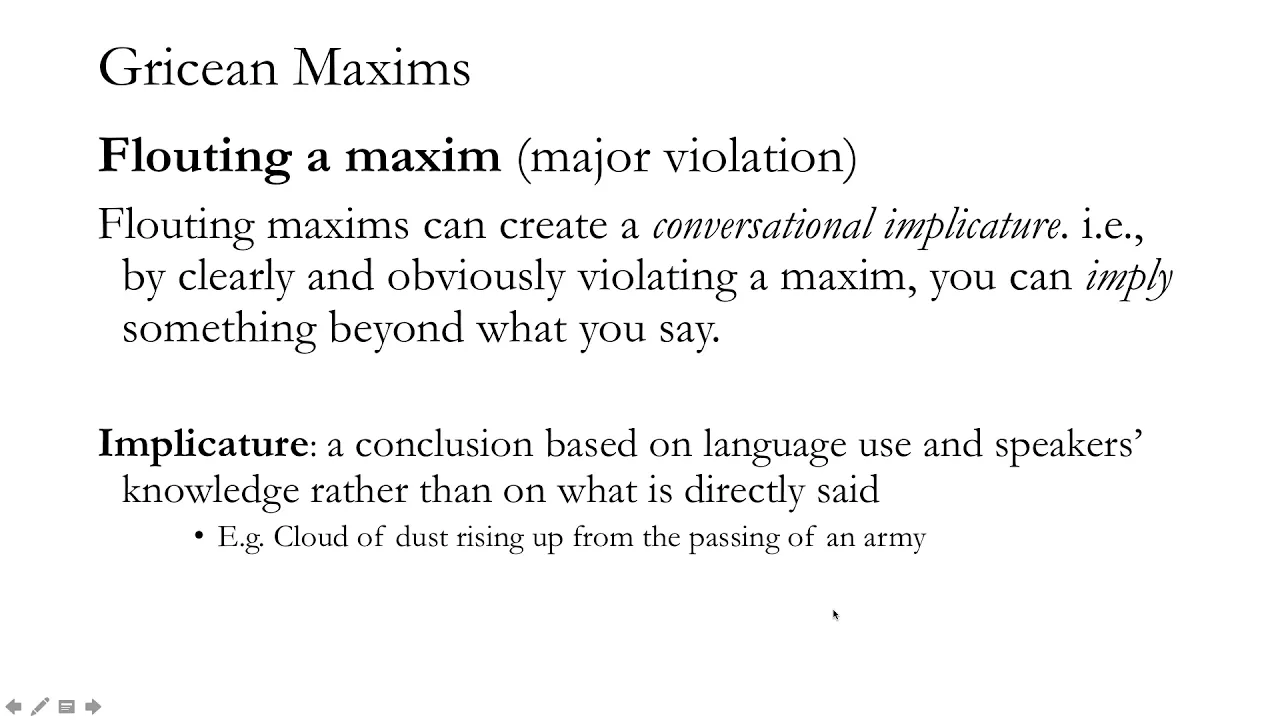
The distinction between 'flouting' and 'violating' conversational maxims, and how these actions generate specific implicatures like sarcasm or irony.
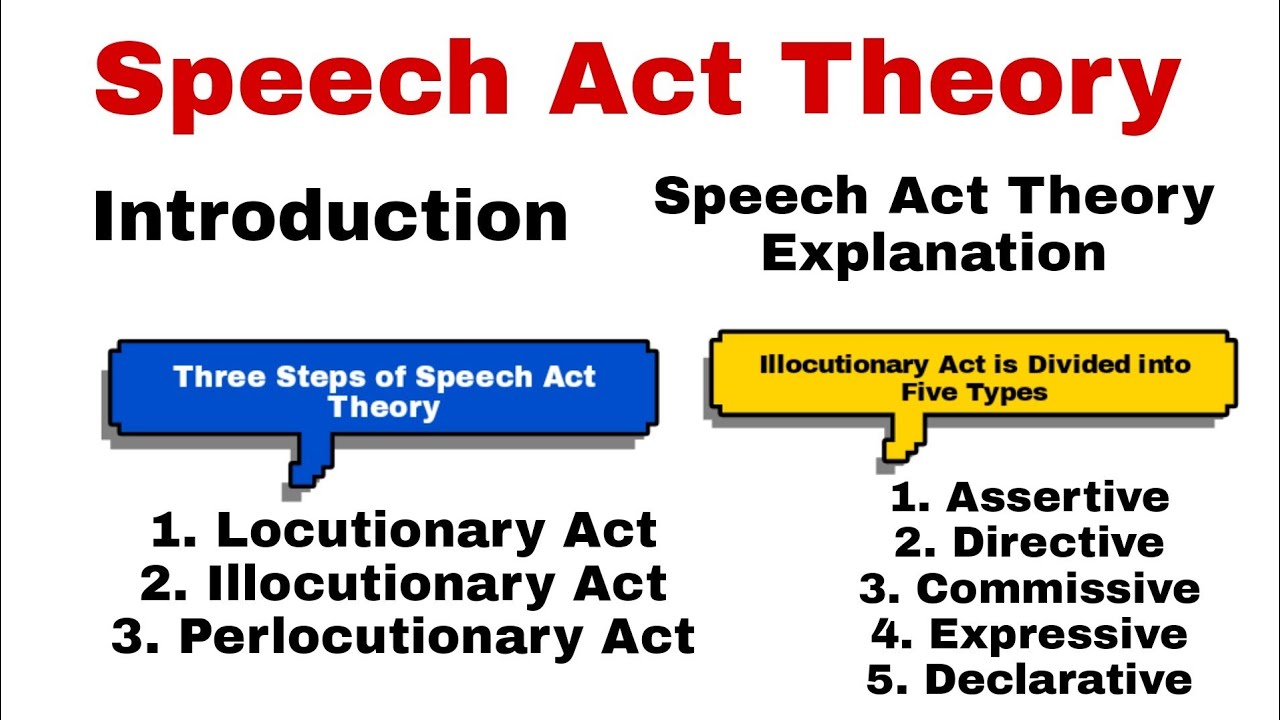
Speech Act Theory (pioneered by Austin and Searle), which examines how utterances are used to perform actions (e.g., requests, promises).
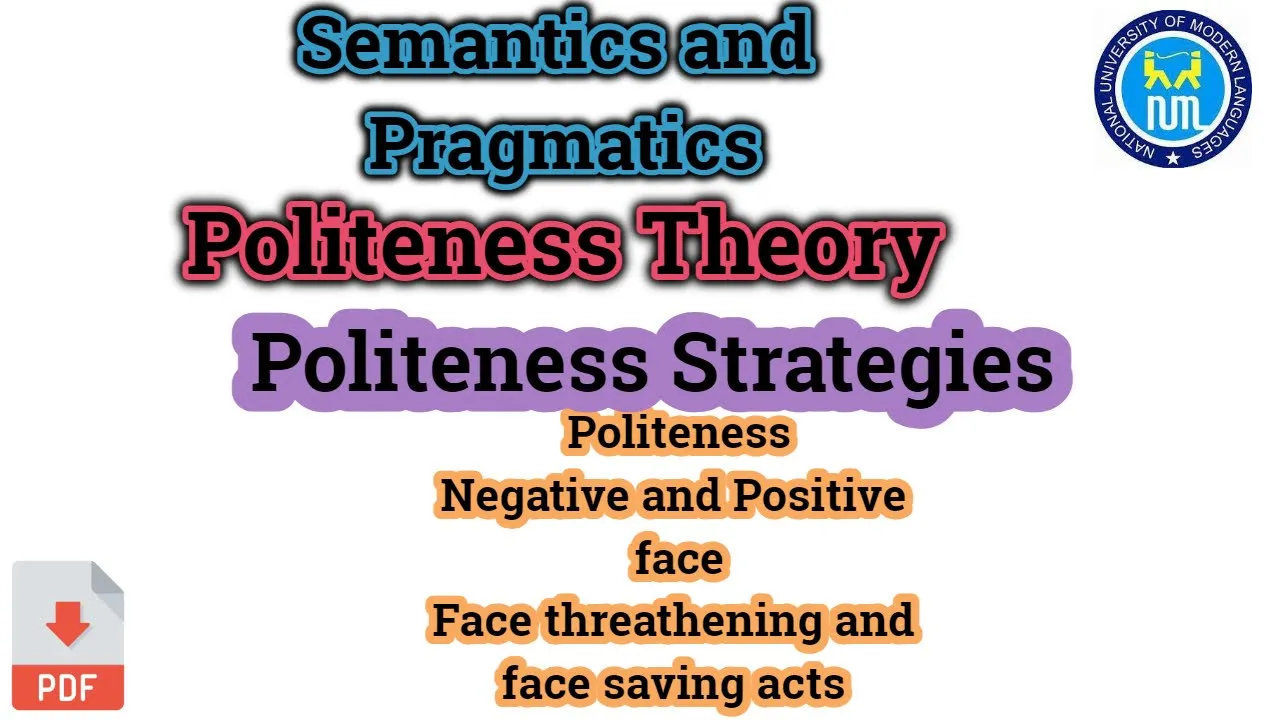
Politeness Theory (Brown and Levinson), which investigates how speakers deviate from Grice's maxims to protect the 'face' of their conversational partners.
Alternative modern cognitive frameworks such as Relevance Theory (Sperber and Wilson) and Neo-Gricean pragmatic theories.
49.2K views2.2Klikes15:07Original Release: 2019-05-12
how do we understand irony how do we understand sarcasm how do we understand any indirect or non literal use of language when somebody says one thing and means something else how do we do that it happens all the time and yet it's a mystery exactly how we achieve it that's what I want to talk about in this video [Music] hi everybody I'm Bruce Lambert from how communication works calm this is a channel where I teach you about communication skills so you can improve your relationships succeed at work be more confident and lead a more fulfilling life one of the most basic facts about communication is that we mean a lot more than we say and sometimes we mean exactly the opposite of what we say that's what Iren is or sarcasm or sometimes jokes but even in ordinary interaction where we're not being ironic when we're not being sarcastic we communicate indirectly that as we say one thing and we mean something else I'm going to give you a bunch of examples in a minute but trust me it happens all the time so how could that possibly work isn't language kind of a code and don't we directly translate what people get the ideas out of people's words and that's how we get the meanings if that's true how do we say one thing and mean something else how does the hearer know when the speaker doesn't mean what he or she said but means the opposite how does that work that's what I want to talk about today this basic property of communication is sometimes referred to as inference beyond the information given this is just a fancy way of saying we mean more than we actually say and people interpret more than they actually hear I want to give you several examples of this and I'm gonna put some slides up on the screen for you to refer to so the first one here an example one Sanjay says did you finish that report and Rick says it's on your desk so Sanjay asks a direct question did you finish your report literally the only appropriate answer to that question would be yes I did or no I didn't but instead Rick says it's on your desk but Sanji doesn't have any difficulty understanding this he understands that it's on your desk is an indirect way of saying yes I finished it and I put it on your desk but how does Rick come to this I mean how does Sanjay make this inference that's the mystery in the second example you see that's a letter of reference mr. x's attendance at work was excellent and he always dressed professionally now the question is is this a good reference or a bad reference if this is all the letter says this is a bad reference why it doesn't say anything bad about mr. X it says their attendance at work was excellent and they always dress professionally but anyone who got a reference letter like that we know this was a terrible reference letter how do we know that what magic is going on that allows us to figure that out it's this inference beyond the information given but how do we know when to do it how do we know he's not being literally true that his attendance was excellent and he always dressed professionally how do we know he doesn't intend for us to infer nothing else here's another example in example three Martin says the report is really poorly written and Maria says Bob wrote it so again there's an implication here there's an inference that Martin is going to make and Maria is pretty sure Martin's going to make it correctly but how by what mechanism are these inferences being made and finally on this slide there's nothing now what I'm trying to illustrate here is that even silence has meaning so if you've ever gone home and seen your boyfriend or girlfriend or children or your spouse or whatever and they're giving you the silent treatment this is not meaningless right we make inferences so even silence speaks even when people don't say something we make inferences about it and inferences can be drawn so what's going on how can even silence speak yeah well I thought the meaning was in words but if the meaning was only in words then silence couldn't speak in the way it does so meaning must exist not just in words but elsewhere in the realm of our actions are in our inferences the person who helped communication theorists understand how this inference beyond the information given worked was a philosopher by the name of Paul Grice and more than fifty years ago he wrote an article about something called the co-operative principle and that helped us understand how this inference works how we know when to take someone literally and when to look for a hidden meaning or an indirect or an implied meaning in what they say so let's read what the co-operative principle is and then I'll try to explain it so he says and this is a little bit obscure I apologize but this is it make your conversational contribution such as is required at the stage at which it occurs by the accepted purpose or direction of the talk exchange in which you are engaged oh that is a mouthful what on earth does he mean he says that we're all assuming that when we're in an interaction that the other person is being cooperative in this sense and that when they appear not to be cooperative we use their apparent non cooperative nough students so when someone says something that violates this that appears to violate this principle of cooperativeness we don't assume oh they're being uncooperative no we assume basically all the time that people are being cooperative in this communicative sense and that when they appear to diverge from this kind of cooperativeness it's our trigger to make an inference we say oh the literal thing that they said appears to be irrelevant or untruthful or they're saying too much or they're not saying enough the literal thing seems uncooperative but I know they're being cooperative so I have to search for another meaning that would allow me to see them as cooperative because I know they're being cooperative this is my bedrock assumption of human interaction that the other person is being cooperative in this communicative sense of the word it's very important to remember that this does not imply cooperativeness in the general sense of the word that is that someone will lend you their car that someone will lend you money that someone will help you with your homework that someone will do your laundry for you it doesn't mean cooperative in that sense it means cooperative in this special technical philosophical communicative sense and this is the assumption we make about all people and when they appear to be violating this co-operative principle that's our cue to make inferences to search for a hidden meaning an implied meaning an indirect meaning because the surface literal meaning is not cooperative that's the essence of the co-operative principle so Paul Grice said the co-operative principle was made up of four Maxim's or rules or postulates basic ideas and here they are there is the quantity maxim which and I've simplified them here they're even more obscure than this the way that Grice wrote them but the quantity Maxim says say enough but don't say too much now remember all of these are triggers for inference they're triggers for when we should look for a hidden indirect or implied meaning and ignore the surface meaning so the quantity Maxim says say enough but not too much so when someone doesn't say enough or when someone says too much we should be triggered to look for a hidden meaning the second is quality the second Maximus the quality Maxim this is just be truthful if someone is not being truthful then we should be appears to not be truthful we should be triggered to look for a hidden meaning that allows them to appear cooperative and in the sense of being truthful so violations of the quality Maxim make us search for a hidden meaning violations of the quantity Maxim make us search for a hidden implied indirect meaning the third Maxim is the maxim of relation this just says be relevant so when someone appears to be irrelevant they say something that is on the surface irrelevant that's our trigger search for a hidden or indirect or implied meaning and the fourth and final Maxim is the maxim of manner which says be brief and orderly do not be ambiguous or obscure so when someone is not brief or not orderly or someone is ambiguous or obscure on the surface we search for a hidden meaning they must be trying to tell us something by being obscure by being ambiguous and so it's our job to use our common knowledge of the world and end of the other person and make deductions like Sherlock Holmes from the evidence to figure out what their intended meaning must be apart from their surface meaning which was just a clue so we always assume people are adhering to the co-operative principle and the Maxim's when they're communicating and whenever they appear to violate the co-operative principle or one of its Maxim's we know we're triggered we aha that violates the some maxim or the sense of cooperation but I know they're being cooperative so this must be a clue for me to search for another meaning the intended meaning as opposed to the literal or spoken meaning or surface meaning so I'm gonna give you several examples of violations of the Maxim's and how they trigger our inferences so the first one where have you been out so the question is what inference do we draw they're violating the maxim of quantity they're not saying enough to be cooperative in response to this question by saying so little they're implying basically it's none of our business that they don't want to tell us and if you hear someone answer like this it's pretty clear that's their intention so here we have a via the quality Maxim member the quality Maxim is be truthful so here the person a says the doctor said she would see us promptly at 10 a.m. and person B says sure and the Bears will someday beat the Packers too when you say an obvious falsehood like the Bears will someday beat the Packers although I think they finally did beat them last year after many years of not beating them when someone tells a lie they violate the maxim of quality we know that they're being cooperative so we see so we look beyond the lie to what must be the underlying message that they lied in order to trigger an inference and so it's our job to try to search for the inference that allows them to appear cooperative so this is an example of violations of the maxim of a relation or relevance so person a says can I get a ride with you and person B says my car is not working well on the surface at least this is a very easy to see the indirect meaning here sometimes indirect meanings are so transparent and our ability to make these inferences happen so quickly we don't even realize the indirectness is there but if you look carefully can I get a ride with you the answer should be yes or no but person B says my car is not working so that appears to be in some way your relevant response to a yes or no question but using common knowledge and knowledge of the world we can obviously that's a cooperative response it's relevant because if the car is not working then I can't give you a ride and so on and so forth so the violation of relevance allows us to make the correct inference and see the indirect meaning so here's a violation of manner so manner is don't be obscure don't be ambiguous and the person a says where's professor Fowler's office and person B says latitude 39 degrees 70 minutes 48 seconds longitude etc etc this is an incredibly obscure answer to a simple question so we must assume that person B doesn't want to tell us where professor Fowler's offices is irritated with us or is trying to be funny but they're not literally trying to tell us where professor Fowler's offices by giving us a subscrib of manner is when people are fired from a company and then especially high-profile people that are in the in the public eye and they at the the media will ask why was so-and-so fired and instead of telling the truth which is you know they stole money from the company they were sleeping with their employees they were guilty of harassment whatever what the truth was they say something like mr. Smith was a dedicated long-term employee and it became apparent after much deliberation that we had to go in a separate direction though we cordially wish mr. Smith all the best in his future endeavors this is such an obscure long-winded ambiguous answer that we know that they don't really want to tell us why mr. Smith was fired from the company they're not going to tell us the truth and the implication is it was a bad reason and we're not going to embarrass him by telling you what the reason was so there you have it the cooperative principle the essence of the co-operative principle is that it's this assumption that triggers us to make inferences now what I haven't explained is how do we make these inferences so the co-operative someone could be irrelevant or appearing to tell a lie or saying too much or saying too little and this will via the co-operative principle this will signal us ah don't trust the literal meaning look for an implied indirect meaning because when they appear to be uncooperative they're really signalling to us hey don't trust the literal meaning look for the hidden meaning that's how sarcasm works that's how I already works I'm gonna make a separate video about sarcasm and irony but you need to understand the co-operative principle first and what I haven't explained is how you actually make these inferences that in a sense is not all about communication that's more generally about cognition that is how do we take clues and make deductions like Sherlock Holmes and figure things out by putting the pieces together but that's what the process of inference is about that's why as I wrote on my blog or I'll put a link to that one of these early blogs down in the description I tried to say communication is not as much like decoding as it's like problem solving or being a detective what we're always trying to do is take all the clues that people give us use those clues like Sherlock Holmes and deduce or infer the speaker's intentions and we do that in part by using the co-operative principle and in part by going through this process of inference and deduction from whatever evidence we have and that evidence can include what I know about self what I know about the other person what I know about the knowledge that we share what I know about general principles of inference what I know about common sense and the way the world works and all those things get put together as the foundation of and basis for my being able to make inferences from these indirect statements it's a kind of complicated topic I hope I've made it a little bit clearer for you so you can understand it this is one of the fundamental facts about communication it's critical to understand this if you want to understand all forms of indirectness including irony and sarcasm and let's face it there's a lot of people actually don't get sarcasm don't get irony they're failing to see when people are being uncooperative and so they're not triggered to make these inferences but that's a subject for another video in the meantime if you like videos like this please give it a like even more importantly I'd be so grateful if you would share this video or one of my other videos or a link to the channel with your friends on social media so we can grow this community of people who think about communication if you like this type of material in general please consider subscribing and clicking the bell notification so YouTube can let you know every time we upload a video go on over to how communication works comm and sign up for our mailing list we'll send you a couple of emails a week maybe letting you know when we've released a new YouTube video and we'll also send you a free ebook about empathic communication skills thanks so much for watching we'll see you next time
Up Next
14:28
Speech Acts Overview | Pragmatics & Language Use
@oer-vlc
213.8K views•2012-09-16
36:52
Constraint Interaction in Optimality Theory: Epenthesis & Deletion
@Vidyamitra
180 views•2018-08-20
17:56
Understanding Face-Threatening Acts: Navigating Social Embarrassment
@HowCommunicationWorks
93.8K views•2019-07-20

21:32
Accent Expert Explains U.S. Regional Dialects | Part 1
@WIRED
9.3M views•2021-01-21
Related Study Plans & Knowledge Roadmaps
Structured learning paths in Linguistics
linguistics
Optimality Theory: Tableaux & Constraints
01Phonological Basics: Sounds, Syllables & Rules
02Foundations of Optimality Theory: GEN, CON, and EVAL
03The Constraint Inventory: Markedness vs. Faithfulness
+ 2 more learning modules
15h5 modules
Explore Roadmap
linguistics
Morphosyntactic Alignment: S, A & P Systems
01Foundations of Syntax: Transitivity and Arguments
02The Linguistic Variables: Mapping S, A, and P
03Nominative-Accusative Alignment
+ 3 more learning modules
12h6 modules
Explore Roadmap
linguistics
Analyzing Sign Language: Phonology & Syntax
01Foundations of Sign Language Linguistics
02Phonology: The Five Parameters of a Sign
03Morphology: Word Formation and Classifiers
+ 2 more learning modules
14h5 modules
Explore Roadmap
linguistics
Pragmatics: Speech Acts, Grice & Politeness
01Introduction to Pragmatics: Meaning in Context
02Grice’s Cooperative Principle & Implicature
03Speech Act Theory
+ 2 more learning modules
14h5 modules
Explore Roadmap