




![Konsep dasar kolokasi [LK 116]](https://i.ytimg.com/vi_webp/Fge3_TrJ6rE/maxresdefault.webp)









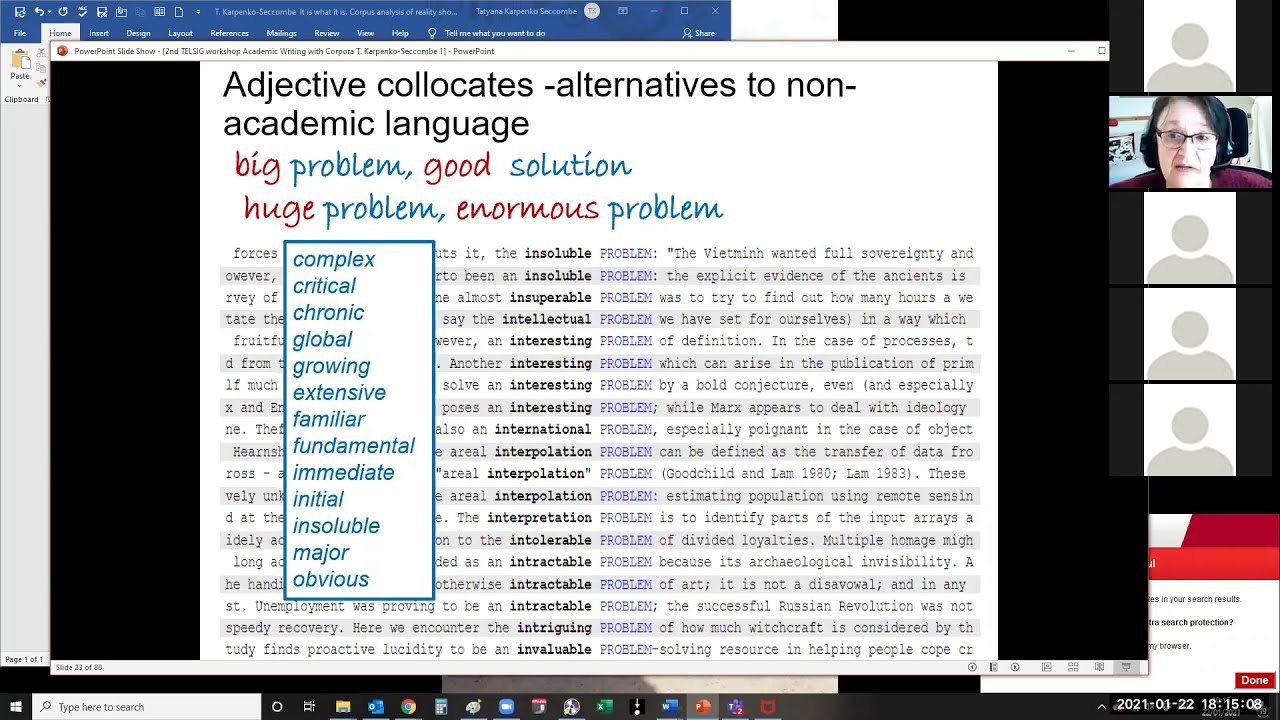








Collocations are words that tend to appear together in language, and researchers can use corpus tools like COCA to investigate these patterns for three main purposes: understanding grammatical structure and syntax (such as which prepositions follow specific words), analyzing how linguistic context affects meaning through semantic prosody (where words habitually appear with positive or negative connotations), and conducting sociolinguistic and discourse analysis to examine how language patterns shape social relationships and representations of social categories.
Guide to Collocations in COCA: Corpus Linguistics Tutorial
Added:Basic understanding of corpus linguistics, including what a corpus is and how it represents language use.
The linguistic concept of collocations—how words habitually co-occur more frequently than by chance.
Familiarity with the Corpus of Contemporary American English (COCA) interface and its basic query functions.
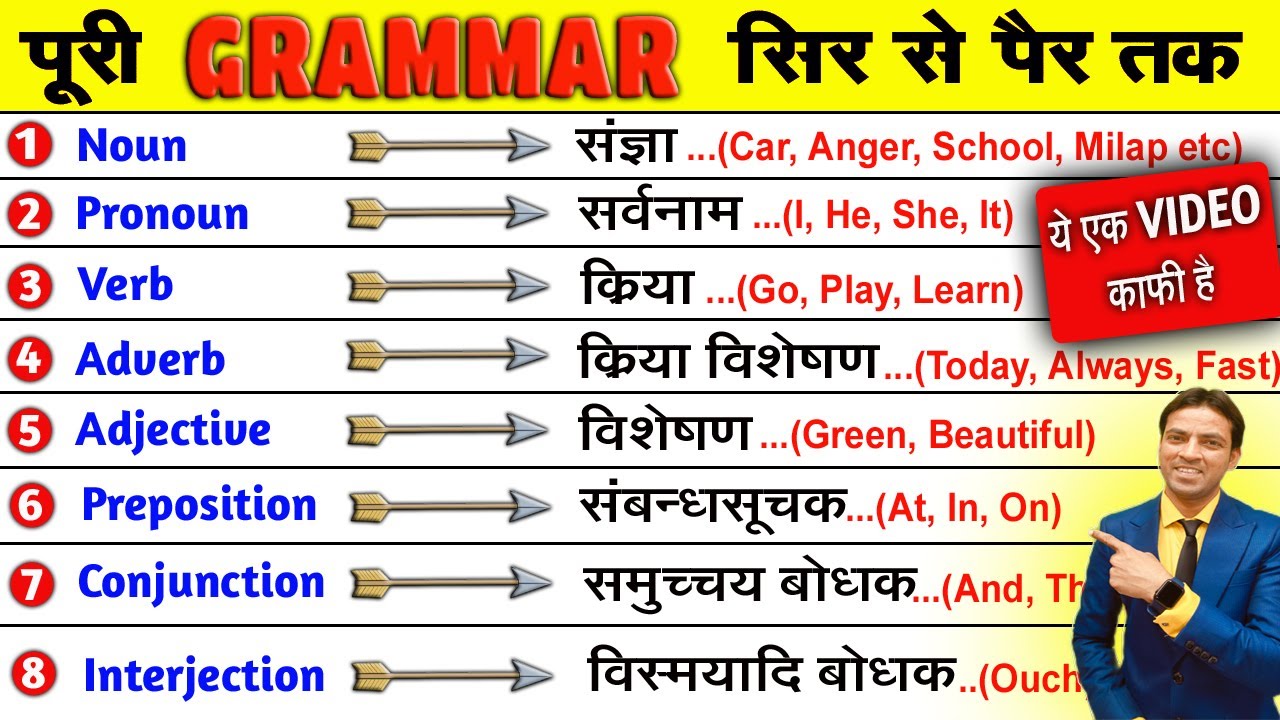
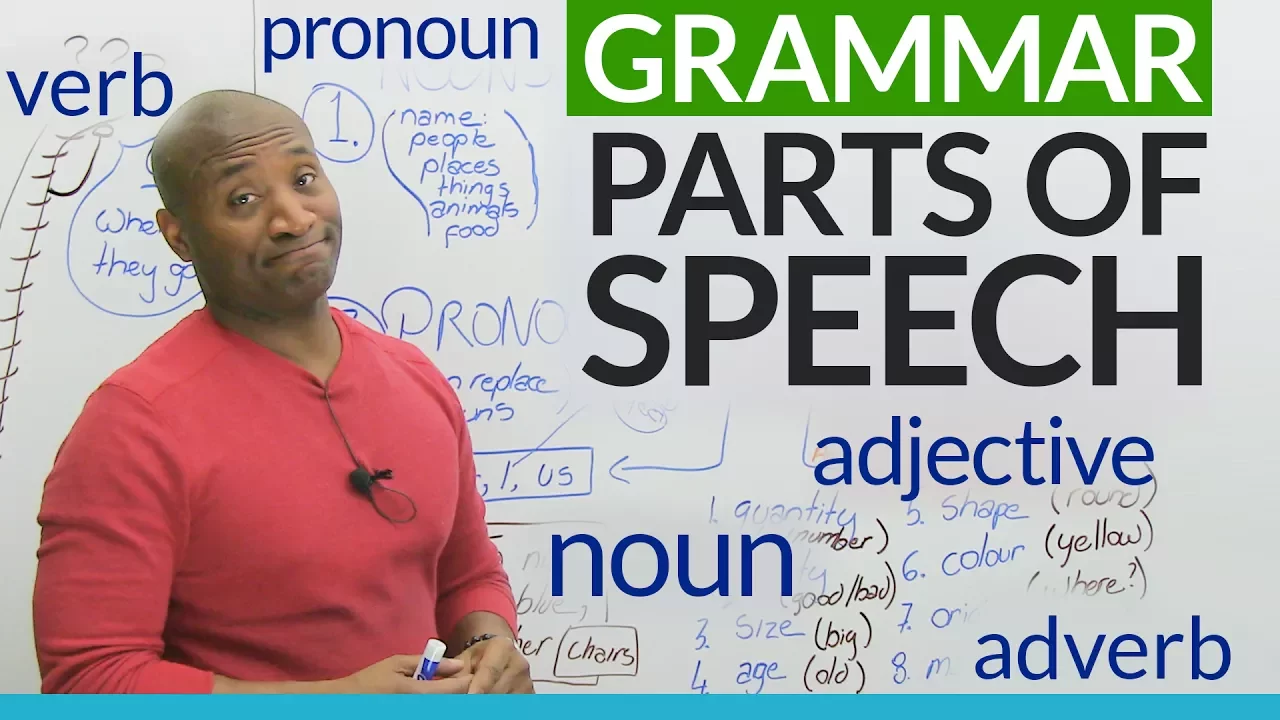
An understanding of basic English parts of speech (POS) and how they are tagged (e.g., nouns, verbs, adjectives) for search filtering.
Analyzing statistical measures of association such as Mutual Information (MI) scores and t-scores to evaluate collocation strength.
Conducting cross-register analyses to compare how collocations differ between academic, spoken, and fiction genres in COCA.
Applying collocation data to pedagogical contexts, such as developing vocabulary lists and curriculum for language learners.
Exploring semantic prosody and semantic preference to understand the hidden attitudinal meanings of collocated words.
27.3K views0likes11:42Original Release: 2012-08-21
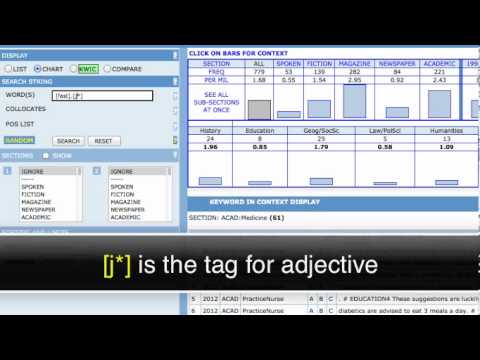
in this video I'm going to show you how you can search for collocations in the corpus of contemporary American English we use the term collocation to describe words or tokens that have a tendency to appear together and using coca we can uncover patterns in the words that appear with other words we could for example search for patterns in the words that are used around cause to the coals of the fire causing widespread flash flooding that can cause severe illness the root causes of the economic downturn so what's causing the attacks or we might want to investigate the patterns of representing teenagers in this course teenage doll is not a pretty picture the teenaged terror in the schools a jock a rebel in order to carry out these kinds of investigations who will need to use some of Coca's collocation 'el tools so let's get started collocation z' can help us with different kinds of linguistic analysis and in this video I want to talk about three first they can help us understand structure and syntax for example we might want to know what prepositions follow a particular word like the verb talk and understanding such patterns can provide us important information about patterns that govern usage second that can help us understand how linguistic context contributes to meaning and the ways in which associations accrue to words through patterns of use areas of study associated with what are called pragmatics and semantics prosody I'll explain this more in a minute and third they can help us carry out studies involving approaches like sociolinguistics and discourse analysis which sometimes examine the ways in which social and political relationships are constituted and reproduced through language let's start with some simple investigations of structure and syntax there are two basic ways to search for collocation zin khoka one is to just use the basic search field and I'll start there let's say we wanted to search for the prepositions that follow the adjectives similar they search like this might be interesting for at least a couple of reasons we might be a non-native speaker and not have intuitions about the possibilities or we might want to investigate the pattern to more fully understand it I'll start by typing similar into the search field followed by the tag for all prepositions you the results show that two is by far the most frequent prepositional Kollek it but let's dig a little deeper the second most frequent colic it is in first I'm going to click on the results to look at the concordance data here we find a number of nouns like style shape flavor and size these nouns seemed to indicate a pattern as there are characteristics of something now I want to see if the pattern actually holds up we'll go back to the search field first I'll type similar in next I'll click on colic it's which generates some additional search options in the new box I'll type the symbol for the noun tag this tells coca that I'm searching for nouns that co-locate with the phrase that we've typed in the box above namely similar in next we have two drop-down lists with numbers these lists define our range that is the first tells coca the number of words we want to search to the left of our first search string and the second tells coca the number of words we want to search to the right we want nouns that appear after similar in so I'm going to set the range as 0 to the left and 2 to the right so our search is this we're looking for nouns that collocate two words to the right of the phrase similar in the results confirm our hypothesis the frequent Kollek it's like sighs appearance nature and style all indicate characteristics that are being compared all right now that we've done some searches relating to structure let's explore semantic prosody but first let me explain the concept briefly the idea of collocation is that the same words tend to appear together certain words tend to hang out the idea of semantic prosody is that by habitually hanging out words can affect the meaning of their Kollek 'it's either positively or negatively to better understand how this works we might think of collocations as a words neighborhood consider the adjective rife if we think about its neighbors like despair decay violence disease bitterness corruption cronyism abuse and fraud it tends to hang out in a pretty rough neighborhood thus we can say rife has a negative semantic prosody let's check out an example using coca the example I want to explore is one that is well known in corpus linguistics and one I mentioned at the beginning of the video what kind of nouns collocate with cause like the previous search for this one we'll use the colic it's option in coca first I'll type COS and brackets in the search field so we're finding all forms of cause in the colic its field I'll type in the tag for all nouns and we'll leave the range as four tokens to the left and four tokens to the right like rife cause collocates with many words that have strongly negative connotations problems death damage pain disease cancer it too has a negative semantic prosody before we move on I want to call your attention to a couple of features of our search and suggest ways that it could be refined or extended first note that I set the range to capture potential examples occurring in a variety of grammatical situations when you search for collocations it is often useful to try different ranges after trying a range you can look at some concordance lines and see what results you're generating that information can then help you refine your search even further second note that we didn't specify cause is a particular part of speech we could for example investigate whether there is any variation in collocation aladdin's with the verb form versus the noun form finally take care when analyzing semantic prosody most patterns have exceptions and we don't want to overstate our results some scholars for example have suggested that the negative prosody of cause is stronger in some registers than in others we could investigate that by restricting our search to specific text types using the sections option other scholars have explored collocation Aladdin's of cause with positive terms like happiness I'm gonna try that here using the corpus of historical American English the distribution here shows an interesting change over time okay let's do one more search for this one I want to give you some quick background on patterns of discourse and how they can shape our social worlds the relationships among discourse and social structure is sometimes studied using approaches related to socio linguistics and discourse analysis in simple terms one way to think about how those relationships work is to first recognize that we often talk about categories of people in recurrent ways even groups of people we have little or no contact with the descriptions of those groups tend to conform to patterns that are replicated those patterns in turn shape the ways in which we think about or understand those categories finally such perceptions and form social relationships and interactions let's see how coca can help us to investigate these kinds of patterns I'll type in teenager and then we'll look for adjectives in the attributed position that is adjectives that occur immediately before or one to the left of teenager you we could group these modifiers into a number of different patterns but for now I'll point out just one note the number of adjectives that describe negative behaviors or emotional states here we have troubled scroll down and we find a few more and if we keep scrolling we find even more what is also interesting about this pattern is that although there are clusters of neutral descriptors like those relating to nationality or ethnicity there are very few positive adjectives that colligate with teenager also to demonstrate that the linguistic representation of social categories isn't somehow natural our stable here is our teenagers search in the corpus of historical American English as a social category teenager is a relatively new invention finally be aware that how you input your search will affect the data that you generate if we did our teenager search like this this is the data that we would get these are sometimes called clusters or engrams these are the most common two-word clusters that contain an adjective followed by a form of teenager when we carried out our search this way this is the data we got these are the most common adjectives that appear before all forms of the word teenager I encourage you to experiment to figure out the searches best suited to your research questions all right let's review collocations are words that tend to appear together we can use collocation 'old data to better understand English structure it can also help us understand how contexts can affect meaning and it can help us analyze how patterns of use inform our conceptions of things ideas and people which shape our social relationships to generate collocations in khoka use the kala Kate search options you can put a word or phrase in the main search field and a single variable in the Kollek 8 field use the drop-down list to set your range to the left and to the right a kala cat search like this will generate single word results you can also use the main search field with one or more variables this kind of search will generate multi word units called clusters or engrams try playing around with the different options to see how they affect your results okay that's it thanks for watching
Up Next

60:57
Lexical Bundles in Academic Writing: Advanced Analysis
@Pleu2025
142 views•2025-10-02

73:00
American English OKAY Over Time: A Diachronic Interactional Linguistic Study
@Abralin
1.2K views•2020-07-30
10:37
Using Part-of-Speech Tags in COCA | Corpus Linguistics Basics
@TheGrammarLab
23.6K views•2012-08-14

21:32
Accent Expert Explains U.S. Regional Dialects | Part 1
@WIRED
9.3M views•2021-01-21
Related Study Plans & Knowledge Roadmaps
Structured learning paths in Linguistics
linguistics
Corpus Linguistics: AntConc, COCA & Collocation
01Introduction to Corpus Linguistics & Digital Corpora
02Navigating the Corpus of Contemporary American English (COCA)
03Concordancing and Lexical Collocations using AntConc
+ 2 more learning modules
12h5 modules
Explore Roadmap
linguistics
Optimality Theory: Tableaux & Constraints
01Phonological Basics: Sounds, Syllables & Rules
02Foundations of Optimality Theory: GEN, CON, and EVAL
03The Constraint Inventory: Markedness vs. Faithfulness
+ 2 more learning modules
15h5 modules
Explore Roadmap
linguistics
Morphosyntactic Alignment: S, A & P Systems
01Foundations of Syntax: Transitivity and Arguments
02The Linguistic Variables: Mapping S, A, and P
03Nominative-Accusative Alignment
+ 3 more learning modules
12h6 modules
Explore Roadmap
linguistics
Analyzing Sign Language: Phonology & Syntax
01Foundations of Sign Language Linguistics
02Phonology: The Five Parameters of a Sign
03Morphology: Word Formation and Classifiers
+ 2 more learning modules
14h5 modules
Explore Roadmap