

![[Phonology] Rule Ordering](https://i.ytimg.com/vi_webp/fz5z3SsEVY8/maxresdefault.webp)
![[Phonology] SPE Phonological Rules](https://i.ytimg.com/vi_webp/klKzPIJYU7E/maxresdefault.webp)

![Phonetics: Intro to linguistics [Video 2]](https://i.ytimg.com/vi_webp/GLBsvdaR_ow/maxresdefault.webp)










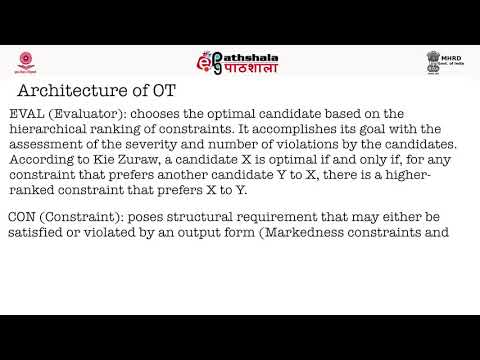


Optimality Theory is a linguistic framework that models phonological phenomena as conflicts between ranked constraints, where languages choose the best possible output by satisfying the highest-priority constraints first; this approach explains how Japanese compounds achieve single-accent patterns through competing rules (e.g., accent near boundary, avoid final accent, accent on second word) that are resolved by selecting the candidate satisfying the most important constraints, demonstrating that languages share universal constraint sets but differ in their ranking priorities.
Phonology, Part 2: Optimality Theory and Constraints | MIT 24.900
Added:Basic phonology concepts, including phonemes, allophones, and the distinction between underlying and surface representations.
Traditional rule-based phonology (SPE-style rules) and how rules map inputs to outputs sequentially.
Articulatory phonetics, particularly concepts of voicing, place of articulation, and phonological processes like assimilation.
An introductory understanding of morphological processes such as compounding and morpheme concatenation.
Advanced Optimality Theory (OT) frameworks, including Harmonic Grammar, Stochastic OT, and Maximum Entropy models.
The mechanics of constraint ranking algorithms and how children learn constraint hierarchies (Learnability Theory).
Applying Optimality Theory to other linguistic domains, such as OT Syntax or OT Pragmatics.
In-depth analysis of typological variation and factorial typology to predict possible human languages based on constraint rankings.
8.1K views141likes1:12:19Original Release: 2023-01-27
[SQUEAKING] [RUSTLING] [CLICKING] NORVIN RICHARDS: OK.
So last time, we ended on one of these cliffhangers.
And so I rushed you through a bunch of Japanese data.
And then we got to this new bit of linguistic technology-- [BUZZING] that's going to be annoying-- this new bit of linguistic technology and went through it pretty fast.
So what I want to do is do the run up to that again a little more carefully and show you what it is that we're talking about.
What we were talking about at the end was the position of accent in Japanese compounds.
So here are a bunch of compound nouns in Japanese.
And the observation was that when you have a compound consisting of two parts, the result always has one accent.
It has accent on one particular syllable.
The accented syllable doesn't have to be the accented syllable in either of the original parts of the compound.
So "raw egg," which is the first example in this slide-- "raw" and "egg"-- they have accents where they have accents.
"Raw" has an accent on the first syllable.
"Egg" has an accent on the second syllable.
But "raw egg" has an accent on the syllable which is not normally accented in "egg."
What we said was there is a set of rules for where accent goes in these compounds.
And the rules go something like this.
There's only going to be one accent.
It needs to be next to the boundary between the words.
And if possible, it should be on the second word.
That is, it should be after the boundary between the words.
But you don't do that if that would result in the accent being on the last syllable.
So the general pattern is the one you're getting in "French fry" up there-- "furaido POteto"-- where you get accent at the beginning of the second half of the compound, "potato."
Yeah.
That's what you get in most of the examples on the preceding slide.
If we go back to the preceding slide, you can see that in "raw egg," right?
It's at the beginning of "egg."
And you can see it in "field mouse."
It's at the beginning of "mouse."
And you're also getting it in "French fry."
But there's this coherent class of exceptions.
If the second half of the compound is only one syllable long, then you don't put accent on the second half.
You put it at the end of the first half.
So Kagawa prefecture-- "kagawa" is the name of a place.
And it's got accent on its first syllable.
But the expression for "Kagawa prefecture" has accent at almost at the boundary.
It's right before the boundary between them, not on the second half of the compound, unusually, because the second half of the compound is only one syllable long.
So we get "kagaWAken."
Yeah.
I'm telling you all this not just to educate you in what a cool and complicated language Japanese is, but to show you that there are cases of cool and complicated phenomena that can be fruitfully thought of as a series of things that you're trying to do which are in conflict with each other sometimes.
So Japanese wants the accent to be on the second word and next to the boundary between the words.
But it also wants it not to be final.
And if it can't have all of those things at once, like in "Kagawa prefecture," it has to decide, do I care more about it not being final, or do I care more about it being on the second word?
And Japanese cares more about it not being final, right?
So it retracts it from the second word to the end of the first word.
Does anybody still read-- Isaac Asimov had these stories, the robot stories.
He had a book, I, Robot.
It was a series of stories.
Some of you have heard of them, at least?
Yeah.
So they feature robots that have these laws governing how they work.
And the laws act like these kinds of laws.
So there's the first law.
And then there's the second law.
And the rule for the second law is you must obey the second law unless it comes in conflict with the first law.
Then you disobey the second law and do the first law, right?
And there's a third law, which you should do unless it conflicts with the first or the second law.
So this is like that, right?
So Japanese wants the accent to be on the second word, oh, unless that's going to make the accent final.
Then you don't do that.
Does that make sense?
That's a way-- or to put that another way, don't put the accent on the last syllable is more important than put the accent on the second word.
That's the picture that we end up with.
So you get "kagaWAken" with the accent at the end of "kagawa" and not "kagawaKEN."
You don't put accent at the end.
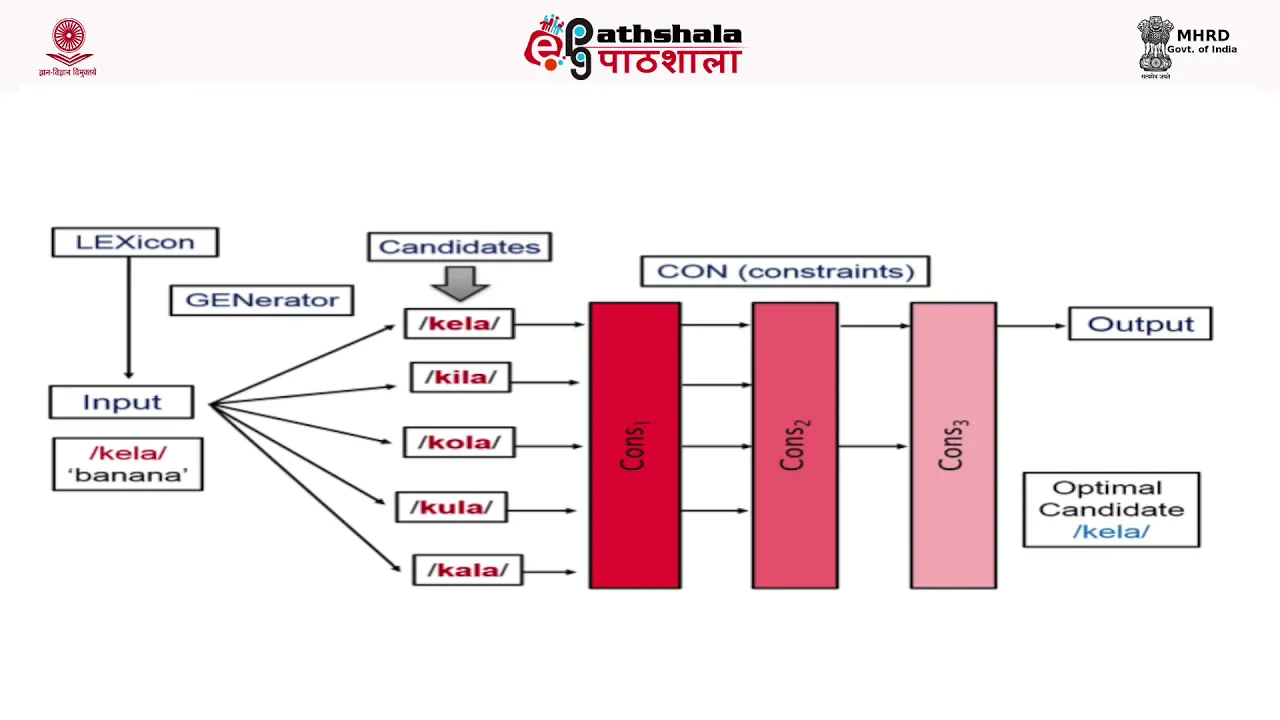
There's a standard way of representing these kinds of facts, these bodies of facts, which involves this table that I've got here at the bottom of the slide.
This was an approach to phonology that was invented by people who-- one of them in particular, Alan Prince, is a brilliant, brilliant man.
But he enjoys intimidating people.
And so instead of calling this a table, he decided to call it a tableau.
So he gives it a French name in order to be as intimidating as possible.
So I'll adopt that because that's what phonologists, linguists standardly call these objects.
This is a tableau.
And what the tableau represents is this interplay between the different laws that are governing where the accent goes.
The idea is the most important laws are toward the left.
And the least important laws are toward the right.
And what you do is imagine all of the places where you could put the accent.
And you ask yourself, how does that placement of the accent square with the various different laws?
The little asterisks mark places where one of the candidates, one of the options you're considering, violates one of the laws.
So for example, the first one, which kept both of the accents in the parts of the compound, just kept them both, violates the most important law, which is you may only have one accent.
So it gets a star right there.
And that eliminates that one from competition because it's violated the most important law, the one that's furthest on the left.
And then what I've done is consider examples where the accent is-- it's a four-syllable word, so we're considering putting the single accent on any of the four syllables.
The first two, which have the accent on the first or the second syllable, violate the second law, which says put the accent near the boundary between the two halves of the compound.
So those are ones in which the accent is not on a syllable that's next to the boundary.
And then the next to last one, which is the one that wins-- that's the one that obeys all of the conditions except for the least important one, which is it's best to put your accent on the last word, right?
You notice, there is no perfect candidate.
There isn't anything that doesn't have any stars.
What the tableau does is allow us to think in a formal way about how you satisfy conditions that are not compatible with each other.
And I just realized I get to take this off.
I keep forgetting that.
Yeah.
So that's what the tableau is meant to represent.
Are there are questions about the tableau?
There's a standard way to represent the fact that the winner is that next to last one there, where the stress is on the next to last syllable, the accent is on the next to last syllable, which is to put a pointing finger next to it like that.
This is the one that wins.
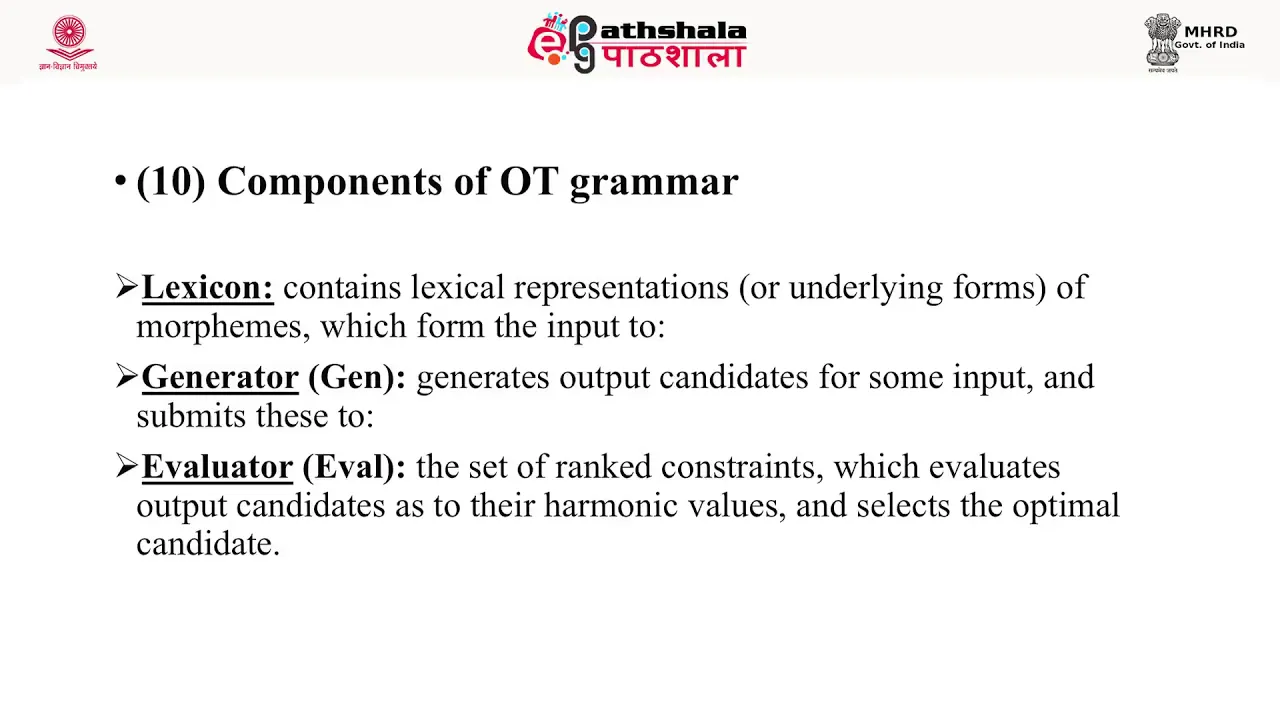
Optimality theory-- this approach to phonology is called optimality theory.
And I don't know.
I guess they just liked the font that had the pointing finger in it.
So they decided to use it.
OK?
This is an approach.
Yeah?
STUDENT: Question about-- there is an accent on-- how do we know there's an accent on "ken" if it just never shows up because every time [INAUDIBLE]??
NORVIN RICHARDS: Oh, you mean why am I putting an accent on "ken" over there?
STUDENT: Because every time "ken" shows up, one syllable is at the end.
So there's no-- so it's always the final accent.
So how do we know there's an accent?
NORVIN RICHARDS: Yeah, that's a very good point.
It is possible to pronounce "ken" by itself, not as part of a compound.
So if you want to talk about "the prefecture," it's a word.
It means "prefecture," which is like a state.
It's an administrative subdivision of Japan.
And it's possible to say that word by itself.
STUDENT: So unbounded.
NORVIN RICHARDS: Sorry?
STUDENT: So it's unfounded?
NORVIN RICHARDS: It's?
STUDENT: It's unbounded?
NORVIN RICHARDS: "ken" is unbounded?
I don't think I know what you mean.
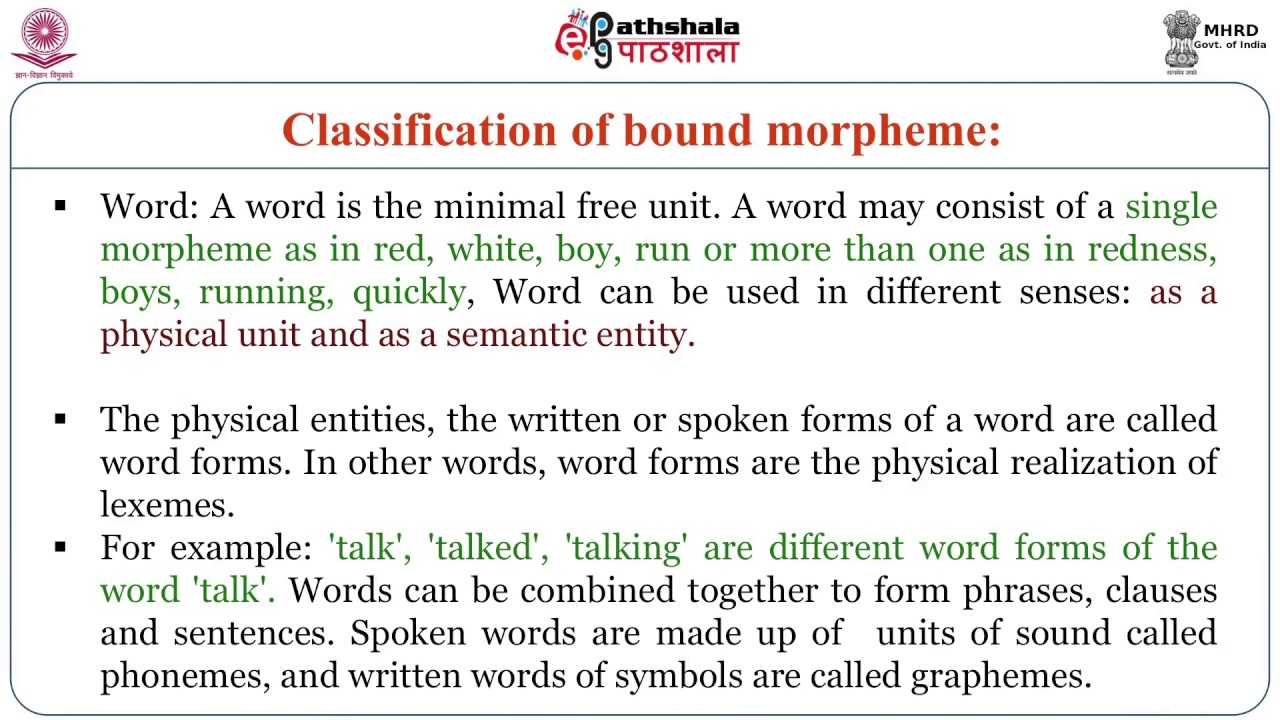
Oh, it's not a bound morpheme.
That's right.
It can be a free morpheme.
Yes, yes.
That's right.
So you can say in Japanese, "The prefecture is large" or whatever.
And then you can show that it's accented, yeah.
Good question.
There are other questions people have about this?
OK.
So this is just meant to illustrate the workings of optimality theory.
Why am I showing you this one?
I'm not sure.
OK.
Oh, I see.
This is a similar tableau for "French fry."
So this has the same constraints, these things that I put in all caps up at the top.
In this case, you do end up with accent at the beginning of potato on the second word.
That actually is a perfect candidate.
So this is an example in which none of the laws are violated by the best candidate.
The laws aren't in conflict with each other.
So you can put accent at the beginning of the last word, "potato."
And it won't be final.
Yeah, yeah?
STUDENT: So for example, if this perfect candidate didn't exist, and you were having to choose between the first and the third-- NORVIN RICHARDS: Yeah.
STUDENT: --you would want to choose the third because it violates a rule that's less important.
NORVIN RICHARDS: Yeah, that's absolutely right.
So if, for some reason, that fourth candidate were impossible-- say, there was another very high ranking constraint-- don't put accent on "potato," then yes.
The third would win.
That's right.
And actually, we can see that by looking at the behavior of "kagaWAken."
So if we eliminate the option of putting accent on the last word, that's where the accent goes.
It goes at the end of the first word.
So it's the best you can do, right?
Still near the boundary, still only one accent, just didn't manage to accent the last word, which is what you'd like to do.
But it's not high on your list of constraints.
Yep.
Does that make sense?
So this is an approach to thinking about phonology.
Optimality theory is the name for it.
It says-- in a way, it's a comforting theory-- It says, "Do the best you can."
You have all of these things.
Probably, all of you have encountered things like this in other domains at MIT if you've ever dealt with engineering problems.
There are probably cases where you have various things that you want to achieve.
And you can't optimize all of them.
You have to decide which ones are the most important.
And the idea here is that language is like that.
There are cases where you have to decide among your various desiderata which ones you care about the most.
The hope in optimality theory is that we'll end up with a list of these constraints, these laws, these rules that will be universal.
And the differences between languages are just a matter of deciding what order the different constraints are in.
So there could be languages in which the one accent rule is very low ranked and the first candidate maybe wins, right?
You could imagine a language like that.
Tokyo Japanese doesn't work that way.
So differences between languages are all a matter of reranking the constraints.
That's the mission statement of optimality theory, is to try to figure out how the world could work that way.
Yeah?
OK.
Optimality theory was partly inspired by the discovery of these kinds of conspiracies that we started talking about when I was showing you some stuff about Yawelmani.
And now we've seen another example from Japanese.
For Yawelmani, the conspiracy was, I don't want three consonants in a row.
And I'll do various things to achieve that.
We said you could state rules governing the various things.
And maybe in a sense, you should.
But you-- the idea is, let's try to keep sight of the fact that all of these rules are trying to achieve the same thing.
We want to also capture that kind of a fact.
And there's something similar going on here in Japanese.
One of the rules, the highest ranking rule, was "Don't have more than one accent in a word."
And what we saw last time was that there are various things that Japanese does to achieve this depending on the situation.
So there are words like "gurai," which I think I translated last time as even, which are accented.
And if you attach them to another word that's also accented, you delete the accent on the first word, in the word you're attaching "gurai" to.
And there are other words, like "made," which means "to," or "up to," "as far as," which are accented but only if they are attached to unaccented words.
And then we've done all this talking about compounds.
These are all different kinds of examples in which different things happen.
There are different strategies, right?
So for "gurai," it's "Delete the accent on the word you've attached 'gurai' to."
For "made," it's "Delete the accent on 'made' for the compounds."
We've now talked about this computation that you go through to try to figure out where the single accent should go.
But what all of these things are doing is trying to arrange for there to just be a single accent.
And one of the virtues of optimality theory is that it allows us to make that part of our analysis.
If we just stated these rules, we'd be losing sight of the fact that these rules all seem to be trying to achieve the same thing.
That's one of the things people who work on optimality theory are trying to get.
And then of course, the goal is to try to understand why we have the constraints that we have and not others.
That's another thing people who work on this try to do.
Yes.
I just said that and that.
So remember, Yawelmani, which was "Avoid strings of three consonants either by inserting vowels or by deleting 'h' if you have an 'h'."
So I've been saying we could just state these rules.
But we'd be missing a generalization.
Yawelmani is trying to avoid three consonants in a row.
Japanese is trying to avoid two accents in a single word.
Maybe it's obvious.
We don't want to miss generalizations like that.
We want to find them and understand them.
So similar kind of thing that we could think about here-- we've talked now a couple of times about Polish.
Polish is one of the number of languages in which if you have certain kinds of consonants at the ends of words, consonants like "b," and "d," and "g," and "z," we convince ourselves that they devoice.
They become voiceless at the ends of words.
That allows us to capture various kinds of facts about what happens to Polish words when they become plural-- namely, that consonants that sound voiceless when they're at the ends of words become voiced sometimes when they're no longer at the end of words, we decided.
That's because they're underlyingly voiced.
And they devoice when they're at the ends of words.
So this is all familiar.
You all remember Polish?
It's not just Polish.
There are lots of languages that do this.
And so what I'm inviting you to do at the end of this slide is to imagine two kinds of stories about Polish-- one that would say, yeah, final consonants devoice in Polish, and another that would say, well, there are four rules, actually.
There's a rule that says "b" voices when it's final, and a rule that says "d" devoices when it's final, and a rule that says "g" devoices when it's-- yeah?
Both of those would capture all of the Polish facts.
One of them is clearly better.
So we want to understand why we get the particular phenomena that we do in Polish.
Is it clear to everybody that it would be better to do things that way?
And what we're doing here is similar.
Why would it be better?
What would be wrong-- why is it better to be able to say final consonants devoice than to say, well, we have these four rules.
Yeah, Faith?
STUDENT: I think you're addressing the more general phenomenon.
It's very difficult to catalog every single letter and to have vowel sound as something like that because you eventually have a list that's very long.
NORVIN RICHARDS: Yeah.
So it might make it easier to make cross-linguistic comparisons.
Yeah, that's a very good point.
Yeah, yeah.
Yeah?
We also maybe-- I don't know if this is a good way to say it.
Maybe it is.
We want to understand why the sounds that become voiceless at the ends of words in Polish are "b," "d," "g," and "z," and not "b," "d," "a," and "o," right?
If we're just making four rules for those four letters, then it's not clear.
There's no reason why one of those rules is more natural than the other.
But as I keep saying-- what's happening here in Polish is extremely common.
So you get it in Turkish.
You get it in Russian.
You get it in a bunch of different languages-- German.
And so we want to understand why it's common.
And part of understanding why it's common is being able to say that that's a common rule, a standard rule that we see all over the place.
And then we can get to work on understanding it.
If we just have these four rules, then it's unclear why those four rules are so common, whereas "b," "d," "a," and "o" devoice at the ends of words is not at all common.
I don't know of any languages that do.
Does that make sense?
That's another sense in which making generalizations is good.
This is becoming a philosophy of science question, yeah.
It's like, why is science good?
Why is it good to make generalizations?
Because it helps us to understand the world better, for Faith's reason, as well as the reason I just offered.
Yeah?
STUDENT: Is the vowel still a vowel when you devoice it?
NORVIN RICHARDS: Yeah, yes, arguably.
So there are languages that devoice vowels.
Mokilese is one.
Oh, Japanese is another.
So Japanese has a general rule devoicing its high vowels when they are between voiceless consonants, I guess.
So here's the Japanese word for "like."
And it's pronounced "suki," "suki."
So the oo isn't pronounced.
You don't say "soo-kee" unless you're being very slow and careful.
And it's still a vowel in the sense that your tongue and the rest of your vocal tract is still in the configuration that it would be if your vocal chords were vibrating.
But they aren't.
So yeah, there arguably are voiceless vowels.
Yes, Joseph?
STUDENT: What if you were putting an affix after that, which is "i" is high, too?
So what would happen?
NORVIN RICHARDS: Oh.
So in this particular example, there aren't any affixes you can add to "suki" to devoice the vowel.
But let me think of an example.
Yeah.
So "tatsu"-- so this is not high.
So it doesn't devoice.
This is the verb "to stand."
The more polite version of this-- no, no, no, no.
That's not what I want to do.
Let me try to think of an example.
Let me try to think of an example that does what you want.
But there aren't any examples that will work with "suki."
Yeah.
OK, so when I think of an example, at 3:00 in the morning, I'll give you a call.
Leave your phone number and think of that.
There's got to be a straightforward way to do this.
Hmm, this is going to bother me now.
Yeah.
Other questions about this?
Try to think of questions while I try to think of examples that do what Joseph wants.
Because the past tense suffix in Japanese-- oh, oh, oh.
[JAPANESE] oh, yeah, OK.
Here's one.
Adjectives in Japanese.
So this is the word for new, "atarashii."
And the negative of it, "atarashiku nai" ends-- so there's a "ku" that you add to make the negative form.
And it ends up putting this vowel between voiceless sounds.
And then yes, it devoices.
So it goes from "atarashii" to "atarashiku nai," "atarashiku nai," or the past tense, actually.
If you want to say something was new, it's "atarashii" [JAPANESE].
So again, the "i" that's after the "sh" devoices because there's a voiceless sound after.
Good.
Phew!
Now I won't call you at 2:00 in the morning.
You have any questions about this?
OK.
So let's go back now to the English plural suffix and review something that we have talked about.
But in the light of all of the things that we've talked about since then, I hope it'll become a little clearer.
So again, we're talking about the regular English plural suffix.
Stop thinking about "oxen" and "fish" and "sheep."
"Cats" and "dogs" and "bushes"-- we decided the underlying form of the plural suffix is a "z," right?
And it undergoes various kinds of sound changes depending on what's before it.
So you add "z" to all three of these underlyingly.
And then there are generalizations like English doesn't like words that end in a "z" that's preceded by a voiceless sound.
And words don't get to end in two strident consonants, where stridents are things like the "sh" and the "z" that's at the end of "bushes," yeah?
So those are generalizations.
But we said one of the attractive things about this way of thinking about the English plural is that these are generalizations that just seem to hold about English generally.
English doesn't have any words that end in a "z" preceded by a voiceless sound.
And we can rely on English phonology to demand that you do something if you add "z" to cat.
And again, we've said this before.
I just want to say it again a little more clearly.
There are these conditions.
And then there are also these procedures for repairing these violations.
So what do you do about the fact that you add a "z" to cat?
Well, you devoice the "z," right?
If the condition just says you can't have a "z" preceded by something voiceless, there are various things you could have done to fix that problem.
You could have voiced the "d," right?
So the plural of "cat" could be "cads," right?
That would be a good English word.
Or you could add a vowel like you do in "bushes," right?
The plural of "cat" could be "cat-es."
There are various things that would fix that problem if that's the problem.
But this is the thing that you do.
Yeah, it's like when we were talking about Yawelmani We said you can't have three consonants in a row.
What do you do about it?
Well, it depends on the situation, right?
So if one of them is an "h," you get rid of the "h."
If not, then you insert a vowel in this position and not that position.
It's similar thing.
So this is all the way of saying it's worthwhile, maybe, to distinguish between the phonotactic considerations or the well-formedness considerations that tell you this language doesn't like three consonants in a row, or two accented syllables in a word, or words ending in a "z" preceded by a voiceless sound.
There's that condition.
And then there's how do you repair it?
What kind of a repair do you use?
So there's the well-formedness condition.
And then there's the repair.
So in this particular case, the procedures are devoice and insert schwa.
There's a particularly striking bit of evidence for this way of dividing things up, this distinction that I'm drawing between well-formedness conditions on words, on the one hand, and types of possible repair on the other.
We need to think about both of those things if we're going to describe what the language is doing.
This is a classic test from 1957.
I mentioned it in class before, but I wanted to talk about it a little more now that we've drawn this distinction.
So Jean Berko, later Jean Berko Gleason, did this work in 1957 with children.
She was demonstrating that they know these generalizations about plurals even with words they've never heard before.
So she would show them pictures like this one.
This is one of her pictures.
She said "This is a wug."
And then she would show them two pictures of the same thing.
And she would say, "Now there are two of them.
There are two"-- and children were supposed to say "wugs" even though they'd never heard anybody say "wug" before, right?
So Jean Berko Gleason, Jean Berko made up a bunch of words.
She worked hard to make sure they were not real words.
And then she drew many cute pictures and showed children singulars and plurals and said, OK, here's the singular.
What's the plural?
And the kids responded.
And she wrote down their responses.
And their responses, interestingly, were accurate in one way, and sometimes inaccurate in another, which is interesting to think about.
So she was working with children who were five years old and children who were seven years old.
What she discovered was that by the time they were five years old, they are, in a sense, perfect, in the sense that all of the words that they came up with were phonotactically well formed English words.
So here are three of Berko's words-- "hif," "fas," and "muz," yeah?
And I think everybody did "wug" perfectly.
Everybody said the plural of "wug" is "wugs."
But there were other cases where children would say, sometimes, things like the plural of "hif" is "hifes," or the plural of "fas" is "fas," or the plural of "muz" is "muz."
These are all words where-- and then there were other kinds of mistakes that children didn't make.
So nobody said that the plural "wug" was "wuks," or that the plural of "wook" is "wookz," right?
Or that the plural of fas is "fas-z," yeah?
What were children doing?
Well, children know if you show them something that's underlyingly-- you give them "hif," which for some reason I'm spelling backwards-- you give them "hif" and you ask them the plural, they know that you're supposed to add a "z."
And they know that English doesn't allow words that end in a "z" preceded by a voiceless sound.
But some of these five and seven-year-olds were a little fuzzy on the possible repairs.
None of them said, "Oh, yeah, It's hifz," right?
But I just said this.
If the only problem is, well, this word ends in a voiceless sound followed by a "z," in fact, what you're supposed to do is devoice the "z."
That's what an adult would do.
So the plural of "hif" is "hifs," yeah?
But if you were instead to insert a schwa, well, that would fix it, too, right?
So now the "z" is preceded by a voiced sound.
The plural of "hif" is "hif-ez," yeah?
And there were some kids who were going through a stage who were entertaining that possibility, that that was the correct repair for that.
So what Berko found was that children universally knew the phonotactics, right?
They knew that English doesn't allow words that end in a "z" preceded by a voiceless sound.
But they made intriguing mistakes of various kinds-- not very often.
Most of the kids just did everything perfectly.
But every so often, she would get kids who made some mistakes.
And the mistakes were of this class.
That is, mistakes where they knew that there needed to be a repair but got the repair wrong.
Similarly for "muz," this was a kid who-- the singular is "muz," and the kid knows that you need to add a "z."
And the kid knows that you can't have two stridents at the end of a word.
The correct answer, the adult's answer, is to insert a schwa so the plural of "muz" will be "muzes."
But deleting the "z," one of the "z"s-- hard to know which one-- also fixes that problem.
And so that was a kid who thought, yeah, I'll delete a "z," yeah?
Yeah, Joseph?
STUDENT: Is the deletion of a consonant viewed as [INAUDIBLE]?
NORVIN RICHARDS: As something that English does?
Yeah, no.
So English-- there aren't, I don't think, any English nouns that form their plural by adding a "z" and deleting something before the "z."
I don't believe that ever happens.
This is me slowing down while I try to think of English nouns, of which I know several, but I can't think of any that do that.
Yeah.
OK.
Yeah, so is this clear?
Another reason to draw this distinction between, on the one hand, what I was calling phonotactics, these rules for which kinds of sounds can be where, and on the other hand, the repairs-- so the kids that Berko was working with knew the phonotactics, but were sometimes fuzzy on what the correct repairs were.
Yeah.
OK.
So, moral-- yet again, need to distinguish between, on the one hand, the phonotactics, and on the other hand, the particular sound changes, the repairs that enforce the phonotactics.
It's apparently possible to know one of those but not the other.
OK.
That ends the chapter.
Now we're going to talk about something else.
So are there any questions about that?
Is that clear?
OK.
We've already done some of this, but I want to do more.
We've been talking about how there are some kinds of sound changes that are natural because they apply to natural classes of things that can be almost circular.
So I quickly introduced you to the word stridents because the generalization about English plurals is that two stridents can't end a word in English.
And that's why you introduce a schwa just in case you're in danger of having two stridents at the end of your word, yeah.
The word strident has an acoustic definition.
They are fricatives that have lots of high frequency noise.
But it's of interest that there are phenomena like the allomorphy in English plurals that make reference to that acoustic fact.
That's apparently something that a language can care about-- how much high frequency noise you have at once.
It's also something that varies from language to language.
There are languages that are perfectly happy to have long strings of stridents.
English just isn't one of them.
Yeah.
So we've already done, as I said, some talking about this.
So when I was first introducing you to consonants or introducing you to vowels, you'd already met consonants at some point in your life.
But we were talking about them in a particular systematic way.
We talked about various ways of classifying them, saying there are some consonants that are fricatives and some consonants that are stops, or saying there are some consonants that are voiced and some consonants that are voiceless.
So what I want to do today is to introduce you to some other kinds of classification.
And I'll, as much as possible, try to show you places where languages care about a particular class of sounds.
Again, this is all in the service of making it easier for us to understand why certain kinds of sound changes are natural and others are not.
OK.
So here's one that we've already seen.
There are sounds that are nasal.
This is a contrast that I believe I have introduced you to before, but let me introduce you to it again.
There's a distinction-- I think I brought this up last time, actually.
There's a distinction, when we talk about consonants, between what are called sonorants and what are called obstruents.
So these are opposites of each other.
I hope I have the word "obstruent" on a later slide.
But just in case I don't, there are these two kinds of sounds-- obstruents and sonorants.
And the distinction between them has to do with whether you are building up pressure in the oral cavity.
So the sonorants are the nasals and the liquids and the glides, the consonants in which there's no pressure building up in the oral cavity, whereas the obstruents-- those are the stops and the fricatives, the oral stops and fricatives.
Those are the sounds in which there is pressure building up in the oral cavity.
For a stop, it's because, well, you've stopped the flow of air at the mouth.
And so pressure is building up.
And for a fricative, well, you haven't stopped the flow of air, but you're constricting it.
That's how you make a fricative.
And so pressure is building up in the oral cavity.
And when I say pressure is building up in the oral cavity, what I mean is that phoneticists have put instruments inside people's mouths to measure air pressure to find out what happens.
And they have discovered that this is true, yeah.
So I try not to lie to you in this class any more than I can help it.
But in this particular case, what I'm saying is absolutely true.
OK, so there are sonorants and there are obstruents.
We have already talked about the classification of sounds into voiced and voiceless sounds.
So the red sounds on this slide are voiced.
And as you can see, in this cross-cut-- some of the other classifications.
So you can be an obstruent, like a stop or a fricative, and you can be either voiced or voiceless.
So English stops can be voiced or voiceless.
English fricatives can be voiced or voiceless.
English sonorants, interestingly, can only be voiced.
They cannot be voiceless.
We have sonorants like "l," like "l," but we don't have a voiceless version of "l."
We talked about this when we were first going through sounds.
There are languages out there that have a voiceless version of "l," that have a "lh" sound.
Tibetan has one, for example.
So if you go to Lhasa, the capital of Tibet, you must learn to make voiceless "l"s.
Welsh has a voiceless "l.".
They spell it with two "l"s.
So if you look at Welsh words, you'll see pairs of "l"s.
That's their way of spelling a voiceless "l."
So there's a traditional Welsh name spelled like this and pronounced "Lhoyd," which has been borrowed into English twice as the name Lloyd and the name Floyd.
These are both attempts to pronounce "Lhoyd," which we can't pronounce because we don't have that sound.
Yeah.
So English has voiced and voiceless obstruents, stops and fricatives.
But it only has voice sonorants.
That's a very common state of affairs.
If you're going to have a voicing distinction in only one of these places, it's in the obstruents.
Languages only having voiced sonorants-- that's very common, though not universal, as we've said.
Quick interlude to use one of these features.
Here are a bunch of verbs that you can make out of adjectives.
So you can take an adjective like "black."
And you can make a verb, "blacken," which can be either a transitive verb or in intransitive verb, I guess.
So you can blacken the paper or blacken the fish, I guess.
It means to make it black.
Similarly, something can whiten or lessen or freshen or darken.
You can offer to freshen a drink, say.
It means to make it fresh, right?
So there's this "-en" that you can add to adjectives to make verbs.
Does that sound right?
On the other hand, there are these other adjectives which can't have "-en," yeah?
So the screen of a computer can darken, but it cannot "yellowen," yeah?
A piece of paper that gets old-- what you say is that the yellows.
It yellowed with age.
You don't say that it "yellowened," yeah?
Similarly, you can't "dimmen" or "grayen" or "clearen" or "brownen."
All of those things-- if you want to make them into verbs, you just [SNAPS].
They're verbs, yeah?
Yeah?
Does that sound right?
What's the difference between "black," "white," "less," "fresh," and "dark" on the one hand, and "yellow," "dim," "gray," "clear," and "brown" on the other?
STUDENT: They end with voiceless stops in the first line?
NORVIN RICHARDS: In the first line, "black," "white," and "dark" end with voiceless stops.
And "less" and "fresh" end with voiceless fricatives, yeah?
Yeah, yeah.
Yeah, nice.
And "yellow," "dim," "gray," "clear," and "brown" end in voiced sounds.
What's the cover term for stops and fricatives?
STUDENT: Obstruents.
NORVIN RICHARDS: Obstruents.
So "-en" can be added to words ending in obstruents.
And it can't be added to adjectives ending in sonorants, yeah?
Another place where it's useful to distinguish sonorants from obstruents-- Polish plurals-- I think this is the last time I will say anything about Polish plurals.
I can't promise because it's a very useful example.
But if you're getting tired of Polish plurals, I apologize.
I think we're just about to the end.
On the other hand, if you've become fond of Polish plurals, please gaze at this slide for a while.
This is your last big chance.
What we said about Polish plurals was that it's useful to say that there are words that end underlyingly in sounds like "g" and "b" and "z."
And those final sounds, "g" and "b" and "z," devoice when they're at the ends of words.
So underlying "wuk," the word for "lye," becomes "wuk" if you don't add anything after it.
And same with the word for "club" and the word for "rubble."
And I have been incautiously saying things like, "Polish devoices its final consonants," which was a lie.
I think I told you just now that I try not to lie to you any more than I have to.
It doesn't devoice its final consonants, right?
Because Polish has words like "dom," which is the word for house.
And that ends in a voiced sound, right?
"Dom" doesn't become "dom" [pronounced with voicelesss "m"], yeah?
Right?
So it's not the case that final consonants become voiceless in Polish.
What are the things that become voiceless in Polish?
Obstruents, yeah?
Stops and fricatives.
Those are the things that become voiceless in Polish.
Relatedly, Polish is like English in having voiced and voiceless obstruents, but not having voiced and voiceless sonorants.
So Polish-- the "m," in a sense, doesn't have anywhere to go.
Polish doesn't have that sound.
Common situation.
So it's really final obstruents that are becoming voiceless.
OK, all right.
So that's a reason to want to care about the distinction between sonorants and obstruents, not just because you want to understand why it's "whiten" and "darken" and "lessen," but not "yellowen."
It seems to be a distinction that cares about sonorants and obstruents.
Here's another one.
Polish, which as I've said now several times, and I think this might be the last time-- Polish is doing something that is very common in languages of the world.
It's devoicing final obstruents.
That's a thing that happens a lot.
All right.
So phonology so far-- we've been doing phonology for a couple of days now.
It's useful to think of sounds as undergoing changes sometimes driven by sounds coming in contact with each other.
And we can describe these changes in terms of rules.
There's the formalism for rules that I've been showing you.
So we'll say sound A changes into sound B.
The slash introduces you to the environment.
This is a description of what's happening in Polish, and Turkish, and German, and Russian, and lots of other languages.
Final obstruents-- so if you are an obstruent that is something which is not a sonorant, you become something which is not voiced.
If you are at the end of a word-- that environment description is the way to write at the end of a word.
That hash symbol is the symbol for a boundary between words.
And the underscore is where the change takes place.
So this rule says this change happens when the sound is before a word boundary, or to put it another way, when it is at the end of a word.
Does that make sense?
This is a way of writing rules.
These rules are part of our knowledge of a language.
So we've talked about this.
As adults, anybody who is a native speaker of English knows how to make the plural of "wug," or how to make the plural of "Bach," even.
So how to make plurals of words you've never heard before and even words that end in sounds that your language doesn't have, right?
So if I insist on calling the composer "Bach"-- if I insist on the original Inupiaq pronunciation of the word "qaiaq," which is kayak, a single person boat, which in Inupiaq begins and ends with a uvular stop-- so if I'm trying to impress you with my ability to make uvular stops and I insist on calling a kayak a "qaiaq," then my plural for it is going to be "qaiaqs," right?
So I'm going to add an "s" sound.
I'm going to devoice it because that uvular stop, although it's a sound we don't have an English-- it's voiceless.
So we're going to devoice after it.
So these rules are part of our knowledge of a language.
And we can apply them to unfamiliar problems, unfamiliar words, and even unfamiliar sounds.
And I've now tried to convince you the best way to state these rules, sometimes at least, is in terms of features.
That is, we don't just want to list the sounds that undergo a change.
We want to have these features which are ways of capturing sets of sounds.
We think that there are natural classes of sounds that undergo particular changes.
So there are sound changes that apply, say, to obstruents, to sonorants, or to vowels, to voiced sounds, or to voiceless sounds.
We're not just going to list the sounds that undergo sound changes.
We're going to state these in terms of features, OK?
And then the other thing that I've introduced you to is the idea that at least sometimes, it's fruitful to model these kinds of sound changes as involving ranked constraints.
This was the optimality theory tableaux-- that is, to imagine that languages have a list of things that they are trying to achieve.
And it's a list that's ranked in order of priority.
And you get to observe the interplay between these different priorities in certain kinds of complicated cases.
The Japanese accent case was one of the ones that we looked at.
OK?
And I think that's it for this review slide.
Was there something else?
Oh, OK.
Is everyone happy with all of this?
Is there any of this that people are looking at and going, no, wait.
How did-- how did we see that?
Or what does that mean, or anything like that?
Just an attempt to make sure that we're all n the same ballpark here.
Yeah?
STUDENT: Could you clarify what "feature" means?
NORVIN RICHARDS: Oh.
All I mean by "feature" are things like voiced, or sonorant, or those kinds of things.
Yeah, good question.
And a standard way to write rules involves putting features in brackets like that.
So the fancy way to say something is voiceless is to say that its value for the feature voice is minus.
So it is not voiced, yeah.
That's all that means.
Yeah?
OK.
When we ask you to do phonology, we will tell you whether we want you-- to what extent we want you to be formal about how you write your rules.
So I think the problem set that I just sent out asks you to look around for possible rules in-- what is it?
It's Greenlandic data, I think.
You don't have to sweat this level of formality in your rules.
So if your rule for that problem set-- so if you think you've figured out what's going on, you can just tell us, more or less.
Don't feel like we're going to count off for not using features or not writing your rules this way.
OK.
All right, then.
Now I told you just now-- I tried to convince you earlier-- that there are cases where-- the Japanese accent case was the one that we spent the most time on, where it's fruitful to think of the phenomenon as involving a bunch of ranked priorities, a bunch of constraints that are all pulling in different directions.
And you solve that problem by deciding which is the most important one, which ones are more important than which other ones, ranking your various constraints with respect to each other.
There are other cases, though, that are problematic for that way of thinking about things.
And there's big literature on trying to reconcile these kinds of observations.
On the one hand, the observation that there do seem to be these conspiracies where a language is doing the same thing in a variety of ways, which is the kind of thing that makes people want to think in terms of ranked constraints, and on the other hand, the kinds of cases, which we've talked about before, where it looks more like what's happening is that you have a bunch of rules.
And they're applying in an order.
And they don't necessarily all get obeyed.
We did this on the board-- when was it?
Last time, I think.
But let's do it on the slide a little more carefully.
So cast your minds back to when we were talking about Lardil.
I tried to convince you-- we worked out an analysis of Lardil in which, again, bare nominative singular-- Lardil doesn't mark number.
But bare nominative forms of nouns undergo various kinds of sound changes.
So Lardil has words that underlyingly end in a "k," for example.
And there was a general rule in Lardil that said if you have a word that ends in a "k," get rid of the "k."
So I'll start writing these down.
Some Lardil rules-- one of them was eliminate-- and I won't try to write them formally.
Eliminate final "k."
So the word that we think is underlyingly "wangalk," the word for boomerang, in its nominative form is "wangal."
And the reason we think that it's underlyingly "wangal" is that if you add any suffixes to it, you get to see that "k."
So the accusative, I think I told you, was [LARDIL].. So the "k" shows up, and in other forms as well.
We thought there was another rule that said a final "u" becomes "a," yeah?
And that was why "kandu," which is the word for "blood" underlyingly, becomes "kanda" in the nominative.
And in the accusative, it's [LARDIL].. That's why we think it starts out as "kandu."
So we have these two rules.
And what we said when we were doing Lardil before was something like we might want these rules to apply in a particular order.
In fact, I see that I have written them in the wrong order.
If you were to take the word "ngaluk," which is the underlying form for "story," and apply this rule and then this rule, well then, you would eliminate the final "k."
That would get you ngalu.
And then you would change the final "u" to "a."
And then you would get an "ngala."
But that's not, in fact, the nominative form for "story."
The nominative form for story is ngalu, yeah?
And so what I said at the time was one way of thinking about this, a popular way of thinking about this is, to think there are these rules.
And it's like an assembly line.
The first station is the one where you do this, where you get rid of final "u."
And then after you're done with that, you get handed off to another place in the assembly line where they eliminate final "k."
And what's happened with that "ngaluk," underlying "ngaluk," is that it got handed to the first station first.
First station said, well, this word, "ngaluk"-- it doesn't end in "u."
I'm not going to do anything.
And then it gets handed to the second station.
The second station says, oh, I need to get rid of the final "k."
It'll be a "ngalu," by which point the people in the first station might have been saying, wait, wait.
Let us have that back.
But it's too late, was the idea.
Yeah, so these are rules that apply in a particular order.
That's the way we were talking about Lardil.
Does that all sound vaguely familiar?
There are these procedures, and the procedures happen in order.
But if we imagine, thinking about things in an optimality theoretic kind of way, well, it's not hard to come up with constraints that say this.
Star, final-- I have to write it in capital letters because that's what you do in optimality theory.
No final "k."
No final "u," yeah?
And those constraints would look at "ngaluk"-- or sorry, "wangalk," and they would say, no, we can't have the final "k."
It'll be one "wangal."
And they would look at "kandu."
And they would say, no, can't have the final "u."
It's got to be "kanda."
It might have other constraints that are responsible for helping you decide the best thing to do with "kandu" is to change it to "kanda" instead of "kandi," or "kand," or any of a variety of other things you could have done.
So it's not all that hard to have constraints that say there's something wrong with "wangalk."
There's something wrong with "kandu."
But it's not easy to figure out what to do next.
So if you have those conditions that say Lardil cannot stand words that end in "k." or words that end in "u," that's the kind of thing we were saying about Japanese accent.
Japanese doesn't like accent on the last syllable.
So avoid it if you're making a compound.
Those generalizations hold for "boomerang" and for "blood."
But they don't hold for "story."
The one about not having a word ending in "u" doesn't hold.
Yes?
STUDENT: You talked about no final "k," no final "u" as being part of optimality theory.
NORVIN RICHARDS: Yeah.
STUDENT: Is it possible to satisfy both if you were to do "ngala"?
NORVIN RICHARDS: Mm-hmm.
STUDENT: Does optimality theory support each of the rules?
NORVIN RICHARDS: So that's just it.
It doesn't, right?
So the conditions-- the sense in which it has something like an order is that the conditions are ranked with respect to each other.
There's the one that's most important and the one that's next most important, and so on.
But if we were to build a tableau, we would have these two conditions.
Don't have final "k."
Don't have final "u."
And we would start off with "ngaluk."
And we'd consider keeping "ngaluk."
And we'd consider getting rid of the "k" at the end.
And maybe we'd consider "ngala," right?
And this one would get knocked out by star final "k," right?
Because it would end in "k."
And this one would get knocked out by star final "u," yeah?
And this one would pass both of those conditions.
So if we just did a tableau like this, if we said, Lardil seems to not like this and not like that, and we have evidence for that in these other cases, it seems as though "ngalu" ought to become "ngala."
But that's wrong.
So the fact is this is the one we want to win.
And it's hard to see, once we've posited these conditions, how we can get this to win.
This seems like it ought to be better once we've posited these conditions.
So the puzzle-- and there's something people work on is try to figure out, why is that second one better than the third one?
Yeah.
STUDENT: How about we rephrase the no final "u" rule?
NORVIN RICHARDS: Yeah.
STUDENT: We rephrase it as no final "u" unless it's original form ends with a "k."
NORVIN RICHARDS: Ah, OK.
So we could have a rule that says-- that's nice.
We could say, no final "u."
This is another way of saying what you just said.
No final "u" that was final in original form.
Yep.
So we need more capital letters, but it's OK.
So yes, if we state it that way, then this passes that version of it.
And as long as we have some other condition that says, don't change vowels just for the fun of it, don't change "u" because you want to, which we surely need, right?
If you give Lardil a word that has an "u" in it that's not at the end, it's not going to change.
Then yes, then this would win.
That's right.
That is indeed one of the kinds of things people do in order to handle this kind of problem.
They make these conditions more complicated because now the conditions we've had so far are all about the form that gets pronounced.
They say things like the form that gets pronounced had better not end in a "k," or the form that gets pronounced had better not end in a voiced obstruent if we're doing Polish, or it'd better not have two stridents at the end of the word in a language like English.
This is a more complicated constraint.
It says it had better not end in this kind of sound if it ended in this kind of sound originally, before we started.
So there's an actual debate going on in optimality theory about whether we want to allow ourselves that power, allowing constraints that make reference not just to the pronounced version but to an earlier version.
But you're absolutely right.
That's a move people make, people argue for.
I'm bringing this up just to show you there's this tension between these two ways of thinking about phonology.
And you've just raised one of the ways, one of the ways that, indeed, has been taken in the literature to try to figure out how to deal with this tension.
But if you thought that linguistics was finished, like we understood everything, no.
Yeah, so this is one of the kinds of things that linguists still fight about-- how to deal with these kinds of tensions.
Yes?
STUDENT: I think we can still think of it as an assembly line.
NORVIN RICHARDS: Yeah.
STUDENT: If we think of it as an assembly line, and we throw at that, we can make it like a priority then.
NORVIN RICHARDS: Uh-huh.
STUDENT: We can make it like an assembly language.
NORVIN RICHARDS: Uh-huh.
STUDENT: We can form rules.
NORVIN RICHARDS: Yes.
STUDENT: Actually enforce the priority.
NORVIN RICHARDS: Yeah, yeah.
Yeah, so that is another move that people make.
Sorry, this slide has gone away.
That is another move that people make, where they say, well, there are various ways of interpreting what you just said.
One move that people made, especially early on when people were worried about this problem in optimality theory, was to say we're going to do something in optimality theory that allows us to simulate having rules in an order.
So what we'll do is we'll have a word go through the tableaux more than once.
Or the conditions can be in different orders in the different tableaux.
So we'll have a tableau first that says final "k" is very bad, let's say.
And it doesn't have final "u" is bad, right?
And then we'll have another tableau that maybe doesn't have final "k" is very bad, but has final "u" is bad, right?
And that's a way to simulate ordered rules, basically, is to say we go through tableaux multiple times.
And the tableaux look different from each other.
They have different conditions in them, or they have the conditions in different orders.
That's one way to talk about it.
You might have had a more clever idea, though, which is the tableaux-- I was talking as though these rules are ranked with respect to each other.
You know which ones are more important than which other ones.
But optimality theory-- people are generally talking not as though those happen one at a time.
It's just you're considering all these possibilities.
And you decide which one is best by all of these conditions.
You sound like you're thinking about something different where you would say you'd go back to the simple one and you'd say, we start with "ngaluk."
And what we want is something that says something like, well, I should have put star final "u" first.
I'll just reverse these.
We have all of our candidates here.
And we first consider a star final "u."
Uh-oh.
But if we consider a star final "u," star final "u" will look at "ngalu," and it will knock it out, right?
So that will be bad right there.
And we won't ever get it back if we do that.
So what we want is something more like using the tableaux to do something like ordered rules, something that says we look at this first thing.
And we are now basically doing rules in an order.
We look at this first thing and we ask ourselves, what's "ngaluk"?
Well, it doesn't violate this first rule.
And so we'll keep it.
And then we'll consider the next rule.
It does violate that rule.
And so we'll change it.
We'll make a minimal change to it.
This is a way of converting tableaux into ordered rules, I think.
That's what we're now doing.
And it could be.
These are all things to think about-- open research questions.
Cool.
OK, so the goal here was to get all of you to try to do better than linguistics has so far done.
So right now we have these two ways of thinking about phonology.
And there are in some kind of conflict with each other.
And there's active work on trying to figure out how to get them to mesh.
OK.
Cool.
Oops.
Where are we?
Here we are.
Sonorants and obstruents, we did that.
We did that.
OK, so let me introduce you-- we're running-- yeah, yeah, yeah.
Let me introduce you to another class of sounds.
Again, the point is to show you ways in which it's useful to categorize sounds.
And the way to try to convince you of that is to show you phenomena that care about certain classes of sounds and not others.
Here are a bunch of Arabic nouns together with their definite article, which you can see is "al."
English has borrowed a bunch of Arabic words that have kept this "al."
So we have words like "algebra," for example, or "algorithm," where the "al-" at the end is this word for "the."
So here are some Arabic nouns with the word for "the" in front of them.
But there's this other class of nouns, where the word for "the" changes.
It's no longer "al."
What it gets-- it still starts with "a," but the consonant in it becomes a copy of the consonant that's after it.
So the word for sun, which is [ARABIC].. The sun is [ARABIC].
It's not "al-" [ARABIC].
Here I am pretending to speak Arabic.
Is there anyone here who actually speaks Arabic?
OK, cool.
I'll just keep pretending, then.
OK.
This is a classic observation.
Arabic linguists noticed this about their language.
They name and noticed the relevant condition is that there are certain kinds of sounds that get the phenomenon on the right, where the definite article ends in a copy of the first consonant of the following noun, and other consonants that don't do that.
They're called "moon letters" and "sun letters" in the Arabic tradition because well, "moon" is one of the words in the column on the left.
And "sun" is one of the words in the column on the right.
It's a mnemonic for these classes of sounds.
So the moon letters are letters like "kuh," and "fuh," and "k," and "h," and glottal stop.
And the sun letters are sounds like "sh," "d," "z," "n," and "th."
The sun letters-- yes.
The sun letters are the ones that I've got in the box there.
They are what are called coronals.
So coronals are the interdentals and alveolars and the postalveolars.
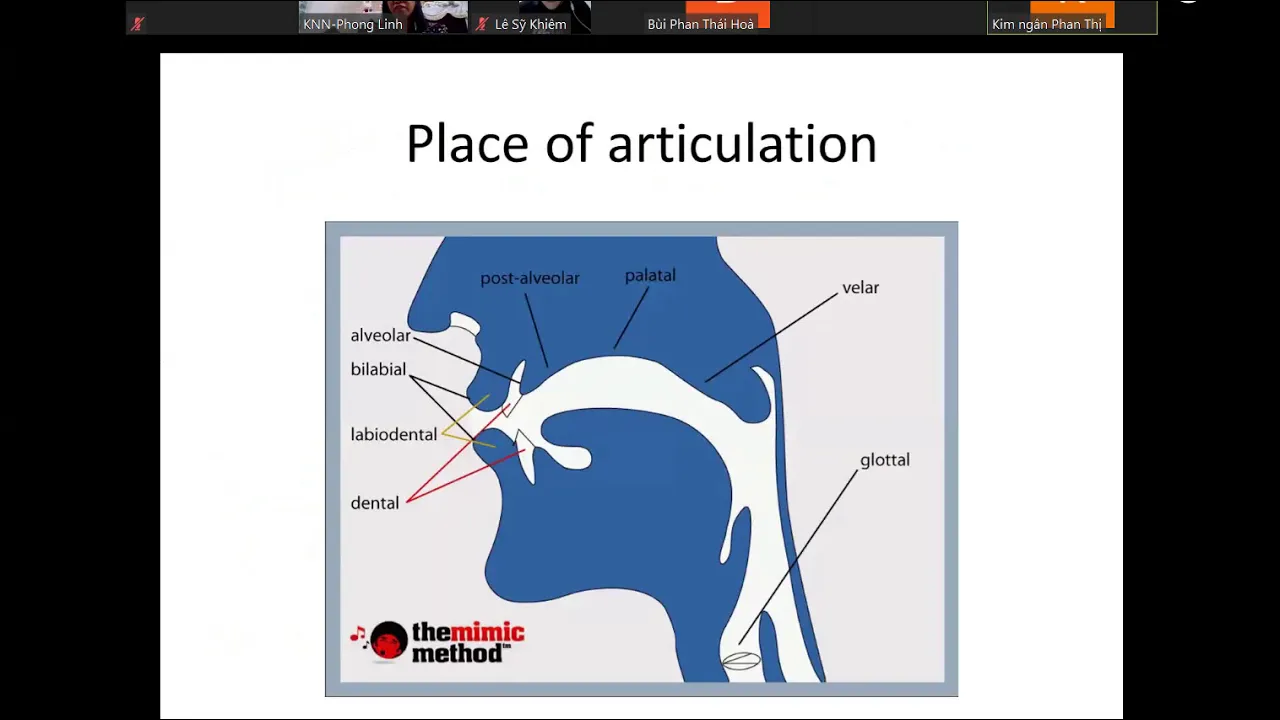
If you think about them-- so feel free to sit there making those noises to yourself if you want to-- what all of them do is make a consonant sound that's articulated with the tip or the blade of your tongue-- so if the front of your tongue is touching some part of the top of your mouth or other places.
So the interdentals-- your tongue is sticking out between your teeth, or the alveolars, or the postalveolars-- the tip of your tongue or the blade of your tongue is coming into contact almost with the top of your mouth as opposed to, say, bilabials, where your tongue can do whatever the heck it feels like, or velars, which involve your tongue, or uvulars, which involve your tongue.
But it's the back of your tongue, "k," or "g," as opposed to the front of your tongue, which is what you're using for things like "t," and "d," and "f," and "th" and "sh" and "zh."
Is that clear?
That distinction clear?
And Arabic gives this a nice illustration of this.
The coronal sounds are the ones that are the sun letters.
They're the ones where the last consonant of the definite article just becomes a copy of the following consonant.
Notice that the last consonant of the indefinite article underlyingly is "l," which is itself coronal.
So it's like the end of the definite article is going to be coronal.
If nothing else happens, it's going to be "l," But if there's a coronal right after it, it just becomes a copy of the following coronal.
Does that make sense?
That's what's going on in all of these examples.
So with "moon," and "mare," and "book," and "war," and "father," the "l" of the definite article can't become a copy of the following consonant and remain coronal, whereas in the sun letters, the ones on the right, by copying the following consonant, the "l" of the definite article is still a coronal.
[ELECTRONIC CHIME] Bling.
Somebody had a great idea about that.
So that's what's going on in these Arabic examples.
A rule that we could have for the Arabic definite article-- yes, I just said this.
Thank you.
"l" is also coronal.
A rule we could have for the Arabic definite article would say in the definite article, an "l" becomes a copy of a following coronal consonant.
So we have a variable, consonant subscript "i" which says whatever the following consonant is if it's coronal, the "l' will also get the value consonant sub i, but it'll have the same form as the following consonant.
Yeah?
STUDENT: I had a question about coronals.
So what I noticed is the sun letters are the letters that you can maintain for a long time, like "sh," and like the "sh," like [ARABIC] in sun, for "d" in [ARABIC].
NORVIN RICHARDS: Yeah.
STUDENT: You maintain them for a long time.
NORVIN RICHARDS: Yeah.
STUDENT: And Arabic actually has [ARABIC],, which duplicates one letter.
NORVIN RICHARDS: Yeah.
STUDENT: So what I'm thinking is that when you can duplicate the letter, you just duplicate it.
NORVIN RICHARDS: Uh-huh.
STUDENT: With [ARABIC],, and other words.
NORVIN RICHARDS: Yeah.
STUDENT: But for [ARABIC],, just the moon, you can't do that.
NORVIN RICHARDS: Yeah.
But there are-- STUDENT: Do you see what I'm saying with that?
NORVIN RICHARDS: I see what you mean.
But look.
There are consonants like "p," and "t," and "k," which are all stops.
But "t" is coronal and "p" and "k" are not, right?
And so all of those are equally hard to maintain for a long time, I think.
Or similarly, I think what we're hoping-- and you can stop me if this is not true-- is that if there are Arabic words that start with "m," you'll get al before an "m," yeah?
But for Arabic words that start with "n," you get a copy of the "n," yeah?
And again, those are all equally easy to hold on for a long time.
So this is a good example of science.
You had a good hypothesis.
And now we're finding data, yeah.
And I should have called on you to do to say these Arabic words.
Yeah, Joseph?
STUDENT: So you mentioned that the English language has borrowed quite a few words from Arabic.
NORVIN RICHARDS: Yeah.
STUDENT: And we accidentally brought the definite article with it.
So the word "algebra."
NORVIN RICHARDS: Yep.
STUDENT: "Algebra."
At least, the English pronunciation starts with coronal.
NORVIN RICHARDS: Oh, yeah.
But in Arabic, I think it doesn't.
So maybe you know.
Do you know know what "algebra" is in Arabic?
STUDENT: I believe it's [ARABIC].. NORVIN RICHARDS: [ARABIC] STUDENT: [ARABIC] NORVIN RICHARDS: Oh, OK.
So I got it backwards.
Yeah, so we kept the "l," We didn't do the change.
So it starts with a "j," starts with a coronal.
But it didn't do the change.
I wonder whether we borrowed it before Arabic did this sound change.
I have no idea.
I don't know enough about the history of Arabic.
Cool.
Yep.
All right.
So this is one rule.
It's a very common rule, where one sound becomes more like another sound.
It's called assimilation.
And in this particular case, it's what's sometimes called total assimilation, where one sound just becomes a complete copy of another sound.
We'll see other cases where one sound just changes in ways that resemble a nearby sound.
Why do you do assimilation?
Languages do assimilation all the time.
And it's not hard to have pretheoretical notions about why, right?
You're saving wear and tear on your articulators.
So" making it so that your articulators-- your tongue, your lips, your velum don't have to do as much moving around.
Things don't move as far or don't move at all.
It probably also makes perception easier in the sense that if you're speaking Arabic and instead of an "l"-- so let's take the sun.
If you know that the word for "sun" is [ARABIC],, and you've got this thing before it, basically, it's as though you only need to give your hearer enough information to help them to know that they're hearing a definite article before the word for sun.
And Arabic has decided it's enough if you hear the glottal stop and the vowel, and then a coronal.
Underlyingly, that coronal, maybe, is an "l."
But as long as we keep it coronal, we've given the hearer enough that they get to hear it.
And in fact, we give the hearer, in a sense, two shots at hearing the beginning of the word for sun.
So we'll lengthen that sound.
We'll pronounce it twice.
So we're redistributing the signal, in a way, to the hearer to make their life arguably easier, giving up some of what makes the definite article distinctive in order to emphasize some of the beginning of the word for sun.
Yeah.
Questions about any of this?
Yes.
STUDENT: So would you say generally that the focus is just to facilitate the pronunciation of the word easier.
NORVIN RICHARDS: So I was trying to float the idea that it's partly to make the pronunciation easier.
It's so that your articulators are not having to move as fast or as far.
But it might also make perception, in some ways, easier in a case like this.
So the idea is we'll give up some of the special properties of the definite article in favor of emphasizing or holding for longer the special properties of the word for sun, or whatever, the consonant that's at the beginning of the following noun.
So we'll emphasize some parts of the-- in some ways, the least predictable part of this.
You presumably hear definite articles all the time.
It's not so important that you get lots of clues to the fact that this is a definite article.
The nouns are going to vary.
You'll hear more different kinds of nouns, yeah.
Yep.
OK, cool.
This is probably a good place to stop.
So let's stop here.
And have a good weekend.
And I'll see you guys next week.
Up Next
10:17
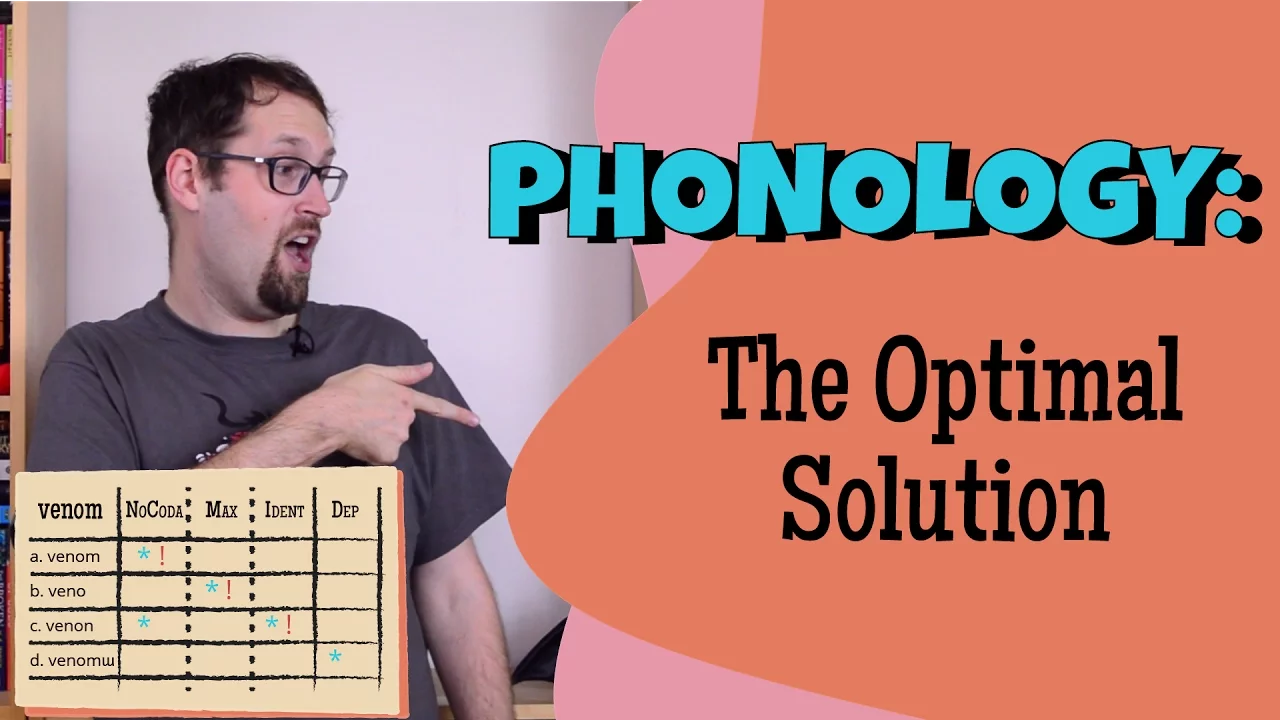
Optimality Theory: Constraints on Linguistic Sounds Explained
@thelingspace
42.9K views•2016-12-01
36:52
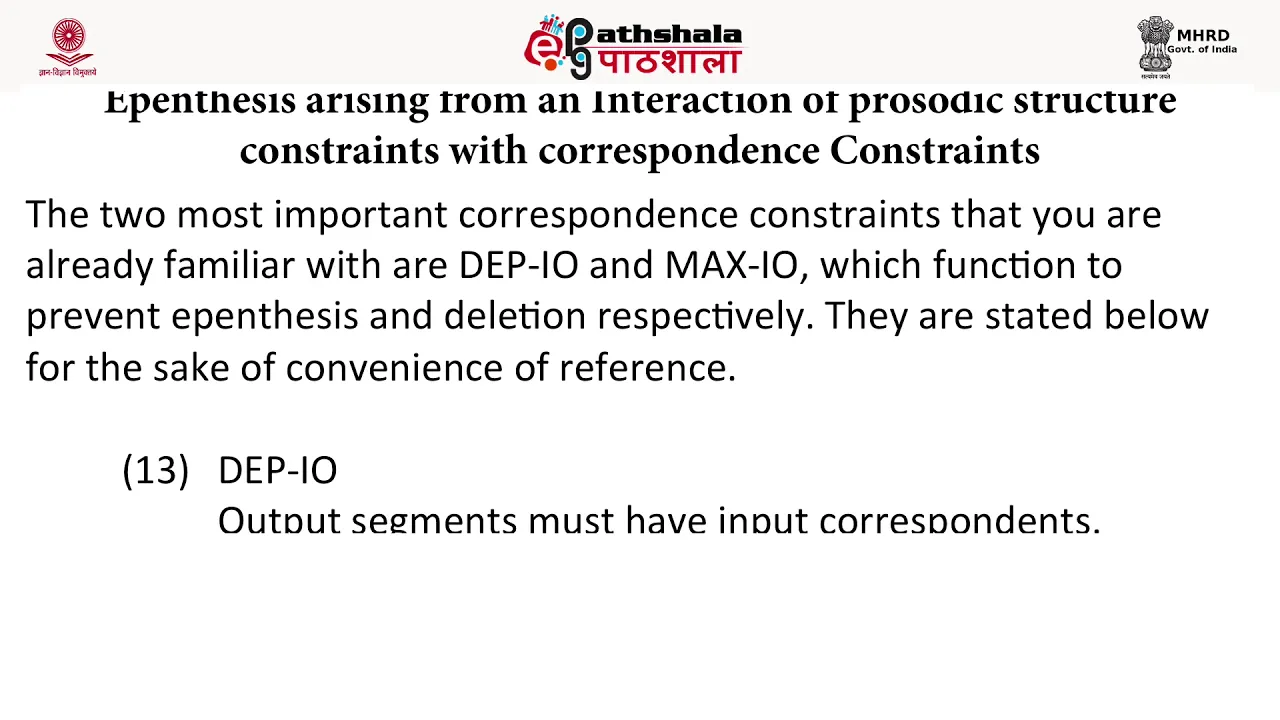
Constraint Interaction in Optimality Theory: Epenthesis & Deletion
@Vidyamitra
180 views•2018-08-20

44:17
Signed Languages: ASL Linguistics & Grammar | MIT Intro to Linguistics
@mitocw
10.7K views•2023-01-27

21:32
Accent Expert Explains U.S. Regional Dialects | Part 1
@WIRED
9.3M views•2021-01-21
Related Study Plans & Knowledge Roadmaps
Structured learning paths in Linguistics
linguistics
Optimality Theory: Tableaux & Constraints
01Phonological Basics: Sounds, Syllables & Rules
02Foundations of Optimality Theory: GEN, CON, and EVAL
03The Constraint Inventory: Markedness vs. Faithfulness
+ 2 more learning modules
15h5 modules
Explore Roadmap
linguistics
Morphosyntactic Alignment: S, A & P Systems
01Foundations of Syntax: Transitivity and Arguments
02The Linguistic Variables: Mapping S, A, and P
03Nominative-Accusative Alignment
+ 3 more learning modules
12h6 modules
Explore Roadmap
linguistics
Analyzing Sign Language: Phonology & Syntax
01Foundations of Sign Language Linguistics
02Phonology: The Five Parameters of a Sign
03Morphology: Word Formation and Classifiers
+ 2 more learning modules
14h5 modules
Explore Roadmap
linguistics
Pragmatics: Speech Acts, Grice & Politeness
01Introduction to Pragmatics: Meaning in Context
02Grice’s Cooperative Principle & Implicature
03Speech Act Theory
+ 2 more learning modules
14h5 modules
Explore Roadmap