


![Phonetics: Intro to linguistics [Video 2]](https://i.ytimg.com/vi_webp/GLBsvdaR_ow/maxresdefault.webp)

















![SFU LING 100 - [9] Computational Linguistics](https://i.ytimg.com/vi/jDRkw8FRAuA/maxresdefault.jpg)

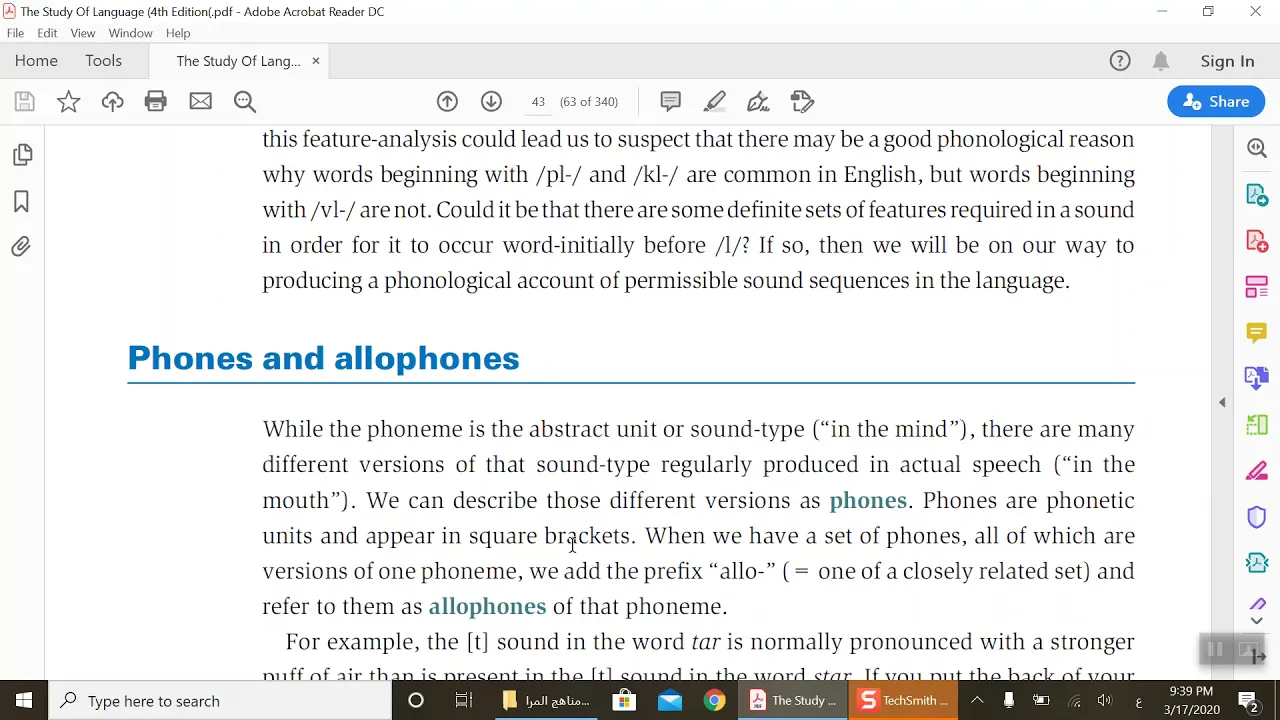
Phonology is the study of sound patterns in language, examining how sounds vary across contexts and languages; linguists distinguish between phones (any sound difference, written in brackets) and phonemes (language-specific meaningful differences, written in slashes), where allophones are different pronunciations of the same phoneme that don't change word meaning, such as the aspirated [tʰ] in 'team' versus the unaspirated [t] in 'steam' in English, but serve as separate phonemes in languages like Nepali where they create different meanings.
Phonology in Linguistics: Sounds, Phones, and Phonemes
Added:Basic concepts of Articulatory Phonetics, including how speech sounds are produced using vocal organs (place, manner, and voicing).
Familiarity with the International Phonetic Alphabet (IPA) and its role in transcribing human speech sounds objectively.
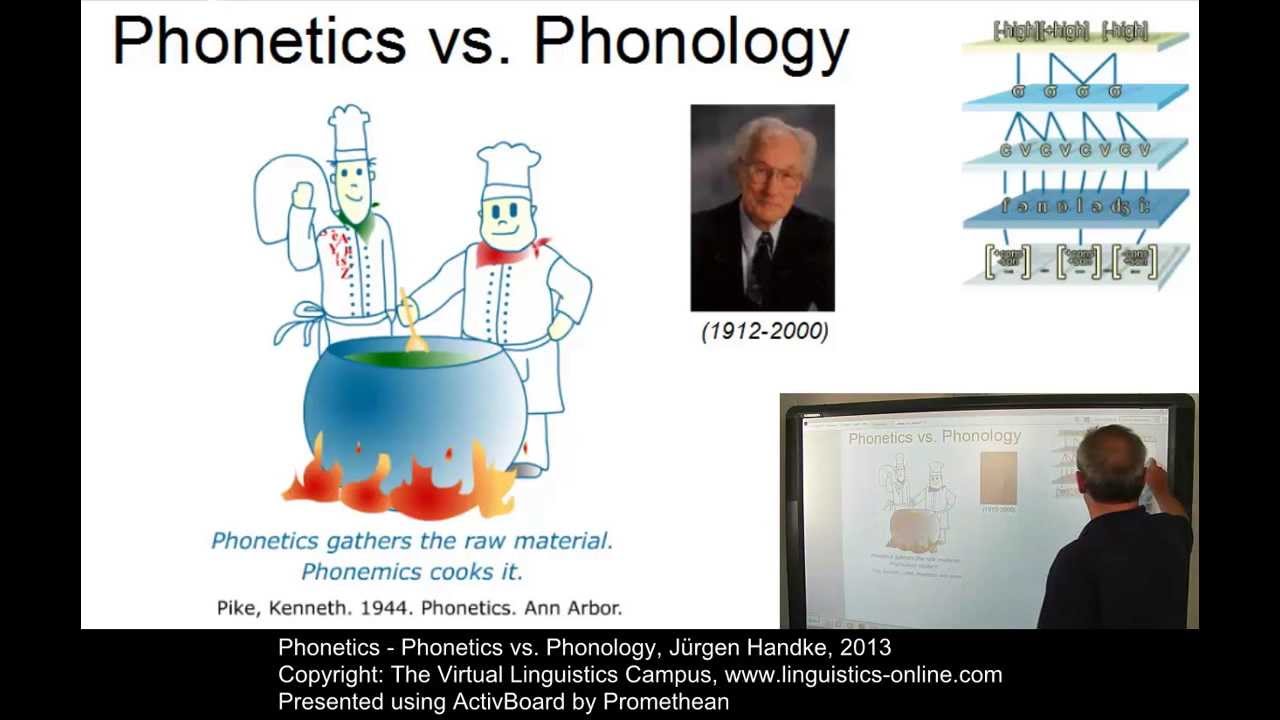
The fundamental distinction between phonetics (the physical properties of speech sounds) and phonology (the cognitive patterning of those sounds).
Phonological Rule Notation, learning how to write formal rules that describe sound changes (e.g., /A/ becoming [B] in specific environments).
Phonotactic Constraints, which dictate the permissible combinations of phonemes and syllable structures in a given language.
Advanced phonological processes such as dissimilation, deletion, insertion (epenthesis), and metathesis.
Suprasegmental Phonology, exploring features like stress, tone, pitch, and intonation that extend over more than one sound segment.
Practical applications in computational linguistics, such as developing text-to-speech engines and automatic speech recognition systems.
366.6K views8.9Klikes12:05Original Release: 2020-11-20
Hi, I'm Taylor and welcome to Crash Course Linguistics!
Could you get me a glass of water?
What if I asked for waTer, like some people, but certainly not me, pronounce it?
For other people, that /t/ in the middle of the word can become ‘wa-a’.
Our brains treat these different sounds as equivalent.
It's still liquid H2O whether you pronounce it wadder, waTer, or wa-a.
This isn’t just true for /t/ — all of the sounds or handshapes of a language can be produced differently depending on the context.
Different languages and accents have their own variation.
These patterns, and the study of them, is known as phonology.
[THEME MUSIC] When we first start to pay attention to phonology, it's like trying to see the trick in an optical illusion.
We need to learn a different way of paying attention, which can involve looking closely at what our bodies are physically doing or using external tools to measure it.
It’s like when you cross your eyes or drag an optical illusion into a photo editor to prove that two grays are really the same color.
But unlike optical illusions, phonology is different for each of us depending on which languages we were exposed to at a young age.
As babies, we’re not attached to any one phonological system.
So a baby that's been hearing only English for a few months can still hear all the subtle differences in pronunciation that might matter in a different language context.
But we lose this ability as we get older and start only paying attention to certain languages.
So phonological distinctions that may be obvious for some people might seem minute or impossible to distinguish for others.
We can see how ingrained a phonology is when people learn another language, because they’ll use the sounds they already recognize.
An American English speaker like me learning Hindi might use /t/ when learning to say "chutney” instead of a retroflex /ʈ/ “chutney”.
It might still be recognizable to a Hindi speaker, but it won't sound the same.
Before we get further along in this discussion, we need to talk about sound.
Linguists use the word sound to refer to two different concepts, and have come up with distinct terms for each of them.
On the one hand, linguists use the word sound to refer to any difference that's relevant for any language.
For example, “wadder” and “waTer” mean the same thing in English, so the distinction between these sounds isn't relevant for English speakers.
But for Spanish speakers there's an important difference between the same two sounds: it creates new words, like paro, which means, "I stop" and pato, which means "duck."
Linguists call this non-language-specific distinction a phone and write these symbols in square brackets.
On the other hand, linguists also use “sound” to refer to any difference that is relevant or meaningful for forming different words in only a specific language.
In English, that would include the sounds /t/ and /d/, since they’re the difference between “rabbit” and “rabid.” But it wouldn’t include the different ways you could pronounce the "t" in the middle of "water".
Linguists call this language-specific distinction a phoneme and write these symbols in slashes.
Let’s play this out with another English example.
Try putting your hand up in front of your mouth as you say "team" or "tall".
Now try saying "steam" and "stall".
You may not be able to hear the difference, but you can feel it on your hand — there’s an extra burst of air when you say “team,” but not when you say “steam.” That puff of air is called aspiration.
In English, there’s no meaningful difference between the aspirated [tʰ] as in "team" and unaspirated [t] as in "steam."
They both sound like “t” to English speakers, even though, as you just felt, they aren’t exactly the same.
In linguistic terms, we say that these two phones are part of the same phoneme in English.
Specifically, we say that aspirated [tʰ] and unaspirated [t] are allophones of the same phoneme in English.
They're technically different, but English speakers think of them as the same sound.
But in some languages, there is a meaningful difference between these two sounds.
In Nepali, unaspirated [tal] means ‘lake’ while aspirated [tʰal] means plate.
You need to be able to tell the difference so your lunch doesn’t get soggy.
Because the distinction between [t] and [tʰ] is meaningful to Nepali speakers, we say that these two sounds are different phonemes in Nepali.
So, in Nepali, aspirated [tʰ] and unaspirated [t] are both different phones AND different phonemes.
In English, these same sounds are different phones, but they're NOT different phonemes.
Now, despite the etymology of ‘phone’ as sound, signed languages also have their own phonologies, with some handshapes, movements, locations, and orientations for signs that are relevant in some signed languages and not others.
For example, an extended ring finger is a meaningful handshape in Taiwainese Sign Language but not in BSL or ASL.
Let's go into the Thought Bubble to observe some phonemes in their natural environment.
To think about how two different sounds can be allophones of the same phoneme, let's compare them to a rabbit.
The snowshoe hare specifically.
It looks like a regular cute brown rabbit most of the year, and then in the winter its brown fur changes to white.
Even across different seasons, a snowshoe hare is the same rabbit — it lives in the same hole, it's still recognized by its baby rabbits, and it still munches on all the veggies it can find.
But sometimes it shows up as a brown rabbit, and it sometimes shows up as a white rabbit.
If we were wildlife observers, we'd want to pay very close attention to when these versions appear before we conclude that they're the same animal.
After all, in other places, there are rabbits that are brown or white all year round.
So if we see both a white and a brown rabbit in summer and in winter, we actually have two different rabbits.
We can write out our observation of the snowshoe hare in three parts.
The first is what we're starting with: one rabbit, of no specified color.
The second is what changes: the rabbit's fur color.
And the third is the environment where that change happens: whether it’s winter.
From this, we have two rules: the first one describes how the rabbit changes to white when it’s winter and the second one describes how the rabbit changes to brown when it’s not winter.
We can make observations like this about sounds in a language, to determine whether we're dealing with a phoneme with two allophones, like a color-changing rabbit, or two different phonemes, like two differently colored rabbits.
Thanks, Thought Bubble!
The difference in meaning between unaspirated [tal] and aspirated [thal] in Nepali is like seeing a brown and a white rabbit at the same time — we know that they have to be distinct species, or phonemes.
In English, we know there isn’t a difference in meaning between words that have the aspirated /th/ and the unaspirated [t].
Also, when looking at single-syllable words, we hear these two sounds in the same places each time.
The unaspirated [t] always occurs after an s or at the end of a word, while the aspirated /th/ always occurs at the beginning of a word.
That's like seeing the white rabbit in the winter and the brown rabbit in the summer — the different versions of /t/ appear in predictable environments.
That’s how we prove that these two sounds are allophones of one phoneme.
Based on these observations, we can write a rule for English that says a /t/ is pronounced without an aspiration after an /s/ and with aspiration at the beginning of a word.
Linguists write them out with this notation, using an arrow from the underlying form /t/ to what's changed about it, like aspiration, and a slash mark between the sound change and the environment, like being at the beginning of the word.
By the way, this hash mark represents a word boundary — you can think of it as like a visible version of the space between words.
We can use the hash mark to indicate whether a sound is at the beginning or end of a word.
The notation is a short form that lets us keep track of the many phonological rules in each language.
It’s like training our brains to see the optical illusion--to see pattern in language like a linguist.
/t/ isn’t the only English consonant that follows this rule.
Other consonants, like /p/ and /k/, also have no aspiration after an /s/.
Linguists call this category of consonants voiceless stops, and can create a general rule: voiceless stops become aspirated at the beginning of a word.
We could keep going with more rules in English and other languages, like the /t/ in English water, but let's zoom out and take a look at the big picture instead.
There are some common phonological processes that we see happening across different languages.
While all languages have phonologies, the processes in signed languages have not been studied in as much detail.
So sometimes the categories for spoken language don’t quite fit for signed languages.
Phones that are produced one after the other can sometimes become more similar, which makes it easier to produce a word or phrase.
When speaking quickly, many English speakers will say ‘handbag’ as ‘hambag.’ Changing /nd/ to /m/ shifts the sound to the lips so it’s now a bilabial like /b/, which makes them easier to say together.
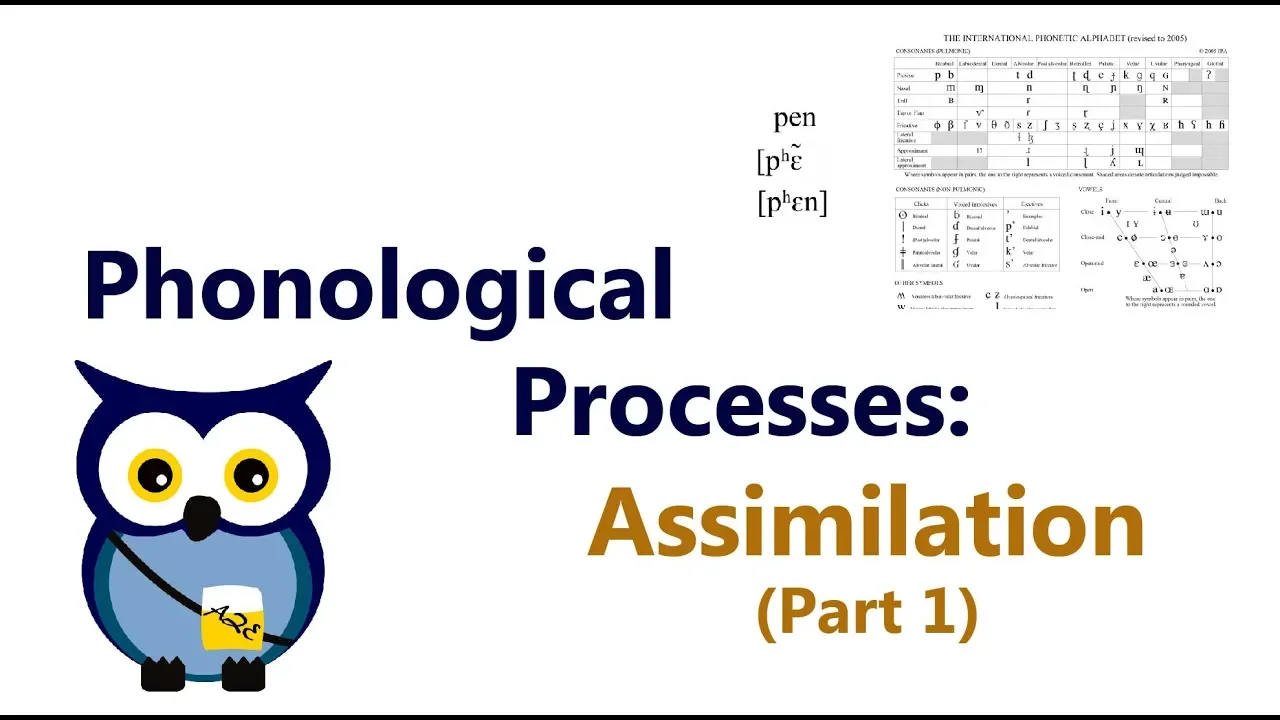
This phonological process is known as assimilation.
Assimilation in signed languages can affect the handshape or sign location.
The Auslan sign for ‘name’ is typically made at the head.
When it’s used in the phrase ‘my name’ it’s often performed lower, perhaps near the cheek, because it’s following the ‘my’ sign at the chest.
Phones can also become more distinct when we produce them.
The English word ‘venom’ used to be ‘venin.’ But the two /n/ sounds so close together didn’t sit well with medieval English speakers, who changed the second one to /m/.
Many English speakers do the same with cardamom, or maybe cardamon, today.
Linguists call this phonological process dissimilation.
Phones can sometimes be added in to break up a difficult string of sounds or signs.
You might hear people adding a /p/ in ‘hamster’, or notice the extra vowel Rhianna uses to make ‘umbrella’ into 4 syllables.
This phonological process is known as insertion or epenthesis.
We can sometimes see a movement insertion between signs.
When counting in Auslan people often add a little movement of the hand between each number.
Phones can also be removed.
We have even made this part of the English writing system with contractions like ‘I’ve’, ‘it’s’ and ‘can’t’.
Sometimes sounds are removed from the middle of words too, like /i/ in ‘family’.
This phonological process is known as deletion or elision.
In Auslan, the sign for ‘girl’ includes a repetition of the movement, but in conversation the repetition can be deleted.
And finally, phones can switch around.
The Old English word for third’ was thrid, but English speakers switched the ‘i’ and ‘r’ around--although they didn’t in ‘three’.
This process is also why we have ‘aks’ as well as ‘ask’.
In fact, at various points in history ‘aks’ has been the more common pronunciation.
This phonological process is known as metathesis.
In ASL, the sign for ‘deaf’ shows metathesis.
The standard form is ear to mouth, but it can also be performed going from mouth to ear.
These processes either make it easier for us to produce words and phrases or help our audience understand them.
Over time, they’re part of what drives changes in a language.
It can be challenging to retrain your brain from the phonological patterns it's used to, but phonological rules are important.
They help synthesised speech technology like Siri sound more natural, and help us be more sympathetic language speakers and learners.
An appreciation for phonology is useful whatever your environment.
Thanks for watching this episode of Crash Course Linguistics, which is produced by Complexly and PBS.
So 2020 has been... bad.
PBS has a new show called Self-Evident that explores how we've been persevering in this supremely weird year.
It's hosted by historian Danielle Bainbridge from Origin of Everything and therapist Ali Mattu, who you might know from The Psych Show.
Because who better than a historian and a therapist to help guide us through ALL of this.
Self-Evident is part of PBS American Portrait, a massive storytelling project involving thousands of people around the country.
Subscribe to PBS Voices for Self-Evident and other great shows, and tell them Crash Course sent you!
Up Next

52:35
Southern American English & African American Vernacular | Dialects Explained
@rodgerwilkie3617
356 views•2020-12-16
36:52
Constraint Interaction in Optimality Theory: Epenthesis & Deletion
@Vidyamitra
180 views•2018-08-20

9:57
Pragmatics and Grice's Maxims | Crash Course Linguistics
@crashcourse
338.9K views•2020-10-16

21:32
Accent Expert Explains U.S. Regional Dialects | Part 1
@WIRED
9.3M views•2021-01-21
Related Study Plans & Knowledge Roadmaps
Structured learning paths in Linguistics
linguistics
Optimality Theory: Tableaux & Constraints
01Phonological Basics: Sounds, Syllables & Rules
02Foundations of Optimality Theory: GEN, CON, and EVAL
03The Constraint Inventory: Markedness vs. Faithfulness
+ 2 more learning modules
15h5 modules
Explore Roadmap
linguistics
Morphosyntactic Alignment: S, A & P Systems
01Foundations of Syntax: Transitivity and Arguments
02The Linguistic Variables: Mapping S, A, and P
03Nominative-Accusative Alignment
+ 3 more learning modules
12h6 modules
Explore Roadmap
linguistics
Analyzing Sign Language: Phonology & Syntax
01Foundations of Sign Language Linguistics
02Phonology: The Five Parameters of a Sign
03Morphology: Word Formation and Classifiers
+ 2 more learning modules
14h5 modules
Explore Roadmap
linguistics
Pragmatics: Speech Acts, Grice & Politeness
01Introduction to Pragmatics: Meaning in Context
02Grice’s Cooperative Principle & Implicature
03Speech Act Theory
+ 2 more learning modules
14h5 modules
Explore Roadmap