

!["Optimality Theory in Generative Phonology" [a brief description on Optimality Theory]](https://i.ytimg.com/vi/1HwT3gFKli4/maxresdefault.jpg)
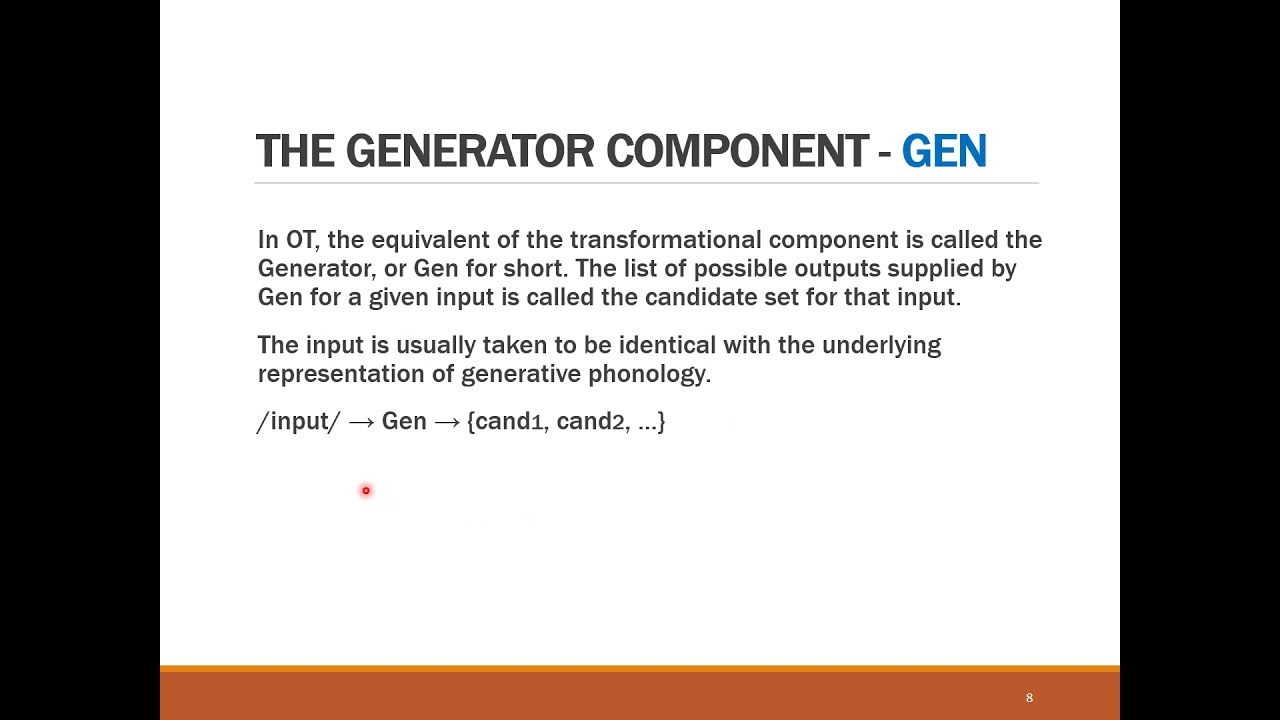

















Optimality Theory (OT) typologies possess intrinsic geometric and order structures that determine how languages classify together, where geometric contiguity and preservation of order relations (captured by the 'moat'—a unique structure derived from border-point analysis) are essential for valid typological classification, distinguishing genuine linguistic generalizations from merely geometrically plausible but logically inconsistent groupings.
Metrical Theory and Optimality Typology | Alan Prince Analysis
Added:Fundamental principles of Optimality Theory (OT), including Gen, Eval, Con, and the concept of constraint ranking.
Basics of Metrical Phonology, specifically syllable weight, foot structure (iambs and trochees), and stress assignment rules.
Elementary set theory and order theory, particularly partial orders, lattices, and transitive relations.
The concept of linguistic typology and how cross-linguistic variation is modeled through constraint reranking.
Advanced analysis using Elementary Ranking Conditions (ERCs) to formally represent and compute constraint rankings.
Alan Prince's 'Property Theory', which decomposes complex typological spaces into orthogonal, logical properties.
Applying algorithmic tools and software (such as OTSoft or OT-Multilog) to calculate and map factorial typologies.
Comparing standard Optimality Theory typologies with weighted constraint systems like Harmonic Grammar and MaxEnt (Maximum Entropy) models.
3.2K views26likes53:56Original Release: 2013-10-18
welcome to the first session of the morning the first speaker will be alan prince speaking on metrical theory as a portal on theory let me make a brief housekeeping remark donca kindly informed us speakers that we could use the 45 minute period as we wished so i have a tripartite argument and i would like to make the argument and then open the floor so i will proceed organically in that fashion uh let me begin by saying how delighted i am to kick off this celebration of morris halley's works and days it is his broad shoulders on which we stand and i'd also like to remember jean rejo our friend and colleague who i think would enjoy the view of what we can see now so let's take a look and see what there is to see so i'm going to talk about recent work with my colleagues jointly and severally beerget albert and nazare merchant and i'll refer variously throughout to stuff we've done okay i'm going to try to advance and demonstrate three theses first is that an ot typology comes with an intrinsic geometry that influences how its languages class together so i'm going to be investigating the issue of how the languages of a system grouped together into classes illustrating fundamental properties and the geometric result is that geometric contiguity is required for this to happen and here's an example of a geometric representation of the target typology the grand target which we will allude to but uh only make steps toward today this is a stress typology of 21 languages using a type of constraints that i'll introduce in a minute and it's distinguishing characteristic is that it allows completely unparsed strings as candidates if we disallow those and only use them only allow monosyllables to be unparsed things simplify like this and if we go a step further and generalize across these classes ignoring distinctions of foot type and directionality we get a geometry like this and this is of course the kind of geometry we'll actually be studying today okay a second hypothesis and it's not really a hypothesis it's a it's a demonstrated uh property that we will we'll see how it emerges uh and ot typology comes with an intrinsic order and equivalent structure that determines how its language is classed together now this is not an order on candidates of the type we're familiar with which is used in optimization and so forth on a daily basis this is uh an order on languages so we'll see that each constraint imp imposes a kind of order structure on all the languages of the typology and the result is the classification result is that the defining properties of order must be preserved by generalization which will reduce graphically to a perspicuous condition that no cycles may occur in the graph so what does the graph look like well this is what the graph of the full system looks like if we look at the simplified system that we were just talking about its uh graph looks like this and another simplified system worth discussing looks like this okay and the third thesis will be that an ot typology is analyzed by other ot typologies which generalize or articulate its grammars so we tend to think of things as being analyzed by something else like a uh a segment is analyzed by features or some such but what we'll actually see here is a somewhat different kind of relationship in which we refer typologies to typologies to understand their structure let's begin with that idea so the relation takes place inside the lattice of all typologies what does that look like well this is not the lattice of all typologies this is a part of it a sub lattice which we will investigate somewhat and more to the point we'll also investigate a very simple fragment of it which will show some of the key properties okay so the main issue is this that we're trying to address a theory classifies phenomena but how so consider the positioning of feet in a typical dense footing pattern in a language which there are many feet say crammed to maximality up to say possibly up to binary possibly completely and so in it happens as uh that in familiarly in odd syllable words the leftover syllable is loose or footed and i i've indicated that by this notation which i hope you will find perspicuous to save me from going on about it so i'm just using capital f to mean a binary foot x to indicate a stressed syllable and therefore a unary foot an o to represent an unfooted syllable so then therefore we're looking at patterns like this sequences of feet followed by an unpar syllable or preceded by one a monosyllabic foot succeeded or preceded by a train of feet and so the question is how are these classified and as you can see there's two ways to classify them so there's the alignment style classification first noted by megan crowhurst and mark hewitt and also anticipated a work by paget and mester on syllables and then there's the iteration style classification which has came to predominate after it's in uh serial theories of stress assignment after its uh introduction by people like irwin howard and c douglas johnson okay so that's simple in that we sort of can identify what the prop what the classifying difference is uh now i just want to point to another kind of issue that arises namely uh consider languages like l1 and l2 and asks the question of what causes the difference in rhythm namely trochaic and by syllables and iambic elsewhere in longer words to emerge so in the paper important paper by albert which uh imposed both rhythmic and left alignment constraints forms like these occur in languages where troche dominates i am in other words the current trochaic language so they classify with the trochaic languages how do we learn that we can't learn that by looking at these forms the data does not where its classification on its face so we have to look a little further into the theory even then in the first example and you have to possess a notion of how the theory classifies to be able to make any kind of solid assertion on this point that's what we're going to be concerned with okay now this is a general issue which you might call the paradox of analysis that is the more deeply you've analyzed something into finer and finer parts the less you understand how the parts fit together so we're never going to describe the flight of a baseball in terms of string theory okay now returning to the humble subject of the day we we're dealing with a class of modern linguistic theories which all have this character to a degree namely they are the elements of description are atomized and they're highly interactive and therefore it just follows that they have to be descriptively and explanatorily opaque this means that to understand how to proceed in the theory and to engage in the content contentious battle between mighty theories that um cancer which was discussing we have to real understand that the theory is also an object of analysis just because we have laid down its premises does not mean we understand anything about it and so this work is distinct from and prior to the betterness struggle okay so this then fits into the analytical program which was described in more detail in my handout but i just like to allude to the basic strategy which i will exemplify today rather than preach upon so the idea is that we want to work from simple to complex and we want to beyond that we want to understand and ascertain how the simple relates and builds into the complex so there's a notion of simplification there's also a notion of generalization we'll see that these can part company in order to do this we have to show a brazen willingness to simplify we must deal with things which are not immediately responsive to reality and it's what we can observe of it we earn our right to examine a theory x because it relates to a theory why and not because it immediately phenomena is immediately phenomenally successful and so how do we this relates also to a strategy in the analysis of typologies which i will be exemplifying and that i've been developing and joint work with beerget albert namely we seek to analyze typologies into a structured set of choices among mutually exclusive ranking conditions this is a kind of basis for the typology by making each choice you you get the languages of the typology so in order to do this in order to approach this goal we need to begin to ask what the intrinsic classes intrinsically are so let's do that so let's take a step back and ask what does it mean to classify something so think of a classification as the of the elements of a set as a partition so we have some set of objects tendentiously chosen here to be relevant and we classify them by grouping them and in such a way that we group everything and no gr and there's no overlap of groups and there's an interesting relationship between uh partitions or classifications in this notion which is illustrated right here namely there's a built-in notion of generalization so here's another classification of the very same set of elements this classification generalizes the one that we just saw because it has the same categories or it has a class in it which lumps together two of the other classes okay so uh just to extend the idea one step uh here is an example where we have a a class of six elements and there's two very almost trivial classifications one lumps them all together in one class one divides each into a separate class and between that there's a bunch of different ways of classifying them which i have chosen two and we can see that the one on the left here takes a and b to be a class sharing properties and also e and f whereas the one on the right takes the class c and d c d to be sharing properties and so on and we can see that how each of the ones in the middle generalizes the lowest one but they do it in different ways so they're not actually comparable themselves neither is a generalization of the other although both are a generalization of the fundamental one and things like this are known of course as lattices and this one goes like so it runs from the bottom to top becoming more and more general and from the top to the bottom becoming more and more articulated so these are i'm going to use these terms because i think they're more suggestive in the circumstances so if we wanted to talk about lattices we'd be talking about coarsening refinement and about partitions we'd be talking about blocks or parts but let's talk about classes generalization and articulation okay so what are the objects of linguistic theory that we're going to be worrying about uh i distinguish three there's a language an extensional notion which is a set of linguistic objects a set of candidates under ot from each candidate said optimal under some given ranking now we have to take a a little step here to clarify what the basic objects of the theory are namely what is a grammar so we're going to define a grammar as the collection of rankings which all give the same language very natural i think it lies behind the common usage now importantly this collection of rankings has a characterization a principled characterization in terms of its structure not in terms of uh the facts that it describes but simply in terms of its formal structure and this can be given uh and indeed is probably most simply given in terms of the notion of the irk or elementary ranking condition so we can characterize the grammar by a set of elementary conditions or irks and that gives us an er grammar indeed many okay so what is then a typology a typology the notion splits into two halves one is the extensional notion which is the one that we usually end up dealing with it's extensional it's the set of languages so we uh figure out what the typology is and then we rush out in the world and try to figure out whether this or that language is reflected in some piece of reality that we have personally analyzed in the greatest possible to the greatest possible level of depth or uh we can also think of it intentionally as a collection of of of grammars okay and we can think of it as therefore a collection of ranking grammars or if we want to think of it in logical terms as a collection of er grammars both characterizations have uses today we will concentrate on the kind of structural insight we can gain by thinking of a grammar as a collection of rankings which is kind of linguistically repugnant since it uh doesn't tell us anything about them so uh with that we come to the notion of abstract ot with the notion of grammar we have stepped away from the concrete based on analysis of something or other and uh we have got ourselves an abstract object whose properties that we we can study and we we know we can do this because a grammar is characterized by an irk set and we know what an erkset is so let me just briefly remind you that an irk is a condition on ranking which arises from the comparison between two candidates the first asserted optimal and it forms the primary link between theory and data in optimality theory it characterizes the exact ranking conditions in which candidate q is better than z namely some w constraint dominates all l constraints a condition of sufficient complexity that it pushes the grammar out of the class of partial orders and into that of the anti-metroid and if you want to be enlightened on that you can examine the works of wriggle and merchant and wriggle and importantly the logic of ot is the logic of ergs and we'll be able we'll point to cases where that can be used today okay so now let's step back and see what we've gathered together before we plunge forward okay so we're studying the notion of classification as partition which comes with a notion of generalization and that's why we can talk about the lattice of partitions the lattice is based on the notion of generalization and articulation of those partitions okay and the fact is that a typology is a partition of the set of rankings there's a secondary fact which we will not dwell on but which is of use which is that the set of all possible typologies on end constraints is also a lattice this is not totally obvious and it i i have shown it in a paper soon to appear somewhere okay uh so consequence we have a baseline notion of classification built into ot so we started out by asking how do we classify these things together we look into the internally of the theory and we see that right there without even asking we have a theory of classification so what i would like to do in today is show the basics of how that works because it turns out to be not entirely trivial okay so how are we going to do this well metrical theory provides us with an excellent stalking horse because uh from the point of view of the analytical program it admits of a range of simplifications although it encompasses a vast range of distinctions uh they can be meaningfully simplified so we can forget about primary secondary tertiary and stress and just discuss stress and unstress and still have many interesting things to talk about and so here i um articulate the theory that i will be talking about today namely it's a fairly familiar one in which feet our binary unary syllables are parsed into feet or they can be left unparsed within that parsing is free except that we're going to distinguish among systems as i hinted at the beginning where there is some control of parsing in terms of the candidate which is entirely unparsed so candidates suffix with o system suffix with or ones in which we admit a completely unparsed candidate with x not and we're going to have five constraints here again familiar if contested but what we're really interested in is the interactions of them and how they illuminate the classification structure that emerges from ot so the familiar ones are par syllable demanding that every syllable will be parsed i am troche to uh to be noticed is what the what how the definition runs so that the i am constraint dislikes that both the binary troche and the unary foot the troche dislikes the uh i am and the unary foot okay so there's a variety of choices of how to chop up the foot world into constraints this is the choice that berget and i have made and explored then we're going to use the generalized alignment constraints uh which accumulate the distance of each foot from an edge and we're going to construct further simplified systems by omitting we're going to use a strategy of simplification in accord with the analytical program we're going to omit one of the symmetrical pairs i t and left right and see what we can learn from those simplified situations okay so this generates a whole class of different languages so the big mother languages are the ones which distinguish between i am troche left and right and the simplified systems have only a distinction between foot type and direction not distinguishing among those and i'm for personal concreteness i'm going to restrict that to iambic and left so this is a with the o that indicates that we're letting in the nil parse and we've simplified all the way down to iambic and left and so forth and then there's the various intermediate systems which one are worthy of contemplation okay so what do we get from these systems well from the the one where we have uh no completely unparsed form we get three languages which i i've spelled out the forms here and given them highly mnemonic names which i hope will carry you through the day so there's the sparse language which allows just one foot there's the weakly dense language in which all feet are binary and therefore in odd syllables we have a leftover unpar syllable and there's the strongly dense languages in which everything is always completely parsed okay if we let in the completely unparsed language and when we simplify down here we get this sparse splits into two kinds depending on the treatment of monosyllables so in sparse.oh the monosyllable is not stressed it is unparsed in the language sparse.x it is parsed and the everything else is the same so those are the presonic systems we're going to study and the criterion that we're placing on them is they have enough rapport with reality so that what we learn will not be utterly fantastical in our minds okay so we were talking about the lattice of partitions okay these guys are partitions on the set of rankings what does that look like it looks like this this is the lattice we get from the system uh the four language system which allows unparsed forms and so we can see the pattern of generalization as we go up the lattice right so for example um take there are two types of dense languages weekly dense which are labeled here dense dot x and uh against.o rather and strongly dense labeled dense.x notice as we ascend the system this becomes the category d dense the two um sets of rankings that encompass density of footing correspond to one language in this abstract typology and we if we as we go further we see that uh we can also join the sparse ones and then this gives us a two language typology generalized which analyzes as i promised the languages of the root typology we go up here do the same thing and then we have the distinction between those which allow and those which do not allow the unparsed monosyllable okay now how do we get analysis out of this well what we do is we take these two guys and we find their minimal mutual articulation in other words we find the typology which is an articulation of both of them into minima and only articulates as far as it has to so we can see here that sparse over here and o intersect to give us sparse dot o dense and x give a intersect to give us dense dot x and that's generally how it's going to work so we end up with an analysis that looks like this so the analysis of the typology is these other typologies and we can see how they come out in these forms here so this typology a two language typology is characterized by the irk negative er pair given here or translating into the the choice of ranking conditions par syllable dominates i am i am dominates per syllable and so on okay so we want to do analysis we want to figure things out uh so we have to navigate the typological lattice how do we do that the first observation to make is that going down is easy if we know the things up here at the top we can easily construct their minimal mutual articulation simply if we have their vts their violation tableaus we can simply lump them together and that will be the violation tableau of this so we have the irk sets similarly we lump them together that's going to be the irk set of this so there isn't any problem going down but there is an issue that lurks with this observation namely we actually need to go up we start at the bottom here and we're trying to analyze this typology so we've got to climb up here to get to the primitives of the analysis so we're going to do it some effort into how to do that the first observation to make is we can go up using a logical operation on irks known as the merchant join so we it's what it does it's a combination of the uh components of the irk vector like fusion except that the motive combination is the three valued version of or so it's like uh it's related to the idea that p entails p and q is is sort of the minimal p or q p entails p or q p or q is the minimal form that is entailed by both p and q so what we get here is the minimal language which embraces both of the joining languages now problem this need not be the simple union of the rankings it can be bigger because sometimes having having different rankings putting them together entails that you must have other rankings to flesh things out into an authentic grammar which has an irk set so we can distinguish conservative joins which are good in that we join two languages and they include nothing but what was in them and we also but unfortunately not all joins are conservative and we we can also go one step further if we look a little harder and we see that not all conservative joints are typological in that just because you join two languages conservatively in a typology doesn't mean you get a typology in the output an interesting point uh which is uh which we'll save for later now what's the solution to this problem this analytical problem the solution lies in understanding the geometry of optimality theory and going then going beyond that geometry to seeing how the fundamental notion of order in the theory imposes an order structure on that geometry which then completely determines how you generalize okay so what's the geometry of ot it's given by this fact there's a natural notion of adjacency in permutations so if you have two permutations consider that to be a sequence of stuff right so p a b q is a sequence of things constraints of which a and b are constraints and p and q are sequences of constraints if we have another permutation which is identically the same except for the switch of the pair a and b then those are said to be adjacent this is uh standard and lifted from the literature on the symmetrical group and the study of permutations okay now the fun begins uh with arthur cayley when we know how to lay these things out lay out this notion of adjacency as this ad very abstract algebraic notion of adjacency as geometry and this is something which has been no notice and explored by wriggle and a little bit later by mit's own igor yanovich okay so we're going to extend this rendering to the type analysis of typologies as follows on the basis of three facts one a grammar is a connected region in the geometry of permutations uh in fact to add a nice word to the discussion if you take the entire set of permutations and arrange it by adjacencies like exactly like that you get an object known as a permutation discovered about a century ago in france and causing quite an argument about the name uh okay so fact a grammar is not just a bunch of rankings scattered all over the permeated it's concentrated in a region secondly a typology partitions the permia promutohedron into regions and therefore we can lift the notion of adjacency from that of the single rankings to whole regions so two two regions are adjacent if they have border points namely uh one point or ranking in one and the other in the other okay so what does this look like let's get some physical grasp on it so here's the permeahedron on four constraints and here's a picture that i made myself this is the furry permutahedron and it is intended to show the intrinsic structure of it mainly to bring out the fact that it's made up of a bunch of hexagons okay so this is on four constraints it has 24 vertices why hexagons well they have six three factorial right so you take these the hexagons of the three three permuta hedron and you kind of glue them together and then that gives you this figure and if you want to go up to the um five constraints you take this guy and you glue it together uh in a in a completely analogous fashion uh in four-dimensional space which is in fact where we'll be operating to a degree okay so of course today we will not be flying around much in four dimensional space let's go back to two dimensions okay we can learn everything we need to know there so this is the permutahedron on three constraints the a simple hexagon and indeed this is the representation of our system uh our highly simplified system of three languages which uh contains a sparse language a weekly dense language and a strongly dense language caused by collapsing the distinction between iambic and trochaic feet and the distinction left and right alignment so you might ask yourself what is this language sparse where is the damn foot is it left or is it right it's diamond or is it okay this is not a question you can answer we have lifted those uh um distinctions and we're just focusing on the fact that it is sparse so the no no no candidate uh of a concrete type is going to characterize this because you know it's something's either left aligned or rightly and it's either ambiguous okay but when you class things together you lose the ability to make those distinctions and that's exactly what classification is the loss of certain distinctions okay so you can now see how this bermudahedron is constructed very graphically you might not have been able to completely parse the truncated octahedron we were just reveling in so if we look at this we see that we can begin over here at the left the right border of sparseness which has the constraint i am dominating a f l dominating par syllable and it's nearby neighbors obtained by flipping these two guys one one labor neighbor we flip i am and afl and that gives us great okay uh no let's not do that let's flip afl and par syllable okay and that gives us that flips us across the border into weekly dense i am parcelable afl okay and we if we go around in this in this circle flipping things or we're going to go from neighbor to neighbor to neighbor to neighbor and sometimes we cross the border from one language to the next at the border points okay so great so we have this gigantic permutahedron with a zillion n factorial vertices and we can arrange it into regions and we can see how the regions are connected how do we make sense of that well we use the simple dodge of shrinking each region to a point because that's the points we want to talk about you want to talk about the languages that's what we do okay so this is the geometric diagram that is truly relevant to the analysis of this simplified generalized typology so what have we done we've taken the actual permutahedron located the regions that are languages and we have shrunk them to points so each region retains all its external connections but all the internal guff is lost and mashed together okay so that's how we we generalize over all those rankings to get the language so this is just a geometric analogy of what we always do when we talk about a language okay so having done that we can now return to the question of classification so the natural sense of classification is oh no before that before we do that i wanted to entertain you with some permetohedra uh some that have been shrunk to points so this is the five dimensional permutation 120 vertices with the languages of our 21 language system located on it as regions and so each one is connected as shown here connoisseurs of dimensionality you'll notice this is basically a four-dimensional object like a cube with other stuff traipsing through it now the other stuff that traipses through it can be will disappear if we simplify the language the gen to consider not letting ourselves have unparsed forms except for the monosyllable so if we only allow unparsed monosyllables this is what things look like in other words it's a perfectly cubical system although as we'll see though the the way the parameters form is going to be somewhat more interesting now if we then toss away all completely unparsed forms completely and begin again with a system of a theory of stress based on that then things simplify yet further because what happens is we lose the distinction in the sparse languages which can only occur in monosyllables so we throw away the monosyllabic distinction bing they they close up and we get this geometry and if we uh apply the analytic program and engage in a brazen application of the will to simplification this is what we get and of course this is what we'll look at okay so this is the language interested in looking at and we ask ourselves how do we classify things geometrically well the natural way to do it is by adjacency so we can have groups of adjacent vertices in this geometry so sparse and weakly dense can classify together as a as opposed to strongly dense and so on and so forth for any two against the three okay so uh let's make an interesting misstep let's try to classify these two together geometrically any adjacent pair can be a possible class try these let's join sparse and strongly dense and set them against weakly dense so we we have a contrast in two defining properties here but we can we have another way of looking at things through the lattice of typologies right so what have we done we've wandered off to talk about geometry and what it tells us about classification and now we abruptly remember that we already have an intrinsic theory of classification in the system namely the lattice structure which we we can construct and when we do that we get the lattice for this language and we examine the classes and we notice to our horror that the class that we just hypothesized is conspicuously missing so this is a geometrically possible class which does not show up in the natural classification of typologies okay so now we enter the final phase when we will see the key aspect of typological structure which determines how the language is going to be classified so we talked about the adjacency relation and particularly in purely order in purely geometric terms these things are structurally adjacent as in the pictures we looked at okay but we are dealing with lexicographic optimization the order makes a difference in how good its objects are compared to other objects therefore we find that when we push in from geometry into ot itself we discovered that the adjacency relation imposes an order on languages and grammars when the two rankings belong to different grammars that is to say when they're border points or different regions and in particular it works like this which is actually not as unintuitive as it is dryly presented so here we have our two neighboring points one of them delivers language one the other delivers language two okay and this turns out this can only happen if language one is in this order better than language two big surprise right so on the constraint a so the constraint a is the one which is doing the job here ejecting language two and favoring language one the constraint b in the inverse here is doing the job for language two so that gives us an order relates two languages two entire languages okay and on top of that there's an equivalence because inside the prefix p all these l one and two must be exactly equal otherwise they're just not gonna make it through the prefix right because if you're going to be go through an ot filtration and you're going to pass through a constraint together with your buddy you've got to both have identical numerical violations or one of you leaves okay good now this seems utterly crazy how could it be that languages are ordered by ot ot is about candidates right it turns out however that every single typology in ot considered as a set of rankings considered as a set of grammars can be derived from a single typology from a single violation tableau now why is this puzzling well because in concrete ot we often need a bunch of different candidate sets to get the typology in fact part of the art of doing ot properly is to get enough candidate sets to actually generate the typology okay and for some systems you've got to have more than one in some simple concatenative systems like the theory of syllables you can take a word long enough that it has every configuration they're independent that will give you the whole typology in other areas probably more generally you need several concrete inputs for example in stress theory there is no candidate that is both monosyllabic and tetrasyllabic yet you need short and long forms to generate many kinds of typologies you need ah even and odd forms as well in many typologies but there is no candidate that is even an odd so how can it be possible that there is out there assuredly a single tableau that gives you every typology including the ones whatever ones we were just talking about so this is a result which i show in a paper called one tableau suffices and it shows that every typology can be derived by a single vt and we won't have time to review it but what happens is rather simple you given several vts you form the minkowski sum of those vts you add uh uh you make a sum by adding the the violation rows one from each vt and and add every combination that gives you the tableau okay but the rows of this uvt this unitary bt which describes the entire typology are really languages and we know that back in that and given a violation tableau each constraint imposes order and equivalence on the columns right so what are the rows most of the time we talk about inputs and outputs here we're talking about actual languages what does this look like it looks like this here is a unitary violation tableau for the typology of maximal interest today right and this is in fact a language where you concretely must have more than one input to get its typology how do i arrive at this simple i depressed the button that said minkowski some in ot workplace and out this comes i check it it works when i first happened on this let me tell you of my astonishment that it actually worked but it does okay so now we arrive at the key question there are many many many many many many many unitary violation tableaus that will produce any given typology why is that because we have this violation tableau with numbers on it pick some different numbers that doesn't guarantee a different result right if we retain the ordinal structure of the columns we get the same result trivially but we can do all kinds of other things as well and still get the exact same typology of grammars so the immediate and fundamental question is what do all of these guys have in common this vast swirling collection of unitary vts which give us a typology and impose a variety of order structures on the languages and the answer is they have in common the order and equivalences that are the same in every single one of them so you just go through every single one of them and note which things are identically the same and then put those together and that gives you the structure that each one of them must have now this might seem like a daunting task there being a denumerable infinity of such things however it turns out that the orders and equivalences we are seeking are exactly the set of orders and equivalence relations that are disclosed by border point analysis so we just look at the border points of the typology and see what they tell us about the relationship between the languages that span that are lie across the border which one is better than the other one in this order and that will completely determine every single uvt that describes the typology so merchant and i call this the moat so each typology has a unique moat so what is the moat we'll see in one second but let me just advertise its properties first of all the numerics of every unit unitary violation tableau accord with the order and equivalence relations that are in the moat that's why it's called the mother of all tableau's you consult this object and it tells you everything about every numerical representation of the typology furthermore every typology has a unique moat and every mode has a unique typology attached to it and the mode then consists of single order and equivalent structures that we call epos namely equivalence augmented privileged orders and one for each constraint so the epo is really the essence of what the constraint is much more than the numbers that assign it says what the constraint is in every imaginable um realization of the typology which has exactly the same grammars so what does an epo look like here's the moat for the typology that we're interested in uh and here's the epo for parcelable for i am for all feet left in this order is shown by the red arrows and equivalents by the double blue lines so this tells us we get exactly this typology if as long as we pick numbers that accord with these relations small bigger bigger small same bigger right small bigger bigger this tells us something interesting already even though the example is uh simple namely that we can as long as the numbers assigned to weekly dense and strongly dense are less than the number assigned to sparse um we get the typology these stand in no particular relationship to each other okay now let's use this we're going to use this to determine all classifications that are possible of all typologies so we have this three language typology i took a generalization of it to join these two guys and looked at this guy and then i constructed the moat for this typology and what i'm looking for is that it comes out bravo okay so what did i do i constructed a the mode for the classification of sparse the sparse language versus the two dense languages okay and is i want to know is this is this a legitimate typological classification the answer is well we know from our basic finding that a typology's classified typologies that this must be a typology therefore it must have a moat so what is its mode its moat looks like this where do we get this moat have we laboriously been speeding around in the background no we get it directly from the moat of the underlying typology we're trying to analyze we simply take the nodes and fuse them together we merge these nodes so this derived mode is obtained by simply taking the the nodes sd and wd merging them and keeping all external relations so this we know that this derived class stands in an order relationship to sparse because one of the external relations of one of its members does we know that this derived class is equal to sparse because one of its x one of its members has an external relation to sparse which is preserved by simply uh the internal joining now we can now answer the question that we set out to look at namely what about the geometrically feasible but uh non-typological breakdown that joins these two guys together sparse and strongly dense as against weaklings when we apply the procedure this is what happens if we try to join sparse and strongly dense and retain all external relations of the participating members we get a cycle which corresponds to an order contradiction one member of the joining group says that you must be less than numerically the other language the other one says you must be greater than this cannot be realized as a tableau and here's another case where equality and order bump into each other here we escape by the hair of our chinny chin chin okay so that explains why this geometrical classification doesn't work typologically because there is more than geometry there is order as we as we have explicated this order is represented as the moat and its epos okay so what it's good about moats a hypothesized class is typological if it belongs to a suitably generalized typology that happens when we have an uremote we are analyzing which merges down to a valid moat which carries the generalizations how do we represent this class that we've got by fiddling with this diagram well that's very easy we can either calculate directly from the diagram or we can use the merchant join on the languages represented as irk says okay so this means we've actually solved the problem that we set out to solve we found it was easy to go down in to articulate hard to generalize and we now know how to generalize and we can obtain every possible typological generalization the system implies so we have gained complete knowledge and made no faustian bargain okay now to conclude i would like to use this as a tool to try to convince you that even in complicated circumstances the simplicity of the construct allows us to make uh interesting observations namely the language we've been studying the three uh the typology we've been saying the three language typology is a simplification of the grand 21 language typology but it is not a typological generalization of it there is a difference between simplification and generalization why not well we need nothing more than root around in the moat and its epos fortunately we can focus in on the problem but one thing i would like to note in passing is that this is four of the five epos for the 21 language typology and note that the moat declares with utter transparency these symmetries revealed by the constraints so that i am and troche their utter symmetry is laid before unmistakably before your eyes as you cast them over these diagrams similarly the symmetry between the alignment constraints is laid before your eyes in these diagrams this obviously motivates uh structurally and formally the kind of merger that we uh indulge in in analysis okay so let's figure out what the problem is well this is the articulated full language what happens to the category weekly dense in the simplified typology that analyzes this we'll note that we notice that in the epo here for as it happens for i am the category weekly dense is broken up into four pieces if this if the simple typology which has one piece labeled wd is going to be a generalization of that we've got to be able to merge these for uh and produce a moat well this is not going to happen you can see that right away right because uh there's the four but it's the the merger is obstructed by nil you cannot get through nil without creating a cycle in which neil equals these guys and is less than or better than these guys okay so this tells us and the same argument can be applied to sparse this tells us that there is something more going on in structure uh than a simple typological classification and that the the behavior of of nil which is determined by the uh order structure comes because the class nil does not support the distinctions that uh the sparse and weak weekly dance do so there's an actual strategy we can use uh to recover from this by breaking nil up into five pieces giving us a richer derived tableau typology which we can then climb up back yielding the merchant join i uh mention this in passing to show that there is a region of generalization that we will net we would be interested in next going to uh to understand why certain simplifications are authentically simpler but not authentically uh generalized so that what that means is we have made the first step in the direction of understanding the notion of generalization in typologies and after this first step there are others the first step tells us where the others are and therefore i conclude that having made this first step a bright future beckons that will be built upon it so what are the theses that i advanced at the beginning well i said that an ot typology is intrinsically analyzed by other ot typologies which generalize or articulate its grammars i said that an ot typology comes with an intrinsic geometry that influences how its language is classed together and that it comes with an intrinsic order and equivalent structure on all the languages of the typology that determines how the language is class together typologically and that is the conclusion of today's work thank you okay so we unfortunately have no time for questions but um we can have discussion during the break or not
Up Next
147:51
Phonology Theories: Autosegmental to Optimality Theory | Lecture
@LinguisticsIsland
119 views•2025-08-14
36:52
Constraint Interaction in Optimality Theory: Epenthesis & Deletion
@Vidyamitra
180 views•2018-08-20

8:59
Forensic Linguistics: How Language Solves Crimes | PBS
@pbsstoried
1M views•2024-01-25

21:32
Accent Expert Explains U.S. Regional Dialects | Part 1
@WIRED
9.3M views•2021-01-21
Related Study Plans & Knowledge Roadmaps
Structured learning paths in Linguistics
linguistics
Optimality Theory: Tableaux & Constraints
01Phonological Basics: Sounds, Syllables & Rules
02Foundations of Optimality Theory: GEN, CON, and EVAL
03The Constraint Inventory: Markedness vs. Faithfulness
+ 2 more learning modules
15h5 modules
Explore Roadmap
linguistics
Morphosyntactic Alignment: S, A & P Systems
01Foundations of Syntax: Transitivity and Arguments
02The Linguistic Variables: Mapping S, A, and P
03Nominative-Accusative Alignment
+ 3 more learning modules
12h6 modules
Explore Roadmap
linguistics
Analyzing Sign Language: Phonology & Syntax
01Foundations of Sign Language Linguistics
02Phonology: The Five Parameters of a Sign
03Morphology: Word Formation and Classifiers
+ 2 more learning modules
14h5 modules
Explore Roadmap
linguistics
Pragmatics: Speech Acts, Grice & Politeness
01Introduction to Pragmatics: Meaning in Context
02Grice’s Cooperative Principle & Implicature
03Speech Act Theory
+ 2 more learning modules
14h5 modules
Explore Roadmap