












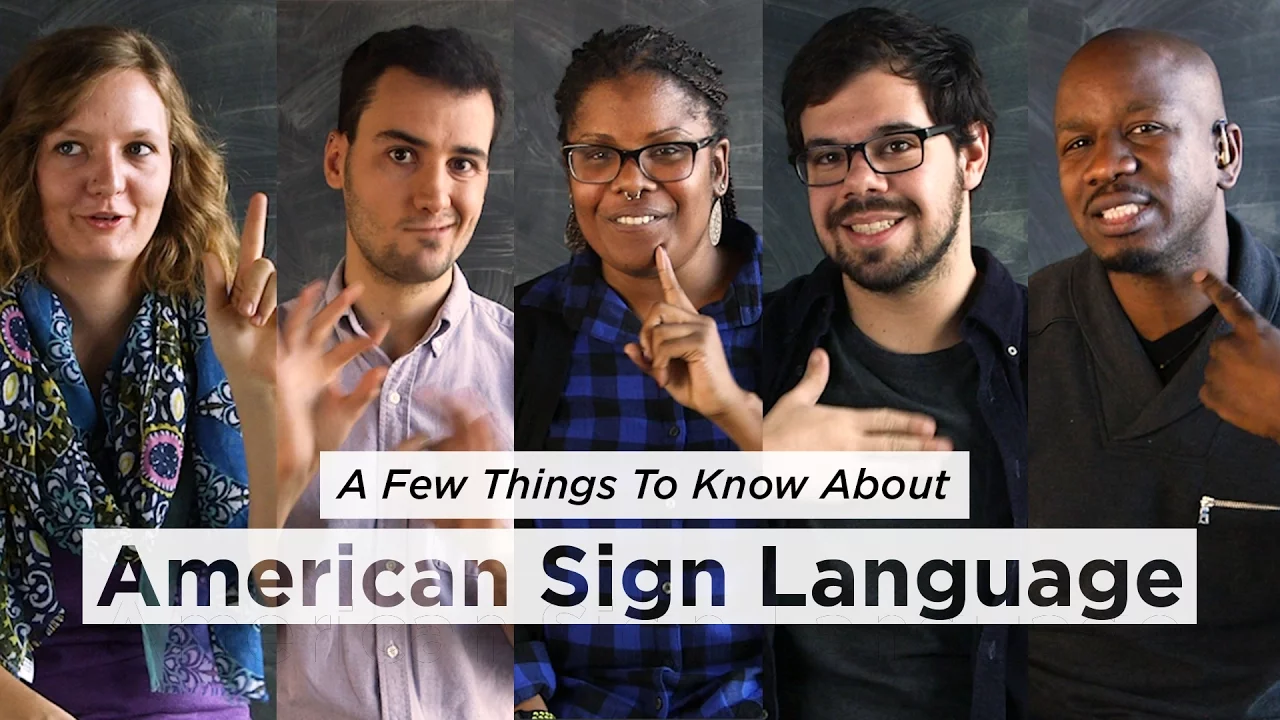

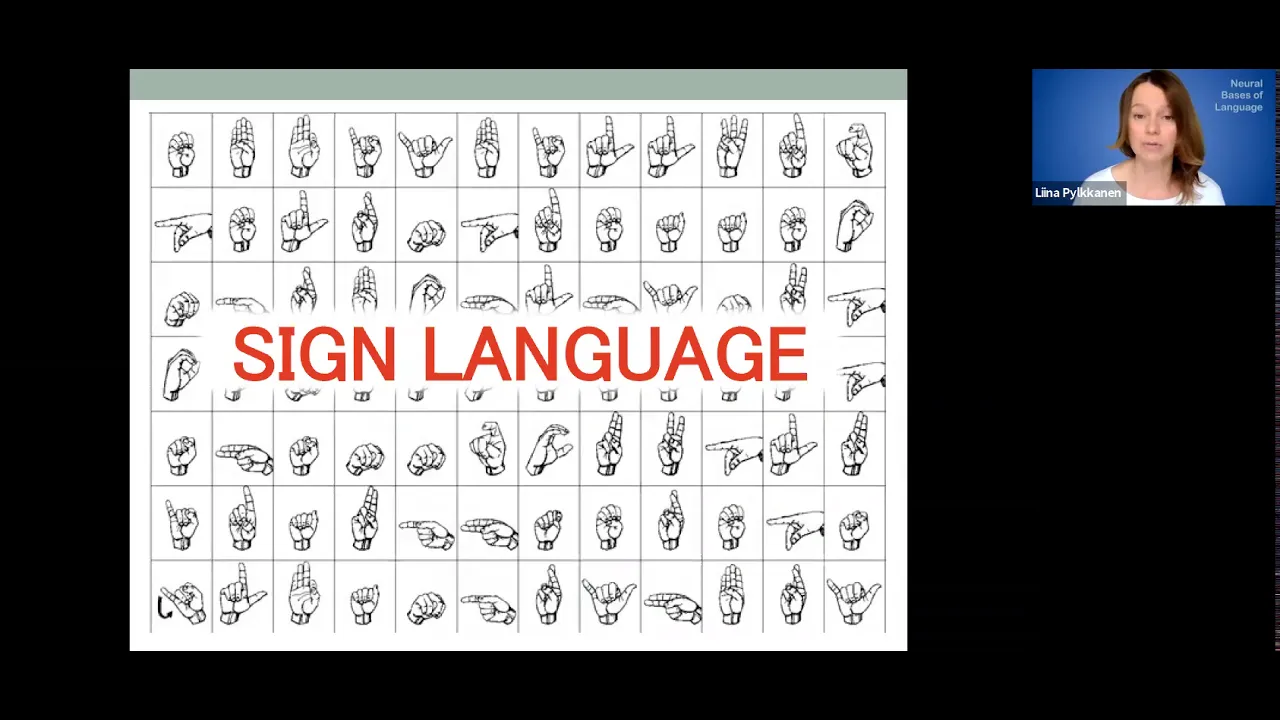

American Sign Language (ASL) is a complete, independent language with its own grammar, phonology, and syntax, not merely a coded version of English; it exhibits unique features such as wh-in-situ question formation, facial expression markers for grammatical categories like negation and questions, and the use of loci in space for referring to entities, demonstrating that signed languages possess the same complexity and systematic structure as spoken languages.
Signed Languages: ASL Linguistics & Grammar | MIT Intro to Linguistics
Added:Basic terminology of linguistics, including the core definitions of phonology, morphology, syntax, and semantics.
The concept of language modalities, specifically understanding the difference between auditory-vocal (spoken) and visual-spatial (signed) modes of communication.
The fundamental premise that sign languages are natural, complex, and rule-governed human languages, distinct from spoken languages and pantomime.
An understanding of descriptive linguistics, which studies how language is actually used by its native signers/speakers rather than prescribing rules.
Advanced ASL morphology, focusing on how non-manual markers (facial expressions and body shifts) function as grammatical morphemes.
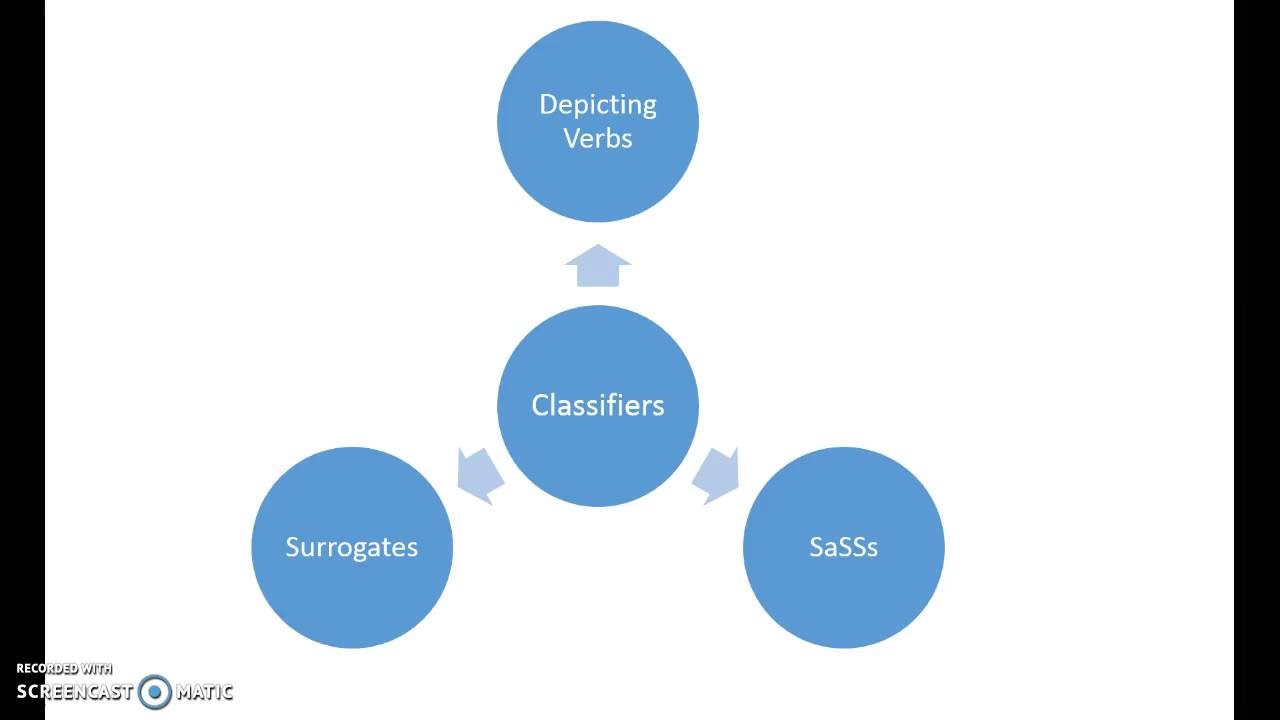
The syntax of spatial verbs and the complex system of ASL classifiers used to denote movement, location, and size/shape specifiers.
The sociolinguistics of the Deaf community, including the history of ASL, language deprivation, and variations such as Black ASL (BASL).
Comparative sign linguistics, analyzing the historical relationships and structural differences between ASL and other global sign languages like British Sign Language (BSL) or French Sign Language (LSF).
The neurolinguistics of visual-spatial processing, investigating how the brain's language centers adapt to process sign language vs. spoken language.
10.7K views156likes44:17Original Release: 2023-01-27
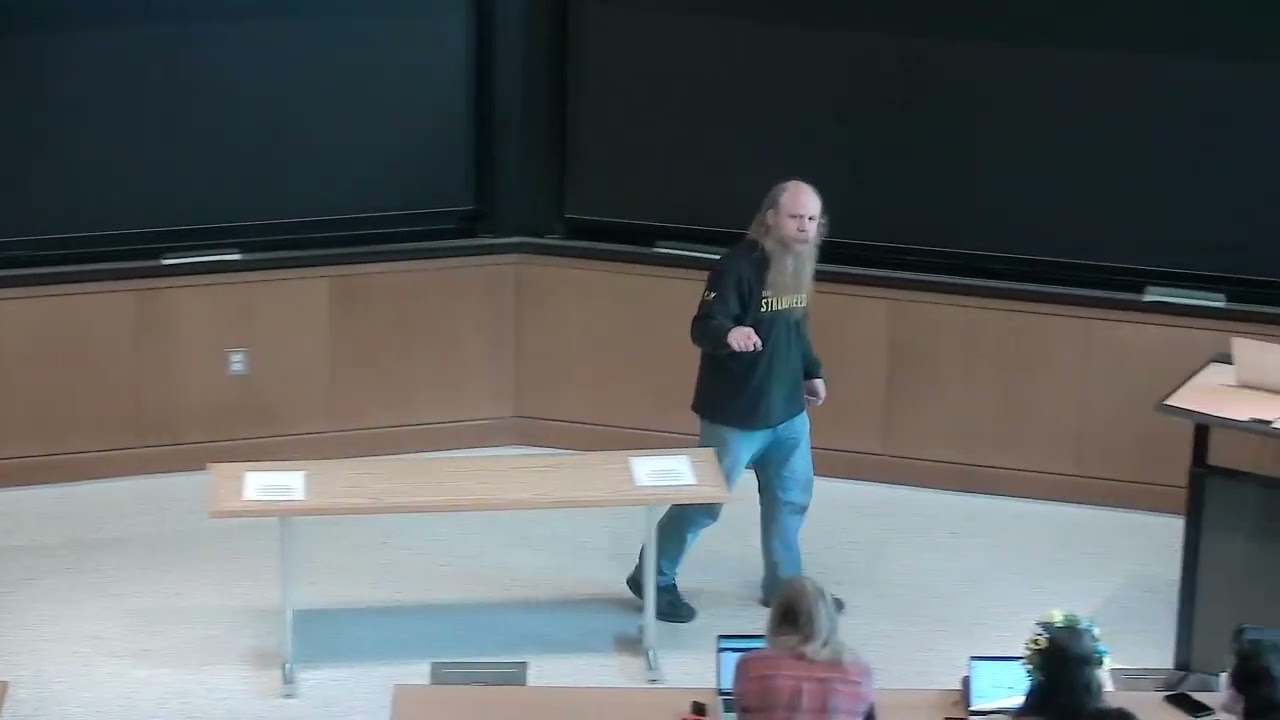
[SQUEAKING] [RUSTLING] [CLICKING] NORVIN RICHARDS: Signed languages-- there are a bunch of signed languages.
I've listed three of them here, but there are many.
And maybe the first thing to say about them, I can remember a time when I believed, as a child, that signed languages were basically just codes-- coded versions of spoken languages.
When I was a kid, you were sometimes taught ASL signs for things every so often in class, sort of the way you would be taught the occasional Spanish word in class or whatever.
It's like, here's the word in a foreign language.
Let's all learn this word.
Unlike Spanish, the impression I was given by my teachers-- who may actually have believed this-- was that the way you spoke ASL was to speak English, but to use your hands.
So like every English word had an ASL translation.
And there is something like that.
It's called Signed Exact English.
But it is not the standard language used by the deaf.
The deaf use something called American Sign Language in America.
Another way to make this point may be that signed languages are not just coded versions of the spoken languages that are around them, is that American-- to point out that American Sign Language is fairly closely related to French Sign Language, which I won't try to pronounce in French because I don't speak French, for historical reasons.
The first schools for the deaf in America were established by people from France who had established schools for the deaf in France and began establishing them here.
So American Sign Language is a descendant of French Sign Language, and it is unrelated to British Sign Language and quite different from it.
So go ahead and make all the jokes you want about American English and British English being different, but they're more similar to each other than either is to French.
But American Sign Language is more similar to French Sign Language than it is to British Sign Language because American Sign Language is not English.
It's another language, one which is spoken with your body, especially your hands.
Yes, I just said that.
Thank you.
Another way to make the same point, there are big grammatical differences between ASL and English, some of which we'll be exploring.
Here's one.
In English has overt wh-movement.
Remember wh-movement?
So in "Who did John see?"
Lots of other languages, like Mandarin, don't.
And in this regard, ASL is more like Mandarin than it is like English.
It's actually a blend.
You can do either one.
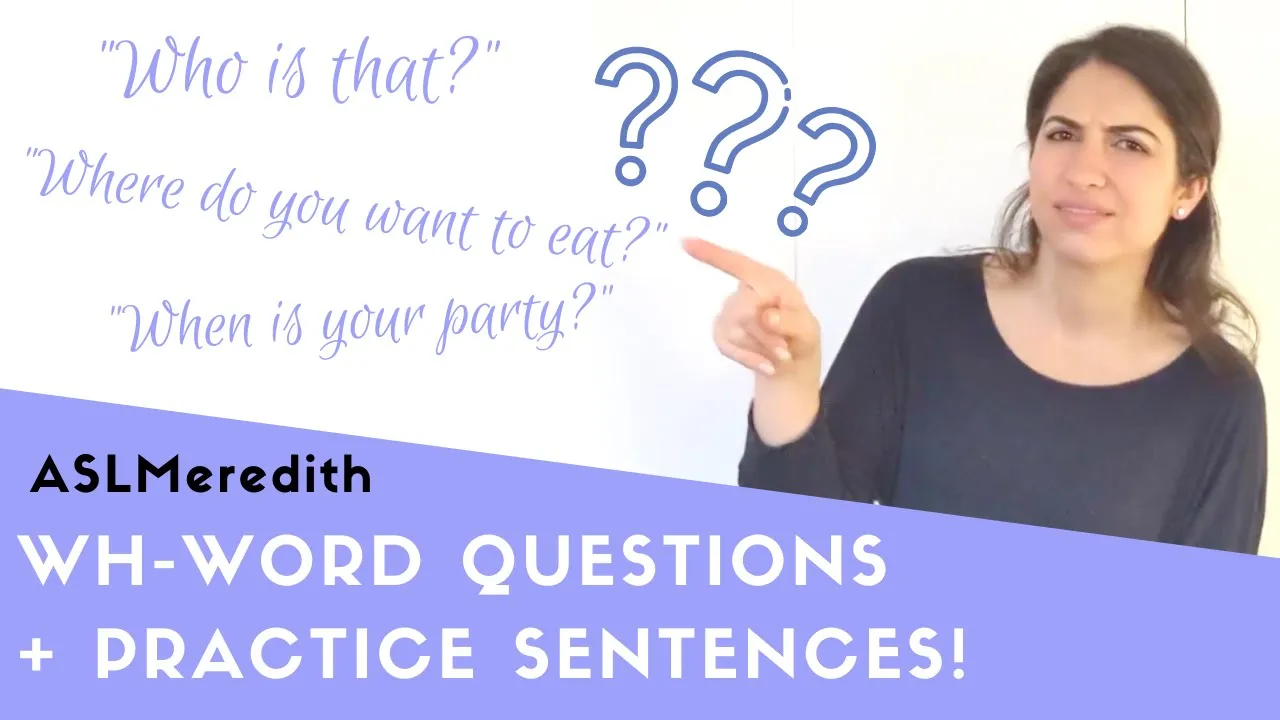
But there's a very natural way to ask wh-questions in ASL, which looks something like this.
Here's a guy who is about to say, I think, "Who did John see?"
"John"- "saw"- "who?"
Yeah, so I'll get him to sign that again.
So "John saw who?"
And "who" is signed like this.
That's the ASL for "who."
There's another thing he's doing, which we'll talk about.
Part of signing a question in ASL is not just what you do with your hands, but what you do with your face.
You're required to look puzzled as you ask these particular kinds of questions-- and so to tilt your head and furrow your brow.
And there's some very careful work on where, exactly, you're required to tilt your head and furrow your brow.
It turns out to be very interesting.
It isn't just you do that for the whole question.
You do that for certain parts of the question.
And linguists who work on signed languages do work on what's going on.
I'll put a link to this.
This is a corpus of American Sign Language utterances by the folks over there at BU who have a center for studying ASL.
There's a lot of really interesting data in here, which is tagged, as you can see.
Anyway, I'll put a link to this on our website.
So this is Carol Neidle, who's done a lot of really interesting work on ASL.
Back into full screen mode.
I'm sorry, I'm going to do a lot of this because we're going to be going back and forth between videos and my slides.
And I am low tech.
If I were higher tech, I would have figured out a way to incorporate the videos into the slides, but that's why this is the linguistics department and not some other department.
OK, so ASL is not English.
It's not English because it's not all that closely related to British sign language, and it's also not English because, well, it has wh- [INAUDIBLE] too, like, English standard way to ask "Who did John see?," the word order is, "John saw who?"
That's not to say that sign languages aren't in some kind of contact with spoken languages.
So typically, if you're a deaf person growing up in America, you have some kind of relationship with ASL.
What kind of relationship depends on the circumstances.
So it's not at all uncommon for deaf children to be the deaf children of hearing parents, and then their parents have to do some hustling and be careful to make sure that their children have a chance to learn ASL.
Some children of hearing parents will try to learn ASL themselves and raise their children in ASL.
But, of course that's quite difficult, to learn quickly a language like ASL.
I say "quickly" because if you didn't know ASL before you realized that you had a deaf child, well, then, you need to hurry up and learn it fairly fast.
And that's a difficult position for parents to be in.
So there are some barriers with respect to how much resources these people have, whether they can do that in time for their kids to be exposed to ASL the way you need to be exposed to your first language.
They're the deaf kids who-- and then, there are deaf kids who are lucky enough to be around native ASL signers from a very early age.
Now, the upshot of all this is that if you're deaf and you're growing up in the United States, you probably have some kind of relation to ASL.
Maybe you become a fluent speaker.
That's one hope.
But you also have some kind of relationship with English.
You're surrounded by people who are communicating with each other in English.
And so there are what you could think of as borrowings between gestures of hearing people around you and the gestures that are used in the sign.
Maybe one of the clearest examples of this, the pronoun for "I" in American Sign Language is this.
You point at your own chest.
The pronoun for "I" in Japanese Sign Language is this.
You point at your own nose.
That's borrowing from the standard way to point to yourself in these places.
So in Japan, and a lot of Asia, I think, the way to point to yourself is to point at your own nose, whereas in America, the standard way to point to yourself is to point at your chest.
So we could think of this as borrowing, if we wanted to, some kind of contact between the spoken language and the sign language.
From very early on-- one of the first days, I think-- we talked about Saussure and the idea of the arbitrariness of the sign, the observation that the fact that this is called a "table" is an arbitrary fact.
There's nothing about it that demands that it be called a table.
It could have been called "chair", and the fact that it's called a table is an accident.
The fact that we call it a table in English but that in another language it could be called a "mesa," or a [NON-ENGLISH],, or a bunch of other things.
Yeah, languages get to arbitrarily decide what they're going to call things.
Even in spoken languages-- I think we said this before-- there are places where the way a word is pronounced has some kind of connection with what it refers to.
The classic example of this is names for birds, which are not always, but often imitations of the call of the bird.
So a little chickadee is named after the thing that a chickadee says.
It sounds like it's saying "chickadee," if you listen to a chickadee.
Or Passamaquoddy, the word for "Great Horned Owl," is [NON-ENGLISH],, which is a pretty good imitation of an owl.
So there are some things like that where people seem to be imitating the sounds made by something.
In ASL, of course, your sounds are not relevant.
In a sense, you have a lot of chances to have non-arbitrary signs.
So there are signs that really do look like you're imitating the thing, trying to make an image of the thing.
So here's "book."
That's "book."
You can see why that's the word for "book."
Or this is "tree," and you can see why that's the word for "tree."
It's a picture of a tree.
This is the kind of thing that gets people to think that ASL is basically a very sophisticated version of charades, that people are just trying to imitate things, and then you're done.
But of course, that's not it.
Signs are just as arbitrary in ASL as they are in any spoken language.
That is to say they're mostly arbitrary, with some other cases like "chickadee" for English or "book" for ASL, cases where it's possible to imitate something.
There's a fair amount of work on the phonology of signed languages-- which, when I say it that way, sounds like a bad joke.
I mean, what does that mean, the phonology of sign languages?
But it's actually, there's this really cool stuff that people have observed about, if you think of phonology as being the study of how basic units can be combined to make slightly larger units-- so OK, for spoken languages, those units are sounds-- and we make all kinds of observations about the rules for how those things get to combine.
And cast your mind back to when I was showing you some Lardil data, and I said, we convinced ourselves that it was useful to think that the accusative forms were a more reliable guide to the underlying forms than the nominative forms were.
That's what we ended up saying for Lardil.
So we wanted to say, -in is being added to the underlying form of the noun, which for "woman" is "bidngen" and for "fish" is "yak."
And if you ask a Lardil speaker, what's your word for fish, they're not going to say "yak."
They're going to say "yaga."
But that's because, although the Lardil word for fish is underlyingly "yak," Lardil also has a basic rule-- a bunch of rules-- that lengthen monosyllabic words.
And we talked about various rules of this kind.
They add different things depending on what the monosyllabic word ends in, what sound it ends in, with the upshot that "yak" is not a possible Lardil word because it's too short.
And Lardil, therefore, lengthens it if you haven't added anything to it.
So if you've made it accusative, you're fine.
It's two syllables long, "yaga," and you're all done.
But if you wanted it to be nominative, you weren't going to add any suffixes to it, well, then, you need to add another vowel because it's too short.
That was the picture of Lardil that we ended up with.
Does that sound even faintly familiar?
That's what we were talking about.
That's a story about Lardil that says Lardil is like many languages in having what's called a minimal word requirement.
That is, in Lardil, it says Lardil words can't be just one syllable long.
If you have a word that's going to end up being one syllable long, you do something to it to make it longer.
ASL has also been argued to have a minimal word requirement, and the argument goes like this.
There are signs that, if they're by themselves, they involve a movement which is often short.
But then, that movement goes away if they're made part of a larger word.
So here's the ASL for "think."
You take your finger, you move it towards your temple, and touch yourself in the temple briefly.
Yeah, that's "think" and [INAUDIBLE] "I think."
And here is "shocked."
So "shocked" starts with your finger at your temple, where it would be for "think," and then it has a second component, "shocked."
"I'm shocked."
Yeah, so "think," one way to think about "think" is just having your hand in a position.
That's too small.
That's like a monosyllable in Lardil.
And so you add something.
You add emotion.
Your hand moves towards your temple.
But if you're adding, if you're making "shocked," which is "think" plus something else-- that's kind of like the accusative of "fish"-- then it's OK to just start with your hand at your temple and then do the second half.
You don't have to add that motion to your hand.
And the suggestion that's been made in the literature on ASL phonology is this is like a minimal word requirement.
So Diane Brentari has suggested ASL signs have a minimal word requirement.
She doesn't say "like Lardil."
I forget what minimal word language she's talking about.
So they have to contain at least one move, is her idea.
"Think" Is the ASL version of the Lardil word for "fish."
Remember Polish obstruents?
I like this class because I think I promised you that I was never, ever again going to talk about Polish, and so I apologize.
It's the last day.
You don't have to hear any more about Polish.
Sorry, go ahead.
AUDIENCE: I just have a question.
NORVIN RICHARDS: Yeah.
AUDIENCE: Are there other words that have "think" something?
NORVIN RICHARDS: Oh, dear, now we get beyond my very modest knowledge about ASL.
I don't know.
Are you thinking that might be the only one?
AUDIENCE: Well, I think, again, if you, I guess, look at compound words, there is definitely the ability to pair them with other things.
So I was just wondering if that's a common way to just show surprise, maybe confusion.
NORVIN RICHARDS: Oh, you mean having this as part of a larger sign?
Yeah, so Brentari's discussion certainly makes it sound like there are a bunch of these.
"Shocked" is the examples she uses, and I'm afraid I don't know any other examples off the top of my head.
I'll try to find the paper that I got this from, and I can put it on the website so you can take a look.
So here I am signing things at you, yeah.
Polish-- last time, I promise, we will talk about Polish.
Polish obstruents, so stops and fricatives-- we convinced ourselves that Polish has what's called final voicing, cross-linguistically extraordinarily common, a phenomenon in which, if you have a voiced obstruent at the end of a word, it becomes voiceless.
So if you look at the plurals of these nouns, then you can see that before the plural suffix "i", you can have both voiced and voiceless stops and fricatives-- in the last example, "nose" and "rubble," plural of "rubble," which, hopefully, none of us will meet any time soon.
But that if you don't have the plural, all of these obstruents are voiceless if they're at the end of a word because Polish has final devoicing.
This was part of the argument that we need to posit an underlying representation for a word like "lye," let's say-- the second line there-- which ends in a voiced stop, because that gives us the best-- well, the best match on the data.
So it allows us to account for the fact that the plural of "bow" and "lye" look different from each other-- they're "wuki" and "wugi"-- even though the singulars look the same.
So this is what we were doing back when we were doing Polish, Yeah?
Have I triggered your Polish flashbacks?
OK, so it has voiced obstruents, but they're limited in where they can go.
They can't go at the ends of words.
Here's an observation about the distribution of finger wiggling in the ASL sign.
So sometimes when you make an ASL sign, you wiggle your fingers.
There are ASL signs in which there isn't much movement, or just one of Brentari's shortened ones, like the word for "color," which is this.
So you put your hand to your chin, and you wiggle your fingers.
There are also signs where your hands are moving and the wiggling is happening during the move, like go up in flames, where your hands are rising and your fingers are wiggling.
That's how you do go up in flames.
So ASL signs can have finger wiggling in them, but there are imaginable signs that you don't get.
So you could imagine a sign where your fingers would wiggle, and then you would move.
It would be like go up in flames, except you would wiggle first before you began moving-- or in which you moved and then, having reached your destination, you did a long move-- not one of your short moves, but a long move-- did your move, and then wiggled your fingers.
But there aren't any signs like that.
So finger wiggling is either confined to the position at the end of one of Brentari's short movements, or if your hands are moving over a longer distance like in "go up in flames," well, you have to wiggle the whole time.
Similar observation about hand shape change.
So there are signs where your hands just do a short move and then change their hand shape, like "understand," where your hand moves into position and then, put up one finger, "understand," or "old", where your hand starts at your chin and moves as it moves away from your chin-- "old."
Yeah?
AUDIENCE: You're talking about other mental concepts being expressed in sign language and understand-- so it also starts at the temple?
NORVIN RICHARDS: Yeah, so I think, right, I think there are a number of-- not surprising, maybe a number of mental.
So "forget" is another one.
This is "forget," where you wipe something off of your brain, yeah, using your middle finger.
Your middle finger is also used for being sick.
So yeah, there are a bunch of signs, that use your head that have to do with what's going on in your head.
Yeah, that's right.
That's right.
OK, so ASL has finger wiggling, but there are limits on where finger wiggling can go.
It goes during the motion, or it goes right after one of Brentari's short movements.
Hand shape change is the same.
It goes after one of Brentari's short movements, like in "understand," or it goes during the movement, like in "old."
Yeah, but there aren't-- did I say this in the next slide?
Yeah, again, you can imagine a sign where-- which would be like "old" where you would start with one hand shape, you change shapes, and then move, or where you would move along distance and then change shapes, but there aren't any signs like that.
And so people have suggested, yeah, just like a phonologist has to be able to say things like, this is a language that has voiced obstruents but not at the ends of words-- there are limits on where they can go-- ASL has finger wiggling, and it has hand shape change, but it has rules about where they can go in the sign.
And then, of course, you want to know why-- like why, what constrains these to where they go.
But when I say that there's work on ASL phonology,, this is what I mean-- there's people trying to figure out what makes something a possible well-formed ASL sign.
It turns out there are limits on this.
One observation, actually, that people have made as they do this work, there are compounds or polymorphemic signs, which you can tell they're polymorphemic because they appear to violate these rules.
So I just said, there aren't any signs where you first finger wiggle and then move.
Here's an apparent counterexample to that.
There's a word "hypnotist," which goes like this.
But that's a two-morpheme sign.
So it's "hypnotize"-- which is a Brentari short movement plus finger wiggling-- and then there's a suffix, which is the agentive suffix.
You use it to make-- you attach it to nouns to make people who do that now.
So it's a hypnotist.
So "hypnotist" by itself looks like you're finger wiggling and then moving.
But that's because there's a morpheme boundary between those two things.
So within a morpheme, you can think of it as a bisyllabic word if you want.
So in the first syllable, you're doing finger wiggling the same way you're doing finger wiggling in color.
And then there's a second move, which involves moving your hands.
ASL has one-handed signs, like "understand," and it also has two-handed signs, like "go up in flames."
There's an interesting restriction in two-handed signs on the second hand.
So the second hand either has to stay still, like in tree, where one hand moves and the other hand just stays there in the background for the first sign, or it does the same thing as the other hand.
So "teach," both your hands are doing the same thing.
I love the sign for "teach."
I want to do this when I teach now.
Or bicycle, where your hands are doing the same thing, but they're out of phase with each other.
So they're both going in circles.
Which is kind of interesting because-- so and that's it, right?
So there aren't ASL signs in which one hand is doing one thing and the other hand, is doing a completely different thing.
And it's not because-- does that make sense?
So your hands can't both be moving and doing different things.
Which is interesting, because it is actually physically possible to violate this, to have your two hands both moving and doing different things, in poetry.
So there's a video which I'll try to show you now of an ASL poet, guy named Clayton Valli, who wrote many poems in ASL.
There are a lot of YouTube videos of him performing his poems.
And this one is called "Snowflake."
And what he does in it-- the reason I'm going to show you the video is that I can't physically do it very well.
I'll show you what he does.
But I'll tell you what he's about to do, just so you can see it.
With one hand, he's doing the sign for "snowflake"-- which is a snowflake falling.
And, then with the other hand, he's signing one-handed versions of-- I may not get the order right-- white, cold, beautiful.
And he's doing this as this hand is moving.
So this hand is moving, and with the other hand, he's going, white, cold, beautiful.
And as you can see, I can't physically do this, but he can.
Let me show you him doing it.
Let me get it.
Where is he?
Yeah, so here's Clayton Valli.
And I think I paused it in more or less the right place, and we have to watch this for a little bit.
So he's about to sign about looking out the window at a snowy day.
The snow is coming down.
And now I think it's about to come.
Here's the snow piled up.
Come on, Clayton.
Yeah, here it is.
There's the snowflake falling, and white, beautiful, cold, yeah, with his other hand.
So it's physically possible to do that, at least if you're Clayton Valli, if you're a fluent ASL signer.
But there aren't any ASL signs that do it.
It's one of those rules that you break in order to perform poetry.
So I'll put a link to that.
I'll put link to that poem on the website so you can see.
Yeah?
AUDIENCE: I feel like that might just be because most people aren't capable of doing that, like do a circle with one hand and a square with the other.
Most people can't do that.
NORVIN RICHARDS: So I think it's one of those things that probably requires practice, right?
And question, is this something that any ASL signer could just do cold without any trouble?
If they saw the Clayton Valli video, they'd be like, oh, yeah, and then they would do it, and I can't do it because I'm not a fluent ASL signer?
Or whether it's because Clayton Valli practiced in his room hour after hour and eventually got to where he could get his hands to do that?
Yeah, right.
So I think you're right.
It's not exactly that.
It's not surprising that ASL isn't full of signs that are like this, with your two hands doing two different things.
But it's interesting that it is physically possible to learn to do it.
Yeah?
AUDIENCE: I think that it's in contrast to the signing rule.
It's one of the first things you learn in an ASL class.
And I believe that is where you should focus all your attention, on the dominant hand.
NORVIN RICHARDS: Yeah, yeah, yeah.
So I mean, you're absolutely right.
What happens is that the non-dominant hand either copies the dominant hand or just sits still, like in "tree."
And so you think this is something somebody deliberately did?
They decided that ASL should work this way?
It'd be interesting to see.
I have no idea.
I'm doing all this talk about ASL.
I started by saying, there are many sign languages.
I don't know whether this is true in every sign language.
I haven't heard of a sign language in which your hands are allowed to move independently of each other.
So it'd be interesting to see how universal this is.
Yeah?
Is there a left-handed versus right-handed version of ASL?
No, I mean if, so I'm right-handed, and so this is my version of "tree."
If I were left-handed this would be my version of "tree."
And they mean the same thing, as far as I can tell.
Similarly, for the signs that use both hands-- I mean, this is a consequence of these facts about the signs that we've been talking about-- for the signs that use both hands, like "teach," if I'm-- somebody described this to me as the equivalent of talking with your mouth full-- if I'm busy with my right hand, if I'm holding something or whatever, then I can sign "teach" just with my other hand, and you don't lose anything, in a sense.
You might if there's also a sign that's just like this.
And Valli, actually, in this video, is doing something like that.
The sign for "cold" uses both hands.
They're both moving.
But because his right hand is busy doing "snowflake," he does a one-handed version of "cold," yeah.
Yeah, OK, and I alluded to this a second ago.
There's a lot of work on the use of parts of the body other than your hands, so your non-manual component.
There's facial expressions that are involved in doing certain kinds of things.
So as I said, in wh-questions in ASL, wh-questions require you to furrow your brow and look puzzled.
And there's all this interesting work on where, exactly, you're required to do that.
As I said, ASL is a wh-in-situ language, or it has the option of wh in situ.
And I do have chalk today, which is nice.
So apparently, what that means is that if you're doing the ASL for "You gave what to the teacher?"
where just pretend that all of this is ASL, you're required to look puzzled here-- that is, from the beginning of the question until you get to the wh word.
And then you're allowed to relax your face.
And if this is an embedded question like, I don't know-- so if I'm saying the ASL for, "I don't know what you gave to the teacher"-- well, then, this is still true.
You sign "I don't know" without doing a wh- facial expression, but you do one for this part.
So from the beginning of the question to the wh- word, you're required to look puzzled.
Just kind of cool there's this work on this.
Or similarly, there's a negation in facial expression in ASL.
And so negation-- ASL has a word for "not."
It's this.
And so if I want to sign-- oh, sorry.
AUDIENCE: So does that mean that the facial expressions we make when [INAUDIBLE] are related to [INAUDIBLE] face and interaction with others?
Because I would think it's something that's unique, like when you're confused, to make an expression with your face.
Is it just related to the fact that you're talking with someone you want to understand you're confused.
Or is it [INAUDIBLE]?
NORVIN RICHARDS: These are all really interesting questions to which I don't know the answers.
One possibility is that the puzzled facial expression, the wh- facial expression in ASL, it's a little bit the two pronouns for "I" that I was talking about earlier-- that this is "I" in ASL, and this is "I" in Japanese Sign Language, and that maybe that's connected to gestures that hearing people make that speakers of sign languages are using in a different way.
So you're right, I might, if I were asking you a wh- question, look puzzled.
I don't have to look puzzled to ask you a wh-question, and there are no particular restrictions on when I should look puzzled-- where during my question I should look puzzled.
But in ASL, there are.
You actually have to do this, and you have to do it at the right points, in the right points of the wh- question.
So their use of facial expressions is a little more sophisticated, I guess, or rule-governed, than they have been shown to be, anyway, for speaking people.
Now, maybe all this shows is that there hasn't been enough work on facial expressions for spoken languages.
We're all obsessed with the sounds, but for ASL, there's all this clever work on what you do with the rest of your body.
Yeah, good question.
Similarly, there's a negation facial expression.
So if I want to say, "I'm not deaf," I can sign, "I," "not," and "deaf."
or I can point at myself and shake my head as I sign "deaf."
So I don't have to use the sign for "not" at all.
By shaking my head, I convey negation without using the negation sign.
So there are facial expressions for both of these things.
I don't know what happens when they combine because, presumably, you can ask negative questions.
I guess you can do all of these things with your head at once.
One of the other properties of signed languages which is cool and there's a lot of work on it is the use of loci in space to refer.
So an English sentence like "Trump told Biden that he would win" is ambiguous.
So "he" could refer to Trump, or to Biden, or to anybody else, in principle.
It has to refer to some male person.
It could refer to either of these people.
If you were going to sign this in ASL-- and I'm not going to.
I don't know enough ASL, but I can tell you the basic ideas about how this would work-- first of all, you would need what are called "name signs."
So you would need to sign the names "Trump" and "Biden".
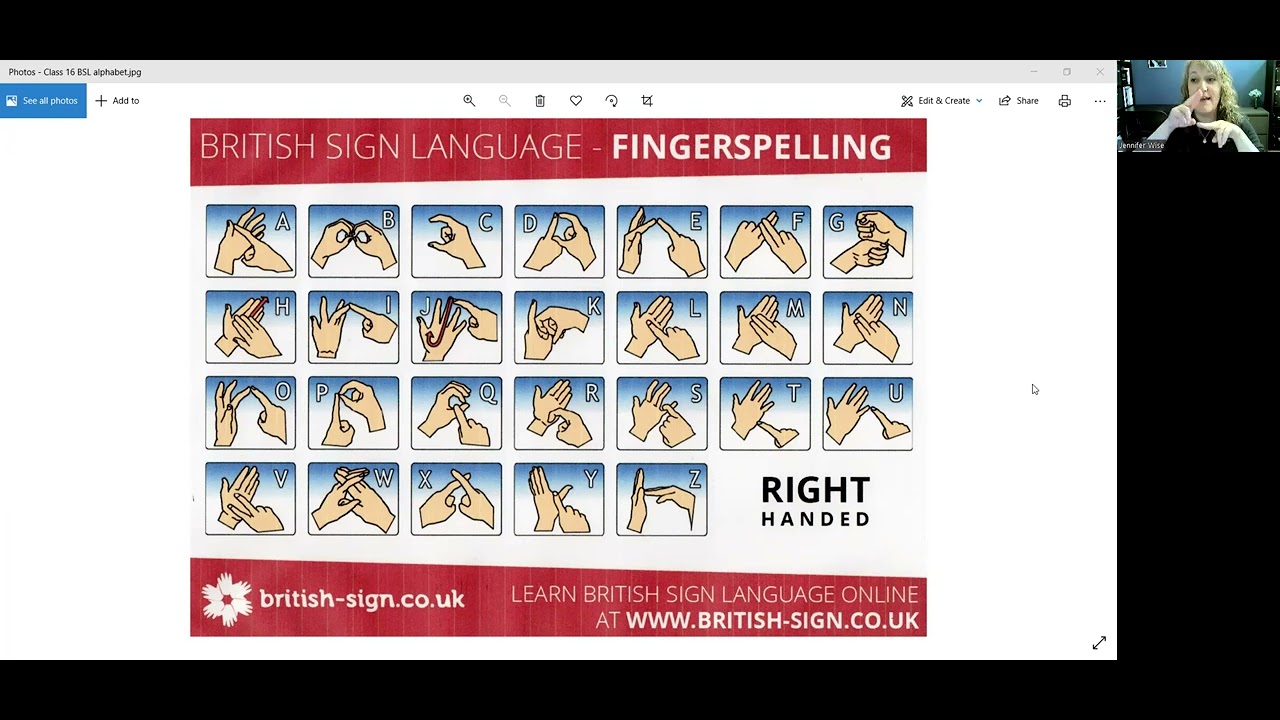
The simple way to do that is by finger spelling.
So there are correspondents to all of the letters.
You can sign all of the letters of the English alphabet.
So you could sign T-R-U-M-P, only you'd do it faster if you knew ASL.
But there are also what are called "name signs," which are signs that are just signs for particular people-- typically famous people, or people who are deaf, I think, generally end up with name signs.
Name signs are often based-- they often contain the first letter of the person's name.
I had a classmate in grad school who was deaf.
He's now a professor at Gallaudet University.
His name was Gaurav in English, and his ASL sign involved the letter G, which is the first letter of his name, put on the chest.
Sorry, so that's Gaurav in ASL.
The name sign for "Noam Chomsky," which is one of the few other signs I know, is this.
So it's a C. When I first saw it, I was like, what, they think he's an alcoholic?
What is the deal?
It turns out to be based on the sign for "God."
So it's "God" with a C.
[LAUGHTER] It's Noam Chomsky.
It was invented by someone with the proper level of respect for Noam Chomsky.
The name of sign for Trump, there are apparently various name signs for Trump.
One of them is this-- [LAUGHTER] Or this, that's another one.
For Biden, I was looking, and apparently, there isn't general agreement on what the name sign for Biden ought to be.
One of them is this, which is apparently supposed to be a gesture that indicates that he likes to wear sunglasses, I guess.
It's connected to the fact that he has sunglasses a lot.
By now, there must be a name sign for Biden because, of course, he's surrounded by interpreters when he's talking, you hope.
But anyway, if you wanted to say-- bless you-- in ASL, "Trump told Biden that he would win," you'd sign Trump, and you'd sign Biden, and you would put them in places.
So you'd say "Trump," and you'd put Trump here, and Biden, put Biden here.
And then you would say, he told him that he-- and then you would either point at Trump, or you would point at Biden-- would win.
So the ASL versions of the sentence are not ambiguous.
So you make it clear.
You've either pointed at Trump, or you've pointed at Biden.
So he always refers to someone in particular.
Or, if what I want to convey to you is "Trump told Biden that Obama would win," well, then, I need to sign "Biden," "Obama," and put "Obama" somewhere else.
You can have many, many people in front of you in space.
I believe people who have studied this have not found limits on how much space, how much subdividing of space you can do in front of you.
I don't know how hard they've tried, but yeah, it's certainly not just two.
You can have lots of pronouns in front of you.
There are even fancier things you can do.
I was just reading a paper about this.
This is kind of astonishing.
So if I want to say something in ASL like "Most of my students came to class," what I do is I start by signing "my students," and then I put my students in a circle.
So I have my students, and then I establish a circle that all of my students are in.
And then I'm going to make the sign for "most," which I think is something like this.
And then I describe a smaller circle that's part of the circle that I've just described for you.
And then I would sign, "went to class."
So I make my circle that has all the students, And then I have a subset of that that's-- I draw the kinds of Venn diagram-y things we were talking about before.
Here are the students.
And the cool thing about this is now, what I've got in front of me is a space that's got my students, and it's subdivided into a larger space that's got most of my students, the ones who came to class, and a smaller space that's got the students who didn't come to class.
So the next sentence, apparently, can be "They stayed home," pointing at the ones who didn't come to class.
In English, if I say "Most of my students came to class, they stayed home," I'm contradicting myself.
And there's something interesting going on here.
When we were talking about pronouns, we just breezed by them, right?
Pronouns, well, they refer to people who are salient or whatever.
Certainly, if I pass a bunch of students on the Infinite Corridor, I could remark to you, "They're on their way to class."
We don't have to have been talking about them before.
They're just there in the world.
I get to assume that you're thinking about them.
But if I say "Most of my students came to class," well, that-- I mean, I'm telling you that they're my students, and that most of them came to class, and then there were the ones who didn't, right?
I mean, that's what that means.
But I still don't get to refer to the ones who didn't come to class with "they."
"They" has to refer to the ones who did come to class.
But in ASL, I get to point at them.
And so I get to refer to them right away.
Joseph?
AUDIENCE: So the "Most of my students came to class."
NORVIN RICHARDS: Yeah.
AUDIENCE: Because [INAUDIBLE] the quantifier "most," you're describing a subset.
But doesn't it conservatively mean you get to ignore the [INAUDIBLE]?
NORVIN RICHARDS: So if we didn't know about ASL, I might have said, why don't I get to refer to that other set?
And you might have said, ah, it's because of the conservativity of "most."
Yeah, that would have been a pretty plausible thing to say, and it's maybe even right.
But the fact that in ASL you can refer to them with a pronoun suggests that maybe it's actually something else going on.
There's all kinds of stuff like this in spoken languages, by the way.
It's not just about modifiers.
And so like-- old observation-- if I say, John has a child; she's five-- that's fine.
And "she," you probably figure it's the child I'm talking about.
If I say, "John is a parent; she's five," that's a weird thing for me to say, even though by saying, "John is a parent," I'm telling you that John has a child, right?
That's what that means, but it doesn't help.
[LAUGHS] So we're limited in how we can use pronouns.
I'm sorry.
You had a point you wanted to make.
AUDIENCE: Is there any finer distinction, like with [INAUDIBLE] say, I get most of my students who don't come to class because-- NORVIN RICHARDS: I believe you can, then, draw subparts of these.
I'll put that paper on the website, too.
You can-- AUDIENCE: [INAUDIBLE].
NORVIN RICHARDS: Yeah, there's all kinds of stuff that you can do with space.
Again, I don't know what the limits of it are, but it would be really interesting to find out.
Yeah, they can do more referring to sets and subsets than we can do because they have the advantage that they've got a blackboard.
They get to point out where everything is.
Yeah?
AUDIENCE: OK, so that seems pretty different from spoken English.
NORVIN RICHARDS: Yeah.
AUDIENCE: [INAUDIBLE] shapes that individual's perception of the world into certain [INAUDIBLE].. But is their written form of communication very different from a non-deaf individual's?
Or are they similar?
NORVIN RICHARDS: Oh, OK.
So there have been various attempts to come up with writing systems that are indigenous to ASL, and I don't think any of them have gained a lot of popularity.
So when linguists are writing papers about ASL, what they typically do is-- I mean, I did a parody of it over here-- that if you want to write an example sentence that's like, "I saw a tree," for "tree," you're going to write-- for this sign, you're going to write the English word "tree" in all capital letters.
So you use all capital letters to indicate that you're talking about signs.
And then, they'll annotate these, if you're interested in indicating things about facial position, and facial expression, and things like that, there are ways of annotating that to show you're doing the wh- facial expression or whatever.
As far as actual ASL speakers go, my understanding is that they typically don't write in ASL.
So dictionaries, you can find dictionaries of ASL online.
They have lots of videos, or they'll have pictures of one frame after another of-- so there isn't-- literacy among the deaf is apparently a really serious problem, as you might imagine, right?
So somebody who's profoundly deaf, who hasn't heard a sound-- learning to spell if you can hear is hard enough.
Learning to spell if all of the symbols that you're being asked to write just don't represent anything for you at all, it's going to be a nightmare.
And so although ASL native signers typically write in English, it's apparently very hard, as you might imagine.
Yeah.
Yeah?
Points about this?
OK.
Oh, OK, so yeah, this has all been about space and other things to do with your body.
I wanted to show you one other video.
So there's another phenomenon that people use when they are telling stories or talking about multiple people, which is what's called "role shift"-- that's what people who work on it call it-- where you'll shift your body.
People do this in spoken language, too, but again, in ASL, it's apparently more or less obligatory.
You'll shift your body to represent the different characters that you're talking about.
And I'll show you a story where somebody does this.
It is a story about throwing a stick for a dog, and one of the nice things about it is that there's no need at all to explain what the guy is talking about.
Maybe at the beginning a little bit.
He's going for a walk with his dog.
No, stop that!
OK, so there's his dog, right?
[LAUGHS] And there's him.
[LAUGHS] Yeah, so he's doing role shift.
He's going to get a stick.
Yeah, and there's the dog again.
The dog's all excited.
There's the guy.
He throws the stick.
Phew, clunk.
And here comes the dog.
And so-- [LAUGHTER] I'm showing this to you partly because it's a cute story-- "Thank you," he says.
I'm showing that to you partly because it's a cute story, but also because it's a good example of role shift.
So he's-- oh, there's Clayton Valli again-- a good example of role shift.
So he's using his body to go back and forth between being the dog and being the person.
And apparently, this is a standard thing that you do if you do ASL, if you're a native speaker of ASL.
It's part of being a fluent signer as opposed to being someone who knows a bit of ASL.
Full screen mode, that's what I want.
OK.
So this was what I wanted to try to show you about ASL.
So just to review, ASL, American Sign Language, it's a language.
It's a language spoken here in America by many deaf people.
It is not English.
It's not any form of English.
It's not charades, and it's not English with all of the words replaced by signs, which is what I believed when I was a kid.
It's a language that's quite different from English in various ways, as I've tried to show you.
There's a lot of interesting work on ASL.
A lot of it is on ASL phonology, where by "phonology," we mean what we always meant by phonology, I guess, which is the rules for how the articulations work.
So phonology up until now has all been about what you're doing with your vocal tract and what the rules are for what your vocal tract is allowed to do here or there in a word.
There is an ASL version of this where people try to understand what are the various articulations your fingers, your hands, your wrists, the rest of your body, what are those parts of you allowed to do at different points in the sign?
And then, as I said, there's a lot of interest in the use of parts of your body other than your hands.
Lots of work on facial expression and on role shift, shifting your shifting your body back and forth.
And that's what I wanted to tell you about ASL.
Any questions about any of that?
Then we are done.
You officially know everything about 24.900.
So 24.900, you know everything about linguistics.
[LAUGHTER] No, actually, that's false.
But one of the main goals of this class-- this class has had several goals, but one of the main goals of this class has been to convince you that there are some interesting mysteries having to do with how language works and that, if you take more linguistics classes, you might get to learn more about how those mysteries work.
If you take even more linguistics classes, then you could be the person who solves these mysteries for the rest of us, which would be great.
One of the nice things about linguistics-- I think I've said this before-- it's a field that's been around for a while.
We have some results.
But it's not all that hard, even in an intro class, to bring you right up to the edge of what we understand and invite you to look down into the abyss and ask yourself how you could build a bridge-- this metaphor is getting away from me-- how you could move further, how you could get further from where we are.
So I hope that at least some of you will be inspired to want to do that because we need people to go out there and solve the mysteries that haven't been solved.
Questions about any of that?
All right, then, we are done.
Go forth.
Do your class evaluations.
So we're ending early, so you'll have a good half hour to think hard about what you want to write in your class evaluations.
And thanks very much.
[APPLAUSE] Thank you.
Thank you, thank you.
Go out and enjoy the day.
Up Next
52:26
Introduction to Signed Languages: Myths, Structure & History
@LangFest
2K views•2020-02-21
36:52
Constraint Interaction in Optimality Theory: Epenthesis & Deletion
@Vidyamitra
180 views•2018-08-20
72:19
Phonology, Part 2: Optimality Theory and Constraints | MIT 24.900
@mitocw
8.1K views•2023-01-27

21:32
Accent Expert Explains U.S. Regional Dialects | Part 1
@WIRED
9.3M views•2021-01-21
Related Study Plans & Knowledge Roadmaps
Structured learning paths in Linguistics
linguistics
Optimality Theory: Tableaux & Constraints
01Phonological Basics: Sounds, Syllables & Rules
02Foundations of Optimality Theory: GEN, CON, and EVAL
03The Constraint Inventory: Markedness vs. Faithfulness
+ 2 more learning modules
15h5 modules
Explore Roadmap
linguistics
Morphosyntactic Alignment: S, A & P Systems
01Foundations of Syntax: Transitivity and Arguments
02The Linguistic Variables: Mapping S, A, and P
03Nominative-Accusative Alignment
+ 3 more learning modules
12h6 modules
Explore Roadmap
linguistics
Analyzing Sign Language: Phonology & Syntax
01Foundations of Sign Language Linguistics
02Phonology: The Five Parameters of a Sign
03Morphology: Word Formation and Classifiers
+ 2 more learning modules
14h5 modules
Explore Roadmap
linguistics
Pragmatics: Speech Acts, Grice & Politeness
01Introduction to Pragmatics: Meaning in Context
02Grice’s Cooperative Principle & Implicature
03Speech Act Theory
+ 2 more learning modules
14h5 modules
Explore Roadmap