















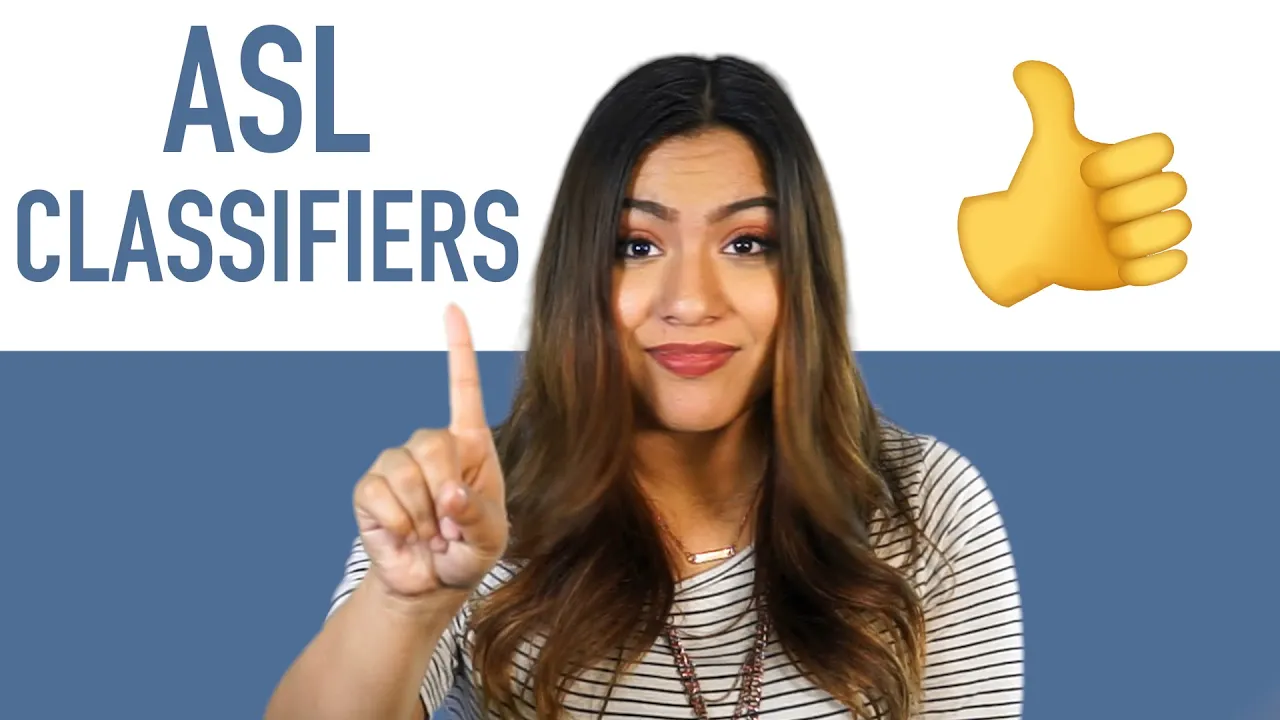
Classifiers (CL) in American Sign Language are a specialized category of signs that use handshapes, facial expressions, body movements, and pantomime to represent nouns or verbs, expanding upon information by describing shape, location, movement, and other characteristics; there are nine main classifier categories including Locative Classifiers (establishing object positions in space), Instrument Classifiers (showing object use), Body Part Classifiers (emphasizing specific body parts), Body Part Shape and Size Specifiers (describing physical appearance), Semantic Classifiers (representing noun categories), Descriptive Classifiers (describing visual characteristics), Element Classifiers (representing natural elements like water or fire), Body Classifiers (describing upper body movements), and Plural Classifiers (indicating multiple items).
ASL Classifiers Explained | Learn Sign Language Grammar
Added:HS stands for handshape, and the sign is "HS".
All signs have either one or two handshapes.
Time.
Home.
Rooster.
Help.
Grandma.
Now is that all of them?
No. There are many more.
Classifiers and it is signed "CL".
Classifiers use handshapes, the face, the body, pantomime to represent either nouns or verbs.
Classifiers have their own rules.
You must first identify the noun, and once you've done that you can incorporate classifiers to expand upon the information you want to share.
That can include shape, location, movement, and so on, and this is what it looks like.
Classifiers have nine different categories. Take a look.
Locative Classifiers and it is signed "LCL".
That's where you establish objects in space.
The cup is on the left side of the table.
The cup is on the left side of the table.
The cup is on the right side of the table.
The cup is on the right side of the table.
Secondly, you can show how objects move.
The ball is rolling.
The ball is rolling.
The ball is bouncing.
The ball is bouncing.
Instrument Classifiers and it is signed "ICL".
It can show a person using an object, and typically speaking, they use the hands to show that.
Turn on the water.
Turn on the water.
Put the sugar in the mug.
Put the sugar in the mug.
Body Part Classifier and it is signed "BPCL".
What that is... it shows a specific part of the body to emphasize the legs or represent the feet.
Cross your legs.
Cross your legs.
Tap your feet.
Tap your feet.
Body Part Shape and Size Specifier and it is signed "BPSASS".
It describes a specific body part, and what that looks like.
Typically speaking, the face is incorporated.
Curly hair.
Curly hair.
Birthmark.
Birthmark.
Semantic Classifier and it is signed "SCL".
This represents categories of nouns.
It could be things like objects, people, and how those move.
The woman met up with another person, and they walked side by side.
The woman met up with another person, and they walked side by side.
I drove my car.
I drove my car.
Descriptive Classifier and that is signed "DCL".
DCLs describe objects or a person in terms of what they look like.
The blue and white striped shirt.
The blue and white striped shirt.
The white shirt with black flowers.
The white shirt with black flowers.
Element Classifier and it is signed "ECL".
ECLs represent the different types of elements.
For example air, smoke, water, rain, fire, light.
They describe what those elements movements look like.
Dripping water.
Dripping water.
Running water.
Running water.
Body Classifier and that is sign "BCL".
BCLs show how a person's upper body, to include the arms or the shoulders or the head, and describe what those body parts do.
Hug.
Hug.
Sometimes, role shifting is incorporated.
"Where is Cindy?" "I don't know."
"Where is Cindy?" "I don't know."
"Where is Cindy?" "I don't know."
Plural Classifier and it is signed "PCL", and that means many.
If you have a specific number, for example, two people walk side by side.
Two people walk side by side.
If there is not a specific number.
A slew of books.
A slew of books.
Up Next
ASL Grammar Guide: Understanding Referents for Clear Signing
@aslrochelle
22.8K views•2017-03-21
Constraint Interaction in Optimality Theory: Epenthesis & Deletion
@Vidyamitra
180 views•2018-08-20

Forensic Linguistics: How Language Solves Crimes | PBS
@pbsstoried
1M views•2024-01-25

Accent Expert Explains U.S. Regional Dialects | Part 1
@WIRED
9.3M views•2021-01-21
Related Study Plans & Knowledge Roadmaps
Structured learning paths in Linguistics