Optimality Theory proposes that grammar operates through ranked, violable constraints rather than unbreakable rules; unlike rule-based approaches that mandate specific outcomes, this framework evaluates competing candidates and selects the optimal output—the one incurring the least serious violations of the highest-ranked constraints—demonstrated through examples like plural -s pronunciation varying between [s] and [z] depending on surrounding sounds.
Optimality Theory: Grammar as Ranked Constraints (Linguistics)
Added:Deep Dive
Basic concepts of phonetics and phonology, including phonemes, allophones, and distinctive sound features.
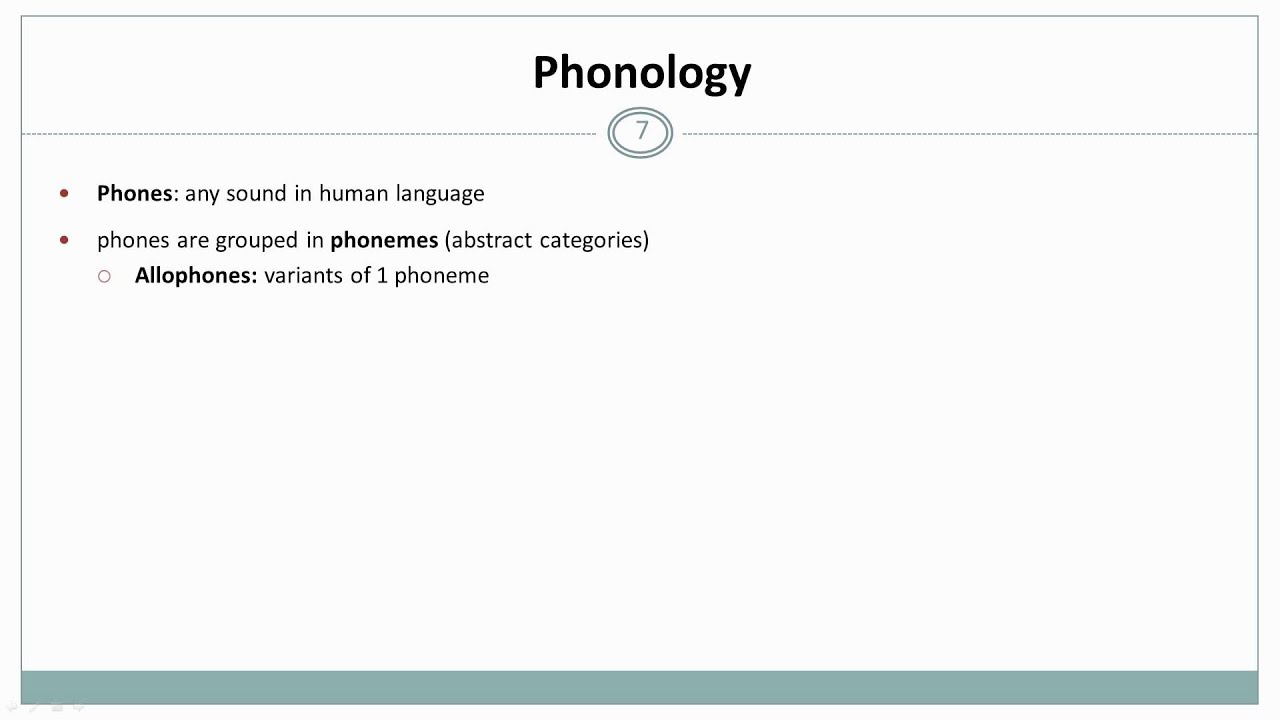
Phonetics & Phonology: Linguistics
98.9K
Phonetics studies the physical properties of speech sounds across all languages using articulatory features like manner, place, and voicing for consonants, and height and backness for vowels, while phonology categorizes sounds that make distinctive differences in specific languages through phonemes (abstract sound categories), allophones (different realizations of the same phoneme), and uses minimal pairs to determine whether sounds belong to different phonemes or are in complementary distribution.
Click to watch →
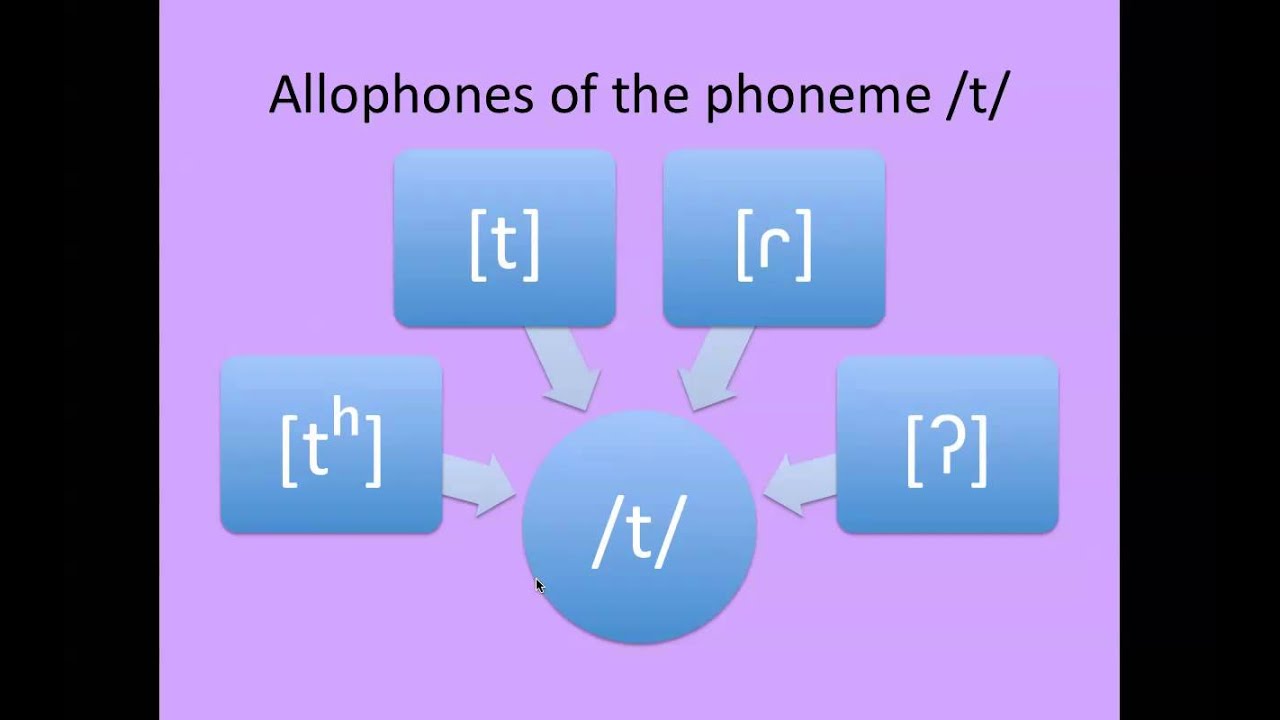
Phonology
126.5K
Phonology is the study of sound patterns and differences within a language, contrasting with phonetics which focuses on individual sounds; phonemes are contrastive sounds that affect word meaning (like /p/ in English where aspirated and unaspirated versions are allophones of the same phoneme), while allophones are non-contrastive sound variations that don't change meaning and occur in predictable environments, such as the English /t/ which realizes as a glottal stop before syllabic nasals, a flap between vowels, an aspirated stop at word beginnings, and an unaspirated stop after voiceless fricatives.
Click to watch →
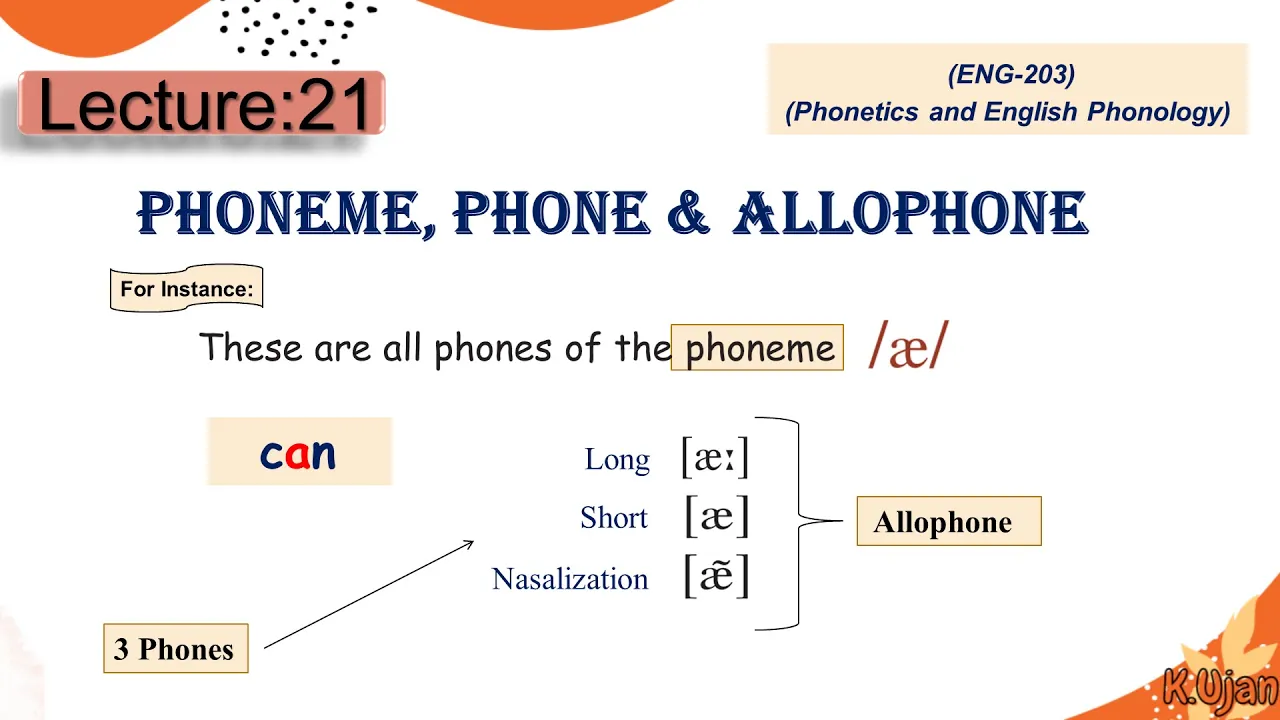
Phoneme Phone and Allophone
13.7K
This lecture covers three fundamental concepts in phonetics: phonemes, phones, and allophones. A phoneme is the smallest unit of sound in a language that can distinguish two words, such as the /p/ in 'pen' versus /b/ in 'ben'. English has approximately 44 phonemes (24 consonants and 20 vowels). A phone refers to individual sounds as they occur in speech, representing the physical realization of sounds. Phones are grouped by phonemic analysis into phonemes. An allophone is a phonetic variation of a phoneme, such as the aspirated /t/ in 'top' versus the unaspirated /t/ in 'stop'. Substituting one allophone for another does not change word meaning, only pronunciation. These concepts form the foundation for understanding how languages organize and categorize speech sounds.
Click to watch →
Phonemes and Allophones
12.6K
A phoneme is the smallest distinctive unit of sound in a language that can change meaning, while allophones are different pronunciations of the same phoneme that do not change meaning, such as the 'l' sound in 'clear' versus 'learning' which are allophones of the same phoneme.
Click to watch →

Phoneme, Minimalpaare und Allophone - Grundwissen Phonetik & Phonologie
14.9K
Phonemes are the smallest meaning-distinguishing units in a language, identified through minimal pairs (word pairs differing by only one sound in the same position with identical surrounding context), and allophones are phonetic variants of phonemes that do not change meaning; for example, in German, [g] and [z] are phonemes because they distinguish 'gehen' from 'sehen', while different pronunciations of 'R' (uvular fricative, uvular trill, alveolar trill) are allophones of the same phoneme since they don't create new words.
Click to watch →
Deep Dive
The traditional rule-based approach to generative grammar, specifically rewrite rules (such as 'A becomes B in environment C').
Gilles Dowek : Une deuxième révolution galiléenne?
1.5K
Rule-based systems, such as chemical reactions and grammatical transformations, can be expressed as algorithms using rewrite rules. A rewrite rule specifies how a pattern on the left transforms into a pattern on the right. The example of addition using tally marks demonstrates this: rules transform representations of numbers, and applying these rules systematically computes results. Chemical equations represent algorithms for transforming matter, with the arrow indicating transformation from reactants to products. Formal grammars provide algorithmic descriptions of language structure through rewrite rules. A grammar consists of non-terminal symbols and rules specifying how they can be rewritten into terminal symbols. This approach generates all grammatically correct sentences while excluding incorrect ones. Unlike traditional grammars expressed in natural language, formal grammars provide precise, unambiguous rules that can be mechanically applied.
Click to watch →

Phrase Structure Grammar | Syntax | HSA English
46.1K
Phrase structure grammar uses rewrite rules (also called phrase structure rules) that provide directions for generating abstract frameworks of basic sentences. These rules show how symbols are expanded step by step. For example, a rule might specify rewriting 'NP' as 'D + N,' meaning a noun phrase consists of a determiner plus a noun.
Click to watch →

Kálmán László: Paradigma(vissza)váltás a nyelvészetben?
6.7K
Traditional linguistics (19th-20th century) viewed language rules as lists of similarities and differences between word forms. Rules were understood as operations like affixation, modification, or transformation from base forms. This approach assumes one or more base forms (like dictionary entries) and describes how other forms are derived through these operations. This method, similar to school grammar, focuses on regularities and remains influential today.
Click to watch →

THE FORM OF PHRASE STRUCTURE RULES
340
A phrase structure grammar consists of a set of ordered rules known as rewrite rules, which are applied stepwise to generate sentences. A rewrite rule has a single symbol on the left and one or more symbols on the right. The arrow between left and right symbols is read as 'is written as' or 'has as its constituents.' The plus sign between symbols on the right is read as 'a followed by' but is often omitted.
Click to watch →

اللسانيات الحديثة: نظريات ونماذج - الدكتورة فاطمة السلامي
2.1K
The 1957 model by Chomsky uses rules of rewrite (cواعد إعادة الكتابة) that allow for the rewriting of symbols as sequences of symbols. These rules enable the production of an unlimited number of linguistic sequences through limited means and allow for the identification of common properties across languages rather than emphasizing differences. The rules are clear and are derived from specific linguistic texts that generalize to all languages. The goal is to build a system of rules that can be considered a means of producing sentences of the language being analyzed.
Click to watch →
Deep Dive
The core distinction between underlying representations (mental inputs) and surface representations (pronounced outputs) in linguistics.
The Stupidly Complicated Linguistics of Toddler Languages
165.4K
In linguistics, underlying representation (UR) refers to the abstract form in which a word is stored in the mind, while surface representation (SR) is the actual physical manifestation of the word when spoken or heard. The distinction is necessary because speakers cannot store every possible variant of a word; instead, they store an abstract form and apply rules to generate the correct pronunciation based on context.
Click to watch →
Aula PPCL 2 1 Modelos fonológicos
359
Generativism distinguishes between underlying representation (what speakers have in their heads - the abstract form) and surface form (the actual realization in speech). The underlying representation is associated with phonological structure, while surface form is associated with phonetic realization. This dichotomy represents a fundamental division in generative phonology between abstract mental representations and concrete speech output.
Click to watch →
Introduction
163
Underlying representation is an abstract form that captures the relatedness between morphemes that share the same underlying structure. For example, 'divine' and 'divinity' share the underlying representation /divine/, with the long vowel /e/ becoming a diphthong in 'divine' and being shortened in 'divinity' by phonological rules. Surface representation is the actual pronunciation. Phonological rules explain the transformation from underlying to surface forms, allowing linguists to show that related words share a common abstract structure.
Click to watch →
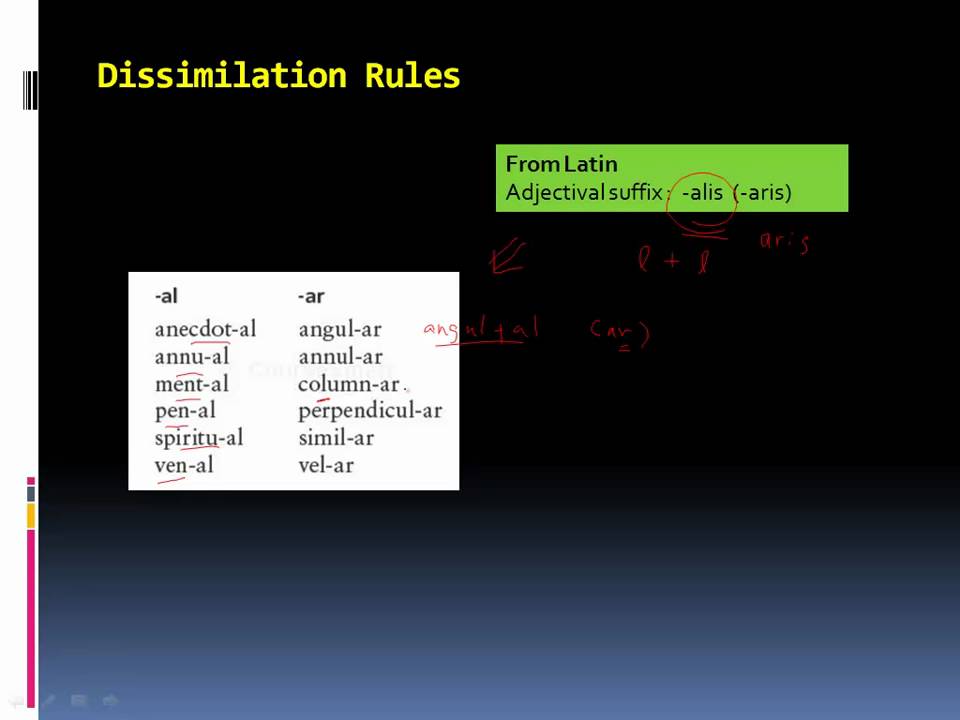
Phonology 2
185
The underlying representation is the abstract mental representation of a word, while the surface representation is the actual pronunciation after phonological rules apply. For 'Tempest', the underlying form is /tempest/, but surface pronunciation involves aspiration of T, nasalization of e, and schwa insertion. Native speakers are unaware of these rule applications, which happen automatically.
Click to watch →

Morpho-phonemics (ENG)
5.2K
An underlying representation is the most basic form of a morpheme or word before any phonological, morphological, or morphemic rule has been applied to it. A surface representation is the actual occurrence—the form of a word that is spoken and heard. For example, the morpheme /z/ is manifested as [z], [s], and [ɪz] due to different phonological environments, representing different surface forms derived from the same underlying morpheme.
Click to watch →
Prerequisite Knowledge
- Concept 01Basic concepts of phonetics and phonology, including phonemes, allophones, and distinctive sound features.
- Concept 02The traditional rule-based approach to generative grammar, specifically rewrite rules (such as 'A becomes B in environment C').
- Concept 03The core distinction between underlying representations (mental inputs) and surface representations (pronounced outputs) in linguistics.
Subsequent Learning
- Step 01How to construct and interpret formal Optimality Theory tableaux, including utilizing the Generator (GEN) and Evaluator (EVAL) components.
- Step 02The mechanics of Faithfulness constraints (which preserve input) versus Markedness constraints (which demand structurally unmarked outputs).
- Step 03How children acquire language within this framework, specifically using the Constraint Demotion Algorithm to learn language-specific rankings.
- Step 04Applying Optimality Theory to other domains of linguistics beyond phonology, such as syntax, pragmatics, and historical language change.
- Step 05Modern developments and alternatives to strict ranking, such as Harmonic Grammar and Maximum Entropy (MaxEnt) models that use weighted constraints.
Optimality Theory Basics
Tableau & Constraints
Optimality Theory Basics
0:01Playing Section
- 1
Explains rule-based vs constraint-based language models.
- 2
Introduces competing constraints as better for grammar explanation.
- 3
Uses friend analogy to illustrate constraint ranking.
Rule-Based Generative Phonology (Derivationalism)
While Optimality Theory (OT) relies on the parallel evaluation of violable, universal constraints to determine grammatical outputs, its primary theoretical rival is Rule-Based Generative Phonology (often associated with Chomsky and Halle's Sound Pattern of English). This derivational approach posits that grammar consists of absolute, inviolable rules applied in a strict, step-by-step (serial) order to convert abstract underlying representations into surface forms. Critics of OT argue that its parallel evaluation mechanism lacks computational tractability, as it theoretically requires the brain to evaluate an infinite set of candidate outputs simultaneously. Derivational theories solve this by using localized, sequential rewrites. Furthermore, rule-based approaches more naturally account for phonological "opacity"—cases where the motivation for a sound change is not visible on the surface. OT struggles to explain opacity without introducing highly complex, ad-hoc modifications like sympathy theory or stratal OT, leading some linguists to argue that step-by-step derivations remain a more cognitively realistic model of grammar.
Deep Dive
How to construct and interpret formal Optimality Theory tableaux, including utilizing the Generator (GEN) and Evaluator (EVAL) components.
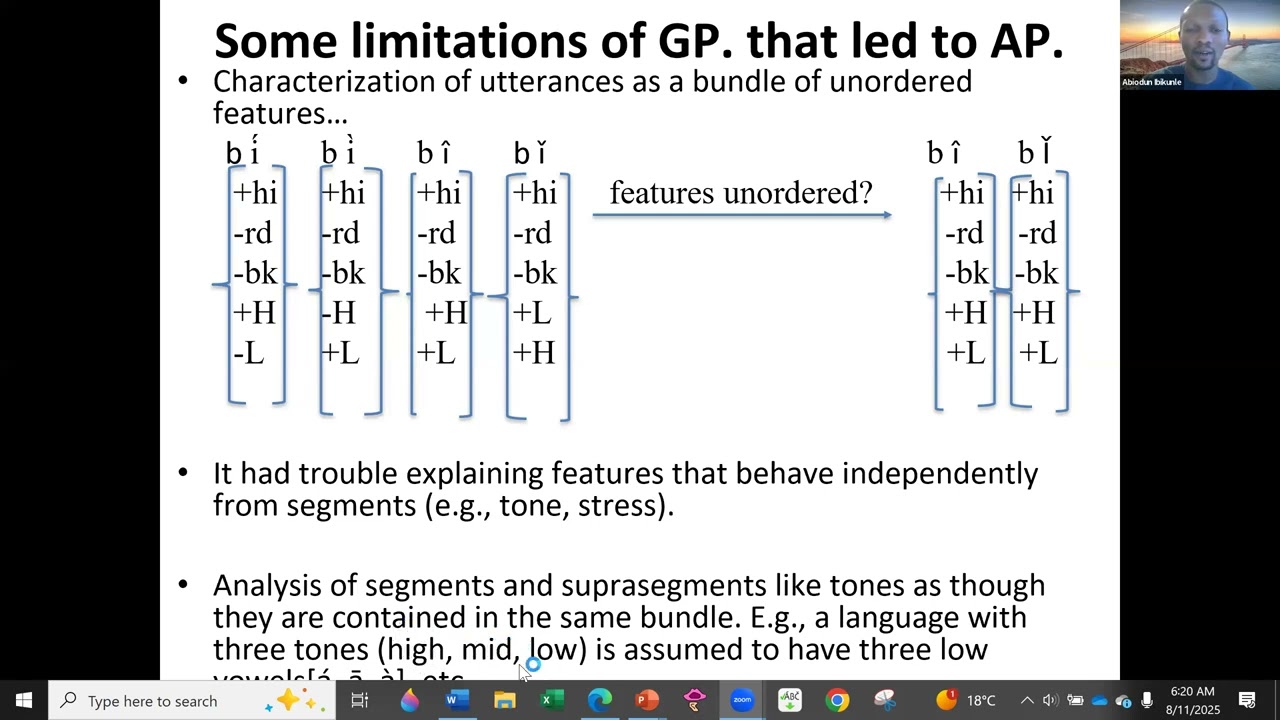
Phonology from Pre-generative to Optimality Theory 2
119
OT uses tableaux to evaluate candidate outputs. The tableau has constraints on the left and candidates on the right. Candidates are generated by GEN and evaluated against ranked constraints. The winner is the candidate that least violates the highest-ranked constraints. Candidates that violate high-ranked constraints are marked with exclamation marks and eliminated from competition. The winner may violate lower-ranked constraints but must not violate any higher-ranked constraints. This systematic evaluation allows OT to explain why certain outputs are preferred over others in different languages.
Click to watch →
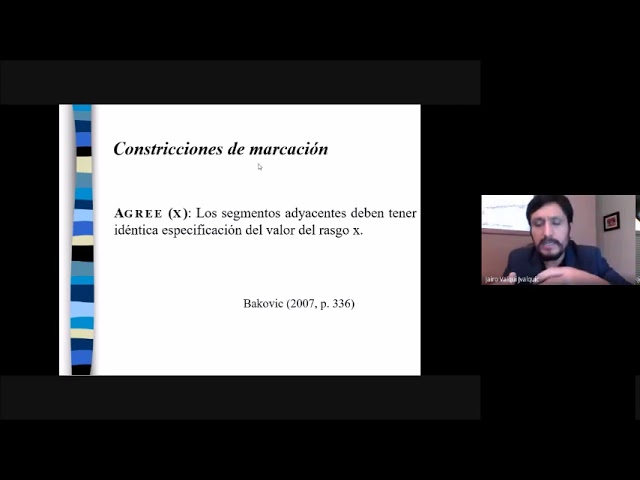
Fonología: Semana 2
273
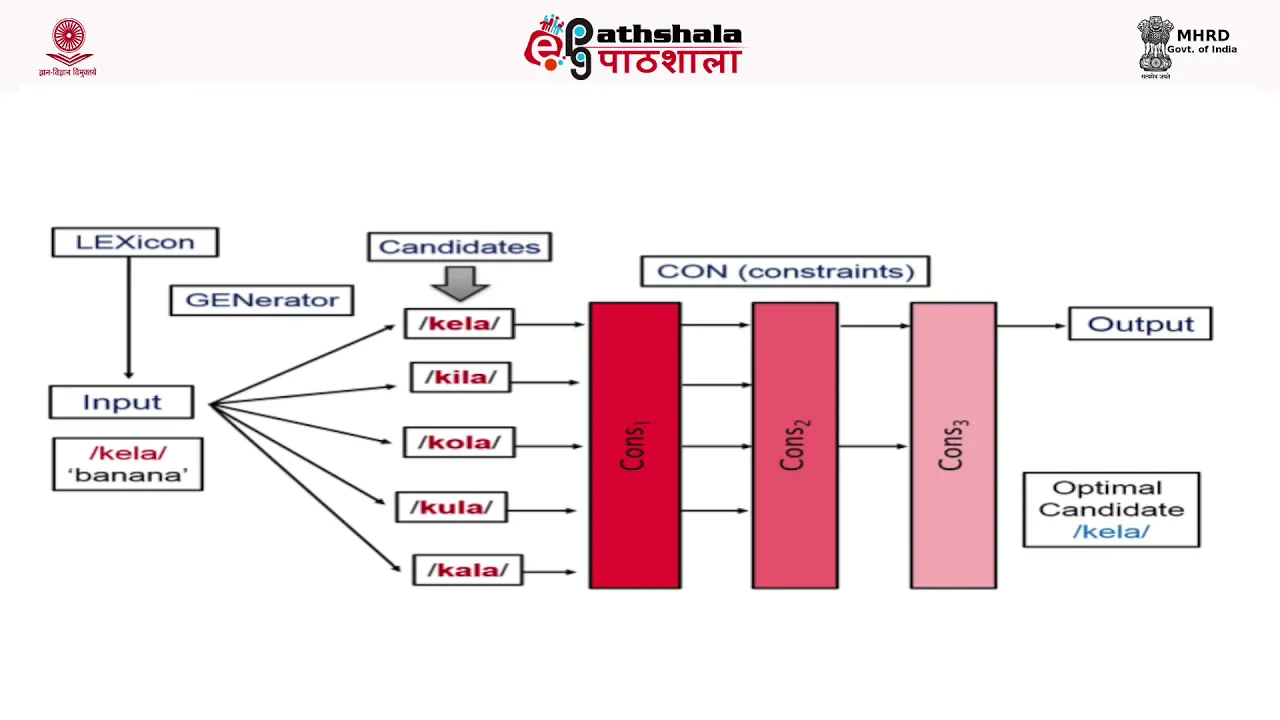
OT architecture consists of two components: the Generator and the Evaluator. The Generator takes an input form and produces a set of candidate outputs (possible surface forms). The Evaluator then assesses each candidate against the constraint hierarchy and selects the optimal output. This differs from rule-based models because it generates multiple candidates simultaneously rather than applying sequential transformations. The Generator is universal (produces candidates the same way for all languages), while the Evaluator contains language-specific constraints.
Click to watch →
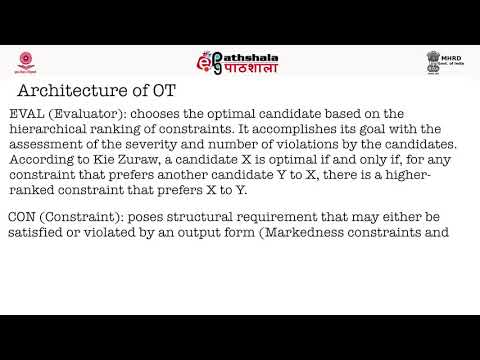
Lings P8 M26 Optimality Theory 1
1.2K
Optimality Theory (OT), developed by Alan Prince and Paul Smolensky in 1993, is a general theory of cross-linguistic variation and formal theory of linguistic typology that explains phonological phenomena through competition among ranked, violable constraints rather than rule-based systems; the theory features a four-component architecture (Lexicon, Generator, Evaluator, and Constraints) where the Generator creates potential candidates from underlying forms, the Evaluator selects the optimal candidate based on constraint rankings, and two major constraint types—markedness constraints (enforcing well-formedness of outputs) and faithfulness constraints (preserving input-output identity)—interact to determine optimal outputs, with constraint rankings being language-specific and determining whether languages exhibit full contrast, allophonic variation, or neutralization.
Click to watch →

النظرية الأمثلية وترتيب القيود المقطع في العربية أنموذجا
962
Optimality Theory (OT), developed by Prince and Smolka in 1993, proposes that grammars consist of universal constraints on well-formedness that determine possible forms. These constraints are violable but ranked hierarchically, with higher-ranked constraints taking precedence. The five fundamental principles are: (1) Universality - grammar provides universal constraints shared by all languages; (2) Violability - all constraints are violable but to varying degrees; (3) Ranking - constraints are ranked hierarchically with higher-ranked taking precedence; (4) Subset - higher-ranked constraints must be satisfied by candidates satisfying lower-ranked constraints; (5) Parallelism - grammar operates on parallel evaluation of all candidates simultaneously. The main components are: (1) Generator - produces infinite candidate outputs from input; (2) Constraints - universal constraints evaluating candidates; (3) Evaluator - selects optimal candidate based on constraint ranking; (4) Lexicon - repository for language-specific information.
Click to watch →

Optimality theory
1.3K
Optimality Theory is a linguistic framework proposed by Alan Prince and Paul Smolenski in 1993 that explains language forms through the interaction between conflicting universal constraints, where grammars differ by ranking these constraints differently; the theory consists of three components—GEN (generates candidate outputs), CON (provides violable constraints), and EVAL (selects optimal candidates)—with constraints divided into faithfulness (requiring input-output identity) and markedness (requiring structural well-formedness), and predicts factorial typology based on constraint rankings.
Click to watch →
Deep Dive
The mechanics of Faithfulness constraints (which preserve input) versus Markedness constraints (which demand structurally unmarked outputs).
النظرية الأمثلية وترتيب القيود المقطع في العربية أنموذجا
962
OT uses two types of constraints: (1) Markedness constraints ensure outputs are well-formed according to language-specific patterns, including Nucleus (every syllable must have a nucleus), Onset (every syllable must have an onset), and No Diphthong (syllables cannot contain diphthongs); (2) Faithfulness constraints ensure complete correspondence between input and output, including Maximal (input properties must be preserved) and Containment (output material must be present in input). In Arabic, Waw Hamza insertion occurs when words begin with complex onsets. The input consists of consonant sequences creating unacceptable syllable structures. The output inserts a hamza (glottal stop) followed by a short vowel. Arabic syllable structure is governed by: Onset (syllables must begin with consonant), Complex Onset (syllables cannot begin with more than one consonant), and Diphthong (syllables cannot contain diphthongs). Tanween (nunation) in Arabic involves deletion of underlying nasal consonant and merger of remaining consonant with preceding syllable. This affects syllable structure and must be evaluated against constraints. The optimal candidate best satisfies interaction between faithfulness constraints (preserving underlying material) and markedness constraints (maintaining well-formed syllable structure). The Onset constraint requires syllables begin with a consonant, ranked high because Arabic does not allow syllables to begin with a vowel. This constraint is satisfied only by candidates beginning with a consonant or hamza followed by a vowel. Optimality Theory is an extension of generative phonology maintaining distinction between underlying and surface forms but from different perspective. While earlier rule-based theories could describe many phenomena, they were insufficient in explaining how phonological systems interact. OT generates candidate outputs and evaluates them against ranked constraints to select optimal form. Markedness constraints ensure well-formed outputs, while faithfulness constraints ensure correspondence with inputs. The Evaluator selects optimal candidate based on language-specific constraint ranking.
Click to watch →

Optimality theory | Wikipedia audio article
723
Optimality Theory proposes that observed language forms arise from optimally satisfying conflicting constraints. The theory has three universal components: Generator creates candidate outputs, Constraint provides ranked violable criteria, and Evaluator selects the optimal candidate. Faithfulness constraints (Max, Dep, Ident) ensure output matches input, while markedness constraints impose structural requirements. OT originated from Prince and Smolensky's 1991 work and applies to phonology, syntax, and semantics. It assumes universal constraints with language-specific rankings, predicting factorial typology. Local conjunctions combine constraints to address opacity. The emergence of the unmarked describes intermediate-ranked constraints that violate in some cases but remain observable when higher-ranked constraints are irrelevant.
Click to watch →
Phonology from Pre-generative to Optimality Theory 2
119
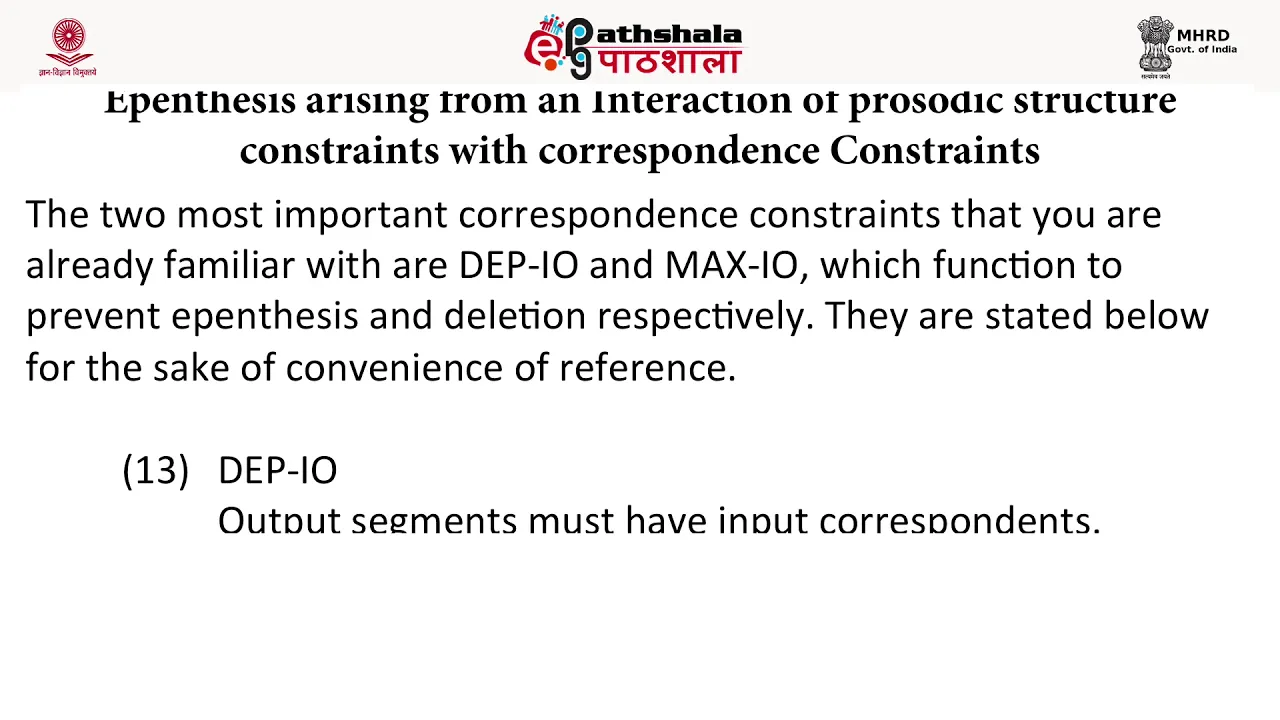
This extensive section introduces Optimality Theory (OT) as a paradigm shift from rule-based to constraint-based phonology. OT uses constraints that evaluate candidate outputs rather than applying rules. Constraints are universal principles present in all languages, but their ranking varies across languages. Faithfulness constraints (MAX-IO, DEP-IO) preserve input material, while markedness constraints (NO-CODA) require specific structures. The winner is the candidate that least violates the highest-ranked constraints. OT operates under inclusiveness (considering all possible outputs) and parallelism (applying all constraints simultaneously). The section demonstrates constraint ranking through English and Edo examples, explaining how the same constraints produce different outputs based on ranking. Key concepts include tableaux, fatal violations, and the role of GEN in generating candidates.
Click to watch →

Linguistics Lecture - UC Berkeley - Introduction to Optimality Theory in Phonology
66.2K
Optimality Theory (OT) is a constraint-based framework in phonology that evaluates competing phonological outputs (candidates) against a ranked set of constraints, where the optimal output is the one that violates the fewest highly-ranked constraints; this approach captures the tension between markedness constraints (which impose specific structural requirements on outputs) and faithfulness constraints (which preserve input-output correspondence), allowing linguists to model complex phonological phenomena like tone spreading and consonant cluster restrictions through systematic tableau evaluation.
Click to watch →
!["Optimality Theory in Generative Phonology" [a brief description on Optimality Theory]](https://i.ytimg.com/vi/1HwT3gFKli4/maxresdefault.jpg)
"Optimality Theory in Generative Phonology" [a brief description on Optimality Theory]
3K
Optimality Theory (OT), introduced by Allen Prince and Paul Smolensky in the 1990s, is a constraint-based linguistic theory that explains how languages resolve conflicts between competing constraints to produce phonological and grammatical patterns; unlike rule-based phonology, OT uses two fundamental constraint types—faithfulness constraints requiring correspondence between mental input and surface output, and markedness constraints demanding unmarked configurations or prohibiting marked ones—and operates through three core structures: GEN (generator) for creating candidate outputs, CON (constraint component) for defining the set of constraints, and EVAL (evaluator) for ranking and selecting the optimal output based on constraint violations.
Click to watch →
Deep Dive
How children acquire language within this framework, specifically using the Constraint Demotion Algorithm to learn language-specific rankings.
Formal Approaches to Moroccan Arabic Phonology and Syntax
432
In optimality theory, children's acquisition of syllable structure is explained through constraint demotion—a learning process where children gradually rerank universal constraints until they converge on the adult grammar. Early in development, markedness constraints (like *ComplexOnset) outrank faithfulness constraints (like MaxIO and DepIO), causing children to avoid clusters and codas by using repair strategies. As development continues, some markedness constraints are demoted, allowing certain clusters or codas to appear. Finally, faithfulness constraints rise in ranking, making the child's grammar converge with the adult grammar and allowing production of full complex syllable structures.
Click to watch →
The Stupidly Complicated Linguistics of Toddler Languages
165.4K
Toddlers show systematic sound preferences: coronals preferred over dorsals and labials. Structure constraints (NoCoda, place constraints) outrank faithfulness constraints (MaxIO, IdentIO) in early production, causing deletion of final consonants and substitution of preferred sounds. Yet toddlers still comprehend adult words because perception operates under different constraint rankings. This explains the classic discrepancy: children understand more than they can say.
Click to watch →

Mehrnoosh Sadrzadeh - How can large language models learn from humans? - IPAM at UCLA
418
Comprehension involves assigning interpretations to sub-phrases by ranking possible completions based on probability. Cognitive dissonance occurs when incoming input doesn't match predicted completions or appears with very low probability. This framework explains how children acquire language by learning to rank syntactic structures and semantic interpretations based on experience. Different verbs have different thematic roles and argument expectations, affecting interpretation ranking. The probability distributions over larger phrases can be restricted to smaller phrases, allowing calculation of divergence measures that quantify the degree of cognitive dissonance caused by unexpected inputs.
Click to watch →

Explorations in Language Learnability
144
This lecture presents a computational framework for understanding how children acquire syntax, arguing that hierarchical phrase structure constraints can be learned from child-directed speech through Bayesian inference that balances grammatical complexity with fit to data, offering an alternative to traditional nativist views of Universal Grammar.
Click to watch →

NLP with Friends, Featured Friend: Tom McCoy
816
A single language in the framework is defined by: (1) which consonants and vowels can appear, (2) which consonant and vowel will be inserted when needed, and (3) a ranking for the four constraints. The set of constraints is always the same across languages, but the ranking is chosen separately for each language. The space of languages is the set of all languages that could be generated this way.
Click to watch →
Deep Dive
Applying Optimality Theory to other domains of linguistics beyond phonology, such as syntax, pragmatics, and historical language change.
Optimality theory | Wikipedia audio article
723
Optimality Theory (OT) is a linguistic model proposing that observed language forms arise from the optimal satisfaction of conflicting constraints, where grammars consist of three universal components: a Generator that creates candidate outputs, a Constraint component providing ranked violable constraints, and an Evaluator that selects the optimal candidate; this framework, developed by Alan Prince and Paul Smolensky in 1991, differs from rule-based approaches by using constraint ranking rather than transformational rules, and has applications beyond phonology to syntax and semantics.
Click to watch →
Optimality Theory in Generative Phonology
1.3K
Optimality Theory (OT) is a general theory of cross-linguistic variation and formal theory of linguistic typology, invented in generative grammar to address conceptual crises in phonological thought. Introduced in 1993 by Alan Prince and Paul Smolensky from the USA, OT became one of the top five developments in generative grammar. The theory consists of three components: (1) Lexicon/Input Generator providing underlying forms, (2) Generator producing infinite candidate outputs, and (3) Evaluator selecting optimal candidates based on hierarchical constraint ranking. OT has been adapted across linguistics including syntax, semantics, and historical linguistics.
Click to watch →

Optimality Theory
248
Optimality Theory is a linguistic framework that explains language patterns through a hierarchy of ranked constraints, where languages select the optimal output form by minimizing violations of these constraints, with higher-ranked constraints taking precedence over lower-ranked ones; this theory originated from neural network research and has been applied across phonology, morphology, syntax, and semantics to explain why certain linguistic forms are preferred over others.
Click to watch →

【学部3年でスカウトされた】一流研究者のヤバいエピソードにビビる回#277
98.9K
Optimality Theory is a frontier theory in phonology developed by Alan Prince, Paul Smolensky, and John McCarthy, which explains how linguistic constraints interact to produce optimal outputs; the theory was conceived during a casual moment when Prince and Smolensky were folding laundry, and despite being published in 1993, it remains largely untranslated to Japanese, with only one Japanese translation appearing in 2004.
Click to watch →
Lings P8 M26 Optimality Theory 1
1.2K
Optimality Theory (OT), developed by Alan Prince and Paul Smolensky in 1993, is a general theory of cross-linguistic variation and formal theory of linguistic typology that explains phonological phenomena through competition among ranked, violable constraints rather than rule-based systems; the theory features a four-component architecture (Lexicon, Generator, Evaluator, and Constraints) where the Generator creates potential candidates from underlying forms, the Evaluator selects the optimal candidate based on constraint rankings, and two major constraint types—markedness constraints (enforcing well-formedness of outputs) and faithfulness constraints (preserving input-output identity)—interact to determine optimal outputs, with constraint rankings being language-specific and determining whether languages exhibit full contrast, allophonic variation, or neutralization.
Click to watch →
Deep Dive
Modern developments and alternatives to strict ranking, such as Harmonic Grammar and Maximum Entropy (MaxEnt) models that use weighted constraints.

最大エントロピーモデル入門(理論説明編)
2.6K
The Maximum Entropy (MaxEnt) model is a probabilistic framework used in linguistics since the late 2000s for capturing probabilistic generalization of linguistic phenomena. It maximizes entropy to avoid unwarranted assumptions, making it mathematically equivalent to multinomial logistic regression with formal guarantees for optimal solutions. MaxEnt competes with Optimal Theory (OT) and Harmonic Grammar (HG), where OT uses ranking-based constraints while HG uses weighted constraints. The framework calculates harmonic scores by summing constraint violations weighted by their assigned weights, then transforms these into probabilities through negative logarithm. This creates a sigmoid relationship where small harmony changes at low values produce large probability changes, while high harmony changes produce smaller effects. The model can be interpreted as a formalization of human decision-making, where constraints represent evidence and weights represent persuasiveness.
Click to watch →

50 years of Linguistics at MIT, Lecture 8
7.1K
Free variation in phonology occurs when multiple outputs are possible for the same input, and speakers choose between them. Instead of strict constraint rankings, certain subsets of constraints can be ranked freely. Stochastic approaches like noisy harmonic grammar or MaxEnt grammars can generate specific percentages or probabilities for rival output forms. Empirical evidence shows that native speakers match frequency patterns in corpora, suggesting that quantitative modeling captures real linguistic behavior better than purely categorical approaches.
Click to watch →

Paul Smolensky - Generative Grammar in the Cognitive Science of Language
713
Markedness theory identifies universal poles of preference across linguistic dimensions—unmarked poles are preferred while marked poles are dispreferred. This provides building blocks for universal grammar. Harmonic grammar uses numerical constraint weights where violations accumulate additively. Optimality theory uses strict domination hierarchies where higher-ranked constraints completely override lower-ranked ones regardless of violation count. Harmonic grammar can approximate strict domination if constraint strengths grow exponentially, but languages cannot count violations, requiring strict ranking for typological adequacy. Optimality theory posits universal constraints (CON) and a universal generator (GEN) of candidate outputs. Human grammars differ only in constraint rankings, creating a closed-form characterization of possible languages. Grammar operates as a dialectic between markedness constraints (favoring unmarked structures) and faithfulness constraints (requiring surface forms match underlying forms). These conflicts create diversity—different rankings resolve conflicts differently, producing different languages. The theory commits to universal typology: studying any grammatical domain requires accounting for all possible systems.
Click to watch →

Why study sound symbolism (from a generative perspective)?
578
Cumulativity refers to whether multiple sound symbolic effects add up when they occur together. This is an important debate in phonological theory because Harmonic Grammar with weighted constraints predicts that effects should add up, while Optimality Theory with ranked constraints predicts that only the most important constraint matters. Two types of cumulativity exist: (1) Counting cumulativity - whether multiple instances of the same sound evoke stronger images (e.g., multiple /p/ sounds), and (2) Ganging up cumulativity - whether different sounds associated with the same image add up. Studies show that labiality, consonant voicing, and vowel backness all contribute to perceptions of 'bret' cumulatively. Recent research models these cumulative effects using MaxEnt Harmonic Grammar frameworks.
Click to watch →

Maxent Introduction
29.7K
MaxEnt (Maximum Entropy) is a widely-used algorithm for species distribution modeling that estimates potential species distributions by finding the probability distribution of maximum entropy (most spread out) that meets constraints derived from presence data and environmental variables; the algorithm uses features (linear, quadratic, product, threshold, and hinge transformations of environmental variables) to calculate a Gibbs probability distribution, with outputs including raw probability values, logistic transformations, and C-log-log transformations, and model evaluation relies on metrics like AUC (Area Under the Curve) and omission error, with thresholding rules converting continuous suitability values to presence-absence predictions.
Click to watch →
Optimality Theory Basics
Tableau & Constraints
Optimality Theory Basics
0:01- 1
Explains rule-based vs constraint-based language models.
- 2
Introduces competing constraints as better for grammar explanation.
- 3
Uses friend analogy to illustrate constraint ranking.
Rule-Based Generative Phonology (Derivationalism)
While Optimality Theory (OT) relies on the parallel evaluation of violable, universal constraints to determine grammatical outputs, its primary theoretical rival is Rule-Based Generative Phonology (often associated with Chomsky and Halle's Sound Pattern of English). This derivational approach posits that grammar consists of absolute, inviolable rules applied in a strict, step-by-step (serial) order to convert abstract underlying representations into surface forms. Critics of OT argue that its parallel evaluation mechanism lacks computational tractability, as it theoretically requires the brain to evaluate an infinite set of candidate outputs simultaneously. Derivational theories solve this by using localized, sequential rewrites. Furthermore, rule-based approaches more naturally account for phonological "opacity"—cases where the motivation for a sound change is not visible on the surface. OT struggles to explain opacity without introducing highly complex, ad-hoc modifications like sympathy theory or stratal OT, leading some linguists to argue that step-by-step derivations remain a more cognitively realistic model of grammar.
Basic concepts of phonetics and phonology, including phonemes, allophones, and distinctive sound features.
The traditional rule-based approach to generative grammar, specifically rewrite rules (such as 'A becomes B in environment C').
The core distinction between underlying representations (mental inputs) and surface representations (pronounced outputs) in linguistics.
How to construct and interpret formal Optimality Theory tableaux, including utilizing the Generator (GEN) and Evaluator (EVAL) components.
The mechanics of Faithfulness constraints (which preserve input) versus Markedness constraints (which demand structurally unmarked outputs).
How children acquire language within this framework, specifically using the Constraint Demotion Algorithm to learn language-specific rankings.
Applying Optimality Theory to other domains of linguistics beyond phonology, such as syntax, pragmatics, and historical language change.
Modern developments and alternatives to strict ranking, such as Harmonic Grammar and Maximum Entropy (MaxEnt) models that use weighted constraints.
48.3K views947likes4:00@NativLangOriginal Release: 2012-10-04
[Music] Have you ever had someone explain grammar to you? Maybe you had a slip of the tongue and a know-it-all friend of yours didn't hesitate to point out your mistake. Or maybe you were learning a new language and your teacher told you how to pronounce a certain letter in different contexts.
Chances are these people gave you linguistic rules that went something like, "Oh, this one." Plural Sounds like S after voiceless consonants, but like Z after voiced consonants.
Rules like this one are supposed to tell you how the language works. And what's more, they're not supposed to be broken.
A paradigm called optimality theory takes issue with this approach. Instead of applying unbreakable rules to language, optimality theory contends that viable competing constraints do a better job of explaining how language works. Before we take a peek at the guts of this model, let's get a sense of the difference between a rule-based and a constraintbased approach. Say you have a very principled friend who lives life by a bunch of rules she really sticks to.
One of those rules is don't stay up late. Another friend of yours doesn't have a rule like this, but does have a bunch of preferences and demands on her time. Things like get enough sleep and play video games for fun. The first friend expects her rule to be followed, never broken, so it's inviable.
The second friend has a list of constraints. She ranks the constraints by priority, sleep above games. A situation arises. Both friends are invited to an allnight game fest. The first friend checks her rule. The plan doesn't pass, so the outcome is she doesn't go. The second friend compares her constraints. And since she can't sleep and play games, going to sleep violates the low rank constraint, while playing video games violates the high rank constraint. She chooses the best outcome, the optimal candidate. going to sleep.
Both friends ended up sleeping. So, our debate isn't over the outcome. It's about the process.
Optimality theory claims to be a better model even for what the first friend is doing in this situation. Well, at least when we take it back to language. So the same goes when we consider the input bag plus plural s with constraints like match voicing and keep the sounds identical.
We could end up choosing between the candidates bags and bags.
What's the output going to be? Since the pronunciation bags incurs the least serious violations here, it's our optimal candidate. Other candidates might do even worse, like if we added bag.
This little evaluation table here gets called a tableau in optimality theory.
Notice one more time that the constraints are ranked and viable.
It's also proposed that there's a constant tension between marketkedness constraints, ones that shape words and sounds, and faithfulness constraints, ones that keep words and sounds the same.
I just wanted to leave you with the gist of the basics of optimality theory. I'm sure you have other competing constraints on your own time, so thanks for taking a moment to learn with me.
Up Next
19:00
Optimality Theory in Linguistics: Key Concepts & Architecture Explained
@Vidyamitra
14.1K views•2018-08-20
36:52
Constraint Interaction in Optimality Theory: Epenthesis & Deletion
@Vidyamitra
180 views•2018-08-20
2:45
Morphosyntactic Alignment: Nominative-Accusative vs Ergative-Absolutive (4/4)
@NativLang
13K views•2013-08-23

21:32
Accent Expert Explains U.S. Regional Dialects | Part 1
@WIRED
9.3M views•2021-01-21
Related Study Plans & Knowledge Roadmaps
Structured learning paths in Linguistics
linguistics
Optimality Theory: Tableaux & Constraints
01Phonological Basics: Sounds, Syllables & Rules
02Foundations of Optimality Theory: GEN, CON, and EVAL
03The Constraint Inventory: Markedness vs. Faithfulness
+ 2 more learning modules
15h5 modules
Explore Roadmap
linguistics
Morphosyntactic Alignment: S, A & P Systems
01Foundations of Syntax: Transitivity and Arguments
02The Linguistic Variables: Mapping S, A, and P
03Nominative-Accusative Alignment
+ 3 more learning modules
12h6 modules
Explore Roadmap
linguistics
Analyzing Sign Language: Phonology & Syntax
01Foundations of Sign Language Linguistics
02Phonology: The Five Parameters of a Sign
03Morphology: Word Formation and Classifiers
+ 2 more learning modules
14h5 modules
Explore Roadmap
linguistics
Pragmatics: Speech Acts, Grice & Politeness
01Introduction to Pragmatics: Meaning in Context
02Grice’s Cooperative Principle & Implicature
03Speech Act Theory
+ 2 more learning modules
14h5 modules
Explore Roadmap