To purchase a profitable business, follow these five steps: secure $20,000-$60,000 for down payment and financing; find an auto repair shop in a good location with strong reviews and a boomer owner ready to sell; perform due diligence by reviewing 3-5 years of tax returns and customer lists while checking staff retention intentions; finance the deal using loans with 10% down or seller financing; then increase income by identifying underpriced services, setting up subscription packages, and modernizing systems.
How to Own a Cash Flowing Business in 5 Steps
Added:Deep Dive
Understanding of basic financial statements, specifically Cash Flow Statements, Balance Sheets, and Income Statements (P&L).

Experta en Finanzas: 56 minutos que pueden salvar millones de negocios | Alba Luz Hoyos
94.1K
The three essential financial statements are the Income Statement (P&L), Balance Sheet, and Cash Flow Statement. The P&L shows revenue, costs, and expenses to determine profitability. The Balance Sheet reveals the company's actual financial position, including accounts receivable and inventory. The Cash Flow Statement tracks actual cash movements. Many companies fail to analyze their balance sheet, missing critical information about liquidity. Understanding all three statements provides a complete picture of financial health.
Click to watch →
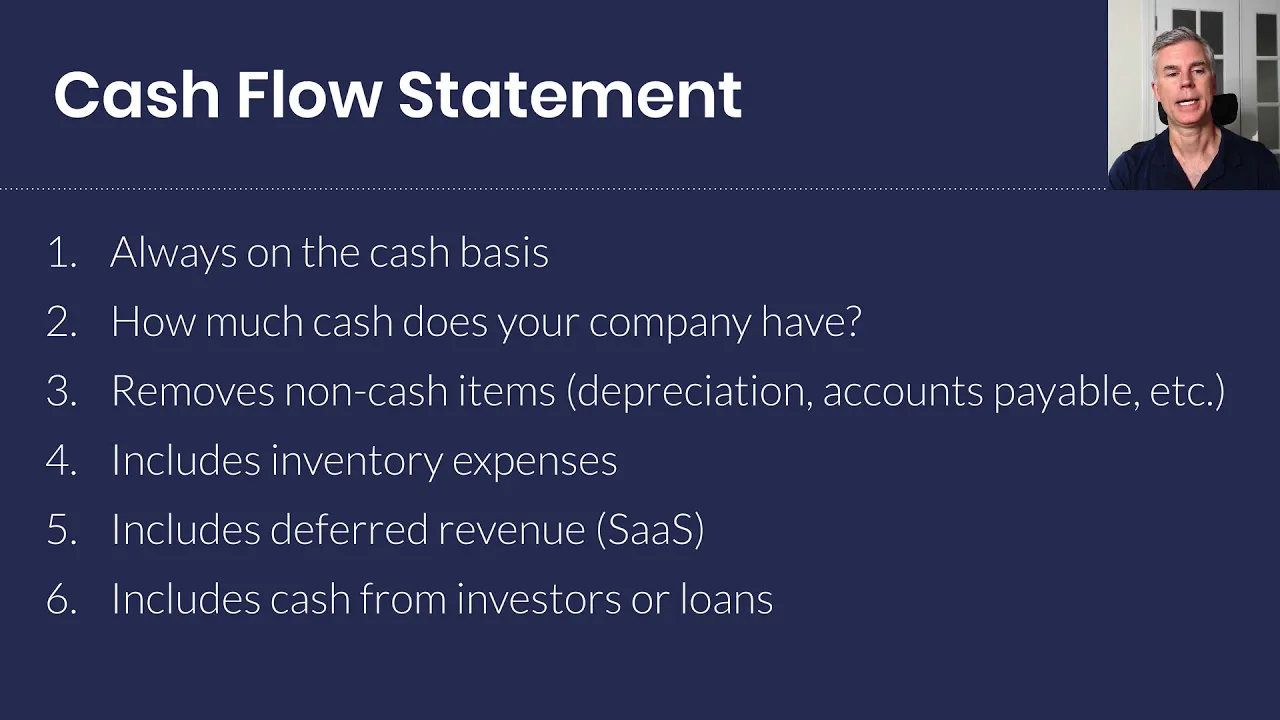
The 3 Financial Statements: Income Statement (P&L), Cash Flow Statement, and Balance Sheet
3.8K
The three financial statements are: (1) Income Statement (also called Profit and Loss or P&L), which shows revenue, expenses, and profit/loss; (2) Cash Flow Statement, which provides an accurate snapshot of cash flowing into and out of the business; (3) Balance Sheet, which lists the company's assets, liabilities, and net worth (which can be positive or negative). These three statements work together to provide a complete picture of a company's financial health.
Click to watch →

W3_L3: Cash flow statement - part 3
620
The three basic financial statements are: (1) Balance Sheet - shows assets, liabilities, and equity at a specific point in time; (2) Income Statement (also called Profit and Loss Account or Revenue and Expenditure Statement) - shows revenues and expenses over a period; (3) Cash Flow Statement - tracks the movement of cash and cash equivalents over a period. These three statements are interconnected and provide a complete picture of a company's financial position and performance.
Click to watch →

Cordero CPA -Aspectos Financieros al Abrir su Negocio pt.2
301
The three basic financial statements are: (1) The Balance Sheet (also called the Statement of Financial Position), (2) The Income Statement (also called the Profit and Loss Statement), and (3) The Cash Flow Statement. These three statements work together like a medical checkup: the balance sheet checks assets, the income statement checks revenues and expenses, and the cash flow statement checks where the money is going. Together, they provide a comprehensive picture of a business's financial health.
Click to watch →

How to Read a P&L, Balance Sheet, and Cash Flow Statement Like a CFO
4.3K
Every business has three standard financial statements that provide different perspectives on financial health. The Profit and Loss (P&L) or Income Statement charts total revenue (money coming in) and total expenses (money going out) to determine profitability. The Balance Sheet shows what the business owns (assets), what it owes (liabilities), and the owner's equity. The Statement of Cash Flows connects the dots by showing how money actually moves through the business, because profit doesn't always equal cash on hand.
Click to watch →
Deep Dive
Familiarity with the concept of EBITDA (Earnings Before Interest, Taxes, Depreciation, and Amortization) and how business valuation is determined.

The TRUTH About SELLING Your Clinic During COVID 2022 | Rick Lau and Paul Moon
166
EBITDA (Earnings Before Interest, Taxes, Depreciation, and Amortization) is a fundamental metric for business valuation. It represents net profit with certain expenses added back: (1) Interest payments on bank loans are added back; (2) Taxes paid are added back; (3) Depreciation and amortization expenses are added back (e.g., $200,000 in renovations might be added back over 5 years). Normalizing EBITDA means removing extraneous expenses like owner vacations or personal expenses that don't reflect true business operations. The valuation formula is: Business Price = EBITDA × Multiple. This metric helps buyers understand the actual profit potential of the business.
Click to watch →

How To Do Business Valuations & Structure | Carl Allen Dealmaker
52.6K
EBITDA (Earnings Before Interest, Taxes, Depreciation, and Amortization) is the primary profit measure used in business valuation. It represents the operating profit of a business before accounting for financing decisions, tax strategies, and non-cash expenses like depreciation. Different business sectors have different multiple ranges, and the quality of the business within that range determines its attractiveness to buyers.
Click to watch →

EBITDAR & Bucket Going Far | Ashville Weekly ep142
188.6K
EBITDA (Earnings Before Interest, Taxes, Depreciation, and Amortization) represents operational profit before financing costs and non-cash expenses. When valuing a business, the enterprise value is calculated by multiplying EBITDA by a multiple, which varies based on business size and industry. Larger businesses typically receive higher multiples. This metric is particularly useful because it allows potential buyers to assess operational profitability independent of how the business is funded, whether through cash reserves or debt financing.
Click to watch →

What Is EBITDA? (The Number Every Shop Owner Needs to Know)
474
EBITDA (Earnings Before Interest, Taxes, Depreciation, and Amortization) represents the cash flow generated from business operations before accounting for financing costs, taxes, and equipment depreciation. It serves as the primary metric for business valuation, where valuers multiply EBITDA by a multiple to determine worth—for example, a business with $500,000 in EBITDA would typically be valued at approximately $2 million (4x multiple). This metric is critical because it is the first number buyers, banks, and growth partners examine when evaluating a business, making it essential for shop owners to understand and track.
Click to watch →

Business Valuations: How to Determine Your Company's Worth? Part 2
2.9K
EBITDA (Earnings Before Interest, Taxes, Depreciation, and Amortization) is calculated by taking a company's profit and adding back interest, tax, depreciation, and amortization. This figure is then multiplied by a multiple to determine business value. The average multiple used by valuers is typically three times, though this can vary based on industry standards, business performance, systemization level, and company size. Smaller companies typically receive lower EBITDA multiples, while larger, well-systemized businesses with strong cash flows, strong income, loyal customers, and independent operations command higher multiples.
Click to watch →
Deep Dive
Basic knowledge of financing mechanisms, including debt vs. equity, SBA (Small Business Administration) loans, and seller financing.

How I Built 12 Income Streams Without Tons of Cash
179K
Three methods exist for buying small businesses: SBA loans with government incentives, seller financing where owners finance purchases using future profits, and bringing other people's money (investors) to fund deals. Seller financing benefits both parties: sellers receive more money than bank financing would allow, pay less in taxes through structured payment arrangements, and sell faster (within 30 days versus 120 days for traditional loans). Payments can be structured as long-term capital gains, distributions with low tax rates, or LLC distributions allowing write-offs. A personal story illustrates the consequences of not knowing how to buy businesses: a family business worth millions died because the owner didn't know about acquisition options, and a big corporation took all clients for $0 while the family got nothing.
Click to watch →

LIVE: let's talk business - deal flow, finance, negotiation, live q&a (ep. 1)
6.1K
Seller finance is considered the best financing option because it eliminates the need to negotiate with third-party banks and involves only the seller and buyer. SBA loans require extensive paperwork and a lengthy approval process. Both options can work, but seller finance is preferred when available. The key principle is that any financing method that allows you to close the deal is acceptable, though you should aim for the best possible terms.
Click to watch →
How Entrepreneurs Use SBA Financing to Add Profitable Revenue Streams (Webinar Replay)
233
SBA loans are cash flow loans where banks typically lend 90% of the business value, with the borrower providing 10% equity. For a $1 million business, this means $900,000 in SBA financing plus potentially additional line of credit. The remaining 5% can be held back as a seller note on 'full standby,' allowing the buyer to effectively purchase a $200,000 salary for $50,000. This structure enables buyers to acquire businesses with minimal personal capital while maintaining debt service coverage.
Click to watch →

SBA Loans and How to Get Approved
14.9K
The Small Business Administration (SBA) is a government agency formed in 1953 to support small business growth. SBA does not directly lend money but guarantees loans from traditional banks, reducing lender risk. SBA offers three main financing programs: (1) Microloans under $50,000 through non-profit intermediaries for newer businesses; (2) 504 loans up to $5 million for purchasing or refinancing fixed assets like real estate, equipment, and machinery, with 20+ year terms and low rates; (3) 7(a) loans, the most popular program, offering loans or credit lines up to $5 million with 20+ year terms, including specialized options for veterans, international businesses, and faster 6-week funding.
Click to watch →

Asking Billionaires How They Got Rich! (Beverly Hills)
3.1M
Seller financing enables business acquisitions when traditional bank financing alone is insufficient. The buyer offers the seller a down payment equivalent to two times the business's profit, with the seller holding a promissory note for the remaining balance. This arrangement benefits both parties: the seller receives immediate payment while the buyer secures financing through government-backed SBA programs.
Click to watch →
Deep Dive
An understanding of the 'Entrepreneurship through Acquisition' (ETA) model compared to starting a business from scratch.

Search Fund and ETA Intro Presentation to University of Texas ETA Club (Jan 2025)
328
ETA is buying existing profitable small businesses to sell for profit, contrasting with greenfield startups. Less than 10% of startups reach $1 million sales, and less than 1% reach $10 million. ETA offers higher success probability while providing autonomy. Two main paths exist: self-funded search (SBA loans) and traditional search fund (investor-backed). The speaker emphasizes that most people don't have novel startup ideas, making ETA a more practical path to entrepreneurship.
Click to watch →
Entrepreneurship Through Acquisition (ETA) Explained | Tee Time Global Podcast
108
Entrepreneurship Through Acquisition (ETA) is an alternative pathway to entrepreneurship where individuals acquire and grow existing businesses rather than starting from scratch, offering a faster and more secure route to business ownership by leveraging established businesses with proven revenue streams, cash flows, and product-market fit, typically involving a two-year search phase followed by a 4-8 year operating phase before exit.
Click to watch →

What Is Entrepreneurship Through Acquisition?
834
Entrepreneurship Through Acquisition (ETA) is a business strategy where entrepreneurs acquire existing businesses with established customer bases, cash flow, and operational infrastructure rather than starting from scratch, offering significantly higher success rates (estimated at 80% compared to 10% for startups) by allowing entrepreneurs to infuse innovative methodologies into proven business models; this approach is particularly valuable given that over 40% of US businesses are Baby Boomer-owned and projected to transfer within the next decade, creating opportunities for aspiring entrepreneurs to build on existing foundations rather than navigating the high-risk startup environment.
Click to watch →

Entrepreneurship Through Acquisition (ETA)
1.6K
Entrepreneurship Through Acquisition (ETA) is a lower-risk form of entrepreneurship where individuals purchase existing businesses that already operate successfully, rather than building new ventures from scratch; this approach leverages the 'silver tsunami' of trillions of dollars being passed from retiring baby boomers to younger generations, with a significant portion held in small businesses, allowing aspiring entrepreneurs to acquire established operations and build upon existing momentum and systems.
Click to watch →
¿Emprender o adquirir un negocio? ¿Qué es mejor? #74
3.2K
Entrepreneurship Through Acquisition (ETA) is a business strategy where entrepreneurs acquire existing small and medium businesses rather than starting from scratch, offering lower risk since the acquired business has already achieved product-market fit and revenue, but typically provides lower returns compared to traditional entrepreneurship which carries higher risk but offers exponential returns if successful; the trend is driven by demographic shifts as Baby Boomers age and seek to transfer business ownership to younger entrepreneurs.
Click to watch →
Prerequisite Knowledge
- Concept 01Understanding of basic financial statements, specifically Cash Flow Statements, Balance Sheets, and Income Statements (P&L).
- Concept 02Familiarity with the concept of EBITDA (Earnings Before Interest, Taxes, Depreciation, and Amortization) and how business valuation is determined.
- Concept 03Basic knowledge of financing mechanisms, including debt vs. equity, SBA (Small Business Administration) loans, and seller financing.
- Concept 04An understanding of the 'Entrepreneurship through Acquisition' (ETA) model compared to starting a business from scratch.
Subsequent Learning
- Step 01Advanced due diligence methodologies, including financial, legal, and operational audits of a target business.
- Step 02Deal structuring tactics, such as negotiating asset vs. stock purchases, earn-outs, and working capital pegs.
- Step 03Post-acquisition integration and 100-day transition planning to ensure operational continuity and team retention.
- Step 04Growth optimization strategies, including modernizing technology systems and implementing digital marketing to scale cash flow.
- Step 05Portfolio management or exit planning strategies for eventually selling the acquired business at a higher multiple.
Boomer Shops
Down Payment
Find Shops
Vast Market
Due Diligence
Financing
Boost Income
Boomer Shops
0:00Playing Section
- 1
Hundreds of boomer-owned firms close daily due to no buyers.
- 2
Series focuses on finding, acquiring, and profiting from these businesses.
The Hidden Risks of Acquisition Entrepreneurship
While the "buy then build" model is popularized as a low-risk shortcut to business ownership, critics point out significant, often glossed-over dangers. First, "key-man risk" is immense; small businesses often depend entirely on the outgoing owner’s personal relationships, leading to high customer churn post-acquisition. Second, buyers face asymmetric information, where sellers hide operational flaws or declining market demand. Most critically, acquiring a business typically requires leveraging substantial debt, often secured by personal guarantees (such as SBA loans). If the business underperforms, the buyer faces personal bankruptcy, transforming a promised "cash-flowing asset" into a catastrophic financial liability. Additionally, managing a small business requires intense, hands-on operational expertise rather than passive oversight, debunking the myth of easy managerial transition.
Deep Dive
Advanced due diligence methodologies, including financial, legal, and operational audits of a target business.

Due Diligence | Advanced Audit & Assurance ACCA P7 | English
440
Due diligence is a systematic investigation performed by audit firms to reduce investment risk in business acquisitions, involving comprehensive analysis of financial, operational, legal, tax, HR, and market aspects of the target company; it can be conducted as a review engagement (limited assurance) or agreed-upon procedures (no assurance), and differs from external audit by focusing on future prospects and multi-dimensional assessment rather than just historical financial statements.
Click to watch →

ADA POTENSI 'CUAN' NIH, NEW MIND SIAP AMBIL PELUANG❓(CEO Mastermind w/ MARDIGU & HELMY YAHYA)
77.3K
Effective due diligence requires examining three critical dimensions: legal compliance, financial health, and operational/technical capabilities. Many business owners focus primarily on financial numbers while neglecting legal and operational assessments, which often become the primary sources of problems in business partnerships. Comprehensive due diligence should include legal reviews to identify potential liabilities, financial audits to verify actual performance, and operational assessments to evaluate technical capabilities and business sustainability. This holistic approach prevents costly surprises and ensures informed investment decisions.
Click to watch →

What It Really Takes to Buy a Local Service Business in 2025 #10
125
Due diligence in business acquisitions consists of three main components: legal, financial, and operational. The recommended approach is to start with financial due diligence to verify the business's earnings, then move to legal to identify potential deal killers, and finally conduct operational due diligence. Financial due diligence involves verifying Quality of Earnings (QoE), ensuring all money is properly accounted for, and confirming that the business is not being used as a personal pocketbook by the owner.
Click to watch →

Processus d’audit et due diligence
402
Due diligence is a comprehensive verification process conducted during mergers and acquisitions to assess a target company's financial, legal, operational, and strategic health, involving multiple specialized audits (financial, legal, social, fiscal, and strategic) that help buyers identify risks and weaknesses while enabling sellers to prepare their companies for successful transactions.
Click to watch →

ACCA I Advanced Audit & Assurance (AAA) I Due Diligence - AAA Lecture 22
3.3K
Due diligence is a fact-finding exercise conducted to reduce investment risk by gathering comprehensive information about a target company, including financial performance, operational matters, legal issues, tax compliance, and HR matters, which helps stakeholders make informed decisions about acquisitions; unlike external audits that provide reasonable assurance on financial statements, due diligence typically provides no or limited assurance as it focuses on presenting factual information rather than expressing professional opinions, and requires careful consideration of acceptance criteria including confidentiality, objectivity threats, and resource availability before proceeding with the engagement.
Click to watch →
Deep Dive
Deal structuring tactics, such as negotiating asset vs. stock purchases, earn-outs, and working capital pegs.

Amazon FBA Roll-up Company Buying Your Business? Do THIS To Profit More with David Newell
6.2K
Roll-up companies (aggregators) acquire multiple smaller e-commerce brands to consolidate them into portfolios, creating instant equity for sellers. The key advantage of competitive bidding is that multiple buyers competing simultaneously significantly improves deal terms compared to single-buyer negotiations. A single buyer typically offers royalty structures rather than clean cash purchases. When multiple buyers compete, they raise paddles, compete for the business, and offer better prices, structures, and terms. Three critical deal structures affect business sale value: Earn-outs (80/20 structures where 20% is held back as revenue-based earn-out over 1-2 years), Working Capital Pegs (buyers demanding 2 months of inventory as additional cash), and Stability Payments (10% held back to protect against revenue decline). Earn-outs capture future upside for growing businesses (50-100% YoY growth), potentially achieving 5.5-6.5x effective multiples. Working capital pegs represent significant value loss when sellers give away inventory at cost rather than selling at market value.
Click to watch →

Episode 109 What you need in a Letter of Intent / Term Sheet when Buying a Restaurant
215
Stock purchases acquire the entire company including all liabilities, while asset purchases allow buyers to select specific assets and exclude unwanted liabilities. Asset purchases are preferred to avoid inheriting lawsuits or past mistakes. Payment structures include earn-outs (partial upfront payment with remainder based on future performance) and seller financing (seller carries a note with down payment and installment payments). These structures allow flexibility in deal structuring based on buyer resources and seller needs.
Click to watch →

Spring 2021 M&A Bootcamp: Market Update and Overview- Part 1 of 3
169
M&A deal structures have evolved: (1) Public company-style deals have reps and warranties that expire at closing, with only fraud or intentional misrepresentation remaining as liability, (2) Working capital adjustments are structured as effective daily rates from a lock box date to closing, (3) For every day beyond the lock box date, an extra amount is added to the purchase price to compensate sellers for business performance, (4) This provides certainty to both parties about proceeds, (5) It reduces risk of fraud or litigation post-closing, (6) Sellers get their consideration and move on, (7) This structure is now common in approximately 30-40% of deals.
Click to watch →

How To Structure A Business Acquisition (Detailed Examples)
33.4K
This comprehensive section covers the complete framework for business acquisitions. It begins with the fundamental choice between stock purchases (all-you-can-eat buffet—inherit everything including liabilities, credit history, and contracts) versus asset purchases (à la carte—select specific assets and leave unwanted liabilities). Stock purchases offer tax advantages (long-term capital gains), preserve credit history for future financing, and transfer all contracts automatically. Internal financing sources include surplus cash, seller financing (using business cash flow to pay seller), and earnouts (bonus payments tied to future profitability). External financing includes asset-based lending (80% LTV on receivables, 50% on inventory), SBA loans (government-guaranteed with 75-80% guarantee), equity investors, hard money lenders, crowdfunding, and creative options like 401(k) loans and HELOCs. The speaker prefers stock purchases because they leverage the business's established reputation. Seller financing shifts risk from buyer to seller—the more seller financing, the better for the buyer. Earnouts bridge valuation gaps by creating shared upside. Business brokers typically promote asset sales because they know trade buyers pay more due to synergies, but direct negotiation with sellers often splits the difference. Asset purchases offer tax advantages: write-off goodwill over shorter periods (15 vs 20 years) and selective employee retention in the US.
Click to watch →

Understanding Buyer Power In Negotiating M&A Deals | Transaction Advisors Institute
50.4K
When structuring earn-outs, parties must choose between revenue-based and EBITDA/cash flow-based metrics. Revenue-based earn-outs are simpler to measure and implement but may incentivize unprofitable revenue growth since management focuses only on top-line numbers. EBITDA or cash flow-based earn-outs better align incentives with healthy bottom-line performance but require more complex calculations and definitions. Key considerations include what revenues count (specific products vs bundled offerings), how costs are allocated, measurement periods, and whether key employees remain in control to achieve targets. These decisions significantly impact the complexity and length of the earn-out provisions in the acquisition agreement.
Click to watch →
Deep Dive
Post-acquisition integration and 100-day transition planning to ensure operational continuity and team retention.
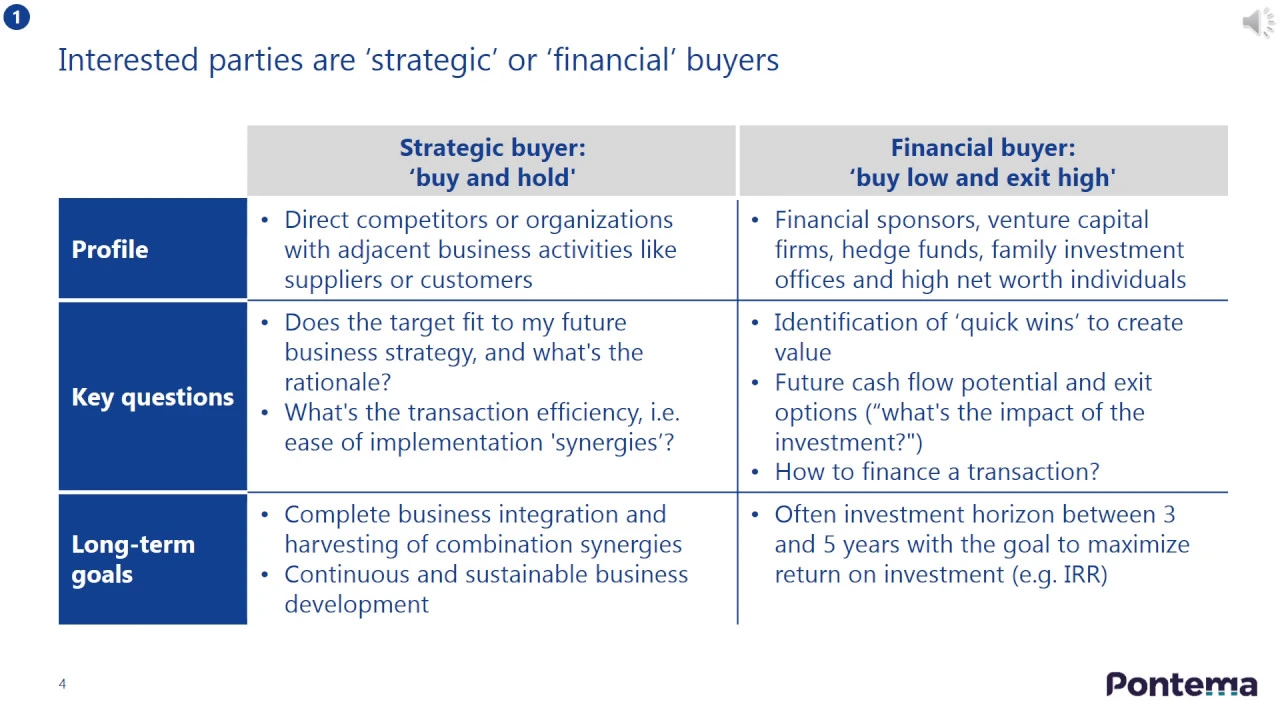
The Mergers and Acquisitions process
14.6K
The first 100 days following an acquisition are critical for realizing value. All acquirers should carefully consider developing the future strategic positioning and organization of the target and identifying capability gaps needing filling. Attention should turn to efficiency improvements such as supply chain optimization to drive business performance. A coherent strategic roadmap and operational agenda lead to a comprehensive 100-day action plan. Early merger integration planning decreases probability of failure and builds toward successful single organization formation.
Click to watch →

The 100 day plan every acquirer needs
214
Most acquisitions fail in the first 100 days after close, not at the deal table; successful integration requires a phased approach: Days 1-30 involve listening and learning without making changes, Days 31-60 focus on identifying and fixing the single constraint holding the business back, and Days 61-100 implement one clearly communicated operational upgrade, as immediate restructuring on day one typically causes the loss of best employees by day 30.
Click to watch →

How Nostalgia Can Boost Employee Retention After Acquisitions | Dr. Boris Maciejovsky
110
A practical implementation framework spans 90 days: First 30 days focus on identity reflection—understanding individual narratives and focusing on continuation symbols, historical narratives, and mission alignment at the individual level. Days 30-90 transition to relational interventions, embedding individuals in their teams and natural work environments, then broadening scope to include combined organization interactions between target and acquirer employees. This gradual progression moves from individual to social environment to integrated recombined environment, building continuity slowly and systematically.
Click to watch →

Transformer une PME familiale en un acteur panafricain en 10 ans - Hassanein HIRIDJEE CEO d'Axian
4.2K
After finalizing an acquisition, AXIAN implements a 100-day integration plan. Teams are given 100 days to prepare a comprehensive plan covering commercial, marketing, finance, technical, IT, and HR aspects. Progress is tracked every 30 days with review meetings. On day 100, a major celebration occurs where the group debriefs with teams for 4 days, comparing what worked, what didn't, and what challenges were faced. The most important question is 'how can we support you?' rather than just demanding growth targets without providing necessary resources.
Click to watch →

M&A and Integration Success – Telecom Insights
123
Effective post-M&A integration planning involves several critical components: building the target operating model and integration design; creating day-one plans and 100-day plans outlining immediate priorities; identifying quick wins to demonstrate progress; establishing transitional services agreements (TSAs) which are separate contracts where the seller provides services to ensure business continuity during the transition period, such as HR or IT systems support. These agreements are often treated as independent contractual obligations requiring separate follow-up.
Click to watch →
Deep Dive
Growth optimization strategies, including modernizing technology systems and implementing digital marketing to scale cash flow.

Danny's Intro Video to Genius Solutions
388
Established businesses that are generating cash flow but could perform better can improve through four key areas: (1) Digital Marketing - requires companies already spending on marketing with some results, offering startup ($3K/month, $25K minimum revenue) and enterprise ($6K/month, $50K minimum revenue) solutions with 6-month programs; (2) Remote Sales - focuses on high-ticket sales and sales funnel optimization, helping businesses close more leads and build trust; (3) Cash Growth - acts as a virtual CFO, analyzing both top-line revenue and bottom-line costs to optimize cash flow with 13-week rolling projections; (4) Agile Leadership (Crystal Circle) - a 12-month program with three levels (Enterprise $12K/year, Emerald $18K/year, Sapphire $24K/year) that provides structured strategic planning and mentoring to help businesses evolve from current to higher performance levels.
Click to watch →

Ele Ensina Como Dominar A Criação De Ofertas E Escalar No Digital | Olivio Brito - Kiwicast #430
7.9K
Scaling requires focusing on profit rather than just ROI metrics - the key is what you keep in your pocket. Three main digital marketing strategies exist: launch strategy (20+ day anticipation), webinar strategy (few-day capture), and direct traffic strategy (immediate cash flow). To improve margins, build complete funnels with multiple upsell and downsell opportunities. A healthy profit margin is 20-30%. Effective campaign scaling requires systematic testing: test creative for 2 days with moderate budget across 2-3 accounts, then move to structure testing (1-3-1 vs 1-5-1). Test winning structures across different ad accounts. When scaling, start with moderate budget and double every 2 hours if performance is good.
Click to watch →

ROMPIENDO EL PARADIGMA QUE A MAYOR RENTABILIDAD, MAYOR RIESGO
127
To increase cash flow, businesses should implement digital marketing strategies including quality photos, compelling descriptions, and positive reviews. Understanding seasonal demand patterns, local events, and market conditions helps businesses optimize pricing and maximize revenue during high-demand periods.
Click to watch →

Microsoft's in a Funk | Coder Radio 56
1.9K
A three-step approach to bringing a company up to date with new technologies: Step 1 - Build a reputation as having strong technical skills without being cocky, by asking colleagues about articles and solutions. Step 2 - Do step 1 with technical leadership, either by making a business case or offering lunch-and-learn presentations. Step 3 - Implement newer technologies or update current ones, starting small to demonstrate value, and be prepared to ask for forgiveness if things don't go as planned.
Click to watch →
![[LIVE Sales Call] Helping My Media Buyer Close a $1250 Deal (Who Said He "Had No Money" 😂)](https://i.ytimg.com/vi/h3oRNuM49oY/maxresdefault.jpg)
[LIVE Sales Call] Helping My Media Buyer Close a $1250 Deal (Who Said He "Had No Money" 😂)
811
Successful business scaling requires addressing both technical implementation and strategic growth. Technical improvements include switching from Facebook boost posts to professional ad management for data ownership, optimizing landing pages with social proof, installation videos, and FAQs, and implementing product bundles to increase average order value. Strategic growth requires overcoming mental barriers including self-limiting beliefs about revenue potential, ego barriers preventing acceptance of help from younger individuals, and misconceptions about cash flow and payment processing. Modern payment processors offer instant payouts, and businesses can scale rapidly when these barriers are addressed.
Click to watch →
Deep Dive
Portfolio management or exit planning strategies for eventually selling the acquired business at a higher multiple.

VR Business Brokers Webinar featuring Walker Deibel
3.5K
Successful buyers should already have an exit plan when they acquire a business. This means having contacts or a plan for eventually selling the company. Building something of value requires thinking about the exit from the beginning. The first priority after closing should be building cash reserves and understanding the business before making any changes.
Click to watch →

Inside Merchant Services Portfolio Acquisitions: Multiples, Attrition, & Exit Strategies
2.6K
Successful portfolio exits require strategic planning rather than simple account offloading. Agents should implement an 'off-ramp' strategy where they continue working for 2 years while negotiating 45-50x multiples on boarded residual revenue. This approach ensures maximum value extraction. Agents must understand that diversified portfolios with low concentration risk command higher multiples, while concentrated accounts (one account representing large revenue percentage) may be excluded entirely during acquisition.
Click to watch →

THE PRIVATE EQUITY PLAYBOOK: Making Billions from Buying Businesses Part 2 with Adam Coffey
9.2K
Exit planning should begin at the start of the investment. There are two main exit windows: the first at $4-7 million in enterprise value (where PE firms with limited partners can invest), and the second at $10-17 million (where larger PE firms become interested). The goal is to buy at 4-5x earnings and sell at 8x, creating multiple expansion. For example, buying $4 million at 5x ($20 million) and selling at 8x ($48 million) creates $28 million in profit. Portfolio building involves acquiring multiple companies simultaneously to create a larger, more valuable entity. Each company can be grown organically to higher enterprise values, then sold at higher multiples. For example, acquiring four companies at $4 million each and growing them to $5-6 million each creates a $20-24 million portfolio that can be sold at 8x ($160-192 million). This strategy creates multiple liquidity events and maximizes returns through multiple expansion.
Click to watch →
![How To Exit Your Company At Higher multiples [Trade Buyers]](https://i.ytimg.com/vi/uHl2zMJjsCk/maxresdefault.jpg)
How To Exit Your Company At Higher multiples [Trade Buyers]
781
Business owners can significantly increase exit value by building a holding company structure before selling. Instead of selling a single company at 3x multiples with deferred payments, owners should acquire 3-5 similar companies to create a larger group. This strategy works because business value is ultimately determined by what buyers are willing to pay, not internal operational efficiencies. The holding company structure allows each subsidiary to operate independently while presenting a consolidated entity with higher revenue and multiple, commanding premium valuations.
Click to watch →

Business Acquisitions and a Successful Exit Ft. Orrin Klopper
133
For successful exit planning: (1) Get a realistic view of valuation early on, as many owners waste time expecting unrealistic multiples; (2) Have a very clear five to ten year view of life goals, passions, and dreams post-exit; (3) Involve your management team in the exit planning process, as they need time to digest and wrap their minds around the transition.
Click to watch →
Boomer Shops
Down Payment
Find Shops
Vast Market
Due Diligence
Financing
Boost Income
Boomer Shops
0:00- 1
Hundreds of boomer-owned firms close daily due to no buyers.
- 2
Series focuses on finding, acquiring, and profiting from these businesses.
The Hidden Risks of Acquisition Entrepreneurship
While the "buy then build" model is popularized as a low-risk shortcut to business ownership, critics point out significant, often glossed-over dangers. First, "key-man risk" is immense; small businesses often depend entirely on the outgoing owner’s personal relationships, leading to high customer churn post-acquisition. Second, buyers face asymmetric information, where sellers hide operational flaws or declining market demand. Most critically, acquiring a business typically requires leveraging substantial debt, often secured by personal guarantees (such as SBA loans). If the business underperforms, the buyer faces personal bankruptcy, transforming a promised "cash-flowing asset" into a catastrophic financial liability. Additionally, managing a small business requires intense, hands-on operational expertise rather than passive oversight, debunking the myth of easy managerial transition.
Understanding of basic financial statements, specifically Cash Flow Statements, Balance Sheets, and Income Statements (P&L).
Familiarity with the concept of EBITDA (Earnings Before Interest, Taxes, Depreciation, and Amortization) and how business valuation is determined.
Basic knowledge of financing mechanisms, including debt vs. equity, SBA (Small Business Administration) loans, and seller financing.
An understanding of the 'Entrepreneurship through Acquisition' (ETA) model compared to starting a business from scratch.
Advanced due diligence methodologies, including financial, legal, and operational audits of a target business.
Deal structuring tactics, such as negotiating asset vs. stock purchases, earn-outs, and working capital pegs.
Post-acquisition integration and 100-day transition planning to ensure operational continuity and team retention.
Growth optimization strategies, including modernizing technology systems and implementing digital marketing to scale cash flow.
Portfolio management or exit planning strategies for eventually selling the acquired business at a higher multiple.
350.3K views9.6Klikes0:52@CodieSanchezCTOriginal Release: 2025-09-05
Every day, hundreds of businesses owned by baby boomers are shutting down because they have nobody left to buy them. So, I started a series showing you how to find them, buy them, and get rich. And today, we're talking about mechanic shops. Step one, you get 20 to 60K for a down payment. You just need enough money to get financing.
Step two, find an auto repair shop with space to service two or three cars at a time. You want something in a good location with strong Google reviews, and most importantly, a boomer owner who's ready to walk away. Baby boomers own 58% of small businesses in the US, so the opportunities are vast. Step three, do your due diligence. You're looking at 3 to 5 years of tax returns, customer lists, and you're asking the staff if they plan to stay. Step four, finance the deal. You can even use a loan and put down 10% or get seller financing.
Step five, do it better than the last business owner. There are three things you can do immediately to increase your income. Step one, see if underpriced services can be increased. Step two, set up subscription packages. Step three, modernize systems.
Up Next

14:25
Website Valuation: Key Factors & Multiple Ranges
@TheAffiliateSchool
1.1K views•2022-04-13

46:36
Retention Habits of Top DTC Ecommerce Brands Revealed
@SendItPodcast
44K views•2026-03-03

79:36
Business Acquisition Playbook: Finding Undiscovered Firms
@CodieSanchezCT
261.3K views•2025-08-24

17:30
The Planned Obsolescence of Light Bulbs and Tech
@veritasium
25.3M views•2021-03-26
Related Study Plans & Knowledge Roadmaps
Structured learning paths in Business
business
Pop-Up Retail: Strategy, Design & Execution
01Introduction to Pop-Up Retail & Strategic Goal Setting
02Budgeting, Site Selection, and Legal Essentials
03Experiential Retail Design & Visual Merchandising
+ 2 more learning modules
15h5 modules
Explore Roadmap
business
Reg CF: Startup Funding, Marketing & Launch
01Introduction to Equity Crowdfunding & Reg CF
02Platform Selection & Legal Preparation
03Crafting High-Converting Campaign Assets
+ 2 more learning modules
14h5 modules
Explore Roadmap
business
Productized Services: Scaling Solo Freelance
01Foundations of Productized Services
02Packaging and Scope Definition
03Pricing and Subscription Models
+ 2 more learning modules
15h5 modules
Explore Roadmap
business
Gov Procurement: Find, Bid & Win Contracts
01Introduction to Government Procurement & Business Setup
02Small Business Certifications & Set-Asides
03Finding and Analyzing Contract Opportunities
+ 2 more learning modules
14h5 modules
Explore Roadmap