








![Zwyczajna żarówka [TOWARY MODNE 135]](https://i.ytimg.com/vi_webp/VzuwJar-YPc/maxresdefault.webp)
























Planned obsolescence is a business strategy where companies intentionally design products to have shorter lifespans to increase sales and profits, as demonstrated by the Phoebus Cartel's 1924 agreement among major light bulb manufacturers to limit bulb lifespans to 1,000 hours, which increased sales by 25% while reducing average bulb lifespan from nearly 2,000 hours to just 1,205 hours; this practice has continued in various forms across industries, including electronics (Apple's battery throttling) and automobiles (General Motors' dynamic obsolescence), though consumers are increasingly fighting back through 'right to repair' legislation.
The Planned Obsolescence of Light Bulbs and Tech
Added:The concept of market structures, specifically oligopolies and cartels, and how collusive behavior influences product standards.
A foundational definition of planned obsolescence and its distinction from functional obsolescence.
Basic principles of incandescent light bulb technology, including how filament thickness and electricity affect bulb lifespan.
The transition from 19th-century manufacturing durables to 20th-century mass consumerism and economic growth models.
The 'Right to Repair' movement, including current legislative battles and consumer rights advocacy in the modern technology sector.
Principles of Sustainable Design and the Circular Economy, focusing on cradle-to-cradle product lifecycles rather than linear disposal.
The environmental and geopolitical impacts of electronic waste (e-waste) disposal and global recycling supply chains.
Antitrust laws and consumer protection regulations designed to prevent collusive market behavior and monopolistic practices.
25.3M views852.1Klikes17:30Original Release: 2021-03-26
- This is a video about things like cars, phones, and light bulbs and an actual conspiracy that made them worse.
This video was sponsored by NordVPN, more about them at the end of the video I am outside Livermore Fire Station, number six.
And in here, they have the longest, continuously on light bulb in the world.
It has been on for 120 years since 1901.
There it is.
- [Host] Yeah, that's it.
- It's not even connected to a light switch but it does have a backup battery and generator.
So the big question is, how has this light bulb lasted so long?
It was manufactured by hand not long after commercial light bulbs were first invented, And yet, it has been running for over a million hours, way longer than any light bulb today is meant to last.
Awhile back, a friend of mine told me this story, that someone had invented a light bulb that would last forever years ago, but they never sold it because an everlasting light bulb makes for a terrible business model.
I mean, you would never have any repeat customers and eventually you would run out of people to sell light bulbs to, I thought this story sounded ridiculous.
If you could make an everlasting light bulb, then everyone would buy your light bulb over the competitors.
And so you could charge really high prices, make a lot of money, even if demand would eventually dry up.
I just couldn't imagine that we had better light bulbs in the past and then intentionally made them worse, but it turns out I was wrong.
At least sort of.
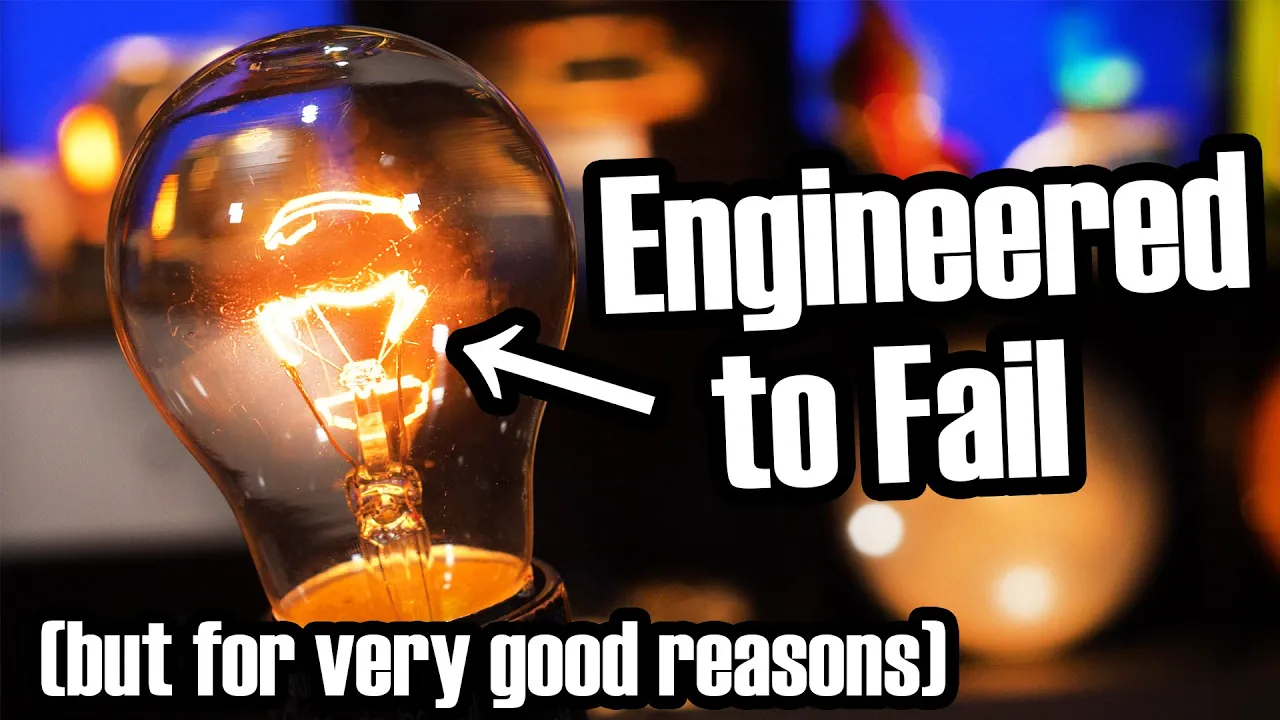
Inventing a viable electric light was hard, I mean, this is the typical incandescent design, which just involves passing electric current through a material making it so hot that it glows, less than 5% of the electrical energy comes out as light.
The other 95% is released as heat.
So these are really heat bulbs, which give off a little bit of light as a by-product.
The temperature of the filament can get up to 2,800 Kelvin.
That is half as hot as the surface of the sun.
At temperatures like those, most materials melt.
- That's so cool. - And if they don't melt, they burn, which is why in the 1840s, Warren De la Rue came up with the idea of putting the filament in a vacuum bulb, so there's no oxygen to react with.
By 1879, Thomas Edison had made a bulb with a cotton thread filament that lasted 14 hours.
Other inventors created bulbs with platinum filaments or other carbonized materials.
And gradually, the lifespan of bulbs increased.
The filaments changed from carbon to tungsten, which has a very high melting point.
And by the early 1920s, average bulb lifetimes were approaching 2,000 hours with some lasting 2,500 hours.
But this is when lifetimes stopped getting longer and started getting shorter.
In Geneva, Switzerland just before Christmas, 1924, there was a secret meeting of top executives from the world's leading light bulb companies, Phillips, International General Electric, Tokyo Electric, OSRAM from Germany, and the UK's Associated Electric among others.
They formed what became known as the Phoebus Cartel named after Phoebus, the Greek God of light.
There, all these companies agreed to work together to help each other by controlling the world supply of light bulbs.
In the early days of the electrical industry, there had been lots of different small light bulb manufacturers, but by now they had largely been consolidated into these big corporations, each dominant in a particular part of the world.
The biggest threat they all faced was from longer lasting light bulbs.
For example, in 1923, OSRAM sold 63 million light bulbs, but the following year they sold only 28 million.
Light bulbs were lasting too long, eating into sales.
So all the companies in the cartel agreed to reduce the lifespan of their bulbs to 1,000 hours cutting the existing average almost in half.
But how could each company ensure that the other companies would actually follow the rules and make shorter lasting light bulb.
After all, it would be in each of their individual interests to make a better product to outsell the others?
Well, to enforce the 1,000 hour limit, each of the manufacturers have to send in sample bulbs from their factories and they were tested on big test stands like this one.
If a bulb lasted significantly longer than 1,000 thousand hours, then the company was fined.
If a bulb lasted longer than 3000 hours, well the fine was 200 Swiss Francs for every 1,000 bulbs sold.
And there are records of these fines being issued to companies.
But how do you make a worst light bulb in the first place?
Well, the same engineers who had previously been tasked with extending the lifespan now had to find ways to decrease it.
So they tried different materials, different shaped filaments, and thinner connections.
And if you look at the data, they were successful.
Ever since the formation of the cartel.
the lifespan of light bulbs steadily decreased.
So that by 1934, the average lifespan was just 1,205 hours.
And just as they had planned, sales increased for cartel members by 25% in the four years after 1926.
And even though the cost of components came down, the cartel kept prices virtually unchanged, so they increased their profit margins.
So did people know that the light bulb companies were conspiring together to make their products worse?
No, the Phoebus Cartel claimed that its purpose was to increase standardization and efficiency of light bulbs.
I mean, they did establish this screw thread is standard.
You can find it on virtually all light bulbs around the world now.
But all evidence points to the cartels being motivated by profits and increased sales, not by what was best for consumers.
So one of the reasons this light bulb has lasted so long is because it was made before the cartel era.
Another reason is because the filament has always been run at low power, just four or five watts.
It was meant to be a nightlight for the fire station to provide just enough light so that firemen wouldn't run into things at night.
And the fact that it was always on reduced the thermal cycling of the filament and components limiting the stress caused by thermal expansion and contraction.
The Phoebus Cartel was initially planned to last at least until 1955, but it fell apart in the 1930s.
It was already struggling due to outside competition.
And non-compliance amongst some of its members, but the outbreak of World War II is really what finished it off.
So this cartel was dead, but its methods survived to this day.
There are lots of companies out there that intentionally shortened the lifespan of their products it's a tactic known now as planned obsolescence.
This was actually the subject of Casey Neistat's first viral video all the way back in 2003.
- [Support] Thank you for calling Apple, my name is Ryan.
May I have your first name please?
- [Casey] Casey.
- [Support] ] All right, and what seems to be the issue today?
- [Casey] I have an iPod that I bought about 18 months ago and the battery is dead on it.
- [Support] 18 months, okay, it's past it year, which basically means there'll be a charge of $255 plus a mailing fee to send it to us to refurbish, to correct it.
But at that price, you might as well go get a new one.
- [Narrator] This video got millions of views in a time before YouTube or social media.
And it spawned a class action lawsuit, which Apple settled out of court, but it didn't stop the company from practicing planned obsolescence.
After an iOS update in 2017, users of older iPhones found apps loading significantly slower or the device shutting down altogether.
Apple said they throttled performance to protect the battery of older devices and increase their longevity.
Of course, that wouldn't be an issue if the battery were replaceable.
In a series of lawsuits that concluded in 2020, Apple was fined or reached settlements to pay hundreds of millions of dollars, undoubtedly, this amount pales in comparison to the extra revenue they generate by limiting the lifespan of their products.
But some would argue that planned obsolescence isn't just about greed, but that it's also good for everyone.
During the great depression in the 1930s when as much as 1/4 of Americans were out of work and real estate broker Bernard London proposed mandatory planned obsolescence as a way to get people back to work and lift America out of the depression.
He wrote, "I would have the government assign a lease of life to shoes, and homes, and machines when they are first created and they would be sold and used within the term of their existence, definitely known by the consumer.
After the allotted time had expired, these things would be legally dead and would be controlled by the duly appointed governmental agency and destroyed if there is widespread unemployment."
Now, this might sound like a wild fringe idea, but people were clearly afraid of being put out of work by technological progress and products that were too good.
There was even a popular Oscar nominated film about it.
"This is the man in the white suit from 1951."
It's about a scientist who invents the perfect fiber.
It won't stain or break, or fray.
- I think I've succeeded in the copolymerization of amino acid residues and carbohydrate molecules, both containing ionic groups.
It's really perfectly simple.
- [Narrator] The Academy award nomination was for best screenplay, I kid you not.
Anyway, everyone is initially excited about our heroes scientific discovery.
He makes a suit out of the thread and it has to be white because the fiber is so stain resistant, it can't even be dyed, but this is when trouble strikes, the factory owners realize they won't be able to sell as much of this thread because it's so durable.
And the workers worry it'll put them out of a job.
- Why can't you scientists leave things alone?
What about my better washing when there's no washing to do?
- This is when you get the climactic scene where factory workers and factory owners team up to chase down the scientist to destroy him and his invention.
And believe it or not, this movie may have been inspired by real events.
In the 1940s, the synthetic fiber nylon replaced silk in stockings, and it was so durable that the products became an overnight sensation.
There were literal riots when women tried to get their hands on them.
When the manufacturers realized they had made the product too good, they didn't destroy the fiber, but they did follow the example of the Phoebus Cartel.
They instructed their engineers and scientists to find ways to weaken the product to shorten its lifespan, so people would have to buy more.
Now, it seems like consumers are finally fighting back against planned obsolescence.
In the European union and in over 25 states in the US, there's proposed legislation to enshrine the right to repair.
And these laws would force manufacturers to make it easier to repair their products.
They would have to provide information and access to parts.
So you could replace a battery or fix a cracked screen at a third-party repair shop without voiding your warranty.
So if right to repair does become law, does that mean artificial obsolescence will be gone for good?
Sadly, no, because there is one last thing manufacturers can use to make their products obsolete, which is you.
(instrumental music) Henry Ford released the first mass market car, the model T in 1908.
And he envisioned it like a workhorse, an affordable tool that wouldn't wear out, a bit like the everlasting light bulb.
In 1922 Ford said, "We want the man who buys one of our cars never to have to buy another, we never make an improvement that renders any previous model obsolete."
But by 1920, 55% of American families already owned a car.
Nearly everyone that could afford one had one.
And that same year, there was a small economic downturn driving down sales for both Ford and General Motors.
In 1921, DuPont, the chemical and paint company took over the controlling share in General Motors.
And they started experimenting with painting cars different colors, up until then, Henry Ford had said, you could have whatever color you like so long as it's black.
It took a couple of years of testing, but in 1924, GM released their first cars in different colors.
And soon after, they introduced a trick that feels very familiar now.
Each new year, they would introduce cars in different colors.
The goal wasn't just to make Ford's model T lookout dated, but to make their own cars feel outdated every year encouraging customers to trade in their old cars for shiny new ones.
Years later, GM's head of design, Harley Earl, candidly discussed his role in creating what he called dynamic obsolescence.
"Our big job is to hasten obsolescence.
In 1934, the average car ownership span was five years.
Now, which was 1955, it is two years.
When it is one year, we will have a perfect score.
By the time he said this, General Motors was the most valuable company in the world and it's sold half of all vehicles purchased in the US every year.
These days, the world's most valuable company, Apple, seems to have copied directly out of this playbook.
I mean, new styles every year, check, new special colors every year, check, marginal technological improvement, check.
I mean, is this useful innovation or just a gimmick?
The inspiration for General Motors and hence for Apple comes from fashion where real innovation is all but impossible.
So the only way to make people feel the urgency to get out there and buy is to create styles that last but one season.
The trouble then is you run through these styles too quickly.
And then what are you supposed to do?
Well, just recycle the styles from a few decades ago.
The iPhone also shows this recycling trend.
I mean, just look at the way the edges were initially rounded and then they were squared off and then they were rounded again and now, they're squared off.
And how much do you want to bet that the iPhone 14 has rounded edges?
I think the point is that with design and styling, there is no best, there's only different, which is apparently enough to remind us that we don't have the latest and greatest, and so we have to rush out and keep buying.
The only type of obsolescence we should support is technological, which brings us back to the light bulb.
In the last 20 years, light bulbs have gone from incandescent, which was basically unchanged for 100 years to compact fluorescent.
And now, to LED, these use just a 10th of the energy and can last anywhere from 10 to 50 times longer.
Yeah, that's pretty bright.
So you're more likely to sell your house than to have to replace an LED bulb that you've installed inside it.
So we finally reached the point of what is essentially an everlasting light bulb?
(upbeat music) Hey, this video was sponsored by NordVPN.
I am featured in an episode of the British TV program, "QI," it's a show I really like, and I'd highly recommend it if you haven't seen it already.
And it's on Netflix, but only if you're in the UK.
I feel like TV and film are still trapped in antiquated business models where they divide up the world into broadcast territories that doesn't make a lot of sense now that information can flow freely through the Internet.
Luckily using NordVPN, anyone can set their location to the UK and watch whatever they like.
If you're interested in seeing what streamers have to offer in different countries, you can get a huge discount on a two-year plan at nordvpn.com/veritasium.
Use code very Veritasium to get an extra month free and using NordVPN, you can also protect your privacy by masking your IP address.
In fact, you can change your IP twice to cover your web traffic with an extra layer of security.
NordVPN has a no logs policy, they don't track collect or share your private data, which is what a lot of the world's biggest companies are trying to do right now.
So for privacy, when browsing and access to all the shows the world has to offer, go to nordvpn.com/veritasium for a huge discount of a two year plan and use code Veritasium to get one additional month free.
And this is all risk-free with no Nord's 30-day money back guarantee.
So I wanna thank NordVPN for sponsoring Veritasium and I wanna thank you for watching.
Up Next

11:57
Planned Obsolescence vs. Heirloom Electronics: The Last Game Boy
@casey
942.4K views•2025-07-10
46:36
Retention Habits of Top DTC Ecommerce Brands Revealed
@SendItPodcast
44K views•2026-03-03

15:23
Decoy Effect: How Pricing Psychology Influences Consumer Spending
@bobinvestsUS
90K views•2026-01-05

152:35
Recycling Innovations: Trash-to-Treasure Technologies & Sustainability
@BusinessInsider
13.6M views•2023-01-11
Related Study Plans & Knowledge Roadmaps
Structured learning paths in Business
business
Pop-Up Retail: Strategy, Design & Execution
01Introduction to Pop-Up Retail & Strategic Goal Setting
02Budgeting, Site Selection, and Legal Essentials
03Experiential Retail Design & Visual Merchandising
+ 2 more learning modules
15h5 modules
Explore Roadmap
business
Reg CF: Startup Funding, Marketing & Launch
01Introduction to Equity Crowdfunding & Reg CF
02Platform Selection & Legal Preparation
03Crafting High-Converting Campaign Assets
+ 2 more learning modules
14h5 modules
Explore Roadmap
business
Productized Services: Scaling Solo Freelance
01Foundations of Productized Services
02Packaging and Scope Definition
03Pricing and Subscription Models
+ 2 more learning modules
15h5 modules
Explore Roadmap
business
Gov Procurement: Find, Bid & Win Contracts
01Introduction to Government Procurement & Business Setup
02Small Business Certifications & Set-Asides
03Finding and Analyzing Contract Opportunities
+ 2 more learning modules
14h5 modules
Explore Roadmap