






![Биология поведения человека: Лекция #23. Язык [Роберт Сапольски, 2010]](https://i.ytimg.com/vi/_knieax3HK8/maxresdefault.jpg)


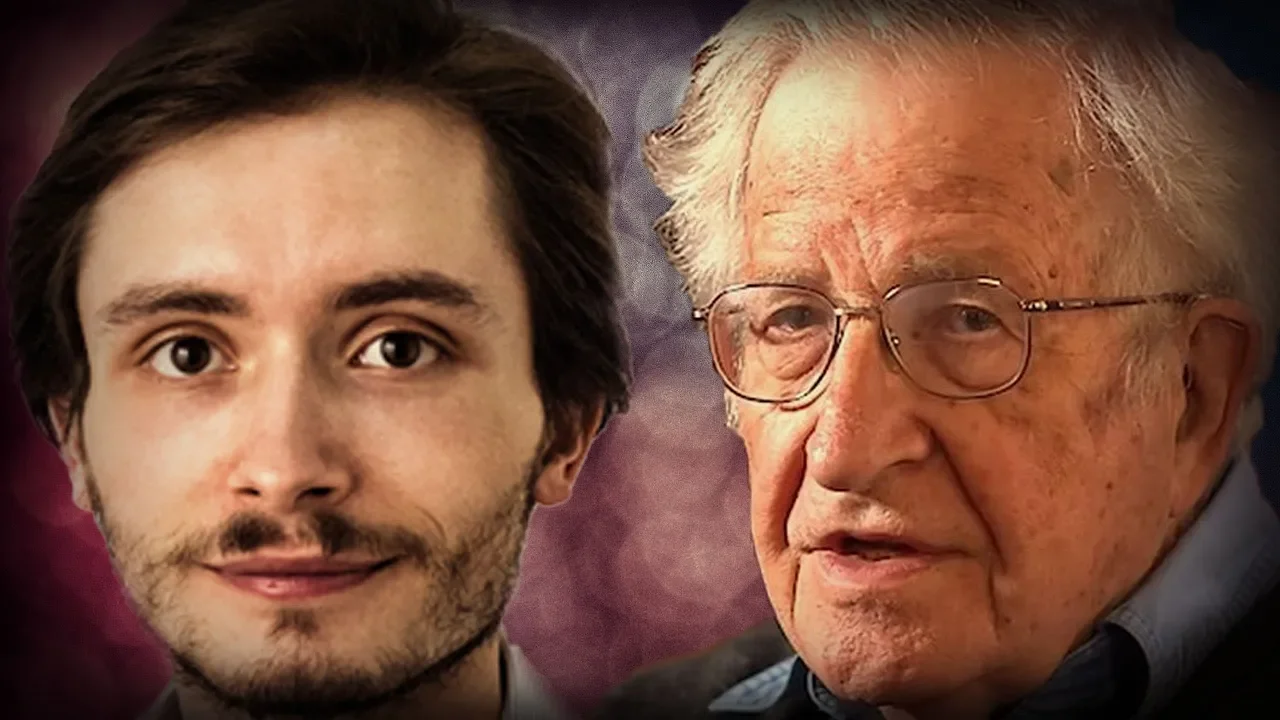









The biolinguistic approach treats language as a biological system, specifically a computational faculty of the human brain with an innate initial state that enables children to acquire complex language despite limited environmental input; this perspective challenges traditional mind-body dualism by viewing mental faculties as emergent properties of biological computation, similar to how other biological systems operate, and suggests that understanding language requires examining the interplay between innate principles, experiential factors, and general computational constraints rather than treating language as a separate mental phenomenon.
Noam Chomsky on Language & Mind: The Biolinguistic Turn (2003) | UC Berkeley Lecture
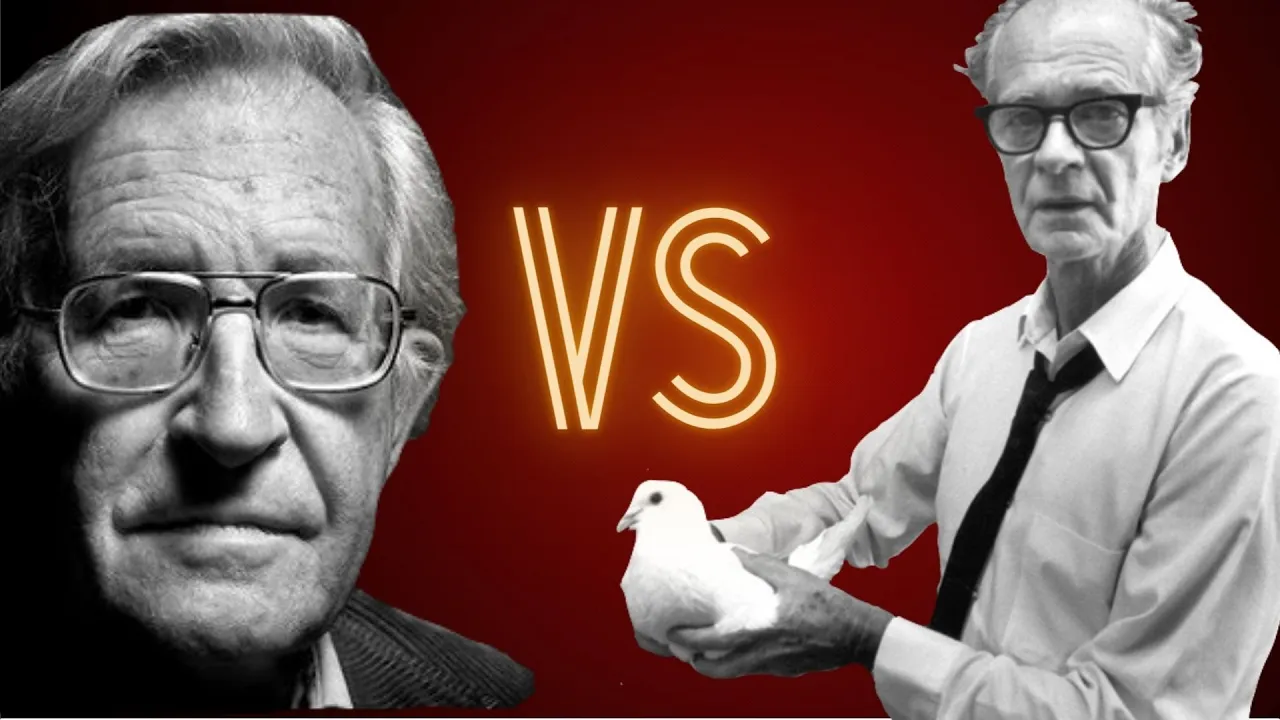
Added:The historical debate between B.F. Skinner's Behaviorism and Chomsky's Nativist theory of language acquisition.
The concept of Universal Grammar (UG) and the hypothesis of an innate Language Acquisition Device (LAD).
The 'Poverty of the Stimulus' argument, which posits that linguistic input alone is insufficient to explain a child's rapid language mastery.
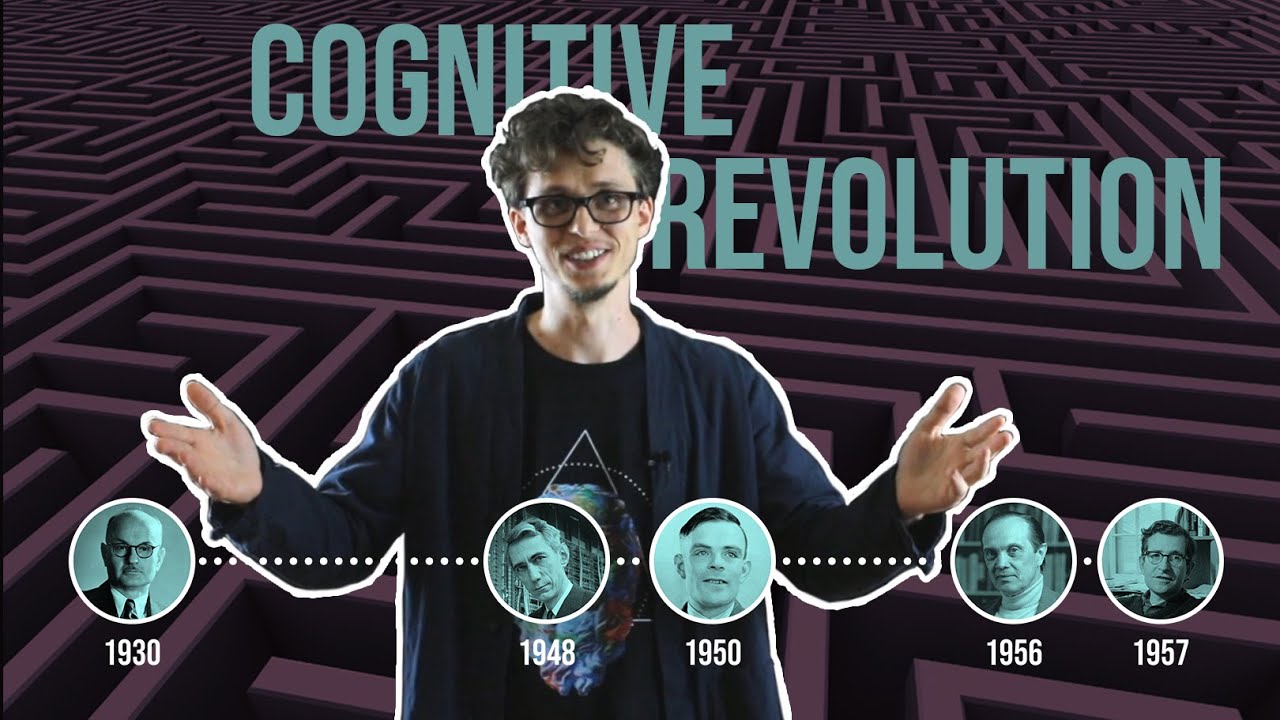
Basic tenets of the 1950s Cognitive Revolution, which shifted psychological focus from external behavior to internal mental representations.
The Minimalist Program, Chomsky's subsequent theoretical framework aiming to simplify generative grammar down to essential computational mechanisms.
Neurolinguistics and cognitive neuroscience, exploring how modern brain imaging (like fMRI) investigates the physical substrate of language.
The evolutionary biology of language, focusing on how the capacity for syntax evolved in Homo sapiens (including the debate between adaptationist and non-adaptationist views).
A comparative analysis between biolinguistic models and connectionist/statistical approaches used in modern Natural Language Processing and LLMs.
201.2K views1.7Klikes1:27:52Original Release: 2008-01-11
(soft music) - Almost exactly 35 years ago, I had the opportunity to give several lectures here, same auditorium I think on the topic language and mind.
And quite a lot has been learned in the intervening years about language and the brain, hence the mind in the sense in which I used the term then, the term mind, and mental and such terms.
And those lectures, (audience member speaking off mic) Pardon.
Aw, thank you.
(all laughing) And we'll continue to use them now, always nice to have a friend in the audience.
(audience laughing) I'm using these terms as just descriptive terms for certain aspects of the world, pretty much on a par with such descriptive terms as a chemical or optical electrical, and so on.
These are terms used to focus attention on particular aspects of the world that seem to have a rather integrated character, and to be worth considering for a special investigation but without any illusions that they cut nature at the joints.
In those earlier lectures, I took for granted that human language can reasonably be studied as part of the world, specifically is a property of the human organism mostly the brain and for convenience, I'll keep to that.
Both then and now, I'm adopting what Lyle Jenkins in a recent book calls the biolinguistic perspective, that's the framework within which the approach to language that I'm considering developed about 50 years ago.
Also for convenience, I'll use the term language to refer to human language, that's a specific biological system there is no meaningful question as to whether the communication system of bees or what might be taught the Apes, or mathematics or music, there's no question as to whether these are languages or whether airplanes really fly or submarines really swim, or whether computers think or translate languages, or other comparably meaningless questions many of them based on a misinterpretation of a important paper by Alan Turing little over 50 years ago in 1950, which has spawned a large and to my mind mostly misguided literature, explicitly, despite Turing's very explicit warning not to pursue that direction which has apparently been overlooked.
From the bio linguistic perspective, language is a component of human biology more or less on a par with mammalian vision or insect navigation, and other systems for which the best theories that have been devised, attribute, computational capacities of some kind, what's in informal usage sometimes called rule-following.
So for example, contemporary texts on vision describes the so called rigidity principle, it's formulated about 50 years ago as follows.
That says if possible, and other rules permit, interpret image motions as projections of rigid motion in three dimensions.
In this case later work provided substantial insight into the mental computations, that seemed to be involved and when the visual system follows these rules in informal terminology.
But even for very simple organisms that's no slight test.
A great many issues remain unresolved in these areas which are quite obscure even for insects.
The decision to study languages part of the world, in this sense should be in my view uncontroversial but it has not been, on the contrary, the assumption that this is a legitimate enterprise was rejected pretty forcefully 50 years ago and continues to be rejected.
Virtually all of contemporary philosophy of language and mind is based on rejection of the assumption.
The same is true of what's called the computer model of mind that underlies a good deal of theoretical cognitive science denied in this case not only for language but for mental faculties generally.
It's explicitly denied, and the technical linguistic literature and what are called plate mystic, accounts of language and also in a different way denied by the conceptualism that was devised by the same authors inaccurately attributed to many linguists including me.
It's also apparently denied by many sociolinguists, it's incompatible with structural, behavioral approaches to language.
It's a little to my surprise rejected by current studies of language by leading neuroscientists most notably Terrence Deacon and recent work which has been favorably received by eminent biologists, again little to my surprise.
The approach therefore seems to be controversial, but I think the appearances are misleading.
A more careful look will show I think that the basic assumptions are tacitly adopted even by those who strenuously reject them, and indeed have to be adopted even for coherence.
I'm gonna put aside this interesting topic of contemporary intellectual history, and I'll simply assume that language can be studied as part of the world, continue in other words to pursue the biolinguistic approach that took shape about half a century ago, heavily influenced by ethology, comparative psychology and intensively pursued then along quite a few different paths, including much of the work that claims to reject the approach.
Well, assuming that turn to some things that ought to be obvious.
It can scarcely be denied that some internal state is responsible for the fact, that I speak and understand some variety of what's loosely called English, but not say Hindi or Swahili at the borrow and in fact adapt a traditional term, we can call this the state whatever it is, it's internal to me, a state of the human faculty of language primarily a state of the brain.
We can call each such state an internalized language in the technical literature often called an I language for simplicity I'll call it that.
It should also be uncontroversial, that the Faculty of language has an initial state part of our biological endowment which permits a certain range of options, the attainable I languages.
The Faculty of language then is a special property that enables my granddaughter, but not her pet kitten or chimpanzee to attain a specific I language on exposure to appropriate data, data which her mind in some obscure way is able to extract from the booming, buzzing, confusion and to interpret as linguistic experience, that's no slight task nobody knows how it's done but it obviously is.
More accurately every infant acquires a complex of such states, that's a complication that I'll put aside.
The expectation that language is like everything else in the organic world, and therefore is based on a genetically determined initial state, that it distinguishes say my granddaughter from her pets that assumption has been called the innateness hypothesis.
And there's a substantial literature debating the validity of the innateness hypothesis.
The literature has a curious character there are lots of condemnations of the hypothesis, but it's never formulated and nobody defends.
It's alleged advocates of, of whom I'm one, I have no idea what the hypothesis is.
Everyone has some innateness hypothesis concerning language at least, everyone who's interested in the difference between an infant and say her pets.
Furthermore, the invented term innateness hypothesis is completely meaningless, there is no specific innateness hypothesis rather there are various hypotheses, about what might be the initial genetically determined state these hypotheses are of course constantly changing as more is learned, that all should be obvious.
Confusion about these matters has reached such extreme levels, that it's becoming hard even to unravel but I'll put all that aside.
The bio linguistic approach takes mental faculties to be states of the organism.
In particular, internal languages, I languages that are states of the Faculty of language.
I'll focus on language, but most of what follows that should hold as well for other cognitive faculties and in fact for far simpler organisms, say a bee communication or navigation for example.
Well, when we adopt this approach, several questions arise at once.
The central one is to determine the nature of the initial and attained States.
And though the matter again appears to be controversial I know of no serious alternative to the thesis that these are in substantial measure computational states, whether we have in mind insect navigation or what you and I are doing right now.
Again, that's held to be controversial but since there's no alternative ideas I don't understand why.
It's held to be controversial for humans it's not held to be controversial for say, insect navigation but the questions about the same.
Investigation of the brain in these terms is sometimes called psychological, and it's contrasted with investigation of term in terms of cells chemical processes, electrical activity and so on that's called physiological.
These are again terms of convenience, they don't have any sharp boundaries, chemistry and physics were distinguished in pretty much similar way, not very long ago.
So, the formulas involving complex molecules that we now study in school.
These were pretty recently considered to be, I'm quoting merely classific story symbols, that summarize the observed course of a reaction.
The ultimate nature of the molecular groupings was held to be unsolvable, and the actual arrangement of atoms within a molecule if that even means anything, was never to be read into the formulas.
I'm quoting from a standard history of chemistry.
Keiko Leong whose structural chemistry paved the way to eventual unification of the chemistry and physics, he doubted that absolute constitution of organic molecules could ever be given, his own models his analysis of valency and so on were to have only an instrumental interpretation as calculating devices.
The actually large parts of physics were understood in the same way, by prominent scientists including the molecular theory of gases even Bohr's model of the atom.
In fact, only a few years before physics and chemistry were united in Linus Pauling's account of the chemical bond, America's first Nobel prize-winning chemist, dismissed talk about the real nature of chemical bonds as in his terms metaphysical twaddle, this was nothing more than a very crude method of representing certain known facts about chemical reactions a mode of representation only, just a calculating device.
The rejection of this skepticism by a few leading scientists whose views were incidentally condemned as a conceptual absurdity, that paved the way to the eventual unification.
These are fairly recent debates, this is talking about the 1920s.
These fairly recent debates in the hard sciences, I think have considerable relevance for today's controversies concerning computational theories of cognitive capacity, that's from insects to humans.
Important topic, one that discussed a little bit elsewhere and I think deserves a good deal more attention than its received.
Well, with the biolinguistic approach in place, this framework in place, we wanna discover the relationship between psychological states and the world as described in other terms.
We want to know how computational states are related to neuro physiological states, states of the brain were represented in them and one terminology.
We also want to find out how these mental states relate to the organism external world, as for example when the motions and noises produced by a forager be direct others to a distant flower, or when I talk about a recent trip to India or when I say that I recently read Darwin's Dissent of Man, referring to a book, all of this is called intentionality and philosophical jargon.
The broad issues were raised prominently at the end of the decade of the brain, which brought the last millennium to a close.
The American Academy of Arts and Sciences and at the end of the millennium year 2000 published the volume to mark the occasion, that summarized the current state of understanding in these areas.
The guiding theme of the volume was formulated by a distinguished neuroscientist Vernon MountCastle in his introduction to the collection.
It is in his words, the thesis that things mental indeed minds are emergent properties of brains, though these emergences are not regarded as irreducible but are produced by principles that control the interactions between lower-level events, principles we do not yet understand.
That same thesis has been put forth in recent years as quoting as an astonishing hypothesis of the new biology, a radically new idea in the philosophy of mind, the bold assertion that mental phenomena are entirely natural and caused by neuro physiological activities of the brain, opening the door to new and promising inquiries and so on.
Contributors to the American Academy volume, were for the most part quite optimistic about the prospects for overcoming the remaining gaps between psychological and physiological accounts.
Mountcastle's phrase, "We do not yet understand."
Reflects that optimism suggests we will soon understand.
Wilson wrote that, "Researchers now speak confidently "of a coming solution to the brain mind problem."
Similar confidence has been expressed for half a century including announcements by prominent scientists, Nobel Prize winner in one case that the brain, mind problem has already been solved.
We may recall usefully similar optimism shortly before the unification of chemistry and physics.
So in 1929, Bertrand Russell who knew the sciences well, he wrote that chemical laws cannot at present be reduced to physical laws.
In his phrase at present, like Mountcastle's word yet expresses the expectation, that the reduction should take place in the course of scientific progress, perhaps soon.
Now, in the case of physics and chemistry it never did take place, and what happened was something different and totally unexpected.
Namely, unification of a virtually unchanged chemistry with a radically revised physics.
And it's hardly necessary to stress the fact that the state of understanding and achievement in these areas, 50, 80 years ago was far beyond anything that can be claimed for the brain and cognitive sciences today, which oughta give us pause.
The American Academy volume reviews many important discoveries, but the leading thesis should arouse our skepticism.
And not only for the reason that I just mentioned, another reason is that the thesis is by no means new.
In fact, it was formulated and virtually the same words two centuries ago, late 18th century, by the eminent chemist Joseph Priestley.
He wrote that properties of mind arise from the organization of the nervous system itself, and those properties termed mental are the results of the organical structure of the brain, just as matter is possessed of powers of attraction and repulsion that act at a distance contrary to the founding principles of modern scientific revolution from Galileo to Newton and Beyond.
Half a century before Priestley, David Hume had casually described thought as a little agitation of the brain, and shortly after the French philosopher, physician Gabonese wrote that the brain must be considered a special organ designed to produce thought as the stomach and the intestines are designed to operate the digestion, the liver, to filter bile and various glands to prepare salivary juices.
Lemetri, he had similar proposals, they were suppressed at the time but they're well known today.
A century later, Darwin asked rhetorically, why thought being a secretion of the brain should be considered more wonderful than gravity which is a property of matter.
Actually, these and many other conceptions developed from an inquiry, into what was called thinking matter in part developed from what's sometimes called by historians of philosophy Locke's suggestion, John Locke's suggestion.
That is, his observation in his words that God might have chosen to super add to matter a Faculty of thinking, just as he annexed effects to motion which we can in no way conceive motion able to produce the theological apparatus, may well have been for self-defense.
So Locke's correspondent suggests.
By the late 18th century, the thesis was widely regarded as inescapable.
Newton had demonstrated to his considerable dismay that matter does not exist, in the sense of the Galilean revolution and of the scientists of his own day and his own sense.
That being the case, the mind-body problem could no longer even be formulated, at least in anything resembling the classical form.
Current formulation, as seem at best to restate the problem of unification of psychological and physiological approaches, and to do so in highly misleading terminology.
There was no mind-body problem, any more than there was a chemistry physics problem in the 1920s.
Unification of Newton's discoveries led to, they really left no coherent alternative to the conclusion that was drawn by Hume Priestley, others and rediscovered today in pretty much the same terms.
But with the problem of emergence, as unresolved as it was two centuries ago and that includes the question whether this notion, with its reductionist connotations is even the right notion, maybe it's the wrong notion, as proved to be the case for chemistry and physics.
The traditional mind-body problem is often ridiculed as a problem of the ghost in the machine but that's misconception.
Newton exorcized the machine, he left the ghost completely intact.
A similar observation is made very recently by two physicists Paul Davies and John Griffin concluding a book of theirs, called the Matter Myth.
They write that during the triumphal phase of materialism and mechanism in the 1930s, that Gilbert Ryle derided, mind-body dualism in a pithy reference to the mind part, as the ghost in the machine.
But already when he coined that pithy expression in the 1930s, the new physics was at work undermining the materialist worldview on which Ryle's philosophy was based.
By the end of the 20th century they continue, we can see that Ryle was right to dismiss the notion of the ghost in the machine, not because there is no ghost but because there is no machine.
Their point is correct, but the timing is off by at least two centuries, actually three.
Although, it did take some time for Newton's demolition of what was called at the time, the mechanical philosophy, the belief that the world is a machine, it took a little time for that to enter scientific common sense.
Newton himself was well aware of the conclusion and far from pleased by it.
He regarded his own conclusion as an absurdity that no serious person could entertain, and he sawed away around it to the end of his life as did prominent scientists of his day, and much later always in vain.
Over time, it just came to be recognized that Newton had not only effectively destroyed the entire materialist, physicalist conception of the universe, but he had also undermined the standards of intelligibility on which the early Scientific Revolution was based.
The outcome is familiar at least in history of science, it was described very well in the classic 19th century history of materialism by Friedrich Longa.
He pointed out that scientists have accustomed theirselves to the abstract notion of forces, or rather a notion hovering in a mystic obscurity between abstraction and concrete comprehension.
A turning point in the history of materialism that removes the surviving remnants of the doctrine far from the ideas and concerns of the genuine materialists of the 17th century, and deprives them of any significance.
That too is now a virtual truism, at least among historians of science.
One of the founders of the modern discipline Alexandre Corre he wrote 40 years ago that a purely materialistic or mechanistic physics is impossible, and we simply have to accept that the world is constituted of entities and processes that we cannot intuitively grasp.
The problems of emergence and unification take on an entirely new form, in the post-newtonian era.
A form that's furthermore unstable, changing as science comes to accommodate new absurdities as they would have been regarded by the founding figures of the Scientific Revolution including Newton.
And I know of no reason to suppose that the process has come to an end.
It's worth pointing out that the only part of our knowledge or what we take to be knowledge, for which we can claim much confidence is our mental world, that is the world of our experience.
As reflective beings, humans try in various ways to make sense out of this experience.
One part of this effort is sometimes called folk science when it's conducted in a more systematic, careful, controlled way we nowadays call it science.
One standard conclusion of contemporary science, is that each organism, humans in particular reflexively develop what ecologists call and unveiled the particular mode of constructing an interpreting experience given the data of sense, it's quite different for us and for bees for example.
Furthermore, there is no great chain of being in fundamental respects, insects have richer experience and more sophisticated ways of dealing with it for action, using it for action than humans do.
Among other standard conclusions of modern science, are those that Priestley and many others drew the conclusions they drew centuries ago, about thinking matter reiterated at the end of the decade of the brain, just two years ago, that without notable change or maybe surprisingly without much awareness that its revival, not innovation and that its revival of something that was taken to be an unavoidable truism, two centuries ago for quite good reasons.
Given the lack of a positive determinant account of the non mental part of the world of the world, what sometimes called the physical world.
Talk of the hard part of the mind-body problem, recent years that's been taken to be consciousness conventionally.
That talk of that kind is misleading at best, if it's even meaningful.
It may not be, sometimes the problem is not very clearly posed, that is it's posed in terms of questions to which we can't even of wrong answers.
So for example, there's no sensible answer to the question, what is it like to be me?
Or, what is it like to be a bat, and quoting Thomas Nagle's famous paper.
There are no bad answers to that, they're no good answers, none at all.
Formal semantics inquiries, often take the meaning of a question to be the set of propositions that are answers to it.
And if that is at least a condition on meaning, then it follows that if there are no sensible answers, the question has no meaning.
Even when legitimate questions are posed, we don't have any good reason as far as I can see, but to suppose that they are intrinsically harder than lots of other problems, say the problems posed for our understanding by quantum mechanics or cosmological theories of an infinity of universes.
Or for that matter by the properties of motion.
We don't have any reason that I know of, to question the opinions of Newton, David Hume, and other not inconsiderable figures who in various ways reached Locke's conclusion that motion has effects which we can in no way conceive motion able to produce.
Even before Newton puzzlement about motion was profound his precursors or William Petting described springing or elastic motion as the hard rock in philosophy, philosophy means what we call science.
The obscurity was so great, Robert Boyle felt as to prove the existence of an intelligent author or disposer of things.
Even the skeptical Newtonian Voltaire felt that the impenetrable mysteries of motion proved that there must be a God, who gave movement to matter rather like Locke suggestion.
One cannot say that the hard problem was solved, it was just abandoned in the course of a significant revision of the enterprise of science, that is the recognition that in some fundamental sense the world is just unintelligible to us, and that we have to reduce our sights to the search for intelligible theories, that's something quite different.
And even that goal has been strongly contested by prominent physicists.
For example, in the critique a century ago of atomic theory or even of the idea that physics should go beyond establishing quantitative relations between observable phenomena.
The significance of that shift, should not be underestimated, it was recognized soon enough for example by David Hume who wrote that in his words, "Newton's discoveries reveal the obscurity "in which nature's ultimate secrets ever will remain."
These mysteries of nature as Hume called them, referring to the phenomena of motion.
Will remain beyond our cognitive reach, perhaps we might speculate, he didn't for reasons that are rooted in the biological endowment of the curious creature, that alone is able even to contemplate these questions.
Well, I did talk a little bit about these topics 35 years ago, and what's happened since including incidentally my own belated self-education inclines me to believe that what I said then, should be reiterated much more forcefully, and in much greater depth and with much more explicit connections drawn to contemporary discussions about problems of language and mind.
Well, let's return to the narrower question of emergence of mental aspects of the world, or perhaps the development of an account of the non mental world that can be unified with them if the physics, chemistry model turns out to be accurate.
The scale of the gap that remains and the very dubious grounds for the general optimism about overcoming it, are revealed very clearly in the American Academy symposium that reviewed the state of understanding at the end of the millennium.
One leading specialist on vision who was toward the optimistic end of the spectrum, and nevertheless reminded the reader that how the brain combines the responses of specialized cells to indicate a continuous vertical line, is a mystery that neurology has not yet solved.
Or even for that matter how one line is differentiated from others or from the visual surround.
Sameera Nzeki, the AAAs journal American Association for advancement of science, journal science.
A year ago they devoted an issue to neuroscience.
The summary article was co-authored by Eric Kandel, Nobel laureate, it was subtitled Breaking Down Scientific Barriers to the study of brain and mind.
The article covers a lot of interesting ground but it ends up with the conclusion that the neuroscience of higher cognitive processes is only beginning, it's surely beginning from a higher plane than was constructed by Descartes who was in many ways, the founder of modern neuroscience but nonetheless, it's still beginning.
Fundamental questions remain beyond even dreams of resolution.
That includes those that were traditionally considered at the heart of the theory of mind, such as for example at choosing some action or even thinking about doing so.
There's been very valuable work about the narrower questions.
For example, how an organism executes a plan for integrated motor action, say how a cockroach walks or how a person reaches for a cup on the table.
Well, let's return to the narrower question of emergence of mental aspects of the world or perhaps the development, of an account of the non mental world that can be unified with them, if the physics chemistry model turns out to be accurate.
The scale of the gap that remains, and the very dubious grounds for the general optimism about overcoming it, are revealed very clearly in the American Academy symposium that reviewed the state of understanding at the end of the millennium.
One leading specialists on vision who was toward the optimistic end of the spectrum, and nevertheless reminded the reader that how the brain combines the responses of specialized cells to indicate a continuous vertical line is a mystery that neurology has not yet solved, or even for that matter how one line is differentiated from others or from the visual surround, Sameera Nzeki the AAAs Journal American Association for advancement of science, journal science, a year ago they devoted an issue to neuroscience.
The summary article was co-authored by Eric Kandel Nobel laureate, it was subtitled Breaking down Scientific Barriers to the Study of Brain and Mind.
The article covers a lot of interesting ground but it ends up with the conclusion that the neuroscience of higher cognitive processes is only beginning, it's surely beginning from a higher plane than was constructed by Descartes who was in many ways the founder of modern neuroscience, but nonetheless it's still beginning.
Fundamental questions will remain beyond even dreams of resolution, that includes those that were traditionally considered at the heart of the theory of mind.
Such as for example choosing some action or even thinking about doing so.
There's been very valuable work about the narrower questions.
For example, how an organism executes a plan for integrated motor action.
Say how a cockroach walks, or how a person reaches for a cup on the table.
But no one even raises the question of why the person or the cockroach executes one plan rather than some other one, that question is raised only for the very simplest organisms single-cell organisms.
In fact, the same is true even of a visual perception which is often considered a passive process.
A couple of years ago, a few, two cognitive neuroscientists one a colleague of mine, published the review of research on a problem that was posed in 1850 by Helmholtz, his words.
"Even without moving our eyes we can focus our attention "on different objects at will, "resulting in very different perceptual experiences "of the same visual field."
There's been interesting work on that but the phrase at will points to an area that's beyond serious empirical inquiry, it remains as much of a mystery as it was for Newton at the end of his life when he was still seeking what he called a subtle spirit that lies hidden in all bodies, and that might without absurdity account for their properties of attraction and repulsion, the nature and effects of light sensation and the way members of animal bodies move at the command of the will.
These are all comparable mysteries for Newton that perhaps even beyond our understanding he thought like the principles of motion, and the classical problems of the theory of mind at least since Descartes, who incidentally also regarded them as possibly beyond human understanding.
Even if we restrict ourselves to the study of mechanisms, the gaps are quite substantial.
One of the leading cognitive neuroscientists Randy Gallistel pointed out recently, that we clearly do not understand how the nervous system computes, or even the foundations of its ability to compute even for the small set of arithmetic and logical operations that are fundamental to any computation.
He happens to be talking about insects but obviously extends beyond.
In another domain, one of the founders of contemporary cognitive neuroscience Hans-Lukas Teuber.
He introduced an important review of perception and neurophysiology, by writing that, it may seem strange to begin with the claim that there is no adequate definition of perception, and to end with the admission that we lack the neurophysiological theory.
Though this was the most that could be said.
Now, it's true that that was 40 years ago and there were dramatic discoveries, right at the time that he was writing and since.
But I suspect that Tueber who's since died would have expressed much the same judgment today.
Tueber also outlined a standard way to move towards addressing the problem of unification.
He explained that his purpose in reviewing the perceptual phenomena and offering a speculative psychological account of them was because this may suggest directions in which the search for neural basis of perception should proceed, namely by clarifying the assumptions that those neural basis must satisfy.
Now, that's a classic approach, along with the restriction of the scientific enterprise to more modest goals, namely intelligibility of theories rather than of the world.
Another consequence of Newton's demolition of the hopes of the Galilean revolution, for a mechanical conception of the world.
Another one was recognition that scientific inquiry is gonna have to be local in its expectations.
Overarching unification, may take place but perhaps over a long term, and in ways that can't be anticipated.
The 18th century English chemist Joseph Black set the tone for subsequent scientific work by recommending that chemical affinity be received as a first principle, which we cannot explain any more than Newton could explain gravitation, but let us defer accounting for the laws of affinity till we have established such a body of doctrine as Newton has established concerning the laws of gravitation.
And chemistry in fact proceeded along that course, separating itself increasingly from physics.
Physics followed Newton's admonition that nature will be comfortable to herself and very simple, observing a few general principles of attraction and repulsion that relate the elementary particles of which all matter is constituted more or less in the way that different buildings could be constructed from the same bricks.
The goal was therefore to understand to quantify, to reduce the whole of nature to simple laws as Newton did for say astronomy.
I happen to be quoting Arnold Thackeray in his history of Newtonian matter theory, and the development of chemistry.
He goes on to say "This was the compelling, "the enticing, indeed the almost bewitching goal "of much work pursuing the thoroughly Newtonian "and reductionist task of uncovering "the general mathematical laws "which governed all chemical behavior."
There was a distinct chemical tradition, followed the path that was outlined by Joseph Black Lavoisier Wallace founded modern chemistry, that tried to keep neutral probably to avoid controversy.
But his own work helped to found the separate chemical track Dalton abandoned and entirely the Boyle, Newton corpuscular theories of matter.
He adopted the radically different view that matter could exist in heterogeneous forms with varied principles.
His approach, Thackeray writes was chemically successful and therefore enjoyed the homage of the history, unlike the philosophically more coherent if less successful reductionist schemes of the Newtonians.
By the end of the 19th century, the fields of interest of chemists and physicists had become quite distinct, including a standard history of chemistry.
Chemistry dealt with a world consisting of some 90 material elements, with many and varied principles and properties, while physicists handled a more nebulous mathematical world of energy and electromagnetic waves that were perceived in light radiant heat, electricity, magnetism, later radio waves and x-rays the chemists matter was discrete and discontinuous, the physicists energy was continuous and the gap appeared unbridgeable.
Meanwhile, chemists developed a rich body of doctrine achieving chemistry's triumphs in isolation from the newly emerging science of physics, Thackeray again.
As I mentioned the isolation, ended only recently in a completely unanticipated way, not by reduction, but by unifying a radically revised physics with the bodies of doctrine that chemistry had accumulated which had in fact provided important guidelines for the reconstruction of physics, basically towards this point about perception, and that's happened often in the history of science and we cannot know whether something similar might be required for unification of the study of brain and mind, if assuming that to be a task that is within our cognitive reach, and that we don't know either.
Well, I've already suggested and will repeat that there are interesting and important parallels between the debates concerning the reality of chemistry up to the unification which was just 65 years ago.
And current debates in the philosophy of mind about the reality of the constructions of psychological approaches.
The former debates, chemistry physics they are now understood to have been totally pointless, based on serious misunderstanding.
We simply have no grasp of reality other than what our best explanatory theories can provide.
If they happen to be computational theories, okay that's reality.
My own view, I've discussed it elsewhere, is that current debates very much alive right now, are also largely pointless and for essentially the same reasons, this includes central topics of philosophy of mind and theoretical cognitive science, which those of you in the disciplines will recognize or even in the general literature.
Well considerations of the kind that I've been reviewing these were in the background of the so called cognitive revolution of the 1950s, at least for some of the participants.
Although it was unknown at the time, in many ways the shift of perspective brought about by the cognitive revolution actually recapitulated the first cognitive revolution of the 17th century, that includes the focus on vision and language in the latter case adopting the bio linguistic approach that is shifting the focus of attention from phenomena like behavior and its products, say texts.
Shifting from that to inner mechanisms that enter into producing the phenomenon.
Now, that's a shift but it's actually a shift that was taken in the 17th century.
Notice again then there was regression for a long time.
Notice again that that shift still leaves us a long way from the problems of action, that's a vastly different matter.
I've myself often quoted though Hume from Humboldt's aphorism, that the core problem of the study of language is the infinite use of finite means, so it was a leading concern of Cartesian philosophy before him, and a problem that really couldn't be posed very clearly at least until the mid 20th century that when the concepts of recursive generative procedures that was fully clarified.
These procedures constitute the finite means that are put to infinite use, but it's important to be aware I don't think I've stressed this enough.
It's important to be aware that despite quite a lot of progress in understanding the means, the means that are employed for infinite use the question of how they are used, is scarcely even addressed and it was that question that was the fundamental one for Descartes Humboldt and other early modern figures, and again those questions aren't even addressed for say insects, let alone humans.
It's reasonably clear that the human capacity for language is what's called a species property, that is biologically isolated in essential respects and close to uniform across the species.
That actually seems less surprising today than it did not long ago, in the light of very recent discoveries about the very limited genetic variation among humans as compared with other primates, suggests that we've all descended from a very small breeding group, maybe 100,000 years ago.
So, humans are basically identical from the point of view have say, an outside biologist looking at us.
The bio linguistic approach adopted from the start, what has been called quote, the recently published encyclopedia of cognitive neuroscience, what's called the norm these days in neuroscience, the modular view of learning, that is the conclusion that in all animals learning is based on specialized mechanisms instincts to learn in specific ways happen to be quoting Randy Gallistel again, "These organs within the brain," as he calls them, "Perform specific kinds of computation "in accordance with specific design.
"Apart from extremely hostile environments "the organs change state under the triggering "and shaping effect of external factors, "they do so more or less reflexively "and in accordance with internal design."
That's the process of learning, although growth might be a more appropriate term avoiding misleading connotations of the term learning.
The language organ the Faculty of language fits that pattern, the normal pattern.
according to the best theories we have each attainable state of the system each I language, is a computational system that determines, generates in the technical sense.
Infinitely many expressions each of these expressions is a store of information, about sound and meaning which is accessed by performance systems.
The properties of the I language, result from the interplay of several factors, one factor is individual experience which selects among the options that are permitted by the initial state.
A second factor is the initial state itself, which is a product of evolution.
And a third factor is general properties of organic systems, in this case computational systems incorporating it's reasonable to expect principles of efficient computation.
The general picture involving crucially the third factor, is familiar in the study of organic systems generally this classic work of Darcy Thompson and Alan Turing on organic form and morphogenesis is an illustration the topic currently and contemporary biology.
One example, current example that might be suggestive in the present connection, present context is recent work by Christopher Juniac mathematical biologists at Maryland who's been exploring the idea that minimization of what he calls wire length, as in microchip design should produce what he calls the best of all possible brains.
And he's tried to explain in these terms, the neuroanatomy of nematodes, one of the simplest and best studied organisms and also various pervasive properties of nervous systems such as the fact that the brain is as far forward as possible on the body axis, wants to try to show that that's just property of efficient computation based on wire length minimization.
Well one can trace interest in this third factor general properties of organisms, back to a Galilean intuition namely Galileo's concept that in his words, "Nature is perfect."
From the tides, to the flight of birds and it's the task of the scientist to discover in just what sense this is true.
Newton's confidence that nature must be very simple, which I quoted, that reflects the same intuition.
However obscure it may be that intuition about what Ernest Pickle called nature's drive for the beautiful, has been a guiding theme of modern science since its smart modern origins and with a Galilean revolution, perhaps even its defining characteristic.
It's hard to say exactly what it is but that it's a guiding intuition is not a doubt.
Biologists however have tended to think rather differently about the objects of their inquiry.
Very commonly, they adopt what Francois Jacob, the Nobel laureate his image of nature as what he called a tinkerer, which does the best it can with the materials at hand often a pretty rotten job, as human intelligence seems to be keen on demonstrating about itself.
One well-known contemporary biologist Gabriel Dover British geneticist, he concludes in a recent book that biology is a strange and messy business and perfection is the last word one could use to describe how organisms work, particularly for anything produced by natural selection.
Though of course produced only in part by natural selection as he emphasizes, and as every biologist knows and to an extent that can't be quantified by available tools.
Well, we just don't know which of these conflicting intuitions is more accurate, the Galilean intuition or say Jacob's intuition.
And we will not know until we know the answer, and they seem very remote those answers.
The same author Gabriel Dover writes that "We are nowhere near relieving our deepest ignorance "about the biological world around us."
Now, he goes on to reserve his sharpest words for those who seek to give scientific respectability to complex behavioral phenomena and humans that we cannot even begin to investigate seriously.
He calls that a sign of intellectual laziness at best, and shameless ignorance at worst when confronting issues of massive complexity which far exceed the reach of contemporary science.
He gives some examples but for charity, I'll ignore them.
The long-term goal of investigating the third factor that is the role of general properties of organisms in determining the Faculty of language, and the states that can attain internal languages, that goal was actually formulated in the early days of the bio linguistic turn, but it was put aside as unfeasible and attention focused on the first two factors experience and the initial state.
In technical terminology that's called the problems of descriptive and explanatory adequacy, and the latter is the question of how the initial state enters into determining the transition to the final state, the state attained.
The earliest attempts 50 years ago, to replace traditional or structuralist accounts of language by generative rule systems, revealed very quickly, that very little was known about the sound and meaning and structure of language and that huge problems had been unwittingly swept under the rug, rather as in the days when it was assumed that bodies fall to their natural place.
As has often been the case, one of the hardest steps in the development of the sciences is the first one namely to be puzzled by what seems so natural and obvious.
To gain some realistic sense of what had been overlooked was an enormous task in itself, even more so in the light of the recognition that the apparent complexity and diversity of languages that was very soon discovered, just had to be an illusion.
The reason for that conclusion is a standard one in biology namely as in the case of other organs of the body.
Experience can play only a very limited role in determining the state that's obtained in this case the attained I language.
So, even a young child has mastered a rich and highly articulated system of sound and meaning and structural properties.
that goes far beyond any evidence available, and that's shared with others who have different but also highly restricted experience.
So, it has to be the case, that the initial state plays an overwhelming role, in determining the language that the child attains in all of its aspects.
Experience surely has a role of triggering and shaping role, as in the case of other organs, but it has to be a limited one.
So, there's no reason to suppose that language and other higher mental faculties depart radically from everything known in the biological world.
The task was to show that the apparent richness and complexity and diversity is in fact an illusion, that all languages are test to the same mold and that experience serves only to set options within a fixed system of principles, all determined by the initial state.
Much as in the case of other biological systems.
Well, a great deal of the research the last 40 years in these areas has been driven by a kind of tension between descriptive and explanatory adequacy, that is the tension between the search for true theories of I languages the attained state on the one hand, and a true theory of the invariant initial state of the language or again on the other.
The invariant initial state is the topic of what's come to be called Universal grammar, it's adapting a traditional notion to a quite a new context.
The search for a descriptive adequacy like a true theory of Hungarian, that leads to complex intricate theories of particular constructions and particular languages differing from one another.
In contrast, the search for explanatory adequacy seeks to find the common ground from which the existing languages and all possible others arise given the data that are structured is experienced, by the operations of the initial States, again in some unknown manner.
The first proposals from the 1950s suggested that the initial state, the topic of universal grammar.
That the initial state provides a kind of a format for rural systems in their organization, and a procedure for selecting one instantiation of the format over another, in terms of its success in capturing authentic linguistic generalizations and empirical notion that incorporates also a kind of a theory internal version of standard best theory considerations.
The rules themselves at the beginning were adaptations of informal traditional notions, which had proven to be utterly inadequate when they were subjected to close examination.
So that meant for example rules for forming relative clauses in Hungarian or passives, or in Japanese or positives and the Romance languages and so on.
The general approach did offer a kind of solution to the core problem of the study of language, sometimes called in the literature, the logical problem of language acquisition that is how does the initial state map constructed experience, to the final state.
But as was emphasized, that solution holds only in principle because in practice the conception was unfeasible because of the astronomical computational demands.
Well, from about 40 years ago attempts were made to reduce the scale of the problem by seeking valid general principles that can be abstracted from particular grammars and attributed the universe grammar meaning to the initial state of the language faculty leaving residue that might be more manageable.
Actually some of those proposals were kind of proposals that were then being explored.
I reviewed in the lectures here 35 years ago, after that time, by then already there was some progress after that time then considerable progress, but it still left the tension unresolved.
That as the general picture was somehow fundamentally defective, there was no true solution, feasible solution to the logical problem of language acquisition.
Well, a possible resolution of the tension was reached after a good deal of effort about 20 years ago, with the crystallization of a picture of language that marked a very sharp break from a long and rich tradition of tracing back to classical Indian and Greece, is sometimes called the principles and parameters approach that dispenses entirely with the core notions of traditional grammar notions, like grammatical construction or grammatical rule.
From this point of view, categories such as a relative clause or passive construction are understood to be real enough, but only as taxonomic artifacts.
So for example, aquatic organisms which would include say dolphins, trout, eels and some bacteria it's a category but not a biological category.
The phenomena, the phenomenal properties of these artifacts result from the interaction of invariant principles of the initial State, Faculty of language with parameters that are finite number of parameters fixed in one or another way.
It would incidentally follow that there are only finitely many possible human languages apart from idiosyncrasies and choice of lexical items, and even these are sharply constrained.
That means that the problem of unfeasible search is eliminated it's a major conclusion if correct.
The conception has now been applied to typologically different languages of just about every known kind, it's led to many discoveries a host of new questions that were never before contemplated sometimes suggestive answers.
This principles and parameters approach is an approach, it's not a theory.
Within the general approach, there are many diverse theories there is actually a very good introduction to the topic just published by Mark Baker, called Atoms of Language he himself has made major contributions to the approach, that he's been working primarily on languages that appear to be at opposite ends of the spectrum of typological possibilities, picking that on purpose of course.
Mohawk and English that's the pair that he studied most intensively, trying to show that although they are about as different phenomenally as two languages can be, there in reality virtually identical apart from very small changes in a few parameters, so that's a Martian observer who views humans as we view other organisms, would conclude that they're essentially identical dialectal variants of the same language.
There's been extensive work of a similar character carried out worldwide with quite revealing results.
One major program funded by the European Union is studying the vast number of languages in Europe, huge number in fact misleadingly called, things like German and Italian and so on though they're totally different languages.
Included by those in those characterizations and it's happening being done elsewhere as well.
I don't wanna suggest that the approach has been established that's very far from true, but it has been very successful as a research program as a stimulus to empirical and theoretical inquiry that progress towards the goals of descriptive and explanatory adequacy, has far surpassed anything that precedes, that not only in depth of analysis of particular languages, but also in the range of typologically different languages that have been investigated.
And also a new areas of linguistic structure that had barely been explored before.
Related fields such as the study of language acquisition have also been completely revitalized within a similar framework, they now look totally unlike anything that was around 20 or 30 years ago.
There are some important steps towards convergence although it's certainly gonna be a long and difficult course even if the approach turns out to be more or less on the right track, we're far from having a clear idea of what the principles and parameters actually are.
But I think it's fair to say that the study of language in the last 20 years, has moved to an entirely new plane.
Well, I wanna pick up these topics tomorrow and then move on to the issues, particularly the role of the third fact there are general properties of organisms and say something about that.
And then to move on to the work called the questions of intentionality, now that is the question of how language now understood within the by linguistic framework relates to the rest of the world.
(audience applauding) - Professor Chomsky has agreed to take a couple of questions that were submitted by the audience.
Since these questions were submitted at the beginning of the lecture, they may not have been part of what's covered today, it might be a sneak preview of tomorrow.
"Do you still believe that the human language faculty "evolved all at once in a sudden evolutionary leap?
"Doesn't this conflict with the general finding "that evolution is gradual?"
- This idea sometimes called the monster mutation was invented as far as I'm aware by Elizabeth Bates, and has been repeated by many other people, that's been attributed to me for some reason I haven't got the slightest idea why, I've never said a word about it.
And I have no idea whether it's true nor does anyone know anything about these topics in general.
Why it was invented, why it was attributed to me you can try to figure out.
The fact of the matter is no one knows anything about these things, even for much simpler questions.
So for example there, one well-known fact about biological organisms is they all you know above the level bacteria, they all seem to have essentially the same body type, same body forms.
And it's now kind of understood how that works certain regulatory genes have been master genes have been discovered that create the forums and it just runs through the whole organic world of animals.
Well very recent work, actually a couple of papers in nature just a few weeks ago, show laboratory experimental work that shows how this might have happened in one monster mutation.
Well, okay maybe maybe not.
There's recent work about the evolution of the human brain articles in science a couple of weeks ago, suggesting in fact that one small mutation took place which suddenly led to explosion of brain cells.
Maybe, maybe not these are you know, I don't have anything to say about these matters, I just repeat what's in the technical literature.
But why this conception was attributed to me is a total mystery as far as I know.
- I hope this is not at the same you like it, so do you still question again.
"Do you still view language as self-contained module "that is independent of other cognitive systems?
"Wouldn't it be simple to assume that language ability "is grounded in the same cognitive mechanisms "as other forms of human cognition?"
- Well, I take for granted that the human language, I mean it's kind of like asking whether the visual system is distinct from other systems of the body.
Of course it isn't or say the immune system.
Of course, it's not distinct from the rest of the body like you can't cut the immune system out and leave the rest of the body, I mean it's impossible.
Every subsystem of the body that's isolated for a particular inquiry is isolated because it has a kind of an integrated character, and you think you can learn something about it.
It doesn't mean that it's in a little box that you can pull out, right?
So the immune systems in every cell, but it's still a system.
And presumably the same is true of the language faculty.
I mean, it's brings together, many different components which come from all over the place, for example the language faculty what you and I are now doing, makes essential use of the delicate architecture of the bones in the middle year, okay.
They're terrific for wonderfully designed for understanding language.
Of course they evolved for reasons having absolutely nothing to do with language, they evolved from the fact that they apparently that the skulls of early mammals about 160 million years ago were getting bigger, and as they got bigger blowing in the reptilian jaw started migrate and for mechanical reasons apparently, it ended up in the middle of the ear which turns out to be great for language.
And the same is true of, it could, I mean the computational principles that are at the core of language, and we might discover that those are the same computational principles that are used by insects for navigation, if we did that the fascinating discovery, would mean that it's one of the things that was recruited to form the language faculty.
The idea that the language faculty is isolated from other cognitive systems just makes no sense at all, can't be.
I mean we use the language faculty to express our thoughts to think to ourselves to communicate, to have and communicate attitudes, to perceive the world.
Of course, it's integrated with the entire collection of cognitive faculties and other faculties.
Again, the interesting question that should be asked about that question is why it says do I still believe, because nobody could possibly believe this.
There's a huge mythology about these things which has been developed.
It's kind of characteristic of studies of human higher mental faculties.
They are pursued at a level of irrationality that is just hard to deal with.
In fact centuries ago, the hard sciences were dealt with in a similar way, but we should be able to escape from that.
- [Moderator] Have your views regarding poverty of the stimulus change in light of these studies?
- There are no such studies.
(audience laughing) All studies show what everybody knows in advance, that the amount of data available for language acquisition is extremely small.
This notion of poverty of stimulus is a little bit like what I call the innateness hypothesis.
Everyone believes in poverty of stimulus, not only for language but for everything.
There was a certain embryo once upon a time that turned into my granddaughter okay.
Why didn't it turn into a worm let's say?
I mean is it because of the nutritional input?
Like what a different nutritional input to the cell have turned it into a worm?
Well you know, nobody even takes questions seriously they're so idiotic.
What is assumed automatically by every scientist is what's called poverty of the stimulus, in the case of language.
It's considered controversial in the case of human mental faculties, but taken for granted without even any discussion throughout the rest of biology because it's so obvious.
I mean it cannot possibly be that what you and I are now doing, is based on early or for that matter late input for the environment because there isn't any, virtually none.
In fact, it's easy to demonstrate that the things that even a young child do have a statistical level that is barely at the point of noise in an actual discourse.
The point is kind of obvious, there's nothing to discuss about it.
Everyone agrees that there is poverty of the stimulus, the only question is well what is the initial state that in fact, first of all structures data as experience which is no trivial task, and then takes that experience and almost instantaneously and reflexively as Gallistel points out, constructs an attained state, that's the problem.
Somebody has some ideas about it, be my guest it's a great topic.
- [Moderator] You have suggested that human beings possess a language acquisition device, is this device a real entity or a metaphor?
- Well, kind of like asking whether the genetic endowment that leads to an immune system is a real system or a metaphor.
I mean we end up doing what you and I are... Well, let's go back to my granddaughter and her imagined pet chimpanzee.
Let's suppose that the two of them are exposed to exactly the same data okay.
One of them ends up doing what you and I are now doing, the other one does nothing.
Suppose that she also happens to have a pet bee, okay.
Well, the pet bee and my granddaughter exposed to the same visual data in the case of the bee, it'll end up with a complicated intricate system of communication, the humans can't possibly duplicate it's way beyond their cognitive capacities to communicate the distance and height and quality of a flower, humans simply can't do that but the bee does it reflexively.
Well, observing facts like that, every scientist just takes for granted, there's something special about my granddaughter, or the bee and the chimpanzee which uses the same data to end up in very different states.
And unless it's miracles, that has to do with their genetic endowment.
So, therefore we can talk about a language acquisition device a chimpanzee call acquisition device, a bee communication acquisition device these aren't metaphors, these are just descriptions of sub components of an organism which you try to understand, there's nothing metaphoric about them and there really should be nothing controversial about them.
I mean unless one thinks that the bee, the chimpanzee and my granddaughter should end up the same way with the same data, unless anybody thinks that, then the answer should be obvious.
- [Moderator] Is there any evidence of evolutionary change in the historical record of human language?
- No, that's why I mentioned before the current, at least current understanding is that there's extremely little genetic variation among humans as compared with other primates.
Meaning which can only, is taken to mean that we're basically all kind of cousins coming from the same small breeding group not very long ago like a 100, 1,000 or 200,000 years is essentially nothing in evolutionary time.
There's been no time for any evolution nobody knows exactly when language got into the picture, but probably about the same time roughly plus or minus a 100,000 years.
And there's been just no time for any evolutionary change to take place, that's why say my granddaughter and don't know why I'm focused on her.
But my granddaughter if she'd grown up say in Tokyo, would be talking perfect Japanese because she's genetically identical to the kids who grow up in Tokyo, as far as this capacity or probably just about every capacity is concerned.
So then if that's true, there can't have been evolutionary any meaningful evolutionary change in the history in the brief history of language, it's just way too short.
- [Moderator] Now this is the last, and it's a very open-ended question so feel free to ignore it or do what you like.
"what details are results of current neuroscience "bear on your current biologically based language theories."
- Well currently neuroscience is providing some new ideas, not so much neuroscience as new techniques, for example imaging, brain imaging is providing rather interesting suggestive results you know FMRI and things like that.
You don't exactly what to make of them because you know these are investigating systems that are just not understood on the basis of signals that are detected from the outside.
Some of the results are quite in a way startling, so for example Proceedings of the National Academy of Sciences, just recently a couple of months ago published a paper by Laura Patito, an investigator who's was in Montreal now and Dartmouth.
She apparently has seems to have shown that sign language, the deaf children who use sign, the neural centres that are involved in processing the sign are close to identical, as far as you can tell, identical with those of hearing infants who are processing auditory input.
That's a very surprising result.
I mean a little less surprising than it would have been 20 years ago because work has shown that these systems are very similar in many structural respects.
But that there neurally represented in the same place is quite interesting, if it's true it would mean that whatever our Faculty of language is it's probably independent of modality, sensory modality, some analytic computing system that could use one modality or another.
The fact that say vision and hearing end up analyzed in the same place is a little bit surprising, because of what's known about the projection of sensory systems into the cortex.
But that kind of inquiry is pretty interesting and suggestive, and there is work of that kind coming along.
As for neuroscience itself, remember that very little is known.
I mean, I quoted the encyclopedia, the current edition of the MIT encyclopedia of cognitive neuroscience is pointing out that we do not understand the neurophysiology of even the most elementary computations, that are used throughout the animal world, say for insect navigation.
Even the simplest ones, the neurophysiology is completely obscure.
When you try to get to human language you're off in some in outer space somewhere.
It's an important problem maybe someday it'll be understood, but it's pretty remote.
- [Moderator] Well, thank you very much for a most stimulating lecture.
(audience clapping) (upbeat music)
Up Next

15:26
What Experts Wish You Knew About African American English
@languagejones
69K views•2022-02-01
36:52
Constraint Interaction in Optimality Theory: Epenthesis & Deletion
@Vidyamitra
180 views•2018-08-20

8:59
Forensic Linguistics: How Language Solves Crimes | PBS
@pbsstoried
1M views•2024-01-25

21:32
Accent Expert Explains U.S. Regional Dialects | Part 1
@WIRED
9.3M views•2021-01-21
Related Study Plans & Knowledge Roadmaps
Structured learning paths in Linguistics
linguistics
Optimality Theory: Tableaux & Constraints
01Phonological Basics: Sounds, Syllables & Rules
02Foundations of Optimality Theory: GEN, CON, and EVAL
03The Constraint Inventory: Markedness vs. Faithfulness
+ 2 more learning modules
15h5 modules
Explore Roadmap
linguistics
Morphosyntactic Alignment: S, A & P Systems
01Foundations of Syntax: Transitivity and Arguments
02The Linguistic Variables: Mapping S, A, and P
03Nominative-Accusative Alignment
+ 3 more learning modules
12h6 modules
Explore Roadmap
linguistics
Analyzing Sign Language: Phonology & Syntax
01Foundations of Sign Language Linguistics
02Phonology: The Five Parameters of a Sign
03Morphology: Word Formation and Classifiers
+ 2 more learning modules
14h5 modules
Explore Roadmap
linguistics
Pragmatics: Speech Acts, Grice & Politeness
01Introduction to Pragmatics: Meaning in Context
02Grice’s Cooperative Principle & Implicature
03Speech Act Theory
+ 2 more learning modules
14h5 modules
Explore Roadmap