Auditing Smart Contracts: Solidity & Security
Learning Goal: Master the science and art of smart contract security auditing. By the end of this curriculum, you will possess a deep, production-ready understanding of the Ethereum Virtual Machine (EVM) mechanics, write highly secure Solidity smart contracts, identify and exploit complex vulnerabilities (including Reentrancy and Flash Loan manipulations), utilize advanced automated tooling, and compile industry-grade manual auditing reports.
Prerequisites
- Basic understanding of command-line tools (terminal/shell).
- Prior exposure to programming concepts (variables, loops, functions, and object-oriented design in languages like JavaScript, Python, or C++).
- No prior smart contract security or assembly knowledge is required.
Estimated Study Time
- Total Course Duration: ~22 Hours (includes video runtimes, hands-on coding exercises, setting up security toolchains, analyzing report repositories, and performing mock audits).
Module 1: Blockchain & Ethereum Fundamentals
In this module, you will master the underlying computation engine of decentralized networks. Rather than focusing on high-level cryptocurrency concepts, you will dive directly into the technical implementation of the Ethereum Virtual Machine (EVM), its state-transition model, execution logic, and how EVM-compatible code operates globally across a distributed peer-to-peer network.
Recommended Videos

- Why this video: This video directly bridges the gap highlighted in the curriculum review by providing a highly technical, end-to-end breakdown of the EVM's design space. It explores how the EVM processes transactions, executes bytecode operations, and acts as a global, decentralized state engine.
- Why this video: A rigorous developer-centric breakdown of the EVM storage architectures. It explores the physical execution limits, costs, and behaviors of Stack, Memory, Storage, and Calldata. Understanding these data locations is critical, as wrong gas optimizations or incorrect data persistence choices are a primary source of smart contract bugs.
- Why this video: A visual architectural breakdown of the EVM that maps how nodes achieve consensus over executing smart contract bytecode. It serves as an excellent mental anchor for the state-machine execution flow.
Module 1 Knowledge Checkpoint
- Understand the exact technical difference between Stack, Memory, Storage, and Calldata within EVM architecture.
- Explain how Solidity code is compiled to EVM bytecode and executed via opcodes.
- Describe how global consensus is maintained across thousands of independent nodes running identical state calculations.
Module 2: Solidity Programming Foundations
This module transitions from theory to practical software construction. You will learn the mechanics of the Solidity programming language, starting with basic syntactic layouts, advancing to storage variable layouts, and mastering security-critical access control modifier patterns and class inheritance.
Recommended Videos

- Why this video: Solves the crucial review gap of requiring a cohesive, English-language beginner course. It walks through Solidity fundamentals (mappings, structs, arrays, functions, and state inheritance) step-by-step using a practical, project-based engineering approach.

- Why this video: Focuses explicitly on the implementation of function modifiers. Understanding how custom modifiers execute code before and after core logical functions is critical to analyzing and writing robust access control frameworks.

- Why this video: Explains inheritance syntax and override rules in Solidity 0.8.x. Auditors must understand how state compiles in parent-child relations to trace hidden overrides or scope visibility issues.
Module 2 Knowledge Checkpoint
- Write, compile, and deploy a basic smart contract in the Remix IDE using state variables and custom view/pure functions.
- Create and apply custom modifiers (
modifier onlyOwner) to restrict administrative state updates. - Implement multi-tier contract inheritance patterns using correct
is,virtual, andoverridesyntax.
Module 3: Common Smart Contract Vulnerabilities
Security auditing is the practice of structured offensive analysis. In this module, you will study how common code patterns manifest as devastating system-wide vulnerabilities. You will dissect reentrancy execution patterns, examine access-control bypasses, and study the mechanics of flash loan manipulation vectors.
Recommended Videos
- Why this video: This video fulfills the review request for isolated, code-level vulnerability walkthroughs. It demonstrates a complete, step-by-step reentrancy exploit on a vulnerable contract in real-time, showing how an attacker drains contract assets through mapping updates that happen too late.
- Why this video: Breaks down the conceptual "timing gap" inside EVM transaction execution that enables recursive reentrancy attacks. It clearly illustrates how the violation of the Checks-Effects-Interactions design pattern occurs.

- Why this video: Takes the student beyond classic reentrancy into a highly complex, modern attack vector: Read-Only Reentrancy. Shows how third-party contracts querying state mid-execution can be misled, resulting in downstream exploits (e.g., pricing manipulation).

- Why this video: Introduces flash loans, exploring how capital can be borrowed without collateral to perform complex oracle manipulations and multi-protocol arbitrage attacks in a single block transaction.
Module 3 Knowledge Checkpoint
- Detail the chronological execution steps of a reentrancy attack on an unshielded transfer function.
- Design and apply the Checks-Effects-Interactions (CEI) layout to prevent reentrancy without relying on gas-intensive locking structures.
- Explain how flash loan attacks exploit temporary liquidity imbalances to manipulate decentralized price feeds (Oracles).
Module 4: Security Tooling & Static Analysis
Relying on manual review alone is insufficient for modern decentralized systems. This module focuses on the automated side of auditing. You will learn how to integrate industrial static analysis tools (Slither, Mythril) and construct complex automated unit tests and fuzzing suites utilizing the robust Foundry developer environment.
Recommended Videos
- Why this video: A comprehensive, hands-on tutorial showing how to compile, configure, run, and interpret reports using the Python-based Slither static analysis framework to catch semantic bugs before code deployment.
- Why this video: Explains symbolic execution analysis using Mythril. It teaches students how Mythril evaluates code-path invariants to discover deep architectural bugs that bypass traditional linter/static tools.

- Why this video: Teaches you how to write local, high-performance unit tests natively in Solidity using Foundry. This approach avoids the complex JavaScript wrappers typical of Hardhat setups.
- Why this video: Demonstrates boundaries-testing via Forge's built-in fuzzing engine. It teaches you how to supply random parameters automatically to identify edge-case overflow/underflow state transitions.
Module 4 Knowledge Checkpoint
- Run Slither locally, triage generated warnings, and successfully configure custom rule filters to ignore false positives.
- Build a local Foundry testing workspace and execute basic Forge assertions to verify secure state changes.
- Implement an automated fuzzing test that supplies randomized input parameters to isolate edge cases inside arithmetic operations.
Module 5: Professional Auditing & Real-World Case Studies
In this final module, you will synthesize your foundational and tooling skills into a professional manual audit workflow. You will learn how to analyze specifications, structure codebase walkthroughs, trace data-flows, and draft clear, actionable security findings for clients and audit contests.
Recommended Videos

- Why this video: An unmatched, live masterclass from an industry-leading security researcher. This video demonstrates the manual auditing methodology in real-time, showing how to read non-code project artifacts, map system designs, find edge cases, and think from the perspective of an attacker.

- Why this video: Teaches a structured approach to manual audits using the GTDA (Goals, Tags, Diagrams, Attack) method. This systematic strategy ensures comprehensive code coverage, preventing auditors from overlooking critical pathways.
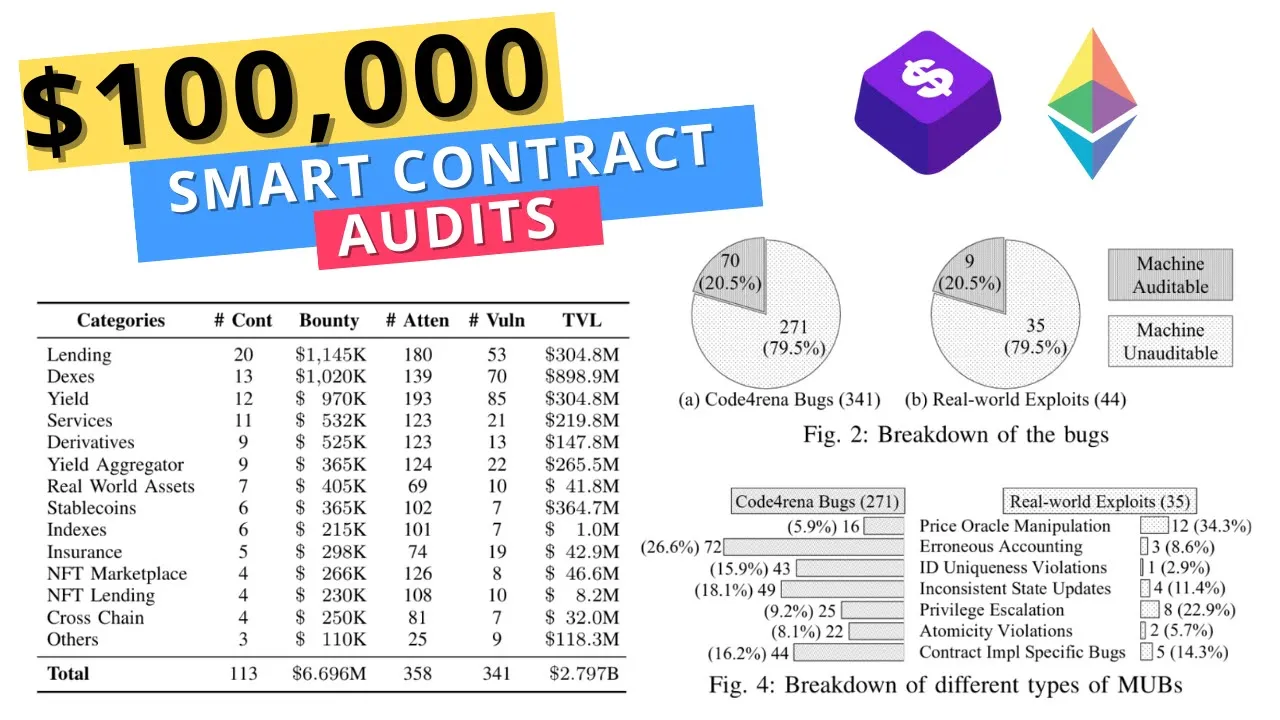
- Why this video: Highlights the best educational resource for auditors: real audit reports. It shows how to dissect Code4rena competitive findings databases to spot recurring vulnerabilities in decentralized finance (DeFi) protocols.
Module 5 Knowledge Checkpoint
- Outline the complete stages of a professional audit, from analyzing specifications through to draft preparation and client triage.
- Draft a professional vulnerability finding complete with Description, Impact, Proof of Concept (PoC) code, and Remediation.
- Contrast private auditing firms with crowdsourced public audit contests (e.g., Code4rena, Sherlock) regarding scope, strategy, and incentives.
Course Map
Key People Index
- Mudit Gupta (@MuditGuptaBlockchain): Chief Information Security Officer (CISO) at Polygon, a leading EVM-compatible scaling network. Renowned security researcher who regularly performs live auditive walk-throughs and incident response post-mortems on multi-million dollar exploits.
- Owen Thurm (@0xOwenThurm): Creator of the GTDA (Goals, Tags, Diagrams, Attack) method. His work focuses on establishing standardized processes for auditing, moving the industry away from ad-hoc manual code reviews.
- Patrick Collins (@PatrickAlphaC): Lead Developer Advocate and Security Educator at Cyfrin Audits. Well-known for his comprehensive, highly technical Web3 security courses, testing guidelines, and work promoting crowdsourced smart contract security.
- Johnny Time (@JohnnyTime): Web3 developer, security researcher, and independent trainer who provides educational materials focused on exploiting and securing smart contracts.
Final Self-Assessment
Achieve operational auditing capabilities by completing the following checklist:
- EVM Mechanics: Can you explain the physical storage layout differences between dynamic and static variables in EVM storage slots?
- Secure Syntactic Layouts: Can you identify the vulnerabilities in compiling code using outdated compiler pragmas (e.g.,
<0.8.0) without utilizing a safe math framework? - Reentrancy Shielding: Can you confidently implement both a state-level
nonReentrantinheritance guard and trace correct Checks-Effects-Interactions flows on dynamic calls? - Access Controls: Can you read and auditing inheritance maps to confirm parent functions do not accidentally expose internal states via public visibilities?
- Static Analysis Workflow: Can you execute automated security scans using Slither via CLI and map warning outputs directly to code vectors?
- Unit Tests with Forge: Can you write a functional Proof of Concept (PoC) exploit inside a Foundry unit test to demonstrate an asset-drain vector?
- Flash Loan Defense: Can you analyze a protocol's price oracle and identify if it relies purely on unsafe spot liquidity pools instead of TWAP/Chainlink price feeds?
- Professional Documentation: Can you draft a clear severity rating (Critical/High/Medium/Low) for an identified state-override vulnerability using standard CVSS threat mapping?