Coding HM Type Inference: Algorithm W & OCaml
Learning Goal: Complete a production-grade, mathematically sound implementation of a Hindley-Milner type-inference engine (Algorithm W) for a statically-typed functional programming language from scratch using OCaml.
Prerequisites
- Conceptual comfort with basic programming structures (variables, functions, recursion).
- No prior OCaml or advanced Type Theory knowledge is required; the course builds these foundations from the ground up.
Estimated Total Study Time
- 28 Hours (including video lectures, recommended reading, and hands-on programming labs).
Module 1: Introduction to Functional Programming & OCaml
This module establishes your programming foundation. You will configure your development environment, transition from imperative to pure functional thinking, and master the core syntactic mechanics of OCaml, focusing heavily on pattern matching and recursive list processing.
Recommended Videos
Why this video: A quick guide to bootstrapping your compiler environment. This video walk you through configuring your OCaml compiler toolchain and Visual Studio Code on your machine.

Why this video: This video provides a high-level theoretical bridge between typical object-oriented/imperative programming and the safety guarantees offered by OCaml's functional paradigms and compiler.

Why this video: Essential preparation for compiler design. Pattern matching is the primary tool used to traverse syntax trees. This video teaches you how to deconstruct lists into head (h) and tail (t) components cleanly.
Why this video: Recursion is the default mechanism for iteration in functional languages. Because type checkers recursively traverse AST structures, mastering list recursion here is vital.
Knowledge Checkpoint
- Configure a working local OCaml development environment using
opamanddune. - Write recursive functions in OCaml using the
let reckeyword. - Implement robust list-processing logic using pattern matching with the cons operator (
::) and empty list ([]). - Understand why compiler developers prefer static, compile-time checks over dynamic, runtime error-handling techniques.
Module 2: Abstract Syntax Trees & Language Interpreters
To analyze code, a compiler or type-checker must view programs as structured data rather than raw text. Here, you will learn to represent code structurally as Abstract Syntax Trees (ASTs) using OCaml's Algebraic Data Types (ADTs) and write a recursive interpreter to execute expressions.
Recommended Videos

Why this video: This video explains how to build custom datatypes in OCaml. It details tuples, records, and sum types (variants), which are the building blocks of an Abstract Syntax Tree.
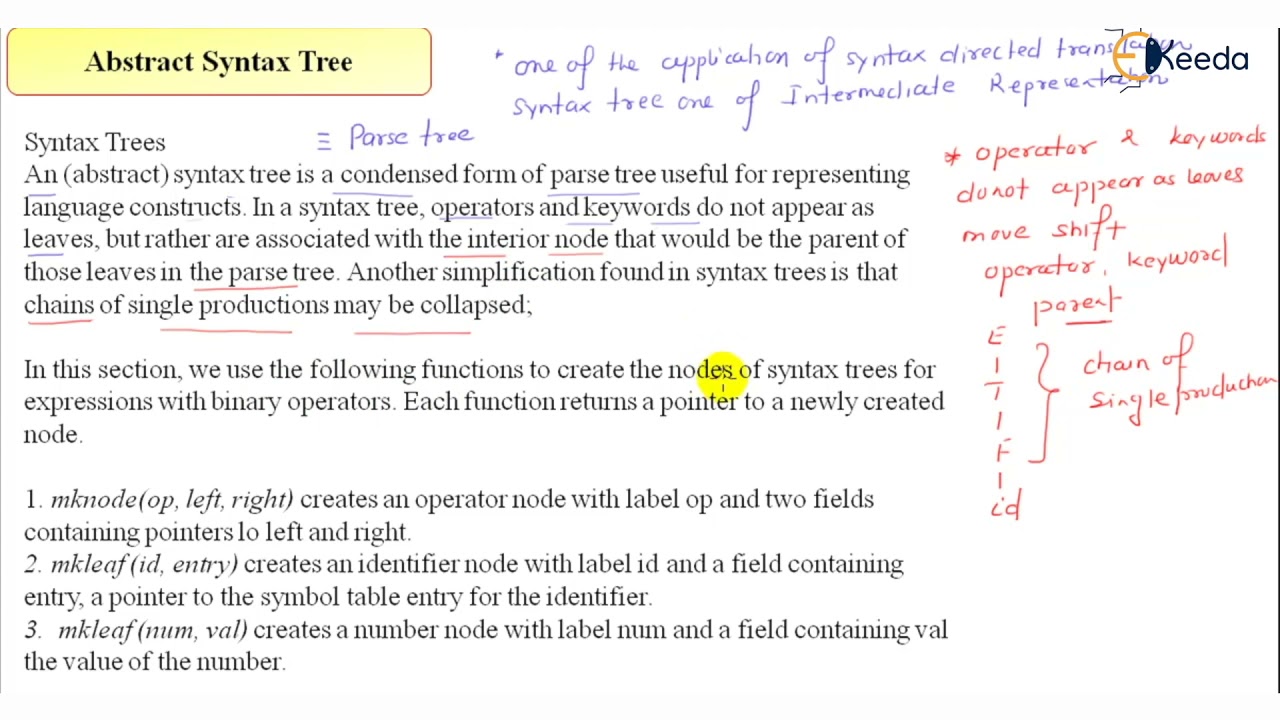
Why this video: An academic breakdown explaining how parsing pipelines transition from a concrete syntax parse tree to an abstract syntax tree. It illustrates how syntax is represented hierarchically.

Why this video: A practical, hands-on demonstration of modeling a mini-language's AST in OCaml and writing a recursive eval function to evaluate its arithmetic and variable binding structures.
Knowledge Checkpoint
- Explain the difference between concrete parse trees and Abstract Syntax Trees (ASTs).
- Define custom sum types (variants) in OCaml to represent simple operations like addition, variable definitions (
let), and literal integers. - Write a recursive evaluation function (
eval : env -> expr -> value) that evaluates an AST down to a final value using an environment map.
Module 3: Type Systems & Lambda Calculus
Before writing an automatic type inference engine, we must understand the core mathematics of type checking. This module introduces Type Theory, typing rules, and the Simply Typed Lambda Calculus (STLC)—the baseline calculus of all statically-typed functional programming languages.
Recommended Videos
Why this video: Provides an intuitive conceptual introduction to the limitations of untyped lambda calculus and explains why types are mathematically necessary to prevent non-terminating loops and logical inconsistencies.

Why this video: A formal lecture that breaks down the structural grammar of STLC and presents base types, arrow types (function signatures), and standard typing judgments.

Why this video: Walks through building a basic, explicit type checker in OCaml. It shows how typing judgments translate into pattern matching code that checks AST node consistency against expected types.
Knowledge Checkpoint
- Interpret the standard mathematical syntax of typing judgments (e.g., ).
- Trace typing derivations for variable lookups, functional abstractions (), and functional applications ().
- Explain the differences and performance trade-offs of static versus dynamic typing.
- Implement a basic, non-inferring type checker in OCaml that validates explicit type annotations in a program.
Module 4: The Hindley-Milner Algorithm (Algorithm W)
This module details the theoretical core of Hindley-Milner (HM): how a compiler infers the most general (principal) type of an expression without explicit annotations. We will examine type variables, substitution mappings, Robinson's first-order unification, and the mechanics of let-polymorphism.
⚠️ Curriculum Note & Gap Correction: Traditional search queries regarding "Robinson's Unification" often inadvertently return organic chemistry tutorials on "Robinson Annulation." To review computer science unification resources, prioritize search terms like:
"Type inference unification algorithm programming"and"Let polymorphism generalization instantiation type checking".
Recommended Videos
Why this video: A comprehensive academic overview of the six fundamental inference rules of Hindley-Milner, presenting the formal theory behind how variables, abstractions, and lets are typed.

Why this video: A detailed, classroom-style lecture showing how constraints are generated and solved. Watch this to see step-by-step traces of type equations being solved using variable substitutions.
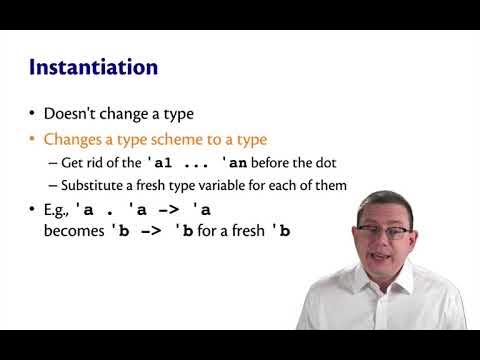
Why this video: This video explains how HM achieves polymorphism. It details how the compiler generalizes types at let-bindings (converting them to type schemes with universal quantifiers ) and instantiates them with fresh type variables at call sites.

Why this video: To understand type-level unification, you must understand the classic logic algorithm it is based on. This lecture covers Robinson's unification algorithm, detailing how terms are made identical through variable substitutions.
Knowledge Checkpoint
- Define the difference between monomorphic types (e.g.,
int,bool,a -> b) and polymorphic type schemes (e.g., ). - Explain how Robinson's Unification resolves type equations, and run through a manual unification of and .
- Describe "occurs check" and explain why unifying a type variable with a type containing (e.g., ) causes infinite types and compiler rejection.
- Explain why standard functional languages restrict polymorphism to
let-bindings (let-polymorphism) instead of allowing arbitrary -parameter polymorphism.
Module 5: Implementing the Inference Engine in OCaml
In this final module, you will write a complete Hindley-Milner type inference engine. You will translate the mathematical typing rules and unification steps into runnable OCaml code, implementing a functional type engine that infers the principal types of custom expressions from scratch.
⚠️ Curriculum Note & Gap Correction: Full-scale walkthroughs of Algorithm W implemented line-by-line specifically in OCaml are rare. To bridge this gap, we use conceptual walkthroughs of Algorithm W's structure along with targeted OCaml videos on variable inference. When writing your codebase, refer to the structure of the TypeScript reference below—it maps directly to OCaml patterns due to its structural use of switch-case/match expressions.
Recommended Videos

Why this video: A complete, step-by-step structural analysis of the classic Algorithm W specification paper. Essential for organizing your compiler pipeline.

Why this video: This video builds a clean, functional implementation of Algorithm W. Though coded in TypeScript, it models the compiler state using substitutions, generalization, and instantiation. This logic translates directly into OCaml patterns.

Why this video: Demonstrates how to handle base-level values (integers, booleans) and environment lookups inside an OCaml-based Hindley-Milner type inference loop.
Knowledge Checkpoint
- Implement a
substitutiontype in OCaml (a map from type variables to concrete types) and write anapply_substfunction to substitute variables within types. - Write a recursive
unifyfunction that takes two types, finds their most general unifier, and returns a substitution map or throws a type error. - Build a robust
generalizefunction that finds all unbound type variables in an expression and wraps them in a type scheme. - Build an
instantiatefunction that replaces universally quantified variables in a type scheme with brand-new, globally unique free type variables. - Assemble the complete
infer : env -> expr -> (subst * type)recursive function in OCaml to automatically infer types for:- Literal Constants (Integers/Booleans)
- Variables (Lookup from environment)
- Abstractions ()
- Applications ()
- Let-bindings (
let x = e1 in e2)
Course Map
This map outlines the recommended learning order and structural dependencies of the modules:
Key People Index
The development of modern type theory and functional programming relies on the contributions of several key researchers:
- Robin Milner: British computer scientist who designed the ML language family and proved the mathematical soundness of Hindley-Milner type inference.
- J. Roger Hindley: British logician who analyzed principal type schemes for combinators, laying the mathematical groundwork that Milner adapted.
- J. Alan Robinson: Invented the first-order syntactic unification algorithm, a fundamental component of automatic type inference and logic programming.
- Alonzo Church: Formulated the Lambda Calculus and the Simply Typed Lambda Calculus, establishing functional programming's mathematical model.
- Philip Wadler: Prominent functional programming researcher who helped design Haskell, monads, and generic type systems.
Final Self-Assessment
Complete this comprehensive self-assessment to verify your mastery of the material:
- Development Environment: I can compile OCaml modules, run testing loops, and execute compiled binaries using dune.
- Functional Paradigms: I write recursion and pattern matching naturally without resorting to mutable states, imperatively styled loops, or global variables.
- Abstract Syntax: I can model any user-defined programming language construct using an elegant Algebraic Data Type (ADT) structure.
- Interpreter Execution: I can write an interpreter that recursively traverses an AST and evaluates expressions using an environment map.
- Type Judgments: I can read standard typing rules and manually derive type trees for STLC expressions.
- Substitution Application: I can write a function that safely applies variable substitutions across nested types.
- Occurs Check: I can explain why the unification of variable
'awith'a -> intmust fail, preventing infinite type derivation loops. - Polymorphic Schemes: I can explain the mechanics of generalization and instantiation, specifically why they must be restricted to
letbindings. - Completed Engine: I have written a working, error-free implementation of Algorithm W in OCaml that successfully infers the type of complex programs like the polymorphic identity function (
let id = fun x -> x in id).